LLC Filing with FinCEN

I was chatting with a financially savvy friend of mine, and she asked about filing our Limited Liability Corporation (LLC). I had no idea what she was talking about. Mr. ODA had no idea what she was talking about. I sent a text to 3 of my investor Realtor buddies (in two different states), and none of them heard about it. So I started digging.

Sure enough, if you have an LLC, you’re required to file with FinCen this year.

So here’s my attempt to let a few more people know of this legal requirement that carries fines, yet no one decided an email or mailing to LLC owners (which are filed with the State governments and are required to have physical mailing addresses) would be worth their time and cost of a stamp.

THE CORPORATE TRANSPARENCY ACT

On October 23, 2019, Congress passed this Act. The purpose being “to ensure that persons who form corporations or limited liability companies in the United States disclose the beneficial owners of those corporations or limited liability companies.” Essentially, they’re trying to ‘crack down’ on companies using LLCs as a shell game to move or hide money, or pay into criminal behavior.

It states, “Criminals have exploited State formation procedures to conceal their identities when forming corporations or limited liability companies in the United States.” In 2006, an international body determined that the United States fails to comply with beneficial owner information reporting, and gave a July 2008 deadline to fix it. The United States Federal level had urged State laws to comply, but didn’t follow up, and was cited again for failure in 2016. Since the States didn’t make progress, Congress issued this ruling.

The Act states that nearly 2 million LLCs are formed each year, with few States requiring beneficial owner information. A beneficial owner is generally someone who exercises control over the company, owns 25% or more, or receives substantial economic benefits; there are exceptions listed in the law.

While this was passed in late 2019, they then needed to establish a way to securely collect and retain the information reported. FinCEN established a Beneficial Ownership Information (BOI) website, in which you’re required to enter the pertinent information. It opened January 1, 2024.

Because this is the age where there are scams around every corner, note that this is a ‘.gov’ website, and their logo is below (i.e., don’t enter your personal information into a third party website).

REPORTING COMPANY

A reporting company is those that qualify based on the law’s detail. There are either domestic (registered here, doing business here) or foreign (registered in another country, doing business in the United States) reporting companies.

There are 23 ways a company may be exempt from reporting. The general gist of the exemptions are based on whether you’re already reporting to the government in another form (e.g., banks and accounting firms). “These entities include publicly traded companies meeting specified requirements, many nonprofits, and certain large operating companies.” Don’t assume you’re exempt; be sure to check the list on the official website.

BOI REPORTING

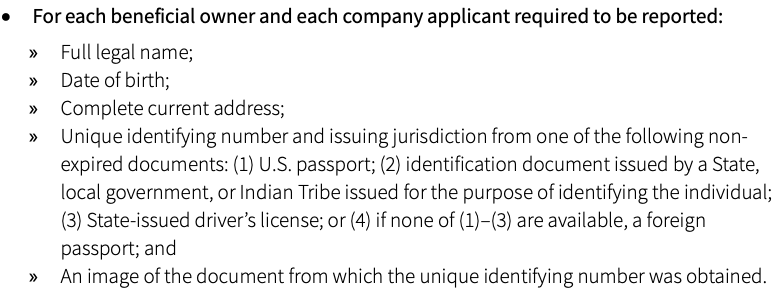
The reporting is straightforward. You will need a legal identification card image uploaded for each person entered in the system.

From the main page, I selected the icon that said prepare a BOI Report. I chose to prepare and submit, so it’s a form within the website. There’s another option that appears to allow you to fill it out in PDF form and submit the form. I preferred the prompts along the way.

Below is a snapshot of the information that’s needed in the initial filing.

When we set up our LLC, our drivers licenses were copied, so this request isn’t for anything more than we’ve already provided to our State. For us, establishing an LLC was solely a way for Mr. ODA and I to create an ownership stake in two properties that we purchased with a partner. Though there are 3 of us listed in the LLC, Mr. ODA and I are 50% partners together, and this other guy is a 50% partner. I pay him out at 50% each month after I collect rent.

It’s very simple; I’m sure there are LLCs with employees and more paperwork. However, I didn’t need a social security number for the beneficial owner(s) or any dollar amounts paid. We did establish a EIN for the LLC several years ago, so I submitted that EIN for the reporting company. Otherwise, I would have submitted my social security number as the company’s identifier.

There are more details associated with the reporting; for instance, you can update your report through their website. However, I’ll leave it to you to dig deeper on all those instances, as I’m just trying to build awareness.

DEADLINES

As with all new systems, there’s a phased approach to the requirements.

If you were already registered before this year, then you have until January 1, 2025 to file the initial BOI report. If you create an LLC during 2024, then you have 90 calendar days from the registration effective date to report. For all LLCs created on or after January 1, 2025, you have only 30 calendar days to report.

Reaching Goals

Whether you have a lofty goal of paying off a mortgage or a short term goal of not struggling to pay rent each month, it helps to establish a plan. The first step should be learning your relationship with money instead of mindless spending paycheck to paycheck. Last month, I mentioned budgeting and how it can lead to overspending instead of spending wisely. I also mentioned the envelope system and not liking it.

The envelope system is where you establish your spending categories and put cash in the envelope each month. When the money is gone from the envelope, that’s it. Don’t borrow from another envelope. If there’s money left over in an envelope, it can be added to next month’s envelope to increase your spending, or you can use that money to treat yourself to something. In few articles that I read did I see that the extra money should be put towards your goal.

THE GOAL

The first step is to write your goal down. What is it? How long do you think it will take to reach it? I’ve learned that establishing interim goals helps reach the bigger goal that may seem too lofty.

The second step is to track your expenses. Look at what you’re spending your money on. Start categorizing your spending. Can you see that you’re spending more than you thought on something other than essentials? Is hitting up the drive through several times a week costing you more per month than you realized? Have you purchased decorations for your home that aren’t on display, but you’re scraping together rent or mortgage for the beginning of each month? Are you paying up-charges and delivery fees for a meal delivery service instead of going to pick it up yourself (or cooking your own meal)?

MONEY RELATIONSHIP

I have experience living paycheck to paycheck. It’s not like we’ve always been in a position where we’re not worried about how to pay our bills. I thought if I shared two defining stories from our finances, it may trigger an idea for you.

College

I lived on campus for the first two years of college. My parents were paying my tuition, and they said that either I needed to take out a loan to pay the following year’s room and board, or I had to be a Resident Assistance to get free boarding. I didn’t want the responsibility and having to be in my dorm so much to be an RA (I never researched it; I was just 20 and knew everything.). I decided the best approach was to live off campus because I’d be able to pay my living costs monthly instead of in two large chunks at the beginning of each semester. If I broke down the monthly cost of the ‘room and board,’ it was $1533 per month (and only for 9 months of the year). I figured I could live for less than that, while paying month-to-month as I earned income, if I moved to an apartment. My rent off campus that first year was $650/month. My utilities were about $150/month in the winter. I don’t know how much I spent on food, but I know it was the bare minimum. It wasn’t that I was purposely trying to be debt-free and a hero; I just simply didn’t know how to get a loan, so that wasn’t an option to me.

I had a job at JCPenney. I was making 5.15/hour (minimum wage in 2006), and I worked outside of my school schedule as much as I could. I was able to pay my rent every month because that was my priority. I dipped into my savings from my summer jobs, but I mostly changed my lifestyle. I packed my meals with peanut butter and jelly sandwiches for when I was working. I ate pasta for dinner. I didn’t go to restaurants often. I wasn’t in a phase of life where I wanted to go to bars, so my social life was hanging at my boyfriend’s house, where he lived with 3 other guys, drinking cheap beer and watching tv. I made sacrifices in my spending so that I could pay rent every month. I didn’t want to pay a late fee every month. If I could just barely afford $650, I certainly didn’t want to owe an extra $65 because I couldn’t pay rent by the first of the month.

There is one caveat in my story that first year. Since I was making just what it took to have a roof over my head and food in my stomach, I chose to forego heat. Do you know where Albany, NY is? It’s into freezing temperatures in October. It was fine – I had sweatshirts, sweatpants, socks, slippers, blankets. I lived on the first floor of a two story home, so that helps keep the temperature reasonable into October, but I knew I couldn’t last through the days of teen temperatures without eventually turning the heat on. My parents found out that I didn’t have my heat on, and they sent me $100/month to cover that. So I did get assistance. They sent me that for 6 months to cover my utilities, and that was the last assistance I received.

My parents paid my tuition, which was $2,175 per semester in 2004. Yes, less than $5,000/year for my college education.

Buying a House

Mr. ODA and I wanted to buy a house and settle down. We had each been part of a training program at work that would end with our placement anywhere in the country, so we weren’t in a good position to purchase a house in Albany, NY. Mr. ODA got placed in Pennsylvania, while I was still employed in their NY office. It wasn’t handled well, so we started looking for other options. I accepted a job in Washington DC, and Mr. ODA went to Sterling, VA; we moved to an apartment in Fairfax, VA to live in between those two places. We chose an apartment because we didn’t know anything about Virginia and needed a place to live while we scoped it out.

This wasn’t a scenario where we couldn’t afford to live, like my college example. This was a situation where we set a goal, and to achieve that goal, we needed to spend less.

Mr. ODA was saving and preparing for a house in the $150-200k range, not the $350-500k range as a first time home buyer. So we needed a plan to come up with over $70k worth of the downpayment and closing costs.

We set a goal of spending no more than $5/day/person on food. We ate a lot of peanut butter and jelly sandwiches, pasta sides, chicken nuggets, canned vegetables, etc. That threshold meant we weren’t paying to go out to lunch at work. We were eating the bare minimum at dinner. We were eating any leftovers that were in the refrigerator. We didn’t have a desire or lifestyle where we would want to go out for a drink or buy a lot of things, so it wasn’t hard to scale back in that area. After a month or so of doing this, we decided that happiness should be part of the equation too, and we started going out to a restaurant no more than once per week.

This isn’t a magical story where we went from $10k in savings to $75k in 6 months, but we were able to increase our savings a decent amount. We each took a residential loan from our retirement accounts, and we borrowed $5,000 from Mr. ODA’s parents. We didn’t expect to find all the funds needed, but we were able to decrease the amount of money we had to borrow from our retirement accounted by changing our spending pattern.

Our rent at the apartment, including utilities, was over $1800/month. When we purchased our house, our mortgage was $1576 and our utilities averaged $150/month.

REACH THE GOAL

If you don’t know where your money is going, you don’t know how to get your money to work for you. If you don’t take the time to evaluate whether or not you’re spending wisely, then you don’t know if there’s wiggle room in your budget to put you in a position that you’ll be more comfortable. Create a relationship with money. Know where each dollar is going. Determine if you should make changes to your spending to reach the goal, or if you should find a way to create additional income.

There’s usually a way to create more room in your budget with your spending. Some examples are to eliminate alcohol purchases, reduce your restaurant spending (whether it’s not going to restaurants as often or it’s changing how you order – do you need the steak; do you need a soda, or could you get by with water and drink a soda at home), reduce your home decor type purchasing, put your heat down a degree or two.

Instead of complaining that there are bills to pay, change your mentality to take control of your money instead of it controlling you.