Our turnover this year has been higher than usual. However, it’s been for good reasons, and not just because someone is looking to rent from a different landlord, so I’ll take that win. In this case, the tenant was house hunting. We knew that a year ago, and we had set up our lease to allow them to break it. Since April was their last month in this current lease term, there was no “lease break fee” associated with their notice. They gave us notice at the end of February, which requires 30 days worth of payment. March rent was paid.
They had moved out of the house early though, which ended up being very helpful. The house needed a lot of work. There was a lot of deferred maintenance on this house. We bought the house as a flip. It looked fine on the surface, but we knew it wasn’t going to hold up. Our last couple of turnovers happened really quickly, so we didn’t put much effort into the turnover process. With the extra time, we knew we needed to address some issues.
PAINT: $2,750
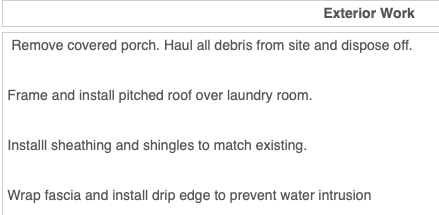
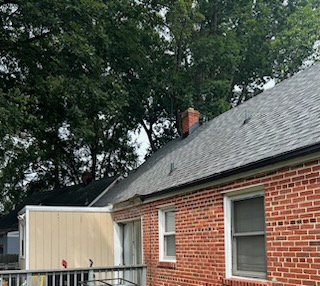
First, we finally got the flat roof addition fixed on this house last summer. The flippers before us had added a laundry room to the back of the house. They used the existing covered deck infrastructure, and it was horrible. They didn’t tie it into the house correctly, so we endured several leaks into the laundry room. We struggled for years to get a roofer who would address it for us. We even hired a roofer, highlighted the flat roof issue, and missed that his contract didn’t do anything except replace the shingles on the main house roof. There was plenty of saga once we finally found someone to rebuild it, but it’s done. We hadn’t fixed the drywall from the leaks, so that needed to be done now (a.k.a. deferred maintenance).
We found a painter who repaired the drywall, repainted the ceiling, and painted the walls. He also painted most of the trim in the house to white (there was some damage on the baseboards that needed fixed) and all the walls Green Tint by Benjamin Moore.
Two tenants ago, we had given an offer that if she wanted to paint any of the rooms, we’d offer a rent concession. That was part of the deferred maintenance; most of the house was dingy white that took a beating over the years, but we never had the time between tenants already lined up to paint everything. She took us up on that offer. She even painted the bathroom vanity and medicine cabinet. It was a beautiful robins egg blue, but we didn’t have the paint to do a few touchups on the side of the vanity that were needed. Our painter added that to the work at no cost. He absolutely didn’t need to do that! But everything has a fresh coat of paint now, and I’m so happy at the facelift it gave.
FLOORING: $6,613
When we first bought this house, the bedrooms on the first floor had dingy carpet in it. The prospective tenant we had requested we replace the carpet. I can’t remember the series of events, but we determined it was better to refinish the hardwoods underneath the carpet than to continuously replace the carpets every 3-6 years. They’ve held up pretty well, but they are starting to show wear at 7 years in.
Regardless, we didn’t touch the carpet on the stairs or on the second floor of the house. It’s blue indoor/outdoor carpet. I truly can’t believe we’ve been able to house renters in this place with this carpet still in place. We’ve put it off because re-carpeting stairs is just so expensive relative to doing a whole room. One of the bedrooms on the second floor even has wood paneling, which just made it even more amazing that anybody wanted this house. It was not the most aesthetically pleasing place.
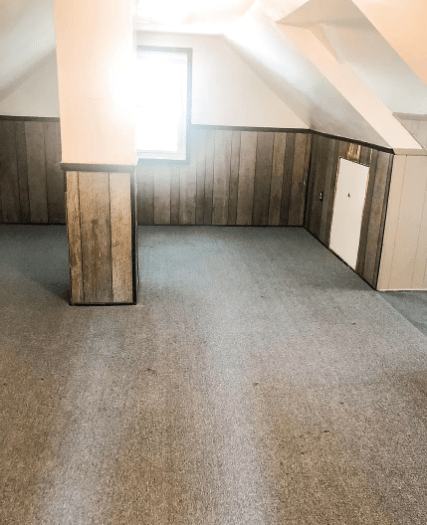
We replaced all the carpet. With the fresh carpet and fresh paint, it’s looking so much more inviting.

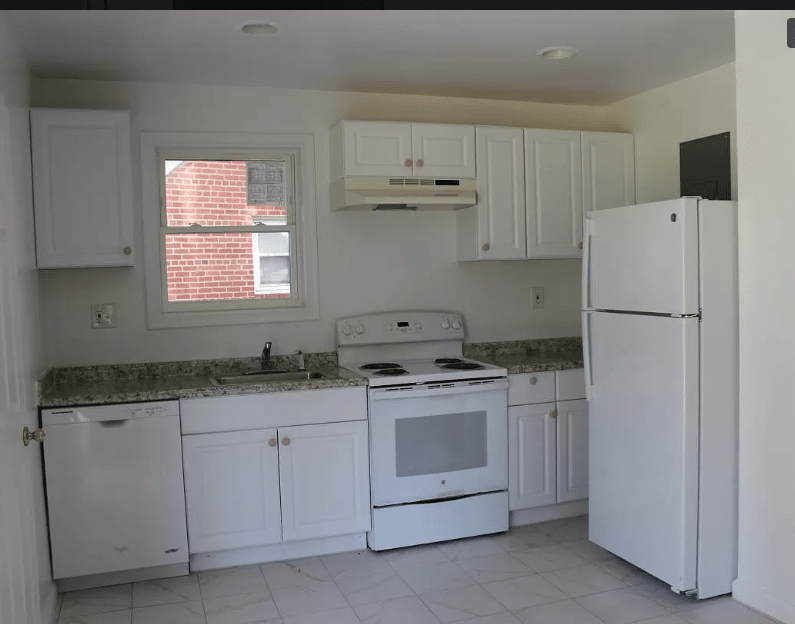
Then we move on to the kitchens and bathrooms. The first floor bathroom and kitchen floor were clearly just lipstick-on-a-pig situations by the flippers. The subfloor was clearly bowing and making all the cheap tile crack. The humidity issues in the bathroom (I’ll touch more on in a moment) weren’t helping matters in there.
Here you can see the kitchen (and its pink knobs!) with the tile floor. The tile had all cracked by this time.
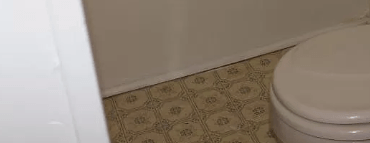
The upstairs bathroom was original 1970s linoleum. Here’s a snip of it in its glory.
Trying to match/add the hardwood was not an option. We considered ‘luxury vinyl tile,’ but that was more expensive than I wanted to put in a rental property. I didn’t want to retile it because I just personally don’t find tile floors to be warm and cozy for a house. The only reasonable option left is ‘luxury vinyl plank.’
We requested a quote from Home Depot. Their quote was cheaper than the one we ended up going with, but we didn’t use them for good reason. We had a subfloor issue in another house. Home Depot was extremely difficult to work with. Not only were they doing questionable work, they also just threw their hands up at the subfloor issue. Luckily, we had a friend that was able to help us repair it (because we didn’t live there). We know for a fact that there’s subfloor issues here (we can see the bow in the floor at the sliding door), so we wanted to go with a contractor who could handle everything.
We picked a local company. They did both the carpet and the LVP. They were so easy to work with. I didn’t love that they wanted me to pay for the entire job up front, but it ended up being great. They had to come back to finish a few tasks, and they did it all perfectly. I’m really happy with the process and their product.
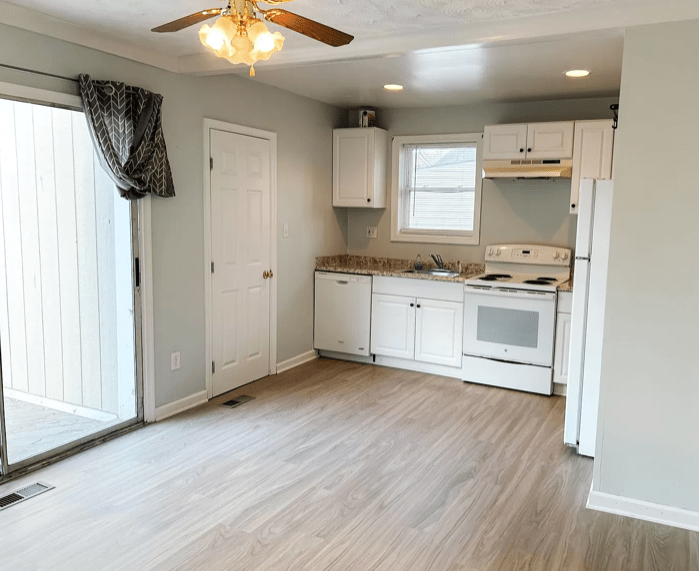
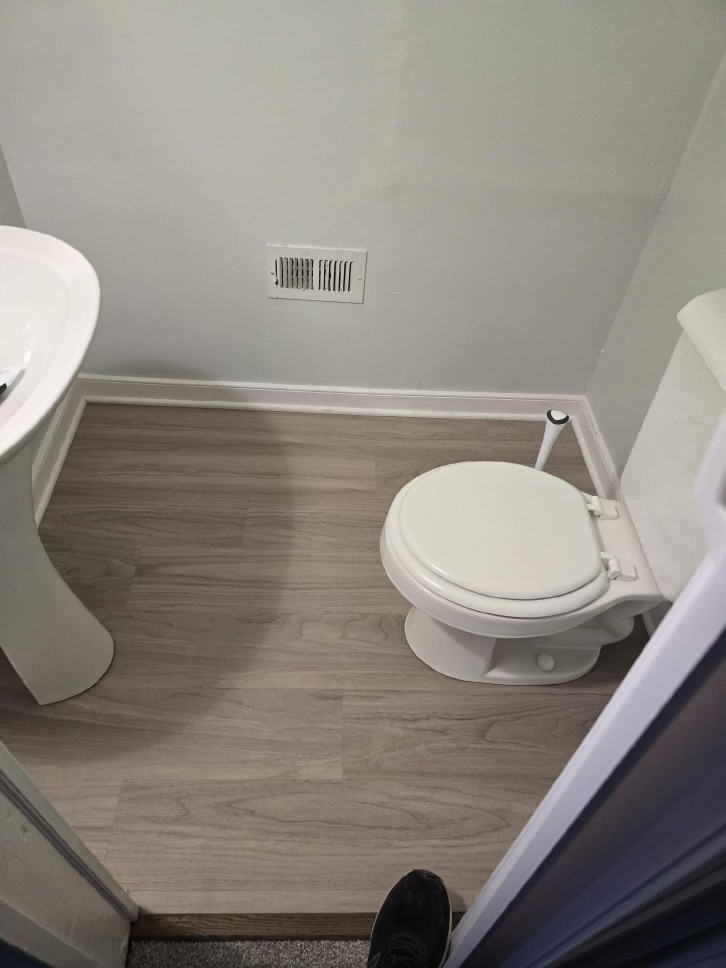
Another miscellaneous flooring issue was that the vent covers were rotting. The finish on them were peeling. This could be explained by humidity in the bathroom, but that doesn’t really explain the issues in the kitchen and living room also. Our handyman was able to pop those out and get new, clean looking ones in for us.
RANDOM WORK
We had to call on our handyman for random jobs. He had to tighten the front porch banister. It’s likely the original banister and has just corroded at the connections. He also had to tighten up the screen door (which, if it were to break would be removed; having to maintain non-essential pieces of a rental is no fun). Some light fixtures needed major TLC. We replaced the light fixtures in both second floor bedrooms, the sconce type light fixture in the half bath upstairs, and the main bathroom’s vanity light (it was all corroded and looked bad).
The upstairs half bathroom had a brown accordion door. The pieces were falling off and it just generally looked bad. The space is tight, and an accordion door style was definitely the best solution for the area, so we had a white one put in. It’s still less than ideal, but it looks much better.
The previous tenant didn’t clean up the yard as they were supposed to, so we had to hire out that work. We also asked him to clear the gutters, which was very necessary because it looked like trees were growing out of them with how many twigs were stuck. He charged me $250 to rake the leaves from the yard and flower beds, mow the yard, and trim the bushes. Then he added on $50 for the gutter clean out. We also did a final mowing before the new tenants moved in, and he charged me $60 for that.
I’m not exactly sure what the issue is, but for some reason we had water damage in the main bathroom. It wasn’t water damage in the sense of standing water. It was just too much moisture. The mirror was corroded; the tub faucet handles were corroded; the caulk was all moldy (and we knew it was fine a year ago); the walls had water streaks on it. I don’t know how it was fine for years and now it’s not, but I’m guessing the only answer is that last tenant just liked really hot showers and didn’t use the vent or window. The tub knobs were so corroded that they had to be sawed off and new valves and such installed. Luckily our plumber was able to handle it timely and it looks better now, but that was a minor inconvenience.
The back sliding door had always been questionable. No one ever pushed us on it though, so we didn’t know just how bad it was. I don’t know that the door ever fully locked. There was a block used to hold it shut for security measures (although I feel like everyone who has a sliding door uses something like that). I finally wanted it replaced. It was likely the original door (think nickel type finish), and it was overdue. We did this through Home Depot because I knew their prices were reasonable and it should be an in/out job. It was $1063.
NEW TENANT
Our property manager showed the property to several candidates. Only two provided their interest form timely. An interest form is a way to gather background documentation on the potential tenant without the tenant having to spend any money. It’s a way for the prospect to divulge any negative remarks on their credit or background check. It’s a good gesture that we allow them to fill this out before spending money on an application fee that will identify disqualifying information. We have found that some people don’t tell us anything, and then they’ve spend $43 for us to say they don’t qualify.
Both prospects submitted their interest forms on April 18. Unfortunately, both of them were interested in a mid-May lease start date. They both offered to do a 2 year lease as a compensating factor though, which was a nice gesture. I also appreciated that both of them were well spoken and up front with a lot of information.
We chose someone and ran her background check. Several “unlawful detainers” (a.k.a. evictions) came through, which hadn’t been disclosed. We told her that her credit score was slightly below 600 and the unlawful detainers would disqualify her. She then wrote back a very nice note explaining all the data that we found and asked us to reconsider. We agreed to rent to her and to take a higher security deposit as a compensating factor. She agreed to the 1.5 times a month’s rent as a security deposit.
Unfortunately, the house was vacant for a month and a half. Luckily, during that time we were able to get a lot of work done in the house. I hope that this tenant takes good care of the home and that we’re pleasantly surprised with her tenancy regardless of her history of late payments and court filings.



 One Dollar Allowance