Today’s post is going to be short and sweet. Well, that’s how I think to start every thought I have to share, and it turns into a novel with research and ‘citations.’ Let’s see how this goes. Update: It’s long, there’s a legal citation, and I ‘teach’ math. Sorry. 😛
We have two houses with flat roofs. They’re a pain. They always seem to leak, and no one wants to work on them.
In 2019, we had issues with a house that had an internal ice dam and gutter system, in addition to a flat roof over an extension. Water kept leaking in the kitchen. After two years of issues, we finally had a roofer respond to our request for help on a flat roof. As soon as a roofer hears “flat roof,” they seem to shut down and say they don’t work on flat roofs. Here was the quote.

So we had this work done for $1,900, and we haven’t heard about the roof since.
We have another house where there was a flat roof added to an addition. In 2017, we had a roofer replace the roof. Somewhere, something was lost in translation of the job. We thought he’d address the flat roof and fix it, incorporating it into the main roof line. He finished the job, and it was clear that was not part of the scope as we thought, even though that was the whole reason we called him out. He simply said “I don’t work on flat roofs.” That wasn’t clear when we asked you to give us a quote, and how do you just ignore that there’s another roof line as a roofer?
The more we spent time and money on this roof, the more it came to light what happened. It appears that there was a deck that eventually was covered with a corrugated metal sheet. Then someone decided they wanted a laundry room, so they built a laundry room under this metal sheet. The roof line wasn’t properly insulated from water infiltration. We had several issues of water leaking into the laundry room. Mr. ODA put silicone and caulk along the roofline as a stopgap because roofers weren’t acknowledging us. We thought we had fixed it, and I had put a lot of effort into fixing the wet drywall and repainting the room. After two years, the silicone finally gave way.
Our property manager was able to get 3-4 roofers to come look at the job, but only 2 gave us a quote (why is it a norm to just ghost customers and not have the decency to close the loop and say you don’t want the job?). One of the contractors didn’t appear to understand the job, and that concerned me. He seemed to want to redo the entire roof, and that was definitely not in our finances for this house because we replaced the roof 3 years ago. Then he also suggested a ‘TPO roof’ for the flat roof. I don’t know what that is, and I didn’t like that the explanation to me started with “it’s a flat roof that…” No. I’m done with “flat.” Did I give it a fair chance? No. Do I care? No. I wanted a pitched roof line. This is important for later in the story.
I had several concerns about the other roofer’s estimate, but they were less fundamental (or so I thought). First, I was concerned about the terminology being used as a porch. Perhaps it’s just me, but I call the open-air overhang on the front of the house the porch, and the open-air part attached to the back of the house a deck. I was concerned that the terminology “pitched roof” was not explicit enough to our end goal. I questioned that his removal of the corrugated metal roof would leave the deck exposed, so the gutters would need to be rerouted and added. I also questioned about how he was going to cover the sides once the pitch was created – would it be just painted or would it be sided, and if sided, how would he match it to look right.
I had my property manager call him, I called him, and I emailed him, but I received no response. I was trying to confirm the scope of work. Mr. ODA told me that these contractors are good at their job, but not good at the administrative side, so just let it go. I was an auditor; accurate documentation for a job is important to me. 🙂
Here’s how it was written:
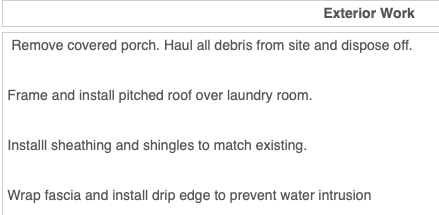
I decided to try to be easy going. There was a space for comments when I accepted the proposal. I added: I’m accepting this estimate based on the verbal agreement with [property manager] that the scope of work is confirmed as removing the flat roof over the DECK and laundry room (not sure ‘porch’ terminology), that the deck won’t be covered again and a lean-to roof will be put over the laundry room, and that all gutter systems will be appropriately rerouted to divert water from the house.
He gave me the quote on June 23rd. I accepted this work on July 5th. He kept delaying us. He would say “I’m going to get the materials today, so we’ll be there tomorrow.” Tomorrow never came. On August 25, he said he was going to 100% start the following Monday and be done by Wednesday. He finally called on Wednesday, and he said, “I got my guys out there today. I decided to do a TPO roof instead.” You’re kidding me, right? He kept pushing that it’s a “better” roof than a pitched roof, and I should be ok with it. Except, I signed a contract. The contract did not say their job was to install a TPO roof. I said that was unacceptable and I wanted a pitched roof. Here’s the picture that I received at that point. It looks really flat to me, and it has the point where it meets the main house still below the roof line (although you probably can’t tell there as well here).
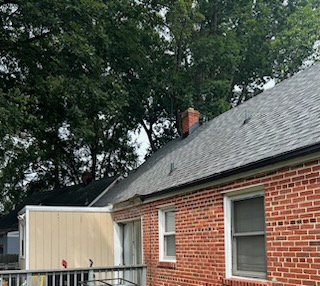
On September 5th, he said they should be out the following day to finish it as a pitched roof. It took until September 11th for us to be told that the roof was done. As you can see, the gutters were not addressed. Luckily he said he’d get right out to fix that, and he did, which was appreciated.

While you can see that there has been a slight pitch added, it is not a sufficient pitch as required for asphalt shingles. Did I know there was a minimum slope requirement for asphalt shingles before September? Nope. But you bet I read up on it and figured it out as fast as I could. Nearly all manufacturers of asphalt shingles have a minimum requirement of a 2:12 slope. On top of that, Virginia Code has the same slope requirement.
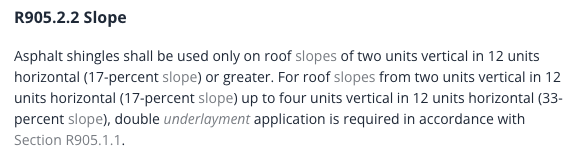
This means that for every foot, the rise of the tallest point must be twice that in inches. A 7 foot long distance from the top of the pitch to the outer wall requires a 14 inch rise at the tallest point. That’s the simplest way I’ve been able to describe it.
While the connection point in the second try is above the wall/roof intersection, and it may have been ‘fine,’ I wasn’t here to spend $3,800 on “fine.” He kept pushing that he guarantees his work for 5 years. He also pointed out that a tropical storm was on its way that coming weekend, so it would essentially be a good stress test. So, he was asking me to pay him for a job that was “good enough” and hope that if there was a problem, he’d come back and fix it. No thanks.
He got up on the roof, held up a piece of metal (with no level), and claimed that his zoomed in distance was 2″ off the roof, so it was 2:12. Once I finally got to the point of saying, “what’s the distance from the house?” He said 7′. I said “so the rise has to be double that, so 14″. Is it 14″?” He said no and that he’d fix it. He finally got it done last week. He took pictures along the way to prove that he did the job correctly since I called him on not doing it correctly (or let’s just do the work right to begin with instead of hoping a homeowner won’t question it – where’s integrity these days).

All that was to share that you should do your due diligence when hiring contractors. Don’t assume that they’re going to do the right thing because they’re probably going to assume you’re not well-educated in their field. By no means am I a roofing expert at this point, but I appreciate knowing something new. I just wish I didn’t have to learn things quickly in order to protect my ‘investments.’ So now you also know that there are manufacturer requirements, in addition to your expected state-wide requirements in most fields. Take the time to be educated just enough or have someone you can trust to point out where it went wrong. In this case, I said “that doesn’t look like what I expected,” and I had our handyman look at it. He said the pitch isn’t enough, and that’s where I learned that there are minimum slope requirements. It’s hard because I didn’t know what I didn’t know, but I appreciated having other trusted people to bounce questions off of.
 One Dollar Allowance