Our first investment purchase was a townhome in central Kentucky (while living in Virginia) in February 2016.
At this point, we had purchased and sold our first primary residence, and had purchased a new construction home. Our first home sold for $62,500 more than what we purchased it for and we walked away from the sale with over $130,000. Our new home needed about $70k for closing, leaving $60k that we wanted to use for investment properties.
PURCHASING FROM FAMILY
Mr. ODA’s brother-in-law had purchased a foreclosed townhome while he was in college and rented a room out to his friend – excellent forethought and financial decision making there! When him and his wife got married, they were ready to look into a home with more space and less stairs, so we offered to purchase the house. About 2.5 years after he had purchased it, we set him up to make $16,500.
Their Realtor suggested listing at $90-95k. The comparable sales in the area were suggesting 95-100k, but the townhouse in question had a lower PVA than the others recently sold. There was another townhome in the community listed for sale at $100k, but it had been on the market for 4 months at that time, meaning the market wasn’t interested in it at that price. Additionally, this deal was being done off market, which automatically yields a higher net for the seller because there were no Realtor commissions and minimizes the risk of a listing. They didn’t need to get it ‘show ready’ or have to leave the house for an indefinite number of showings. We removed the uncertainty of how long the house would be listed and therefore how many mortgage payments they’d still be paying before it sold. We also eliminated the possibility of an appraisal and home inspection negotiation during the contract period. For all those reasons, we offered $85,000. We settled on $87,000 with $2,000 in seller-paid-closing-costs. A family member, who’s a lawyer, sent us a template for a contract, so we used that as a starting point, and I wrote up our own contract.
We first looked into a loan assumption. We started with several questions regarding how he was paying PMI (whether we’d have to assume the PMI, whether the PMI would be recalculated for the new appraised value based on our purchase, and whether there would be a penalty if we paid down the balance faster to eliminate the PMI), how the loan balance would transfer cleanly, and whether they needed to cash out escrow. After asking all these types of questions, we learned that PNC wouldn’t allow a loan assumption of an FHA loan since our intent was to use it as an investment property.
We did not do our own home inspection. We figured the HOA would cover the exterior, and we reviewed the home inspection he had completed two years prior. There had been a few upgrades since the initial home inspection, and there wasn’t anything that needed our immediate attention. We bought a new washer and dryer since the unit didn’t have any, and I painted most of it before it was listed for rent.
THE LOAN PROCESSING
Both sides of the transaction were able to sign the purchase contract electronically. We went through the whole loan processing without having to visit Kentucky. The attorney shipped the loan documents to us, we invited a notary over to watch us sign the papers, and then we FedEx’d the papers back to the loan officer for the sellers to sign.
While the closing itself went smoothly, we had several issues with our loan provider.
Our loan was a portfolio loan, which means that it’s a loan on the primary market and not backed by Fannie/Freddie. The interest rate was 4.5%; it was amortized over 30 years, but it had a balloon payment after 10 years. We paid careful attention to this loan (e.g., made many, frequent principal payments) because that meant we’d owe over $59k in 10 years.
It was amortized by 365/360 Rule (i.e., by the day) rather than the way it works in a traditional mortgage (annual rate divided by 12). In a traditional mortgage, the principal and interest difference is based on an annual APR, which creates a consistent amortization that gradually reduces the amount of interest in each month’s payment compared to the principal that will be paid. In the 365/360 Rule, each month’s principal and interest applied to the loan is different because it’s based on the number of days in the individual month. For example, in March, we paid February’s 28 days of interest, and in April, we paid March’s 31 days of interest; therefore, more of our March payment was applied to principal.

The bank’s system was antiquated in that we could not make online payments unless we had a bank account with their bank. Being that this bank was in Kentucky while we lived in Virginia, we weren’t interested in opening a bank account and funding it just to pay this loan. This meant that all of our payments had to be sent by check to their location for keyed entry. The people responsible for entering these payments were not aware of the principal-only concept, and we spent almost the entire first year of the loan having to call every single time we sent a principal payment to have them reverse it, apply it as principal-only, and credit us the days worth of interest it cost us. After several months of this occurring and the response being that the teller doesn’t know how to enter it (then teach them…), we filed a complaint with the Better Business Bureau. We received all the interest owed to us as a result and all future payments were applied correctly.
Due to the poor relationship with the bank and the impending balloon payment, we paid off the loan faster than the 10 years. The loan was issued February 2016, and we made our final payment in April 2020.
PROPERTY MANAGEMENT
We hired a property manager since we were not local and didn’t want to manage showings or maintenance issues in an unknown market. The property management fee is 10% of the monthly income. We actually had several issues with the first property management company, but ‘managing the property manager’ is another post. We released ourselves from that first contract and negotiated with another company, who has been managing the property for the last 4 years.
We have also had to manage the HOA company to address water leaks that stemmed from the brick facade. Both times, the issue presented was eventually resolved, but never in a timely manner. Unfortunately, we are responsible for interior fixes (e.g., drywall) caused by the exterior cracks, which are covered by the HOA since it’s a townhome.
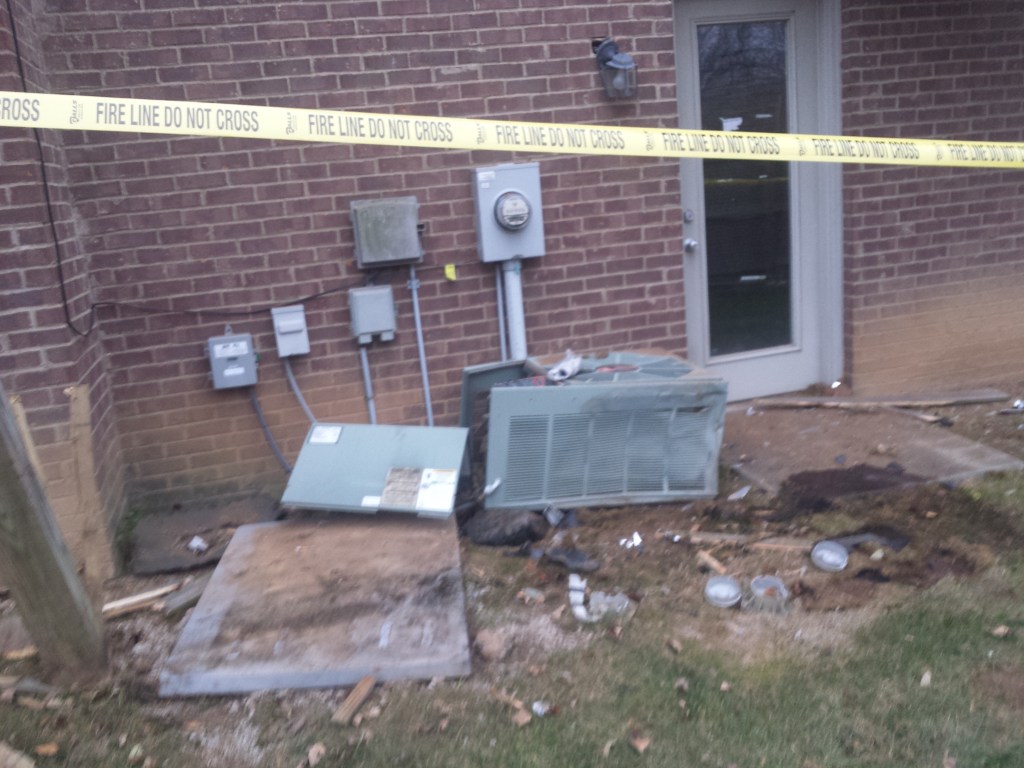
One final interesting story about this house. In November 2016, just a few months after we purchased the house, an intoxicated driver crossed the center line, hopped the curb, drove through the fence, and drove into the back of our townhome, destroying our HVAC unit and taking out a post of the 2nd story deck. It was a Sunday morning. We didn’t pay anything for this incident. The HVAC and a broken light were covered by the insurance company; the deck was repaired by the HOA’s management company. It was an incredible incident.

The townhouse hasn’t been easy to rent. We actually looked into selling it, but our property manager, who is also a Realtor, thought we could only list it at $90,000, which was not something we were interested in, having purchased it at $85k. Once the place is rented, we don’t have issues with maintenance, rent payment, or tenant-related issues. It just takes a month or two of vacancy before we find a qualified applicant. We have offered incentives for leases longer than 12 months to help eliminate our turnover rate and number of days vacant.


 One Dollar Allowance