Home Sale Proceeds

*This post was started in November 2022, but our son was born 3 weeks early (and on Thanksgiving), so it fell off my radar for a long time while I caught back up. Let’s dive in now.

We sold our primary home at the beginning of November to move a half hour away and closer to family. It was a new construction home, and we purposely sold when we did to avoid capital gains taxes. If you call it your primary residence for 2 of the last 5 years, you’re exempt from capital gains. Considering the market over the last two years (2020-2022), we were slated to owe a hefty penny if we sold before that 2 year mark.

Had we sold earlier or perhaps waited for the spring, we could have made more. Instead, we opted to be rid of the home, not try to rent, and be able to have that behind us. We were extremely fortunate that we were under contract by the end of the first weekend we listed. The market had cooled significantly from the multi-bid, exorbitant pricing, with appraisal waiving language days.

We only had 2 showings. The first politely let us know they wanted a walk-out basement. We had an amazing basement with 9′ ceilings and no soffits, but it didn’t have a door due to the floodplain. We don’t really understand why, but the backyard was definitely low enough for it to have been a walk out basement. It was one of the red flags that made me uncomfortable living there, along with a long delay for construction on our lot and a few around us due to extensive sink hole surveying. The second showing made us an offer 10k below asking. We sort of split the difference at $495k, and they accepted.

There were several houses listed in that neighborhood for weeks after we closed, that were listed the same weekend as us, so I am eternally grateful that the stars aligned for what we wanted/needed.

PROCEEDS CALCULATION

We purchased the home for $346,793 in November 2020. The contracted purchase price when we sold was $495,000, which was completed in November 2022. That’s a difference of $148,207, but that’s not “take away” money.

As the seller, you’re typically responsible for paying out the Realtor commissions. They’re typically 6%. We asked our Realtor if she would drop it to 5% (buyers agent gets 3%, sellers agent gets 2%) since we had drawn up our purchase contract sight unseen and this was the 4th commission based transaction she had from us in less than 2 years. She agreed. I truly don’t like asking someone to take a lower commission, but due to there being several transactions in a short period of time, many not even needing much effort (showings, phone calls, etc.), I accepted Mr. ODA’s plea to ask. That comes to $24,750 paid in Realtor commissions.

We then have to pay off any loans that used that property as collateral. We had a mortgage and a Home Equity Line of Credit (HELOC). We had put 20% down on the purchase, so the mortgage had about $266k left as the balance. The HELOC had been used for a couple of other things than just the down payment on a new home, and it didn’t require principal payments on it while we had it, so that balance was about $86k.

We walked away from the closing table with about $117,000 after tax offsets and such.

PAST DETERMINATIONS FOR WHAT TO DO WITH THE PROCEEDS

In July 2012, we purchased our first home for $380,000. We put 20% down; it was a foreclosure, but the only work we had to do was on the main floor bathroom. When we sold that home Fairfax, VA for $442,500 in October 2015, we paid off a car loan and bought our second two rental properties in Richmond, VA. The car loan was only at 0.9% interest, so it didn’t meet Mr. ODA’s requirements to pay down loans with higher interest rates, but it did alleviate one monthly payment I had to manage. The irony of that statement, now that I manage 14 houses worth of payments all year. We also used those proceeds to put 20% down on the purchase of a new primary home outside of Richmond, which had a purchase price of $359,743. We paid off House1’s mortgage because the loan had a balloon payment that we needed to be ahead of.

When we sold that Richmond home for $399,000 in September 2020, we took about $109k away. We used those proceeds to put 20% down on the purchase of our new home, at $346,793, outside of Lexington, KY. We paid off House4, House6, and House13. Since paying towards a mortgage and not paying it off doesn’t change your monthly cash flow, we focused on where we could eliminate a mortgage payment. We’ve since paid off House11 and House12. House12 had a high interest rate, so we were interested in eliminating that as fast as possible, even though we were paying for it with a partner.

WHERE DID THE MONEY GO THIS TIME

We purchased our current primary home last summer and put work into it. Since we purchased it before selling our house, we used a HELOC to pay for the down payment. That meant that when we walked away from the closing table, the money we were putting in our bank account had no distinct purpose (like in the previous cases where we had to use some of the sale proceeds to buy another primary house).

The first thing we did was open a high yield savings account. At the time, it was necessary because our savings account wasn’t paying market rate. I remember Mr. ODA complaining that interest rates on loans were increasing, but it wasn’t being shown on savings interest side. He found a high yield savings account that gave a sign on bonus (we like that ‘free’ money!). We put $50,000 into that account, earning over 4% interest. The money in that account was removed and put into our regular savings account, which is now earning over 4%.

Since the money didn’t have a purpose, we needed to get it into the market. If we put it all in the market at once, then we’re subject to a lot more fluctuation. To hedge our volatility, we planned to schedule regular investments. It seemed crazy to me, but our financial advisor and Mr. ODA decided on $5,000 per week. That would take 20 weeks to accomplish. To my chagrin, this was set up as an auto transfer. Even with a large balance sitting in the account, it didn’t hurt any less watching $5,000 every week be taken out. This plan didn’t last long though because Mr. ODA found Treasury accounts that act as short term certificates of deposit. My next post will go into this in more detail.

Not an immediate need, and we didn’t rush to buy something for the sake of buying it, but we earmarked about $20k for the purchase of a new van. I love the van we bought in 2019 (which was a used 2017), but it had a few kinks in it. I also felt pretty good about the deal I got on it. However, I didn’t put the time into test driving and looking at this van that I really should have because one of us had to stay in the show room with the kids while the other went for a drive. I also know what I’m looking for in a used car now (that was our first used car experience), versus buying a brand new car that hadn’t been driven by others. It helped that I was looking to buy the same exact van, just newer, so I know how it’s supposed to work and what to test. We ended up finding a van about 2 hours away from us in early 2023. We’re almost a year into this van, and I absolutely love it.

In the back of our minds, we’re still looking for another rental property. There’s an area in town near us that would work for short term rentals, which I’d like to dabble in. We have seriously considered a few, but interest rates have shot it down. A 1500 square foot house, with a $200,000 mortgage, comes to a monthly payment (of just principal and interest) of about $1,400. That’s just not good margins with such high interest on it. We’ll keep an open mind, but so far it isn’t panning out.

SUMMARY

Our savings account is currently earning 4.22%. Mr. ODA is also managing that balance by using the short-term Treasury bills. Since we started with the Treasury bills, we’ve made about $500, which is on top of the interest we’ve earned to date on the savings account, which is over $1600.

We started off with paying the mortgage that had a balloon payment. It was a commercial type loan, so it was amortized over 30 years, but was really only a 5 year loan. We decided to pay it off instead of re-mortgaging it at the end of the 5 years. After we took care of the balloon payment approaching, we started paying off mortgages where we could eliminate a payment (we had multiple houses with $30-60k worth of a balance), and then moved onto paying off high interest rate mortgages (for reference, a high interest rate was 5% … which is much different than today’s mortgage rates being “good” at 7.5%). We went through the process to refinance several mortgages, so we’re at a point where we’re happy with the mortgages that are left. If we wanted 100% cash flow, we’d start paying towards principal balances. However, we don’t feel that’s necessary for our current situation. We have 6 mortgages left (including our personal residence) out of 14 houses.

We definitely are more hands on with our money management than most people are going to be interested in. Now that we’re happy with our mortgage situation, we are focused on the interest side of our money working for us. With multiple Treasury bills that are reinvested for short periods of time (4 week and 8 week bills), then we’re able to earn quick interest while we don’t have a purpose for that money.

One of our houses has a balloon payment again (commercial loan). That will come due in about 3.5 years. Considering what current interest rates are, it doesn’t appear that refinancing is as enticing as just paying off the balance or selling the house. We’ll have to keep that in mind as we work on investments and having enough liquid cash over the coming years, because that loan’s balance is going to be about $173k at the end of the 5 year term.

For now, we’re in a good money management state with several short term bills and a savings account rate over 4%.
October Financial Update

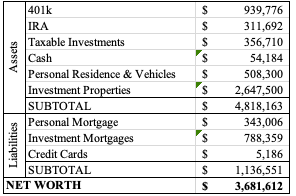
Our net worth took a hit this month, over $96k less than last month. I updated the value of each house we own. I don’t do this regularly anymore because it doesn’t change significantly month-to-month and it’s very time consuming. The market is cooling from the multiple-bid market we were in over the last few years, so home values are starting to come down ever so slightly. They’re still much higher than what they were 3 years ago (and I have tax assessments to prove the pain of that), but it does affect our net worth this month since it’s lower than it had been.

Also affecting our net worth is the market itself. It’s down, which it does around this time every year (confirmed through the history of my financial update posts). Our investment accounts are slightly down, our cash is significantly down because I paid off a large credit card balance and because Mr. ODA has transferred to a Treasury account for some of it, and our investment property values are down.

We opened a new credit card this month because we have purchased new carpet for our house (our entire second floor except 2 bathrooms, the stairs, and the living room all add up very quickly). As I’ve shared numerous times, when we’re about to have a large purchase, we look to open a new credit card that we can use as a loan. Sure, we have the cash available to pay this immediately, but wouldn’t it be nice to earn interest on your cash balance for 12-15 months and get some sort of sign-on bonus from the company?

I paid off our last 0% interest credit card at the end of September. But our credit card balance is still slightly higher than I’d expect because I haven’t paid last month’s statement on one, which is almost $3,000. I used to try to pay off all balances before doing a net worth update so that it was the most accurate, but now that we’re keeping Mr. ODA’s paycheck separate and trying to capitalize on interest to earn, credit cards aren’t paid until the last minute. We’re also still carrying about $30k worth of insurance money that we can’t seem to spend because State Farm is doing their hardest to drag their feet and restart our claims process each week.

I have a house that hasn’t paid a penny towards rent this month. She did let us know that it’ll be paid in October some time (no date or expectation given to me is infuriating). If she doesn’t pay something tomorrow (assuming we’re two Fridays into the month for pay checks), I’ll give a warning about the notice of default being given.

Roofing Lesson

Today’s post is going to be short and sweet. Well, that’s how I think to start every thought I have to share, and it turns into a novel with research and ‘citations.’ Let’s see how this goes. Update: It’s long, there’s a legal citation, and I ‘teach’ math. Sorry. 😛

We have two houses with flat roofs. They’re a pain. They always seem to leak, and no one wants to work on them.


In 2019, we had issues with a house that had an internal ice dam and gutter system, in addition to a flat roof over an extension. Water kept leaking in the kitchen. After two years of issues, we finally had a roofer respond to our request for help on a flat roof. As soon as a roofer hears “flat roof,” they seem to shut down and say they don’t work on flat roofs. Here was the quote.

So we had this work done for $1,900, and we haven’t heard about the roof since.


We have another house where there was a flat roof added to an addition. In 2017, we had a roofer replace the roof. Somewhere, something was lost in translation of the job. We thought he’d address the flat roof and fix it, incorporating it into the main roof line. He finished the job, and it was clear that was not part of the scope as we thought, even though that was the whole reason we called him out. He simply said “I don’t work on flat roofs.” That wasn’t clear when we asked you to give us a quote, and how do you just ignore that there’s another roof line as a roofer?

The more we spent time and money on this roof, the more it came to light what happened. It appears that there was a deck that eventually was covered with a corrugated metal sheet. Then someone decided they wanted a laundry room, so they built a laundry room under this metal sheet. The roof line wasn’t properly insulated from water infiltration. We had several issues of water leaking into the laundry room. Mr. ODA put silicone and caulk along the roofline as a stopgap because roofers weren’t acknowledging us. We thought we had fixed it, and I had put a lot of effort into fixing the wet drywall and repainting the room. After two years, the silicone finally gave way.

Our property manager was able to get 3-4 roofers to come look at the job, but only 2 gave us a quote (why is it a norm to just ghost customers and not have the decency to close the loop and say you don’t want the job?). One of the contractors didn’t appear to understand the job, and that concerned me. He seemed to want to redo the entire roof, and that was definitely not in our finances for this house because we replaced the roof 3 years ago. Then he also suggested a ‘TPO roof’ for the flat roof. I don’t know what that is, and I didn’t like that the explanation to me started with “it’s a flat roof that…” No. I’m done with “flat.” Did I give it a fair chance? No. Do I care? No. I wanted a pitched roof line. This is important for later in the story.

I had several concerns about the other roofer’s estimate, but they were less fundamental (or so I thought). First, I was concerned about the terminology being used as a porch. Perhaps it’s just me, but I call the open-air overhang on the front of the house the porch, and the open-air part attached to the back of the house a deck. I was concerned that the terminology “pitched roof” was not explicit enough to our end goal. I questioned that his removal of the corrugated metal roof would leave the deck exposed, so the gutters would need to be rerouted and added. I also questioned about how he was going to cover the sides once the pitch was created – would it be just painted or would it be sided, and if sided, how would he match it to look right.

I had my property manager call him, I called him, and I emailed him, but I received no response. I was trying to confirm the scope of work. Mr. ODA told me that these contractors are good at their job, but not good at the administrative side, so just let it go. I was an auditor; accurate documentation for a job is important to me. 🙂

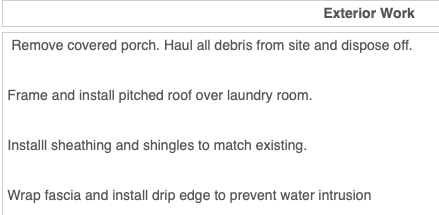
Here’s how it was written:

I decided to try to be easy going. There was a space for comments when I accepted the proposal. I added: I’m accepting this estimate based on the verbal agreement with [property manager] that the scope of work is confirmed as removing the flat roof over the DECK and laundry room (not sure ‘porch’ terminology), that the deck won’t be covered again and a lean-to roof will be put over the laundry room, and that all gutter systems will be appropriately rerouted to divert water from the house.

He gave me the quote on June 23rd. I accepted this work on July 5th. He kept delaying us. He would say “I’m going to get the materials today, so we’ll be there tomorrow.” Tomorrow never came. On August 25, he said he was going to 100% start the following Monday and be done by Wednesday. He finally called on Wednesday, and he said, “I got my guys out there today. I decided to do a TPO roof instead.” You’re kidding me, right? He kept pushing that it’s a “better” roof than a pitched roof, and I should be ok with it. Except, I signed a contract. The contract did not say their job was to install a TPO roof. I said that was unacceptable and I wanted a pitched roof. Here’s the picture that I received at that point. It looks really flat to me, and it has the point where it meets the main house still below the roof line (although you probably can’t tell there as well here).

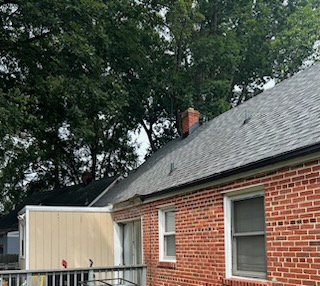
On September 5th, he said they should be out the following day to finish it as a pitched roof. It took until September 11th for us to be told that the roof was done. As you can see, the gutters were not addressed. Luckily he said he’d get right out to fix that, and he did, which was appreciated.

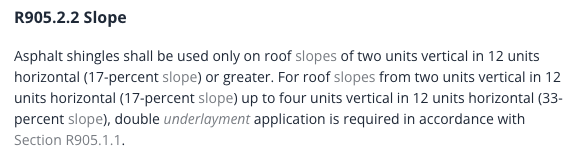
While you can see that there has been a slight pitch added, it is not a sufficient pitch as required for asphalt shingles. Did I know there was a minimum slope requirement for asphalt shingles before September? Nope. But you bet I read up on it and figured it out as fast as I could. Nearly all manufacturers of asphalt shingles have a minimum requirement of a 2:12 slope. On top of that, Virginia Code has the same slope requirement.

This means that for every foot, the rise of the tallest point must be twice that in inches. A 7 foot long distance from the top of the pitch to the outer wall requires a 14 inch rise at the tallest point. That’s the simplest way I’ve been able to describe it.

While the connection point in the second try is above the wall/roof intersection, and it may have been ‘fine,’ I wasn’t here to spend $3,800 on “fine.” He kept pushing that he guarantees his work for 5 years. He also pointed out that a tropical storm was on its way that coming weekend, so it would essentially be a good stress test. So, he was asking me to pay him for a job that was “good enough” and hope that if there was a problem, he’d come back and fix it. No thanks.

He got up on the roof, held up a piece of metal (with no level), and claimed that his zoomed in distance was 2″ off the roof, so it was 2:12. Once I finally got to the point of saying, “what’s the distance from the house?” He said 7′. I said “so the rise has to be double that, so 14″. Is it 14″?” He said no and that he’d fix it. He finally got it done last week. He took pictures along the way to prove that he did the job correctly since I called him on not doing it correctly (or let’s just do the work right to begin with instead of hoping a homeowner won’t question it – where’s integrity these days).


All that was to share that you should do your due diligence when hiring contractors. Don’t assume that they’re going to do the right thing because they’re probably going to assume you’re not well-educated in their field. By no means am I a roofing expert at this point, but I appreciate knowing something new. I just wish I didn’t have to learn things quickly in order to protect my ‘investments.’ So now you also know that there are manufacturer requirements, in addition to your expected state-wide requirements in most fields. Take the time to be educated just enough or have someone you can trust to point out where it went wrong. In this case, I said “that doesn’t look like what I expected,” and I had our handyman look at it. He said the pitch isn’t enough, and that’s where I learned that there are minimum slope requirements. It’s hard because I didn’t know what I didn’t know, but I appreciated having other trusted people to bounce questions off of.