I snapped a screenshot of a back and forth with THE Dave. I don’t know if it was accurate, but it sparked the same frustration in the poster as it would me. In summary, the caller says that if they put $2,000 worth of expenses on a credit card and pay it off before interest hits, getting 2% cash back, that’s an extra $40 per month. Do you see where this is going yet? Dave says no credit card. The $40 per month isn’t worth the credit card, and that’s not how you get rich.
I guess the first question is: Is everyone’s intent to be rich? Or is the average person’s desire to live comfortably and enjoy their life without worrying about their spending and making ends meet?
Every year I summarize the extra income we made in the year. I admit that we’re far above average in the management we do to get that, but the concept is there – we made more than $0 in extra income, and it’s nice to have money coming in that took barely any work.
I also take the time to admit that some people can’t manage their credit card spending and need the immediate acknowledgement in their account balance that money is leaving. However, even if you made credit card mistakes at 18, have you learned that lesson 10, 20, 30 years later? Do you think you’re in a different phase of life with more control and brain capacity to manage that spending?
$40 per month is $480 per year. If you took that extra income and put it in a separate bank account, what could you do for yourself for about $500? Does that sound enticing to put towards a trip, or to use that month allowance to go to a restaurant?
The flippant response that having no debt and not using a credit card, even if it’s paid off monthly, is doing a disservice to actually teaching people money management. Make your money work for you through rewards and interest, with very little effort, and you have that extra money to do things, even if that thing is just to pay a utility bill more easily.
My next post will detail the extra income we made in 2025 and how we manage our money to work for us.
We opened a new credit card to purchase windows for our house. When we bought our house, there were 3 windows that had the gas seal broken and were dirty looking (not cloudy like I’d think would happen). Three sashes were really bad. One is on the side of the house in our bedroom, so we never see it. The other is the window over the garage, so front and center. We just keep the black curtain drawn so hopefully you can’t notice it, but it’s definitely noticeable if you look for it. Over the past 3 years, more windows have started to go. Some are getting to the point of being that bad, and some just have a holographic look to it that you can catch at certain angles. We also have a couple of windows that are freezing if you get near them. In my daughter’s room, I line the bottom of the curtains with stuffed animals to keep some of the cold out and let the animals absorb the cold.
Well, it was time to open a credit card then.
All of these companies are happy to open a line of credit for you. You can make payments on your windows (or really anything) for 5, 7, 10 years. Well, if you have good credit and don’t open credit cards often, you can look into giving yourself an interest free loan for 12-18 months.
We look for a credit card that offers at least 12 months of 0% interest and a reward of some sort. Usually the reward is related to an amount of cash back if you spend a certain amount in a certain period (e.g., $300 cash back if you spend $5,000 in the first 3 months).
We’ve done this several times. We opened a credit card to pay for IVF to have our first child (~$30k). We opened a credit card for the new carpet we put in our current house (~$10k). Now we opened a new one for windows ($11k). We pay about $500 (at least the minimum monthly payment owed) per month and always by the due date. If you are late on a payment, you forfeit the free interest and may even owe the interest that would have been owed on previous payments. Then as the end date of the 0% interest gets closer, we make a plan on where money will be transferred from savings to pay it before that date.
That’s one of the keys. We’re not taking this because we don’t have the money to pay it right now. We’re opening a credit card to allow our money to earn interest in a savings account of some sort for all that time. So instead of spending that money and losing that income, we delay the payment as long as possible to keep our money working for us. If you need something and don’t have the money to pay it right now, but you think you’ll be able to make payments on it as you earn income, then make that the variable. Don’t open a credit card if you haven’t ever and don’t plan to have that amount of money within the term. We also don’t open a new credit card while we’re paying on the previously opened credit card. In this instance, we paid off the balance of the carpet this past October. While it would have been nice to delay opening a new card a bit longer, the windows are really in rough shape, so we only had 2.5 months without a large credit balance to think about.
I’ve been working on the ‘year in review’ posts for 3 months. I really want to be consistent on tracking our spending and making sure I’m being intentional in our spending. Our main credit card had the nerve to tell me that it was exporting 461 line items for me to categorize and manipulate in Excel. We have 8 credit cards. So that wasn’t a fun realization.
Additionally, if I track it more than once every two years, I may be able to better categorize our spending. For example, a Walgreens purchase may be pictures that I printed, or it could be a prescription. My Amazon purchase may be clothes for the kids they needed, a gift for someone, something in the home improvement category, etc. The entertainment category can include exercise that we’ve paid for (e.g., 5K, ultimate frisbee, kids’ activities) or a trip we went on.
There’s also no direct way that I’m tracking where a credit card expense has been offset by someone paying us back. For instance, I put $980 on my credit card for a trip, but someone paid me $480 for it via Venmo. That offset is in my year’s total transactions, but not in a manner where I can capture it for this year-long-view of expenses. Additionally, we go out to eat at restaurants, but Mr. ODA gets paid for some of those as a secret shopper.
EXPENSES
This doesn’t identify the actual money spent in each category, but it shows how categories align with each other. To simplify this graph (and to allow all bars to even be seen), I combined several smaller categories into an overarching category. For example, the entertainment category includes anything from doing a brewery tour to traveling to another state. Home Improvement includes $10,000 worth of new carpeting, so it’s an outlier. This also doesn’t include expenses that were paid for out of our checking account(s); although nearly all of our expenses are paid via credit card to gain the rewards.
MEDICAL: We spent the first half of the year managing doctor appointments. They were mostly for the baby, and then halfway through the year, I started having serious vertigo issues. The baby was born a little early, had jaundice, diagnosed with reflux and put on medication, and then had trouble gaining weight. My 3rd baby then needed to have formula supplemented, after I nursed two kids and had extra milk to donate to NICU babies. That was an unexpected psychological and financial change. Once he started to become healthier, I hit a wall. After a week of wondering why I kept feeling lightheaded and dizzy, I woke up one morning not able to walk a straight line, and if I even attempted to, I’d throw up. I was diagnosed with an ear infection, which seemed to make sense, but the antibiotics didn’t stop the vertigo episodes. After several specialists, I was given the same thing that I always am: “your symptoms don’t fit neatly into any one category, and I don’t know what’s wrong with you.” Luckily, most of my symptoms have died down at this point. And thankfully, outside of random viruses and a bout of pink eye through 3/5 of us, the others were healthy.
SPORTS: We joined the Y and were really strong for the first 3 months. Once my mom died, I didn’t have it in me to go exercise, and then I got sick for most of the summer with that vertigo issue. Mr. ODA played softball, vintage baseball, and ultimate frisbee; I was able to play some ultimate frisbee and run a 5K. The kids did swim lessons at the Y (and was quite a terrible experience). Our oldest attempted soccer for the second time, and then cried through all practices and games. Our middle thrived in ‘acro’ for the second half of the year. I plan to finish our this semester with her in acro, but I think she’s going to love gymnastics after that.
TRAVEL: We traveled to NY for my mom’s funeral. I took 3 flights in a few days with the baby, all with points (which American Airlines was super easy to work with for last minute flights and using points). We went to the middle of nowhere Tennessee with Mr. ODA’s family, to NY two more times, a short family camping trip, to Indy for some kid-related fun, and a trip to Cincinnati to see Christmas lights and take the kids skiing for the first time. I bought myself new skis (I had been snowboarding for the last 13 years), which led to buying the kids ski equipment (although, it’s noteworthy that we bought them second hand and their skis and boots totaled $100 for two kids). That then led to buying mid-week season passes at our local ski resort. On top of our family trips, Mr. ODA took two work trips, a golf trip, and a mountain biking trip.
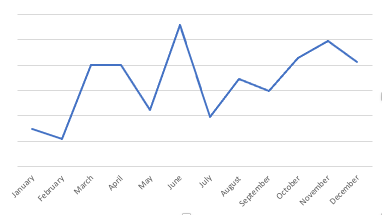
GAS: Typically, our gas usage can correlate to our travel because we usually drive somewhere instead of fly with 3 little kids and all the gear they come with. In June and November, we drove to NY, so those have bigger spikes in the graph below (June also included a trip about 4 hours away). In the beginning of the year, we were more interested in staying home because we had a new little baby, but we ventured out more towards the end of the summer.
RESTAURANTS: I was pleasantly surprised to see the amount spent each month in this category. I didn’t feel like we ate at restaurants all that much in the last year, but I was concerned with whether the numbers who support that. There’s an outlier in March because we spent a lot at one restaurant during the week of my mom’s funeral. On Long Island, food is a big deal; while every one else was paying for meals, I felt it was our turn. We don’t need to actually mention how much that meal was. May’s spike was simply the volume of times we went out to eat, and the majority of them being related to Mr. ODA’s secret shopper gig.
HOME: In July, we had a storm come through that wrecked our neighborhood. No one reported the damage to the National Weather Service, which makes me sad because I wanted to know if it was a tornado! We had several trees fall. One took out our deck, another took out our fence, and another cracked our driveway, but missed Mr. ODA’s car by centimeters. We fought insurance for 5 months, and now we’re in the queue to have it replaced some time late Spring.
CAR: We bought a car. That’s $6,000 worth of the “Home Bills” category. Since most of our bills actually can’t be paid by credit card, it’s surprising to have such a high category for that on the graph, but that’s why. They allowed us to do two $3,000 transactions on a credit card so we could get the points, and then we paid the balance by personal check.
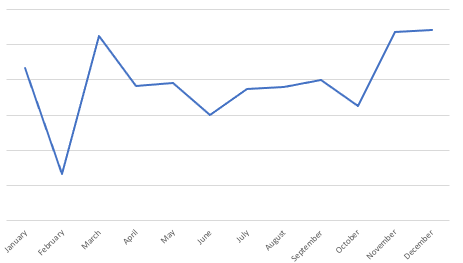
GROCERIES: I’d like to watch this spending more in the future. A purchase at Walmart may include non-grocery items (e.g., shoes), but that is being lumped in with the groceries because I can’t possibly siphon out individual transaction expenses for an entire year in one sitting. So here’s a graph of our “grocery” spending per month, but noting such a caveat.
SUMMARY
While I know we’ve had some larger one-time expenses, I’m still not happy to see the amount spent in each category. I feel we’re diligent in our food spending, but I think we can reduce that amount.
I removed rental information, any rewards received, the $6,000 car purchase, and the $10,000 worth of carpet purchase to try to show that our spending is consistent month-to-month. Again, the baby kept us home in January and February, but we’re generally consistent in spending. I hope that I can review our expenses more often going forward so that I can more accurately categorize our spending.



 One Dollar Allowance