House 9 Turnover

I recently posted “Lease Break Agreement,” where I went into the concepts we used to determine a lease break clause in our renewal with a tenant. The purpose of our fee structure was directly correlated to the time of year and probability of turning over the unit quickly. As I suspected, it took us an entire month to find a tenant. The lease break fee was one month’s rent, so we didn’t go without income during that time, but we also didn’t net a positive.

The tenant gave us notice on November 24th. Our property manager listed the property on November 26th at $1700. The higher price points are worrying me. While the market may claim that this is a fair rate, it doesn’t mean that we have a large pool of qualified candidates for this amount per month.

TURNOVER WORK

The house was painted before the current tenant moved in a few years prior. Unfortunately, some of the rooms were addressed, but not all of them. And the ware of time hit the walls all differently, so it looked like different colors of paint. I asked our property manager to get her painter over there and give all the walls a fresh coat. It looks great. That was $2,000.

I had a carpet cleaner come out and a cleaning company come out. The cleaners forgot about the refrigerator and had to come back. But otherwise everything looked great for less than $500 together.

The front porch was starting to sink. So while this wasn’t an activity done before someone moved in, we do have our handyman working on replacing the back deck, the trim around the back door, and the front porch (he jacked up the supports and is replacing the railing and stairs). I don’t even know what this final cost is yet, but it’s a lot.

APPLICANT #1

We had a lot of interest; hardly anyone qualified. After getting through some of the weeds, we did have a couple interested that appeared to be a good fit. They viewed the property twice over a week to be sure it was a good fit. The application was received on December 13, but it only listed one of the two adults who would be living there. We require all residents 18 years and older to complete a background check. We didn’t expect an issue with that since she works at a school, but it didn’t go well. Due to the holidays, their applications weren’t received until December 26th. She had several collections on her history. However, since he qualified on his own without her income, we agreed to overlook her lower credit score and collections history. I set up the lease with their names and sent them over.

We were excited because they wanted a January 1st rental, which meant we wouldn’t have any loss of income and would be able to put the lease break fee back into the house easily. They asked us if we would clean the carpets and clean the outside of the house. We agreed to the carpets and said that they outside of the house (mildew) would have to wait until warmer weather, but that we would address it.

Technically, all my tenants are supposed to clean the carpets and provide a receipt upon departure. However, I don’t hold this to anyone unless they were a real pain. A couple of hundred dollars out of my pocket and a happy ex-tenant is how I’d prefer to keep it (you’d be surprised at how many ex-tenant referrals we’ve had).

Suspiciously, they then withdrew their interest. I wish I knew why. I don’t know if their circumstances changed, if they were hiding information we hadn’t found on our own that caught up to them, or if something in the lease spooked them. If it was the lease, I wish they would have asked questions because we’re so easy going. I could have either explained why it’s there to protect them/us, or changed it.

So while we were a month ahead of schedule with being able to list the house, we now have a vacant house with no prospects. The goal is always to have the house ready to re-rent with little down time.

LISTING CHANGE

The market for the area called for $1600-1800 in rent. We originally listed it at $1700. It made me nervous. When the initial applicant backed out, I immediately adjusted the rent to $1650. We had plenty of interest at the $1700 amount, but it wasn’t worth weeding a few people out because they didn’t want to go that high. I decided to risk it with only a $50 decrease, since people would be able to see the decrease (and I try really hard to list it at the right price so I don’t have to do a price adjustment, but a December listing is hard to nail on the head). Again, we had a lot of interest, but few qualified.

APPLICANT #2

Two twenty-something men saw the property and asked to apply on January 11th. Neither of them had a job. Seriously. Neither had a single dime of true income, but wanted to commit to $1650/month in rent. Noteworthy was that they wanted us to consider that he had the potential to make $40k per year day trading stocks. We asked a few questions. They said they thought it better to find housing and then find a job. We suggested they try to find work and then live where they find a job (they had just moved ‘home’ from about an hour away).

APPLICANT #3

A woman showed interest who appeared to qualify on the surface. My broken record is to tell me things up front and be open with communication. I can’t help you if you don’t help me. Her information on paper looked fine. I’ve learned over the years to check the local jurisdiction court records myself, instead of relying on the background check. I’ve also tried to look things up before they submit their application; this way if there’s anything out there, they haven’t given us money for the application to not be used. During my search, I found several garnishment cases. Like a lot. An unreasonable amount of court records for a single person. We denied her interest form and did not pursue an application.

But on January 16, she asked for us to reconsider and explained the garnishment. There was one point deducted because the woman’s email asked if “he” as the landlord would reconsider her application (why can’t a friendly, reasonable woman be the landlord? 🙂 ). I didn’t appreciate that the garnishment wasn’t disclosed up front. However, she did explain what happened. It sounded like she was told that there was nothing due, made no payments, and then this debt showed up that she didn’t know she owed, but she’s been working a second job to pay it off. Honestly, the documentation didn’t clearly support the story, but my gut reaction was to believe her.

She also had three evictions recorded on top of this garnishment. The evictions appeared to be filed immediately upon unpaid rent by an apartment complex management company, and then the rent paid before the court date, thereby clearing the debt. I expect to have future issues with rent payments, but I suspect it won’t be anything more than I’m used to handling (e.g., where a tenant needs an extra week or so to make rent).

Our property manager appreciated the in-person interaction with this person, she was well written and well spoken when making her case to be accepted to apply, and overall it seemed worth giving her a chance. I’m also a sucker for giving borderline qualified individuals a chance. I think I’m 50/50 on it working out for me.

The lease was signed on January 18th. We agreed that she would pay the security deposit, first month’s rent, and last month’s rent. The last month’s rent was an additional way for us to hedge our bets with her unqualified application background. This is a “compensating factor.” Since she did not qualify according to our list of requirements, we’re taking an extra fee as insurance to our business interests in this property. We typically will work with someone on compensating factors so that they get a place to rent and we don’t lose out on too much in case our olive branch doesn’t work out.

She paid the security deposit with the lease agreement signature and paid first month’s rent on February 1st. We agreed to give her until February 17th for the last month’s rent. She was asking for a later move in date because she didn’t have all the money up front, but I didn’t want to cause extra stress on her moving plan/date over that.

FINAL THOUGHTS

I don’t even know how many people actually saw the property, since my property manager handled that. However, I know it was a good amount. I typically handle it where I set up an “open house” style visit window for people to come through (so many people claim they’ll show up to a scheduled appointment, and they don’t). I believe she tried to do this at the beginning, but it was taking so long to find a qualified applicant, that she ended up having to do one-on-one meetings.

She has them fill out an “initial interest” form after the showing. For the most part, I do that after the showings as well. However, it does help if you’re scheduling individual appointments to have people fill this out before hand. You want to know ahead of time if there’s even a chance of them qualifying. You don’t want to take time driving to/from an appointment and letting them looking around the house, only to find out they have a criminal background and/or less than favorable credit history.

THERE IS NO CHARGE FOR AN INTEREST FORM. If you are a tenant looking for a place to live, do not pay anyone anything until you’ve seen the property. There are a lot of scams out there where “landlords” are claiming they need an application before allowing you to see the property. They’re listing places “for rent,” that they have no vested interest in. People who recently sold their house, so pictures are available to use, are the ones finding out that people are driving by and looking around their house because someone claiming to be a landlord collected an “application fee,” with no intention of showing you the house or renting it to you.

So while this person didn’t expressly qualify based on our list of requirements to rent one of our properties, I felt like she deserved the chance. I feel bad when someone’s previous life choices immediately disqualify them, and I enjoy giving people a moment to voice their side of the story. Sometimes, their story is enough to solidify a denial from us. But sometimes, it appears worth giving them this opportunity to right their wrongs. I also feel good that I didn’t feel pressured into making a decision just to recoup vacant days on market, but that I made a logical decision. Now let’s see where we end up with this property in 18 months, and whether I still think it was a good decision!

Tenant Evaluations

When looking to rent your house, you should do your due diligence. Our concerns are whether a person has a history of late payments, collections accounts, and if they have a criminal history.

We do two steps of initial screenings before asking a tenant to pay an application fee. The first two steps given them the opportunity to disclose anything that may be seen as unfavorable or not meet our rental criteria. This way, once they pay the application fee, it’s a verification step, and they’re not wasting any money for me to find out that I’m going to decline them.

Here are the details of how I go through the evaluation process, and specifically how I just did it for our new rental.

RENTING CRITERIA

First, I send everyone interested an “Interest Form.” We ask for their legal name, contact information, credit score, employment data, number of occupants, whether they smoke, if they have pets, if they’ve been evicted, and if they’ve been convicted of a felony. I also ask them to provide any other information they think I should know that may affect their ability to rent the house. I send this form to everyone who expresses interest, and it’s the first step before scheduling a showing. I request the data before scheduling a showing because I don’t want to waste my time or theirs showing the house, when they had adverse responses to our criteria. This was more important when I was scheduling individual showings, but I now conduct an “open house.” I set aside two hours to be at the house and ask they come during that time. If that doesn’t yield a tenant, then I’ll evaluate who couldn’t make it and field new requests to see it to determine if I’ll show it individually or host another open house.

We have this at the top of our Interest Form.

Properties are offered without regard to race, religion, national origin, sex, disability or familial status.

Required standards for qualifying to rent a home are:
• Each prospective applicant aged 18 or older must submit a separate application.
• We limit the number of occupants to 2 per bedroom.
• Your combined gross monthly income must be at least $4,000.
• You must be employed and/or be able to furnish acceptable proof of the required income.
• You must have a favorable credit history.
• You must have good housekeeping, payment, and maintenance references from previous Landlords.

Compensating factors can include additional requirements such as double deposit and/or a cosigner.

Our typical rental actually requires 3x the rent as the monthly income, but since our last house was more expensive, we put the requirement as a dollar amount threshold instead.

Then I would historically review those who say they’re interested and pick the one that appears to be most qualified. I’d send them a “pre-application” form to fill out. However, for our last tenant search, I asked everyone interested to fill out the “pre-application.” The tenant screening system doesn’t tell me their last landlord information or their employer, which are both necessary for making phone calls and checking their information given. The “pre-application” repeats some of the questions on the Interest Form, but the pre-application requires them to sign the form as an “affidavit” that the information is accurate.

If they tell me that they’re going to have a low credit score, it helps me to know the reasons for it up front. Additionally, by letting me know any issues up front, it saves them money. If they self-report that they have several collections accounts, then it could be cause for me to move on to a different person interested. If they don’t tell me that they have some issues in their history that may be unfavorable, and I send them the application, then they’re spending $40 per person only to potentially not get the house. I prefer to use the online tenant screening as a final verification step than an initial screening and potentially waste someone’s money.

One time I got through all these steps, had 3 different people submit an application for a house, and the report came back with an eviction. We asked why they didn’t disclose that to us originally. They told us a story about how they were asked to leave somewhere, but they didn’t know that it was reported as an eviction. We told them that they were disqualified. We went with our “runner up,” and they’ve been in the house almost 3 years without any issue or late payment.

We also had two people submit an application and then a bankruptcy was reported on the credit report (it was before the pre-application step I implemented). She said she didn’t see a place to explain a bankruptcy, so she didn’t think to mention it. For future reference, if I ask for your credit score and you have anything concerning in that credit report, it’s helpful to be upfront about it. In that case, everything else was fine and her explanation for the bankruptcy was clear and thorough. We gave them a chance, and they were amazing. She was rebuilding her life after taking on a lot of new bills after a divorce, juggling single-income life, and it was a way to consolidate the debt.

DECIDING BETWEEN TENANTS

In this last situation, I had several people express interest in the property.

I held the open house, and I asked everyone to let me know by noon the following day if they were interested in pursing an application after seeing the property. I received 6 or 7 people who were interested in the house.

I don’t look at one factor. I weigh all the information given to me in my head. In a perfect system, I may assign a weight to each data point, but that’s more effort. I’m reviewing the data and trying to see who has the best, well-rounded criteria.

The house is big (2100 sf with 4 bedrooms), and rent is higher than anything we’ve ever managed. I looked at what they are currently paying in rent. If they’re currently paying $1500 per month, then that made me more confident that they’d cover the $1750; if they are currently paying $400 per month, then I was concerned that they weren’t prepared to cover such a large expense difference. Along those lines, I also gave more credit to someone who has a stable job that they’ve been at for more than a year, versus a few people who said “I’m starting a new job at the end of April.” We have a tenant that goes through jobs every 1-3 months and is always a pain with rent, so I’m probably more scarred by job history now.

I gave more credence to those who had at least a 600 credit score, but I didn’t rule out anyone with a credit score less than that. One woman did have a lower credit score, but she had other good information, so I didn’t rule her out.

Finally, the determining factor came down to availability. My top two contenders had different desired move dates. One said early April, and another said June 1st, but May 1st may be ok. When I asked her to explain about her move date, I received a detailed story that didn’t have any conclusion on when she was available. Since this is a business, and I had a qualified group interested in the house sooner than others, they were the ones selected. If I didn’t have someone qualified for an April move in, then I would have waited for a May 1st rental instead of lowering my standards.

Luckily, I had enough interest in the property that I could select someone who was well qualified and get it rented sooner than later.

APPLICANT SCREENING

Once I’ve given someone these two opportunities to disclose unfavorable information in their credit or criminal history, and they’ve provided favorable responses that meet our criteria, I send the link for the application. The potential renter enters their data into the system, which helps keep their information secure (e.g., I don’t have their social security number) and helps eliminate any typographical errors that I may make transferring the information into the website instead of them entering the data they already know. Additionally, the tenant pays the fee (currently $40) directly to the website, which helps them understand that once the report is run and the fee is paid, it was for a service so it’s not refundable. I heard multiple stories this past week where people paid “application fees,” but were later told that they weren’t the first to respond. That’s not fair. I don’t need to know everyone’s detailed reports and cost people money if they aren’t going to get the property. So here’s how I handle the tenant screening process.

The system generates a report for me to see that includes their credit history, criminal history, eviction history, and income verification.
– The credit history shows any missed or late payments; collections accounts; bankruptcies filed with the chapter, date filed, and amount settled; and their score. I’m more concerned about late or missing payments than anything else there. The collections accounts are typically related to medical bills, but if they’re for general credit cards or an enormous car loan, I’d find it more concerning. I’ve also not ruled someone out simply because they’ve filed bankruptcy; two of our tenants actually have a bankruptcy in their report.
– The criminal history tells me if they’ve had any judgements against them. I’ve seen traffic violations, misdemeanors, and felonies. The report also tells me if they’ve been listed on any sex offender registry. If they have felonies, multiple misdemeanors, or are on a sex offender registry, it’s automatic disqualification. I’ve gone down the road of giving people chances, and it hasn’t gone well. This report isn’t fool-proof either. I know how to use the court record system where we have most of our houses, and I now look them up in all the nearby jurisdictions to be sure there’s nothing reported.
– The eviction report will tell me if they’ve been formally evicted. This doesn’t capture any times where a tenant and landlord agreed on the tenant’s departure outside of the court system. This also may miss some jurisdiction evictions. We had someone show up in a separate jurisdiction when I went looking for their information in the surrounding areas, but it didn’t show up on the report. Don’t think that this report is fool-proof.
– The income verification comes with a built-in caveat. I don’t know the details on how the report is run, but the result is something along the lines of “we believe that the self-reported income is near accurate.”

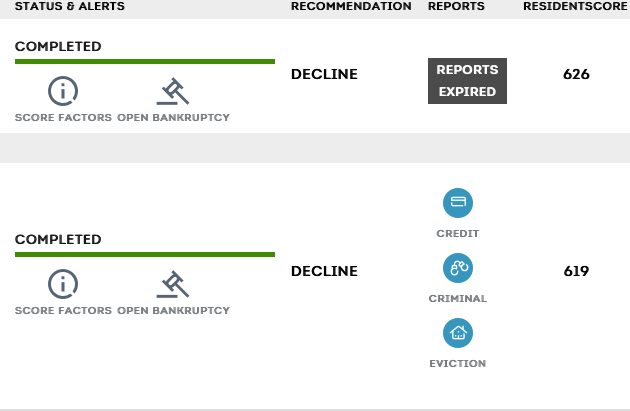
The report suggests whether to accept or decline the applicants. I suggest reviewing the data and making a decision for yourself. Some reasons why the recommendation will be to decline include: criminal history, bankruptcy, and low credit score.

We have given several people “chances” that don’t perfectly meet our criteria. Below is a screenshot where the recommendation was to decline. However, we ended up asking for more information and giving them a chance. They ended up spending a year in a rental of ours, moving out of the area, and then asking for our rental availability when they came back to town. They always paid on time, hardly asked for anything, and took great care of the house.

We have also accepted tenants that had some concerns in their report, but the system recommended we accept them. We tried to overlook the issues, but we’ve ended up regretting it. We have one tenant who has a criminal history (forgery) and we ended up having to release her roommate from the lease because of a domestic violence and restraining order issue. She’s also consistently late on making rent payments and doesn’t keep communication lines open. We plan to ask her to leave at the end of this lease term. We also had a tenant with a 480 credit score who wrote us a letter about her low credit and asked for a chance. She ended up consistently paying late (she always paid, but it was always a fight); we threatened eviction when it got to a breaking point where she was combative, but she left on her own terms. That’s a good example where she was a terrible tenant, who we gave multiple opportunities and even restructured her rent, but her eviction report won’t say anything to that effect.

DEPOSIT

Once I have an approved application, I request a deposit to hold the property and remove the listing. Typically, the lease signing doesn’t occur immediately. In those cases, I want protection of my cash flow that I’m holding the property for someone specifically. I’ve had a couple of houses that have signed a lease immediately, but typically there’s a lag between “acceptance” and the lease being signed (forming a contract).

In this last instance, the tenant was accepted on Friday, but the lease wasn’t going to be signed until the following Thursday. I requested a $400 deposit, which will be applied to their balance owed to get the keys transferred to them. I originally was going to request $500, but I realized that the week’s worth of time at the rent per diem rate came to $408. If they back out between now and Thursday, then I haven’t lost income if I had chosen someone else and not held the property until the date they wanted a lease. Ironically, they ended up paying a deposit of $500. For them to obtain the keys, they owe a security deposit ($1750), the first month’s pro rated rent (about $1300), and a pet fee of $500. Their total is $3,550, but the $500 I’ve already collected is applied to that balance. Therefore, on Thursday, they’ll owe me $3,050 for me to hand them the keys.

Usually, I require the first month of rent to be the full amount, and then the proration is applied to month 2. Since for this tenant, they already paid rent at their current address for the month of April, and the rent here is higher than our average, I went ahead and prorated the first month so they didn’t have to put so much cash out of pocket in a short period of time.

SUMMARY

You can see how I am not making black-and-white decisions. I’m not hanging my hat on one or two factors. I’m being reasonable in my decisions and understanding that there’s a person, and maybe a family, on the other end of this transaction.

Be fair. Utilize a variety of factors in making your eligibility determination. Keep your communication lines open with potential renters until you have a deposit and/or lease signed on the property.

Treat this as a business and make informed, logical decisions instead of emotional ones, but be reasonable.