2023 in Review: Personal Spending

I’ve been working on the ‘year in review’ posts for 3 months. I really want to be consistent on tracking our spending and making sure I’m being intentional in our spending. Our main credit card had the nerve to tell me that it was exporting 461 line items for me to categorize and manipulate in Excel. We have 8 credit cards. So that wasn’t a fun realization.

Additionally, if I track it more than once every two years, I may be able to better categorize our spending. For example, a Walgreens purchase may be pictures that I printed, or it could be a prescription. My Amazon purchase may be clothes for the kids they needed, a gift for someone, something in the home improvement category, etc. The entertainment category can include exercise that we’ve paid for (e.g., 5K, ultimate frisbee, kids’ activities) or a trip we went on.

There’s also no direct way that I’m tracking where a credit card expense has been offset by someone paying us back. For instance, I put $980 on my credit card for a trip, but someone paid me $480 for it via Venmo. That offset is in my year’s total transactions, but not in a manner where I can capture it for this year-long-view of expenses. Additionally, we go out to eat at restaurants, but Mr. ODA gets paid for some of those as a secret shopper.

EXPENSES

This doesn’t identify the actual money spent in each category, but it shows how categories align with each other. To simplify this graph (and to allow all bars to even be seen), I combined several smaller categories into an overarching category. For example, the entertainment category includes anything from doing a brewery tour to traveling to another state. Home Improvement includes $10,000 worth of new carpeting, so it’s an outlier. This also doesn’t include expenses that were paid for out of our checking account(s); although nearly all of our expenses are paid via credit card to gain the rewards.

MEDICAL: We spent the first half of the year managing doctor appointments. They were mostly for the baby, and then halfway through the year, I started having serious vertigo issues. The baby was born a little early, had jaundice, diagnosed with reflux and put on medication, and then had trouble gaining weight. My 3rd baby then needed to have formula supplemented, after I nursed two kids and had extra milk to donate to NICU babies. That was an unexpected psychological and financial change. Once he started to become healthier, I hit a wall. After a week of wondering why I kept feeling lightheaded and dizzy, I woke up one morning not able to walk a straight line, and if I even attempted to, I’d throw up. I was diagnosed with an ear infection, which seemed to make sense, but the antibiotics didn’t stop the vertigo episodes. After several specialists, I was given the same thing that I always am: “your symptoms don’t fit neatly into any one category, and I don’t know what’s wrong with you.” Luckily, most of my symptoms have died down at this point. And thankfully, outside of random viruses and a bout of pink eye through 3/5 of us, the others were healthy.

SPORTS: We joined the Y and were really strong for the first 3 months. Once my mom died, I didn’t have it in me to go exercise, and then I got sick for most of the summer with that vertigo issue. Mr. ODA played softball, vintage baseball, and ultimate frisbee; I was able to play some ultimate frisbee and run a 5K. The kids did swim lessons at the Y (and was quite a terrible experience). Our oldest attempted soccer for the second time, and then cried through all practices and games. Our middle thrived in ‘acro’ for the second half of the year. I plan to finish our this semester with her in acro, but I think she’s going to love gymnastics after that.

TRAVEL: We traveled to NY for my mom’s funeral. I took 3 flights in a few days with the baby, all with points (which American Airlines was super easy to work with for last minute flights and using points). We went to the middle of nowhere Tennessee with Mr. ODA’s family, to NY two more times, a short family camping trip, to Indy for some kid-related fun, and a trip to Cincinnati to see Christmas lights and take the kids skiing for the first time. I bought myself new skis (I had been snowboarding for the last 13 years), which led to buying the kids ski equipment (although, it’s noteworthy that we bought them second hand and their skis and boots totaled $100 for two kids). That then led to buying mid-week season passes at our local ski resort. On top of our family trips, Mr. ODA took two work trips, a golf trip, and a mountain biking trip.

GAS: Typically, our gas usage can correlate to our travel because we usually drive somewhere instead of fly with 3 little kids and all the gear they come with. In June and November, we drove to NY, so those have bigger spikes in the graph below (June also included a trip about 4 hours away). In the beginning of the year, we were more interested in staying home because we had a new little baby, but we ventured out more towards the end of the summer.
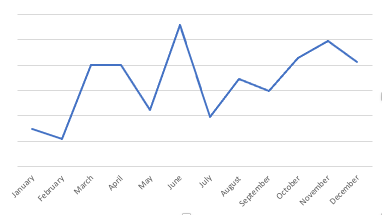
RESTAURANTS: I was pleasantly surprised to see the amount spent each month in this category. I didn’t feel like we ate at restaurants all that much in the last year, but I was concerned with whether the numbers who support that. There’s an outlier in March because we spent a lot at one restaurant during the week of my mom’s funeral. On Long Island, food is a big deal; while every one else was paying for meals, I felt it was our turn. We don’t need to actually mention how much that meal was. May’s spike was simply the volume of times we went out to eat, and the majority of them being related to Mr. ODA’s secret shopper gig.

HOME: In July, we had a storm come through that wrecked our neighborhood. No one reported the damage to the National Weather Service, which makes me sad because I wanted to know if it was a tornado! We had several trees fall. One took out our deck, another took out our fence, and another cracked our driveway, but missed Mr. ODA’s car by centimeters. We fought insurance for 5 months, and now we’re in the queue to have it replaced some time late Spring.

CAR: We bought a car. That’s $6,000 worth of the “Home Bills” category. Since most of our bills actually can’t be paid by credit card, it’s surprising to have such a high category for that on the graph, but that’s why. They allowed us to do two $3,000 transactions on a credit card so we could get the points, and then we paid the balance by personal check.

GROCERIES: I’d like to watch this spending more in the future. A purchase at Walmart may include non-grocery items (e.g., shoes), but that is being lumped in with the groceries because I can’t possibly siphon out individual transaction expenses for an entire year in one sitting. So here’s a graph of our “grocery” spending per month, but noting such a caveat.

SUMMARY

While I know we’ve had some larger one-time expenses, I’m still not happy to see the amount spent in each category. I feel we’re diligent in our food spending, but I think we can reduce that amount.
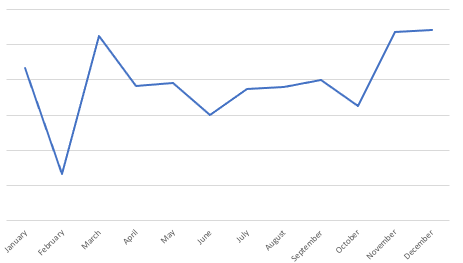
I removed rental information, any rewards received, the $6,000 car purchase, and the $10,000 worth of carpet purchase to try to show that our spending is consistent month-to-month. Again, the baby kept us home in January and February, but we’re generally consistent in spending. I hope that I can review our expenses more often going forward so that I can more accurately categorize our spending.

Medical Bills

Here’s something different. Medical insurance isn’t something I’m going to pretend I understand fully, but I know enough to protect my money. So here’s two quick stories about how due diligence saved us hundreds.

First, an overview.

When you see a provider (e.g., doctor), they bill your insurance on your behalf. The claim that’s submitted is reviewed by the insurance’s benefits administrator, and any coverage is paid out. Your insurance will likely have a “disallowed” amount (what your insurance deems is too expensive to be billed for the given service), a benefits paid amount (what insurance pays on your behalf), and then a member responsibility amount (what you owe). Once the claim is processed, these are outlined in an explanation of benefits, or an EOB. If and when you receive a bill from the provider, verify against your EOB to ensure that it aligns with your insurance benefits.

Here’s an example of an EOB. By using a provider that is in-network (in a negotiated agreement plan with my insurance company), the doctor and the insurance have agreed costs for services provided. My insurance’s “allowances” are negotiated with each provider who participates in the network. Allowances may be based on a standard reduction or on a negotiated fee schedule. For these allowances, the provider has agreed to accept the negotiated reduction and you are not responsible for this discounted amount. In these instances, the benefit paid plus your coinsurance equals payment in full. So here, for the services that I received, the insurance company is saying, “I see you billed for $115, but we agreed that this service only costs $65.34, so that’s what we’re allowing.” You, as a covered member, are not charged for the ‘disallow’ amount of $49.66.

In our case, we have a high deductible plan, which means we have to spend a certain amount of money on covered services before the insurance pays out benefits. Ours is $3,000. This means that for the first $3,000 worth of doctors visits to in-network providers, we’re paying the total allowed amount (e.g., our son had to go to the ER, and we paid $609 for the visit, which is the fully allowed amount). There are plans out there where you don’t have a deductible, but you have a copay (e.g., I had a plan where I paid a flat $20 for each doctor’s office visit and $125 for each hospital visit, but I was also paying a higher premium for that coverage type). In a future post, I will share how we compared our plan options and chose a high deductible plan.

After we meet the deductible, most of our services are covered at 95% (i.e., we’re responsible for paying 5% of the allowed charges). In the example above, we had to pay 5% of the $65.34, or $3.27.

There are tons of nuances to insurance though, but hopefully this broad overview helps understand how to read the EOB. I have more stories of where my interpretation of the coverage in my brochure doesn’t seem to match the benefits administered, but those are for another time. For now, here’s how we protected hundreds of dollars by staying on top of our coverage.

MR. ODA’S STORY

Speaking of nuances, here’s one of those. Preventative care is covered at 100% (e.g., maternity screenings and annual physical exams). Mr. ODA needed a physical to qualify for his agency’s wellness program (they’re given 3 hours per week to exercise). When he went to get the physical, it got coded as a sports physical because the doctor had to sign off on a paper that said he was healthy enough to participate in the wellness program. A routine annual physical is fully covered by insurance, regardless of deductible. Apparently, a sports physical is not the same concept and regular coverage requirements apply.

Mr. ODA had to call back to explain that the exam was routine with a signature on paper, and not any more in depth to be considered a sports physical. The doctors office offered a reduction in the amount owed, twice, but eventually realized they were spending more in postage and phone calls than the bill was worth while Mr. ODA fought the coding, and they wrote it off.

MRS. ODA’S STORY

I saw a doctor in December 2019 when having pregnancy complications. In February 2020, I received a bill, which I promptly, and erroneously, paid. A few days ago, I received a check for the amount I paid a year and a half ago. So it wasn’t a quick resolution, but I wasn’t going to let $300 go.

The bill said:
Charges to Date: $451.00
Payments/Discounts to Date: $157.85
Remaining Patient Balance: $293.15

I had seen multiple doctors in a short period of time, so I was just in auto mode to pay all the medical bills that I had. After I paid it, I realized that on the back of the bill there were more details about that “payments/discounts” line item. There were three columns: Insurance Payments, Patient Payments, and Adjustments to Date. The total $157.85 was in the Adjustments to Date column, and the insurance column said $0. I checked into my insurance claims online and didn’t see this date of service. Well, I’m insured, so this should have been submitted to my insurance for review first. I called the hospital to indicate that there was an error made, and I shouldn’t have paid this in full, even with an “uninsured discount” they graciously offered me.

I called the hospital to ask why this wasn’t submitted to my insurance and discovered that my name was spelled wrong, my insurance was entered wrong, and this claim wasn’t tied to all my other hospital-related claims I had processed. Supposedly, they updated my information and resubmitted. I still didn’t see it on my online claim history after the 30-45 day window they told me, so I called again in April 2020. I was told they would resubmit. Two months later, I was managing a newborn and we were just deciding to move, so this fell off my radar. Then all of our things were in storage for two months. By the time I got this paperwork back out, it was March 2021.

I explained my story to the hospital again and asked for it to be properly submitted. I was again told they would submit the claim, but this time they’d submit by paper handling. Again, nothing showed up in my insurance. I called in April 2021 and was again told that they would try submitting again. This time I escalated to a supervisor. I said that this was unacceptable, and I didn’t want to keep being told they would try again, delaying my reimbursement by another 30-45 days each time I called. The supervisor said she would ensure the paper claim was sent out and call me back in a week. I never got the call. On May 18, I called again, immediately asking for a supervisor. This supervisor said that my account showed a refund was approved, but he needed to issue it (why couldn’t that just have been done?!).

Well, on June 1, I received a check in the mail for $293.15. That’s the amount I paid back in February 2020 for a December 2019 date of service. I could have written this off in my mind a year ago and not made these five or six phone calls, taking about 90 minutes of my time in total. I could have said to myself, “I called. There’s nothing more I can do.” But we wouldn’t be in the position we’re in now with our finances if I kept saying “oh well, that’s all I can do.”

The moral of the story is that you should be an informed consumer. If you know how to determine your benefits and calculate your coverage, you can make sure the proper payments are made to the provider, and that you aren’t overcharged.