Lease Break Agreement

Last March, it was time to make a decision on renewing the tenant’s lease on House9. There were several variables at play, and we ended up adding “lease break” terms to the renewal agreement. Here’s how and why we did such a thing.

LEASE BREAK CLAUSE

All of my leases are set up as a lump sum fee. This means that if the rent is $1,000 per month, then the lease is a legal binding agreement for $12,000 for the year. If you wanted to leave 6 months into the agreement, I could hold you accountable for the entire sum. In reality, this wouldn’t happen. I’d have to show a good faith effort to re-rent the property once the tenant vacated the property, and they’d only be responsible for the time it was vacant, at most.

The point here is that there is no section of my lease agreement template that allows the lease to be “broken,” and the tenant to leave “early.” In some instances, a tenant will request the flexibility to leave early, and we typically charge up to a month’s rent for that ability. We most often use this for tenants that expressed interest in buying a home. There are some other fee structures that we use depending on the circumstances, but this will focus on those instances where we know in advance that this is a possibility.

ORIGINAL LEASE AGREEMENT TERMS

The tenants had signed their original lease in June 2020. From the beginning, they were clearly money savvy. They had said from the beginning that they were looking for a place they could live until he finished his schooling, which was about 2 years away. They negotiated a two year lease for $1,280. In September 2021, so 6 months before their lease was set to expire, he reached out with an offer. His program was set to end in May 2023, but they didn’t want to commit to any longer than that since he could be placed anywhere upon graduation. He asked to go month-to-month after that.

We agreed to extend their lease until May 2023, but it would be $1,300 (instead of $1,280) between 7/1/2022 and 5/31/2023. We decided not to engage in the month-to-month conversation that far in advance, which he understood.

In March 2023, we started discussions on their status. They were about to have a baby, the market had cooled for buyers, interest rates were high, etc. They didn’t want to rush their buying process. Instead of paying the premium for a month-to-month lease, we decided on another year-long lease, but it would have a “lease break clause.”

NEW LEASE AGREEMENT TERMS

The new lease was executed for $1,350 per month, which was still a bargain for their property. However, we added lease break provisions, as seen below.

The thought process here was that we were protecting our financial interests based on the time of year. First, we required a month’s notice. Our original lease already states that we can have access to the property to show it to prospective tenants, so that wasn’t repeated here (although it is worth noting that this in our lease agreement, since renting while a unit is occupied is not always a given; we struggled with our property manager in KY getting access to our properties (that was a property manager issue)).

I don’t know if there are facts to back this up, but it seems (through my own years of renting, as well as all these years as a property manager) that most people are looking for a rental to be somewhere between May 1 and July 1 as the start. A quick search tells me that the common months are May to September. However, in the south, we start school in mid-August. If you’re not moved by August 1st, I’d venture to say you’re not preferring a September 1st start date.

If the tenant left in the summer months, then the fee was only 1/2 of a month’s rent. We had a good chance of being able to re-rent the property if it was during the summer and before everyone focusing on back-to-school in the end of August/September. If they requested a lease break between September and the end of March, then it was a full month’s rent. This was due to the fact that the turnover process was going to be longer than our typical turnaround, and it would put us at a disadvantage in re-renting the property down the road. We then put that there would be no fee if they left in the last two months of their agreement because 1) we’d likely be able to rent it quickly, and 2) as a way of showing that we’d meet in the middle since they were such great tenants.

EXECUTION OF THE LEASE BREAK AGREEMENT

The tenant had used our property manager as their Realtor for a new home purchase. She tipped me off that they’ve be giving their notice shortly, sometime at the beginning of November. I naively thought that meant they were newly under contract, but by the time their notice was given, they had already closed on their new home. They purposely waited to give their notice so that they had time to move their belongings without being rushed (which is fine; I don’t know why that reads negatively). On November 24th, they let us know that they’d be leaving by 12/31.

While the fee was due upon notice, per the lease agreement, it wasn’t something I was willing to fight. If you’re a good tenant and hold the lines of communication open, I’m happy to treat you as an equal. They paid the fee on 11/29, and then they paid their December rent on 12/4.

LESSONS LEARNED

Honestly, it worked just as planned. We weren’t able to rent the house for January. The lease break fee alleviated the pressure to settle for a tenant just to fill the house because we had the month’s income already accounted for. We’ve done something similar in the past, and this set-up has worked well for us. It gives a little grace to the tenants and real life needs, while still protecting our interests as business owners.

We put the same type of clause in another tenant’s lease. They executed the clause on February 23rd, letting me know they’ll be leaving by the end of March. If they broke their lease in March or April, there was no fee (their lease was set to expire April 30th, so it’s one month early).

Their are times where a tenant doesn’t know up front that they’re going to find a house they love or a job is going to move them. We handle each on a case-by-case basis. Generally, it’s either going to be a month’s worth of rent as the fee or it’s going to be a fee of $250 (the amount I pay to the property manager) and they pay rent until we find a new renter (which has never taken more than 6 weeks, and is typically a few days turn around for me).

LLC Filing with FinCEN

I was chatting with a financially savvy friend of mine, and she asked about filing our Limited Liability Corporation (LLC). I had no idea what she was talking about. Mr. ODA had no idea what she was talking about. I sent a text to 3 of my investor Realtor buddies (in two different states), and none of them heard about it. So I started digging.

Sure enough, if you have an LLC, you’re required to file with FinCen this year.

So here’s my attempt to let a few more people know of this legal requirement that carries fines, yet no one decided an email or mailing to LLC owners (which are filed with the State governments and are required to have physical mailing addresses) would be worth their time and cost of a stamp.

THE CORPORATE TRANSPARENCY ACT

On October 23, 2019, Congress passed this Act. The purpose being “to ensure that persons who form corporations or limited liability companies in the United States disclose the beneficial owners of those corporations or limited liability companies.” Essentially, they’re trying to ‘crack down’ on companies using LLCs as a shell game to move or hide money, or pay into criminal behavior.

It states, “Criminals have exploited State formation procedures to conceal their identities when forming corporations or limited liability companies in the United States.” In 2006, an international body determined that the United States fails to comply with beneficial owner information reporting, and gave a July 2008 deadline to fix it. The United States Federal level had urged State laws to comply, but didn’t follow up, and was cited again for failure in 2016. Since the States didn’t make progress, Congress issued this ruling.

The Act states that nearly 2 million LLCs are formed each year, with few States requiring beneficial owner information. A beneficial owner is generally someone who exercises control over the company, owns 25% or more, or receives substantial economic benefits; there are exceptions listed in the law.

While this was passed in late 2019, they then needed to establish a way to securely collect and retain the information reported. FinCEN established a Beneficial Ownership Information (BOI) website, in which you’re required to enter the pertinent information. It opened January 1, 2024.

Because this is the age where there are scams around every corner, note that this is a ‘.gov’ website, and their logo is below (i.e., don’t enter your personal information into a third party website).

REPORTING COMPANY

A reporting company is those that qualify based on the law’s detail. There are either domestic (registered here, doing business here) or foreign (registered in another country, doing business in the United States) reporting companies.

There are 23 ways a company may be exempt from reporting. The general gist of the exemptions are based on whether you’re already reporting to the government in another form (e.g., banks and accounting firms). “These entities include publicly traded companies meeting specified requirements, many nonprofits, and certain large operating companies.” Don’t assume you’re exempt; be sure to check the list on the official website.

BOI REPORTING

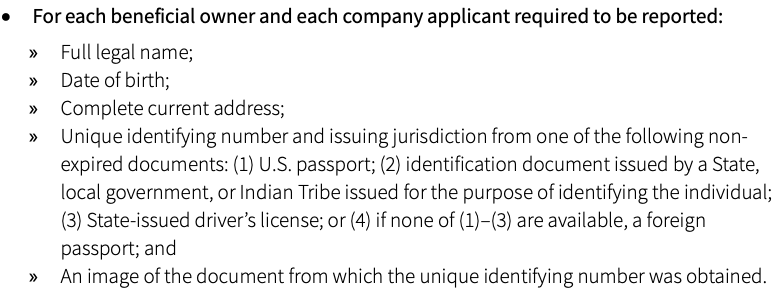
The reporting is straightforward. You will need a legal identification card image uploaded for each person entered in the system.

From the main page, I selected the icon that said prepare a BOI Report. I chose to prepare and submit, so it’s a form within the website. There’s another option that appears to allow you to fill it out in PDF form and submit the form. I preferred the prompts along the way.

Below is a snapshot of the information that’s needed in the initial filing.

When we set up our LLC, our drivers licenses were copied, so this request isn’t for anything more than we’ve already provided to our State. For us, establishing an LLC was solely a way for Mr. ODA and I to create an ownership stake in two properties that we purchased with a partner. Though there are 3 of us listed in the LLC, Mr. ODA and I are 50% partners together, and this other guy is a 50% partner. I pay him out at 50% each month after I collect rent.

It’s very simple; I’m sure there are LLCs with employees and more paperwork. However, I didn’t need a social security number for the beneficial owner(s) or any dollar amounts paid. We did establish a EIN for the LLC several years ago, so I submitted that EIN for the reporting company. Otherwise, I would have submitted my social security number as the company’s identifier.

There are more details associated with the reporting; for instance, you can update your report through their website. However, I’ll leave it to you to dig deeper on all those instances, as I’m just trying to build awareness.

DEADLINES

As with all new systems, there’s a phased approach to the requirements.

If you were already registered before this year, then you have until January 1, 2025 to file the initial BOI report. If you create an LLC during 2024, then you have 90 calendar days from the registration effective date to report. For all LLCs created on or after January 1, 2025, you have only 30 calendar days to report.

February Financial Update

RENTALS

The rentals were expensive this month with $4600 paid out. This doesn’t include work that’s currently under way, but not paid for yet.

I paid for a water heater replacement, which was $1,904. I had to pay insurance on a larger property ($793). I paid the balance of the window replacement at one property, which was $1,064. I also paid for a plumber to address a leaking toilet and a rotted faucet ($325). We had a new tenant move into a vacant property, so we had that cleaned before her arrival ($165).

I had to pay for a plumber’s service call ($95) for clogged drains, for them to refer me to a rooter company ($250). I emailed that tenant that preventive measures need to be taken because I’ve not had so many calls to one property. She assured me they have taken appropriate measures and it’s just old pipes. The only problem being that we have several other properties with old pipes that never call for clogs.

We’ve turned over two properties and are about to turnover another property in the dead of winter. It’s so frustrating to be in such a position. All of those stories will be elaborated on in future posts.
– On one property, we charged a lease break fee of one month’s rent to cover our losses (the fee was different based on the month in which they broke the lease). Luckily, that covered our entire month of January being vacant, but we found someone for 2/1.
– Another tenant asked to leave a property because he lost his job. That was handled a bit different because we didn’t know in advance that this tenant would want to leave mid-lease. We told them there’s a fee of $250 (which is what it costs us to pay the property manager to find a new tenant), and that they had to pay rent until we found a new tenant. We didn’t lose any rent on that property.
– Now, we have a newly vacant property because the tenant can no longer afford it. I’m not expecting to recover her unpaid rent at this point. We approved a tenant to start 2/28, leaving us with 27 days of lost rent. However, we sent a lease over for them to sign. They’re currently dragging their feet on signing because they want to pay with their tax return. I don’t love that idea. They’ve been easy to communicate with up until this point, just slow. I’m hoping this gamble works out.

PERSONAL FINANCES

I had to transfer money to Mr. ODA’s account to cover the purchase of our new back door and a new treadmill (although that was only $400). This is an interesting concept for us. Mr. ODA had an account before we met. His account was grandfathered in to new terms and conditions at this bank. He’s kept his checking account and credit card for the rewards (I have access to the account; my name just isn’t on it). Any online purchases go on that credit card. However, that account only receives $250 every other week from Mr. ODA’s pay check (occasionally it’ll receive rent via Zelle). So sometimes, we need to transfer money from our main checking account to cover that credit card payment. All our security deposit accounts are with that bank too. So I had to then transfer from a security deposit account into his checking account, and then have him send that money to our main account. It wasn’t our finest money management moment.

Not much else happened this past month. We’ve gone skiing with the kids some more, I went on a moms’ cruise (which was amazing), took a small trip to piggyback Mr. ODA’s work trip, and have done activities around town. We’re gearing up for a procedure at a local children’s hospital next week, which I’m expecting will wipe out our deductible. Luckily that’s only $3,000, but I’m sure we’ll hit it. We’ll actually be late hitting it this year; it’s usually done in January.

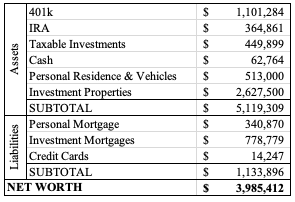
NET WORTH

One of this year’s goal is to hit $4 million net worth. I thought it was going to be a ways away, but the market has been up big recently. We’re only about $14k away from that goal now!

“Cheap” Flights

I recently went on a trip. We booked one of those “cheap” airlines, where you pay a la carte. Our round trip flight was about $50. In the process, I was amazed at the number of people who were frustrated by the rules, as if you don’t have ample opportunity to learn the rules in the process. So I wanted to go through a booking, to show you that there are plenty of warnings, and that it may or may not be cheapest to go this route.


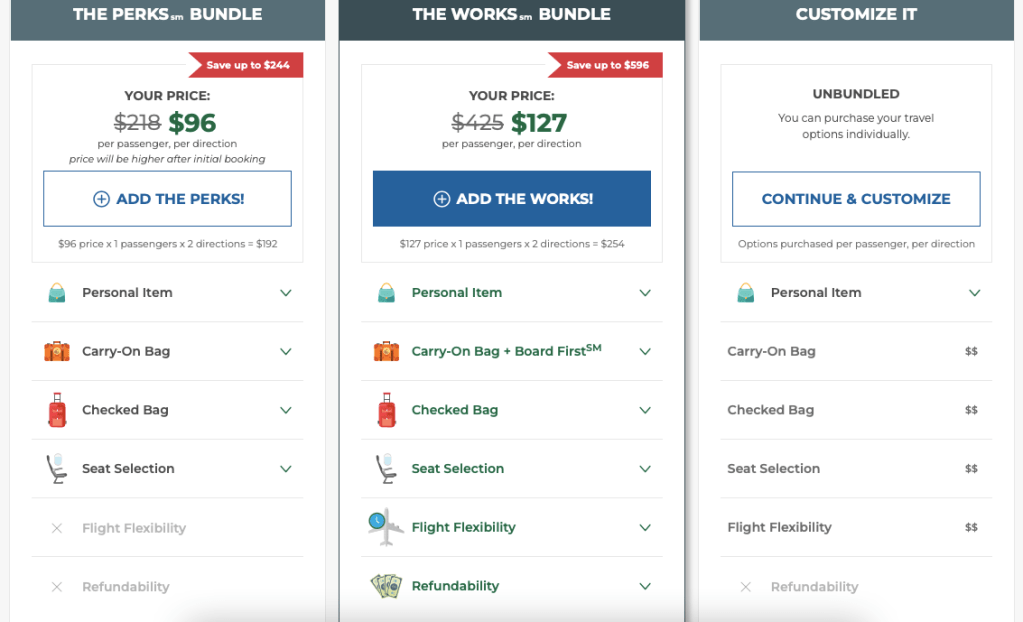
I’m going to pretend to book a flight. From Cincinnati to Orlando, round trip, I found a flight for $87.96. The next page asks for my personal information. They then offer me a few options.

The price highlighted is for one way, and in smaller font, it indicates the round trip price. This could be a bit more straight forward, since my selection is for a round trip flight, so one way worth of baggage isn’t the expectation. I decide to ‘continue and customize.’ The next page is seat selection.

Every single seat has a price associated with it. Again, this could be more straight forward. Nowhere on the page does it clearly indicate that you don’t have to pick a seat. I click “continue.” There is a link below continue that says “what if I don’t pick,” but I didn’t check that. The next page causes me to pause and lets me know I should rethink my options.

I select no thanks. The next page provides my carry on and checked bag costs. I can select that I want to carry on and board first, just carry on, or have no carry on. I select no carry on and no checked bag. As I scroll down, it lets me know that I can have a personal item for free, and it lets me know the size restriction for this personal item. It tells me multiple times on this page that bags will be more expensive at the airport.

I click continue, without selecting any baggage, and it halts me again.

I then get asked a few questions about the check in process and any other add-ons. I decline everything, and I’m sent to the payment page. At the end of the page, I have to agree to several things, including baggage requirements, before booking.


The entire point here is that this airline has warned the consumer several times, through multiple pages and “clicks” that there are fees outside of the ticket price. So even if you didn’t know that the reason you found such cheap flights was because their pricing is a la carte, they’ve told you multiple times through the booking process. Similarly, you know going in, on any airline, that a bag over 40 or 50 lbs is going to be considered overweight.

It was frustrating to watch so many people get mad that they checked your bag size as you boarded the plane. You signed up for that. You could have checked the size. I read the wrong section when I packed my bag, so I had verified it as a carry-on size, which I didn’t pay for. I was able to move things around in my bag for it to be able to fit. If it didn’t fit, I knew that mistake was on me, and I’d pay the fee. The fee in the airport was $99. Yes, it seems astronomical to pay that fee for something that you can walk on with if you’re flying Delta or American, but it’s the rules for this airline, and I know that going in. I could have adjusted things for the flight home, so my total for this roundtrip would have been $150, still cheaper than roundtrips on other airlines.

For the pretend flight I went through above, if I had selected The Perks bundle, my total would have been $279. I’d get a carry on, checked bag, and the ability to select my seat at that price. Had I selected just a carryon each direction, my total would have been about $225. For the same dates, I could fly more inconvenient schedules (e.g., midnight arrival) for $209 through American.

When comparing the prices, you need to see what the best options are for what you need. If you can’t get by with just a personal item, then you need to factor that into the flight cost when comparing to other airlines. If you can’t handle the psyche of having your bag checked for size when you board the plane, then stick with the traditional airlines.

Be an informed traveler. Know the fees associated with your airline. Know the restrictions for each item. Plan in advance instead of having to move things around at the airport where you’re going to feel the stress.

Slider to French Door Replacement

In my January financial update, I mentioned that we “somewhat on a whim” replaced our back door. I started to tell the story there, but I had more to share about the process and how we went about it.

We purchased our home in June 2022 with a sliding door out to the deck. This is the first house we’ve had with a slider. It’s not my preference, but it wasn’t worth putting any energy into.

Over the last year and a half, we’ve had trouble with it. The lock mechanism kept freezing on us, making it difficult to unlock the door to let the dog in and out. The door was also very heavy and/or hard to open. Our slider in the basement is much easier to move, but this one just wouldn’t budge without a lot of effort. On top of all that, there were vertical blinds over the door. I had no problem with how they looked. However, they weren’t installed correctly to begin with (the story of everything in this house, apparently), and the stick used to open and close them were on the wrong side. Then add in a one-year-old pulling on the blinds. Slats kept breaking, I was being blinding by the sun, and I was tired of fighting the baby to stop pulling at them.

In our Virginia home, we had a french door style (although one side was stationary) back door. Then in our last home, we had a regular back door, but there were blinds between the windows. That was my dream at this point: blinds between the glass so that they weren’t pulled or broken by kids, and a door instead of slider. I really didn’t want to hang curtains over the doors or manage blinds that get attached to the side of the door.

FINANCIALLY

We had a window company come out for a quote. He said that some work may need to be done to adjust the opening because it’s not a standard opening, but didn’t say much else. He went through all the details and finished out our meeting with a quote of $9,300. I can’t even begin to explain how that wasn’t even close to reasonable. He said it wasn’t a custom door and claimed that adding the blinds to the door was $2,100. No thanks.

The door I wanted was at Home Depot for $995. Seriously. It hit all the specs I wanted. The door was primed, not painted. To order the door painted white, it was going to be $2,200. I could paint the door myself for a lot less than $1,200. Both sides actually open, even though I was going to be happy with just one side opening.

I was hesitant to buy it because the window company made me feel like I had a custom opening. A few days later, my dad came to visit, so I asked him to measure the door. He confirmed that it is a standard size door. He said that before even measuring it, he knew it was going to be a standard opening because it would be way too much money to create a custom slider. He said I should get the door, and he’d help install it. I really only wanted the door measured. I planned on having our deck contractor install it, which he said he’d do for $500.

As I looked more into it, I was able to get the door scheduled for delivery for the next day for $79. By amazing luck, it was delivered at 9:30 am, meaning we could get to work right away.

INSTALLATION

The installation process was a lot more straight forward than I expected. It’s a job that requires heavy lifting and extra hands to hold things in place every now and then, but each step is logical.

My dad removed the interior moulding, and then he cut through any screws that were between the door frame and the house. We tipped the slider outward and moved it out of the way. We then cleaned out the opening, removing any extra foam insulation and sweeping out the sill. The next step was to put 3 caulk lines on the sill. The hardest part was keeping the kids and dog from stepping on this before the new door got moved into place. The door was then lined up on the bottom and tilted into place. A couple of screws were put in to hold it while we shimmed it.

The shimming process was time consuming, but it was straight forward. The screws went straight through the holes already in place for the hinges (one screw in each hinge was longer than the others so that it would hold the door in place). Once the screws were all in place, we then put spray foam around the door. It was important to keep an eye on the spray foam so that it wouldn’t creep out and attach (and stain) to the door.

The door that was removed didn’t have the brick mould on the exterior, so it sat further into the house. The door we installed did come with the brick mould, and my dad said it was best to keep it on. This meant that our gap between the floor and door frame was bigger than we’d prefer. My dad actually removed the last row of hardwood flooring (that had been ripped down to fit the original door) and installed a new, full row of flooring (we had some on hand in the basement). That was pretty impressive to me!

FINISHING TOUCHES

We could have used the moulding around the door that was already there, but I wanted to change the look of it. While I decided on the new look, it gave the spray foam almost 24 hours to expand and dry out before we cut it back. We cut it back and installed the moulding as I designed it. I painted the moulding, while deciding on the door color.

Everything around my house is a navy, even though I’m trying to push towards a black-and-white. The kitchen backsplash was navy when we bought it, the back of the living room bookshelves are navy, the dining room walls are navy, and all the roman shades are navy. I was afraid to pick a different color, so I went with navy on the doors. I used a metal-friendly paint to hopefully prevent chipping.

The door has moulding around the glass, with screws on the interior. The hardware bag should have included plugs for the screw holes, but it didn’t. I emailed the company asking for replacements, which they sent within 2 weeks.

COST BREAK DOWN

Door: $1,142
Paint: $22
Moulding: $71
Caulk: $14

Total tangible costs are ~$1,250. We then also bought my dad gifts to pay him for his services, knowing he wouldn’t take straight cash from us.


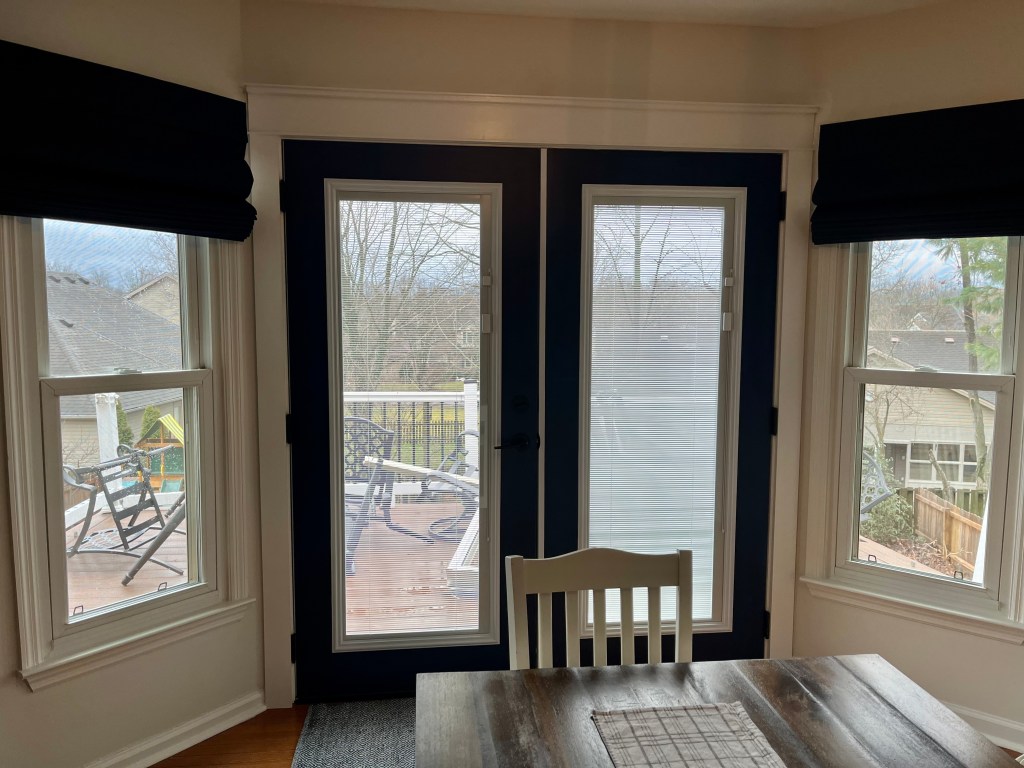
For now, I’m keeping the door navy. This picture only has 2 coats of the navy; I need to do the final coat with a roller. I think I’d prefer a lighter color on the door to compliment the navy, but also so you could see the black handle and black hinges I installed. I need more time to contemplate the change. Maybe once our deck is replaced (ignore the mangled deck railing and furniture that still hasn’t been replaced/fixed from the July 2nd storm where a tree fell on it) and the weather is nicer, I’ll have an epiphany moment. For now, I’m beyond thrilled with the replacement that was under $2000 for all of it.