There has been a lot of talk about thermostat temperatures recently because of how hot it has been where I live. There are Department of Energy images circulating that say keep your home at 78 when you’re home, 82 when sleeping, and 85 when away from home. Personally, I need it colder at night than during the day, but that’s not the point. My goal here is to make you stop and think about your actions. This applies to several areas of your financial life, but this post specifically will be regarding your heating and cooling process.
THERMOSTAT SETTINGS
In our house in the summer, we keep the thermostat at 75 or 76 during the day on the 1st floor. It usually starts at 76 and then if someone feels hot, they bump it down to 75. Upstairs, it sits at 77 for the day, is put at 76 for when the kids go to bed, and then 74 when we go to bed. When we leave the house, the thermostats are at 78; if we leave for extended periods of time, it’s set in the 80s. In the winter, the heat is set at 65 during our waking hours and 64 or 63 at night.
As a quick aside, our third son was born early and was having trouble breathing and regulating his temperature those first few weeks. We were told to keep the house at 70 or greater for him. We struggled! We made it to 69, but everyone was uncomfortable and hot. I mentioned this to the doctor and he said it was fine to be at 68 if that’s what everyone felt more comfortable at.
While we know these numbers now, we spent a lot of years working on different settings. We didn’t just assume that these were the numbers we wanted to be at. There were winter months where we set it at 63, but my fingers were hurting because they were so cold while I typed on my keyboard, working from home. I was at a friend’s house recently; they had it set at 70, and I was cold.
That brings me to another point. What’s the thermostat temperature where you’re comfortable in the summer while wearing shorts and a tshirt? If you’re wearing a sweatshirt and have the temperature set at 70, is that worth the extra cost to run the air conditioning at that temperature?
TIPS TO SAVE MONEY
This image was shared by a local meteorologist, but a citation wasn’t given, and it differs slightly from the numbers that the Department of Energy published. According to this, we’re saving 19% in the winter by keeping our heat at 65, but then we’re spending 32% more in the summer based on the recommended setting.
While you may have your expected temperature setting, you may want to consider is how hot (or cold) it is outside. If it’s going to be 100 degrees, maybe set the thermostat slightly higher on those days. It’ll feel comfortable at a higher temperature because the unit is going to be running more, therefore pumping more air into the room than on an 80 degree day.
In the summer, another option is to keep the blinds closed. If you keep the sun from peering into the house, especially during the heat of the day, it’ll help keep the temperature lower so the unit won’t want to kick on as often.
My local electricity company provided suggestions to keep your bill lower. Their article said to grill, use a slow cooker, and make sandwiches instead of using the oven and stove, which create more heat for the air conditioner to have to counteract. You can also use fans in rooms where you’re sitting so that you feel cooler while the thermostat is kept a degree or two higher. Make sure your filters are changed regularly so that your unit is working efficiently.
I implore you to increase your cooling temperature by one and see how that feels. Live with that for a week and see if going one more degree helps too. It could be that the cost to run your heating/cooling is worth the level of comfort you feel, but it could be that you find a setting that is still comfortable and it’s worth the savings you reap.
We have several rental properties in Richmond, VA. However, we moved away from the area in September 2020, leaving the properties under a property manager’s oversight. My goal was to make it back to the houses annually to do walk throughs of properties. It’s surprising how many people don’t tell landlords about issues timely. Since most of our properties keep long term tenants in them, we don’t get eyes on the condition of the house regularly like we would if we were turning over the house between tenants.
Generally, I check to make sure their HVAC filters are changed out, that they don’t have any piles of garbage or old food (or the gigantic pile of laundry that was blocking one tenant’s second form of egress), that the yard is maintained, and simple things like that. I also take this as an opportunity to fix or improve things that I know need attention, but weren’t necessarily worth the up-charges of hiring the action out to a contractor.
We did a walk through of the Richmond houses in July 2022. At that time, nearly all our properties had long term tenants in them. A few small items came out of those walk throughs (e.g., change out filter, re-caulk the tub). While we hoped to get there last summer, it just wasn’t in the cards with our 3rd baby.
Based on the rest of our summer schedule (and soon to be constriction of school schedules), we were only able to get there for 2 full days. None of the work that I wanted to get done is a high priority; it’s mostly work that would improve the aesthetic of the house or help the longevity of an investment (like a new porch).
PROPERTY 7
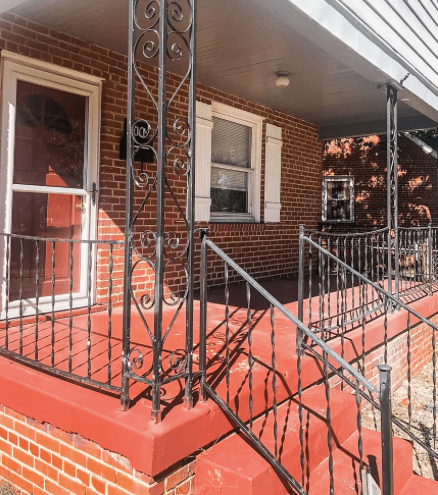
This house recently turned over. The house was flipped when we purchased it 7 years ago, and we knew that everything that was done before we owned it would just be a bandaid. We had a couple of long term tenants in the house, and we even had quick turnovers because people needed a place to live, so we didn’t have time to do major renovations. It was time. We put a lot of effort into fixing up the place (e.g., all new paint, new flooring and fixing of subflooring). The front porch and front door were red, and it just made the house look dingy. I wanted to make it look better. See: not a priority, but something worth looking into eventually.
I arrived on the evening of the 4th to pressure wash the porch so it would dry by morning when I would paint it. I did not account for how bad the condition of the paint was. It appears someone just painted over peeling paint years ago. There were several layers of gray, purple, and red colored paint. The latest paint job had several places where that was the only layer of paint on the concrete. Very odd, but that meant that I had to scrape as much flaking paint away as I could. I spent over 10 hours on this. Not exactly what I had in mind. I scraped and scraped and scraped. I then put two coats on. I’m nervous how long it will hold up though. I did this during an extreme heat advisory so it likely didn’t cure correctly by drying in mere minutes.
I also did 3 coats of black over the red door. I don’t think it’s going to hold up against her animals, but at least it looks better from the street.
This house still needs the back deck pressure washed and painted. However, this is something I’ll do either with tenant turnover or if we sell it. It’s really worn down and places are missing paint because we removed the covered portion of it. The porch railing had also been painted at some point and is peeling, but I hadn’t budgeted time for that. I did a few touch up areas with black paint to cover where previous owners had painted it red.
PROPERTY 3
The tenant here reached out to me a couple of months ago to tell me that a salesman broke their doorbell. Fascinating. They claimed “well, it’s old.” My thought was “well, it’s meant to be outside, and the house next door was built the same time without any doorbell breakage now.” But instead of sending someone out to fix that, I put it on our to do list. It took Mr. ODA about 2 minutes worth of work, and the new doorbell cost $10.
While there, we cleaned out the gutters. That’s been a known issue throughout the life of this house because there are a lot of trees around the perimeter. We also cleaned the mildew growing on the house.
PROPERTY 2
This house is a mirror image of Property 3, but the trees in the backyard are much closer to the house. The back of this house had significant mold growth on the siding. We got all the siding cleaned up there too. Mr. ODA got on the roof to clean out the gutters. While up there, he also cut some trees off the roof.
The first picture is a ‘during’ picture because I didn’t get a ‘before.’ The part at the top that is dark is actually better than what was there, and it was over the entire back of the house. We soft washed with a mold and mildew cleaner and got it looking almost brand new.
PROPERTY 9
During the last turnover period of this house, we had the front porch jacked up (it was sinking), had the front stairs redone (they were sinking too), and had the back decking replaced. I had intended to stain the new wood for this house, but it being well over 90 degrees precluded that action. Instead, Mr. ODA got the siding on this house all cleaned up, and he cut/pulled several large weeds that were growing.
DRIVE BYS
We did drive by the other Richmond properties that we have. I didn’t have the time (or energy) to schedule walk throughs of everything. Once you do a walkthrough, you inevitably end up with a list of things to do to the house. I already had a lengthy list of things to do, so I didn’t want to manage that right now. Just by driving by, I did add to my to do list that one house needs its gutter replaced (how does a gutter, with no trees around, twist away from the house), and that their back deck really needs to be replaced (just the deck boards and railing; the substructure is fine).
I’ll need to make it back there to walk through the properties. If nothing else, it gets the tenants to clean things up once a year. One of our property managers offered a filter check quarterly, which was really used as a way to get into a house and make sure things were being kept clean and orderly. While a filter should be changed that often, I think that’s too much time being in someone’s place they call home. However, once per year is worth it to keep things moving in the right direction and to make sure there aren’t any maintenance issues that hadn’t been reported.
We took a trip to Richmond, VA to work on rental properties. It was fairly last minute. I had a schedule of work at each house that I planned. However, I didn’t plan on the heat index being 113 and 112 for the two main days we were there. I was able to get everything on my list done except for staining the new deck at one of the houses. I didn’t want to risk it not applying or curing correctly because it was too hot and in direct sun. Plus, the tenant didn’t even clear it off so I could work on it.
I had multiple houses pay rent late this month. I was surprised. One let us know on the 5th that they had an emergency, so they wouldn’t be able to pay until the 17th. I had someone pay half their rent early in June, but then haven’t received an answer as to why the rest of her balance ($345) hasn’t been paid yet. Another tenant misunderstood her maternity leave pay, so she asked for more time to pay rent. She paid $800 on the 7th. I told her not to worry about it, and just pay when she can, without the late fee; she only has $150 remaining.
I’m currently working through two roof replacements. One of them will be covered by insurance, but then I’ll be paying to have vents added, the chimney torn off and capped, and the soffits repaired on top of what insurance can do. Then the other one we’re paying out of pocket for. It’s original to the house, which was built 24 years ago. There has been storm damage to it over the last year, and it’s just generally time to address the age even though it hasn’t caused any problems yet.
PERSONAL EXPENSES
Our medical insurance company had some glitches in their claim processing through the first half of the year. Now they’ve caught up, meaning I’m paying large sums of medical bills. Mr. ODA took on booking lodging for his guys trip later this month, which meant that the second half of AirBnB payments were applied to the credit card.
Mr. ODA increased each kid’s UTMA from $75 to $100 per month. That means we’re investing $3,300 each month into accounts, on top of maxing Mr. ODA’s TSP contributions and both of our Roth IRA contributions for the year.
Our contractor has ghosted us on our own deck build. We bought some new furniture for the main deck area. Once it’s not 100 degrees outside, we’ll work on doing the waterproofing of the deck ourselves so that we can start living on the patio under the deck and get that hot tub ordered this fall.
NET WORTH
I updated the valuation of the houses this month. I typically only do that 3 or 4 times per year. I try to account for the big increases we see at the beginning of the spring, and then adjust slightly around this time of year once the comparable houses have closed and sold. This update added $140k worth of equity into the equation. All of our liabilities decreased since last month, and all our assets increased since last month. That has equated to an increase of over $200k in our net worth.
Social security was signed into law by President Roosevelt in 1935. One of the intents of the program was to provide income for retired workers aged 65 or older. The purpose of the Social Security Act was to help destitute aging individuals who were not receiving regular income. The program calculations have changed a bit over the years, but the purpose has remained the same: provide a minimum income to aging individuals, not to provide a source meant as your sole income stream.
Today, most of the United States workers pay into social security through a 6.2% payroll withholding; such withholding ceases once you make $160,200 or more (in 2024). An individual’s year of eligibility is based on their birth year, rather than being exactly 65 years old like it was originally, and is called the normal retirement age. Additionally, there are penalties for filing early and bonuses for filing later than your normal retirement age. The year you file for social security has implications on your income, which I’ll cover later.
CALCULATING SOCIAL SECURITY RETIREMENT INCOME
Social security benefits are computed based on an individual’s highest 35 years of indexed income. The income is indexed, or adjusted, to account for inflation over the years. If you made $10,000 in 1985, that equates to making about $25,000 in 2022. I mention that it’s in year 2022 and not today because indexing applies to all income older than the last two years, while the most recent years are taken at face value. Indexing ensures that your future benefits account for inflation to make them fair and equitable in the year you need that income, and makes all of the annual salaries of your working years comparable.
Once the indexed total is known for all working years (up to the highest 35 years worth), the totals are added together and divided by the total number of months worth of earnings. The average monthly earnings amount is then used to calculate the primary insurance amounts (PIA). The PIA is the amount paid out monthly if an individual waits until their normal retirement age, which is a table published by the Social Security Administration (SSA) and is based on birth year.
According to the SSA website, an individual who first becomes eligible for old-age insurance benefits or disability insurance benefits in 2024, or who dies in 2024 before becoming eligible for benefits, his/her PIA will be the sum of: (a) 90 percent of the first $1,174 of his/her average indexed monthly earnings, (b) 32 percent of his/her average indexed monthly earnings over $1,174 and through $7,078, and (c) 15 percent of his/her average indexed monthly earnings over $7,078. The percentages are based in law, but the dollar amounts, which are called ‘bend points,’ are updated annually based on the national average wage index. These bend points ensure the program weights benefits to lower income earners, and phases out benefits as an individual’s income increases.
Here’s an example that shows how the bend points are used to calculate the PIA, which is the monthly benefit amount that would be paid out to someone who retires at their normal retirement age and is eligible to receive 100% of their PIA. The monthly indexed earnings over the life of their 35 year career was $10,000. The bend points are applied to each bracket of income up to their max of $10,000, and then the bend points are added together. The total is rounded to the nearest dime though.
If you draw before the normal retirement age, but no earlier than 62, the PIA is reduced by as much as 30%. If you draw after your normal retirement age, the PIA is increased by 8% per year, until you reach 70. In the above example, the earner who made $10,000 a month average over the course of their career will receive ~$3,383 a month if they file for social security benefits at their normal retirement age (in 2024 numbers). If they chose to draw at 62, they’d receive 30% less of their PIA, equating to approximately $2,368 per month. However, if they chose to draw later than their normal retirement age, they would receive more than their PIA (with the amount depending on their normal retirement year).
As you can see, social security is not intended to replace your pre-retirement income. It is meant as a safety net to ensure some level of financial security. If you’d like to live a more lavish retirement, you need to plan ahead with additional sources of income/savings to draw from (e.g., retirement plans like a 401k, Individual Retirement Account (IRA) contributions).
WHEN TO DRAW
We recently heard a conversation where someone told another person that they should definitely claim as soon as possible. However, if you’re not in a situation where you absolutely need that income per month, it’s best to wait. Once you draw, you lock in that dollar amount, save for cost of living adjustments as authorized. Cost of living adjustments for inflation, or COLAs, are based on the Consumer Price Index and announced annually in October.
The year you draw is based on your outlook on your life expectancy, your income need based on lifestyle, and your other income sources. This isn’t a decision you need to make at 35, but you should be watching and planning this over the course of your life. If you’re in good health and active at 62, and have saved enough to live off other funds or are still working, it likely wouldn’t be in your best interest to claim social security benefits.
If you’re born in 1960 or later, your normal retirement age is 67. At 67, you get 100% of your PIA. If you file at 62, which is the earliest you can file, you get 70% of your PIA. If you wait to file until after your normal retirement age, then you get 8% each year until 70. On the graph above, I used a PIA of $3,500 to determine the values for the example. You can see that if you were to file at 62, your cumulative income line over the rest of your life time is a flatter line. You’re receiving a smaller benefit, so it’s adding up slowly. Where the lines intersect is how you’ll determine your break-even draw year. For instance, if you think you’ll live until at least 77, then it’s not worth doing an early draw at 62 because a draw at normal retirement age will provide you more income over the course of your life. If you think you’ll live past 81, then deferring your social security filing until 70 yields the most lucrative scenario.
RETIREMENT AND WORKING
There are stipulations associated with claiming benefits and still working, which is another factor to consider when drawing social security. If you’re 62 and still working, then it may not be in your best interest to collect social security. While you can still work while claiming social security, the SSA may reduce your benefits. The SSA reviews income earned against benefits paid out, and may adjust if there was employment income in the previous year (i.e., income based on pensions or other retirement benefits does not constitute current employment income).
If you are under normal retirement age for the entire year, the SSA deducts $1 from your benefit payments for every $2 you earn above the annual limit, which is $22,320 in 2024. In the year you reach normal retirement age, the SSA deducts $1 in benefits for every $3 you earn above a different limit, which is $59,520 in 2024. It’s likely you don’t “need” that money because you’re still working, your benefit isn’t increasing like it would if you deferred, and you’re actually receiving less money in benefits than based on the normal formula.
SUMMARY
There is no hard and fast rule on when to draw these benefits. The point is to be educated on your options. We don’t recommend you rely on someone else’s opinion on the matter or how it worked for them, as each person’s variables are different. Generally, if you’re in good health and still producing income, drawing on the social security benefits earlier than normal retirement age isn’t going to be your best financial move.
As is the case with most personal finance topics, having diversified income sources in retirement, regardless of what age that is, will set you up to make decisions absent emotion and desperation, and for the betterment of your entire financial picture. Utilize your 401k and all available match, your IRA, your taxable savings, and perhaps your pension, so that Social Security is just one more tool in your financial picture, rather than the only one.







 One Dollar Allowance