Social Security Benefits

Social security was signed into law by President Roosevelt in 1935. One of the intents of the program was to provide income for retired workers aged 65 or older. The purpose of the Social Security Act was to help destitute aging individuals who were not receiving regular income. The program calculations have changed a bit over the years, but the purpose has remained the same: provide a minimum income to aging individuals, not to provide a source meant as your sole income stream.

Today, most of the United States workers pay into social security through a 6.2% payroll withholding; such withholding ceases once you make $160,200 or more (in 2024). An individual’s year of eligibility is based on their birth year, rather than being exactly 65 years old like it was originally, and is called the normal retirement age. Additionally, there are penalties for filing early and bonuses for filing later than your normal retirement age. The year you file for social security has implications on your income, which I’ll cover later.

CALCULATING SOCIAL SECURITY RETIREMENT INCOME

Social security benefits are computed based on an individual’s highest 35 years of indexed income. The income is indexed, or adjusted, to account for inflation over the years. If you made $10,000 in 1985, that equates to making about $25,000 in 2022. I mention that it’s in year 2022 and not today because indexing applies to all income older than the last two years, while the most recent years are taken at face value. Indexing ensures that your future benefits account for inflation to make them fair and equitable in the year you need that income, and makes all of the annual salaries of your working years comparable.

Once the indexed total is known for all working years (up to the highest 35 years worth), the totals are added together and divided by the total number of months worth of earnings. The average monthly earnings amount is then used to calculate the primary insurance amounts (PIA). The PIA is the amount paid out monthly if an individual waits until their normal retirement age, which is a table published by the Social Security Administration (SSA) and is based on birth year.

According to the SSA website, an individual who first becomes eligible for old-age insurance benefits or disability insurance benefits in 2024, or who dies in 2024 before becoming eligible for benefits, his/her PIA will be the sum of: (a) 90 percent of the first $1,174 of his/her average indexed monthly earnings, (b) 32 percent of his/her average indexed monthly earnings over $1,174 and through $7,078, and (c) 15 percent of his/her average indexed monthly earnings over $7,078. The percentages are based in law, but the dollar amounts, which are called ‘bend points,’ are updated annually based on the national average wage index. These bend points ensure the program weights benefits to lower income earners, and phases out benefits as an individual’s income increases.

Here’s an example that shows how the bend points are used to calculate the PIA, which is the monthly benefit amount that would be paid out to someone who retires at their normal retirement age and is eligible to receive 100% of their PIA. The monthly indexed earnings over the life of their 35 year career was $10,000. The bend points are applied to each bracket of income up to their max of $10,000, and then the bend points are added together. The total is rounded to the nearest dime though.

If you draw before the normal retirement age, but no earlier than 62, the PIA is reduced by as much as 30%. If you draw after your normal retirement age, the PIA is increased by 8% per year, until you reach 70. In the above example, the earner who made $10,000 a month average over the course of their career will receive ~$3,383 a month if they file for social security benefits at their normal retirement age (in 2024 numbers). If they chose to draw at 62, they’d receive 30% less of their PIA, equating to approximately $2,368 per month. However, if they chose to draw later than their normal retirement age, they would receive more than their PIA (with the amount depending on their normal retirement year).

As you can see, social security is not intended to replace your pre-retirement income. It is meant as a safety net to ensure some level of financial security. If you’d like to live a more lavish retirement, you need to plan ahead with additional sources of income/savings to draw from (e.g., retirement plans like a 401k, Individual Retirement Account (IRA) contributions).

WHEN TO DRAW

We recently heard a conversation where someone told another person that they should definitely claim as soon as possible. However, if you’re not in a situation where you absolutely need that income per month, it’s best to wait. Once you draw, you lock in that dollar amount, save for cost of living adjustments as authorized. Cost of living adjustments for inflation, or COLAs, are based on the Consumer Price Index and announced annually in October.

The year you draw is based on your outlook on your life expectancy, your income need based on lifestyle, and your other income sources. This isn’t a decision you need to make at 35, but you should be watching and planning this over the course of your life. If you’re in good health and active at 62, and have saved enough to live off other funds or are still working, it likely wouldn’t be in your best interest to claim social security benefits.

If you’re born in 1960 or later, your normal retirement age is 67. At 67, you get 100% of your PIA. If you file at 62, which is the earliest you can file, you get 70% of your PIA. If you wait to file until after your normal retirement age, then you get 8% each year until 70. On the graph above, I used a PIA of $3,500 to determine the values for the example. You can see that if you were to file at 62, your cumulative income line over the rest of your life time is a flatter line. You’re receiving a smaller benefit, so it’s adding up slowly. Where the lines intersect is how you’ll determine your break-even draw year. For instance, if you think you’ll live until at least 77, then it’s not worth doing an early draw at 62 because a draw at normal retirement age will provide you more income over the course of your life. If you think you’ll live past 81, then deferring your social security filing until 70 yields the most lucrative scenario.

RETIREMENT AND WORKING

There are stipulations associated with claiming benefits and still working, which is another factor to consider when drawing social security. If you’re 62 and still working, then it may not be in your best interest to collect social security. While you can still work while claiming social security, the SSA may reduce your benefits. The SSA reviews income earned against benefits paid out, and may adjust if there was employment income in the previous year (i.e., income based on pensions or other retirement benefits does not constitute current employment income).

If you are under normal retirement age for the entire year, the SSA deducts $1 from your benefit payments for every $2 you earn above the annual limit, which is $22,320 in 2024. In the year you reach normal retirement age, the SSA deducts $1 in benefits for every $3 you earn above a different limit, which is $59,520 in 2024. It’s likely you don’t “need” that money because you’re still working, your benefit isn’t increasing like it would if you deferred, and you’re actually receiving less money in benefits than based on the normal formula.

SUMMARY

There is no hard and fast rule on when to draw these benefits. The point is to be educated on your options. We don’t recommend you rely on someone else’s opinion on the matter or how it worked for them, as each person’s variables are different. Generally, if you’re in good health and still producing income, drawing on the social security benefits earlier than normal retirement age isn’t going to be your best financial move.

As is the case with most personal finance topics, having diversified income sources in retirement, regardless of what age that is, will set you up to make decisions absent emotion and desperation, and for the betterment of your entire financial picture. Utilize your 401k and all available match, your IRA, your taxable savings, and perhaps your pension, so that Social Security is just one more tool in your financial picture, rather than the only one.

Mentality, Consistency, Follow Through

When I was little, we had friends come to our house a lot. When a certain crew came, they raided the candy drawer like they hadn’t eaten in a week. It was quite a binge. It’s because there was no candy in their house. They were fed 3 small meals each day, and that was it. They had the mentality that they needed to get everything they could in a small period of time. Because they hadn’t been taught self-regulation by having regular access to things, they didn’t understand moderation.

To me, I had access to the candy drawer in my house whenever I wanted. Therefore, it wasn’t exciting to me. It was there if I wanted something here and there, but it wasn’t something I felt the need to covet. I do the same with my kids. They have full access to the pantry. They know the things that are “good” for you, and they know they can take that without asking. They do ask if they can have any of the treats in there, and unless it’s close to a meal time, I try to give more “yes” responses than denials (and my denials always come with a reason).

I use this story regularly in my life it seems. It seems focused on a healthy relationship with food, but it’s really an overall concept of understanding the mentality it takes to make informed and beneficial decisions all day, everyday.

DELAYED GRATIFICATION

We did a stent with a multilevel marketing company. They preached “delayed gratification.” It was meant to say that you shouldn’t spend now because you’re going to produce a significant amount of income in the future, and you’ll be able to spend greatly at that point. Unfortunately, Mr. ODA and I are too cynical to watch that unfold. We took note of every “extra” our “upline” spent that wasn’t hitting that mark.

They who would go on a big trip with the statement, “well it’s ok because it’s for my birthday” or “it’s ok because it’s the last big trip that I’m going to take with my mom.” There was always another trip. Or the big, fancy, rent out a space, decorate to the nines, buy a new outfit, birthday party that happened almost annually. There were excuses to justify these actions that were clearly against their “delayed gratification” preaching, but they thought it was ok because they were “debt free.” They didn’t buy a house, continuing to throw money to rent year after year so that they wouldn’t have a mortgage.

There was a guise of having a “big picture” mentality, but the execution of the financials didn’t add up to us. If you were really in delayed gratification mode, the $3,000 you spent on a trip could have been saved towards a 20% down payment on a house at 2.5% interest rate. That’s what Mr. ODA and I did when we had to pay for a wedding and buy a house in the same year. We set a goal to spend no more than $5 per person, per day on food. We didn’t eat at restaurants. We didn’t go on huge trips (although we did do some weekend trips to visit family). Because of those years of ‘pain’ we went through, we bought a house with no mortgage insurance, and that house turned into 4 houses when we sold it.

I digressed. The point here was that creating a mentality of “delayed gratification” is setting yourself up for failure. If you created a habit of proper spending and a mentality of being able to discern whether the cost of something is worth it to you and your goals in real time, there wouldn’t be these “slip ups” of wanting to take that big trip or wanting to fill a void by throwing a lavish party.

In February, I started a diet. I was working out for a year at that point (after having our 3rd baby), and the number on the scale was exactly the same. I felt better, but I wanted that number to go down. I started reading up on diets, and this concept I found clicked with me. If you commit to a diet that is really restrictive, you’re going to fail. If you can’t have any carbs, then you end up having a binge day to make up for that desire. The concept of depriving yourself of something is more thought-consuming than if you had taught yourself moderation.

This diet concept was to alter your eating each day so that it keeps your metabolism on its toes. One day, eat a lot of protein. The next day, eat your carbs. Go back and forth. I was consistent on this for 3 months (see, best laid plans fail – between end of school things and travel, I haven’t put the effort in), and I lost 17 pounds with little effort. I haven’t been paying attention to this eating pattern, and I’ve been stagnant again. The whole point was that if you deprive yourself of something you want, then it’s going to consume you and make you unhappy. But if you eat in a thoughtful manner, then you’re happier and have an easier time reaching a goal and sticking with it.

RIPPLES

The decisions you make today affect tomorrow. The habit formed by thinking you had a hard day and deserve a “treat,” or that “it’s vacation so we should each have a $10 ice cream at the amusement park,” have ripple effects. I have another post about how people make fun of those who say don’t spend $5 on coffee everyday if you want a better life. Most people see it as a literal $5 per day (granted, it’s more like $7 or $8 at this point), do the math, and then say sarcastically “wow I’m a millionaire.” No, it’s the mentality. It’s the concept of teaching yourself that you don’t need to purchase an expensive coffee everyday, or you don’t need to buy lunch everyday at work, or you don’t need to overspend on treats once per week.

Someone once made fun of us because we like to go exploring new towns and find hikes, while his family goes to Disney at least once per year. I’d venture to say that our trips, where we spend time with our family and learn about new places and things, are more stimulating. I don’t hate Disney (Mr. ODA does though 😉 ), but I don’t see it as something to go to every year with no other experiences. But our trips that end up costing about $1,000 allow us to go do more things. We can do more activities when home, we can go on more trips, we can put money into savings accounts for our kids.

This summer, we have plans to be in 7 states outside of our home state. My kids are extremely happy with just the concept of staying in a hotel or “vacation house.” Add in swimming in a pool somewhere, and they’re ecstatic. I don’t have a desire to teach them that vacation is when you get to eat everything you see and buy whatever trinket you want. If you intentionally spend throughout the year, you end up with things that are more valuable to you than if you buy several trinkets just because you’re on vacation (really – when was the last time your kid played with that light up spinny stick from Disney on Ice). I want to teach them the value of their time, their money, and their family. I want to try my hardest to set them up for success because they understand the value of things in the big picture, and not just the instant gratification that lasts for a couple of days because they go that little toy we walked by.

Tax Returns

Typically, I write a post around this time of year on how we handled submitting our taxes. This year, I’m going to focus on the return itself, and the concept that a large return is somehow “gaming” the system.

OUR TAX FILING

First, I’ll remind you of our process. I spend all year getting ready to do our taxes. This isn’t a last minute activity where I’m trying to find all the income and expenses and recreate data. I know more than one small business owner that constantly files for an extension because they’re not ready. Make it a routine all year to be organized. This way, once the year is over, you’re just verifying you have everything recorded, instead of compiling all paperwork and documentation for the first time. It’s less stress and you’re doing less work (because it’s still work to file the extension).

Most people have just their W2 income, maybe a little other income, and a standard deduction. However, if you have any more than that, you should make it a whole-year process. I have a spreadsheet that I keep for each rental property. I copy the template over each year for a new workbook, keeping the basics (rent income, routine utility costs, taxes, insurance, etc.) and deleting the extra maintenance costs that went into the houses (plumbing calls, HVAC repairs, etc.). As expenses occur through the year, I input them into the appropriate tab in the spreadsheet. At the end of the year, I verify I have all my receipts/invoices recorded.

Then Mr. ODA sits at his computer while I read off each house’s totals from my spreadsheets. This year, I think we hit a record in that it only took about 90 minutes to do our taxes! That’s probably the quickest we’ve done it since we’ve had all these houses. Actually, let me back track for one second there. I’ve spent all year preparing for tax season by inputting information as it happens. Then I spend about 2-3 hours reviewing all the data to ensure I haven’t erroneously recorded data, haven’t missed data, or haven’t omitted recording an expense or income. But the actual time that it took to go from spreadsheet into software and press file was 90 minutes.

“THE GOVERNMENT IS SAVING FOR ME”

A financial friend asked for “financial wins” recently on Instagram. Someone responded that they received a $5,000 tax return. He then said that he had several people comment that this isn’t a win, but he came to this person’s defense that some people need the government to do their savings for them. He said that, for some people, if they had an $100 each week of the year, they would have spent it frivolously.

I actually think that’s an excellent thought process. I see where he’s coming from there. Instead of someone thinking “let me set aside $100 this week to put towards debt,” it just becomes part of the pot of money that goes out with each pay check. That’s also easy to see as not worth putting towards a separate financial goal because it feels like not enough.

My frustration with the thought process of wanting a large return is that people think they’ve gamed the system and done something special to obtain (or earn) that amount, rather than realizing it was “their money” all along. You can project your tax burden for the year; it’s not a secret formula. Paycheck withholdings throughout the year simply allow you to work with your employer to gradually meet that tax burden as you earn your salary.

We project our tax burden each year. Sometimes Mr. ODA doesn’t listen to me on what our net for the rentals is going to be, and then we owe a lot come April, but that’s our own fault for not projecting with the right variables. For most people, the projection is a much simpler formula.

AIM FOR A $0 TAX RETURN

If you are someone who is going to put that $5,000 towards something productive, rather than frivolously spending it just as you would have all year, then that’s fine. However, I encourage a look at your opportunity costs.

Did you receive your tax return and go buy a 75″ tv? Was that a necessity? Did the money that went towards that tv have a better financial purpose?

Did you spend the whole year living paycheck to paycheck and worrying about the next bill to come in? Did you pay bills late because you needed funds from a future paycheck to cover the balance?

Did you spend the year carrying credit card debt, paying 26% interest on the balance, and then wait for your tax return to pay towards your balance? If you did, then maybe realize that the $5,000 you got in a lump sum could have saved you in interest costs had you just put $400 extra per month towards your credit card balance.

If you pay $200 per month (assuming a 26% interest rate):

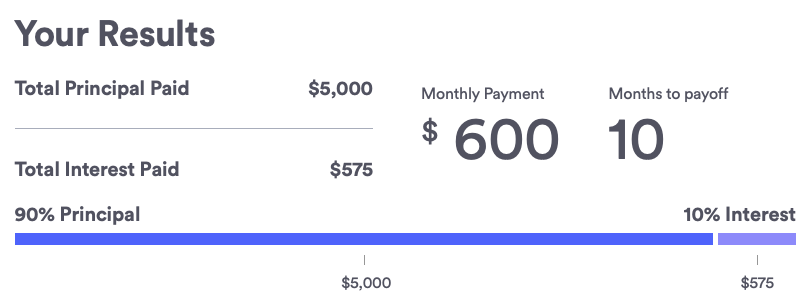
If you pay $600 per month (that extra $100 per week that went into your taxes paid instead of into your pocket all year, causing a $5000 return):

You’ve paid off the balance in less than a year, and saved $1704 worth of interest payments. If you had paid $200 per month for a year and then used your tax return to pay off the balance, you’d have paid about $1,100 of interest, and then would be putting over $3800 of your tax return to pay it off. You also have the benefit of not having a bill hanging over your head at some point within that year, instead of worrying about meeting the minimum payments and continuing to accrue interest.

SUMMARY

So that’s my angst with the “financial win” of the tax return. Something as large as $5000 is an entirely different ball game than $500. Looking to get some money back and using the taxes as a ‘forced’ savings is an option. Perhaps you use that to take the only vacation in your year. But that should still be a reasonable vacation. Spend $1000 or $1500. You don’t need a $5000 vacation when struggling to pay bills or having debt that’s accruing interest.

So while I agree that the forced savings could be an excuse for a large refund, once someone receives a large refund, there should be an evaluation of their financial standing and an education on how that could be turned into a true, productive financial goal.

LLC Filing with FinCEN

I was chatting with a financially savvy friend of mine, and she asked about filing our Limited Liability Corporation (LLC). I had no idea what she was talking about. Mr. ODA had no idea what she was talking about. I sent a text to 3 of my investor Realtor buddies (in two different states), and none of them heard about it. So I started digging.

Sure enough, if you have an LLC, you’re required to file with FinCen this year.

So here’s my attempt to let a few more people know of this legal requirement that carries fines, yet no one decided an email or mailing to LLC owners (which are filed with the State governments and are required to have physical mailing addresses) would be worth their time and cost of a stamp.

THE CORPORATE TRANSPARENCY ACT

On October 23, 2019, Congress passed this Act. The purpose being “to ensure that persons who form corporations or limited liability companies in the United States disclose the beneficial owners of those corporations or limited liability companies.” Essentially, they’re trying to ‘crack down’ on companies using LLCs as a shell game to move or hide money, or pay into criminal behavior.

It states, “Criminals have exploited State formation procedures to conceal their identities when forming corporations or limited liability companies in the United States.” In 2006, an international body determined that the United States fails to comply with beneficial owner information reporting, and gave a July 2008 deadline to fix it. The United States Federal level had urged State laws to comply, but didn’t follow up, and was cited again for failure in 2016. Since the States didn’t make progress, Congress issued this ruling.

The Act states that nearly 2 million LLCs are formed each year, with few States requiring beneficial owner information. A beneficial owner is generally someone who exercises control over the company, owns 25% or more, or receives substantial economic benefits; there are exceptions listed in the law.

While this was passed in late 2019, they then needed to establish a way to securely collect and retain the information reported. FinCEN established a Beneficial Ownership Information (BOI) website, in which you’re required to enter the pertinent information. It opened January 1, 2024.

Because this is the age where there are scams around every corner, note that this is a ‘.gov’ website, and their logo is below (i.e., don’t enter your personal information into a third party website).

REPORTING COMPANY

A reporting company is those that qualify based on the law’s detail. There are either domestic (registered here, doing business here) or foreign (registered in another country, doing business in the United States) reporting companies.

There are 23 ways a company may be exempt from reporting. The general gist of the exemptions are based on whether you’re already reporting to the government in another form (e.g., banks and accounting firms). “These entities include publicly traded companies meeting specified requirements, many nonprofits, and certain large operating companies.” Don’t assume you’re exempt; be sure to check the list on the official website.

BOI REPORTING

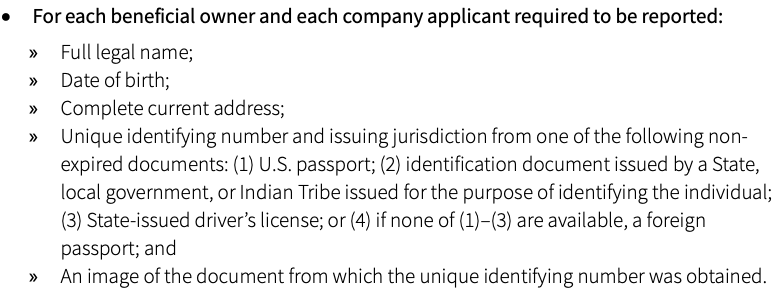
The reporting is straightforward. You will need a legal identification card image uploaded for each person entered in the system.

From the main page, I selected the icon that said prepare a BOI Report. I chose to prepare and submit, so it’s a form within the website. There’s another option that appears to allow you to fill it out in PDF form and submit the form. I preferred the prompts along the way.

Below is a snapshot of the information that’s needed in the initial filing.

When we set up our LLC, our drivers licenses were copied, so this request isn’t for anything more than we’ve already provided to our State. For us, establishing an LLC was solely a way for Mr. ODA and I to create an ownership stake in two properties that we purchased with a partner. Though there are 3 of us listed in the LLC, Mr. ODA and I are 50% partners together, and this other guy is a 50% partner. I pay him out at 50% each month after I collect rent.

It’s very simple; I’m sure there are LLCs with employees and more paperwork. However, I didn’t need a social security number for the beneficial owner(s) or any dollar amounts paid. We did establish a EIN for the LLC several years ago, so I submitted that EIN for the reporting company. Otherwise, I would have submitted my social security number as the company’s identifier.

There are more details associated with the reporting; for instance, you can update your report through their website. However, I’ll leave it to you to dig deeper on all those instances, as I’m just trying to build awareness.

DEADLINES

As with all new systems, there’s a phased approach to the requirements.

If you were already registered before this year, then you have until January 1, 2025 to file the initial BOI report. If you create an LLC during 2024, then you have 90 calendar days from the registration effective date to report. For all LLCs created on or after January 1, 2025, you have only 30 calendar days to report.

“Cheap” Flights

I recently went on a trip. We booked one of those “cheap” airlines, where you pay a la carte. Our round trip flight was about $50. In the process, I was amazed at the number of people who were frustrated by the rules, as if you don’t have ample opportunity to learn the rules in the process. So I wanted to go through a booking, to show you that there are plenty of warnings, and that it may or may not be cheapest to go this route.


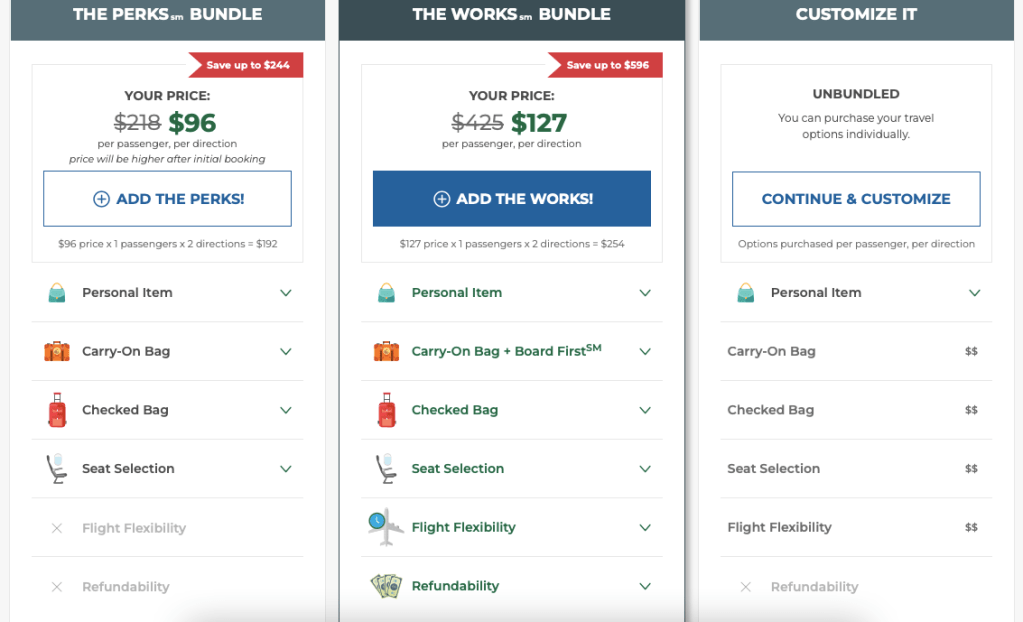
I’m going to pretend to book a flight. From Cincinnati to Orlando, round trip, I found a flight for $87.96. The next page asks for my personal information. They then offer me a few options.

The price highlighted is for one way, and in smaller font, it indicates the round trip price. This could be a bit more straight forward, since my selection is for a round trip flight, so one way worth of baggage isn’t the expectation. I decide to ‘continue and customize.’ The next page is seat selection.

Every single seat has a price associated with it. Again, this could be more straight forward. Nowhere on the page does it clearly indicate that you don’t have to pick a seat. I click “continue.” There is a link below continue that says “what if I don’t pick,” but I didn’t check that. The next page causes me to pause and lets me know I should rethink my options.

I select no thanks. The next page provides my carry on and checked bag costs. I can select that I want to carry on and board first, just carry on, or have no carry on. I select no carry on and no checked bag. As I scroll down, it lets me know that I can have a personal item for free, and it lets me know the size restriction for this personal item. It tells me multiple times on this page that bags will be more expensive at the airport.

I click continue, without selecting any baggage, and it halts me again.

I then get asked a few questions about the check in process and any other add-ons. I decline everything, and I’m sent to the payment page. At the end of the page, I have to agree to several things, including baggage requirements, before booking.


The entire point here is that this airline has warned the consumer several times, through multiple pages and “clicks” that there are fees outside of the ticket price. So even if you didn’t know that the reason you found such cheap flights was because their pricing is a la carte, they’ve told you multiple times through the booking process. Similarly, you know going in, on any airline, that a bag over 40 or 50 lbs is going to be considered overweight.

It was frustrating to watch so many people get mad that they checked your bag size as you boarded the plane. You signed up for that. You could have checked the size. I read the wrong section when I packed my bag, so I had verified it as a carry-on size, which I didn’t pay for. I was able to move things around in my bag for it to be able to fit. If it didn’t fit, I knew that mistake was on me, and I’d pay the fee. The fee in the airport was $99. Yes, it seems astronomical to pay that fee for something that you can walk on with if you’re flying Delta or American, but it’s the rules for this airline, and I know that going in. I could have adjusted things for the flight home, so my total for this roundtrip would have been $150, still cheaper than roundtrips on other airlines.

For the pretend flight I went through above, if I had selected The Perks bundle, my total would have been $279. I’d get a carry on, checked bag, and the ability to select my seat at that price. Had I selected just a carryon each direction, my total would have been about $225. For the same dates, I could fly more inconvenient schedules (e.g., midnight arrival) for $209 through American.

When comparing the prices, you need to see what the best options are for what you need. If you can’t get by with just a personal item, then you need to factor that into the flight cost when comparing to other airlines. If you can’t handle the psyche of having your bag checked for size when you board the plane, then stick with the traditional airlines.

Be an informed traveler. Know the fees associated with your airline. Know the restrictions for each item. Plan in advance instead of having to move things around at the airport where you’re going to feel the stress.

Funds Management in Excel

At the beginning of every year, I set up two spreadsheets in Excel. One is for our personal money management, and one is for each property’s expenses in the year (that will eventually be put into Schedule E in our taxes). I regularly mention using Excel to track your income and bills, so here’s a quick snapshot of what I do.

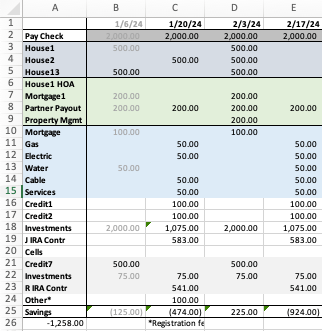
These are all dummy numbers, but otherwise, this is my spreadsheet set up (with several lines eliminated to reduce your visual clutter). The top purple section is rental income per house, the green section is rental property expenses, the blue section is our home’s bills, the gray section is what affect’s Mr. ODA’s account instead of our main checking account (Mr. ODA has his original account from before our marriage (I have access to view it) because of benefits associated with the linked credit card, and it was never worth closing it or adding my name to it). The white is what’s left over. The blue section is not necessary to be a different color and is left over from another way I tracked bills, but I’ve left it to differentiate home bills versus credits and investments.

The final line of “Other*” captures items that only occur once or twice a year, but have a significant impact on the checking account or is a deadline I want to be aware of. I keep the preschool registration fees on there so that it’s on my radar that registration comes due at about this time. In future months, I have taxes that are due for houses we have not escrowed, which is about $1500 worth in June and about $4000 worth in October.

The columns are organized by Mr. ODA’s pay check date. His pay check appears in the account every other Saturday, so that’s the date at the top. Then I’ve put all the income or expenses that align between that pay check’s date and the next pay check’s date in that column. This helps me project whether I’ll need a transfer from savings to cover the checking account balance. This particular section of the spreadsheet doesn’t show account balances, but you get the gist of the organization.

Each year, this is tweaked a little. I eliminate lines that are no longer necessary (for instance, our HOA is now paid annually, so I don’t need a line taking up space for a once-per-year bill). I add lines that become necessary (cable used to be paid by credit card, but now there’s a fee for that; since it affects our checking account monthly, it gets a line). It would probably be better to separate out my “investments” line into the specific transactions that happen each month, but I didn’t want more lines on my spreadsheet.

When rent is received or a bill is paid, I change the font color to gray. This indicates that it’s done and helps eliminate visual clutter for me. I can focus on the black font, which indicates to me it’s still due.

As I get closer to each pay check column, I update the projections. For example, a credit card may have had more than average expenses on it. This could happen because one credit card has a quarterly bonus for gas purchases. So while it’s typically $100 for a statement, it may be more like $200 because of the gas purchases on it. I update the projected payment because I need to monitor the checking account balance too. I also keep last year’s utility bill amounts in each column. I use this to track whether this year’s payment is comparable to last year’s at this time, so I know whether to look further into a bill because it’s significantly different than last year’s (for example, if last year’s June gas bill was $30, and this year’s June gas bill is $60, I want to check to see why it doubled, whether that means a leak or error in billing).

Every person’s tracking is going to look different. You may just have rent and utility bills to pay, and you can manage it via email notifications. You may want a more active approach to the tracking and use a spreadsheet in some fashion. This is just a start for you to have a visual in how a spreadsheet may be helpful in your money management, and may even help eliminate late fees or billing errors because you’re more actively managing your money.

New Year Financial Organization

Two weeks ago, I shared how I organize my home and manage my time. I have my own home’s finances, thirteen rental properties, three kids with two in school, investments, and whatever other ad hoc bills show up to manage. I don’t have the ability to think in a quiet and distraction-free environment after 7:30 am. That post was all about the little steps I take at the beginning and end of my day that help set me up for success. This week is what I’ve done to organize our finances to ensure bills are paid on time, while managing it against what income I’m expecting. This also has tidbits on organizing yourself so you don’t end up with missed bills.

One problem that I run into is business hours. I seem to be working with a lot more companies that won’t let me make payments online and require a phone call. It’s so frustrating. So after a morning of my chores and managing the 3 kids, I need to put on my big girl pants and muster the energy to make my phone calls while the baby naps (and the two big kids are likely placed in front of the tv… except they like to tell me about the show they’re watching while they watch). Then there are ones that are even worse because they require me to leave a message for someone to call me back, even though my ability to have a coherent conversation is really only within these 2 hours of the day. For example, I ended up scheduling my son’s surgery while finishing up check out at Home Depot and walking out the door with two children in tow.

FINANCIAL ORGANIZATION

Every year, I need to set up two spreadsheets. One keeps track of our income and bills, and the other keeps track of property-specific income and expenses. While an investment property tracking mechanism isn’t something that everyone needs, a way to manage your bills is. My financial tracking spreadsheet has been used in the same exact form since 2012, when Mr. ODA and I got married.

Before I get into the spreadsheet tracking mechanism, you can do something as simple as a calendar appointment. At this time, the preschool director sends an email with a new link every month to pay tuition. Last year, it was the same link all year with no reminder email. Since this was something I wasn’t used to, I made a calendar appointment on the first of every month that said “Tuition Due.” I check my calendar every few days at the very least, so I didn’t need it to notify me; but you can set it up to send a push notification or an email if you need one of those forms to help with the reminder.

Mr. ODA gets paid biweekly. The paycheck shows up in our account on a Saturday, so my tracking is by that date. For example, his paycheck showed up on the 6th this month. I also expected to have most of rent paid on the 5th (falls on a Friday, tenants have a grace period until the 5th without a late fee, and it’s just after the holidays). I have each house listed with their respective rent due. As rent comes in, I turn the font color to gray from black, which is my indication that it’s been received. If I’m not expecting rent until later in the month, then I move it out to that two-week period column.

For expenses, I list anything that will come due between the 6th and the 20th. This includes all mortgage payments, utility bills, credit card payments, and investments planned. Again, as they’re paid, I turn their font from black to gray.

This process is necessary for me because of the number of bills I have to manage. The spreadsheet is an indicator to me that a bill is coming due, so if I haven’t noticed an email or mailing with the bill amount by a certain date, I go search for it. I don’t want to miss a payment. Sometimes, a system is updated and your email is missed, or there’s a glitch, and then there’s no email sent as the trigger for me to pay it. I like having the spreadsheet as a “safety net” for our bills.

MAIL ORGANIZATION

Nearly all of my bills are sent electronically to my email, but I sometimes receive paper mail. It could be a medical bill, a rental’s utility bill, tax bills, etc. I open all my mail the day it’s received.
– I separate out the junk mail and put it immediately in the recycling bin. A pile of envelopes building up over the week just creates distractions. You see a big pile that needs attention, and it’s a daunting task. If you eliminate the things that don’t actually need your attention immediately, it leaves a smaller pile for you to see.
– I lay papers that don’t need action, but I want to keep on file, in a pile at the bottom of my stairs. Many of these could probably be eliminated because I have access online. But sometimes it’s easier to have a paper version available. For example, my EOBs are mostly available online. Sometimes they don’t load on the website, and sometimes I need to take notes on issues I’m working on with them (which is far more often than I’d care to admit for a service I’m paying for).
– I lay the papers that need action on my “to do” pile, which is in the kitchen. When I worked in an office and didn’t have kids, managing these bills was a lot easier. Now I’ve set up a routine where I check the pile every Friday. The pile is visually available; it’s not in a basket or a drawer. There have been a few times where time flew, and before I knew it, I hadn’t checked the pile in 3 weeks (newborn life!). The scare that I remembered to pay a bill right on the due date, and by sheer coincidence checked my pile that day, made me establish a more consistent expectation of myself to look at the pile every Friday.

EMAIL ORGANIZATION

When I was working, this was a hot topic. I stayed on a top of my email. I verified that someone else didn’t respond to an email before I responded. I didn’t attend a meeting and state that I hadn’t seen an email pertinent to the topic discussed. I didn’t have leadership coming to ask me for a response to something that they didn’t receive timely.

I hit low hanging fruit first and reduced the clutter. This is the same concept as getting rid of the junk mail you get. I skimmed “all employee” emails to see if it was pertinent to me. I either read it right away (because these are just reading emails and won’t require an action) or I deleted it right away. I see people often just leave it sitting in their inbox unread. It’s a distraction. You’re constantly looking at something that needs to be dealt with, and it’s taking brain power away from the things that you really need to focus on.

Then I looked at emails from my direct leadership team. These items could be not pertinent to me, could require immediate action, or could be part of a larger situation that needs attention. After that, I focused on emails from my counterparts at the State. They’re my “customer,” and typically these emails are issues that need addressed timely.

Essentially, I’m skimming all emails and mentally filing them into how quickly they need attention or how much effort they’re going to take. If I can answer an email without any further research or effort than just typing the response, then I do that. I then immediately file the email because it’s “done.” I get it out of my inbox so that I can continue to focus on what needs addressed. At the end of this, I should only have a few emails left for action, and I get to work.

I manage my email the same way now, for my personal needs. Store coupons and such get deleted right away. A coupon is rarely good for more than a month, so I use my trash as the filing system there (which gets automatically deleted every 30 days). If I go to Kohl’s, then I just do a search in my trash folder for the latest Kohl’s emails to see if I have a coupon. I keep all emails that require action in my inbox. Right now, I have a Walmart order confirmation (so I’m tracking to make sure it arrives), a medical bill, a reminder from the Y to pick up a shirt, and the kids’ tuition email. When I’m done writing this, I’m going to go pay the two bills and immediately file them into their respective folder. When my Walmart order arrives today, I’ll delete that email. I’ll be going to the Y in the next couple of days, and once I pick up my shirt, I’ll delete that email.

BILL PAYMENTS

A lot of people would prefer to set up an auto payment for their bills. This is fine too, but that means you need to be keeping a balance in your checking account to cover all bills. I prefer to pay the bills based on what’s projected to be in my checking account, which is variable throughout the month. Some months, the pay checks align that mortgage payments to be paid on the 5th, sometimes it’s the 10th. You can only transfer out of a savings account 6 times per month, so I’m always managing that aspect as well.

The problem with auto payment is that you’re probably using that to “set it and forget it.” That’s not a great approach with bills. It’s a good approach if you’re sending $500 a month into your Roth IRA account, but not great if it’s your utility bill. If you’re usually seeing an electric bill for $75, then suddenly get a bill for $150, are you looking to see why that occurred? I did. Last year, I had a bill for $210 show up suddenly. I checked the meter against what they said the estimated meter reading was. They told me that the difference didn’t amount to enough to warrant an immediate credit. I thought that was unfair; I can afford to float that, but I don’t think everyone could suddenly absorb such an increase. I didn’t pay 2.5 months worth of electric because the actual readings were so much lower for the next couple of months.

REDUCE SUBSCRIPTIONS

Do you know what you’re subscribed to? Pay attention to all your charges over the next 5 weeks. Carefully consider what’s coming through. I’ve heard people say they didn’t realize they were paying two FabFitFun boxes. I’ve heard people say they’re paying for a Stitch Fix subscription that they haven’t used in 3 years. There are companies and apps out there that are trying to sell you a product to review this on your behalf. Is it really worth paying a fee to see what fees you’re going to save money from? No. Just put the effort into reviewing your statements now. Set a reminder in your email to check your week’s worth of charges at the end of each week. Pay attention.

What that company won’t do is help you decide if a subscription is worth it. Are you paying for 5 streaming services? Are you currently watching shows on all 5 platforms? Probably not. Go through phases. If you’re only watching one show on a platform, then you probably only need that subscription for a month or two of the year. We were subscribed to Peacock, but the only thing we used that for was The Office, which we put on as background noise; we cancelled that.

Have you been paying attention that a subscription has increased its cost? Is it still worth that price to you? These are things that you should be routinely asking yourself.

SUMMARY

The same goal applies in your daily routine as it does here: reduce the clutter so you can pay attention to what’s important. Reduce the number of subscriptions that you have coming in, reduce the number of papers you need to go through by immediately throwing junk mail away, set up an organized bill system so you stay on top of it instead of opening your mail once every two months.

New Year Organization

I had a couple of posts teed up to reflect on last year’s finances and activities, but having some conversations with people made me realize that things that I find basic, aren’t for others. I thought I’d share some things that I do that help me be more successful (calm) in my day. I’m not an organization expert. I’m not the “lazy genius” that gets touted (although, I don’t see people executing what they learn there). I’ve found things over the years that have helped me keep my brain straight. This particular post isn’t financial related, but part 2 will be (but next week will be the monthly financial update, so come back in week 3 this month).

Even though I broke this up, it’s still long. Skim the middle, unless it’s pertinent to you, but the summary ties it up at the end.

I have my own home’s finances, thirteen rental properties, three kids with two in school (and they go different days of the week), investments (and Mr. ODA’s constant moving of money!), and whatever other ad hoc bills show up to manage. I don’t have the ability to think in a quiet and distraction-free environment after 7:30 am. I adapted so that I don’t feel stressed because I’m trying to pay bills while the baby is nipping at my heels and the 3 and 5 year olds are asking me for endless snacks.

Please note that I’m a stay at home mom that manages our rental properties part time and works ad hoc as a substitute. I fully acknowledge that all of this isn’t relatable to someone who is out of the house from 7 am until 5 pm, but I will point out that getting systems in place will make your shorter time at home less stressful.

For a real-time, real-life example, I’m frustrated because my writing of this post has bled into Mr. ODA and two kids being awake, and so I’m trying to finish my thoughts here while Kid #1 tells me about his 14 stuffed animals he brought down from his room, Kid #2 is telling me about her puppy and two babies, and Mr. ODA is asking me to meal plan for my dad’s visit. So here’s why I wake up before anyone else. 🙂

START YOUR DAY RIGHT

I wake up around 6:15 everyday. The kids are in preschool, which starts at 9. When my oldest starts school next year, I’ll start setting an alarm to be awake around 5:15 because I think he needs to be out the door at 6:45.

I know people who even say “I’m not a morning person,” who set an alarm and agree that starting your day without distractions from what you want to achieve makes for a better day.

I start my coffee and make something small for breakfast. I’ve learned that if I don’t eat something, then suddenly it’s 9:30, I’m frustrated by being asked for second breakfast by the kids while I haven’t eaten anything for myself (because if I make any move towards food, suddenly the kids NEED food right then also, even if they just ate). I eat something small, and then around 10 I have … I guess … “second breakfast.” I also learned that if I take time to actually sit and eat a bigger breakfast first thing in the morning, then I’m anxious to get to the other things that I want to do, so it doesn’t help me feel successful to the start of the day.

I empty the dishwasher. If you have young kids, maybe you’re lucky that they don’t see something and then immediately need that thing they wouldn’t have otherwise asked for, but I’d venture to say that’s not the majority. If I’m emptying the dishwasher and laying out their cups, waiting for their matching straw or lid to also get unloaded, they suddenly need milk in that specific cup. Therefore, I unload the dishwasher before anyone is awake and there’s no distraction.

I then make each kid their own water bottle. This was a surprising step to a few people recently. Sometimes this means just filling up the same water bottle as the day before, which is probably sitting on the counter from yesterday. Sometimes their water bottle was washed, so it was just unloaded from the dishwasher. I have specific water bottles that are our “everyday use” water bottles. They’re leakproof. They have a handle. This is what gets carted around when we leave the house. Having a full water cup means that I’m not in the middle of doing something and being asked for water. I refill the water at lunch and dinner, but sometimes there’s a request for more in between.

I set their water bottle and their respective vitamin on the table. When the kids wake up, they go to the table, eat their vitamin, and put their breakfast request in. Sometimes, I’m really on top of things, and I make a breakfast before they wake up (e.g., not cereal). If there’s a plate of food in their “spot,” then they typically just sit at the table and eat it. Most mornings, I’m giving a list of a few options and letting them pick.

I prepare their snack and water for school, if it’s a school day. Again, if I start rummaging through the pantry while they’re awake, they suddenly have preferences and questions. It’s better if I just have it done. As a compromise, I offered my oldest the ability to pick out his own snack every Friday. He wakes up before anyone else, so I have him pick it out before #2 wakes up (who wants everything #1 has or is doing).

If it’s a day that I want to pay bills and/or update our financial tracking spreadsheet, then I also make time for that before anyone wakes up. I can run through our finances in about 10 minutes without distraction. Sometimes, my son wakes up before I get to it, and then for 30 minutes I’m fielding questions about stuffed animals while also trying to keep track of what I’ve already updated.

I know a lot of people lay out their kids clothes the night before. Perhaps this will become part of my routine when my oldest needs to be out the door at 6:45, but at this point, we have plenty of time in the morning to get dressed and ready.

MIDDAY RESETS

I’ve consistently used a child’s nap time to reset the house. Pick up toys that are out (not everything, but most of what hasn’t been touched for a few hours). Clean up any dishes that have been left out. This started with my first’s nap time, and was really because I couldn’t physically sit and relax while I saw toys scattered around the floor or dishes piled on the counter. It has evolved over the years as we’ve had more kids, but the general gist is the same – give it a quick reset, but not a perfect clean up. It’s going to get messed up again before bed time, but it’ll be less items to manage at that time.

Now that my kids are a little older, I task them with it too. Since tidying our house has always been something they’ve seen, they do it well. While I put the baby down for a nap, it indicates that it’s time for them to straighten up. If they put their “morning toys” away, they get to watch a couple of episodes of a show.

I’m a stickler for pieces of toys to stay with each other, so this helps manage that toys don’t have pieces go missing. It also gives everyone a fresh slate to pick out new toys to play with, and it helps no one feel overwhelmed by the state of the room.

I clean up anything left over from lunch, wipe down the table and high chair, and at least get the dishes to the sink, if not the dishwasher. I used to fight anything being left in the sink, but I’ve let go of that.

I then use the baby’s nap time and the bigger kids’ tv time to make any phone calls needed, catch up on any financial things I didn’t get to in the morning, or clean a room.

END YOUR DAY RIGHT

Reset your house.

The two big kids go to bed around 6:30. After they’re in bed, I pick up most toys and clean up after dinner. When I clean, I focus on one room at a time. I start in the living room because rarely am I going to find something in the kitchen that belongs in the living room, but I’ll have items in the living room that need to go to the kitchen.

From the living room, I put any toys away that belong in that room. If a toy is meant to be in the basement, it gets put at the top of the stairs. If there’s a bedroom-related item that got left behind, it gets put at the bottom of the stairs. In both those cases, when someone walks to that area, they’re supposed to bring that to the next floor; in reality, I’m the only one who really does that. If there’s a cup or a plate, it gets put on the kitchen table (because that’s the closest to the living room). The point here is to work in phases. Don’t exert the energy to carry one toy all the way to the basement, to then see that another toy got left under the kitchen table and needs to go to the basement. This makes the task overwhelming.

Once everything is picked up, I move to the kitchen table area. All plates and cups (including whatever I’ve added from the living room), get moved to the kitchen peninsula. The baby’s high chair gets wiped clean, the table and chairs get wiped cleaned, and the dog’s food and water bowls get filled.

In the kitchen, I clear the counters first. Everything goes where it belongs – refrigerated items go to the fridge, any spices left out are put in the cabinet, leftovers are stored away. The goal is to get all the counters cleared off, leaving the dishes in the sink for last. If the stove needs wiped down, I do that once the counters are cleared because the grates need to be placed on the counter. Then I load the dishwasher from the sink and rinse out the sink. I can either rinse the sink after I’m done clearing it, or I can scrub hardened on food in the morning. Put the effort in to do it right so that it’s not a bigger task later.

The baby goes to sleep around 8, so after his bedtime, there’s usually more toys to pick up and a few more dishes that were used.

Then the dishwasher is turned on before bed. Our dishwasher runs for 2 hours. While sometimes it’s overflowing and needs to be run mid-day, it’s more likely that we run it every other night, after we’ve cleaned up the last of our things that need to be loaded from the day.

If I don’t do these things at the end of the night, then they bleed over into my morning chore list. I usually don’t have any “extra” time for my morning chores, so I prefer to focus on my night time to-do list as often as possible.

WEEKLY TASKS

There are things that need to be done, but they’re not done daily. For one, the bathrooms need to be cleaned. I knew someone who said “Sunday is for bathrooms.” She knew that every Sunday, she’d tackle cleaning the bathrooms. I loved that there was a system. I can’t say I’m consistent in that though. I try to remember to vacuum upstairs once a week, but the first floor probably gets vacuumed every other day. One thing that I did that has helped me clean bathrooms more often is that I keep a glass cleaner, all purpose cleaner, and a roll of paper towels upstairs. This means that I’m not thinking, “I should clean this bathroom,” but having to walk downstairs to get supplies and carry them back upstairs.

I change the kids sheets every two weeks. I try to do laundry in order of how it’ll go back on the bed. If I need to wash their blankets and comforter, then I wash the sheets first (since it all doesn’t fit in one load), this way I can get that step done while the blankets are being washed. If I wash the comforter first, then I have to do the entire thing all at once when the sheets are ready (note: my daughter will take any sheets on her bed, but son only wants his Paw Patrol sheets, which is why this system is complicated).

As for laundry, I don’t have any perfect answers, except that piled of laundry do not overflow our hampers. I used to wash our clothes separate from the kids’ clothes because I’d prefer to fold our bigger clothes than theirs, but now it’s a crapshoot. One thing that I have found helpful is that I sort the clean laundry into piles per person. Then I carry the pile into the respective kids’ room, fold it in there, and put it away right then. While my laundry may sit in the dryer for a day or two, this at least gets it folded and put away a lot faster than it used to be. Sometimes I force myself to fold by putting a load of towels in behind the clothes. This means I need to clear the dryer, but it won’t be as daunting because I’ll have the “reward” of “just” towels behind it. Ha!

SUMMARY

The goal here is simple: eliminate stressors that I have control over. I get things done when I don’t have to also manage 74897 toddler questions and a crying baby. I get my house organized before I go to sleep so that I am not overwhelmed by clutter and tasks first thing in the morning.

I’ve seen multiple articles over the last few years that talk about reducing clutter in your house to make yourself feel better. That when your house is cluttered, it makes your brain feel cluttered and exhibits a physically negative reaction. There are distractions everywhere you look that are taking brain power and exhausting you. If you come up with a system that gets kids’ toys out of plain view, that gets your kitchen counter cleared off and the dishes into the dishwasher when dirty, and eliminates piles of papers that will take you an hour to go through and organize, you’ll physically feel more calm and be able to tackle more.

Additionally, just staying on top of little tasks in a “system” you create that works for you and your household makes each day feel more manageable. I do a quick 10-minute reset of the house at nap time. This means that I’m not left with all toys and dishes and mess to deal with at the end of the day when I’m tired. I clean up room-by-room, creating piles of items that need to go to a different room, rather than putting each individual item exactly where it goes as soon as I touch it.

I’ll also point out that even though I use “I” throughout this, it’s a team effort with Mr. ODA. He cooks, cleans up the kitchen, straightens up, etc.

What day is your house sold?

The day that’s in the contract as the closing date.

I truly can’t believe how many people have asked some form of this question in my life recently. While I’ve had multiple in person conversations on this topic, this post really stemmed from a Facebook post. “Is it an expectation for people to be moved out of their home the day of closing when buying a home? We sold our house, and are moving into a new home that we’re supposed to close the same day. Is there not a grace period?” What would that grace period be? How would the timing be determined?

On one side, I see the “closing date” section of a Kentucky contract simply states, “The closing of this transaction shall occur on the ___ day of ________________, 20__.” That’s quite useless actually (as I consistently find in KY law and legal documents). There’s a lot to be inferred by that statement, versus it being explicitly and clearly stated. On the contrary (as this has gone many times over), Virginia wins out.

In the paragraph before this image, it states where closing shall occur and by what date. This excerpt clearly indicates the purpose of “closing,” leaving little room for interpretation.

However, if we take a step back from the legal jargon and contractual obligations, whether explicit or inferred, we can see the logic. If you’re the buyer, once you sign the paperwork to purchase the house, wouldn’t you expect the keys to be handed over to you right then so you can start moving in and living in this house you just paid for? Wouldn’t you want the sellers out of the house because they’re no longer financially responsible for the house, and you don’t want any liabilities of their damage (intentional or accidental) to fall on your hands? You’ve done a final walk through and signed off that the house was in the condition you expected it to be in at that point in time.

Now this isn’t to say that there aren’t other terms and conditions that can be agreed to between both parties. “Lease back” or “rent back” clauses are commonly used. Sometimes it’s beneficial for a buyer to process the transaction (e.g., a rate lock expiration), but they allow the seller to remain in the home for an agreed-upon period of time (e.g., to bridge a gap before their new house is ready/available). But all of these terms are to be agreed to, in writing, before the closing date.

When we just sold our last house, we allowed the buyers to store things in the garage. We entered into a contract separate from the house purchase contract, called a “Preclosing Occupancy Agreement.” I haven’t needed one of these in Virginia, so I don’t know their standard form, but KY’s form does well here. The document outlines the date the buyer can take occupancy and whether there’s a charge for it. There were other items that outlined incidentals, such as utilities. In our case, the buyers were simply asking for garage space to put some of their belongings (because they had a same-day-closing for their sale and purchase), so we didn’t require them to put any utilities in their name before the sale.

BRIDGE LOAN

I can understand the complaint. Financially, you likely need to sell your current home to afford a new home. The “cash” from your sale is what you’ll use as your downpayment, as most people don’t have 20% of $400k sitting in a savings account (nor should you!). That makes the option to buy the house, take a day or two or seven to empty out your old house, and then sell your house not feasible.

There’s such a thing called a bridge loan. It’s a short-term loan used to purchase assets until long-term financing can be secured. There are more fees and high interest rates associated with this. However, it could be worth it to save the hassle of Private Mortgage Insurance (PMI). PMI is required in many cases where you cannot provide 20% as a downpayment for a house purchase. It protects the lender in case you don’t make your mortgage payments. PMI is removed when your principal balance falls below 80% of the original value of your home, whether that’s through regular mortgage payments or you make additional principal only payments. You can request PMI be removed earlier than that if you provide proof that your home value has caused your principal balance to now be less than 80% of the value, which is typically proven through an appraisal at your cost. If you put 0% down on a $400,000 purchase, it would take almost 12 years of payments before your loan reached 80% of the original home value. That’s 12 years that you’re paying PMI on top of your mortgage payment, and those are funds that are doing nothing productive to your net worth. A bridge loan may be worth it if you already have a sale date on your current house and only need to cover a few days or weeks.

SUMMARY

Logistically, it would be great if you could buy your new home, move all your things, and then sell your current home. Financially, this isn’t normally feasible. A lot of the time, you’re needing the equity you have tied up in your current home to purchase your next home.

Our first purchase was made up of two 401k loans (that we maxed as residential loans, which are penalty free), a gift from parents because we were short just a few thousand dollars, and cash on hand. We needed about $80k. Our second transaction, we chose a new build house. We sold our house, went into a rental for 3 months, and then used the sale money to purchase. Our third transaction was also a new build. We hopped AirBnBs until that got old with a 6 month old and 2 year old, and then crashed in Mr. ODA’s parents’ basement. We had 7 weeks between selling our house and purchasing the new one, so the cash from the sale went into our account, and we let it sit there until we needed it to close. Then this current purchase was actually done before we sold our third house, but we had executed a Home Equity Line of Credit prior to the sale. We used the HELOC to put the down payment on the current house, and then the sale of our third house paid off the mortgage and HELOC before distributing the cash balance to us. In all of these transactions, we had the ability to float the funds. That allowed us the ability to house our belongings in “long term” storage (not a day or two) for those two times we had a gap between the sale and purchase. The HELOC allowed us to slowly move our belongings to the new house this last time, and then we did a final moving day of all our big items just before closing (our current house needed work when we bought it, so we didn’t move right away).

But in all cases, unless there’s a separate document indicating so, the closing date of a transaction is the date that you give or take possession of the property. If you were buying, you wouldn’t want to take the risk of the previous owners messing with something in a property you now own. If you were selling, the buyers would have the same expectation.

Fast Food Deals

We stopped at McDonald’s on our way to visit family before Thanksgiving. We sat down at a table where someone had left their receipt. Their total was over $35. This other customer had ordered a 10 piece mcnugget meal for $10.39. We had ordered a 10 piece, a large fry, and a large soda, and we had spent about $2.50.

This thought to share these details was resurrected when my sister complained that she stopped at McDonald’s for two meals and spent $30 to feed just two people. It takes a minute or two of your time, even if you pull into a parking spot and place the order right there, to save a significant amount on your order.

MOBILE APP

Some restaurants only offer earning rewards with each purchase, to then be redeemed at a later date (e.g., I redeemed points earned in the Chick-Fil-A app for a free medium waffle fry). There are others that occasionally send a reward to you with a quick expiration date (e.g., Chick-Fil-A will send a free chicken sandwich if you haven’t ordered recently). While other restaurants may offer deals like coupons within the app (e.g., 50% off a 10 piece nugget).

In the era of scanning your own groceries and placing your own restaurant orders at kiosks instead of a cashier, it’s not surprising that companies are attempting to entice you into mobile ordering with deals. Not all fast food places have as robust of a ‘deals’ section as McDonald’s, which is probably why we almost only stop at McDonald’s on our road trips. However, it’s noteworthy that each McDonald’s restaurant offers different deals. Some may be completely different, while others may just be a different price (e.g., a 40 piece nugget for $9.99, or a 40 piece nugget for $13.99).

THE PROCESS

We typically use my phone and Mr. ODA’s phone to place two orders so we can take advantage of two deals. I fully acknowledge that this is all ‘extra.’ Most of the time, I don’t have the patience to put all that effort in, but Mr. ODA does. He knows the general menu prices so he can quickly evaluate where the best deals are. One time, I was given no instructions on placing my half of the order, and I picked the deal for $1 coke. For a while, that was a big deal because they had raised the price of soda so much (and took away the $1 anytime any size promotion they had run for a long time). It turns out, sodas are now $1.29 on the menu, so the $1 deal isn’t great when there are other deals to be had (like free fries). For McDonald’s, you can only use one deal in a 15 minute span. That means we’ve also placed an order to eat at the restaurant, and then placed another order once we were there and able to on the app.

For my local restaurant, the deals currently offered are:
– Free double cheeseburger or 6 piece nugget when you buy one
– 50% off a 10 piece nugget
– $0 delivery fee with a $15 purchase
– 20% off any purchase of $5 or more
– 30% off any purchase of $5 or more
– Free any size fries with a $1 purchase
– $5 daily double, double cheeseburger, or mcdouble, medium fries, and medium soft drink
– Free 10 piece nugget with a $3 purchase

First, you want to verify that the restaurant address is the correct one you’re going to. You need to utilize the deals of a specific location, and you need to pick up your order at that location.

With a family of 5 (and 3 kids who are 5 and younger…picky eaters), we don’t stray from what we know very much. But let’s delve into the deal options. A large fry is $3.29, a medium fry is $2.99; a McDouble is $2.79; a 6 piece nugget is $3.49, a 10 piece is $4.99, a 20 piece is $6.69, and a 40 piece is $9.49; a small, medium, or large coke is $1.29. McDonalds also has the $1 $2 $3 menu, even though nothing is ever $1 anymore (mine has a McChicken for $2.19, McDouble for $2.79 (glad that’s consistent on the menu), $2.29 small fry, and $2.59 4 piece chicken nugget).

The McDouble deal would be $2.79+2.99+1.29=$7.07. You’re saving $2.07 by utilizing the deal.

The 10 piece nugget meal is $8.39. A la carte, the cost would be $4.99+2.99+1.29=$9.27. You’re saving $0.88 by making it a meal. If I were to use the deals, I could order a medium fry and medium drink for $4.28, hitting the $3 minimum purchase requirement, and get the 10 piece nuggets for free. Then I’m saving $4.11 from the meal price.

We typically will order a large fry and utilize the 10 piece deal on one phone. Then we’ll use my phone to order a coke and use the ‘free any size fry’ deal. Depending on the situation, we may add one or two McDoubles or McChickens to the order. If we order two sandwiches, we’re spending $9 to feed 5 of us.

SUMMARY

We don’t eat from restaurants very often. Sometimes we feel like going out to eat, or running an errand that will include a meal (like a Costco food court meal haha). Most of the time, we’re eating at a restaurant out of necessity (yes, a necessity because I refuse to live off pop tarts and granola bars for a 12 hour drive).

This entire post is a plug to utilize rewards systems and apps to help your money go further. This doesn’t even scratch the surface of mobile ordering, which would include delivery apps like UberEats. Menu prices on these food delivery apps are higher than the restaurant, charge fees, and you have to tip. I don’t think people fully understand how much extra money they’re spending when they use an app like that. But as I said, that’s not the point of this post. If you’re driving to a fast food restaurant (or even a fast casual like Chipotle or Qdoba), join their rewards and take advantage of their app-only deals.

Be strategic and intentional on how you’re spending money. Put the one full minute it takes into placing a mobile order to cut your cost in half!