House15 Purchase

We last purchased a rental property in 2022, after most of our purchasing was done in the the 2019 era. We were busy with 3 kids, and I recently felt like I was coming out of the fog. Mr. ODA and I went to a wealth building seminar in the Spring; my intention was to have that seminar reinvigorate our desire to build our portfolio. It worked well for Mr. ODA, but once options started to show up, I started to panic.

We first went to an open house. It was a bit further away that I’d prefer to maintain a house, and there were a few red flags. For one, it frustrates me that landlords can fill out a seller disclosure claiming they know nothing about the house. I can tell you if I had any roof issues or major system issues in any of my houses, even though I haven’t physically lived there. Mr. ODA wanted to pursue it, but I couldn’t bring myself to get on board.

We were then sitting with his parents one night, telling the story of this open house, and his mom said that she saw a townhouse posted on Facebook that she thought we’d be interested in. It was owned by the son of an old friend of her’s. We asked our real estate agent if she’d show it to us, but she was out of town. So then his mom texted her friend to see if they were there and we could go look. They weren’t there, but they gave us the contractor box code (which is surprising in itself that there wasn’t a sentribox on the door). We went over and the house looked to be in good order, so we put an offer in. We like to surprise our agent with these types of things where all she needs to do is get the contract ratified.

UNDER CONTRACT

The house had been listed for some time when we came across it. It was was listed at $182,500. We offered $182,000 with $2,000 worth of seller subsidy on September 2, 2025. They agreed that day. We ended up needing to redo the contract because the wife wasn’t on the deed of the house, but she had signed the contract, but that wasn’t a big deal.

We had the inspection scheduled for September 10th. There was hardly any issues in the report, and we picked a few of the bigger things to ask for them to fix. They agreed to our list. They gave our agent a receipt showing they had paid someone to fix the items on our list. We did our final walk through the afternoon before closing and were disappointed to find that two of the bigger items (leaks) were not addressed properly and the house was dirty (including things left in the fridge and freezer). Our agent reported that to their agent, and they addressed everything that evening. We swung by the next morning before closing to see it all cleaned up and the leaks addressed.

The appraisal was ordered by our lender and came back at $188,000. That was a pleasant surprise to see we had immediate equity in it.

COMMERCIAL LOAN

We chose to go a commercial loan route. Interest rates aren’t falling as quickly as we expected to see. We have a commercial loan on one of our other properties in town, and I was still surprised to see how easy this process is. The loan qualifications are mostly based on the cash flow of the property. I filled out an application, submitted a ledger of our other property cash flows, and sent in 3 years worth of tax returns.

We were quoted at 6.74% interest. The loan terms are a bit different. Our last commercial loan was amortized over 25 years, but there’s a balloon at 5 years. This time around, it’s amortized over 25 years, but the balloon is at 15 years. A commercial loan also means that the taxes and insurance are not escrowed, and I’m responsible for paying them on my own.

The loan is an Adjustable Rate Mortgage (ARM) too. There was no different to us in the 3 year or 5 year ARM, so for the first time, we picked a 3 year ARM. In the past, it was related to securing our low rate. This time around, we’re expecting rates to drop in the near future, so we locked in our rate for only 3 years. It only changes on 3 year increments (some of the others will change every year after the initial lock period). It also has a clause that indicates the rate has a floor of 4%. I also don’t see a maximum adjustment that can happen (we have other ARMs that state an adjustment can’t be more than 2% at the change date).

We were expected to put 25% down. That would be $45,500 based on the $182,000 purchase price, and would leave 136,500 worth of a loan. They ran some numbers and determined that we could only qualify for a loan of $132,000 based on a rent of $1,400. They only us the cash flow to determine the eligible amount and not the rest of our portfolio. Let’s break that down to the fact that a loan of $136,500 equates to a monthly loan payment of 942.23, and a loan of $132,000 equates to a monthly payment of 911.17. So at a rent rate of $1,400, we could cover the monthly payment of $911.17, but we could not cover a monthly payment $31.06 higher. We pushed back for a second, but in the end it didn’t matter and we accepted the loan of $132,000.

PROS

When I look at this place, it feels like a place someone will rent. It’s clean, feels like home, and has a good layout. It has a closet available for a washer and dryer, which is a plus. Both bedrooms are upstairs and each has its own bathroom, and there’s a powder room on the main floor. It’s more secluded than other units in the complex, giving the occupant more grass area to hang out in the front and back.

CONS

We do have some concerns. The townhouse is at the back of the neighborhood. The entire rest of the community has parking right outside their front door. This group of 4 townhomes is separated from the parking lot, so you have to walk a bit further. The trade off there is that it’s secluded, you have a front “yard” (instead of pavement), and you’re more secluded from your neighbors.

I didn’t want another townhouse in our portfolio. With a townhouse, your value is strongly dictated by what your neighbors have done (or not done) to the property. As much as we don’t plan to resell these properties in a short time frame, I do have the thought that I want to be able to sell it when the time comes.

Also with a townhouse, you’re also at the whim of a community manager that is likely not putting utmost effort in. We asked about the HOA at closing and the previous owner said the cost used to be $35 per month. When it was that cheap, they weren’t paying their bills, so the lawn wasn’t mowed and the trash wasn’t removed. They increased the price to $95 two or three years ago, and that has made a difference in the community’s upkeep.

The HOA is due monthly, which is an inconvenience and a surprising process on their part. I plan to pay it monthly until I have confidence in their ability to process my payment and apply it to my account timely. After some time, I may pay in advance. I just went to process the first payment and planned to pay 3 months worth, but then realized that will create a harder tracking mechanism on me right now.

CLOSING

We had our closing on October 16th. It was super quick and easy. I listed the house for rent that evening.

SUMMARY

At this point, we have the house listed for rent at $1375. We had determined the range for rent during our purchase evaluation. Unfortunately, I hadn’t looked at the current market by the time we went to list, and there’s quite a bit out there. I’ve shown it to 2 people and have another showing today. One of the people from the weekend said they were seeing other places on Wednesday, so I’ll hold out on any changes to the rent price until this weekend.

House 7 Turnover

Our turnover this year has been higher than usual. However, it’s been for good reasons, and not just because someone is looking to rent from a different landlord, so I’ll take that win. In this case, the tenant was house hunting. We knew that a year ago, and we had set up our lease to allow them to break it. Since April was their last month in this current lease term, there was no “lease break fee” associated with their notice. They gave us notice at the end of February, which requires 30 days worth of payment. March rent was paid.

They had moved out of the house early though, which ended up being very helpful. The house needed a lot of work. There was a lot of deferred maintenance on this house. We bought the house as a flip. It looked fine on the surface, but we knew it wasn’t going to hold up. Our last couple of turnovers happened really quickly, so we didn’t put much effort into the turnover process. With the extra time, we knew we needed to address some issues.

PAINT: $2,750

First, we finally got the flat roof addition fixed on this house last summer. The flippers before us had added a laundry room to the back of the house. They used the existing covered deck infrastructure, and it was horrible. They didn’t tie it into the house correctly, so we endured several leaks into the laundry room. We struggled for years to get a roofer who would address it for us. We even hired a roofer, highlighted the flat roof issue, and missed that his contract didn’t do anything except replace the shingles on the main house roof. There was plenty of saga once we finally found someone to rebuild it, but it’s done. We hadn’t fixed the drywall from the leaks, so that needed to be done now (a.k.a. deferred maintenance).

We found a painter who repaired the drywall, repainted the ceiling, and painted the walls. He also painted most of the trim in the house to white (there was some damage on the baseboards that needed fixed) and all the walls Green Tint by Benjamin Moore.

Two tenants ago, we had given an offer that if she wanted to paint any of the rooms, we’d offer a rent concession. That was part of the deferred maintenance; most of the house was dingy white that took a beating over the years, but we never had the time between tenants already lined up to paint everything. She took us up on that offer. She even painted the bathroom vanity and medicine cabinet. It was a beautiful robins egg blue, but we didn’t have the paint to do a few touchups on the side of the vanity that were needed. Our painter added that to the work at no cost. He absolutely didn’t need to do that! But everything has a fresh coat of paint now, and I’m so happy at the facelift it gave.

FLOORING: $6,613

When we first bought this house, the bedrooms on the first floor had dingy carpet in it. The prospective tenant we had requested we replace the carpet. I can’t remember the series of events, but we determined it was better to refinish the hardwoods underneath the carpet than to continuously replace the carpets every 3-6 years. They’ve held up pretty well, but they are starting to show wear at 7 years in.

Regardless, we didn’t touch the carpet on the stairs or on the second floor of the house. It’s blue indoor/outdoor carpet. I truly can’t believe we’ve been able to house renters in this place with this carpet still in place. We’ve put it off because re-carpeting stairs is just so expensive relative to doing a whole room. One of the bedrooms on the second floor even has wood paneling, which just made it even more amazing that anybody wanted this house. It was not the most aesthetically pleasing place.

We replaced all the carpet. With the fresh carpet and fresh paint, it’s looking so much more inviting.

Then we move on to the kitchens and bathrooms. The first floor bathroom and kitchen floor were clearly just lipstick-on-a-pig situations by the flippers. The subfloor was clearly bowing and making all the cheap tile crack. The humidity issues in the bathroom (I’ll touch more on in a moment) weren’t helping matters in there.

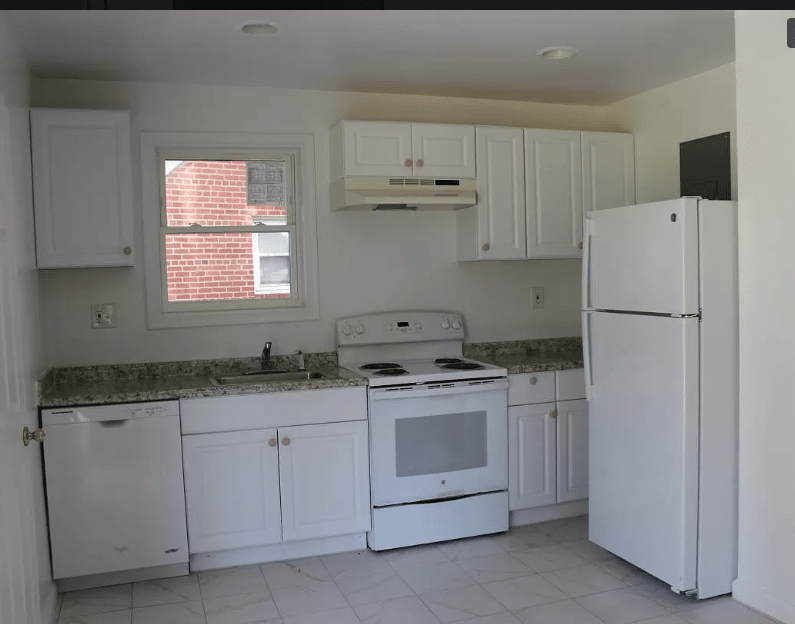
Here you can see the kitchen (and its pink knobs!) with the tile floor. The tile had all cracked by this time.

The upstairs bathroom was original 1970s linoleum. Here’s a snip of it in its glory.

Trying to match/add the hardwood was not an option. We considered ‘luxury vinyl tile,’ but that was more expensive than I wanted to put in a rental property. I didn’t want to retile it because I just personally don’t find tile floors to be warm and cozy for a house. The only reasonable option left is ‘luxury vinyl plank.’

We requested a quote from Home Depot. Their quote was cheaper than the one we ended up going with, but we didn’t use them for good reason. We had a subfloor issue in another house. Home Depot was extremely difficult to work with. Not only were they doing questionable work, they also just threw their hands up at the subfloor issue. Luckily, we had a friend that was able to help us repair it (because we didn’t live there). We know for a fact that there’s subfloor issues here (we can see the bow in the floor at the sliding door), so we wanted to go with a contractor who could handle everything.

We picked a local company. They did both the carpet and the LVP. They were so easy to work with. I didn’t love that they wanted me to pay for the entire job up front, but it ended up being great. They had to come back to finish a few tasks, and they did it all perfectly. I’m really happy with the process and their product.

Another miscellaneous flooring issue was that the vent covers were rotting. The finish on them were peeling. This could be explained by humidity in the bathroom, but that doesn’t really explain the issues in the kitchen and living room also. Our handyman was able to pop those out and get new, clean looking ones in for us.

RANDOM WORK

We had to call on our handyman for random jobs. He had to tighten the front porch banister. It’s likely the original banister and has just corroded at the connections. He also had to tighten up the screen door (which, if it were to break would be removed; having to maintain non-essential pieces of a rental is no fun). Some light fixtures needed major TLC. We replaced the light fixtures in both second floor bedrooms, the sconce type light fixture in the half bath upstairs, and the main bathroom’s vanity light (it was all corroded and looked bad).

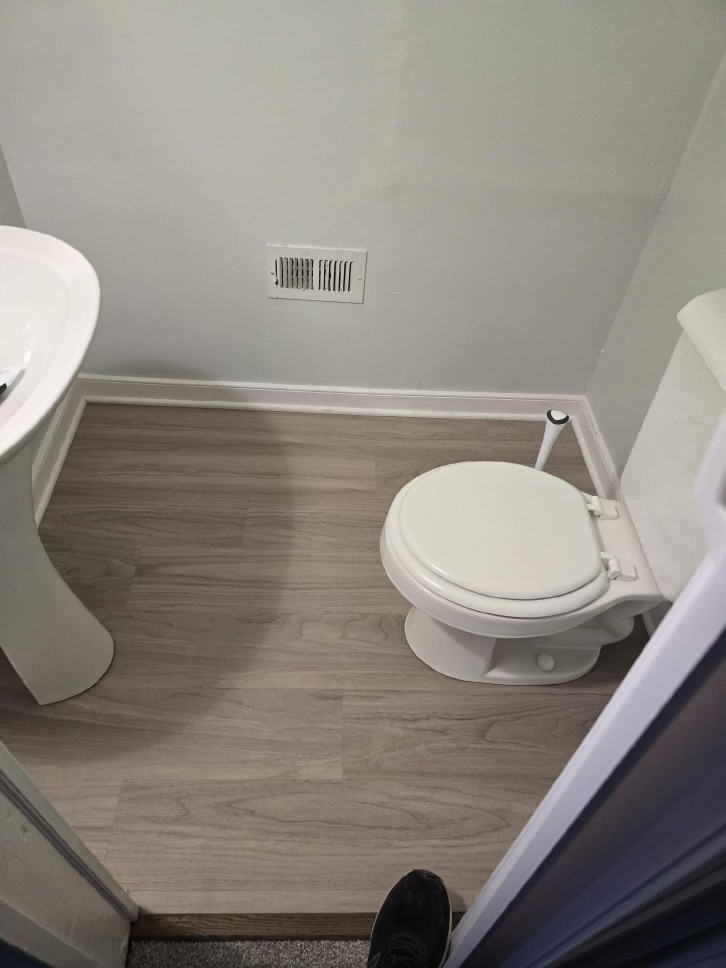
The upstairs half bathroom had a brown accordion door. The pieces were falling off and it just generally looked bad. The space is tight, and an accordion door style was definitely the best solution for the area, so we had a white one put in. It’s still less than ideal, but it looks much better.

The previous tenant didn’t clean up the yard as they were supposed to, so we had to hire out that work. We also asked him to clear the gutters, which was very necessary because it looked like trees were growing out of them with how many twigs were stuck. He charged me $250 to rake the leaves from the yard and flower beds, mow the yard, and trim the bushes. Then he added on $50 for the gutter clean out. We also did a final mowing before the new tenants moved in, and he charged me $60 for that.

I’m not exactly sure what the issue is, but for some reason we had water damage in the main bathroom. It wasn’t water damage in the sense of standing water. It was just too much moisture. The mirror was corroded; the tub faucet handles were corroded; the caulk was all moldy (and we knew it was fine a year ago); the walls had water streaks on it. I don’t know how it was fine for years and now it’s not, but I’m guessing the only answer is that last tenant just liked really hot showers and didn’t use the vent or window. The tub knobs were so corroded that they had to be sawed off and new valves and such installed. Luckily our plumber was able to handle it timely and it looks better now, but that was a minor inconvenience.

The back sliding door had always been questionable. No one ever pushed us on it though, so we didn’t know just how bad it was. I don’t know that the door ever fully locked. There was a block used to hold it shut for security measures (although I feel like everyone who has a sliding door uses something like that). I finally wanted it replaced. It was likely the original door (think nickel type finish), and it was overdue. We did this through Home Depot because I knew their prices were reasonable and it should be an in/out job. It was $1063.

NEW TENANT

Our property manager showed the property to several candidates. Only two provided their interest form timely. An interest form is a way to gather background documentation on the potential tenant without the tenant having to spend any money. It’s a way for the prospect to divulge any negative remarks on their credit or background check. It’s a good gesture that we allow them to fill this out before spending money on an application fee that will identify disqualifying information. We have found that some people don’t tell us anything, and then they’ve spend $43 for us to say they don’t qualify.

Both prospects submitted their interest forms on April 18. Unfortunately, both of them were interested in a mid-May lease start date. They both offered to do a 2 year lease as a compensating factor though, which was a nice gesture. I also appreciated that both of them were well spoken and up front with a lot of information.

We chose someone and ran her background check. Several “unlawful detainers” (a.k.a. evictions) came through, which hadn’t been disclosed. We told her that her credit score was slightly below 600 and the unlawful detainers would disqualify her. She then wrote back a very nice note explaining all the data that we found and asked us to reconsider. We agreed to rent to her and to take a higher security deposit as a compensating factor. She agreed to the 1.5 times a month’s rent as a security deposit.

Unfortunately, the house was vacant for a month and a half. Luckily, during that time we were able to get a lot of work done in the house. I hope that this tenant takes good care of the home and that we’re pleasantly surprised with her tenancy regardless of her history of late payments and court filings.

Tenant Evaluations

When looking to rent your house, you should do your due diligence. Our concerns are whether a person has a history of late payments, collections accounts, and if they have a criminal history.

We do two steps of initial screenings before asking a tenant to pay an application fee. The first two steps given them the opportunity to disclose anything that may be seen as unfavorable or not meet our rental criteria. This way, once they pay the application fee, it’s a verification step, and they’re not wasting any money for me to find out that I’m going to decline them.

Here are the details of how I go through the evaluation process, and specifically how I just did it for our new rental.

RENTING CRITERIA

First, I send everyone interested an “Interest Form.” We ask for their legal name, contact information, credit score, employment data, number of occupants, whether they smoke, if they have pets, if they’ve been evicted, and if they’ve been convicted of a felony. I also ask them to provide any other information they think I should know that may affect their ability to rent the house. I send this form to everyone who expresses interest, and it’s the first step before scheduling a showing. I request the data before scheduling a showing because I don’t want to waste my time or theirs showing the house, when they had adverse responses to our criteria. This was more important when I was scheduling individual showings, but I now conduct an “open house.” I set aside two hours to be at the house and ask they come during that time. If that doesn’t yield a tenant, then I’ll evaluate who couldn’t make it and field new requests to see it to determine if I’ll show it individually or host another open house.

We have this at the top of our Interest Form.

Properties are offered without regard to race, religion, national origin, sex, disability or familial status.

Required standards for qualifying to rent a home are:
• Each prospective applicant aged 18 or older must submit a separate application.
• We limit the number of occupants to 2 per bedroom.
• Your combined gross monthly income must be at least $4,000.
• You must be employed and/or be able to furnish acceptable proof of the required income.
• You must have a favorable credit history.
• You must have good housekeeping, payment, and maintenance references from previous Landlords.

Compensating factors can include additional requirements such as double deposit and/or a cosigner.

Our typical rental actually requires 3x the rent as the monthly income, but since our last house was more expensive, we put the requirement as a dollar amount threshold instead.

Then I would historically review those who say they’re interested and pick the one that appears to be most qualified. I’d send them a “pre-application” form to fill out. However, for our last tenant search, I asked everyone interested to fill out the “pre-application.” The tenant screening system doesn’t tell me their last landlord information or their employer, which are both necessary for making phone calls and checking their information given. The “pre-application” repeats some of the questions on the Interest Form, but the pre-application requires them to sign the form as an “affidavit” that the information is accurate.

If they tell me that they’re going to have a low credit score, it helps me to know the reasons for it up front. Additionally, by letting me know any issues up front, it saves them money. If they self-report that they have several collections accounts, then it could be cause for me to move on to a different person interested. If they don’t tell me that they have some issues in their history that may be unfavorable, and I send them the application, then they’re spending $40 per person only to potentially not get the house. I prefer to use the online tenant screening as a final verification step than an initial screening and potentially waste someone’s money.

One time I got through all these steps, had 3 different people submit an application for a house, and the report came back with an eviction. We asked why they didn’t disclose that to us originally. They told us a story about how they were asked to leave somewhere, but they didn’t know that it was reported as an eviction. We told them that they were disqualified. We went with our “runner up,” and they’ve been in the house almost 3 years without any issue or late payment.

We also had two people submit an application and then a bankruptcy was reported on the credit report (it was before the pre-application step I implemented). She said she didn’t see a place to explain a bankruptcy, so she didn’t think to mention it. For future reference, if I ask for your credit score and you have anything concerning in that credit report, it’s helpful to be upfront about it. In that case, everything else was fine and her explanation for the bankruptcy was clear and thorough. We gave them a chance, and they were amazing. She was rebuilding her life after taking on a lot of new bills after a divorce, juggling single-income life, and it was a way to consolidate the debt.

DECIDING BETWEEN TENANTS

In this last situation, I had several people express interest in the property.

I held the open house, and I asked everyone to let me know by noon the following day if they were interested in pursing an application after seeing the property. I received 6 or 7 people who were interested in the house.

I don’t look at one factor. I weigh all the information given to me in my head. In a perfect system, I may assign a weight to each data point, but that’s more effort. I’m reviewing the data and trying to see who has the best, well-rounded criteria.

The house is big (2100 sf with 4 bedrooms), and rent is higher than anything we’ve ever managed. I looked at what they are currently paying in rent. If they’re currently paying $1500 per month, then that made me more confident that they’d cover the $1750; if they are currently paying $400 per month, then I was concerned that they weren’t prepared to cover such a large expense difference. Along those lines, I also gave more credit to someone who has a stable job that they’ve been at for more than a year, versus a few people who said “I’m starting a new job at the end of April.” We have a tenant that goes through jobs every 1-3 months and is always a pain with rent, so I’m probably more scarred by job history now.

I gave more credence to those who had at least a 600 credit score, but I didn’t rule out anyone with a credit score less than that. One woman did have a lower credit score, but she had other good information, so I didn’t rule her out.

Finally, the determining factor came down to availability. My top two contenders had different desired move dates. One said early April, and another said June 1st, but May 1st may be ok. When I asked her to explain about her move date, I received a detailed story that didn’t have any conclusion on when she was available. Since this is a business, and I had a qualified group interested in the house sooner than others, they were the ones selected. If I didn’t have someone qualified for an April move in, then I would have waited for a May 1st rental instead of lowering my standards.

Luckily, I had enough interest in the property that I could select someone who was well qualified and get it rented sooner than later.

APPLICANT SCREENING

Once I’ve given someone these two opportunities to disclose unfavorable information in their credit or criminal history, and they’ve provided favorable responses that meet our criteria, I send the link for the application. The potential renter enters their data into the system, which helps keep their information secure (e.g., I don’t have their social security number) and helps eliminate any typographical errors that I may make transferring the information into the website instead of them entering the data they already know. Additionally, the tenant pays the fee (currently $40) directly to the website, which helps them understand that once the report is run and the fee is paid, it was for a service so it’s not refundable. I heard multiple stories this past week where people paid “application fees,” but were later told that they weren’t the first to respond. That’s not fair. I don’t need to know everyone’s detailed reports and cost people money if they aren’t going to get the property. So here’s how I handle the tenant screening process.

The system generates a report for me to see that includes their credit history, criminal history, eviction history, and income verification.
– The credit history shows any missed or late payments; collections accounts; bankruptcies filed with the chapter, date filed, and amount settled; and their score. I’m more concerned about late or missing payments than anything else there. The collections accounts are typically related to medical bills, but if they’re for general credit cards or an enormous car loan, I’d find it more concerning. I’ve also not ruled someone out simply because they’ve filed bankruptcy; two of our tenants actually have a bankruptcy in their report.
– The criminal history tells me if they’ve had any judgements against them. I’ve seen traffic violations, misdemeanors, and felonies. The report also tells me if they’ve been listed on any sex offender registry. If they have felonies, multiple misdemeanors, or are on a sex offender registry, it’s automatic disqualification. I’ve gone down the road of giving people chances, and it hasn’t gone well. This report isn’t fool-proof either. I know how to use the court record system where we have most of our houses, and I now look them up in all the nearby jurisdictions to be sure there’s nothing reported.
– The eviction report will tell me if they’ve been formally evicted. This doesn’t capture any times where a tenant and landlord agreed on the tenant’s departure outside of the court system. This also may miss some jurisdiction evictions. We had someone show up in a separate jurisdiction when I went looking for their information in the surrounding areas, but it didn’t show up on the report. Don’t think that this report is fool-proof.
– The income verification comes with a built-in caveat. I don’t know the details on how the report is run, but the result is something along the lines of “we believe that the self-reported income is near accurate.”

The report suggests whether to accept or decline the applicants. I suggest reviewing the data and making a decision for yourself. Some reasons why the recommendation will be to decline include: criminal history, bankruptcy, and low credit score.

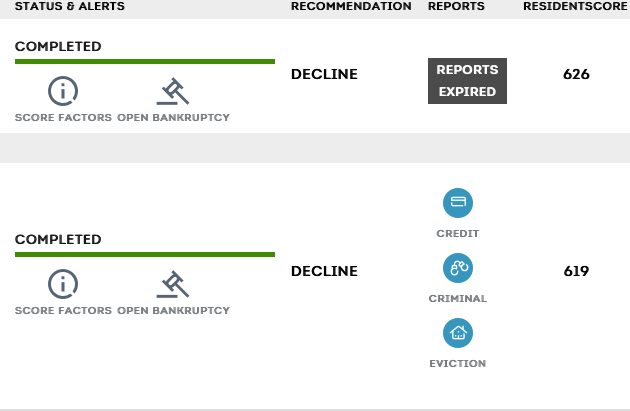
We have given several people “chances” that don’t perfectly meet our criteria. Below is a screenshot where the recommendation was to decline. However, we ended up asking for more information and giving them a chance. They ended up spending a year in a rental of ours, moving out of the area, and then asking for our rental availability when they came back to town. They always paid on time, hardly asked for anything, and took great care of the house.

We have also accepted tenants that had some concerns in their report, but the system recommended we accept them. We tried to overlook the issues, but we’ve ended up regretting it. We have one tenant who has a criminal history (forgery) and we ended up having to release her roommate from the lease because of a domestic violence and restraining order issue. She’s also consistently late on making rent payments and doesn’t keep communication lines open. We plan to ask her to leave at the end of this lease term. We also had a tenant with a 480 credit score who wrote us a letter about her low credit and asked for a chance. She ended up consistently paying late (she always paid, but it was always a fight); we threatened eviction when it got to a breaking point where she was combative, but she left on her own terms. That’s a good example where she was a terrible tenant, who we gave multiple opportunities and even restructured her rent, but her eviction report won’t say anything to that effect.

DEPOSIT

Once I have an approved application, I request a deposit to hold the property and remove the listing. Typically, the lease signing doesn’t occur immediately. In those cases, I want protection of my cash flow that I’m holding the property for someone specifically. I’ve had a couple of houses that have signed a lease immediately, but typically there’s a lag between “acceptance” and the lease being signed (forming a contract).

In this last instance, the tenant was accepted on Friday, but the lease wasn’t going to be signed until the following Thursday. I requested a $400 deposit, which will be applied to their balance owed to get the keys transferred to them. I originally was going to request $500, but I realized that the week’s worth of time at the rent per diem rate came to $408. If they back out between now and Thursday, then I haven’t lost income if I had chosen someone else and not held the property until the date they wanted a lease. Ironically, they ended up paying a deposit of $500. For them to obtain the keys, they owe a security deposit ($1750), the first month’s pro rated rent (about $1300), and a pet fee of $500. Their total is $3,550, but the $500 I’ve already collected is applied to that balance. Therefore, on Thursday, they’ll owe me $3,050 for me to hand them the keys.

Usually, I require the first month of rent to be the full amount, and then the proration is applied to month 2. Since for this tenant, they already paid rent at their current address for the month of April, and the rent here is higher than our average, I went ahead and prorated the first month so they didn’t have to put so much cash out of pocket in a short period of time.

SUMMARY

You can see how I am not making black-and-white decisions. I’m not hanging my hat on one or two factors. I’m being reasonable in my decisions and understanding that there’s a person, and maybe a family, on the other end of this transaction.

Be fair. Utilize a variety of factors in making your eligibility determination. Keep your communication lines open with potential renters until you have a deposit and/or lease signed on the property.

Treat this as a business and make informed, logical decisions instead of emotional ones, but be reasonable.