The day that’s in the contract as the closing date.
I truly can’t believe how many people have asked some form of this question in my life recently. While I’ve had multiple in person conversations on this topic, this post really stemmed from a Facebook post. “Is it an expectation for people to be moved out of their home the day of closing when buying a home? We sold our house, and are moving into a new home that we’re supposed to close the same day. Is there not a grace period?” What would that grace period be? How would the timing be determined?
On one side, I see the “closing date” section of a Kentucky contract simply states, “The closing of this transaction shall occur on the ___ day of ________________, 20__.” That’s quite useless actually (as I consistently find in KY law and legal documents). There’s a lot to be inferred by that statement, versus it being explicitly and clearly stated. On the contrary (as this has gone many times over), Virginia wins out.
In the paragraph before this image, it states where closing shall occur and by what date. This excerpt clearly indicates the purpose of “closing,” leaving little room for interpretation.
However, if we take a step back from the legal jargon and contractual obligations, whether explicit or inferred, we can see the logic. If you’re the buyer, once you sign the paperwork to purchase the house, wouldn’t you expect the keys to be handed over to you right then so you can start moving in and living in this house you just paid for? Wouldn’t you want the sellers out of the house because they’re no longer financially responsible for the house, and you don’t want any liabilities of their damage (intentional or accidental) to fall on your hands? You’ve done a final walk through and signed off that the house was in the condition you expected it to be in at that point in time.
Now this isn’t to say that there aren’t other terms and conditions that can be agreed to between both parties. “Lease back” or “rent back” clauses are commonly used. Sometimes it’s beneficial for a buyer to process the transaction (e.g., a rate lock expiration), but they allow the seller to remain in the home for an agreed-upon period of time (e.g., to bridge a gap before their new house is ready/available). But all of these terms are to be agreed to, in writing, before the closing date.
When we just sold our last house, we allowed the buyers to store things in the garage. We entered into a contract separate from the house purchase contract, called a “Preclosing Occupancy Agreement.” I haven’t needed one of these in Virginia, so I don’t know their standard form, but KY’s form does well here. The document outlines the date the buyer can take occupancy and whether there’s a charge for it. There were other items that outlined incidentals, such as utilities. In our case, the buyers were simply asking for garage space to put some of their belongings (because they had a same-day-closing for their sale and purchase), so we didn’t require them to put any utilities in their name before the sale.
BRIDGE LOAN
I can understand the complaint. Financially, you likely need to sell your current home to afford a new home. The “cash” from your sale is what you’ll use as your downpayment, as most people don’t have 20% of $400k sitting in a savings account (nor should you!). That makes the option to buy the house, take a day or two or seven to empty out your old house, and then sell your house not feasible.
There’s such a thing called a bridge loan. It’s a short-term loan used to purchase assets until long-term financing can be secured. There are more fees and high interest rates associated with this. However, it could be worth it to save the hassle of Private Mortgage Insurance (PMI). PMI is required in many cases where you cannot provide 20% as a downpayment for a house purchase. It protects the lender in case you don’t make your mortgage payments. PMI is removed when your principal balance falls below 80% of the original value of your home, whether that’s through regular mortgage payments or you make additional principal only payments. You can request PMI be removed earlier than that if you provide proof that your home value has caused your principal balance to now be less than 80% of the value, which is typically proven through an appraisal at your cost. If you put 0% down on a $400,000 purchase, it would take almost 12 years of payments before your loan reached 80% of the original home value. That’s 12 years that you’re paying PMI on top of your mortgage payment, and those are funds that are doing nothing productive to your net worth. A bridge loan may be worth it if you already have a sale date on your current house and only need to cover a few days or weeks.
SUMMARY
Logistically, it would be great if you could buy your new home, move all your things, and then sell your current home. Financially, this isn’t normally feasible. A lot of the time, you’re needing the equity you have tied up in your current home to purchase your next home.
Our first purchase was made up of two 401k loans (that we maxed as residential loans, which are penalty free), a gift from parents because we were short just a few thousand dollars, and cash on hand. We needed about $80k. Our second transaction, we chose a new build house. We sold our house, went into a rental for 3 months, and then used the sale money to purchase. Our third transaction was also a new build. We hopped AirBnBs until that got old with a 6 month old and 2 year old, and then crashed in Mr. ODA’s parents’ basement. We had 7 weeks between selling our house and purchasing the new one, so the cash from the sale went into our account, and we let it sit there until we needed it to close. Then this current purchase was actually done before we sold our third house, but we had executed a Home Equity Line of Credit prior to the sale. We used the HELOC to put the down payment on the current house, and then the sale of our third house paid off the mortgage and HELOC before distributing the cash balance to us. In all of these transactions, we had the ability to float the funds. That allowed us the ability to house our belongings in “long term” storage (not a day or two) for those two times we had a gap between the sale and purchase. The HELOC allowed us to slowly move our belongings to the new house this last time, and then we did a final moving day of all our big items just before closing (our current house needed work when we bought it, so we didn’t move right away).
But in all cases, unless there’s a separate document indicating so, the closing date of a transaction is the date that you give or take possession of the property. If you were buying, you wouldn’t want to take the risk of the previous owners messing with something in a property you now own. If you were selling, the buyers would have the same expectation.
Today’s post is going to be short and sweet. Well, that’s how I think to start every thought I have to share, and it turns into a novel with research and ‘citations.’ Let’s see how this goes. Update: It’s long, there’s a legal citation, and I ‘teach’ math. Sorry. 😛
We have two houses with flat roofs. They’re a pain. They always seem to leak, and no one wants to work on them.
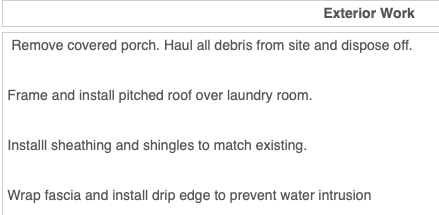
In 2019, we had issues with a house that had an internal ice dam and gutter system, in addition to a flat roof over an extension. Water kept leaking in the kitchen. After two years of issues, we finally had a roofer respond to our request for help on a flat roof. As soon as a roofer hears “flat roof,” they seem to shut down and say they don’t work on flat roofs. Here was the quote.
So we had this work done for $1,900, and we haven’t heard about the roof since.
We have another house where there was a flat roof added to an addition. In 2017, we had a roofer replace the roof. Somewhere, something was lost in translation of the job. We thought he’d address the flat roof and fix it, incorporating it into the main roof line. He finished the job, and it was clear that was not part of the scope as we thought, even though that was the whole reason we called him out. He simply said “I don’t work on flat roofs.” That wasn’t clear when we asked you to give us a quote, and how do you just ignore that there’s another roof line as a roofer?
The more we spent time and money on this roof, the more it came to light what happened. It appears that there was a deck that eventually was covered with a corrugated metal sheet. Then someone decided they wanted a laundry room, so they built a laundry room under this metal sheet. The roof line wasn’t properly insulated from water infiltration. We had several issues of water leaking into the laundry room. Mr. ODA put silicone and caulk along the roofline as a stopgap because roofers weren’t acknowledging us. We thought we had fixed it, and I had put a lot of effort into fixing the wet drywall and repainting the room. After two years, the silicone finally gave way.
Our property manager was able to get 3-4 roofers to come look at the job, but only 2 gave us a quote (why is it a norm to just ghost customers and not have the decency to close the loop and say you don’t want the job?). One of the contractors didn’t appear to understand the job, and that concerned me. He seemed to want to redo the entire roof, and that was definitely not in our finances for this house because we replaced the roof 3 years ago. Then he also suggested a ‘TPO roof’ for the flat roof. I don’t know what that is, and I didn’t like that the explanation to me started with “it’s a flat roof that…” No. I’m done with “flat.” Did I give it a fair chance? No. Do I care? No. I wanted a pitched roof line. This is important for later in the story.
I had several concerns about the other roofer’s estimate, but they were less fundamental (or so I thought). First, I was concerned about the terminology being used as a porch. Perhaps it’s just me, but I call the open-air overhang on the front of the house the porch, and the open-air part attached to the back of the house a deck. I was concerned that the terminology “pitched roof” was not explicit enough to our end goal. I questioned that his removal of the corrugated metal roof would leave the deck exposed, so the gutters would need to be rerouted and added. I also questioned about how he was going to cover the sides once the pitch was created – would it be just painted or would it be sided, and if sided, how would he match it to look right.
I had my property manager call him, I called him, and I emailed him, but I received no response. I was trying to confirm the scope of work. Mr. ODA told me that these contractors are good at their job, but not good at the administrative side, so just let it go. I was an auditor; accurate documentation for a job is important to me. 🙂
Here’s how it was written:
I decided to try to be easy going. There was a space for comments when I accepted the proposal. I added: I’m accepting this estimate based on the verbal agreement with [property manager] that the scope of work is confirmed as removing the flat roof over the DECK and laundry room (not sure ‘porch’ terminology), that the deck won’t be covered again and a lean-to roof will be put over the laundry room, and that all gutter systems will be appropriately rerouted to divert water from the house.
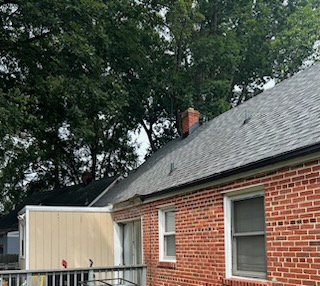
He gave me the quote on June 23rd. I accepted this work on July 5th. He kept delaying us. He would say “I’m going to get the materials today, so we’ll be there tomorrow.” Tomorrow never came. On August 25, he said he was going to 100% start the following Monday and be done by Wednesday. He finally called on Wednesday, and he said, “I got my guys out there today. I decided to do a TPO roof instead.” You’re kidding me, right? He kept pushing that it’s a “better” roof than a pitched roof, and I should be ok with it. Except, I signed a contract. The contract did not say their job was to install a TPO roof. I said that was unacceptable and I wanted a pitched roof. Here’s the picture that I received at that point. It looks really flat to me, and it has the point where it meets the main house still below the roof line (although you probably can’t tell there as well here).
On September 5th, he said they should be out the following day to finish it as a pitched roof. It took until September 11th for us to be told that the roof was done. As you can see, the gutters were not addressed. Luckily he said he’d get right out to fix that, and he did, which was appreciated.
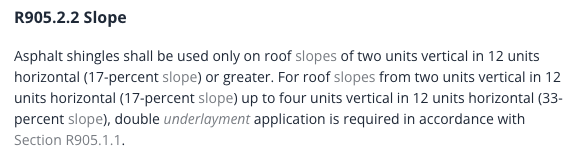
While you can see that there has been a slight pitch added, it is not a sufficient pitch as required for asphalt shingles. Did I know there was a minimum slope requirement for asphalt shingles before September? Nope. But you bet I read up on it and figured it out as fast as I could. Nearly all manufacturers of asphalt shingles have a minimum requirement of a 2:12 slope. On top of that, Virginia Code has the same slope requirement.
This means that for every foot, the rise of the tallest point must be twice that in inches. A 7 foot long distance from the top of the pitch to the outer wall requires a 14 inch rise at the tallest point. That’s the simplest way I’ve been able to describe it.
While the connection point in the second try is above the wall/roof intersection, and it may have been ‘fine,’ I wasn’t here to spend $3,800 on “fine.” He kept pushing that he guarantees his work for 5 years. He also pointed out that a tropical storm was on its way that coming weekend, so it would essentially be a good stress test. So, he was asking me to pay him for a job that was “good enough” and hope that if there was a problem, he’d come back and fix it. No thanks.
He got up on the roof, held up a piece of metal (with no level), and claimed that his zoomed in distance was 2″ off the roof, so it was 2:12. Once I finally got to the point of saying, “what’s the distance from the house?” He said 7′. I said “so the rise has to be double that, so 14″. Is it 14″?” He said no and that he’d fix it. He finally got it done last week. He took pictures along the way to prove that he did the job correctly since I called him on not doing it correctly (or let’s just do the work right to begin with instead of hoping a homeowner won’t question it – where’s integrity these days).
All that was to share that you should do your due diligence when hiring contractors. Don’t assume that they’re going to do the right thing because they’re probably going to assume you’re not well-educated in their field. By no means am I a roofing expert at this point, but I appreciate knowing something new. I just wish I didn’t have to learn things quickly in order to protect my ‘investments.’ So now you also know that there are manufacturer requirements, in addition to your expected state-wide requirements in most fields. Take the time to be educated just enough or have someone you can trust to point out where it went wrong. In this case, I said “that doesn’t look like what I expected,” and I had our handyman look at it. He said the pitch isn’t enough, and that’s where I learned that there are minimum slope requirements. It’s hard because I didn’t know what I didn’t know, but I appreciated having other trusted people to bounce questions off of.
While the housing market has cooled some since I started this post in the Spring, there are still some areas that are moving quickly and aggressively, and this information is still helpful regardless of you being in a multiple offer scenario. Over the course of 6 years and 18 properties purchased (and countless offers made), we’ve caught on to some helpful parts of contracts. Again, keep in mind that I’ve seen real estate contracts in New York, Virginia, and Kentucky; this is not all encompassing or what may work perfectly in your market. This also doesn’t include all parts of a contract since most of them are standard and/or can’t be anything but matter-of-fact (e.g., will the property be owner occupied; is the property subject to a homeowner’s association).
BASICS
Your contract is going to encompass the basics of the purchase each time. This would be the buyer and seller names, address of the property, offer price, and closing date.
Typically, the buyer’s agent draws up the contract with the information being offered. If the offer is accepted by the seller, the seller signs the contract. If there are negotiations, the buyer’s agent will adjust, have the buyer re-sign, and then submit to the seller for signature. When the buyer makes the offer (which is just filling out the contract and sending it to the seller), the buyer will typically include an expiration date of the offer. This isn’t always enacted, but it’s there as a protection so the buyer isn’t sitting idle for extended periods of time waiting for a seller to make a decision. For example, we had an expiration clause in a contract recently where our offer expired at 8 pm that night, but we knew they weren’t going to review offers until the end of the weekend; we had put it in there as a way to hopefully push the seller to make a decision with just our offer instead of waiting for more offers to roll in. We ended up getting the contract on the house, even though our expiration date had technically expired.
In Virginia, the closing date language says “on or before X date, or a reasonable time thereafter.” In Kentucky, it says “on or before X date,” and if you can’t close by that date, you and the buyer have to process an addendum to the contract with a new closing date. We had a contract, as the seller in Virginia, close 2 months after the date in the contract. We were furious about that. We could have walked away and kept the buyer’s earnest money deposit, but then we’d have to formally list (it was an off market deal) and manage that process along with the home inspection issues that may arise. We also had a contract in Kentucky where our lender messed up and delayed our closing, so we had to sign an addendum to the contract to allow us to close a week late.
EARNEST MONEY DEPOSIT (EMD)
Earnest money, or good faith deposit, is a sum of money you put down to demonstrate your seriousness about buying a home. In most cases, earnest money acts as a deposit on the property you’re looking to buy. You deliver the amount when signing the purchase agreement or the sales contract, and it’s applied to your balance owed at closing.
This is not a requirement, but it’s showing your “good faith” to purchase the property because there’s a penalty to you if you try to walk away from the purchase.
In most cases, you pay the EMD to your realtor’s office and they hold it until closing. In Kentucky, they’re on it right away, asking you to send the check as soon as the contract is signed. In Virginia, I didn’t always send the EMD. The amount is listed in the contract, so if I were to default on the contract as a buyer, I would still owe that amount even though I hadn’t paid it to my realtor’s office.
Typically, you’re looking to put 1% down. On a $90k purchase, we gave an EMD of $900. On a purchase of $438k, we gave an EMD of $5,000 (but there were other factors at play as to why we went higher than 1% on that, which I’ll cover later).
CONTINGENCIES
Some items we’ve seen in our contracts are options for the buyer to back out of the contract, or a contingency.
Financing
A sale can be subject to financing. If it’s not an all-cash offer, and there will be a loan secured to purchase the property, data can be entered to protect the buyer’s interests. Typically, it’s going to list the years of the loan to be secured (e.g., 30 year conventional), a downpayment amount, and a maximum interest rate. The interest rates hadn’t been fluctuating much, but this would play into things in the past few months. If you tried to purchase a home when the prevailing interest rate was about 4%, and then interest rates rose to 5.5%, it may affect your ability to qualify for the loan or put you outside a comfort zone for your monthly payment amount. For example, on a $250,000 loan at 4%, your monthly payment is about $1200 per month (principal and interest); if the rate raises to 5.5%, your monthly payment becomes $1420 per month.
This information does not lock you into that break down. If the contract says 80%, and you decide to put 25% down based on the rate sheet, the contract isn’t changed nor is it voided.
Appraisal
If the sale is subject to financing, then it has to be subject to the appraisal. This is a lender requirement to protect their interests. There are some caveats to this, but I will cover them later since they’re more advanced. An appraisal will cost the buyer in the realm of $450-600.
If you’re attempting to qualify based on rental property income, the lender may require you to pay for a rental appraisal as well. We’ve seen this cost at an additional $150, but we’ve typically been able to negotiate our way out of that by providing leases and income history.
Home Inspection
This is one that I almost always recommend including in your offer. This is your “out” in almost every situation. If you get a home inspection, and it finds anything, you can walk away from the contract and not lose your EMD. If a house is important enough to you (a personal residence that you want regardless of what you find on an inspection report), you may eliminate this contingency, but you’ll typically include it. You can even include that you’ll do a home inspection and decide to not do it.
If the house is being sold as-is, it doesn’t mean you can’t get a home inspection. You can still get the inspection to know whether you want to move forward with the purchase. Being sold as-is just tells the buyer that the seller is not willing to negotiate price or fixing items if the home inspection finds something.
The buyer is responsible for the cost of the home inspection. We’ve paid between $300 and $650 for it. The inspector will take about 2 hours to look through the house, including the roof and mechanical parts behind the scenes. Sometimes the inspector will say “this doesn’t look right, but you need to consult a professional in that trade,” which is usually what happens when it comes to roofing. We have done a home inspection, found too many issues to manage (e.g., stairs built out of code) and walked away from the contract. In that scenario, we don’t lose our EMD, but we did pay about $500 for “nothing” (unless you count all the savings of not throwing money into the house to make it safe and livable).
If you find items on the home inspection that you don’t or can’t fix yourself, and the house isn’t being sold as-is, you can request the seller address them. An addendum to the contract will be filed to identify what the seller agrees to fix, and professional receipts have to be supplied before closing to satisfy the requirement. A seller may say they don’t want to be bothered with coordinating the trades to fix the items and offer financial compensation (e.g., we project the cost of these fixes to be $1000, so we’ll take $1000 off the purchase price).
In the realm of “the contract can say almost anything you want,” here’s an example of an additional term that was in one of our contracts. On this particular house, we should have walked away. The closing process was a nightmare because the seller hadn’t paid the electric bill, so we should have known that them wanting a free pass on inspection items was a red flag.
Virginia has a clause to protect the seller’s ability to walk away from the contract in the event of drastic home inspection repair costs.
Wood Destroying Insects (WDI)
A WDI is basically your termite inspection (may include carpenter bees, ants, etc.). We learned with our very first home purchase that this inspection is pretty useless. You can teach yourself what outward signs to look for regarding termite damage. It’s a visual inspection of what the technician can see. But the damage caused by WDIs is behind the drywall. If there’s signs of WDIs outside the studs of the walls, you’ll see it, and that means you have a big problem. Pay the $35 for a professional to say there are signs of active termites.
Another way we found that the WDI is useless is that we had a major termite problem in our house. We were paying for treatment when we sold the house. The treatments weren’t working and the next step was pulling up all the flooring in the basement and treating under the foundation ($$$). The termite company wrote their report: There is an active infestation of termites that are actively being treated. Technically, true. Productively, not the whole picture.
‘ADVANCED’ CONTRACT OPTIONS
I don’t know that these are necessarily advanced, but they’re less common options when making an offer. Some of them come in handy at opportune times, so it’s helpful to know the options at your disposal.
Seller Subsidy
The seller subsidy is the seller’s contribution to closing costs. It reduces the seller’s bottom line based on the offer amount, and it reduces the amount of money the buyer needs to bring to the settlement table. If a contract offer is $102,000 purchase price with $2,000 seller subsidy, then the seller’s bottom line is $100,000.
There is a limit of how much seller subsidy can be in a contract, which is based on the lender’s requirements and is typically 2% of the purchase price. We have had to adjust the contract to account for this limit before we were aware of it; we kept the seller’s bottom line the same, but adjusted the numbers so that we could maximize the seller subsidy.
In Virginia contracts, there’s a boiler plate section identifying the possibility of seller subsidy. In Kentucky, it has to be written into the additional terms section.
Escalation Clause
If you’re in a multiple offer scenario, it may be helpful to offer with an escalation clause. This is an option that a prospective buyer may include to raise their offer on a home should the seller receive a higher competing offer. The buyer will include a cap for how high the offer may go. It’s essentially a way for the buyer to compete with other offers, but not necessarily pay top dollar for the house.
Most recently, our offer was $420,000 and we were told there were at least 4 other offers. We added an escalation clause to our offer. We decided to make it a strange number (e.g., increase by $1770 at a time), and we capped it around $450,000. We were basically saying that we were willing to pay up to $450,000 for the house, but we didn’t have to commit to that number by making our offer at $450,000. The highest offer outside of our offer was about $436k, so our escalation of $1770 over highest offer got us the house for about $438k.
AppraisalGap Clause
As mentioned, a home purchase with financing is going to be subject to an appraisal. With the housing market exploding purchase prices in the last couple of years, houses have been selling for well over list price. This is nice in theory, but that doesn’t mean that a bank is going to agree that your purchase price is “fair market value.” If your contract is for $500,000, but the home values in the area only support $420,000, the bank is not going to give you a loan based on $500,000. Either the seller has to agree to accept the lower purchase price, end the contract and start over with the listing, or the buyer has to agree to pay the difference in value in cash. A gap clause is preemptive attempt to address this difference between the contract price and the potentially lower appraisal price.
If the buyer believes that the area’s home prices will support a purchase price of about $450,000, but they want to make an offer of $500,000, the buyer may include a gap clause of $50,000. This means that the buyer is more attractive to the seller because the seller’s risk of the contract falling through after the appraisal comes back is minimized. This also means that a buyer would have to be able to show the lender that they have the cash to cover the gap clause needed (if needed), the down payment, and the closing costs.
We used a gap clause on our most recent purchase. The list price was $415,000. I was confident that an appraisal would cover up to $425k, but I didn’t see many comparable sales higher than that without venturing into different neighborhoods. We offered, with an escalation clause, up to about $450,000. Since we weren’t sure that the appraisal would go that high, we offered a gap clause of $25,000. Our final purchase price was $438k, and the lender waived an appraisal need, so our gap clause wasn’t enacted.
RANDOM CLAUSES
I mentioned that a contract can almost say whatever you want. Here are a couple of examples of protections we put in an offer that had to be satisfied within the term given or we could walk away from the deal with no penalty.
SELLER THOUGHT PROCESS
The seller’s comfort comes into play when you’re in a multiple offer scenario. A buyer can make an offer saying almost anything they want (within reason of a residential real estate transaction). You can manipulate your offer to show the seller how vested you are in the purchase. Sometimes a seller just cares about the bottom line numbers, but sometimes (like if you’re competing with a similar offer), a few tweaks to your offer may make you more desirable.
I mentioned that we went higher than 1% on our EMD for our personal residence purchase. We wanted to show that we were very interested in the property, so one way to do that is to show that we have a lot of “skin in the game.” If we default on this contract, we’re out $5,000 and getting nothing. Whereas, when we’re purchasing a rental property without emotion, if it doesn’t go through, it doesn’t go. Sticking to about 1% is showing that we’re “checking the box,” but not that we’ll do anything and everything to make sure this deal goes through. We would still be out some money and get nothing if we walked from a contract without enacting a contingency, so the higher EMD you include, the more serious you appear.
A seller may not understand the big picture of providing the subsidy, so that could be risky. If a seller sees that they’re contributing to $2,000 of your closing costs, they may balk at it. Hopefully, they have a realtor on their end that can explain “think of your offer as $100,000 instead of $102,000.”
Eliminating a home inspection may make a seller feel more comfortable too. They may know of some issues in the house and are waiting for the “shoe to drop” through the inspection process, so it could eliminate a stressor for them. I wouldn’t recommend eliminating a home inspection unless you’re confident there aren’t any fatal flaws in the house (e.g., quarter width cracks in the foundation, wet marks on the ceiling, warped/sunken flooring).
The housing market has slowed down, so some of the out-of-the-norm clauses may no longer be worth the buyer’s risk just to compete for a house, but these are some options out there. The general concepts still apply, like when to pay for extra inspections or to expect financing and an appraisal to go together. Know that everything is a negotiation and don’t feel stuck in a contract if red flags are flying.
The key to financial freedom is passive income or cash flow so that you don’t have to work, right? Well, managing rental real estate isn’t truly passive, so a hiring a property manager to do that work on your behalf is enticing. But are the benefits worth the cost?
We have 12 rental properties, and 5 of those are self-managed. While I’ve mentioned the benefits of a property manager, I wanted to run through the reasons we don’t have a property manager on all of our properties. It comes down to time management and cash flow.
THE DETAILS ON SELF-MANAGED HOUSES
The very first property we bought was in Kentucky, while we lived in Virginia, so we needed a manager on that one. But then we bought two houses in Virginia. They were right next door to each other, and I worked about 10 minutes away. Without kids, I had the time and flexibilities to manage them. Plus, both houses had active leases on them when we took possession. Without having the immediate need and learning curve of finding a new tenant, it was easy to manage the rent collection and any minor issues that came up on the houses. A property manager would have cost us $105 each month on each of these houses. Even now that we don’t live near them, the houses are newer and we know they don’t have any major issues, and the tenants keep renewing their lease, so it’s [relatively] easy to manage from afar. There are some maintenance hiccups – like the flooring debacle – but mostly I just collect the rent electronically. One house is routinely late on the rent, so I have to manage that property more than the norm, but it’s all via electronic communication and doesn’t require me to be on site.
Our third purchase in Virginia was of a vacant 2 bedroom house. Still, no kids meant that I could manage listing and showing the property to prospective tenants. This was the first time that we had to figure out the tenant search process, but we were able to show it to a couple and have it rented the first weekend it was listed. Again, the house requires very little attention, and I just collect rent. Even when the house had to be turned over, the tenant leaving put us in contact with a friend of their family’s, and that’s been who’s living there for several years.
Our last two that are self-managed are the two that we have with a partner. I handle the rent collection and paperwork. When we have an issue, we’re more likely to call a handyman than do the work ourselves anymore, but again, phone calls and emails aren’t that difficult. We just had a handyman go out to look at two broken doors and to replace a missing fence panel. While I was there over the summer, I had secured the railing that was loose, but I didn’t want to do any of the other work. It also helps that we have a partner, so the cost of any work to be done is only half for us.
For the past year, we took over management of a property that had been with our property manager in Virginia. We knew the tenants from a previous house of ours, and we felt that our management of that house from afar would be easy as compared to the $120/mo we were saving by self-managing. We didn’t have any issues we couldn’t manage during the year. However, they’re now purchasing a home. We’re obviously not there to manage showings, so we gave this property back to our property manager. She listed the house and showed it for us. It’ll cost us $300 for the listing and 10% of the monthly rent for her management ($135). For the last 11 months, it has been rented at $1200. That means that we’ve had an extra $1620 worth of income for the year than we would have ($120 for 11 months, and the $300 listing fee).
PROPERTY MANAGEMENT
For our Kentucky houses, we are very hands off. We don’t weigh in on costs less than $200, and we don’t get any updates regarding rent payments or tenant searches. Sometimes it’s too hands-off for me. For instance, I don’t even get a copy of the executed leases until I ask for it, and I don’t get a copy of any receipts (I just get a summary of charges taken out of our proceeds). It has been hard on me psychologically, but I’ve learned to let it go over the past few years.
For our Virginia houses, we’re more hands on, and sometimes it’s too much. We still discuss all the details when an issue arises, so it’s just saving me the time of calling and coordinating contractors, which is rarely necessary. Then there are times that I even handle ordering and contractors; for instance, I just handled replacing the hot water heater and refrigerator at one of our houses. All of our tenants pay rent electronically, so that’s not even on our property manager’s radar (she used to collect rent and then deposit it in a joint account we gave her access to). Since she’s not responsible for rent collection, it’s then on me to let her know if someone hasn’t paid, and she handles the follow-up communication.
However, our Virginia property manager has been worth her weight in gold because she has handled multiple lease defaults for us (with one actually leading to an eviction), which involves going to the court house to file the motion and then showing up for the hearing(s). We had one tenant who had to be served multiple notices, but she eventually left on terms mutually agreed upon. We had another tenant vacate a house because his kids were attending a school out of the address’s district (and blamed us for that.. I don’t know!), but we took him to court to require payment of past due rent from before he vacated. Then we had a true eviction, where the tenant stopped paying rent and had to be taken to court multiple times. The judge ruled in our favor and told her to vacate the premises, which involved police officers escorting them out of the house. We have been very lucky that the houses we manage haven’t ventured into the realm of taking them to court (although one in close), and that our property manager has been able to handle everything on our behalf for these instances.
SUMMARY
We can get caught up in the “we’re paying for nothing to happen” mentality with our property managers. Each month, we pay out $720 for property management. In Virginia, our property manager doesn’t even collect rent, so most months there’s no action from her for the houses. In Kentucky, the property manager collects rent, holds it, and pays out our share the next month. It can be hard to see that total number that we’re paying, but for those months that involve a lot of coordination in receiving quotes, going to court, or meeting contractors, it’s nice that we don’t have to deal with it.
Sometimes it’s worth paying for peace of mind and relaxation, knowing someone else is handling your problems for you, but you need to choose where that balance is for you. Do you want to manage it yourself to know your money is being spent fully at your own discretion; do you want to have a manager while maintaining a lot of the decision making; or do you want to be fully hands off with a management company who you can trust to handle your property with your best interests at the forefront? It’s all a balance of how much you think that’s worth compared to your time spent and knowledge on managing rentals.
I just shared the details of the home inspection contingency in the real estate purchase agreements in my last post. I was laying the foundation to share what we’ve encountered to invoke the termination clause of the home inspection contingency.
COMMERCIAL PORTFOLIO
There was a time where we were trying to grow fast. We wanted to work smarter not harder, so we investigated commercial portfolios instead of buying one single family house at a time. We worked with our Realtor’s office’s commercial team to find an off-market deal of several houses. The owner of all these single family houses had lumped several houses in his portfolio by geographic area of Richmond, VA. He had provided us with 13 ‘sub-portfolios’ to review, but he was willing to sell individual houses.
We went through the entire portfolio to decide which houses we were interested in. We were able to eliminate several from the start because his rent to purchase price ratio were far from the 1% Rule we aim for (the monthly rent amount (e.g., $1000) is 1% of the purchase price (e.g, $100,000). We identified 10 houses we wanted to see and met up with the owner’s property manager to get into each house. Afterwards, we went through the list of houses, the comps we could find for purchase price, and discussed the condition of each house as we saw it. We ended up making an offer on 5 houses.
We received the ratified contracts on May 9th of that year, and we immediately contacted our home inspector to come through the houses with us. We met with the property manager, our home inspector, and our Realtor to inspect the 5 houses in one day. We negotiated with our home inspector that he didn’t need to write a report for each of the houses; I would take notes as we went through everything, and he wouldn’t charge us full price for the inspections.
We knew the houses weren’t in great shape, but we weren’t prepared for all the details we found in the home inspections. During our time at the houses, the tenants were quick to complain about the maintenance on the properties, saying things would take a long time to get fixed or they wouldn’t ever be addressed. The inspection found strong evidence of mold, patch jobs in structural beams in the crawl space, appliances not in full working order, windows screwed shut, and several other minor things.
We attempted to negotiate by the seller providing $10,000 per house in seller-paid closing costs. We didn’t ask for anything to be fixed because we saw the work that had been done in these houses, and we wanted it done right. The seller denied our request for funds to address the home inspection issues, and we walked away from all of the contracts.
FIRE DAMAGE
This was a hard one for me to walk away from. The house itself was in a high-crime neighborhood of Richmond. However, only THREE! parcels away, houses were being torn down, rebuilt, and sold for significantly higher than purchased. I saw the potential of the area’s revitalization. But we were not in the business of flipping houses nor doing major repairs. Not only were we not interested in that because we wanted to be able to create the cash flow as fast as possible, we also want to be able to hold these properties as rentals instead of flipping them so we maintained a continuous income stream.
There were several concerns when we walked through the property. The kitchen was a mess, there were signs of water damage in multiple places, the floor felt soft upstairs, the upstairs deck didn’t seem stable, the house needed a lot of TLC with the overgrowth, and then best of all – clear fire damage to the structure of the home when we went in the basement.
This isn’t a picture from when we were looking at the house, but this is the condition 3 years later, which shows just how ‘great’ of a house it was. 🙂 This is the backyard.
We were under contract for $72,500 in May 2017. The house recently sold for $296,000. Although it seems we missed the opportunity that I felt was there, I found pictures of a failed flip attempt in 2019/2020 that uncovered even more damage behind the walls than we even knew (although we suspected), and none of the houses around it have sold for nearly $300k. Therefore, we don’t believe that was a reasonably-expected sale price had we taken this beast on. And what’s not known in those numbers is just how expensive the flip was to that owner, both in headaches and wallet!
A KENTUCKY MESS
Mr. ODA went to see a house in Winchester, KY without me (it was easy because he was working near there, and it wasn’t worth me packing up our baby to go walk through a house that we may not even want). He and our Realtor walked the house and decided it was worth putting an offer in. The house had two units set up inside it, which was a goal of ours (duplex = one building the maintain with two income streams). The cash flow on it was great, so he probably turned a blind eye to too many negative issues during that first visit.
The inspection was $500. I was there for the event, but didn’t walk the house with the inspector. He ran through everything with me after he was done, but the tenants were present, and I didn’t want to bring my baby into their smoke-infested house (first red flag because we don’t allow smoking in any of our properties).
The first thing the inspector said was that the roof needed replaced. He pointed out that several tree limbs were in contact with the roof, and the roof had considerable algae growth on it. Basically, everything on the outside of the house needed repaired or replaced: siding, decks, roof, gutters, removal of vines on the house, negative slope of ground towards the house. The doors and windows were old and broken, so none had the proper seal to prevent water infiltration, in addition to not being able to maintain temperature.
On the inside, there were several code violations with how the kitchens were built (e.g., venting for range), and several large cracks in the walls, some of which were patched poorly and never repainted. There were five or six electrical issues that needed to be addressed immediately because they were a fire hazard. There were signs of water damage in the ceilings, as well as in the bathrooms where the peel and stick tiles were ‘floating’ and warped.
As if that wasn’t enough, the straw that broke the camels back for me was the head room given for the upstairs unit entrance. The required head space by code is apparently 6’6”, and we only had 5’6”. This seemed to be a big problem because an average man is 5’9”, and the average height of women at 5’4” doesn’t exactly give much wiggle room.
I was worried about all the work that needed to be put into this house. The tenants weren’t taking good care of the house, so it wasn’t worth putting a lot of money into it, just for them to destroy it. They had been there for a while, so it wasn’t like they were going to leave voluntarily any time soon. The neighborhood wasn’t in great condition, so a fully renovated house wasn’t called for when it came to resale or the type of client looking for a rental there.
It was a difficult balance, but the house had way too much deferred maintenance, way too many things poorly fixed/maintained when there was an attempt, several unfinished projects, and too many code violations to move forward. Mr. ODA really wanted to buy a house in this area before the summer was up, and he was pushing for the cash flow side of it since it had two separate units bringing in income. But that cash flow is non-existent if you’re having to put it back into the house.
These are the three main stories that have stuck with me. We learned a lot about houses through the process, and we feel we made the right decision on each of them to walk away. Through these experiences, we solidified our decision-making to focus only on houses that have been properly maintained and require little work to get rented. Having a unit already rented with long-term tenants isn’t always the “diamond in the rough” that you think it is.
The inspection is buying you information. Once you find out that information, the money is a sunk cost, and you should use it to now choose if the house is still worth owning or not. While inspections aren’t exactly cheap and aren’t tax deductible if we don’t buy the property (if you have a legal strategy, drop it in the comments please!), that information gained is important. That $500 “lost” is better off because you’re not buying a money pit that will cost a lot more in the long run. Remember, this is a business, and it’s best to keep your emotions out of it. Don’t pinch pennies and end up costing yourself big dollars later on.
Most times you’ll do an inspection, find some things to fix or negotiate down on the purchase price, and even find yourself in a situation where the inspection “pays for itself.” Other times, it doesn’t work like that. Life lessons can cost money, and inspections can help point out duds so that those lessons don’t end up costing a lot more.
I’ve mentioned that you shouldn’t be afraid to [legally] walk away from a contract on a house that isn’t going to work. I thought it would be fun to run through the duds (houses) that we walked away from and why, but first, what is the home inspection clause and how does it work?
The home inspection contingency is a clause within the real estate contract that allows the prospective buyer to enter the home and inspect it before closing. The clause usually has an expiration date on it, meaning the inspection and any negotiations need to be done within X days of the contract ratification (ratification is once all parties have signed). I would recommend using a professional to look at the house, versus you thinking you can find the signs of a major a problem. It will cost you 1-2 hours of time and about $300-$600.
It’s important to note that even if a house is sold “as is,” you can still inspect it, ask for corrections, and/or walk away from the contract. “As-is” just means that the buyer should not enter the contract with the intent of the seller doing anything for them. But really, anything in life is negotiable, right?
Additionally, putting a home inspection clause in the contract doesn’t mean you have to perform a home inspection. So put the clause in there as a means to ‘escape’ if you need it.
THE LEGAL LANGUAGE
I was going to share a screenshot of one of our contracts, but the home inspection section is over a page long, so I’ll paraphrase. The contract was subject to a home inspection, and the Purchaser had to “provide the seller with all inspection reports, cost of repairs and Purchaser’s written repair request no later than 10 days after the Date of Ratification.” It continues to state that the inspection is paid for by the Purchaser, and the Purchaser cannot require the Seller to perform any inspection or pay for it. Then there is an outline for how long each party has to review the request and return it to the other party (e.g., negotiation period). Finally, there’s the clause that allows the Purchaser to walk away.
In one of our Kentucky contracts, it also states that all inspections must be ordered and paid for by the Buyer, and that the Seller must provide reasonable access to the property to perform inspections. Interestingly, the Kentucky contract focuses heavily on removing any responsibility from the Realtor(s) during the inspection process. I hadn’t noticed that nuance before, and now I’m curious how much has gone wrong in Kentucky that there are several sentences along the lines of “The parties hereto release the above Realtors and real estate companies from, and waive, any and all claims arising out of or connected with any services or products provided by any vendor.”
The Kentucky contract’s home inspection contingency is as follows. “The BUYER hereby agrees that he/she has inspected the property and hereby accepts the property and its improvements in its present “AS-IS” condition; with no warranties, expressed or implied, by SELLER and/or Realtors. BUYER may have the property inspected and may declare the contract null and void, with earnest money returned to the BUYER, by notifying SELLER or SELLER’s agent in writing within 15 days from contract acceptance. Failure to have inspection and notify SELLER or SELLER’s agent in writing within said time shall constitute a waiver of this inspection clause and an acceptance of the property in its “as-is” condition. The time frame established in this paragraph is an absolute deadline.”
I’ll say it again: I applaud Virginia’s plain language use in their contract templates. While the home inspection clause is lengthy in Virginia’s template, it’s written in an easy way to read and understand, unlike this Kentucky paragraph. I’ve also read New York’s template, and it’s even more painful to read and is written in legal jargon.
Quick aside. Virginia is a “buyer beware” state. This means that the seller does not have to disclose anything about the condition of the property to you. Whereas Kentucky requires the seller to fill out a form that identifies all known issues. Know the requirements where you’re purchasing/selling.
THE INSPECTION
Remember that you need to have the inspection completed and the inspector’s report written up with enough time for you to review it with your Realtor and decide how to proceed (e.g., ask the seller for repairs), all within the timeframe established in the contract (e.g., 10 days from ratification). If you want the house inspected, you should look to hire that individual within the first day of ratifying the contract.
When you hire a home inspector, they’re going to look through the house and identify any deficiencies. They’re looking at all the major mechanics of the house, identifying any safety issues, recommending repair/replacement, and making note of items that aren’t currently a concern but may develop into one. You should have a good understanding of the house’s foundation, roof, plumbing, HVAC, electricity, and appliances through the inspection.
While it’s not required for you to be there during the whole inspection, I’ve found it to be more helpful if you are. We’ve done it where we were present through the entire thing, but there’s a lot of down time for that, and we’ve been there just for the end to get a walk through of the findings. If you’re not there to see it in person, the pictures and explanations may not be completely clear.
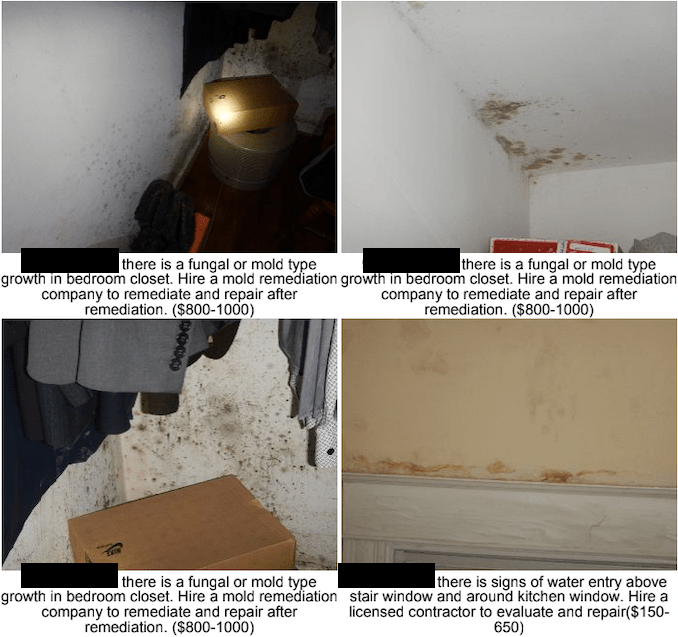
The inspector will provide you with a detailed report within a couple of days of the inspection, which has pictures of the deficiencies and possibly an estimated cost of repair. The issue could be as small as paint imperfections, or as big as a structural issue. Here are some examples we’ve had on homes we did purchase.
BUYER’S NEXT STEPS
You can accept the deficiencies identified and take no further action. Sometimes there’s a contract addendum that’s required where you state you completed the home inspection and are requesting nothing from it.
You can request repairs from the seller, or you can negotiate the contract price to compensate for the deficiencies. The seller is unlikely to address superficial notes (e.g., painting), but may take notice for any major issues (e.g., gutters, roofing, HVAC). You can request the seller to repair any item from the list, but understand that you’ll catch more bees with honey. If you submit every item to them, they’re more likely to say no to many items on the list, and you no longer hold the control of what’s getting fixed. If you provide a short list that appears important, they’re probably going to accept the repair list. The list should be formally submitted (i.e., signatures) to the seller, and the seller should have to sign the list, agreeing to the repairs, within a certain period of time. As good practice, the buyer should be walking the property within a day or two of closing; you want to verify that the house is still in working order and the same condition as when you signed the contract to purchase. We did have an issue where the seller was not performing the tasks agreed to on the home inspection request form, and we had to make a few trips to the house to ensure it got done.
In extreme cases, you can invoke the termination clause and walk away from the contract. We did this on a house that several maintenance issues that were deferred and a structural issue; on another house that had several issues that were fixed poorly and one tenant showed us a huge mold issue in a closet; and on another house that had fire damage that was never fixed. Sometimes the seller will request the home inspection report. It’s a service you paid for, so you’re not required to provide it (but check your contract language to verify you’re not required to turn it over).
HOME INSPECTION MINDSET
If fatal flaws are uncovered through the inspection, you may feel like you’re committed once you’ve spent $500 on a home inspection; think of it in terms of how much you’ll save in headaches and costs down the road fixing all the things that you were made aware of through that process. Real estate investing is a business, and sometimes there are just costs of doing business that may not feel good, but are worth you moving forward in a positive direction in the long run. Just know that the home inspection contingency is a tool in your tool belt as a buyer.











 One Dollar Allowance