Fall Break: Smoky Mountains and Gatlinburg

We’re now on school schedules with our oldest starting kindergarten. We wouldn’t have typically taken an October trip without such prompting, but we decided to take advantage of the “down time.” We also became a Central KY cliche, and went down to Gatlinburg.

We aren’t the type who save up for years to go to Disney. We prefer exploring different trails and different towns around the country. We’ve dabbled a bit more in theme park type adventures as the kids are getting older. I had planned to visit Ober. Their ticket prices start at 5 year olds, so we’d only have to pay for 3 out of 5 us. Of all the bigger attraction places there, Ober seemed to give you the most for your money, and I thought it would be entertaining to see the kids attempt ice skating again.

But then with all the hikes we wanted to do, and the National Park Service opening up a main road in Great Smoky Mountains National Park, we decided to skip that. I really wanted time to explore the town itself, and it didn’t seem we’d have time to do Ober and the town. The kids enjoyed walking through the town because there were a ton of pumpkin-head-people, so it became a game to find the next one and get your picture taken.

I was surprised to see that the town’s main road was mostly restaurants and hotels. I thought we’d run into more activities along the way. By the time we found a mini golf place, I didn’t trust that the kids would have held their emotions together to make it enjoyable. We got some ice cream for a job well done and went back into the park for a short hike to a waterfall.

TRIP COST: $656

Our lodging was the east of Gatlinburg in a cabin community. It was $541 for two nights. I’m still at a phase where the kids need a decent bed time, and the baby is still in the high maintenance (needs to be pitch black) phase of sleep. When we book a place, I’m looking for a room that the kids can go to sleep in while Mr. ODA and I aren’t ready for bed, and then a place (closet or extra bathroom, ideally) where I can put the baby. This was a two bedroom, two bathroom cabin.

I brought all our meals with us. So we paid $10 to be in the park for 3 days, $45 for food (treats and travel day food stops), and filled up our gas tank twice while traveling ($60).

GREAT SMOKY MOUNTAINS NATIONAL PARK

In case anyone’s interested in a similar trip, here’s what we did.

We traveled from central KY, so our first stop before we got to Gatlinburg was the Foothills Parkway. Mr. ODA actually worked on the Foothills Parkway when we were first dating (14 years ago – yikes!). We ended up going the wrong direction to see the bridges he worked on, but we did find a nice little hike. We went up to Look Rock. It was a quiet trail that wasn’t too long, but it was a nice stretch of our legs. The fog was thick, so we couldn’t see much in the observation platform.

Then we drove to Cade’s Cove Loop in the park. I have zero pictures of this because it was not interesting whatsoever. It was prairies and zero animals except two turkeys. People praise it on all the travel blogs, and we couldn’t figure out the hype. We were hopeful when we reached a choke point that the backup of cars was because we’d see something up ahead, but nothing came to fruition. It was just a waste of over an hour to go 11 miles.

Next we traveled to the Sinks. It was a cool waterfall that you could park right next to, so no hiking necessary.
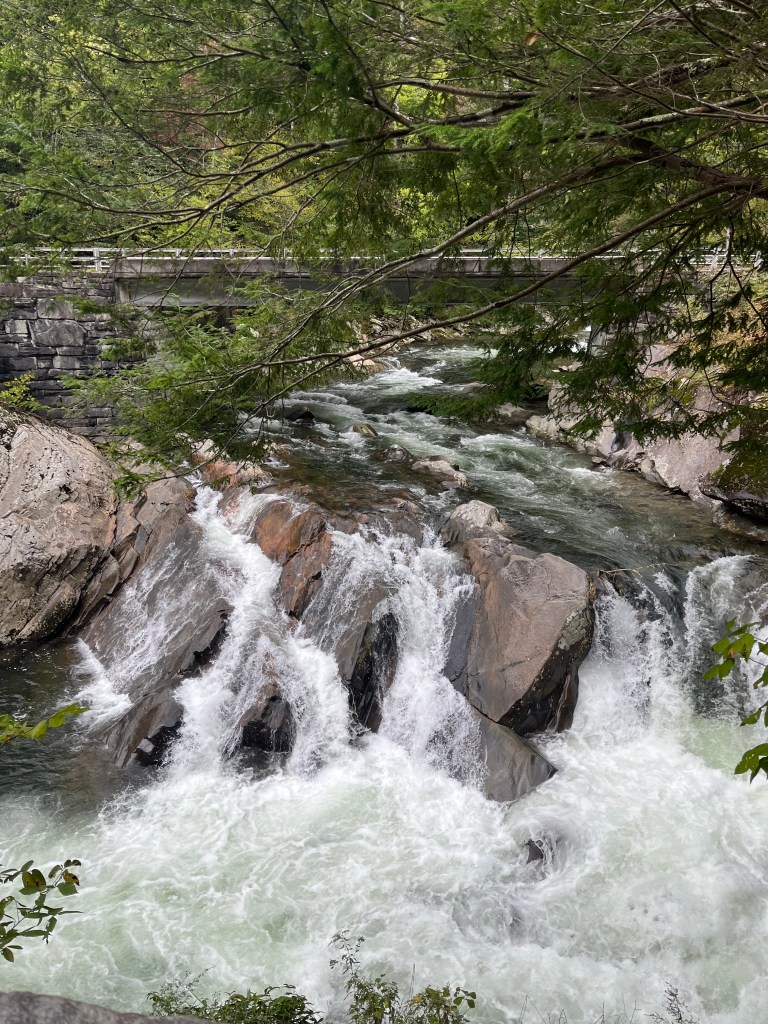
To finish up the day, we hiked the Laurel Falls Trail. It was really pretty, and I thought it was cool that you could walk right up to the waterfall based on how the water flowed. The trail was 1.2 miles one way, with an elevation gain of 420+ feet. The trail was well traveled. It claimed to be “asphalt.” At some point, it was probably all asphalt, but there have been a lot of washouts. Either all of the trail is missing in some places, or just half the trail in other places. I wouldn’t go into this trail thinking it’ll be easier because it’s paved. Look up a video of what the falls looked like during Hurricane Helene because it’s crazy to see just how much water was flowing only a few days prior to us seeing it. It took us about 90 minutes to do it with 2 little kids walking.

On day 2, we went to Cataract Falls because it was a short walk off the parking lot and we had a little extra time to kill. The kids liked this one too because they could play in the water and rocks at the base of the falls.

The hurricane had closed one of the main roads in the park, but it opened up the second day we were there. It was a nice surprise, so we were able to do Clingman’s Dome. This was a wide, paved trail in great condition. The leaves were starting to change colors, and it was pretty on the bottom half. Near the top of the hike, we were hardly able to see anything because the fog was rolling in and really thick. It was cool to see the clouds float right by you though. It’s 1 mile, round trip. It being relatively short and fully paved is misleading though because it’s basically a hill straight up for a half mile (332 foot elevation gain; their website says it’s about a 13% grade). There are multiple benches along the way for plenty of rests. We made it to the top in about 20 minutes. We then spent about 20 minutes at the top of the tower before heading down. It took us about 20 minutes to get down too. We stopped at a pull out with a NC/TN line marker and explored there for a little while too.

On Day 3, we did Grotto Falls. You take a one lane road to the parking lot, where there are about 10 parking spaces, and they were all full. Since it’s a one lane loop road, there was no waiting for something to open up. We kept driving and parked about 0.4 miles down the road in a pull out. The trail itself was 1.4 miles to the waterfall, so the kids hiked with us for a total of about 3.6 miles. They did awesome and didn’t complain once about the distance. We took our time on the trail and stopped for a while at the top to eat lunch and explore. From the time we left our car to getting back to it was about two hours, so not bad at all.

During our drive back, we drove the other end of the Foothills Parkway and saw all the bridges that Mr. ODA was part of building. No hiking around there, and the pullouts were nice, but didn’t take much time to explore the view.

HELOC

HOME EQUITY LINE OF CREDIT or HELOC

A HELOC is a line of credit secured by the equity in your home. This is different from a loan or mortgage.

What is equity? It’s the appraised value of your home that is not mortgaged. You may have put 20% down when you bought the house, and now you’re looking to tap into that equity along with the principal of the mortgage you’ve paid down. Or perhaps your home value has increased drastically, and you want to utilize the equity.

What is a line of credit? It is a revolving account of credit. This means that when you close on a HELOC, you don’t get a check cut for that amount right then. You need to “draw” on the account, as needed, which is essentially writing checks from that account to either yourself or another entity. As you make principal payments, the amount of principal becomes available again for a future draw, as long as you’re within the draw period of the line of credit.

Do you have to disclose the purpose of the HELOC? There are no parameters on what you can use the money for when you draw it from the HELOC. You may want to pay off a credit card that has a higher interest rate, do home improvements, do other construction projects, medical bills, etc. While you’d want to utilize this for larger purchases, you can draw smaller amounts as long as you draw the minimum required by your terms (e.g., no less than $100). You earn interest from day 1, so this isn’t more beneficial than a credit card that gives you a short-term “loan” for your statement period (you don’t pay interest on a credit card balance that is paid off by the due date).

TYPICAL TERMS

The application process is similar to applying for a mortgage. A bank wants to see your credit report, along with some backup documentation (e.g., tax returns, account statements). We also had to update our homeowners insurance to show the HELOC as a mortgagee.

A HELOC will typically only cover a portion of the equity in your home, depending on the bank’s terms. If your appraisal value is $400,000, and your mortgage balance is $250,000, then the equity in your home is $150,000. While there may be instances where a bank would approve a HELOC for the full amount of $150,000, most are going to approve 80% or 85% of that amount.

There are no closing costs associated with the HELOC. Typically, the bank processing the HELOC will cover the costs associated with the line of credit initiation up front. However, they will require those fees to be paid back to them if the HELOC is closed within a certain period of time (usually 36 months). For our first HELOC, when we closed it within the 36 months, we paid back a prorated amount of the fees (e.g., if the fees were $300, and we closed it after a year, we owed $200). For our current HELOC, if we close it within the 36 months, we’re required to pay back 100% of the fees they covered, not the prorated amount.

A HELOC has a variable interest rate, which may adjust monthly or quarterly based on the lender’s terms. A variable interest rate can adjust up or down. But this is something to be aware of because it’s not like a loan or mortgage that has a fixed rate made known up front. The rate, in our case, is set at the index rate with a margin. However, there’s a floor to the bank’s rate. What does this look like? The index rate is 3.50%. The margin is -1.00%. However, the bank’s floor is 3.00%. Therefore, even though 3.5-1=2.5, the minimum interest rate they’ll lend at is 3.00%. Therefore, our current rate is 3.00%.

There is a “draw period,” which means you can only take funds from the line of credit for a certain period of time (e.g., 10 years). When you do draw from the line of credit, you’re charged interest on the principal balance. During the draw period, you must make the minimum required monthly payments on the account, which is typically the monthly accumulated interest owed, but some banks may require principal payments during this period also. When the draw period is over, it enacts the principal repayment period, meaning you have a certain amount of time (e.g., 10 more years) to repay the principal balance of the HELOC. There is no charge for the HELOC existing though; it can be there and never drawn on.

OUR PROCESS

The most recent HELOC we closed on had a different process than the first. We expressed our interest, and since they already had our documentation on hand from a commercial loan, they didn’t ask for supporting documentation (e.g., account statements). However, for some strange reason, she said she couldn’t use the credit report from our commercial loan, and she had to pull our credit again. At the time we were applying for another mortgage, so the hit on our credit counted as “mortgage shopping,” so we gave up the fight and let it happen.

This company would have given us 100% of the equity available in our home. However, two weeks after initiating the HELOC process, we told them we needed a pre qualification letter for an offer we made on another personal residence. They then told us that since we’re on record as wanting to sell our home, they would only approve 80% of the equity.

The loan officer asked for two references for each of us. There was no information given on what this personal reference had to know about us. We both handed over our people, but they were never contacted, so we won’t know the purpose.

Finally, they asked for our homeowners insurance to show them as a mortgagee on our policy, which I was able to do with one quick phone call to that office.

Typically, the process will include an appraisal. This bank had a valuation system that they used. Based on this woman’s inputs into the system (which were all wrong), she said that she could approve us for $100,000 without paying for a full appraisal. We don’t need more than that, so that was sufficient to us.

We closed the HELOC a month after expressing interest. Our process may have been slower than the typical period it would take because we were fighting the credit pull for a while (not to mention the company we were working with is notoriously slow at responding to inquiries). Mr. ODA expressed our interest in pursuing the HELOC on April 12th. We were cleared to close as of May 11th, but we chose to close on that following Friday. We went to a local bank branch, and a relationship banker went through the documents with us as we signed them.

WHY THE HELOC FOR US?

My general plan was that we’d have a HELOC initiated, so that when we found a new personal residence, we could use the HELOC for the down payment of that house without having to sell our current house first. In the past, we’ve sold our home, went into temporary housing, and then moved into a new home. Granted, all our past home purchases were in a completely different locale than where we were living, but I really didn’t want to manage storage of goods or go into temporary housing with two kids and a dog again.

We initiated the conversation on the HELOC without having any intent to move yet. Not to go into too much detail on this topic, but we need to be residents of this house for two years to avoid paying capital gains. Our 2-year mark isn’t until November, so we weren’t in a rush to move before then. A home with the same floor plan around the block from us sold for $190k more than what we bought this house for less than two years ago, so we expect there to be a hefty chunk going to capital gains if we don’t meet the two year requirement.

I was keeping an eye on the market, but clearly had no plans to move. To me, a regular check on Zillow lets me know what I can get for my money. However, there are some things related to our current personal residence that are concerning, and we had decided that this wouldn’t be a long term location for us. With the market right now, I knew we’d either be paying a higher mortgage than I ever anticipated in life, or I’d be compromising on my wish list. Well, a house that met a lot of our wish list popped up in the area we liked for less than $500k, so we jumped on it. The house needs work, so even though we’ll close on it over the summer, we aren’t in a rush to move into a construction zone.

Once we close on the new house with funds from the HELOC, we’ll start accruing and paying interest on the balance. We’re not required to make principal payments until after the draw period, which is 10 years. When we eventually sell our current home, the proceeds from the sale will pay off the HELOC seamlessly through the closing process.