Rental Options

There are options that give the tenant flexibility, while protecting your financial interests in a rental property. I talk about this in some fashion about once per year, but I like to give the reminder.

In January, I ran all my usual numbers to determine if any properties needed a rent increase. The last few years have really hit our margins – insurance has drastically increased, taxes have increased significantly, and the regular trades costs have increased over time as well. During this process, I determined that 5 houses needed some sort of increase in their rent. One was the responsibility of my property manager, and the other four I wrote up the notifications, put them in the mail, and then emailed them also.

I’ve had two tenants respond back that they intend to move in the next year, and they wanted month to month. We don’t agree to month to month options. Well, I should point out that for significant financial compensation, we would consider month to month. However, the expectation is that having a long term tenant renew their lease is less work month over month. If they’re on month to month, I’m constantly watching and waiting for their 30 day notice. Additionally, there’s a concern that their 30 day notice comes in October or November, leaving me with a mid-winter lease that I’m trying to get filled.

Instead, I provide a few options that protect me. I’ve done the “buy out” or “penalty” option multiple times in the past, and that has served me well. I haven’t needed a short term lease option, but since there are certain circumstances with these houses, I put that offer out there.

In both cases, the tenant said she wants to be able to leave sometime in July/August. This is manageable to me because I can likely rent it under a fairly quick turnaround.

  1. Short-term lease
    While I would typically require an increase in rent to cover a short term lease, I was already in conversation about rent increases, so I let it be. I offered a July 31st or August 15th move out. In both cases, I know the house is going to require work. I’d like to have the last two weeks of August available to me for construction activities, instead of going into September and trying for an October 1 lease start date.
  2. “Buy out” options (e.g., penalty payments)
    In this case, I have the tenant sign a year lease. However, the lease comes with “lease break clauses.” The penalty for breaking the lease ranges based on the time of year. In all cases, I require 30 days notice and full payment of rent through the date given as notice. If the tenant wants to leave before 8/15, then there’s no penalty.

    If they want to leave between 8/15 and 9/30, then they have to pay the equivalent of one-month’s rent.

    If they want to leave between 10/1 and 1/31, there’s a two month penalty. This is because finding a renter during this period is difficult. There aren’t as many people looking during the winter because most leases are spring to spring, so the turnover is fairly cyclical, and because most people are distracted with starting school and all the holidays happening during that time rather than looking to rent (or even buy) a house.

    If they want to leave between 2/1 and 3/31, there’s a one-month penalty. Again, this is to cover the longer time it will take me to find someone to take over the lease period, and it provides me with a year-long lease (which most people are looking for) that ends at another inconvenient time for turnover in the next year.

    If they want to leave between 4/1 and 5/31 (which is the end of their lease term), then there’s again no penalty just as there wasn’t for the first few months of the lease term. I’ll be able to get work done on the house and list it for rent, expecting a decent pool of people interested in a rental.
  3. Lease transfer option
    As a final option, which was offered to us when we lived in an apartment building, a tenant can agree to a year-long lease with no extra terms. They then have the knowledge that if they want to “break” the lease agreement at any time in the next year, they are responsible for paying rent until a new tenant is found. They can move out, but they’re on the hook for paying rent until a new tenant has sign a lease.

    This is risk on their end. In some cases, I may be able to get someone in just a week or two. However, if it’s the winter, it could mean that they’re paying a month or two months worth of rent while they’re also living and paying rent somewhere else.

    The only time that I’ve used this option, the tenant provided notice on December 1st, which as I’ve pointed out is not a great time to be searching for a new tenant. Since he was already not living in the house (he had moved back in with his parents), he agreed to empty the house of his furniture so that we could still show it during that time. He paid rent on January 1st per our agreement, and luckily we found someone to take over the lease as of January 7th or 8th, so I refunded him the prorated amount of rent.

The “lease take over” concept was done by a management company in a fancy apartment building outside Washington D.C. It never hurts to ask for options if you’re the tenant. Just understand that managing the rental is work that the landlord has to do, and their “profit” is how they’re paying themselves for that. Especially in today’s environment, that margin is quite small. So when they tell you they don’t want to have a lease fall through in the Fall or Winter, understand how this is their investment and their income, so they need to protect themselves, even if it’s not necessarily what works for you or is your preference. And as for landlords, treat your tenants nicely and be as flexible as you can; it always pays off for me.

House 4 Turnover

We had a long term tenant in this house, who moved out last Spring. We luckily had someone lined up looking for a place to live. There were a few red flags from the beginning, but I went with him because he was a friend of an old tenant of ours. Rent was always paid on time, and everything went fine. Unfortunately, there was a public incident at work in the Fall and he was let go. He asked if he could be released from the lease so he could move back home.

I wasn’t interested in making anything more difficult for them. I didn’t ask for a lease break fee; I just asked that they continue to pay rent until we found someone who could take over the property. It was winter and holiday time, which is least favorable time of year to be finding a renter. They gave notice at the end of November and we listed to house right away. We did our due diligence to get someone in there as best we could, considering it was Christmas time and the middle of winter. The tenant paid January rent on the 1st, as required. Luckily, we were able to get someone moved in on January 5th. The tenant didn’t do anything wrong to the property, so I gave back his security deposit and the January rent they had paid.

TURNOVER

The original tenant had essentially vacated the property, so we were able to get in and do some work to it. The entire place was painted and had extensive maintenance needs met over last summer (after the long term tenant), so this was an easy task to get it ready for a new tenant.

We received a notice from the city that the yard needed to be cleaned up, so we had the tenant go over there and do the work. There was a tree limb that had fallen (and wasn’t reported), so we had someone go clean that up and the rest of the yard for $100.

Several years ago, we had replaced most of the windows in the house. There were 3 windows that were either fine or oddly shaped, so we didn’t replace them. That was a mistake. We ended up spending the same amount on 3 windows this year that we did several years ago for 6 windows.

The front porch of the house is seldom used. The driveway is in the back of the house and leads straight to the kitchen door. The entire front of the house is fenced in too (the house has a huge front yard and small back yard). Due to the age of the house, that it’s a rental, and that the front porch is rarely used, it wasn’t in great condition. It was finally time to replace it. We had our handyman rip out the stairs, banisters, and floorboards to replace it all; it cost us $1,640.

The kitchen faucet wasn’t working right, so we had our plumber replace it. He also tried to flush the water heater to extend the life, but it was broken enough to replace it. We needed a special size because it fits under the counter in the kitchen, so that was $1500.

Other than a clean from our cleaner, that was all that we needed to do.

TENANT SCREENING

We had 4 sets of people show interest in the property. One withdrew her interest form after checking the sex offender registry (understandable, but it is a city home, so that’s not surprising). I was interested in another guy who was retired and seemed handy, but as time wore on, there were several red flags. Another person tried to convince us that his day-trading of stocks qualified him to pay us rent each month, so he was disqualified for not meeting income requirements. Finally, a couple showed interest, and my property manager said they seemed like a decent option in person, so we went with them. At the time, I didn’t really comprehend that one of the tenants was only 20 years old. That comes into play when he shows his age and inability to handle a mature conversation about rent payments a couple of months later.

Due to the unexpected timing of turning over this house, we ended up with an 18 month lease. We didn’t want a 12 month lease, leaving us with another winter turnover. Even though their lease started January 5th, I counted the full month and ended the lease on June 30, 2025. I like a May 31 or June 30 lease ending the best because it seems to be when the most people are looking to move. Once you get to July 31st, most people (in the southern states, at least) are looking to have already been settled in the school district they wanted.

TENANTS THUS FAR

Well, since I had plenty of posts teed up, I’m only getting to post this now, months since they’ve moved in. That means I have a sample size of their tenancy to share, and it’s not good. They’ve had a lot of complaints, which is interesting to me since the previous tenants didn’t seem to have many issues with the house. It’s a 1943 house. It’s not perfect. It’s not spacious. But I assure you, the house is exactly what you see when you first tour it. It’s a cute, little, old house.

The tenants used Venmo to send the first sets of payments when moving in. For some reason, they decided to switch to Zelle; in doing so, they didn’t follow the instructions I gave them, and are sending them to an account I’d prefer them not to, but oh well. In March, rent arrived on the 6th. I was bothered by it, but I let it go. Then for May’s payment, we hadn’t received it by the 5th in the evening. Our property manager reached out to them to ask if they planned on paying that night. They said they had already paid on the 2nd. We explained that we hadn’t received it, and we still see no indication of it arriving electronically. He sent a screenshot of his bank’s information, which did confirm a payment on the 2nd. We said ok, thanks, and we’ll check in the morning.

He then went off the deep end. He attacked us, as if we just sit around pretending we don’t receive money so they’ll send more money. At no point did he stop, think, logically read our messages, and respond politely. He continued to berate us and the property manager over this, where we carefully explained that sometimes there’s an additional verification step required so that this 3-5 day hold doesn’t affect when rent is due. He kept saying he was completely verified and that it’s our bank not accepting the money. That’s not how banks work, but ok.

He eventually agreed to use Venmo. I went back to his January payments, liked them, and ‘friended’ him on the platform so that he’d have the right account in front of him. He did pay June’s rent on time and via Venmo.

In his berating of the house, he talked about how the house was awful. The house that they walked through and agreed to rent. The house that is very small and very old, but is clean and operational. The house is nothing special, but it’s a house with rent under $1000 in 2024 and decent access to the activities in the city.

They complained that the light in the oven was stuck on. They didn’t want to pay to run that electricity in a house that already had a high electric bill. It’s an 800 sf house; if you’re paying $350 per month for electricity, I’d say you’re doing something wrong. All systems in the house have been serviced and/or replaced recently. All the windows in the house are no more than 5 years old. We had our plumber lined up to handle this for us (he’s a good guy!), but they figured out what to do differently to get the light to turn off. What frustrated me the most about this complaint was that they acted like I purposely broke their oven 3 months after they moved in (and I live in a different state), and yet I’ve been very responsive to all their requests for maintenance.

SUMMARY

Overall, everything is fine. They have a lot of growing up to do. I hope at some point they learn that you catch more bees with honey. For now, they’re there until the end of April. We’ll see how the next several months go, but at this point, I’m interested in finding someone else. Based on their hatred of the house, I expect they’ll move out on their own accord regardless.

Lack of Rental Payment

I was going to include this in a financial update post, but it was too long and complicated to include there. I really want this to be a lesson for anyone reading this – mostly on the renter end, but perhaps for a budding landlord as well. We tried really hard to work with the tenant, but we can’t work with someone who doesn’t communicate up front and doesn’t keep her word constantly. When using statements like “I need to keep the water and electricity on for my kids,” understand that the roof over their head isn’t a given. I’m a private landlord and be lenient, but an apartment complex type situation isn’t going to allow you to not pay for months on end; they’re going to file for eviction on the first day 6.

THE DETAILS

After this house was flooded by a tenant, we got it fixed up and on the market. The options at the time were limited; plenty of people were interested, but they weren’t qualified. The area called for $2,200, but I wanted it to move quickly, so we listed at $1600. The previous tenant was paying $1200, so this felt like a huge jump. No one qualified for the property. We had two options that were close enough to our requirements.

We chose a single mom who worked two jobs herself to be able to afford this place. Honestly, kudos to her for her effort. She lost both those jobs (we knew about one, but not both) and ran into some other troubles. She has worked hard to get herself back on track. I commend all that. She’s wonderful like that. Her communication (or lack thereof) was infuriating.

At the beginning of October, she said she’s back on track now with a steady income (replacing both jobs), but with all the outstanding bills, she’s going to need time to catch up. I’m a very understanding person and work with my tenants as long as they work with me. Instead of telling me WHEN I should expect to see payments, she left it open ended with “sometime in October.” I gave her the benefit of doubt. Then two Fridays passed with $0 paid. I asked for an update through our property manager.

On the 16th, she sent over $300 (after we had to ask for payment), and wrote, “I will be sending another payment this upcoming Friday and typically Fridays going forward.” Typically. She reiterated that October would be paid before the end of the month, and then she’d need about two weeks to pay November’s after that. She did pay $500 that following Friday, and then missed the next Friday.

My property manager had to follow up with her 3 times before she actually received an answer. The tenant claimed she had been too busy to respond. Excuse me, but keeping a roof over your head should be a priority in your life (this will be a theme). I asked for a payment plan instead of this open-ended concept of payment. On November 1st, she finally responded that she was going to pay $400-700 every Friday, going forward, unless she needed to pay other bills. Again. “I’ll pay you when I pay you, unless I don’t pay you.” This isn’t appropriate.

She paid $700, as goods and services, on November 3rd. All fees are the tenant’s responsibility, so now she owed another $15. She ended up sending $50 over that same day. At this point, it’s November 3rd, and she’s still $60+ short on October’s rent and $0 towards November. As expected, Friday November 10th came and went with no communication and no payment. She ended up sending an email in the early morning hours of the 11th stating she’s waiting on a deposit to clear, so she’ll pay something on Monday. She did pay that Monday. However, she had said she’d pay every Friday, and the 17th came and went with no payment. Again.

On the morning of the November 18th, I sent the notice of default. It said she had 5 days to pay the entire balance or we’d file for eviction. She threw a little tantrum, claiming she wanted to end her lease. It doesn’t work like that. My property manager had a good idea and was able to articulate our frustration sternly, yet professionally. The property manager said that “forgetting” and “life” getting in the way were not acceptable responses, and it was time to be responsible for herself and her bills, perhaps by setting alarms or utilizing her calendar for reminders. The offer included our waiving of December and January late fees ($160 each) if the tenant continued to pay every Friday without us having to follow up. I thought the incentive was great. The tenant then paid $700 on the 24th and $600 on 12/1. At that point, she was caught up on October and November (sans late fees though), while paying into December’s rent owed.

She paid the first two Fridays in December, missed the 22nd, and paid on the 29th. At the end of December, she had a balance owed of just over $500, which included all late fees, so that was a decent position. Then things went downhill again. She paid nothing until January 17th, and it was only $100 that day. She claimed an issue with the amount she was able to send over, but stopped trying. When we asked why she mentioned $400 in $50 increments, but only sent over $100, she acted like we did something wrong. Over the next week, she ended up sending $300. At the end of January, she owed $1,863.40.

TENANT VACATES THE PROPERTY

In mid-January, seeing that communication was getting worse, and payments weren’t even being made, we asked her to leave. I was really trying to get through February so that we’d have a more favorable market time to list it. She said she didn’t want to leave. That’s a bold statement from someone who owes a lot. On January 25th, we sent her the 5 day notice until eviction document, which showed her balance due. We offered her the ability to leave the house by the end of the month with minimal damages, and we’d just keep her security deposit. Her initial response was that she wants to finish interviews she has scheduled, and she didn’t want to leave.

Within 24 hours, she decided she did want to leave. For the first time in all of this, she fully explained her situation. She gave good reason to have until February 4th to leave (instead of the end of January). We allowed it, but she’d be responsible for those days of rent in February.

As a final goodbye, she told us she would be able “to make another payment that first week of February.” As I suspected, she meant the week of February 5th, and not the 1st or 2nd. She didn’t pay. On February 9th, she “kindly” asked for an extension for the final payment, since she was expecting her tax refund in the next two weeks.

I don’t need to tell you at this point – two weeks came and went. She did end up paying over $500 on 2/29 though. That was more than I ever expected. I don’t know how she arrived at her number (she did email an explanation, but the numbers didn’t add up), but I’m accepting it.

TURNOVER

She actually left the house in great condition. She had sticking LED light strips in a bedroom that said they were easily removed. However, when she removed them, paint came with it. I had to have someone touch that up. She bought blinds, but didn’t hang them, for ones that were damaged (she had asked us to pay for them when she first moved in, so that was a nice gesture to uphold the integrity of the request), so I had to have someone do that. Then I paid someone to clean the house, which is normal. Overall, she was difficult to communicate with, but I do believe she meant well.

BACKGROUND & EXPECTATIONS

I have a track record of being very lenient and very understanding. I promise. I can provide lots of examples where I’ve let people know to take their time, prioritize back to school necessities, waive the late fee, etc. I can not work with you if you don’t talk to me. I don’t know what you need. I don’t know you as a person and whether you’re “good for it.” I need to know your expectations, needs, and plan. Talk to me without me hunting you down for information. I don’t know where I’ve said this before in this blog, but I’m positive you can find that or a very similar statement made throughout. Understand that in nearly all other scenarios, a landlord is not going to be patient for 4 full months to try to get you to pay rent owed.

She said phrases to me that were generally that she has kids so keeping the water and electricity current is her priority (isn’t keeping a roof over their heads equally important?), or that she asked for grace and patience (what have I been doing? I could have issued you the first step of the eviction process on October 6th, and I didn’t, even though you didn’t pay a penny towards rent until the 16th). It’s things like that get under my skin and make my efforts feel unappreciated, making not want to work with you going forward. Take the time to acknowledge how gracious I HAVE been, that I have bills to pay in addition to you having bills to pay, that I deserve to be given regular updates and information without having to follow up and beg for information.

My property manager says “she’s young” and “she’s learning.” There have been learning opportunities, but it’s also not my role to mentor a tenant on how to be an upstanding citizen and uphold your commitments. There were two other late rent moments this summer where my property manager said that if there’s any issues with rental payment, we need to know ASAP, without us having to make phone calls or send emails. My property manager reiterated this expectation on October 31st over the phone – don’t miss a Friday rent payment, assume we know you’re not paying anything, and leave it at that (I already played the “benefit of doubt” game through October when we received $0 for half the month).

LESSON

Communicate with the landlord. Don’t put the landlord in a position where they’re having to keep track of your financials and whether you’re paying timely. Pay regularly or communicate up front. All of my leases state that rent is due without demand. My having to regularly ask for an update or why you haven’t paid a single penny halfway through a month is not in any realm an acceptable way of doing business.

Renters need to understand that landlords have bills to pay. Those bills (that mortgage) are not as lenient as I’m trying to be with you. If I don’t pay my mortgage, there’s a late fee and it’s immediately reported on my credit. They also don’t accept partial payments. If I don’t pay for long enough, it becomes a foreclosure. As a tenant, you don’t know if I have funds to cover that payment. Assume I don’t. If I don’t pay my mortgage, the house is foreclosed, and you’re kicked out anyway. You’re getting by without any credit hits, as you’re now two to four months behind on rent. I’m floating mortgage payments on your behalf. Lucky for you, I’m on top of my credit and paying these bills even if you’re not paying me, but that isn’t an assumption you should make.

Your actions have consequences. You can mitigate those consequences by upholding your word and keeping in regular communication on what’s happening (again, up front, not after the deadline passes).

Lease Break Agreement

Last March, it was time to make a decision on renewing the tenant’s lease on House9. There were several variables at play, and we ended up adding “lease break” terms to the renewal agreement. Here’s how and why we did such a thing.

LEASE BREAK CLAUSE

All of my leases are set up as a lump sum fee. This means that if the rent is $1,000 per month, then the lease is a legal binding agreement for $12,000 for the year. If you wanted to leave 6 months into the agreement, I could hold you accountable for the entire sum. In reality, this wouldn’t happen. I’d have to show a good faith effort to re-rent the property once the tenant vacated the property, and they’d only be responsible for the time it was vacant, at most.

The point here is that there is no section of my lease agreement template that allows the lease to be “broken,” and the tenant to leave “early.” In some instances, a tenant will request the flexibility to leave early, and we typically charge up to a month’s rent for that ability. We most often use this for tenants that expressed interest in buying a home. There are some other fee structures that we use depending on the circumstances, but this will focus on those instances where we know in advance that this is a possibility.

ORIGINAL LEASE AGREEMENT TERMS

The tenants had signed their original lease in June 2020. From the beginning, they were clearly money savvy. They had said from the beginning that they were looking for a place they could live until he finished his schooling, which was about 2 years away. They negotiated a two year lease for $1,280. In September 2021, so 6 months before their lease was set to expire, he reached out with an offer. His program was set to end in May 2023, but they didn’t want to commit to any longer than that since he could be placed anywhere upon graduation. He asked to go month-to-month after that.

We agreed to extend their lease until May 2023, but it would be $1,300 (instead of $1,280) between 7/1/2022 and 5/31/2023. We decided not to engage in the month-to-month conversation that far in advance, which he understood.

In March 2023, we started discussions on their status. They were about to have a baby, the market had cooled for buyers, interest rates were high, etc. They didn’t want to rush their buying process. Instead of paying the premium for a month-to-month lease, we decided on another year-long lease, but it would have a “lease break clause.”

NEW LEASE AGREEMENT TERMS

The new lease was executed for $1,350 per month, which was still a bargain for their property. However, we added lease break provisions, as seen below.

The thought process here was that we were protecting our financial interests based on the time of year. First, we required a month’s notice. Our original lease already states that we can have access to the property to show it to prospective tenants, so that wasn’t repeated here (although it is worth noting that this in our lease agreement, since renting while a unit is occupied is not always a given; we struggled with our property manager in KY getting access to our properties (that was a property manager issue)).

I don’t know if there are facts to back this up, but it seems (through my own years of renting, as well as all these years as a property manager) that most people are looking for a rental to be somewhere between May 1 and July 1 as the start. A quick search tells me that the common months are May to September. However, in the south, we start school in mid-August. If you’re not moved by August 1st, I’d venture to say you’re not preferring a September 1st start date.

If the tenant left in the summer months, then the fee was only 1/2 of a month’s rent. We had a good chance of being able to re-rent the property if it was during the summer and before everyone focusing on back-to-school in the end of August/September. If they requested a lease break between September and the end of March, then it was a full month’s rent. This was due to the fact that the turnover process was going to be longer than our typical turnaround, and it would put us at a disadvantage in re-renting the property down the road. We then put that there would be no fee if they left in the last two months of their agreement because 1) we’d likely be able to rent it quickly, and 2) as a way of showing that we’d meet in the middle since they were such great tenants.

EXECUTION OF THE LEASE BREAK AGREEMENT

The tenant had used our property manager as their Realtor for a new home purchase. She tipped me off that they’ve be giving their notice shortly, sometime at the beginning of November. I naively thought that meant they were newly under contract, but by the time their notice was given, they had already closed on their new home. They purposely waited to give their notice so that they had time to move their belongings without being rushed (which is fine; I don’t know why that reads negatively). On November 24th, they let us know that they’d be leaving by 12/31.

While the fee was due upon notice, per the lease agreement, it wasn’t something I was willing to fight. If you’re a good tenant and hold the lines of communication open, I’m happy to treat you as an equal. They paid the fee on 11/29, and then they paid their December rent on 12/4.

LESSONS LEARNED

Honestly, it worked just as planned. We weren’t able to rent the house for January. The lease break fee alleviated the pressure to settle for a tenant just to fill the house because we had the month’s income already accounted for. We’ve done something similar in the past, and this set-up has worked well for us. It gives a little grace to the tenants and real life needs, while still protecting our interests as business owners.

We put the same type of clause in another tenant’s lease. They executed the clause on February 23rd, letting me know they’ll be leaving by the end of March. If they broke their lease in March or April, there was no fee (their lease was set to expire April 30th, so it’s one month early).

Their are times where a tenant doesn’t know up front that they’re going to find a house they love or a job is going to move them. We handle each on a case-by-case basis. Generally, it’s either going to be a month’s worth of rent as the fee or it’s going to be a fee of $250 (the amount I pay to the property manager) and they pay rent until we find a new renter (which has never taken more than 6 weeks, and is typically a few days turn around for me).

House 7: Two broken leases that have worked out

This one has been pretty easy, but we did have an interesting issue arise with the first tenant.

This is our largest house at 4 bedrooms and 1.5 bathrooms, and 1281 square feet. It’s a cape cod style house, so the upstairs has slanted ceilings, the half bath is not anything to write home about, and the HVAC struggles to work up there. The carpet on the stairs could really be replaced (but it hurts me to spend money on stairs because they’re soooo expensive compared to carpeting a room!). But the house has a huge fenced-in yard with a nice deck that’s a great selling point.

The kitchen was renovated at some point, so that’s held up well – and lets face it, who doesn’t choose baby pink knobs for their new kitchen cabinetry? But the plumbing and roof have been painful.

I’ve already told many of the stories about this house through other teaching posts, so bear with me if things sound familiar.

LOAN

The house is in Richmond, VA, and the purchase was very simple. We offered $109,000, and the seller countered with 112,500 and 2,000 in seller subsidy (i.e., closing costs), which we accepted. It was listed on June 22 at $119k, and we offered on June 25, so I’m actually surprised we got the contract agreed to so quickly.

Quick note here: after reviewing real estate contracts in NY, KY, and VA, Virginia wins. Sure there are several states that I haven’t ventured into, and this is an extremely small sample size. The paperwork is simple yet thorough, all while being in plain language. So if you’re needing a template to work off of, look up Virginia’s purchase agreement.

We settled on a 30 year conventional loan at 5.05%. We received a $200 lender credit since we closed on several properties in a short period of time. This is the house that we refinanced and received an appraisal of $168,000! We had already started with equity in the house because it appraised at $114,000 at closing.

INSURANCE

Interestingly, we couldn’t insure the house through the company that we had gone with because they have a 5 rental limit. Our agent was able to quote us through another company though, so our process appeared seamless. However, the quote was much higher than we anticipated. We went through a friend to insure it, but shortly after closing (literally a week), we were able to find an even cheaper option – that was awkward.

THE NEIGHBORHOOD

Not a category that usually gets mentioned. I discussed the neighborhood of the one house we sold already, which was because I didn’t realize it was in a higher-than-average crime area that tenants honed in on. But this neighborhood is worth mentioning.

Rentals aren’t prevalent here. In fact, many of the homes are the original owners. While working on the house when we first purchased it, the neighbor across the street approached me. He as-politely-as-possible threatened me that this is a nice neighborhood, that everyone keeps up their property, and that they don’t want any trouble. I assured him we have good standards as landlords, and we haven’t had any neighbor complaints for any of the tenants we had in our houses.

The location also comes into play for our first tenant.

TENANT #1

This house is under a property manager for 10% monthly rent.

As with most of our tenant searches, no one fits perfectly into our requirements. We offset this by a higher security deposit or having another signatory on the lease. We had two prospective tenants – one was a mother/daughter combo (an adult daughter) and both had bankruptcies in the last year; the other was a man and his family that had an eviction 7 years prior. We chose the one with an eviction. His application actually said that he “will also respect the property to the utmost.” Boy did he.

He first requested that the carpet be replaced. It was actually a reasonable request because it wasn’t the best. Here’s the carpet on the second floor. Old, bottom of the line padding; a gorgeous blue; lots of wear spots.

We decided to refinish the wood floors on the first floor because 1) he wasn’t moving in for two weeks, and 2) it would save us in the long run to put that investment into the floors instead of carpeting every few years (and risking someone completely ruining it before its useful life was up). It was $1850 and the company was able to start immediately and get it done before the tenant moved in (granted, it was the day he moved in, but it did get done). And the refinish turned out great!

He asked us for a screen door, but we said that wasn’t a necessity. He asked if he could install one himself. We agreed, as long as it didn’t prohibit our access (e.g., he can’t lock it, give us a key). This later becomes an issue because he locks it after vacating and we need it rekeyed.

This tenant had a few late rent payments and struggled with paying rent on time, but overall he was a good tenant to have. He took care of the property and let us know when he ran into issues (it’s amazing how many people don’t tell us of a problem in a timely fashion).

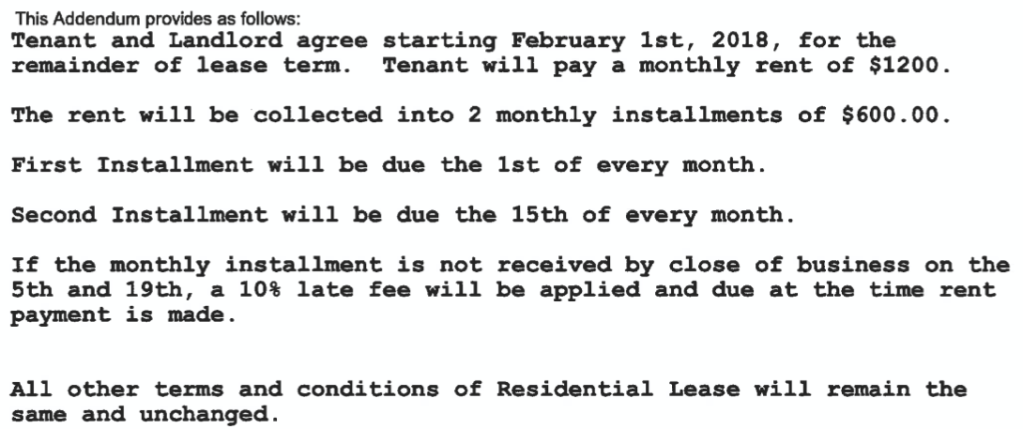
Just as we did on House 5, we offered this tenant the opportunity to pay rent in two installments each month. His rent was $1150 from August through February. He took the opportunity and we executed an addendum to change the rent to $600 twice a month. Again, it’s an inconvenience to us to collect two rent payments, but it theoretically should save the tenant money if they’re constantly in a position that they owe late fees (if he usually pays $1150+115=1265, then 1200 is a better position).

And then the fun happened!

I was at WORK one day, answered my work phone, and someone on the other end asked to speak to the owner of [this house’s address]. I barely used my work phone for work calls, so to receive a personal call on my work phone was very surprising. I informed her that I was the owner. She then went on to ask me questions about the tenant occupying the residence. I couldn’t answer a single question – hah! I let her know that I really didn’t know who was living there or the status of the home because I have a property manager. She was very nice and understanding, and she called my property manager.

She was with the school system. Apparently, our tenant had moved into the City public school district, but kept his kids in the adjacent county school system. It was April. I thought it was ridiculous that the school system would investigate this with 6 weeks left of school, but technically, he was in the wrong. And get this – he blamed me for it! Our nice tenant turned on us and went crazy. He claimed that he could just walk away from the house …. honestly I don’t remember his reason for it, but somehow he thought he had a case.

Virginia has a wonderful statute that says if the house is vacant for 7 days, the owner takes possession without any court interference. There’s also a statute that says we can’t collect double rent, and we need to be doing our best to rent it out if given notice. We tried to keep communication lines open with the tenant, but he was silent. We had told him that we were willing to release him from his lease obligations if we found another tenant, which we did. He was responsible for May’s rent and late fees, and we would have a new tenant move in June 1. We also informed him that he would be responsible for the leasing fee associated with finding a new tenant, which was basically considered the ‘lease break fee’ and is fairly generous ($300 instead of a standard two-months rent that’s typically seen as the fee). It kept going south from there.

On top of the rent owed, he had several lease breaches – room painting (clarification: rooms are allowed to be painted as long as it’s a neutral color or painted back to a neutral color before vacating), wall patching and painting, house cleaning, mowing, re-keying, and utilities since he turned them off. By mid-June, he still owed us $874.76. We made an arrangement with him that he’d pay a certain amount each pay check, but he failed several times. We finally threatened to take him to court, which would affect his credit score and increase the balance owed since court fees would become his responsibility. Since he had been working to rebuild his credit since his bankruptcy, we thought this would light a fire under him.

We went to court.

Court also added a 6% interest charge on the outstanding balance, which now included the $58 court fee.  

It took him over a year to pay the balance. By the time the court judgment arrived, his balance (after paying $50 here and there was $660. The court doesn’t put a timeframe or process on the judgement, but leaves it to the two parties to determine the payment schedule. He didn’t adhere to it well, but we did eventually get the whole balance paid. Mr. ODA also took this opportunity to have fun with calculating interest payments on a declining ‘principal’ balance that isn’t getting payments on a predictable schedule!

TENANTS #2 & #3

These tenants were/are much easier. The second tenant in the house had several large dogs, but we didn’t see any damage to the house. She eventually broke the lease to buy her own house in November 2020; we can’t fault someone for wanting to take advantage of low interest rates! She gave the appropriate amount of notice, but the lease was going to be broken as of 10/31, which isn’t a great time to have a rental come open. She ended up being very gracious with the situation, paid us one month of a lease break fee, and we kept her security deposit.

Right after she gave us notice, we had an old tenant reach out to us. They had moved back into town (I’ve mentioned them several times) and asked if we had a 4 bed/2 bath house available. Amazingly, we did. We showed them the house and they signed a lease within a few days.

Since turnover was fast, and I didn’t really know the status of the house, I didn’t get a chance to paint the house. All the rooms had been white except for the one room that I repainted after the first tenant had painted it lime green. The house really needs a whole paint job, and so I offered her an incentive. If she wanted to paint any of the rooms, she could knock $75 off the rent per room. So far she’s painted three rooms.

MAINTENANCE AND REPAIRS

The plumbing in this house has been horrendous. We had the tub snaked as soon as the first tenant moved in ($150). We then had issues with hot water, which required several adjustments to the water flow rates to coincide with the tankless hot water heater ($325). We had the upstairs toilet serviced ($120). Then a year later, we had to service the hot water tank again ($570). Tenants had complained that the upstairs sink drained slowly. We had attempted to snake it and fix it several times, but it never seemed to work. We finally just bit the bullet and replaced the plumbing – from the second floor to the crawl space. That work and the drywall patching cost us $1563.

Then there’s all the roof work. Shingles had flown off during a storm, so we had those replaced ($350). We also had a leak in the flat roof over the laundry room. We had a roof guy come out, and he said the roof hit its life expectancy. He replaced the pitched roof ($4135), and not the flat roof. So we’ve still had issues there that will need to be addressed.

SUMMARY

That sounds like a lot of money, but we’ve owned this house for 4 years now with our rent being double the mortgage (slightly better now too with the recent refi). When purchasing properties, any good investor is going to build maintenance and capital expenses into their numbers that determine if it’s a worthy investment. Rent cash flow wins out, and all the rest is just the cost of running our business – not to mention the $60k of appreciation we have on paper in just 4 years. It’s also worth noting that these things took up about 10 days worth of action from us over those 4 years, so most months, we just collect the rent with no other action required from us.

No property is going to be perfect, and this business relies on people, the tenants, to make the business profitable. No path will take a straight line, and being flexible to the ebbs and flows of rental property investing help make it fun too!