June Financial Update

We’re continuing our spring/summer of travel and activity, which is why there are fewer posts and lots more spending.

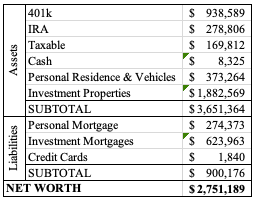
The stock market has increased, which has been the main factor in our net worth change. We paid $2,000 towards the mortgage we’re paying down, leaving a balance of $3,300. This mortgage will be paid off once all our rent is collected for July; it was pushed back a little bit because of the flooring replacement that occurred in one of our rentals, which is why our credit card balance is much lower than last month. We’re also still waiting for half of one property’s rent, which is the norm these days.
  • Utilities: $250. This includes internet, cell phones, water, sewer, trash, electric, and investment property sewer charges that are billed to the owner and not the tenant.
  • Groceries: $518
  • Gas: $268
  • Restaurants: $165. Our credit card reimburses for many of these expenses; we received credits totaling $120.13 in the last month.
  • Entertainment/Medical: $1,093
  • Investment: $1,100
  • Insurance Costs (personal and rentals): $845

VIGILANCE ON CREDIT CARD REWARDS

Mr. ODA discovered that our PNC credit card rewards balance was decreasing, despite earning new rewards this cycle. He investigated further and noticed that we had been losing rewards for a few months now. PNC has a policy that they don’t issue their rewards until you hit $100 worth of rewards. Once we hit $100, PNC sends us a check in the mail. Since they send a check, we still receive paper statements, even though we regularly check our financial accounts online. Over the past few months, both of us checked the balance to see “ok, we’re nearing $100,” but didn’t put any more effort into knowing the details of the balance. Mr. ODA happened to notice that the statement didn’t make sense.
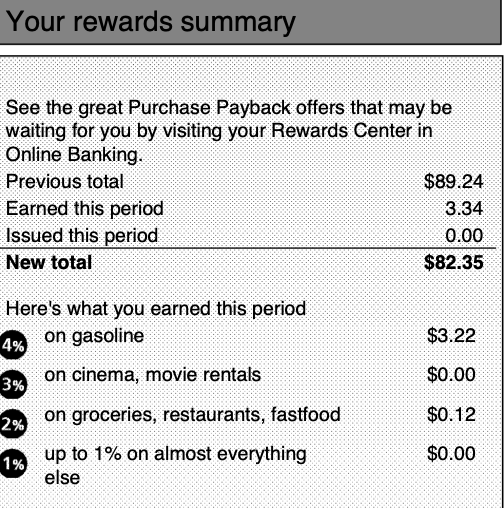
$89+3 somehow equals $82. There isn’t a single section on our statement or via our online account that identifies the loss of rewards Mr. ODA called PNC to ask for more details and learned that our rewards expire after 2 years, despite their policy of not issuing a check until you hit $100. They basically said, it doesn’t matter that your account is over 10 years old, or that credit has been used less in the last year due to the pandemic, or that they don’t clearly identify the expiration of rewards and just identify a lower balance. As a comparison, and I keep going back to Chase, but Chase changed up their reward categories to allow the consumer to earn more rewards during the pandemic (e.g., in addition to giving rewards in the travel category, since consumers weren’t traveling, they added grocery and home improvement stores as major reward categories).

The PNC customer service representative reinstated 60 days worth of lost rewards and issued a statement credit. We don’t want a statement credit because we no longer want to use this credit card, earning rewards that we’ll never be able to capture. If we use this credit card to use up the statement credit, that’s rewards that could be earned on a different credit card. Now Mr. ODA is fighting for the credit to be applied to our checking account or to have a check sent to us (which is the preference on our profile) and fighting for the reinstatement of the rest of the rewards lost.

Without PNC, we’re down to 4 credit cards in our regular rotation. We have 3 cards that we use for categories (gas, grocery, restaurants, travel, home improvement stores), and then we have the Citi Double Cash card that is for “everyday purchases.”

Chase Rewards Portal

GENERAL THOUGHTS

We have several Chase credit cards, both that are active and ones that we used in the past. As we shared in the past, we open new credit cards when we have one or several large purchases to make, so we’re typically looking for a 0% introductory rate for at least 12 months, a sign-on bonus, and no annual fee. We also do a little bit of travel hacking, so even if the card doesn’t hit these typical ‘requirements’ of ours, we’ll open a card if it comes with a sizable sign-on bonus.

Chase offers several cards that have specific rewards categories (e.g., airlines, Disney). However, our general thought process is that if you earn “cash,” you have more flexibilities than being tied to one specific category. Weigh your lifestyle; if you’re the family that does Disney every year no matter what, then maybe a Disney bonus is worth it for your finances.

CHASE CREDIT CARDS

I highlight several of the Chase cards and their main bonuses in a previous post. We currently are using:
– Chase Sapphire Reserve: Has an annual fee, comes with a statement bonus after spending a certain amount after opening, $300 in statement credits as an annual reimbursement for travel, earn 3X points on grocery store purchases per month, dining, and travel booked after the statement credit is earned, and several other bonuses.
– Chase Freedom (now called the Freedom Flex): No annual fee, rotating 5% cash back reward categories each quarter (e.g., gas, internet, grocery).
– Chase Freedom Unlimited: The offerings on this card are slightly different than when we opened them, so I’ll focus on what’s currently available. Sign-on bonus of $200 cash back when you spend $500 in the first 3 months from account opening, no annual fee, 5% on purchases made through Chase Ultimate Rewards, 3% on dining and drugstore purchases, and 1.5% on all purchases.

We’ve also been able to utilize their business card options. However, since several reward categories overlap with others that we have, these are no longer active. We met the requirement for the sign-on bonus, then slowly paid down the balance on the card (while always making more than the minimum payment) over the 0% introductory period, ensuring we had a $0 balance before the interest rate’s introductory period expired. We typically leave a credit card open, but don’t use it, when we’re no longer benefiting from the card’s rewards (e.g., when the reward overlaps with another credit card we use frequently), but we did close the Ink Business Preferred because of the annual fee.
– Chase Ink Business Unlimited: Earn 1.5% cash back for business purchases, offers a sign-on bonus and introductory 0% interest, and has no annual fee.
– Chase Ink Business Preferred: Earn 1% points for all purchases and 3X points for shipping, advertising, internet and phone, and travel. This card has an annual fee of $95.

THE REWARDS PORTAL

We utilize several Chase cards for differing types of bonuses. Chase allows you to transfer points earned from different Chase cards into one account. This is a big bonus for us because we have the Chase Sapphire Reserve card, which offers 50% more value on the points earned when they’re redeemed for travel through Chase Ultimate Rewards than if you took them out based on their straight cash value (e.g., 50,000 points are worth $750 toward travel). That means we’re earning more cash back on those categories and then more when we use those points for travel costs.

Here’s an example: Currently we get 5% cash back on internet with the Chase Freedom card. We pay our internet bill of $45 each month for this quarter. We earn $2.25 cash back or 225 points that gets transferred to the Sapphire Reserve travel portal, where it’s now worth $3.375 for booking travel costs.

We have used the portal several times to book our hotels, car rentals, and flights. Most recently, we searched for a hotel stay. We were able to search for the lodge, review the different types of rooms, and book using our points. Here’s the breakdown of our purchase within the portal.

Chase is also offering 50% more value (100 points equals $1.50 in redemption value) when you redeem points for grocery store, dining, and home improvement store purchases, as well as donations to select charitable organizations. We utilized our points to give ourselves statement credits for several restaurant purchases from the past 90 days that were made on our Sapphire Reserve card.

SUMMARY

We’ve strategically opened new Chase cards over the last 10 years. I wouldn’t recommend opening 3 new cards at once, but, like us, open them as you have a need to cover large purchases. A large purchase looming allows you to meet a fairly high spending threshold to earn the sign-on bonus (e.g., spend $4,000 in the first 3 months to earn a bonus), and opening a new card should give you a 0% introductory interest rate so you can give yourself a free loan for a year or sometimes longer.

Chase offers an array of cards, which have different reward offerings. A positive to Chase’s portfolio is that you can merge your rewards earned on different cards into one portal. This has been especially beneficial because we have the Sapphire Reserve, where your “points are worth 50% more when you redeem for airfare, hotels, car rentals and cruise lines through Chase Ultimate Rewards®.”

DISCLAIMER: Chase has no affiliation with this post; we just love what they have to offer. Be sure to read all fine print on the cards discussed here, and don’t assume we’ve covered all the details that are required to earn the bonuses. All Chase card names and their rewards portal name are registered trademarks of JPMorgan Chase & Co.