Hear more from Mrs. ODA

Back in May, I was a guest on Maggie Germano’s Podcast, “The Money Circle.” I shared some of our background and how we started investing in real estate. We brushed on topics like establishing an LLC, tax advantages, and how you don’t need to start big to just get started. It was a brand new experience for me, but I’m passionate about our real estate experiences, and I loved being able to share. I hope you’ll check it out!

House 7: Two broken leases that have worked out

This one has been pretty easy, but we did have an interesting issue arise with the first tenant.

This is our largest house at 4 bedrooms and 1.5 bathrooms, and 1281 square feet. It’s a cape cod style house, so the upstairs has slanted ceilings, the half bath is not anything to write home about, and the HVAC struggles to work up there. The carpet on the stairs could really be replaced (but it hurts me to spend money on stairs because they’re soooo expensive compared to carpeting a room!). But the house has a huge fenced-in yard with a nice deck that’s a great selling point.

The kitchen was renovated at some point, so that’s held up well – and lets face it, who doesn’t choose baby pink knobs for their new kitchen cabinetry? But the plumbing and roof have been painful.

I’ve already told many of the stories about this house through other teaching posts, so bear with me if things sound familiar.

LOAN

The house is in Richmond, VA, and the purchase was very simple. We offered $109,000, and the seller countered with 112,500 and 2,000 in seller subsidy (i.e., closing costs), which we accepted. It was listed on June 22 at $119k, and we offered on June 25, so I’m actually surprised we got the contract agreed to so quickly.

Quick note here: after reviewing real estate contracts in NY, KY, and VA, Virginia wins. Sure there are several states that I haven’t ventured into, and this is an extremely small sample size. The paperwork is simple yet thorough, all while being in plain language. So if you’re needing a template to work off of, look up Virginia’s purchase agreement.

We settled on a 30 year conventional loan at 5.05%. We received a $200 lender credit since we closed on several properties in a short period of time. This is the house that we refinanced and received an appraisal of $168,000! We had already started with equity in the house because it appraised at $114,000 at closing.

INSURANCE

Interestingly, we couldn’t insure the house through the company that we had gone with because they have a 5 rental limit. Our agent was able to quote us through another company though, so our process appeared seamless. However, the quote was much higher than we anticipated. We went through a friend to insure it, but shortly after closing (literally a week), we were able to find an even cheaper option – that was awkward.

THE NEIGHBORHOOD

Not a category that usually gets mentioned. I discussed the neighborhood of the one house we sold already, which was because I didn’t realize it was in a higher-than-average crime area that tenants honed in on. But this neighborhood is worth mentioning.

Rentals aren’t prevalent here. In fact, many of the homes are the original owners. While working on the house when we first purchased it, the neighbor across the street approached me. He as-politely-as-possible threatened me that this is a nice neighborhood, that everyone keeps up their property, and that they don’t want any trouble. I assured him we have good standards as landlords, and we haven’t had any neighbor complaints for any of the tenants we had in our houses.

The location also comes into play for our first tenant.

TENANT #1

This house is under a property manager for 10% monthly rent.

As with most of our tenant searches, no one fits perfectly into our requirements. We offset this by a higher security deposit or having another signatory on the lease. We had two prospective tenants – one was a mother/daughter combo (an adult daughter) and both had bankruptcies in the last year; the other was a man and his family that had an eviction 7 years prior. We chose the one with an eviction. His application actually said that he “will also respect the property to the utmost.” Boy did he.

He first requested that the carpet be replaced. It was actually a reasonable request because it wasn’t the best. Here’s the carpet on the second floor. Old, bottom of the line padding; a gorgeous blue; lots of wear spots.

We decided to refinish the wood floors on the first floor because 1) he wasn’t moving in for two weeks, and 2) it would save us in the long run to put that investment into the floors instead of carpeting every few years (and risking someone completely ruining it before its useful life was up). It was $1850 and the company was able to start immediately and get it done before the tenant moved in (granted, it was the day he moved in, but it did get done). And the refinish turned out great!

He asked us for a screen door, but we said that wasn’t a necessity. He asked if he could install one himself. We agreed, as long as it didn’t prohibit our access (e.g., he can’t lock it, give us a key). This later becomes an issue because he locks it after vacating and we need it rekeyed.

This tenant had a few late rent payments and struggled with paying rent on time, but overall he was a good tenant to have. He took care of the property and let us know when he ran into issues (it’s amazing how many people don’t tell us of a problem in a timely fashion).

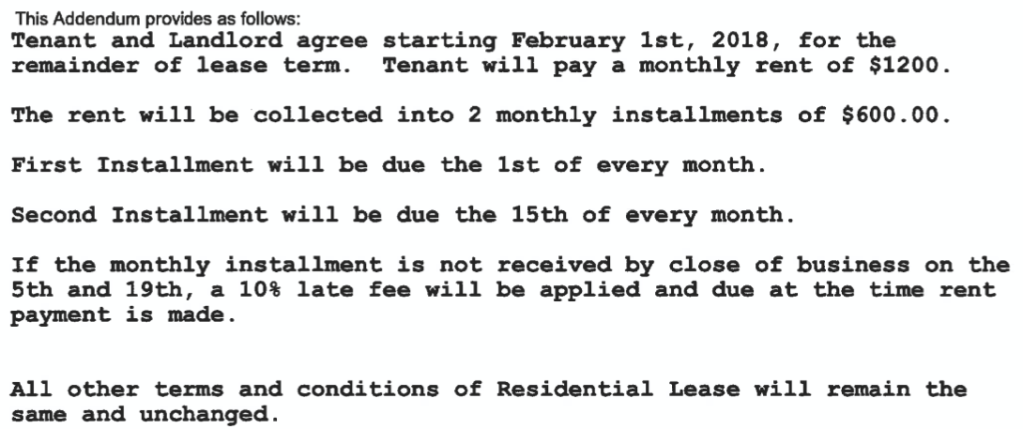
Just as we did on House 5, we offered this tenant the opportunity to pay rent in two installments each month. His rent was $1150 from August through February. He took the opportunity and we executed an addendum to change the rent to $600 twice a month. Again, it’s an inconvenience to us to collect two rent payments, but it theoretically should save the tenant money if they’re constantly in a position that they owe late fees (if he usually pays $1150+115=1265, then 1200 is a better position).

And then the fun happened!

I was at WORK one day, answered my work phone, and someone on the other end asked to speak to the owner of [this house’s address]. I barely used my work phone for work calls, so to receive a personal call on my work phone was very surprising. I informed her that I was the owner. She then went on to ask me questions about the tenant occupying the residence. I couldn’t answer a single question – hah! I let her know that I really didn’t know who was living there or the status of the home because I have a property manager. She was very nice and understanding, and she called my property manager.

She was with the school system. Apparently, our tenant had moved into the City public school district, but kept his kids in the adjacent county school system. It was April. I thought it was ridiculous that the school system would investigate this with 6 weeks left of school, but technically, he was in the wrong. And get this – he blamed me for it! Our nice tenant turned on us and went crazy. He claimed that he could just walk away from the house …. honestly I don’t remember his reason for it, but somehow he thought he had a case.

Virginia has a wonderful statute that says if the house is vacant for 7 days, the owner takes possession without any court interference. There’s also a statute that says we can’t collect double rent, and we need to be doing our best to rent it out if given notice. We tried to keep communication lines open with the tenant, but he was silent. We had told him that we were willing to release him from his lease obligations if we found another tenant, which we did. He was responsible for May’s rent and late fees, and we would have a new tenant move in June 1. We also informed him that he would be responsible for the leasing fee associated with finding a new tenant, which was basically considered the ‘lease break fee’ and is fairly generous ($300 instead of a standard two-months rent that’s typically seen as the fee). It kept going south from there.

On top of the rent owed, he had several lease breaches – room painting (clarification: rooms are allowed to be painted as long as it’s a neutral color or painted back to a neutral color before vacating), wall patching and painting, house cleaning, mowing, re-keying, and utilities since he turned them off. By mid-June, he still owed us $874.76. We made an arrangement with him that he’d pay a certain amount each pay check, but he failed several times. We finally threatened to take him to court, which would affect his credit score and increase the balance owed since court fees would become his responsibility. Since he had been working to rebuild his credit since his bankruptcy, we thought this would light a fire under him.

We went to court.

Court also added a 6% interest charge on the outstanding balance, which now included the $58 court fee.  

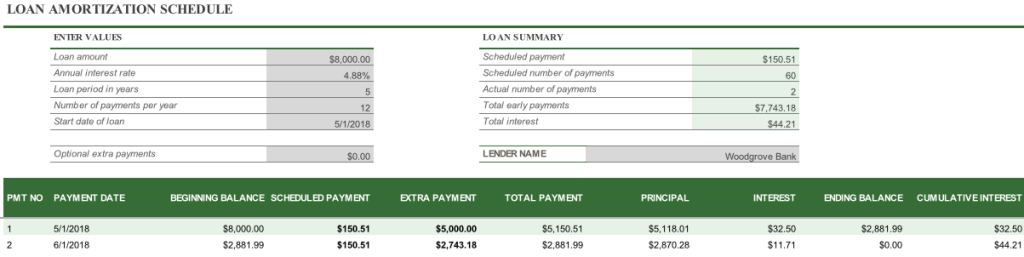
It took him over a year to pay the balance. By the time the court judgment arrived, his balance (after paying $50 here and there was $660. The court doesn’t put a timeframe or process on the judgement, but leaves it to the two parties to determine the payment schedule. He didn’t adhere to it well, but we did eventually get the whole balance paid. Mr. ODA also took this opportunity to have fun with calculating interest payments on a declining ‘principal’ balance that isn’t getting payments on a predictable schedule!

TENANTS #2 & #3

These tenants were/are much easier. The second tenant in the house had several large dogs, but we didn’t see any damage to the house. She eventually broke the lease to buy her own house in November 2020; we can’t fault someone for wanting to take advantage of low interest rates! She gave the appropriate amount of notice, but the lease was going to be broken as of 10/31, which isn’t a great time to have a rental come open. She ended up being very gracious with the situation, paid us one month of a lease break fee, and we kept her security deposit.

Right after she gave us notice, we had an old tenant reach out to us. They had moved back into town (I’ve mentioned them several times) and asked if we had a 4 bed/2 bath house available. Amazingly, we did. We showed them the house and they signed a lease within a few days.

Since turnover was fast, and I didn’t really know the status of the house, I didn’t get a chance to paint the house. All the rooms had been white except for the one room that I repainted after the first tenant had painted it lime green. The house really needs a whole paint job, and so I offered her an incentive. If she wanted to paint any of the rooms, she could knock $75 off the rent per room. So far she’s painted three rooms.

MAINTENANCE AND REPAIRS

The plumbing in this house has been horrendous. We had the tub snaked as soon as the first tenant moved in ($150). We then had issues with hot water, which required several adjustments to the water flow rates to coincide with the tankless hot water heater ($325). We had the upstairs toilet serviced ($120). Then a year later, we had to service the hot water tank again ($570). Tenants had complained that the upstairs sink drained slowly. We had attempted to snake it and fix it several times, but it never seemed to work. We finally just bit the bullet and replaced the plumbing – from the second floor to the crawl space. That work and the drywall patching cost us $1563.

Then there’s all the roof work. Shingles had flown off during a storm, so we had those replaced ($350). We also had a leak in the flat roof over the laundry room. We had a roof guy come out, and he said the roof hit its life expectancy. He replaced the pitched roof ($4135), and not the flat roof. So we’ve still had issues there that will need to be addressed.

SUMMARY

That sounds like a lot of money, but we’ve owned this house for 4 years now with our rent being double the mortgage (slightly better now too with the recent refi). When purchasing properties, any good investor is going to build maintenance and capital expenses into their numbers that determine if it’s a worthy investment. Rent cash flow wins out, and all the rest is just the cost of running our business – not to mention the $60k of appreciation we have on paper in just 4 years. It’s also worth noting that these things took up about 10 days worth of action from us over those 4 years, so most months, we just collect the rent with no other action required from us.

No property is going to be perfect, and this business relies on people, the tenants, to make the business profitable. No path will take a straight line, and being flexible to the ebbs and flows of rental property investing help make it fun too!

House 4: Small, but it works

This little house has been made home by two families. It’s a 2 bedroom, 1 bath that is 719 square feet. While there have been a few issues with the house, it’s been pretty easy to manage because of the tenants taking great care of it.

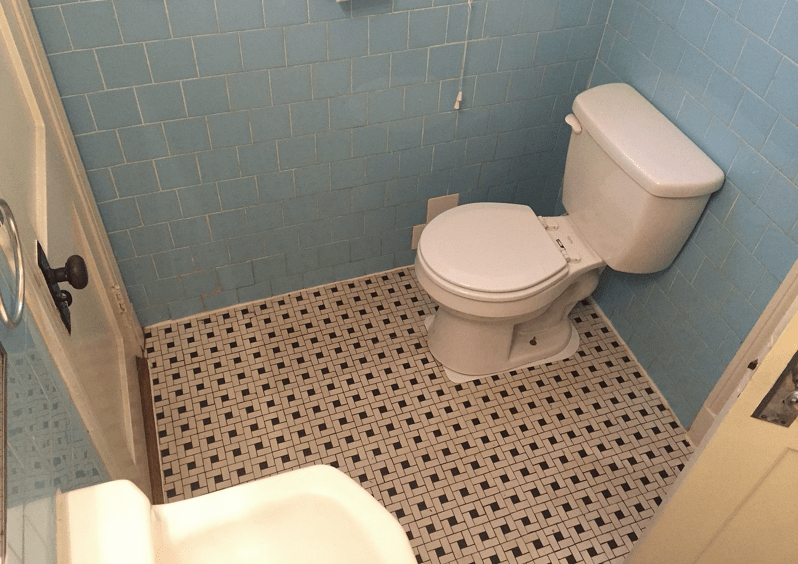
I feel like the bathroom’s blue tile, patterned floor, and that peek at the door knob exemplifies the age of the house.

The first thing we did was remove this prison-like wall mounted sink and install a new vanity from Ikea. During my installation of the vanity, I had a good scare. The house’s orientation yields to using the back door more than the front door (and the fact that the gate at the front of the yard was padlocked and there’s no concrete walk to get to the front door). Someone knocked on the back door, but I ignored it. Then that person went to the front door (through a side gate) and knocked there. That’s incredibly persistent of someone who shouldn’t know anyone’s here. Then he went to the back door and knocked again. I panicked. I called the non-emergency police line, and two officers came out. The man had left by the time they got there, but the officers knew exactly who it was. There is a man who lives around the block that has suffered multiple strokes, but he likes to mow everyone’s grass, so he was looking to see if he could mow ours. While innocent, I still won’t be answering any doors while I’m working on a house alone though.

LOAN

We locked the loan at 4.95% and 0 points. We also received a $200 credit in closing costs due to closing on several houses in a short period of time. Our attorney also lowered their fee from $395 to $350 due to several closings. It never hurts to ask if there’s a discount, especially when we’re a multi-repeat customer!

We closed on the house in June 2017. The purchase price was $63,500, and we put 20% down. We paid off this loan in January 2019.

TENANT SEARCH

We listed the house for rent through HotPads, Zillow, and Trulia. We received a lot of interest. After setting up showings for another house, we learned to do more of an “open house” style showing. It’s amazing how many people confirm a showing time and then don’t show up. I first sent everyone who contacted me an “Initial Interest Form.” It was used as a first-pass look at their income, credit, and whether they disclosed a felony and/or eviction. I still told them about the open house schedule, but the future use of this form will be to weed out non-qualified people before we set up showings.

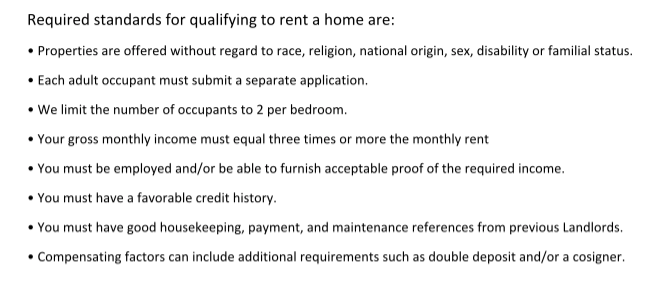
On the form, we list our standards.

I shared in the email when I sent the form that I would be at the house from 3-5pm on a Saturday for them to come see it. If they told me they couldn’t make it, I responded that I would make another time available pending the results of this open house.

Based on the interest forms received and being one of 3 couples to show up, we selected a couple that was most qualified. They requested to move forward with an application. We utilize SmartMove, a tool we found through Bigger Pockets, to screen our tenants. This process allows the tenant to provide personal information directly to the website, pay the entity directly, and eliminates us as a middle man. We also share that the application fee is non-refundable, and that’s why we give an Initial Interest Form to be filled out first, which is their opportunity to disclose any information that would disqualify them, causing them to ‘waste’ their application fee.

In our case, the background and credit check revealed that one of the individuals filed Chapter 13 bankruptcy. Upon further research, Chapter 13 is used to restructure debt. It wasn’t that she had delinquent accounts, and it appeared after asking her to explain, that this was a proactive approach to managing her debt from a divorce than an inability to pay debts. Since they had already paid their two application fees, we felt we’d take on this risk and rented to them. To mitigate our risk, we required 2 months of rent as the security deposit.

They lived in the house for a year before he graduated grad school and moved out of the area. However, at the same time, she had a family friend looking for her own place. We ran her background and credit check, and we were able to approve her easily. She took over their lease term in the Spring of 2018 and has been there ever since. We haven’t raised her rent since lease inception because at $795, it’s over the 1% Rule, and it’s full cash flow since the mortgage was paid off 2 years ago.

Even better, the couple that moved away from the area came back recently. They reached out to us for a bigger house to rent, saying they had such a terrible experience with their last landlord and would only rent from us again. We were actually able to accommodate exactly what they needed, and now they’re in House 7. While at this time I haven’t discussed our 7th house, I did mention their story in the Tenant Satisfaction post.

Treat your tenants fairly, and even give a little where you may not want, and it’ll make your life much easier.

MAINTENANCE AND REPAIRS

The house has a stackable washer and dryer, but it’s actually on the exterior of the main building in a little closet-type addition. It is unfortunate that an individual needs to go outside the house to do their laundry, but I suppose it’s better than having no hookups and going to the laundromat. Remember, the house is only 719 SF! Well, that little closet wasn’t well insulated, and in February 2019, we had a very cold two weeks where we endured several pipes bursting or freezing across our rental portfolio. The washer line froze. The fix was just to wait for the thaw, but we did add insulation to the closet to help prevent it in the future. Later that summer, the washer actually stopped agitating, and we replaced the whole stackable unit. The frustrating thing about stackable units – even though the dryer was perfectly fine, it’s all one unit so we had to replace the whole thing.

The furnace drain line was frozen in January 2018, so we had a plumber thaw it. It happened two weeks later again, and so the plumber installed heat tape around the drain line and sealed it.

We dumped new gravel in the driveway area. The gravel had become muddy, and we saw it as an easy fix to make the tenant happy and improve her experience. Plus, she said she was going to do it, but we felt it was our expense to incur, not hers.

We’ve had long term plans to replace the bathroom, but the contractor we met with in October still hasn’t given us an estimate. It’d also be tricky since the house only has 1 bathroom and she has a toddler living there too. The tub was painted before we purchased the house, and it hasn’t held up to the last 4 years of use, so we see the benefit in fixing up the bathroom, but we just haven’t been able to tackle the logistics yet.

Our tenant pays us every month and doesn’t ask for much. She’s made it her home, which is a good sign from a tenant. Our cash flow being $795 every month (minus semi-annual taxes) with very little repairs and no mortgage is a great scenario.

Tenant Satisfaction

A tenant moves out. Days without a tenant in the house equate to less income. On top of that, you probably have to touch up paint or repaint. You have to clean the carpet. You have to clean all the appliances and bathrooms. You may have to replace an appliance. Then there’s the extreme, that you may have to hire a junk removal company to get rid of the debris left behind and then hire a cleaner that charges a hazmat fee on top of the cleaning fee (does it sound like I’m speaking from personal experience?).

Turnover is when one tenant moves out and another moves in. The goal is to make that period of time as short as possible, or even non-existent. There aren’t always scenarios that you, as the landlord, have control over, but making a tenant feel appreciated and heard can keep them living under your roof for more than the initial lease term.

When a tenant leaves, in the best case scenario, you’re losing 1 or 2 days of income ($80). However, it’s also taken us up to 2 months to get a unit rented. That means you’re making 2 mortgage payments without income to offset them. When calculating your cash-on-cash return, the assumption is typically 5% vacancy rate, or about 18 days per year without rental income.

Then there’s the work you need to do to get the unit ‘rent ready’ again. Again, the best case scenario is cleaning the house and paint touch up. We now pay someone to come in and clean the house between tenants; it became worth the $100 to have someone come in, with the right tools, and be done a lot faster and better than I could do. The preference is to not have any carpet in a house, but we do have a few that have carpet that will need cleaned between tenants ($125). We do our own paint touch ups, so it’s typically no cost except my time because we have a standard paint color, and therefore left over paint. Quick tip: if you’re not painting the whole wall, use a paint brush to touch up the areas that need it, and then go over it with a roller to help blend it together, then you won’t see those touched up spots.

However, there may be more work to do than those quick, simple tasks that you can have lined up for 1 or 2 days. Even if the tenant treats the house great, appliances and carpeting have a useful life and may need to be replaced, which involves ordering and scheduling installation.

The end goal: keep tenants happy and not wanting to move means more money in your pocket. Find compromise and don’t always focus on your bottom line – and your bottom line will likely end up thanking you.

In 5 of our properties, we haven’t had any turnover (owned anywhere from 1.5-4.5 years). In 3 cases of turnover, the tenant left due to a job relocation. We’ve had 2 evictions. Our turnover rate for the average years we’ve owned the properties is 1.75, so the majority of the time the tenants renew their lease.

How do we do it? We create a relationship that says we’ll be responsive and listen to issues, we’re reasonable and fairly lenient with paying rent on time with sufficient notice and justification, and we provide houses that are in good condition.

We had a tenant vacate a house due to a job relocation. She had such a good experience with us, that she set us up with a new tenant for their house. Then a year later, she moved back into town and reached out to me. She said they had such a terrible experience with a landlord that if they were to rent again, it would only be from us. We just happened to have a tenant moving out because that tenant was buying her own house, and our newly vacated house fit all the parameters she wanted. That meant we had 2 days of turnover and didn’t have to list the property.

That house really needed a new paint job. We hadn’t painted it when we purchased it, and now it’s 3 tenants in. We didn’t know that until the tenant moved out and didn’t have time to paint the whole house before the new tenants were moving in. To show that we knew the house wasn’t perfect, we offered the new tenant $50 per room and $25 per paint can if she wanted to paint on her own. She was thrilled because she planned to paint some rooms to begin with, but now there was a financial incentive for her.

As for rent payments, if the tenant usually pays rent without issue and they preemptively reach out to tell us that they’ll need more time to pay rent, we’ll usually waive the late fee. Our calculations for the year don’t anticipate collecting late fees, so it’s not a loss of ours to waive the fee, but it makes them feel like we care about them as people. If you’re a tenant: communicate regularly with your landlord. Your landlord doesn’t want to evict you, doesn’t want to tarnish your record, and doesn’t want to put you in a position of financial hardship, but we can’t work with you if you don’t communicate with us.

We had a tenant ask us to put in a backsplash in the kitchen. He explained that he cooks regularly, and food is splattering on the wall, which was painted in a flat paint and didn’t wipe well (painted before we owned it). This is unconventional because it’s more than a request to fix a leaking sink or an inoperable appliance. However, we saw the benefit to install a backsplash in the longevity of the kitchen’s life and the tenant feeling like they got a ‘win.’ We agreed to do a peel’n’stick backsplash, which met the goal of a wipeable surface without being labor intensive. We even gave them options to choose from that matched the house’s color scheme. It cost us $68 and about 90 minutes of our time to install it. This tenant still lives in the home, which we’ve owned for nearly 5 years now.

We allow pets in the properties. Back when we were trying to rent an apartment for ourselves to live, few allowed pets; if they allowed pets, there was an astronomic fee associated with it. We decided to not eliminate the average 50% of pet owners by mandating a pet-free property, and we wouldn’t charge monthly pet fees or high initial fees (though we still charge some) associated with having a pet. Honestly, I have kids and a dog; my dog has never done anything wrong in our home, but my kids sure do make a mess and spill things. We have had issues with pets in our properties, but the owners have done other things wrong, so it was a poor tenant issue, not necessarily a pet issue.

I also feel that if we provide a house that looks clean and well-kept, then the tenant is more likely to keep it in that condition. We’re setting the expectation that this is the type of house that we’re renting, and we expect it to be in similar condition when we get it back. We understand paint scuffs happen, pictures get hung, and there may be a couple new stains on carpet, but the house is to be returned to us clean and put together, which is even stated in the lease. If we handed over a house that was dirty or had dingy paint and carpet, the tenant is likely to not put as much effort into keeping it in pristine condition. This isn’t foolproof. But we charge the security deposit for anything outside of normal wear and tear, and they understand this will happen from the lease signing, as well as the unspoken expectation made by the condition we hand the house over in. People are more likely to take care of properties when its condition is good enough to feel pride in, and will typically not respect it if it’s apparent the landlord isn’t taking care of it either.

Property Management

Property management can be useful and worth the 10% cost, but sometimes it’s not worth having the middle man. Here, I’ll break down our experiences with 3 property managers, but first, the terms of our management agreements. We have three properties in KY under a management company and three properties in VA with a property manager. In VA, we had 5 managed at one point in time, but we sold one property, and another is now managed by us since we knew the tenant and handled all the showings and lease set up.

FEES

Management fee: 10% monthly income. This is standard. If the rent is $900 per month, then you’re paying the management company $90 each month. If the unit isn’t rented, then they get $0.
Leasing fee: 1/2 a month’s rent in KY and $300 per new lease in VA (based on the fee structure of our individual property managers). Standard seems to be one-month’s worth of rent, so we have better fee structure there. In KY, half a month’s rent is about $400. In VA, we rent the houses for more than our KY homes, so half would be more like $500, meaning our $300 fee is a great deal.
Lease renewal fee: $0. We don’t pay either property manager for a renewal. The KY company had 10% of a month’s rent as the renewal fee, but we negotiated out of it. We don’t feel that renewing a lease is outside of the monthly management responsibility.
Maintenance fees: In KY, the agreement template had a 10% markup on all bills paid by the management company. We asked what the monthly management fee covers if not organizing repairs; with no clear answer, the company agreed to remove this fee. However, I have to request the 10% back every time there’s a maintenance fee because their system automatically adds it, and they’re not on top of removing it for our account. Our agreements also include a minimum dollar amount that they can spend on maintenance without our prior approval. This is meant that they can manage small repairs without having to coordinate with us, thereby making the process more efficient.
Unoccupied unit fee: KY also had a $50 per month fee for the months that the unit wasn’t rented. We felt that this disincentivized moving the unit quickly, and we negotiated the removal of this fee.

In all management cases, there’s also a stipulation that the company we sign with has first right of refusal for listing the house for sale.

RESPONSIBILITIES

The property manager is responsible for rent collection, coordinating maintenance calls, move in and move out inspections, distributing notices to the tenant (e.g., late notice), and any legal matters on behalf of us as the owners (which has happened).


VIRGINIA

In Virginia, we have a property manager for a few of our houses. The relationship began because her husband is our home inspector and handyman. Her experience was managing a few higher end properties, and she wasn’t part of a management company, but she is a Realtor. We were buying houses fairly quickly, and we decided it would be worth our time and effort to have someone managing the ones that were further away from our primary residence, mostly to handle the showings.

At first, the property manager would physically collect rent and deposit it into an account we set up just for the rentals. We chose a bank that was near her and us so that it was more convenient. Over the next couple of years, our tenants organically decided they would all pay electronically. We accept rent via Venmo, PayPal, and Zelle. We closed the bank account, since it required a $500 minimum balance, and now only collect rent online.

We’re more hands-on than your typical investor. This agreement allows charges up to $200, but the property manager calls us for everything. Most times, we want the opportunity to fix it ourselves. No reason to pay a plumber $125 for a service call just to replace a toilet flapper. But then 2 kids entered the picture while Mr. ODA works full time, and doing those types of maintenance calls have gone by the wayside. Two hours including driving time, the trip to get supplies, the possibility of multiple trips to resolve the issue, etc. were all reasons that we now rely on maintenance people to handle much of the work.

We learned a lot about the Virginia Code thanks to our property manager and her experience as a Realtor. We also had several filings and appearances in the court system for evictions that she handled on our behalf.

KENTUCKY MANAGEMENT COMPANY #1

Our first house purchase was in Kentucky, while we lived in Virginia. We required a property manager because we didn’t want to spend an indefinite amount of time showing the unit nor handling maintenance issues in a market where we had no connections yet. The first property manager was awful; we picked the company because their rates were the cheapest. We paid for that in the long run.

We had some struggles renting the unit that first go around, but we were told we had an agreement with a tenant for her to move in on April 1st. After a week, we weren’t told that the lease was executed, and when we followed up on it, he said she was coming in the following week to sign for April 15th start. He didn’t acknowledge the difference in what we were originally told. We then had to ask several questions on how we’d receive our rent. It was as if they had never had a property owner expect to see the income monthly. Their expectation, as well as it was defined through emails, was that the money would go into an account they set up, they’d draw down anything needed for management and maintenance, and we may or may not see a ledger. When we asked to be a signatory on the account, they acted surprised that we’d want access to the money. Once we stumbled through account set up, I then had to ask for the statement of expenses month-after-month. There was no automatic process, and it was just when a specific employee got around to writing up the statement.

Then, an intoxicated driver drove into our property. Our property manager was out of town and couldn’t check on the unit. We expected someone else in the company to be able to take over when our specific manager was out of town, and that wasn’t the case. We had Mr. ODA’s family go take pictures of the wreck to ensure we got them ASAP.

After raising our concerns about response time to the property manager’s supervisor, we received this response: On a side note, [manager] has become very busy with his role in the company and taken on a very large property so I think this is attributing to some of his slow response times, although that doesn’t make it right or give him an excuse not to answer your questions. After that, we had several issues with the rental rate and whether it was listed for rent. Then, they didn’t push to uphold the lease, which allows us to enter to show the property with 48 hours notice, which would assist in not having a long turnover period of vacancy. They allowed the tenant to deny access over and over again, and they didn’t even start showing the unit until a week after she vacated it. After several more rounds of confusion about what it should be listed at and their complete inability to communicate with us, the contract was terminated.

The tenant moved out mid-April. We had a new property manager in place in mid-May. A two-year lease was executed for June 1st.

KENTUCKY MANAGEMENT COMPANY #2

This company now manages the townhouse and two new properties we acquired in September 2019. It has not completely been smooth sailing, but communication has been better than the previous company and we haven’t felt forgotten about. As I shared previously, we negotiated out of the 10% markup on invoices in our management agreement. However, their system automatically adds the 10%, so I need to stay on top of the charges to make sure they’re at-cost with no markup.

We’ve had issues with the lease terms meeting what we agreed upon. For example, we charge a one-time pet fee and a pet deposit. We expect to receive the fee as income, but it was put in the security deposit account. With the way it was written in the lease, we can’t access that fee until the tenant moves out now. There were conversations about 18-month leases, but then one lease was only executed for 12 months. Luckily, the tenant was amenable to entering a 6-month extension on her lease.

All in all though, it’s worked well that they handle rent collection and depositing the balance of the rent after their fees in our account each month. While there have been hiccups, it’s been nice to know that they have processes in place and we don’t feel like we’re starting from square-one. Even though we now live in Kentucky, we find their management fees to still be worth the cost and don’t plan to manage these properties on our own at this time.