Property Assessments & Rent

At the end of last year, I received each property’s revised assessments for 2024 tax purposes. To no surprise, every single property drastically increased. A harder pill to swallow is to see how much it increased just from two years ago.

Higher home sales are great – if you’re in the market to sell. If not, it’s just fueling the local jurisdiction’s ability to increase their tax income. Again, this increase is great for a resale opportunity, but it’s not great when we’re content in our “buy and hold” at the moment.

Where I live, we received our property assessments recently as well. There was an uproar from the citizens. The Property Valuation Administration explained the increases and how they work, noting that home values in our area have exactly doubled since 2014. While their valuation process only occurs every few years, and home prices are increasing about 10% each year, people are seeing 30-50% valuation increases when they receive their notice.

COMPARABLE SALES

When determining a property’s assessed value, whether it’s for tax purposes or a bank loan or such, nearby home sales are used as the basis. Home sales denote what buyers are willing to pay (and likely what an assessor determined as fair market value) for a home. To determine your home value, you would need to look at sales in your neighborhood or close geographic area, for homes (and lots) that are of similar size with a similar number of bedrooms and bathrooms. There are factors that you can use to compensate for a different number of bedrooms and bathrooms, but it’s easiest if you find homes with similar data points.

In today’s market, you’re also going to focus on home sales in very recent months. The amount that a person is willing to pay, and the amount that a bank is willing to loan, is increasing regularly. A home value in 2021 is different than today’s.

HOW DOES A PROPERTY ASSESSMENT AFFECT YOUR RENT?

I wrote a post that went into the details of how our expenses have changed over the last year on these rental houses. It’s noteworthy, as a renter, to be aware of the changes in property assessments because it’ll help you anticipate and understand the need for rent increases that will be coming.

I recently saw someone complain that a landlord was raising rent with no improvements. Rent increases aren’t tied to improving the house (well, they can be). Rent increases are keeping up with the costs that are increasing for the landlord.

I’m a broken record on this, but I’ll continue to work to educate. When you rent a house, you see the one cost. You don’t see that the landlord is holding the mortgage. That mortgage likely has escrow that pays for insurance and taxes, which both increase every year. Even if it’s not escrowed, the landlord is taking the time to manage the income/expenses of the house and paying out the taxes and insurance.

You also don’t see the maintenance costs. When you call me to have a plumber come out, that’s an expense. I used to pay $125 for a service call and minimal work. Now that’s $200-375. Your rent is covering that possible future expense. Could you imagine if you found out you needed a new water heater in the house; would you have $1500 to hand over in a day’s time? As a renter, your rent is set to cover those future expenses.

We typically reserve rent increases for every other year, and it’s usually $50 per month. There have been some cases where a tenant has negotiated less, and a few other cases where we increased the rate more than $50 per month because of the drastic expense increases we incurred. I learned that if I don’t increase $50 every two years, I end up behind on the increases that are coming in future years. I don’t want to increase rent by $100 /month on a good tenant, so I try to keep with this schedule. I always explain that this increase is due to carrying costs. I also always provide a written documentation and give the tenant the option to move out. I’ve never had a tenant move out because of a proposed increase.

SUMMARY

If you’re interested in knowing more about these numbers, review the post that I linked. You’ll see that my annual costs increased by over $4,500 on these properties. You’ll also see that in some cases, where I prefer to only increase rent every two years instead of annually for tenant satisfaction, I’m not keeping up with the cost increases I’m incurring. House3’s two year cost increases of that property’s insurance and taxes total over $125 per month; I increased their rent $50 per month. I have other properties that can float that loss I’m taking there, but having happy, polite, and courteous tenants who take care of the property like its their own is more important to me than drastic rent increases and risking someone less vigilant moving in.

So the next time a landlord increases your rent when your lease term expires, understand that it’s to cover the expenses they’re covering for you to live there. When the property sales in the area increase, know that the landlord’s taxes are increasing, which equates to a higher rent needed to cover it.

House 7 Turnover

Our turnover this year has been higher than usual. However, it’s been for good reasons, and not just because someone is looking to rent from a different landlord, so I’ll take that win. In this case, the tenant was house hunting. We knew that a year ago, and we had set up our lease to allow them to break it. Since April was their last month in this current lease term, there was no “lease break fee” associated with their notice. They gave us notice at the end of February, which requires 30 days worth of payment. March rent was paid.

They had moved out of the house early though, which ended up being very helpful. The house needed a lot of work. There was a lot of deferred maintenance on this house. We bought the house as a flip. It looked fine on the surface, but we knew it wasn’t going to hold up. Our last couple of turnovers happened really quickly, so we didn’t put much effort into the turnover process. With the extra time, we knew we needed to address some issues.

PAINT: $2,750

First, we finally got the flat roof addition fixed on this house last summer. The flippers before us had added a laundry room to the back of the house. They used the existing covered deck infrastructure, and it was horrible. They didn’t tie it into the house correctly, so we endured several leaks into the laundry room. We struggled for years to get a roofer who would address it for us. We even hired a roofer, highlighted the flat roof issue, and missed that his contract didn’t do anything except replace the shingles on the main house roof. There was plenty of saga once we finally found someone to rebuild it, but it’s done. We hadn’t fixed the drywall from the leaks, so that needed to be done now (a.k.a. deferred maintenance).

We found a painter who repaired the drywall, repainted the ceiling, and painted the walls. He also painted most of the trim in the house to white (there was some damage on the baseboards that needed fixed) and all the walls Green Tint by Benjamin Moore.

Two tenants ago, we had given an offer that if she wanted to paint any of the rooms, we’d offer a rent concession. That was part of the deferred maintenance; most of the house was dingy white that took a beating over the years, but we never had the time between tenants already lined up to paint everything. She took us up on that offer. She even painted the bathroom vanity and medicine cabinet. It was a beautiful robins egg blue, but we didn’t have the paint to do a few touchups on the side of the vanity that were needed. Our painter added that to the work at no cost. He absolutely didn’t need to do that! But everything has a fresh coat of paint now, and I’m so happy at the facelift it gave.

FLOORING: $6,613

When we first bought this house, the bedrooms on the first floor had dingy carpet in it. The prospective tenant we had requested we replace the carpet. I can’t remember the series of events, but we determined it was better to refinish the hardwoods underneath the carpet than to continuously replace the carpets every 3-6 years. They’ve held up pretty well, but they are starting to show wear at 7 years in.

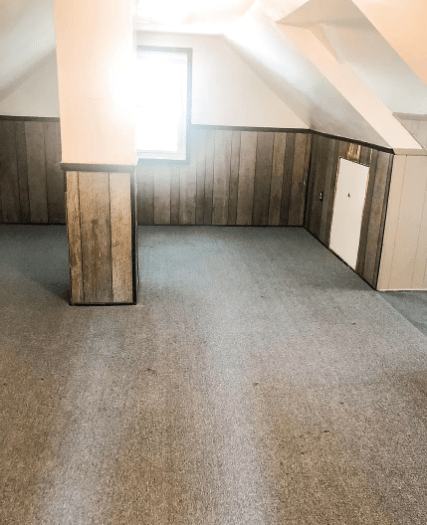
Regardless, we didn’t touch the carpet on the stairs or on the second floor of the house. It’s blue indoor/outdoor carpet. I truly can’t believe we’ve been able to house renters in this place with this carpet still in place. We’ve put it off because re-carpeting stairs is just so expensive relative to doing a whole room. One of the bedrooms on the second floor even has wood paneling, which just made it even more amazing that anybody wanted this house. It was not the most aesthetically pleasing place.

We replaced all the carpet. With the fresh carpet and fresh paint, it’s looking so much more inviting.

Then we move on to the kitchens and bathrooms. The first floor bathroom and kitchen floor were clearly just lipstick-on-a-pig situations by the flippers. The subfloor was clearly bowing and making all the cheap tile crack. The humidity issues in the bathroom (I’ll touch more on in a moment) weren’t helping matters in there.

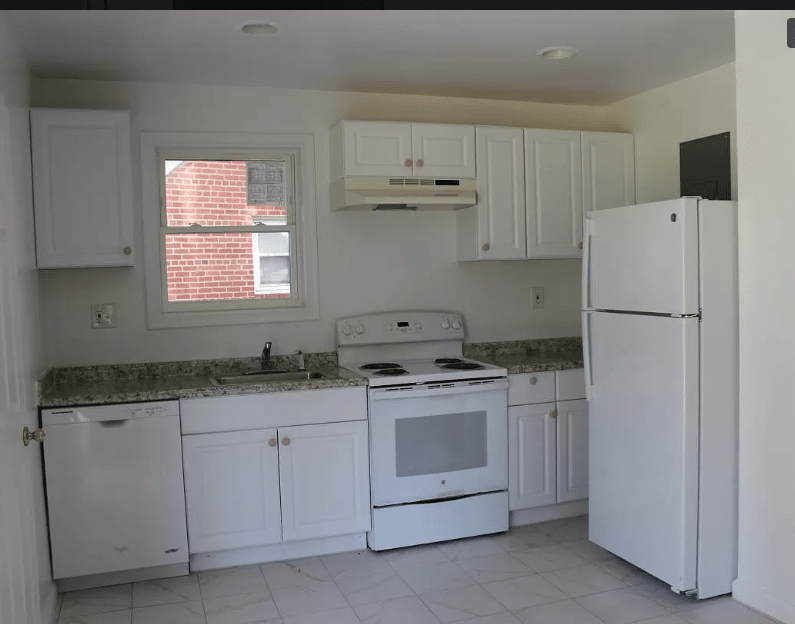
Here you can see the kitchen (and its pink knobs!) with the tile floor. The tile had all cracked by this time.

The upstairs bathroom was original 1970s linoleum. Here’s a snip of it in its glory.

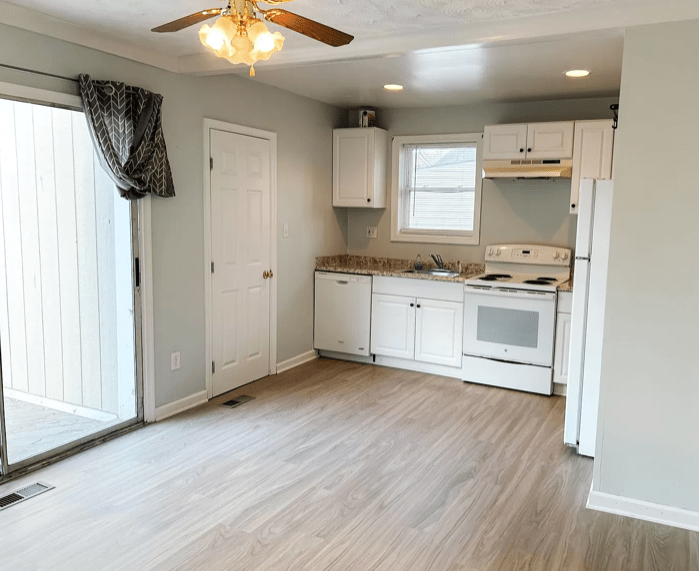
Trying to match/add the hardwood was not an option. We considered ‘luxury vinyl tile,’ but that was more expensive than I wanted to put in a rental property. I didn’t want to retile it because I just personally don’t find tile floors to be warm and cozy for a house. The only reasonable option left is ‘luxury vinyl plank.’

We requested a quote from Home Depot. Their quote was cheaper than the one we ended up going with, but we didn’t use them for good reason. We had a subfloor issue in another house. Home Depot was extremely difficult to work with. Not only were they doing questionable work, they also just threw their hands up at the subfloor issue. Luckily, we had a friend that was able to help us repair it (because we didn’t live there). We know for a fact that there’s subfloor issues here (we can see the bow in the floor at the sliding door), so we wanted to go with a contractor who could handle everything.

We picked a local company. They did both the carpet and the LVP. They were so easy to work with. I didn’t love that they wanted me to pay for the entire job up front, but it ended up being great. They had to come back to finish a few tasks, and they did it all perfectly. I’m really happy with the process and their product.

Another miscellaneous flooring issue was that the vent covers were rotting. The finish on them were peeling. This could be explained by humidity in the bathroom, but that doesn’t really explain the issues in the kitchen and living room also. Our handyman was able to pop those out and get new, clean looking ones in for us.

RANDOM WORK

We had to call on our handyman for random jobs. He had to tighten the front porch banister. It’s likely the original banister and has just corroded at the connections. He also had to tighten up the screen door (which, if it were to break would be removed; having to maintain non-essential pieces of a rental is no fun). Some light fixtures needed major TLC. We replaced the light fixtures in both second floor bedrooms, the sconce type light fixture in the half bath upstairs, and the main bathroom’s vanity light (it was all corroded and looked bad).

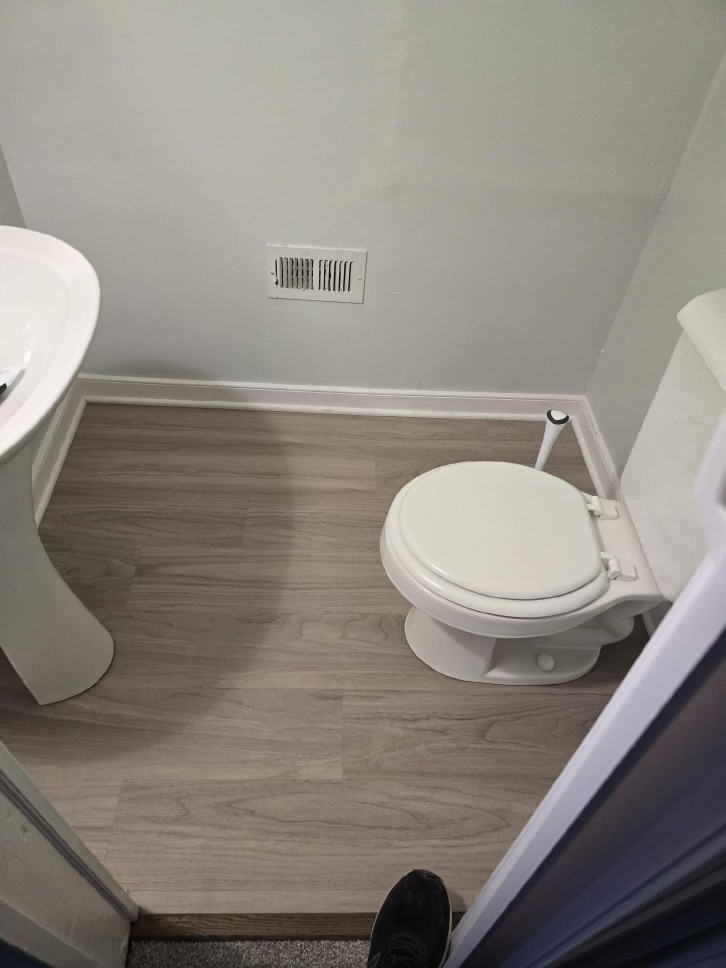
The upstairs half bathroom had a brown accordion door. The pieces were falling off and it just generally looked bad. The space is tight, and an accordion door style was definitely the best solution for the area, so we had a white one put in. It’s still less than ideal, but it looks much better.

The previous tenant didn’t clean up the yard as they were supposed to, so we had to hire out that work. We also asked him to clear the gutters, which was very necessary because it looked like trees were growing out of them with how many twigs were stuck. He charged me $250 to rake the leaves from the yard and flower beds, mow the yard, and trim the bushes. Then he added on $50 for the gutter clean out. We also did a final mowing before the new tenants moved in, and he charged me $60 for that.

I’m not exactly sure what the issue is, but for some reason we had water damage in the main bathroom. It wasn’t water damage in the sense of standing water. It was just too much moisture. The mirror was corroded; the tub faucet handles were corroded; the caulk was all moldy (and we knew it was fine a year ago); the walls had water streaks on it. I don’t know how it was fine for years and now it’s not, but I’m guessing the only answer is that last tenant just liked really hot showers and didn’t use the vent or window. The tub knobs were so corroded that they had to be sawed off and new valves and such installed. Luckily our plumber was able to handle it timely and it looks better now, but that was a minor inconvenience.

The back sliding door had always been questionable. No one ever pushed us on it though, so we didn’t know just how bad it was. I don’t know that the door ever fully locked. There was a block used to hold it shut for security measures (although I feel like everyone who has a sliding door uses something like that). I finally wanted it replaced. It was likely the original door (think nickel type finish), and it was overdue. We did this through Home Depot because I knew their prices were reasonable and it should be an in/out job. It was $1063.

NEW TENANT

Our property manager showed the property to several candidates. Only two provided their interest form timely. An interest form is a way to gather background documentation on the potential tenant without the tenant having to spend any money. It’s a way for the prospect to divulge any negative remarks on their credit or background check. It’s a good gesture that we allow them to fill this out before spending money on an application fee that will identify disqualifying information. We have found that some people don’t tell us anything, and then they’ve spend $43 for us to say they don’t qualify.

Both prospects submitted their interest forms on April 18. Unfortunately, both of them were interested in a mid-May lease start date. They both offered to do a 2 year lease as a compensating factor though, which was a nice gesture. I also appreciated that both of them were well spoken and up front with a lot of information.

We chose someone and ran her background check. Several “unlawful detainers” (a.k.a. evictions) came through, which hadn’t been disclosed. We told her that her credit score was slightly below 600 and the unlawful detainers would disqualify her. She then wrote back a very nice note explaining all the data that we found and asked us to reconsider. We agreed to rent to her and to take a higher security deposit as a compensating factor. She agreed to the 1.5 times a month’s rent as a security deposit.

Unfortunately, the house was vacant for a month and a half. Luckily, during that time we were able to get a lot of work done in the house. I hope that this tenant takes good care of the home and that we’re pleasantly surprised with her tenancy regardless of her history of late payments and court filings.

Grocery Shopping

It doesn’t always work out this way, but we went to 3 different stores to accomplish grocery shopping, while building another order for pickup/delivery. We were shopping sales, which means we had a list and were in-and-out. There are a few times that an in-store sale will catch our eye, but otherwise, we’re in these stores on a mission.

Walmart is our default grocery store. There have been very few things that we have found to be different quality than name brand items. We keep an eye on sales and coupons at other stores, where we’ll pick up name brand items if they’re cheaper than the Walmart version. Walmart has a stigma that it can’t be good, but their items are usually comparable to the more expensive version.

Here are the places we shopped in one day, and what we bought there. We spent $208.05. About a third of these items are perishable (e.g., chicken and fruit) and expected to be consumed in this week, while others are being stockpiled based on the sales available this week (e.g., cereal). Two items were for the house (i.e., weed and feed, and a hose) and account for about $75 worth of this total.

  • Costco: $129.15 for sparkling water, a hose, rotisserie chicken, weed and feed for the grass, and yogurt pouches. We went there for the weed and feed, which is over $50. Costco’s sparkling water is a staple of mine, and grabbing a chicken is a regular occurrence. The hose was about $20 and spur of the moment to replace one of ours that always kinks. The yogurt pouches price caught my eye because they had a manufacturer’s rebate. On the spot, I pulled up Walmart’s price of it. Walmart was 7.78 for 10 pouches, and this price was about $9 for 20 pouches, so I picked up two of them.
  • Kroger: $58.04 for cereal, bacon, milk, yogurt. Kroger deals are more of a “buy X amount” to get the deal, so this is usually a higher charge to our credit card.
  • Meijer: $20.86 for bacon, strawberries, pears, apples, canned vegetables, and marinades.

On top of these sales, we also need a few staples that we typically purchase from Walmart, but that was only about $15 worth. We have plenty of food in the freezer (e.g., chicken, beef) that we can plan meals with for the week.

SHOPPER SYSTEMS

We pay for Walmart+, which is $99 per year and also comes with a Paramount+ subscription. Walmart does not inflate their in-app prices when you purchase that way. However, Instacart does. You’re paying an Instacart fee and inflated prices, while maybe also including a tip. Understand that there’s a tradeoff of your time to paying these inflated prices and fees. What are you doing with the time that someone else is shopping for you? Are you being productive to make the cost necessary? I’ve learned that having groceries delivered is a luxury I appreciate with 3 kids and all their activities/scheduling. I find it worth the $99 per year to have that luxury. But I’d also do fine with grocery pick up orders that are free if you spend $35.

GROCERY COSTS

I regularly listen to complaints that groceries are so expensive. However, I don’t see as many people putting a little bit of effort into finding better prices. If you’re shopping at Kroger, are you doing all of your grocery shopping there, or just the sales? Have you asked yourself why you’re shopping there? Is it a prestige thing because you don’t want to say you shop at Walmart?

For fruit, we buy based on prices. Right now, grapes are $2.69/pound. We look for the price to be $1.99 or less per pound to buy them. Strawberries were purchased at Meijer under their 4 for $5 pricing structure, which makes it $1.25 per pound. I regularly see strawberries at $4.29 per pound. We’re not going to be buy them at that price; there’s going to be another fruit available for less.

At Walmart, I’ve learned that I like their brand of paper towels if I buy them in a 6 pack for $10.22. If I buy the 2 pack, the paper towels are too linty. Walmart and Kroger sell different versions of Bounty to do a comparison, but a 12 pack of Bounty at Walmart is 22.18. A 6 pack of Mega rolls is $25.99, but it’s currently on sale for $23.99. Sometimes it’s not an easy comparison (especially in the paper towel or toilet paper world), but the point here is that I don’t buy name brand Bounty, and I’m happy with the quality (while acknowledging I did find another option I wasn’t happy with).


Make sure your shopping decisions are conscious decisions. We’re not buying strawberries once per week every week of the year because their price fluctuates. We’re buying based on pricing and sales. We’re asking ourselves, “is the price listed worth the item we’re purchasing?” A candy bar could be on sale for $3, down from $5, but I still wouldn’t want to pay more than $1-something. You don’t need to go to 4 different stores like we did this time, but do make conscious decisions. If you’re shopping at a store like Kroger or Shop Rite or whatever is in your location, know that you’re going to be paying more for your staples than if you were shopping at Walmart because a place like Kroger is banking on those sales each week to draw you in.

Hitting our Goals

I mentioned at the beginning of the year that our general financial goal is $4 million net worth. I acknowledge that this is not a specific goal that most people can relate to. But I also pointed out that we weren’t always sitting with nearly that amount in our accounts, and that made me start thinking about where we were. This is long, but I didn’t think it worth splitting into multiple posts. I’ve gone into the topic in general, but this is our actual story and the steps we experienced.

This is just meant to show you that you can grow each year and slowly chip away at a goal. Everyone makes fun of the “don’t buy Starbucks everyday” philosophy. It’s not that saving that $7 per day is literally going to make you a millionaire in itself. It’s saying that if you’re willing to spend that $7 daily, that’s likely indicative of other spending in your day, and you should be more deliberate with your spending. I saw a meme on Instagram that said something similar about buying decor for your home, and if you’re willing to spend “just $25 on this lamp,” those little expenses add up over the year. I’m a broken record in saying make every purchase a deliberate, thought-out action; I went into how much effort (and years) I put in to purchasing a $4 tape dispenser on this post.

The background here is to first show you how I had no money, but I’ve been diligent on my spending and working towards goals. Mr. ODA was more of a saver and more prepared for the big life expenses in your early 20s. The part where we work towards buying a house is where we really buckled up and made life decisions that kept us on that track. Our money philosophies have gotten us to where we are today – every dollar has a purpose.

MY FINANCIAL HISTORY: COLLEGE, WHERE I STARTED MY INDEPENDENCE

I never liked relying on other people, so I was interested in making my own way as fast possible. My parents gave me an ultimatum during my sophomore year of college – either become a resident assistant for free room and board, or take out loans to help pay for it in the next two years. I didn’t want to take out loans, so I started looking for off campus housing. I didn’t mind living on campus. I have no idea why I was so dead-set against taking out loans and how that would have been ingrained in me at that time. But living off campus would allow me to pay month to month, instead of living on campus where I’d have to pay each semester’s housing costs up front.

On top of that, my dad offered me to buy out his car. He had let me drive the car to college that year, but around Christmas time, it started acting funny. It turned out that second gear in the transmission needed to be replaced. He said I could pay for the fix, and then it could be my car. I didn’t like the idea of being 3.5 hours away from my family and having a car that appeared unreliable. So I went car shopping, and I leased a Honda Civic. My car payment was about $300/month. I leased it instead of buying it because I didn’t need to put any money down.

I worked three jobs that summer after my sophomore year of college. It was so hard. I was working 40 hour weekends, and then I’d put hours in during the week. I remember getting burnt out and being overwhelmed because I had to miss my sister’s graduation party. I was working at a catering hall, which meant late hours on Friday and Saturday, and early hours on Sunday. I was also working at a bagel shop (big on Long Island), which was a 5:45 am call time, but at least I’d be done by 10 am. Then I was working as a cashier at K-Mart, which was Monday through Thursday in the afternoon or evening, and sometimes on Friday.

Even though I was working all those jobs, I still struggled with paying my bills once I got to college for my junior year. I paid too much for rent because I wanted to live on my own. None of my friends were interested in living off campus, and I was too afraid to live with someone I didn’t know. My parents ended up giving me $100/month for 6 months so I could pay to run my heat. I remember it being October, and I told my mom that I hadn’t turned my heat on yet. So she sent me the money each month to cover the heating bill instead of trying to live in layers and blankets because I didn’t want to pay for it.

When I moved back up to college, I was working at JCPenney while going to school. I did pretty well. My grades didn’t suffer, and I still felt like I had a life so I didn’t get burnt out with only work and school. I took on extra shifts and stopped going home for the smaller holidays (e.g., Thanksgiving) so that I could work.

MY FINANCIAL HISTORY: MY BIG GIRL JOB

My guidance counselor told me that financial firms would be expecting internships on my resume. This was 2007; financial firms were fat and happy, so they weren’t paying interns. I kept my eye on the job boards (which were literal bulletin boards) in the financial building. I found an internship with the Federal government that was paying $13/hour! I applied in August. I heard nothing for weeks, so I gave up hope. Suddenly, I received a call asking me to come in for an interview on Halloween! I had never interviewed before, so this was scary. Then the guy told me that they didn’t even know if they were going to hire a mid-career hire or go the internship route, and they had never had an intern before. That was the second time I gave up hope. A month later, I received the job offer, and I started working in December 2007.

From the start, I put money into the Thrift Savings Plan (TSP), which is the government’s 401k equivalent. My parents told me to take each raise I got and put it right into there also. If I was used to living on the lower amount, then keep the rest in savings. I followed that advice until I maxed out the contributions. I didn’t have trouble paying my bills, but I wasn’t saving as much as I should have for rainy days.

MY FINANCIAL HISTORY: MEETING MR. ODA

Mr. ODA showed up in my office in October 2009. Shortly after meeting him, we were hanging out, and next thing I knew, he was asking me my social security number. He was signing me up for a rewards credit card, since I had a credit card through my bank that was getting me no incentives. By the time I met him, I was living comfortably, but I wasn’t saving with a goal in mind. Whatever was left over became savings, and it didn’t matter to me what that number was. I was maxing out my TSP and paying my bills comfortably, and that seemed good enough for me.

OUR FINANCIAL HISTORY: IN A RELATIONSHIP

Mr. ODA came with a lot more money than that into the relationship. He had always been planning to save for two big purchases: an engagement ring and a house. To me, buying a house was somewhere down the road, but I didn’t have the confidence to move forward on that. I hope to instill that confidence in my children because that would have made a big difference.

Mr. ODA designed my engagement ring at a little mom and pop jewelry store in Harrisburg, PA (long story on where we’ve lived, for how long, and why). He proposed in November 2011. In December, I moved to DC, and Mr. ODA joined me shortly after. We lived in an apartment. We lived halfway between where he and I worked, but I admit we paid way more for rent than we prudently should have. Even though I grew up in the shadows of New York City, actually living in a big city was scary to me. We went on a house hunting trip, and I struggled with anything that didn’t look really nice/new. We were able to get a reduced rent rate, but at about $800 per month for each of us, it was significantly more than the $450 per month I was paying in Albany, NY.

The goal was to rent for a year while we scoped out the area to find a house to buy. We didn’t know anything about Northern Virginia, and we wanted to go to open houses to learn how far our money would go. Newsflash: not far.

OUR FINANCIAL HISTORY: A WEDDING

While we explored the area for a house, we were also planning a wedding. We paid for more than half of our wedding. My parents gave us a chunk of money towards it. If I had been married in Kentucky, it would have covered most of the wedding. However, I grew up on Long Island, and a wedding is a very different kind of event there. I probably wouldn’t have known any different had I not attended several weddings in South Carolina, where weddings were low key. After looking at venues in both Kentucky and New York, I ended up breaking down one day that I had always dreamed of a specific type of wedding, and Kentucky just wasn’t it.

I saved as much as I could in all the other areas since the venue was so expensive. The venue cost included all the catering, staff, and cake. I went cheap on invitations, my dress, favors. I just didn’t have the cash on hand to do a lot, and I wish I had done more. I also wish that I had been married on site at that venue instead of in my hometown church, but it is what it is. I also went cheaper on the photographer, and the day was terrible because of him. I recommend to everyone to get a good photographer and really check their portfolio (and if they do crazy things for photos, don’t trust that they’ll not do crazy things when you ask them not to).

We got married in August, after our November engagement. We had to lay out over $12k for that. The unexpected part of that was that we found a house to buy earlier that summer.

OUR FINANCIAL HISTORY: OUR FIRST HOUSE

Mr. ODA was a good saver. The problem was that he didn’t expect to pay for a wedding, and he didn’t expect to live in Northern Virginia. He was expecting to buy a house around $150k. We were struggling to find a house with walls and floors (literally) at $350k.

We lived a meager state for that year. Our goal was to spend less than $5 per day on food. That meant we weren’t spending money at restaurants. We were packing our lunches for work days. We were living off of macaroni and cheese. We weren’t taking trips. And yes, we were literally tracking our expenses on food each day.

THIS IS IMPORTANT: We were preapproved to buy a house up to $750,000. THAT IS STUPID. We didn’t want to pay PMI, so our purchasing power was based on our down payment being 20% (if you don’t come to the table for a conventional loan with 20% of the purchase price, the bank tacks on PMI). Between loans we could take from each TSP, cash on hand that we projected to have with our savings over the year, and possible liquidation of investments, we projected we could have about $70,000 on hand. That means we were shooting for $350,000 as the purchase price.

Our Realtor knew we were approved for double that, but we held our ground on our price range. We considered several properties. We put an offer in on a house at $380k. It was a bank owned foreclosure that they had flipped for resale. The flip was bare bones, but the house looked ok. We wouldn’t need to put immediate work into it. Our offer was declined. Then later that day, the bank called and asked if we still wanted it. We were instructed that the previous bidder attempted to counter the bank, and that’s why we were given the offer. We weren’t willing to lose it and accepted. We were under contract for a $380,000 house. That meant we needed at least $76,000 by closing.

Mr. ODA and I each took out TSP loans, we were gifted money from our parents, and we used our savings. Our final closing costs were just over $78k. We got our 20% down, so no PMI. We then spent the next 3-5 years paying ourselves back in our TSP. The loan payment amounts were adjustable, so we paid more when we could, but we had the flexibility to back off some of the payment totals if we needed to.

OUR FINANCIAL HISTORY: SELLING OUR FIRST HOUSE

We bought our first house in July 2012. We sold the house in September 2015. In that time, the house appreciated by $70k. On top of that, we had the 20% equity we had put down, and we had the equity for the principal payments we made over the previous 3 years. We were moving from the DC area down to the Richmond, VA area. We ended up purchasing a new construction home for about $360k. After putting 20% down on that purchase and paying off some debt (I had a car payment, and even though it was 0.9% interest, I wanted to manage less payments per month), we needed to decide on what to do with the rest of the money from the sale. Mr. ODA convinced my to put that towards rentals.

OUR FINANCIAL HISTORY: RENTAL PURCHASES

With that extra equity we had sitting in our account (which we had in an interest earning account), we purchased 3 rental properties (all with at least 20% down). The leap of faith we took into a landlord role, while figuring out things we didn’t know as we went is why we’re where we are now. We created a semi-passive income stream with these rental properties. Our savings continued to grow, which we used to purchase several more rental properties (again, with at least 20% down each time).

OUR FINANCIAL HISTORY: MRS. ODA ‘RETIRED’

By 2017, we had several rental properties, had paid off all our debts (e.g., car, TSP loans, IVF cost), and the net from the rentals was enough to replace my six-figure income. At that time, we had no kids, so there was no ‘real’ reason for me to not be working. As I continued to work, we kept it in mind that we’d be losing my regular income in the near future. I kept working, drawing down my leave balances, until our son was 8 months old (May 2019). I’ve worked a few random jobs here and there since then, but that was for something to do and not because we needed money.

MAKING GOALS

Mr. ODA had a goal of $1 million by 30. He exceeded it. At no point did we say “reach $4 million by 40” or anything like that. However, we’ve regularly tracked our net worth and made smart moves with the money we have. We don’t keep money in a liquid state for long. We make sure our money is working for us as much as possible. We take calculated risks that allow for interest earnings.

We also keep our ears open for extra income opportunities. We’ve been secret shoppers before, and I’ve taken on different short term work roles. That extra income isn’t meant to be frivolously spent; it’s income that we still utilize to move our family’s goals forward. We don’t buy the latest gadgets, but it’s not like we don’t have nice things. We spend will intention within our means; we don’t take out personal loans (e.g., furniture loans, layaway loans).

A goal that keeps moving due to preference is that Mr. ODA will stop working a full time job as well. The lack of insurance options is keeping that from becoming a reality, but if we really wanted to push it, he could quit tomorrow because we’re in a good financial spot. Nearly a year ago, we set up a separate bank account to have his pay check go into. It’s nice to know that we can live without his income, all the while having that bank account as a safety net.