
Adolescent Earning, Entrepreneurship, and Mental Toughness

garden grass meadow green
Photo by Skitterphoto on Pexels.com

From an early age, I appreciated money and wanted my own. My parents weren’t the type to hand us money if we wanted to go see a movie or wander the mall with friends. I understood that if I wanted something, I’d have to buy it with my own money. I also understood quickly that my $1 weekly allowance, divvied up, wasn’t going to grow as quick as I wanted to do or buy things.

My dad worked for a large company in IT, and my mom worked as a teacher. Dad worked your typical business hours, sometimes putting in extra time because of his work ethic, showing you did whatever it took to get the job done. It’s those little things, leading by example, that you don’t realize you’re learning/teaching until long after the fact.

Mom was home for us after school, as she worked the same hours, and this allowed us to build a tight family unit because mom was there to support us in our our extracurriculars both in and outside of school.

It was mom being home in the summer that catapulted me into entrepreneurship.

Image result for red wagon

I grew up in a developing neighborhood, and we saw an opportunity to capitalize on it. My brother and I rolled our radio flyer up and down the street to the many houses being built around us, stocked with a cooler full of sodas. Fifty cents for a cold mountain dew was a nice refreshing treat to the construction workers battling through the summer heat.

It was a rude awakening when mom took some of our earnings to buy more soda, so not all of that 50 cents was profit! Boooo. Lesson 1.

I later graduated to mowing lawns, pushing the mower all over the neighborhood, hitting up the 6-8 houses I was tasked with taking care of each summer for $15-$20 each. Most of this money got saved, as 15 year olds don’t have a lot of expenses. I didn’t have video games growing up, technology hadn’t advanced very far with other toys that interested me, and I spent time playing sports into the wee hours of the night or seeing movies at the dollar theater with neighbor friends.

My family did not go see new releases.

Once I was old enough, I started working at a local country club. It turned out to be the perfect job for a high school and college student. I liked playing golf, I got to be outside, and I got to watch the lives of these affluent members (and befriend some) and create a vision I wanted to reach for later in my life. Oh, and I got to play free golf for 5 years. I worked between 50 and 60 hour weeks all summer, and worked as much during the school year as my parents would let me.

Image result for golf course

I loved being at work; I loved the people; and I loved the paycheck (overtime pay kicked in after 40 hours). I made so much money I didn’t know what to do with it. I wasn’t a big spender, and I loved watching my savings account grow. Who knows what my life had in store, and I wanted to have something saved up in case I needed it.

Mental Toughness

This is when I needed to be mentally strong. People didn’t like how I spent (well, didn’t spend) my money. People didn’t like what I assigned value to and what I deemed wasn’t worth it.

I was called cheap or something similar, on the regular.

My parents set the stage by giving us a comfortable, but not extravagant lifestyle. Down the road, I’m not sure how the mental strength sustained, and it certainly wasn’t easy nor did I maintain my cool at all times, but I never wavered on my principles when faced with adversity.

In college, I drank beers before leaving the house, so as to not spend $6 on a ‘craft’ beer at the bar. I didn’t go out to eat for every meal. Now that I had to start paying for golf, I played during twilight or weekdays. (who wants to play a 6 hour round on a Saturday morning anyway?)

There were a number of things I did to take the path less traveled, but ill get to those in a later post.

My philosophy didn’t change once I graduated college, and the ridicule hasn’t really lessened. I’m lucky enough to have a wife that’s been on board. Sure, we’ll splurge and go out to eat once in a while, but she’s not out shopping regularly, getting her hair done every 6-8 weeks, or getting her nails done every two weeks. She also values her money. We value the time we spend together traveling, or simply staying home and playing board games with friends, rather than going downtown every weekend for dinner and drinks.

Why is it other people’s business how I prioritize my dollar? While this has become a theme for the last decade and a half of me being a W2 employee, I just keep telling myself that my family’s well-being is worth the ridicule. I’ll have the last laugh when I retire in my 30s and the others have to work into their 60s.

My favorite quote since getting into the financial independence movement:

“Do what others won’t so you can live like others can’t.”
Allowances and that Green Ledger Paper

I grew up in a middle class household; my dad set us up with a system to understand the value of a dollar at a young age.

Our allowance each week was a dollar. (Hey, that’s the name of this blog)

We had our typical household chores, and expectations were set early on that straight A’s were the expectation in school. Since we weren’t rewarded for specific actions, like getting good grades, allowance was how we got our money.

It came with a catch.

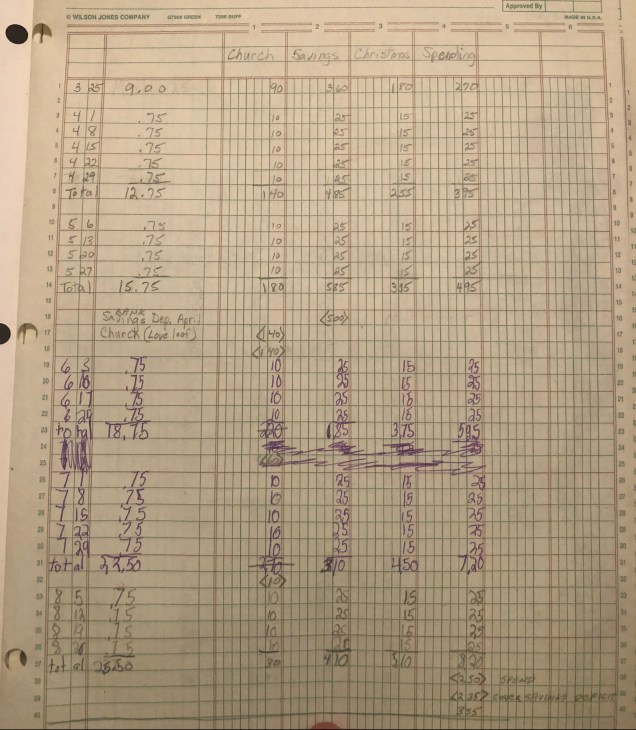
Each dollar had to be split into 4 categories. Each of these categories had to be logged in an accounting ledger book that my dad provided, to keep a running total of the balance. Categories were:

  • Savings
  • Tithing (Church)
  • Christmas gift savings
  • And the leftover: free spending

dad-acct.jpg

(Dad setting the template for how to track)

As you might imagine, these categories didn’t grow quickly – 35 cents in spending per week doesn’t buy you much! So it made us learn what was valuable and “worth it” when it came to spending our money.

Who knew that as an 8 year old, I was learning what it meant to be frugal, assign value to any purchase I made, and establish the difference between needs and wants.

As much as we complained about this forced treatment of money at the time, laughed about it when we went on to get our own high school jobs, and look back at it as a family now that we’re adults, this household policy was the single most important thing that shaped my philosophy on finances in my life.

I was just talking about it with my brother: “ah, memories of learning how to split a nickel!”

me-acct.jpg

(Me trying my hand at tracking; with some mistakes and fascinating hand writing!)

This was reinforced in the way my parents handled their own finances – a high savings rate, smart spending, and strategizing for their whole family’s future.

Here We Go…

My wife and I just welcomed our first son, and while we care for him during his first weeks and months of life, I want to document our path to get here and what the future holds for our little growing family, specifically tied to our finances and investing.

I’m getting my first taste of Financial Independence during my 3 weeks of full time off as paternity leave (no alarm clock!) – although the diaper changes, feedings, and mid-night cry sessions aren’t making this a vacation. 🙂

After the first 3 weeks, I’ll begin working from home part-time and transition back into full-time work in the coming months leading up to the holidays.

My wife and I both work for the federal government. While we are unable to receive dedicated parental leave, we are fortunate enough to accrue enough leave, and roll it over, to take as much time off as needed to care for and bond with our precious new little one. Let’s just say I use my leave and my salary in a similar fashion – save first and spend strategically. After 9 years in the government, I currently have over 800 hours at my disposal.

I hope you tag along for the journey as I detail specific stories the helped transform my philosophies on money, spending, investing, personal finance, and any related topic, and talk about more big picture items that define how my wife and I live our lives.

Health Insurance EOBs

I’m back to discuss this topic. It all comes down to “protect your money.” You need to pay attention to what you’re being billed for before you pay the bill. I’ll just throw out there that I think I had to make a call to correct an Explanation of Benefits (EOB) twice when I had Blue Cross, but it’s nearly every claim with our current insurance.

I had a minor outpatient surgical procedure in March 2025. The pre-op appointments started in January. That’s important because we have a deductible. I don’t trust this company’s calculation of our deductible, so I was paying very close attention to the EOBs for the first few months of the year.

The number of times that I have been sent to collections on a health balance due to their inability to process things correctly is pretty annoying. Every single time, it’s been because of their processes and the lack of insurance communication. Every single time, I’ve been on top of communicating with them to let them know what’s going on with insurance and received assurance that they had everything under control. Then I find out that I’ve been sent to collections.

In this instance, my insurance was really struggling for the first 2-3 months of the year. They had a data breach that screwed up so much of the processing and everything was delayed. I had multiple appointments in January and March (which was also surgery). There were so many insurance delays in processing that the doctors office sent me my statement dated June 16th. In their infinite wisdom, they counted the date of service as the time that I should have paid instead of the time that they received the EOB, and since the date of service was January, I got sent straight to collections. Wonderful.

I can’t stand that they tell me to check their website for help when I’ve already struggled to get their website to do the basic things it should do. But I spent hours calling these people (and the people they tell me to call because they think they can’t help). I finally got through to someone who could help me and understand what my situation was. It turns out I was in “pre-collections,” so not officially reported yet (on my credit; just that they were going to make an attempt to collect, even though I’d love to actually pay them on time). She let me pay the two EOBs worth of a balance and clear the collection record.

There’s no detailed point here. It’s just simply not to trust the doctor/hospital and insurance company to have your best interest in mind. Don’t assume that the paperwork is going to make its way to you. Pay attention to what’s out there and could be pending and a possible bill owed. But even once a bill gets to you, verify that it was paid by insurance correctly and that the amount you owe is accurate. I’ve seen the doctor’s office bill me for the amount unallowable by insurance. I’ve seen a doctor’s office not apply a payment I had made as a “coinsurance” at time of service, even though I had record. I’ve had doctor’s offices require payment up front of $50, but the actual payment owed ended up being $4.

Protect your money. Pay attention.