5% Rent Cap

The President issued a statement calling on Congress to cap rent increases at 5%, specifically for corporate landlords. The statement appears to define corporate landlords as those owning over 50 units in their portfolio. This was not an executive action that is implemented. And while my numbers are different than the numbers of a “corporate landlord,” I do think it’s worth hearing a landlord’s side. I feel that there’s a lot of spite against landlords without a lot of knowledge about their actual financials.

I admit that there is a possibility that some of these companies with large complexes could be raking in on the fees or “utilities” that are in the unit, without actually providing a properly maintained building, but that’s not the case for everyone that’s labeled as a landlord. No one seems to step back and see that this is a business model for landlords, and while everything else around us is increasing in costs, rent needs to as well.

No one predicted such a significant rise in product costs or housing costs in such a short period of time, but here we are. And landlords aren’t in the business to graciously eat the costs of homeownership for renters.

LANDLORD COST INCREASES

The Presidential statement released refers to a press release that starts with, “Today’s U.S. Labor Department Consumer Price Index (CPI) report revealed costs remained largely unchanged in May, with overall inflation cooling faster than economists expected as the Fed considers finally reducing interest rates below a 23-year high.” Is there a comparison to costs that landlords had to take on because the costs of everything increased faster than expected back in 2020-2022? Increases have been seen on small things like a maintenance call for a technician, but also big things like property taxes and insurance.

That same article goes on to state, “Since 2019, the cost of rent has risen 31.4%, with wages only increasing 23%, as tenants on average need to earn nearly $80,000 to not spend 30% or more of their income on rent.” In 2019, on one of my properties, the taxable assessment was $95,000, which equated to about $1,200 per year in taxes. In 2024, the taxable assessment was $242,000, which equates to about $3,000 per year in taxes. That’s a 61% increase in just my taxes over that same period of time where they’re complaining that the cost of rent increased by 31.4%. If rent had been set based on the 1% rule in 2019, rent would have been $950 per month. Had I increased 5% each year from 2019, it would be $1,212 in 2024. If I set rent based on the 1% rule now, it would be $2,420. However, the rent on the property is $1,750. So while it’s more than 5% each year since 2019 (the baseline the government is using), it’s set at an amount where I capture my expenses for owning the house, while also turning a small profit.

It’s taboo for a landlord to turn a profit, but that’s why we’re here. It’s an income stream that we’re establishing for profit. I don’t get to pay myself an hourly rate for managing the property. So this “profit” can actually be looked at like a salary. Every time I need to show the property to a prospective tenant, the lease signing, the walk through, every call or text you make, every trade that I need to schedule and coordinate with the tenant on, any fixes or improvements that I do myself. All of these minutes in a day add up, and I’m not directly paid for any of them.

On the particular house that I’m using for the example, we are assuming $300 per month in profit, which comes to $3,600 per year. Would you work as a manager of a company (e.g., hiring trades to fix things, performing maintenance, making sure all bills are paid timely, general management of having liabilities), for only $3,600 per year?

I wrote a post last Fall about the changes in my rental fixed costs from a year prior. I plan on doing the same this fall when more tax information comes due. The house I’m referring to has been at $1,750 for the past two years. However, between 2022 and 2023, my taxes and insurance have increased by $255 per year. That’s a cost that I’ve “eaten” from my “profits.” I could have said that equates to $22 per month increase, and I could have projected a similar increase for the year coming. I could change their monthly rent to be $1,790-$1,800 to keep my profits on a similar path. However, I didn’t, because they’re good tenants that haven’t had many maintenance calls.

However, if I don’t increase every year, then I could find myself in a sudden deficit like I did during the pandemic because costs increased faster than projected. A 5% cap could actually incentivize annual increases because I wouldn’t want to be caught behind and not able to catch up down the road.

LEASE TERMS

The Federal Housing Finance Agency announced protections for renters in multifamily properties that are financed with loans backed by Fannie Mae and Freddie Mac. The protections include: (a) requiring 30 day notice before rent increases; (b) requiring 30 day notice on lease expirations; and (c) providing a 5 day grace period before imposing late fees on rentals. I know for a fact that every single lease I’ve executed personally already has all of these requirements in it, at a minimum. In many cases, there’s a clause for 60 day notice of a potential rate increase, with negotiations being completed before 30 days from lease expiration.

Some states already have this codified. Other jurisdictions have landlord/tenant agreements that give the tenants rights (and awareness of rights) that can be lobbied against if the landlord is noncompliant.

There’s a clause that I’ve seen that requires expired leases to auto-renew on a month-to-month basis instead of for another year. I would argue that a requirement to renew a lease month-to-month instead of annually actually hurts a tenant. A landlord then only needs to give 30 days notice of a rent increase, and they could technically increase it month after month.

SUMMARY

If the ‘cap’ were to apply to me, then I’d be more inclined to increase rent every year. As a general rule, I increase rent for long term renters by $50 every two years. When we turnover a property, we will evaluate market rent in the area and set the monthly rent at what we see (which could be more than $50). In some cases, the evaluation ends up being too high, and we set the rent at something we think more people can afford. For example, there were comparable houses renting at $2,200 near a house we had listed. We’d rather get the property rented than shoot for top dollar, so we listed it at $1,600. While lower than “market value” probably called for, it was $400 higher than what we had it previously rented at, which covered cost increases that weren’t previously covered.

In the post that I previously linked, I highlight that our standard for increases barely offsets our increase in expenses. While we manage each house individually on setting the rates (asking ourselves: do we think the tenant can absorb the increase, do we have to increase to cover actual costs now), our monthly income among all houses was increased by $475. If you add up the cost increases for taxes, insurance, and property management (increased rent means increased fees because fees are based on the rent price), our costs went up $415 (and that’s before any service calls). On a whole, we’ve offset the ‘fixed cost’ increases. We’re taking ‘losses’ on houses where our routine for increases is slower. Therefore, having 13 properties affords us the ability to be more lenient with tenants and to keep good tenants in the house instead of forcing them out with hgher rent increases.

I support having protections in place for tenants. I’m sure there are landlords out there that aren’t interested in playing ‘by the book’ and just being decent human beings like I intend to. However, landlords are people too, and they’re running a business. Creating boundaries without fully understanding both sides of the situation and focusing on data points that only support your theory is unfair. I’ve joined the Landlord/Tenant Advisory Committee in my city. I hope to bring more awareness to the landlord side of things and bridge the gap between landlords and tenants when it comes to responsibilities.

LLC Filing with FinCEN

I was chatting with a financially savvy friend of mine, and she asked about filing our Limited Liability Corporation (LLC). I had no idea what she was talking about. Mr. ODA had no idea what she was talking about. I sent a text to 3 of my investor Realtor buddies (in two different states), and none of them heard about it. So I started digging.

Sure enough, if you have an LLC, you’re required to file with FinCen this year.

So here’s my attempt to let a few more people know of this legal requirement that carries fines, yet no one decided an email or mailing to LLC owners (which are filed with the State governments and are required to have physical mailing addresses) would be worth their time and cost of a stamp.

THE CORPORATE TRANSPARENCY ACT

On October 23, 2019, Congress passed this Act. The purpose being “to ensure that persons who form corporations or limited liability companies in the United States disclose the beneficial owners of those corporations or limited liability companies.” Essentially, they’re trying to ‘crack down’ on companies using LLCs as a shell game to move or hide money, or pay into criminal behavior.

It states, “Criminals have exploited State formation procedures to conceal their identities when forming corporations or limited liability companies in the United States.” In 2006, an international body determined that the United States fails to comply with beneficial owner information reporting, and gave a July 2008 deadline to fix it. The United States Federal level had urged State laws to comply, but didn’t follow up, and was cited again for failure in 2016. Since the States didn’t make progress, Congress issued this ruling.

The Act states that nearly 2 million LLCs are formed each year, with few States requiring beneficial owner information. A beneficial owner is generally someone who exercises control over the company, owns 25% or more, or receives substantial economic benefits; there are exceptions listed in the law.

While this was passed in late 2019, they then needed to establish a way to securely collect and retain the information reported. FinCEN established a Beneficial Ownership Information (BOI) website, in which you’re required to enter the pertinent information. It opened January 1, 2024.

Because this is the age where there are scams around every corner, note that this is a ‘.gov’ website, and their logo is below (i.e., don’t enter your personal information into a third party website).

REPORTING COMPANY

A reporting company is those that qualify based on the law’s detail. There are either domestic (registered here, doing business here) or foreign (registered in another country, doing business in the United States) reporting companies.

There are 23 ways a company may be exempt from reporting. The general gist of the exemptions are based on whether you’re already reporting to the government in another form (e.g., banks and accounting firms). “These entities include publicly traded companies meeting specified requirements, many nonprofits, and certain large operating companies.” Don’t assume you’re exempt; be sure to check the list on the official website.

BOI REPORTING

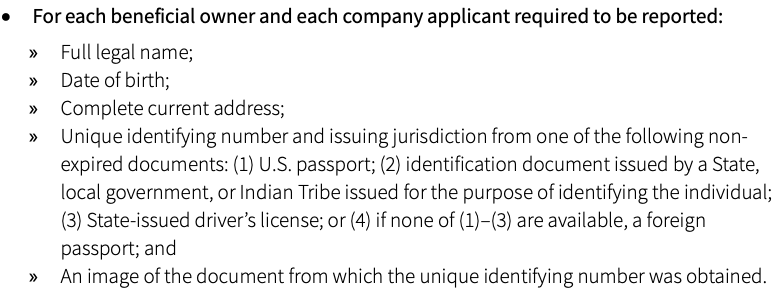
The reporting is straightforward. You will need a legal identification card image uploaded for each person entered in the system.

From the main page, I selected the icon that said prepare a BOI Report. I chose to prepare and submit, so it’s a form within the website. There’s another option that appears to allow you to fill it out in PDF form and submit the form. I preferred the prompts along the way.

Below is a snapshot of the information that’s needed in the initial filing.

When we set up our LLC, our drivers licenses were copied, so this request isn’t for anything more than we’ve already provided to our State. For us, establishing an LLC was solely a way for Mr. ODA and I to create an ownership stake in two properties that we purchased with a partner. Though there are 3 of us listed in the LLC, Mr. ODA and I are 50% partners together, and this other guy is a 50% partner. I pay him out at 50% each month after I collect rent.

It’s very simple; I’m sure there are LLCs with employees and more paperwork. However, I didn’t need a social security number for the beneficial owner(s) or any dollar amounts paid. We did establish a EIN for the LLC several years ago, so I submitted that EIN for the reporting company. Otherwise, I would have submitted my social security number as the company’s identifier.

There are more details associated with the reporting; for instance, you can update your report through their website. However, I’ll leave it to you to dig deeper on all those instances, as I’m just trying to build awareness.

DEADLINES

As with all new systems, there’s a phased approach to the requirements.

If you were already registered before this year, then you have until January 1, 2025 to file the initial BOI report. If you create an LLC during 2024, then you have 90 calendar days from the registration effective date to report. For all LLCs created on or after January 1, 2025, you have only 30 calendar days to report.

December Financial Update

I’m not even sure where to start for this month. It has been a whirlwind. There were a lot of tax payments last month, and this month I was still paying those among several other things.

PURCHASES

I purposely paid my credit card statement a little earlier than the due date so that it wouldn’t be that high for this update, but then I put a bunch of charges on it over the last two days. To catch you up – we’ve been holding money in our savings account for as long as possible. When we were getting 0.2% interest on it, it didn’t matter when I paid the card, so I typically paid it shortly after the statement closed. Now that we’re getting 4.22%, it’s worth keeping the money in there to earn interest, and then paying the credit card closer to the due date.

Our regular-use credit card is currently holding: $300 towards my dad’s iPhone (I should really share that mess of a story in purchasing that) (also, that doesn’t clearly account for my sisters having paid $200 towards that because that’s just “cash” in our checking account balance), $500+ of the kids preschool tuition, renewing our zoo membership for $139 (honestly, 5 of us enjoying the zoo for the year for that price is wonderful), over $200 for signing our son up for tee ball, two car insurance payments, and a rental insurance payment. I don’t typically go through the charges like that, but it’s just been a bunch of just-big-enough charges to grab my attention on our credit card balance. We drove to-and-from NY, so our gas station payments are higher than average too. As a reminder, the credit card balance you see also includes $10k worth of new carpet that we’re paying slowly on a 0% interest credit card.

RENTAL PROPERTY EXPENSES

I paid two of our Richmond houses’ taxes. The taxes are due on January 14th, but if I pay them this year, then it reduces what’s viewed as our ‘profit.’ I make sure to pay any known January bills in December of each year. Those two houses are so tiny, so their tax payments being so much larger than they once were kind of hurt (I’ve discussed the increases in property assessments, thereby increasing taxes). It was about $2,000 paid out (on top of all the things I paid over the last two months).

I also had to pay two supplemental taxes for Lexington. Government entities not meeting deadlines is a pet peeve of mine (I used to work for the Federal government). Last year, I completely missed that paperwork I received was a supplement bill for education, and then I received a penalty.I thought it was their typical assessment notice since it was outside of tax payment time. Luckily it was a few dollars, but I was so lost. This year, I paid close attention when I received an extra tax-related document. This supplemental bill was for trash services. Again, a few dollars. But think of all the extra paperwork, staff hours, postage, payment processing cost to collect an extra $20 from every house.

RENTAL PROPERTY INCOME

We had two tenants give us notice that they’re moving out. While extremely unfortunate timing on the year, I’m also human and understanding of their need. One tenant had a traumatic work event that led to him being laid off, and another family bought a house. We’ll find a way to get the houses re-rented as soon as possible, even though our vacancy time may be longer than it would have been if we were looking for a May 1st or June 1st renter. We have someone interested in both houses at this time, so that’s encouraging.

We had 4 tenants not pay in full. They all reached out to me to let me know in advance, and they paid what they could by the 5th (I always appreciate that – it holds them accountable, and it allows me to not foot all of the bills that I have to pay on the houses). As of the end of the 5th, we were short over $3,000 worth of rent ($1300 of that was for the house that has been late since October 1st and is finally working towards paying their debts).

As of today, we’re short $2,400. The tenant who’s playing catch up only has a balance of $960 left, which is great (that’s been a long road). Another tenant typically pays $750 on the 5th and 19th. So they’re not late on $750, but they are late on the $375 they didn’t pay in the first half of the month (this is a special scenario that we put in place for them because they couldn’t pay all at the beginning of the month, so we increased their rent as a concession to being able to pay twice per month without creating more late fees for them… but they’re still late).

NET WORTH

The market significantly increased over the last month. We also had $28k come in as part of our insurance claim; our cash increased by $35k though, so there’s an additional savings in there. And even though we had large expenses on our credit cards, it’s still slightly down from last month.

BONUS STORY

Mr. ODA and I wait for Black Friday deals to purchase our iPhones. We typically purchase every 3 years. I usually bite for a new phone so that the camera is better, but I’m suspicious that Apple is sending updates to alter the clarity of photos on older phones. How can I take these BEAUTIFUL pictures for the first few months of having a phone, and then all my pictures are grainy suddenly? ANYWAY.

Walmart had a deal that you purchase the iPhone 14 on a payment plan, and they give you a $350 Walmart gift card. These are the deals we typically seek. Apple is still getting their full price for the phone, but Walmart is offering a deal to bring our net to $0. When you want to purchase the phone from Walmart, it asks you to log into your carrier’s account. For this phone, it’s Verizon. We spend hours trying to figure out who the primary account holder is and what that log in it. Verizon does it where you can create your own log in and see you phone’s data at any time, but to see the entire plan’s data, you have to be the account holder (makes sense, but complicates this particular instance). The primary account holder is my mom’s phone number. Who died in March. We finally get assistance with that and log into the account through Walmart. It brings up all the lines on the account, we select my dad’s number, and then it gets to step 2. It says they can’t verify the address on the account and we need to go to Walmart mobile desk in a store. I call Verizon. Can’t help. I call Walmart. They keep telling me to put the item in my cart, which isn’t how you purchase a phone. So no help.

I finally bite the bullet, and on the Saturday after Thanksgiving, march myself to the nearest Long Island Walmart. They can’t help because they need the phone in the store. I swear if I were at my Walmart in Kentucky, they would have helped me. It was actually at the point where I was going to risk waiting until Tuesday so that I could have my phone desk people help me. The Walmart employee actually wasn’t flippant or trying to blow me off; I believe he genuinely thought he couldn’t help me. What needed to happen was that he called their help desk people, and then he was the mediator to figuring out the address. I figure this because a Walmart customer service person transferred me to such a person, who said he’s not allowed to talk to me and has to have a Walmart employee talking to him on my behalf.

I gave up. Sunday comes. I hope that some “overnight” processing of information has magically cured the process. It didn’t. I call Verizon again. Some angel of a lady answered the phone and actually helped me more than I could have imagined. I told her that I wanted the Walmart deal because all the Verizon deals require me to change my plan to unlimited data. I let her know that I’ve already spoken to several people, and they keep trying to convince me that I get a “free” iPhone while my plan increases $30 per month in perpetuity (versus $23 per month for 36 months for the phone). She offered me a deal that equates to $5/month for the phone for 36 months. So I put 100x more hours into this than I should have, but it ended up working out in our favor!