We’re continuing our spring/summer of travel and activity, which is why there are fewer posts and lots more spending.
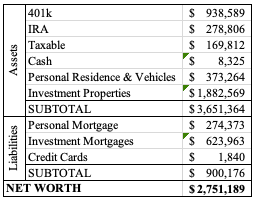
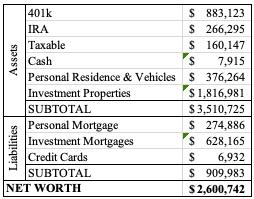
The stock market has increased, which has been the main factor in our net worth change. We paid $2,000 towards the mortgage we’re paying down, leaving a balance of $3,300. This mortgage will be paid off once all our rent is collected for July; it was pushed back a little bit because of the flooring replacement that occurred in one of our rentals, which is why our credit card balance is much lower than last month. We’re also still waiting for half of one property’s rent, which is the norm these days.
Utilities: $250. This includes internet, cell phones, water, sewer, trash, electric, and investment property sewer charges that are billed to the owner and not the tenant.
Groceries: $518
Gas: $268
Restaurants: $165. Our credit card reimburses for many of these expenses; we received credits totaling $120.13 in the last month.
Entertainment/Medical: $1,093
Investment: $1,100
Insurance Costs (personal and rentals): $845
VIGILANCE ON CREDIT CARD REWARDS
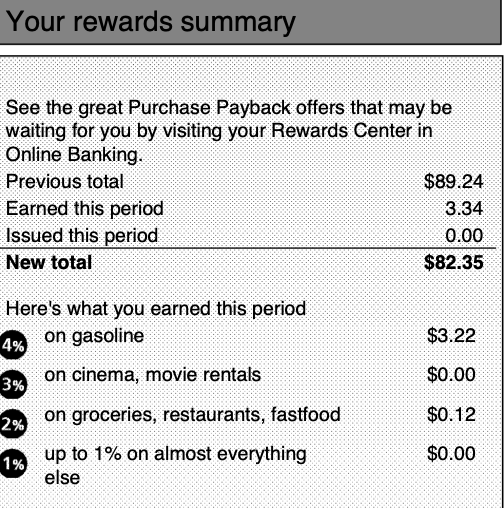
Mr. ODA discovered that our PNC credit card rewards balance was decreasing, despite earning new rewards this cycle. He investigated further and noticed that we had been losing rewards for a few months now. PNC has a policy that they don’t issue their rewards until you hit $100 worth of rewards. Once we hit $100, PNC sends us a check in the mail. Since they send a check, we still receive paper statements, even though we regularly check our financial accounts online. Over the past few months, both of us checked the balance to see “ok, we’re nearing $100,” but didn’t put any more effort into knowing the details of the balance. Mr. ODA happened to notice that the statement didn’t make sense.
$89+3 somehow equals $82. There isn’t a single section on our statement or via our online account that identifies the loss of rewards Mr. ODA called PNC to ask for more details and learned that our rewards expire after 2 years, despite their policy of not issuing a check until you hit $100. They basically said, it doesn’t matter that your account is over 10 years old, or that credit has been used less in the last year due to the pandemic, or that they don’t clearly identify the expiration of rewards and just identify a lower balance. As a comparison, and I keep going back to Chase, but Chase changed up their reward categories to allow the consumer to earn more rewards during the pandemic (e.g., in addition to giving rewards in the travel category, since consumers weren’t traveling, they added grocery and home improvement stores as major reward categories).
The PNC customer service representative reinstated 60 days worth of lost rewards and issued a statement credit. We don’t want a statement credit because we no longer want to use this credit card, earning rewards that we’ll never be able to capture. If we use this credit card to use up the statement credit, that’s rewards that could be earned on a different credit card. Now Mr. ODA is fighting for the credit to be applied to our checking account or to have a check sent to us (which is the preference on our profile) and fighting for the reinstatement of the rest of the rewards lost.
Without PNC, we’re down to 4 credit cards in our regular rotation. We have 3 cards that we use for categories (gas, grocery, restaurants, travel, home improvement stores), and then we have the Citi Double Cash card that is for “everyday purchases.”
We paid $2,850 in extra principal towards the main mortgage we’re paying down, leaving that mortgage with a balance of $5,500. We had a $4k flooring purchase on another house that has set our pay off timeline a few weeks back, but we’ll still have that mortgage paid off in the next couple of months. We have a rental property that we purchased in 2016 that has flooring that’s at least that old. The carpet has long passed its useful life, and the linoleum in the kitchen and laundry room has started to peel up at the seam. Typically, we wouldn’t want to replace flooring while a tenant still lives there, but they’ve lived with this for almost a year, and they’ve been our tenants since we purchased the house. As a means of keeping the tenant happy, we agreed to replace the flooring in all the rooms except the bathrooms.
We had two of our tenants not pay rent by the 5th, as required by the lease. They’re the two that are typically late, and they’re typically not up front with telling us about it. We’ve said several times that we’re really flexible landlords, but we can’t be flexible if we’re not told what is happening. With one tenant, who had just recently irked us with a plumbing issue and being incommunicado, we didn’t even reach out for information. We’ve had enough of their antics and having to chase them for rent. So I simply sent them their notice of default letter, outlining all their rights as tenants as now required under COVID-related procedures. I received an email letting me know that they’d pay on the 7th. I love their nonchalant response, like they hold the power and will pay whenever they feel like it (hmm). For the other tenant that was late, she texted to say she’d be late with the payment on the 7th, and then on the 7th only paid part of the rent due. She said she was in a car accident and there was an issue with her sick leave pay out, but she’d get it to us when it got fixed. She resolved it on the 12th, although still without the late fee.
We were able to get the invoice on the HVAC replacement for one property, which meant we paid our partner the $3,288 we owed him, on top of his usual $2,167 that we pay out for him to pay the mortgages and then his share of the profits (since I manage all the rent collections).
OUR SPENDING
Our credit card balances are high for several reasons. The $4k flooring purchase; as well as the insurance for one of our properties that isn’t escrowed because we paid off that mortgage, which was $436; an expensive gift purchase that isn’t transparent in the cash and credit line items because that cost was split 3 ways (i.e., we received 2/3 of that cost back in cash, but it’s still reflect in the credit line); and our travel.
We booked a camp site for the end of the month that required payment up front. We just got back from a trip, which increased our spending. But I’ll note that when we travel, we’re not eating expensive meals. Our interest is in the experiences and activities, rather than exploring sit down local restaurants. Our food for 5 days cost us $161 as a family of 4. We also ended up only paying for 2 of the 4 nights in the hotel because the air conditioning was broken, even after they came to ‘fix’ it, and then, when I was checking under the bed to see if any toys or socks got left behind as we were leaving, I found a large, dead roach. We didn’t ask for any comps; one was automatically reflected in my final invoice without my prompting, and then when the manager was speaking to Mr. ODA about his stay, he volunteered removing another night.
We opened a new credit card to take advantage of the bonuses since we knew we’d have this travel and the flooring cost to meet the $4,000 spending threshold for their bonus. This credit card has an annual fee of $95 and no 0% interest period, which goes against our norm when looking to open a new credit card. However, the bonus can be transferred to our Chase Rewards Portal, where we can use it to book travel at 50% the cost. We also received a $50 grocery credit.
ROUTINE UPDATES
My husband and I cashed in the last of his savings bonds that we got as children, so that was an extra $735 that we brought it that wasn’t planned.
We paid about $6,074 for our regular mortgage payments. Several of our properties had mortgage increases due to escrow shortages. I haven’t figured out which I dislike more: planning for tax and insurance payments, or the large escrow increases that seem to happen year after year. I think it’s the escrow though.
Every month, $1100 is automatically invested between each of our Roth IRAs and each child’s investment accounts. I should also note that I don’t speak to other investments because they happen before take-home pay, but my husband maxes out his TSP (401k) each year as well, which I had also done when I was employed.
Our grocery shopping cost us $700. Honestly, I don’t even know how to explain that cost jump. I think it’s because my husband shopped some deals at Kroger and Costco, so we stocked up on some things that aren’t part of our routine purchasing.
We spent $200 on gas. Two trips to Cincinnati, our trip to Atlanta, and then more-than-usual trips around town.
$400 went towards utilities. It’s higher than last month because we paid 3 months of our cell phones, which gets us back on quarterly billing as a family. Utilities include internet, cell phones, water, sewer, trash, electric, and investment property sewer charges that are billed to the owner and not the tenant. We still haven’t sought reimbursement from the builder on our electric bill, but this month’s bill was even less than the last month’s.
Our entertainment costs included baseball game tickets for our trip as well as two games later this summer, parking for the games this past weekend, a new shirt for our son, activities for the kids, and the hotel. This past month, we spent $650 on things I’d classify as entertainment related. I also included boarding for our dog ($100) in this total.
Speaking of our dog, he had his annual appointment (shots and the year’s worth of preventative medicines), and that cost us $500.
We spent $292 eating at restaurants and ordering take out. We utilized a Door Dash credit on one of our Chase credit cards, which was about $30.
But! I killed it with running errands this month and actually returning things that needed to be returned. I returned $150 worth of items one day!
We paid our State taxes during this period too. Between two states, that was $954. Also, anecdotally, I’ll share that we spent $6.40 to mail our Virginia tax return. We processed our taxes through Credit Karma, as we had done last year. We got through the federal e-file and moved onto the state filing, only to find out that if you’re filing partial states, Credit Karma doesn’t support it. I had to print 70 pages of our federal return, sign it, and ship it off to Virginia.
SUMMARY
Our net worth actually dipped this month. The stock market is the main factor in that, but the house valuation estimates are starting to level off and look more realistic as well.
Between our personal lives and our business life with these rental properties, we were sure kept busy. We expect the Spring months to be a busy time of year, and honestly it feels good to be active again. While we’ve loosened the purse strings for the summer months, especially after having done hardly anything for the last year, it was still a shock to see just how much we spent in these categories. But that’s the benefit of looking at your finances regularly. We can either choose to remain on course with our summer plans, or we can dial it back if we feel this was more than we expected.
Since we know we’re on top of our finances and have set up a healthy mentality when it comes to spending, we’re comfortable looking at this information once a month. If you’re currently developing these money habits, you may want to do these types of check-ins more frequently.
We have purchased 16 properties directly (3 personal residences) and 2 properties indirectly (partner); we’ve sold 3 properties. All houses have been mortgaged because we choose to leverage our money rather than own them outright (at least at first). This post covers the closing process in terms of clearing the loan processing.
Your loan must pass through underwriters before being approved and issued. The underwriter is evaluating your financial statements to determine risk and credit worthiness. While you’re given a pre-approval based on your credit score and report, the underwriter is verifying there are no other risk factors in the details. I’ll probably never cease to be amazed at what an underwriter focuses on – sometimes they want every account’s statement and several explanations, and sometimes they want you to confirm you don’t own a property that you never did own while ignoring the accounts you do own.
While a deadline is rarely given, you should provide the paperwork within a couple of days. The longer you take to gather the required documents, the more you jeopardize being able to close on time (the timeframe is set within the purchase agreement).
The are several documents that are going to be requested every time that you can keep filed away or know to start gathering them when you make the offer (some need to be more current than having them filed away). Inevitably, there will be follow up requests from the underwriter, so it’s best to get these files to them as quickly as possible.
Most recent 2 years of tax returns
Usually we just hand over the PDF version of our tax returns. One time, we actually had to fill out a transcript request form on the IRS page.
Proof of income (e.g., W-2)
Most recent paystub(s) (e.g., cover 30 days)
Color copy of drivers licenses
Most recent 1 or 2 bank statements
At the beginning of our purchasing, we had to provide a statement for every account (e.g., retirement, investments, banks). Over time, the request has become more focused on showing the statements associated with the accounts that will be used for funds as closing. I don’t know if this is related to our credit worthiness, or if it’s simply how they’ve streamlined the process. Here’s an example that shows they only requested accounts that make up our closing funds.
Proof of paid earnest money deposit (EMD)
EMD is a deposit made along with the signed contract. It’s the buyer’s showing of good faith to purchase the home. There are different expectations on the amount of the EMD. Sometimes it’s 1% of the purchase price, sometimes it’s a flat rate. We’ve just followed our agent’s lead on the amount to put on there, and it’s usually $1000 or $2000. The EMD is held by your Realtor’s office and credited to the total due at closing. If the buyer breaches the contract, the buyer may forfeit this deposit to the seller (e.g., backing out of the purchase without invoking a clause within he contract, such as the home inspection clause).
Proof is usually given by showing the check image along with the bank statement from the account it cleared.
Insurance agent contact information
This isn’t always known at closing, but you’ll need to provide your agent’s information before closing so that escrow can be set up. If the property won’t be escrowed, then you’ll need to provide proof of an executed policy before closing.
When investment properties are involved, you’ll need to provide documentation associated with those properties. For instance, a mortgage statement may be sufficient if you have the taxes and insurance escrowed. If you don’t have it escrowed or don’t have a mortgage, then you need to provide the current tax statement and insurance declaration. You’ll also be asked whether the property is subject to an HOA, and, if it is, you’ll provide a statement or coupon book showing the payment schedule. Neither Mr. ODA nor I are patient when it comes to illogical requests. For example, we were asked to give mortgage statements for all of our properties, as well as tax documentation and insurance policies for every property. Well, if the property is escrowed, then I don’t have tax paperwork because it’s sent to the bank, nor should I have to prove that the taxes are paid since it’s managed by the bank. I eventually provided all the tax documents though – it just took a while.
There may be large deposits or withdrawals that you’re requested to explain. For instance, I had to sign a statement that the deposit in our account was from the sale of our house. While it can be tracked with paperwork, there are many instances where the underwriter wants the details explicitly stated, versus making assumptions. For the example below, I provided the corresponding withdrawal from our main checking account.
Our first home purchase was at the same time as our wedding (we closed on our house on July 15 and got married on August 4!). A NY wedding isn’t cheap, and we were attempting to pay 20% down on our DC suburb home ($$$), so there was a lot of money movement around this time. Since my parents were helping pay for the wedding, we had large cash deposits into our account that had to be explained. We also had several investment account liquidation transactions. The underwriter had a hard time following the flow of money, and it took me several, very detailed, emails to show how each liquidation entered our checking account. We also had to provide gift letters, which stated we were gifted these sums of money and there was no expectation of paying it back (thereby creating another liability). That’s probably been the hardest closing in terms of our financial status, to date.
You may be requested to provide updated bank statements closer to the closing date, especially if there’s over a month between the initial documents given and the closing date. When you go into a closing, you’re told that it’s not a good idea to open new credit cards, make large purchases, or do anything along those lines that would affect your credit worthiness. They run a recheck of your credit before closing to ensure your credit card balances are about the same, and that there’s been no new credit opened in your name. Verification of more recent bank statements accomplishes the same.
We’ve had two closings delayed.
House 5‘s sale was about 6 weeks delayed due to the buyer’s lack of responsiveness. They didn’t respond to information requests quickly and struggled to provide the necessary documents to underwriting. Unfortunately, as the seller, our only ‘play’ is to take their EMD and walk away. If it’s bad enough, this is worth it. But it brings you back to square one. This was an off-market deal, which is enticing to see through rather than attempt to list and sell it. If we decide not to sell, we’re now looking at January or February before we had a renter; it could be even longer since we struggled in the summer to find someone for the house. Plus, the EMD doesn’t cover the lack of rent we experienced while under contract, where we expected to lose only one month of rental income, but it turned into 2.5 months. We had our Realtor (who was a dual agent, unfortunately for this matter) lean into the attorney on the buyer’s side after already being weeks beyond the contract’s closing date. By the time their delays were acknowledged, it was Christmas, which delayed closing into January, unfortunately.
Houses 12 and 13 were purchased together (and not yet discussed here). That closing was delayed a week, and it was completely the loan officer’s fault. We, the consumer, obviously get no restitution for their mishap. He didn’t order the appraisal timely and then had to put a rush on it, but it still didn’t come in on time. He created several errors in our paperwork (including the house number of one of the purchases). It got so bad that we just worked with the title agency, and she was awesome at getting all the documentation in order, even if it was a week later and Mr. ODA had to be my power of attorney!
Be prepared and be responsive. Understand that the bank is doing their due diligence and you want to be able to close on the loan and purchase that property. While there will be several requests for information, keep in mind that it’s over a short period of time and will soon be over.
This was a mess. I learned my lesson to research each property individually and not to make any assumptions. I also learned my lesson to hold true to our standards and expectations for a renter. We owned this house for a year and a half, but we learned a lot about tenants and the selling process. Hey, every struggle is a learning opportunity for next time, right!?
Mr. ODA showed me House 6 first (5 and 6 closed at the same time, and on my numbering list, this one came second… so try to overlook this awkward numbering!). I researched the area and the house’s history in detail, and I decided that it was worth pursuing. Very shortly after that, he approached me about House 5. The house was in better condition than House 6 and was literally only half a mile away. I assumed it was in the same neighborhood. I was wrong, and that’s where things went downhill fast.
LOAN
This house was so cheap that we needed an exception approved to get a loan. The purchase price was $60,000, which means a loan with 20% down is $48,000. The cutoff for even approving a loan with our regular lender is typically $50,000. Since we were below that threshold, we were ‘penalized’ by the rate.
I covered the closing snafu in the House 6 post, which also highlights the decision-making on the loan terms. Since this house was below that $50k threshold, our options were: 5.125% witha $200 credit or 5% with no credit. The higher interest rate would cost us an additional $1300 in interest, which isn’t offset by the $200 credit, so we chose the 5% rate. Hindsight: If we had known we would sell it just 18 months later, the credit would’ve been the better choice!
We purchased the house in July 2017. We immediately started aggressively paying towards the mortgage since it was the lowest balance and the highest interest rate.
We rented the house for $775, which far exceeded the 1% Rule.
WORK ON THE HOUSE
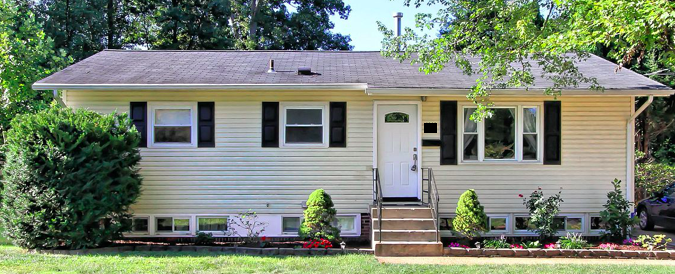
We did a lot of work in the yard. Here’s what the house looked like at some point before we owned it. It’s cute!
While it was under contract, the house sat vacant, so there were a lot of overgrown bushes, flowerbeds were filled with debris and no remnants of flowers having lived there, the lawn hadn’t been cut in a long time, and the tree in the front left had been removed at some point, leaving behind a mound of a stump and mulch that also collected debris. It’s a shame, and I kind of wish we had brought this little 2 bed/1 bath house back to life like it was in this picture. But I digress. Although this picture shows that the previous owner took care of the property, and that’s what attracted us to the purchase.
The floors were in immaculate shape, and the kitchen was quaint, but in decent shape. We purchased a new refrigerator before we could list for a tenant.
The bathroom needed a lot of help, but we didn’t want to overhaul it. The medicine cabinet wasn’t working anymore and the glass was cracked, so we wanted to replace it with just a mirror that covered the old medicine cabinet hole. Interestingly, we found a stash of 100s of razors behind it! (Apparently this is a thing from times gone by. You finish your blade and then you shove it behind the medicine cabinet for it to reside in the wall for all eternity.) We had several plumbing issues in the house. The drain pipe for the tub had multiple kinks in it, which caused the water to drain slowly and be more easily clogged. This would have been a major overhaul to get new plumbing installed in a way that was more direct.
The electric in the house was in need of work. We fixed quite a few electric-related-things while we owned it, but re-wiring the house was a major expense that would’ve come due in a few years.
TENANT ACQUISITION
The house was in great condition, had a big lot, was in a located close to the downtown area, and was on several bus routes (I even had a bus driver stop and ask me what the rent was on the house while I was working out front). It seemed like a great investment. We had several showings to qualified individuals….. who then went home, researched the house, and saw that it was in the highest crime area on Trulia’s crime map.
After sitting on the market for 5 weeks, we lowered our standards. There’s a reason you have standards as a landlord – it’s because if you select the right tenant, you’re saving yourself time, money, and headaches in the future. Here’s the email from our property manager. There are multiple red flags, and yet we gave her a chance.
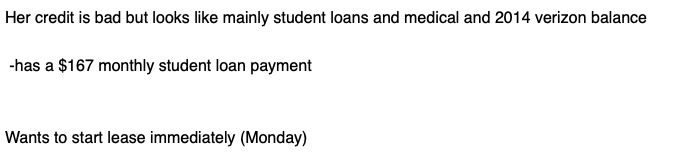
The prospective tenant provided us with an employment verification letter showing that she had just started a new job, her most recent pay stub corroborating the employment verification letter, and wrote a decent introduction in her application. Between it being 5 weeks with no tenant and it now being mid-August (with it harder to rent in the Fall), we overlooked her credit score of FOUR HUNDRED AND FORTY EIGHT (448) and SEVEN (7) accounts sent to collections. I don’t recommend you do this. Oops.
EVICTION
This is the fun part to recount. It’s detailed, but I think it’s interesting.
RENT COLLECTION
She moved in August 2017. By December 2017, we already had enough issues that she wasn’t going to be trusted going forward. We’re very flexible landlords, and we’re happy to work with you on any issues as long as they’re communicated up front and timely (meaning, if we have to continuously reach out to you for rent, you’re not in a position to ask for favors).
We had allowed PayPal to be used to pay rent, but every month there was an issue. She either sent it in a way that incurred fees (after being told that she would be responsible for such fees) or it was sent in a manner that caused PayPal to hold the funds and not immediately release them. After December’s rent was late, the late fee wasn’t paid in full, and there were fees taken out by PayPal, we cut her off from electronic payments. Our property manager informed her that going forward, all rent had to be received by her office (either by mail or drop off) before the 5th.
Speaking of flexibilities – we noticed that she needed to send us rent based on each pay check, versus having all the rent money at the beginning of the month. She was paying us a late fee every month. Her rent was $775, and her late fee was $77.50. That meant every month, we were collecting $852.50, which really wasn’t necessary. We offered a change to her lease terms – rent was due on the 1st and 15th. As compensation on our part, rent would be increased to $800, split into two $400 payments. However, if rent was late, the late fee was now 10% of the late payment ($40) or up to $80 if she was late on both installments. She agreed to this, as it saved her money each month and set her up for success by being able to set up a system with each of her paychecks. We didn’t like that our relationship with the tenant had come to us hounding her over money, so we thought this was the best path forward for both sides of the party. Here’s the addendum to her lease.
And yet this didn’t change anything!! The addendum was signed at the end of January 2018. She paid February’s 1st $400 late. Then she didn’t pay February’s 2nd $400, and we had to reach out to her several times before even getting a response… after she also didn’t pay March’s 1st $400.
Our property manager filed unlawful detainer (eviction) with the court, and that got the tenant’s attention. She then had to pay the balance due, as well as the court filing fee, before March 30th (court appearance date) to dismiss the court action. She showed up to court with the cash to pay and then everyone just went home. You can’t evict someone who has paid in full, even if the process of collecting rent was unnecessarily burdensome.
And then came April. There was another story about a medical emergency and a new job on the books. We had agreed to a new one-time schedule for April’s rent payment, and she missed those deadlines and was incommunicado. We sent her another default notice on April 25. Note that this medical emergency was for her “husband.” This is the first that she had implicated herself that someone may be living in the house other than her and her son. She paid her balance owed on May 4th.
On May 8, she was given another eviction warning notice for lack of May rent (the 1st $400) and gave no response to requests for information on when to expect rent. After continued lack of payment after that notice, she was served with another eviction notice. On May 17, she was given 30-days notice to vacate the premises by June 17, 2018 at 5:00 pm. But then she paid in full and on time. We then changed her lease terms to state she was on a month-to-month basis and she would be granted 30 days notice when we (or she) decided to terminate the lease agreement. It was signed on July 16.
Guess what? She didn’t pay September’s rent. At this time, we also addressed her husband.
She was married when she applied, but we didn’t know. Justnow as I was looking back through our files to write this post, I saw that her pay stub she used for employment verification said that she was filing her taxes as married. I hadn’t seen that before. In all our visits to the house, there were always other people there. There was one man that seemed to be around 90% of the time. We overlooked it, but our lease did stipulate that anyone who stayed for more than 2 weeks was required to pass a background check and be on the lease. I strongly suspect that this individual was not going to pass a background check, which is why it was never disclosed to us that she was married and another adult was living there. Our property manager informed her that only she and her son were on the lease, and that if anyone else was living there, they had to be on the lease. She asked if we were referring to her mother-in-law visiting, our property manager said that it appeared to be her husband was living there, and then she ignored us.
We gave her our 30 days notice on October 5 to vacate, meaning she had to be out by November 5. Our property manager reached out to her on October 26 to see if she would be out earlier and set a time for key pick up. The tenant nonchalantly stated she wouldn’t be able to make it out by the 5th and she’ll be out by the 9th. Umm, excuse me, ma’am, but that’s not how this works. We held strong to the 5th and she lost it. Our property manager said that her lease is over on the 5th, and if she was not gone by then, the court fees would be her responsibility for us to get the court and local police department involved for her removal. She got angry and claimed that we didn’t handle the rental well at all, that we couldn’t charge her any court fees, and that she should charge us for not being able to use her tub because it was clogged (guess what on this one? The plumber removed things like a dental floss pick from the drain, immediately making it her fault (and at her cost) for said clog). She then said: “Lets just hope your (sic) as speedy with my deposit as you all were with terminating the lease.” I laughed out loud on this one just now. We should have terminated her lease an entire year before this discussion happened, but we kept working with her! Hysterical! Gosh, and to think this wasn’t our worst eviction process (more to come :)).
SELLING
A friend-of-a-friend was attempting to purchase a house in the same neighborhood as this house, and they ran into multiple issues causing them to walk away from other deals. Mr. ODA approached him with an opportunity to sell this house, which had similar specs to the one that they were pursuing. The buyer spoke to his wife and father about the deal and agreed to move forward. Of course, this deal was not easy.
The contract was ratified on October 31, 2018. We didn’t close until January 8, 2019. Our typical close time on our purchases is 4 weeks. We’ve done faster, and we may have done a bit longer if the time of month lined up better for our finances, but over 2 months was horrendous. Since our tenant was moving out on 11/5, and the closing was expected to be no later than November 30th, we didn’t pursue finding a tenant.
The appraisal was late being ordered, which was somehow allowable. Then it came in at the beginning of December at $65,000; our contract was for $68,000. We split the difference ($1000 from the buyer, $1000 from the seller, $1000 from the agent who was dual representing).
On December 18, our Realtor finally pushed back on the buyer’s side of the transaction to get things done. But it was Christmas time now. With so many offices closing for the end of the year, we weren’t able to get a closing date until the first week of January. The buyers were signing paperwork from Pennsylvania, which caused more delays because of having to send the paperwork back and forth for everyone’s signatures.
We sold in January 2019 for $67,000, after having purchased it for $60k just 18 months earlier. While this seems like a great deal, it’s not an automatic $7k in our pockets. You need to account for our closing costs from the purchase and sale (about $6,500), loss of rent for two months while trying to close the sale and the 6 weeks of no tenant when we purchased it, utility costs associated with vacant times, and costs to fix things around the house during our ownership. However, during that time, we had a tenant paying our mortgage (covering the loan interest and paying down the principal), and we were collecting more rent than projected because of her continued late payments.
1031 EXCHANGE
We made the decision not to pursue a 1031 exchange on this house. A 1031 continues to defer the depreciation to the next property, and it allows capital gains to be deferred. Based on current tax law, it can be done infinite times. However, there are extra lawyers and fees that come into play, so it becomes worth it when you have big dollars at stake, and that you have another property to purchase quite quickly after selling the first one.
The appreciation on the house was minimal given that it had only been 18 months since purchase, we had two sets of closing costs to add to the cost basis, and we hadn’t earmarked a place for that money to go upon selling. Plus, the cost of an intermediary would continue to eat into the “profit” versus tax paid, so we just went ahead and planned to pay capital gains taxes on it. Unfortunately, since we had depreciated the structure and the fridge over the prior 18 months, that paper money had to be brought back into the fold when calculating our taxes the following April. That’s several thousands of hidden money that is easy to forget about.
Depreciation is a great tax break when you own the property. The IRS assumes the value of your asset is being reduced by wear and tear and father time. This is true. It’s why if a landlord neglects the property and isn’t active with maintenance, renovations, and other replacements, the property will turn into a trash-heap in time. However, when you sell the property, you show the IRS that it in fact did not do that. If someone is willing to buy my property for more than I bought it for, then it obviously didn’t depreciate to a lesser value. I have to pay the IRS back for the depreciation assumptions that I was allowed to make over the time I owned it, plus pay the tax on the actual profits. Bummer, but logical.
In summary, we bought a cheap house and got a poor tenant. We had a TON of headaches with that tenant. We had to do a few house/yard projects over the ownership life of the property, but nothing worrisome and not already built into our numbers. Somehow, we made it work that eventually the tenant always paid up and then some (late fees). We made mistakes, we learned lessons. We figured out a set of streets to avoid for future purchases, learned how to sell an investment, and learned how to file taxes on an investment property sale. The story is fun to look back on. I’m glad we experienced what we did. But I don’t want to do it again.
This is probably our easiest house to own; the closing process was the hardest part here. We closed on House 5 & 6 at the same time, so I’ll cover the closing story here because House 5 has a lot else to be said when I write out that whole saga.
TENANT
This property has a property manager on it (10% monthly rent). She processed a couple of applications at the onset, and it took 2 weeks to find the tenant. The lease started on August 18, 2017, and that’s been the same tenant in the house to date.
Rent is $850 per month. She pays on time, and it’s usually early. She just asked about her renewal, and we decided to keep her rent at the same price, even though it’s the start of her 5th lease term. Our cash-on-cash return was ahead for the last 4 years, so even though our taxes have increased by $400 since we purchased the property, we decided it was best to keep the tenant than to get a few more dollars per month.
She asked if she could paint the kitchen cabinets that were definitely old, and we figured they couldn’t be made any worse. When a tenant wants to make your house their home, it’s most often is a sign they make taking care of the property their priority, and that they want to stick around for a while.
We had to treat the house for ants over this last year, but the only real issue we’ve had on this house is that the main sewer line had to be replaced due to corrosion and tree stump intrusion into the pipe. The poor tenant had her toilets backing up into her house. It was $4,000 to replace the line from the street to the house. Honestly, I expected it to be more.
LOAN DECISION
Option 1 – 20% down payment – conventional 30 year fixed at 4.95% with 0 points Option 2 – 25% down payment – conventional 30 year fixed at 4.7% with 0 points
We weighed these two options for our loan (purchase price of $66,000). The difference is an increase of $3,300 in down payment to save $5,700 worth of interest over the life of the loan. Being that we closed on several houses in a short period of time, we chose Option 1. Having cash for the down payments and closing costs of the other houses was more important than the marginal savings in interest of putting 5% more down.
We’ve been paying down this mortgage. At the time of our decision on which house to pay extra principal towards, this was the smallest loan amount with a relatively high interest rate. We started paying extra towards this mortgage in October 2020. To date, we’ve paid an additional $35,500 towards principal, leaving a balance of just under $14k.
CLOSING
During the Spring and Summer of 2017, we saw a lot of houses. We also made offers on a lot of houses that didn’t end up going anywhere, either because there was no consensus on a purchase price or because the home inspection was unsavory. We closed on House 4 at the end of June, walked away from a deal on one house due to a home inspection issue, and then closings on House 5 & 6 got lost along the way by the attorney’s secretary. We worked with a specific attorney who we had a great relationship with, and who eventually helped us with a difficult purchase (see the story for House 8), but this was a hiccup.
The attorney’s office let us know they were unaware of these two closings around June 20th (in reality, they just missed the ‘all clear’ to move forward with a title search, but they were definitely made aware of them), which left us scrambling. Our rate lock expired July 7, and the secretary responsible for filing all the paperwork was taking her vacation the week of July 2. Since she was taking the week off, our attorney scheduled a surgery of his for the same time, so the office was closed. She said she would find a way to make it work, but then we didn’t hear from her and had to reach out to the attorney himself. Here’s that email, outlining all the details.
It wasn’t until June 30th that our attorney confirmed he was able to hand off our closing to another attorney’s office. We had a few questions about their fees, since we explicitly stated that we didn’t want it to cost us more because we had to change our closing location, and then the secretary there got defensive and gave us an attitude. I was quick to call her on it, explaining that we just wanted to better understand the break down of what they put on our closing disclosure. She backed down, and then we had an awkward interaction a few days later when we showed up in her office to sign the paperwork. It’s interesting how people don’t understand that writing in capital letters can come across as rude. Turns out this other firm was an old law school friend of the attorney we normally use, and they worked out a favor among themselves on the fees to ensure they didn’t lose any future business from us.
At the end of the day, we closed on the houses on time and without costing us anything extra, but it wasn’t a stress-free path to get there.
Luckily, this house has been easy to manage and the tenant has worked out perfectly. Our rent at $850 far exceeds the 1% Rule; with a purchase price of $66,000, our monthly rent goal would be $660. Tax assessments have recently risen given that the local market has appreciated substantially, so we will consider a rent increase in the future. However, at this time, having a long-term tenant on a house that has hardly any issues is more important than risking a rent increase and having her leave.
When reaching out to a loan officer, there are a lot of options to choose from. I’m hoping to break down the decision-making here. I’ll share how we ended up with several different options, too.
Basically, it boils down to:
Put enough down to avoid paying Private Mortgage Insurance (PMI)
Don’t pay more than 20% unless there’s a decent incentive.
Don’t pick a loan term shorter than 30 years unless there’s a decent incentive.
Carefully evaluate any Adjustable Rate Mortgages (ARMs).
PMI
I broke down PMI in a previous post: PMI – Private Mortgage Insurance. We suggest doing whatever you can to meet the requirements to avoid paying this. The cost of PMI can be a couple hundred dollars per month, which is money that can be put towards the principal balance of your loan or other bills, rather than in the bank’s pockets. There are also hoops to jump through to remove PMI early, which may include paying for another appraisal on the house ($400-$700!).
LOAN TERMS
A conventional loan will likely require 20% to avoid paying PMI. There are some loan options out there that may allow a smaller down payment without a ‘penalty’ (e.g., PMI, higher interest rate), but 20% is the standard, and is usually required when purchasing an investment property.
There may be an option to put down more than 20% or you may think you can afford to pay a higher mortgage each month, so you’re interested in a shorter loan term. Unless there’s an incentive (e.g., lower interest rate, better closing costs), stick with the bare minimum to get the loan.
If there is an incentive, you’ll need analyze the math and your goals to determine if committing extra money to a higher down payment or a larger monthly payment is worth it. If you have extra cash each month, you can pay more towards your principal rather than pigeon holing yourself into a higher monthly payment. Plus, if you have more cash liquid, you may be able to purchase another rental property, which will increase your monthly cash flow.
While we evaluate the loan terms on every house purchase, I’ll share the details of the two most “unconventional” options we chose. Two things to note: 1) lenders add a ‘surcharge’ to the rate for it being an investment property, typically around 0.75%, which means the rates aren’t going to be the great, super-low, rates being advertised; and 2) the term “point” means a fee of 1% of the loan amount.
HOUSE #2
For House #2 (purchased in 2016), we were informed that if we put 20% down instead of 25%, the rate would increase 0.25% on average. If we assume a 30 year conventional loan, 20% down at 4.125% equates to about $69,700 paid in interest (assuming no additional principal payments); 25% down at 3.875% equates to about $60,800 paid in interest. By putting an additional $5,850 as part of our down payment, we saved about $9,000 in interest over the life of the loan.
Once we determined that we’ll put 25% down, we then had to figure out the appropriate loan length. On this particular offer, 30 year amortization wasn’t an option for us because we would have had to pay a point to get a competitive rate. We chose a 20 year amortization because the house already came with a well qualified tenant, we didn’t expect a lot of maintenance and repair costs due to the house’s age, and we didn’t have an immediate need for a higher monthly cash flow based on our place in life at the time.
While our long term goal was to have rental property cash flow replace our W2 income, this house was early in our purchasing. At the time, we were focused more on paying off House #1 (higher rate and a balloon payment after 5 years). Frankly, we didn’t truly understand the power of real estate investing at this time, and didn’t know how much it would accelerate the timeline for us to meet our goals. By decreasing our loan length, we increased our monthly payment, but also lowered the total interest paid over the loan’s life by over $22k. Since more of our monthly payment is going towards principal reduction than had it been a 30 year amortization, this loan isn’t on our priority list to pay off early.
HOUSE #3
For House #3, we evaluated the rate sheet for the loan term, interest rate, and down payment percentage again. This house was purchased a few months after House #2, so those rate decisions were fresh on our minds. We were quoted several options: 1) 20% down at 4.25% for 20 or 30 years, 2) 25% down at 3.75% for 20 or 30 years, or 3) 25% down at 3.25% with 0.5% points for 15 years.
As you can see, there’s no incentive to pick the 20-year term because it’s the same rate as a 30-year term. If we have additional cash, we can make a principal-only payments against the 30-year term rather than unnecessarily tying up our money.
At first, we thought paying points was an absolute ‘no.’ However, points aren’t a bad thing. Paying down your rate up front can save you an appreciable amount in interest. Plus, points are tax deductible.
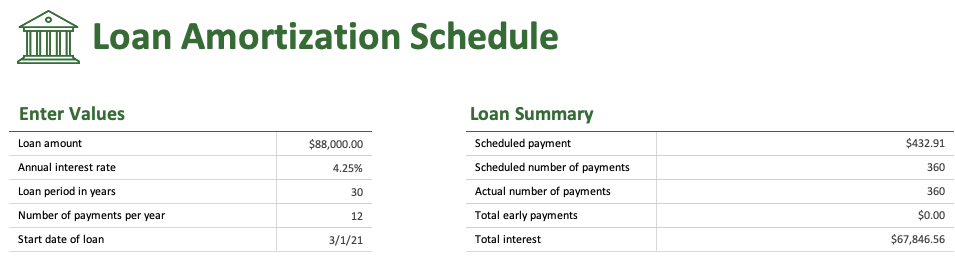
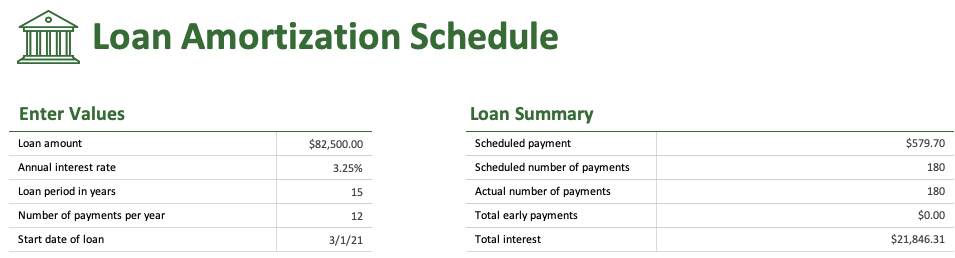
Now for the breakdown of each options. Let’s say the house purchase was $110,000 (because it wasn’t an exact number, and it’ll just be easier to use a ‘clean’ number like this). Microsoft Excel has an amortization template where you can plug in the loan terms and see the entire amortization schedule.
Option 1: 20% down payment equates to a loan amount of $88,000; the annual interest rate is 4.25%; the loan is for 30 years, with 12 payments per year. If we make no additional payments, this totals about $67,800 worth of interest paid over the life of the loan.
Option 2: 25% down payment equates to a loan amount of $82,500 at 3.75%. If we make no additional payments, this totals $55k worth of interest paid over the life of the loan. This requires an additional $5,500 brought to the closing table, but saves almost $13k in interest. It also decreases our monthly principal and interest payment (i.e., not including escrow) from Option 1 by $50.
Option 3: 25% down payment, 3.25% interest, and 15 years (instead of 30 years) equates to just under $22k paid in interest. To obtain the 3.25% rate, it required “half a point.” If a point is 1% of the loan amount, that would be 1% of $82,500. This rate only required 0.5%, so that meant paying $412.50 as part of closing costs along with the additional $5,500 of down payment required for 25%. However, the shorter loan length means that monthly payment is increased (between Option 2 and Option 3, the difference is $197.63).
For about $6k, we pay a higher monthly payment, but we also save a significant amount of interest over the life of the loan. The short loan term of 15 years means this one is also not on our radar to pay off while we focus on paying down other, higher interest and higher balanced, mortgages. In this case, the benefits of the big picture math outweighed the increase in monthly payment.
We are five years in on this mortgage and are already seeing significant reduction in the outstanding principal due to the amortization schedule becoming favorable more quickly. In 10 short years more, our house will be fully paid for, through rent collection, without a single dollar of extra principal payments from our other financials. What a great feeling.
ADJUSTABLE RATE MORTGAGES (ARMs)
An adjustable rate mortgage can be beneficial depending on the terms and how long you expect to own the house. For us, we expect to hold our investment properties for a long time, so it wasn’t worth the risk of an ARM. Many times lenders won’t even offer an ARM on an investment. However, when we purchased our DC suburb home, we knew we didn’t expect to be there for more than 5 years, so we chose a 5 year ARM.
After a positive experience with that decision, we also chose an ARM on our second primary residence. We chose a 5 year ARM, even though we expected to be there longer than 5 years. We figured we would either accept the new rate, if there was one, at the end of the 5th year, or we would refinance when necessary. As a result, Mr. ODA monitored rates and refinance options over the last year or so. Unexpectedly, we sold that house 3.5 months shy of the end of the initial ARM term so we didn’t have to do anything.
I break down all the details of an ARM and our decision making in a recent post.
SUMMARY
When I reach out to my lender to ask what the rates of the day are and begin the process of locking a rate on a new loan, I ask for options. These options are in the form of a “rate sheet.” When you ‘lock’ a rate, you’re actually locking the ‘rate sheet,’ not the individual decisions of loan length and percent down. For every house, we evaluate the rate savings that can come from doing something less “conventional” than a 30-year fixed at 20% down mortgage. Our decision is based on what’s best for our goals and our cash in-hand.
As shown above, in our early decisions, we favored shorter loan terms for rate savings. but since House #3’s purchase, we noticed how much more we cared about low monthly payments and low down payments to allow us to buy more properties along the way. Every investment property loan since House #3 has been the ‘standard’ 30-year fixed at 20% down. Because of this perspective shift, we were able to buy six properties in 2017, which gives us about $2,000 in monthly cash flow that we can then use to pay down mortgages.
Dave Ramsey has convinced (too many) people to pay off their mortgage and be “debt free.” Then you have Robert Kiyosaki telling people not to buy a house because its a liability, but never seems to address that you still have to pay for a roof over your head somehow. We subscribe to a different view – make your money work for you. There are certain types of debt that could truly benefit you, and a mortgage is one of those.
If we worried about paying down our mortgage, we wouldn’t have near the savings and investments we do, and wouldn’t be able to establish enough rental income to replace Mrs. ODA’s income, and being well on our way to replacing Mr. ODA’s.
We lived below our means, took some loans, and bought a house in one of the more expensive regions of the country – DC suburbs (oh, and while paying for a wedding). We knew we’d have no trouble qualifying for a mortgage and paying the monthly payment, but we didn’t want to pay Private Mortgage Insurance (PMI), which meant coming up with 20% to put down (i.e., about $80,000). In fact, we were pre-qualified for double the purchase price of a house than we were comfortable with because we were more focused on our down payment threshold than what we could support as a monthly payment (which is how a bank will pre-qualify you based on your other monthly debt payments).
Our first, expensive, little house that jumpstarted our investing before we even knew
Our primary goal to enhance our savings in the months leading up to the house purchase was to keep the cost of our daily food intake below $10 between the two of us. We were cautious with how we spent money on groceries, whether we ate out (meaning no buying lunch during the work day), and the types of activities we did. While most of our meals consisted of macaroni and cheese and pb&j, we did ‘splurge’ a little more once in a while (read splurge as meaning “2 for $20” at Applebee’s, not steak dinners). That year of actively watching what we spent paid off in ways we wouldn’t know down the road.
Three and a half years later, we sold our house for a $60,000 profit and purchased a home in the Richmond area for less than what that first house cost us when we bought it. That left a substantial balance in our savings account that needed to get to work.
We’re not interested in preparing for doomsday. In an emergency, there’s hardly anything that can’t be put on a credit card. If we can’t pay off the credit card, we have money in the stock market that can be liquidated within 24 hours to pay it. This perspective is particularly possible because we live a lifestyle that allows for a high savings rate while Mr. ODA is still W-2 employed, which means we’re even more unlikely to need stock liquidation to cover expenses. We weigh the risk of a possible emergency against not having our money make more money, which gives us the ability to live less conservatively.Since we’re not interested in maintaining 3x our monthly income in a savings account at 0.01% interest rate, the next option to discuss is paying down our primary residence mortgage.
Our mortgage rate was 2.875%, a very cheap lending rate [this was a 5-year Adjustable Rate Mortgage (ARM), a topic we can discuss in a future post on weighing mortgage options]. The question we had to ask was whether paying down the mortgage at a low interest rate was more beneficial than the income we could bring in with a rental property. If we paid more than 20% for our new primary residence’s down payment, was that going to provide us a greater cash flow to leave our careers before typical retirement age?
No, it wouldn’t allow us to leave our careers. So, we put the balance of money from the sale of our first home into the stock market and investment properties to make it generate income instead.
Our first investment property purchase was in February 2016. Since then, we’ve purchased twelve other investment properties, with the most recent two being in September 2019. Mrs. ODA’s income was replaced by our rental property cashflow by the time our son was born in August 2018; that’s within 2.5 years after we purchased our first investment property.
Of our 12 investment properties, two have mortgages paid off. First, there’s a maximum of 10 mortgages you can have when lending under Fannie Mae. There are ways around this in theory, but that’s another post. One of the mortgages we paid off because it had a balloon payment coming due. Another mortgage was paid off because it had a low balance and was one of the higher interest rates among our properties. Currently, we’re working to pay down two other mortgages due to their relatively high interest rates (5.1% and 4.95%), and each have a balance around $26,000 now. We’re choosing to pay down mortgages in this season instead of purchase new rental properties because we are not finding properties in decent condition that meet the 1% Rule. Plus, not having a mortgage on a property immediately increases your cash flow if you want to live off that monthly income rather than W-2 employment.
Had we chosen to pay down our primary residence mortgage instead of leverage our funds through mortgages, we’d still have a mortgage payment of over $1,500 per month and no other income strings. Instead, we still have a mortgage payment for our primary home, but we also have the cash flow that replaced Mrs. ODA’s six-figure income.