Organization Push

It’s the new year, so that means everyone’s pushing to “start fresh” and “get organized.” Someone I follow on Instagram talks about “getting organized” at least once per month. This month, she bought a new electronic tool that her husband hung on the wall to get her organized. Here’s my unpopular opinion: organization happens in your consistency, not in a new gadget or container.

This electronic calendar costs $300, unless you want the biggest one, then it’s $630. I bought a $14 chalk board with calendar boxes on it. Each month, I write the month’s agenda day by day. Then at the end of the month, I erase it and put the next month’s activities on it. It requires about 10 minutes of my time each month, which I acknowledge is more effort than an automatically synced electronic calendar (if you’re even using your electronic calendar), but I believe those 10 minutes per month are worth keeping that $300 in my bank account to use on something else that brings me joy.

Here’s the thing: the $300 calendar is only as good as your commitment to using it. This isn’t a special robot that keeps your life organized and calendar up to date. You still need to input data. Then you need to create an expectation and routine where you check that data. If you can commit to putting items on your electronic calendar that syncs with the system, why can’t you make the commitment to consistency in other areas? That’s all it comes down to – consistency.

I don’t disagree that there are some people who benefit from this product. But I’d venture to say those are the people and families that are already organized and already have systems in place to provide a well-oiled-machine type household.

STRESS AND MESS

I haven’t delved into the topic in detail, but the blurbs I’ve seen have stuck with me. I think they ring true. “A 2009 study found that mothers with cluttered homes had higher levels of the stress hormone, cortisol.”

The people I know who have high levels of stress and anxiety are also the people who have a lot of clutter in their home and office. They’re surrounded by a lot of distractions and don’t keep a routine, have systems, or make an effort to eliminate the mess. Less things to tidy up, means less time putting things away or finding a home for things. Everything having a home and putting things in their home as soon as possible are good first steps.

MY KEYS TO SUCCESS

Everyone has a different way of thinking, so this isn’t a one-size fits all situation. However, I do have a few things that I do that could be little nuggets into improvements in your day.


Room “Sweeping”

Another thing I’ve seen on social media is that expectation that things are put where they belong in one action. The concept seems like a good idea, but to me, it provides for inefficiencies and everything taking longer. If it takes longer to complete a task, then I don’t think it’s something you’d keep up with.

The idea is that instead of placing your keys on the counter, which then need to go on a key rack or in a drawer, you just put them there to begin with.

Where I see a flaw come in, is that when I’m tidying after my family, if I pick up one item that goes to the basement and put it away, then come upstairs and find another item that needs to go to the basement, I’ve waste that time walking up and down the stairs. Instead, I move room to room.

I usually start in the living room. I move items to where they belong. If they go in the living room, they get put away right away. If they go to another room, they just get placed on a surface (e.g., cups and bowls are placed on the kitchen counter, basement toys are placed at the top of the basement stairs). Then once that room is tidy, I move on to the next, which is probably the kitchen table. The table gets cleared and items get placed in the room they belong in, unless it’s the living room, then it gets put away since I already cleared that room.

I do my best to complete this task all at once. I do the kitchen last because I know an unkept kitchen drives me crazy, so it motivates me to complete the other rooms so that I can get the kitchen cleaned up.

I’ve seen basket concepts too. I haven’t tried this out, but it seems to be generally the same concept. The only issue I’ve noticed is that there’s no expectation that it’s cleared out daily. Once the items are in a basket, it doesn’t seem the room is cluttered anymore, so it doesn’t motivate the final step of clearing out the baskets and putting the items away.


Resets

My days are significantly better if I wake up to a clean kitchen and house. If I need to clear dishes from the sink, pick up toys in the living room, and wipe off the table and counters, then I’ve put my ‘morning chores’ 15-20 minutes behind. I learned that I appreciate focusing only on morning chores in the morning, so I make sure I tidy up the house before I go to bed.

My morning routine is simple, but I know it takes at least a half hour. I empty the dishwasher (which is essentially ran every other night), make the kids’ snacks and lunches for school, get their water bottles filled and set on the table, lay out their vitamins, start my coffee, and get the dog ready for the day. It’s the same thing every school day morning.

I also know that I much prefer to have it all done before any children wake up. They create a distraction. Tasks that take me 3 minutes now take me 8 minutes because I’ve been interrupted several times. While I’m trying to empty the dishwasher, they can now see a plate or cup they want, and then they start asking for these things. While I’m trying to make someone’s lunch for school, they’re asking me what I’m giving them and now having an opinion on whether they want it or not. If everything is done and out of sight before they wake up, it eliminates those distractions and I can accomplish tasks quicker and more efficiently. It also gives me the ability to give them attention for their stories and their breakfasts requests once they start waking up, so I’m not flustered or forgetting steps of the morning that make the rest of my day feel successful.

I used to require all dishes be put immediately into the dishwasher. There was no reason to set a cup in the sink when it could have easily been placed in the dishwasher without having it sit in the sink first. Then I had 3 kids. There’s no way I can keep on top of the dishes, and the fact that they even clear the table and put things in the sink at their ages is a huge win. Instead, I just make sure that before I start any meal, the sink is emptied. One, it allows for no distractions in my own head (because I know that I will see dishes and keep thinking about them being there when they shouldn’t be). Two, it clears out the sink so that I have room to fill pots with water or dump dirty things into the drain (I can’t stand when plates are rinsed off on top of other plates, leaving those plates with a greasy film that I then need to touch). Keeping up with a reset before each meal means that it doesn’t get to an overwhelming point at the end of the day that’s taking a lot of focus and time.

SYSTEMS

Organization comes down to systems. You don’t need to spend a fortune to create organization in your life. Sure, bins here and there create a distraction-free, clutter-free environment. But having an aesthetic container that you pour a box of cereal into creates another step for you to be successful, and it doesn’t gain you anything in the organization realm.

My pantry isn’t organized with perfectly matched bins or containers, but it’s organized. I have all our cereal boxes on one shelf. I expect those boxes to go back on that shelf, not left on the counter and not just put anywhere in the pantry. Cereal has a home. Pasta has a home. Appliances have a home. Every once in a while I realize that we could benefit from having a container, and I’ll get a bin to house several tiny things that kept falling on the floor when someone touched something else. Overall, everything has a home in its original container.

Don’t get me wrong, there are clean ups that need to happen in my life. There are 5 of us touching things in that pantry and this house, so things aren’t perfect. However, everything has a home. There’s a well-known expectation that things are put where they belong (especially since mom answers enough “where is…” questions here).

SUMMARY

The general concept is that your desire to get organized is fueled by your own actions and thoughts. It’s not going to be ‘fixed’ with expensive gadgets if you’re not willing to put the effort into the follow through.

Don’t take this as I’m perfectly organized and have everything under control. I cheat. The last load of laundry is in the dryer. If it stays in there instead of on my bed, then I don’t have to deal with it until I really need or want to. This happens about 75% of the time I do laundry… that last load just lays in there until the next time I do laundry and need to move things along. I also have learned that if I fold the clothes during the day, then I can put them away right away. If I fold clothes after the kids go to bed, then they sit on my dresser for days because I couldn’t immediately put them away while they were sleeping, and I’m typically only seeing them and being reminded while I’m in the middle of another task.

So on top of creating systems and expectations for your household, it’s a matter of finding what makes you tick. When you’re successful at keeping the kitchen clean, does it make you feel like you have better control over the rest of the day? Find these little items that you can be successful at so that they snowball into bigger actions – all of which can be done for free.


New Year Financial Organization

Two weeks ago, I shared how I organize my home and manage my time. I have my own home’s finances, thirteen rental properties, three kids with two in school, investments, and whatever other ad hoc bills show up to manage. I don’t have the ability to think in a quiet and distraction-free environment after 7:30 am. That post was all about the little steps I take at the beginning and end of my day that help set me up for success. This week is what I’ve done to organize our finances to ensure bills are paid on time, while managing it against what income I’m expecting. This also has tidbits on organizing yourself so you don’t end up with missed bills.

One problem that I run into is business hours. I seem to be working with a lot more companies that won’t let me make payments online and require a phone call. It’s so frustrating. So after a morning of my chores and managing the 3 kids, I need to put on my big girl pants and muster the energy to make my phone calls while the baby naps (and the two big kids are likely placed in front of the tv… except they like to tell me about the show they’re watching while they watch). Then there are ones that are even worse because they require me to leave a message for someone to call me back, even though my ability to have a coherent conversation is really only within these 2 hours of the day. For example, I ended up scheduling my son’s surgery while finishing up check out at Home Depot and walking out the door with two children in tow.

FINANCIAL ORGANIZATION

Every year, I need to set up two spreadsheets. One keeps track of our income and bills, and the other keeps track of property-specific income and expenses. While an investment property tracking mechanism isn’t something that everyone needs, a way to manage your bills is. My financial tracking spreadsheet has been used in the same exact form since 2012, when Mr. ODA and I got married.

Before I get into the spreadsheet tracking mechanism, you can do something as simple as a calendar appointment. At this time, the preschool director sends an email with a new link every month to pay tuition. Last year, it was the same link all year with no reminder email. Since this was something I wasn’t used to, I made a calendar appointment on the first of every month that said “Tuition Due.” I check my calendar every few days at the very least, so I didn’t need it to notify me; but you can set it up to send a push notification or an email if you need one of those forms to help with the reminder.

Mr. ODA gets paid biweekly. The paycheck shows up in our account on a Saturday, so my tracking is by that date. For example, his paycheck showed up on the 6th this month. I also expected to have most of rent paid on the 5th (falls on a Friday, tenants have a grace period until the 5th without a late fee, and it’s just after the holidays). I have each house listed with their respective rent due. As rent comes in, I turn the font color to gray from black, which is my indication that it’s been received. If I’m not expecting rent until later in the month, then I move it out to that two-week period column.

For expenses, I list anything that will come due between the 6th and the 20th. This includes all mortgage payments, utility bills, credit card payments, and investments planned. Again, as they’re paid, I turn their font from black to gray.

This process is necessary for me because of the number of bills I have to manage. The spreadsheet is an indicator to me that a bill is coming due, so if I haven’t noticed an email or mailing with the bill amount by a certain date, I go search for it. I don’t want to miss a payment. Sometimes, a system is updated and your email is missed, or there’s a glitch, and then there’s no email sent as the trigger for me to pay it. I like having the spreadsheet as a “safety net” for our bills.

MAIL ORGANIZATION

Nearly all of my bills are sent electronically to my email, but I sometimes receive paper mail. It could be a medical bill, a rental’s utility bill, tax bills, etc. I open all my mail the day it’s received.
– I separate out the junk mail and put it immediately in the recycling bin. A pile of envelopes building up over the week just creates distractions. You see a big pile that needs attention, and it’s a daunting task. If you eliminate the things that don’t actually need your attention immediately, it leaves a smaller pile for you to see.
– I lay papers that don’t need action, but I want to keep on file, in a pile at the bottom of my stairs. Many of these could probably be eliminated because I have access online. But sometimes it’s easier to have a paper version available. For example, my EOBs are mostly available online. Sometimes they don’t load on the website, and sometimes I need to take notes on issues I’m working on with them (which is far more often than I’d care to admit for a service I’m paying for).
– I lay the papers that need action on my “to do” pile, which is in the kitchen. When I worked in an office and didn’t have kids, managing these bills was a lot easier. Now I’ve set up a routine where I check the pile every Friday. The pile is visually available; it’s not in a basket or a drawer. There have been a few times where time flew, and before I knew it, I hadn’t checked the pile in 3 weeks (newborn life!). The scare that I remembered to pay a bill right on the due date, and by sheer coincidence checked my pile that day, made me establish a more consistent expectation of myself to look at the pile every Friday.

EMAIL ORGANIZATION

When I was working, this was a hot topic. I stayed on a top of my email. I verified that someone else didn’t respond to an email before I responded. I didn’t attend a meeting and state that I hadn’t seen an email pertinent to the topic discussed. I didn’t have leadership coming to ask me for a response to something that they didn’t receive timely.

I hit low hanging fruit first and reduced the clutter. This is the same concept as getting rid of the junk mail you get. I skimmed “all employee” emails to see if it was pertinent to me. I either read it right away (because these are just reading emails and won’t require an action) or I deleted it right away. I see people often just leave it sitting in their inbox unread. It’s a distraction. You’re constantly looking at something that needs to be dealt with, and it’s taking brain power away from the things that you really need to focus on.

Then I looked at emails from my direct leadership team. These items could be not pertinent to me, could require immediate action, or could be part of a larger situation that needs attention. After that, I focused on emails from my counterparts at the State. They’re my “customer,” and typically these emails are issues that need addressed timely.

Essentially, I’m skimming all emails and mentally filing them into how quickly they need attention or how much effort they’re going to take. If I can answer an email without any further research or effort than just typing the response, then I do that. I then immediately file the email because it’s “done.” I get it out of my inbox so that I can continue to focus on what needs addressed. At the end of this, I should only have a few emails left for action, and I get to work.

I manage my email the same way now, for my personal needs. Store coupons and such get deleted right away. A coupon is rarely good for more than a month, so I use my trash as the filing system there (which gets automatically deleted every 30 days). If I go to Kohl’s, then I just do a search in my trash folder for the latest Kohl’s emails to see if I have a coupon. I keep all emails that require action in my inbox. Right now, I have a Walmart order confirmation (so I’m tracking to make sure it arrives), a medical bill, a reminder from the Y to pick up a shirt, and the kids’ tuition email. When I’m done writing this, I’m going to go pay the two bills and immediately file them into their respective folder. When my Walmart order arrives today, I’ll delete that email. I’ll be going to the Y in the next couple of days, and once I pick up my shirt, I’ll delete that email.

BILL PAYMENTS

A lot of people would prefer to set up an auto payment for their bills. This is fine too, but that means you need to be keeping a balance in your checking account to cover all bills. I prefer to pay the bills based on what’s projected to be in my checking account, which is variable throughout the month. Some months, the pay checks align that mortgage payments to be paid on the 5th, sometimes it’s the 10th. You can only transfer out of a savings account 6 times per month, so I’m always managing that aspect as well.

The problem with auto payment is that you’re probably using that to “set it and forget it.” That’s not a great approach with bills. It’s a good approach if you’re sending $500 a month into your Roth IRA account, but not great if it’s your utility bill. If you’re usually seeing an electric bill for $75, then suddenly get a bill for $150, are you looking to see why that occurred? I did. Last year, I had a bill for $210 show up suddenly. I checked the meter against what they said the estimated meter reading was. They told me that the difference didn’t amount to enough to warrant an immediate credit. I thought that was unfair; I can afford to float that, but I don’t think everyone could suddenly absorb such an increase. I didn’t pay 2.5 months worth of electric because the actual readings were so much lower for the next couple of months.

REDUCE SUBSCRIPTIONS

Do you know what you’re subscribed to? Pay attention to all your charges over the next 5 weeks. Carefully consider what’s coming through. I’ve heard people say they didn’t realize they were paying two FabFitFun boxes. I’ve heard people say they’re paying for a Stitch Fix subscription that they haven’t used in 3 years. There are companies and apps out there that are trying to sell you a product to review this on your behalf. Is it really worth paying a fee to see what fees you’re going to save money from? No. Just put the effort into reviewing your statements now. Set a reminder in your email to check your week’s worth of charges at the end of each week. Pay attention.

What that company won’t do is help you decide if a subscription is worth it. Are you paying for 5 streaming services? Are you currently watching shows on all 5 platforms? Probably not. Go through phases. If you’re only watching one show on a platform, then you probably only need that subscription for a month or two of the year. We were subscribed to Peacock, but the only thing we used that for was The Office, which we put on as background noise; we cancelled that.

Have you been paying attention that a subscription has increased its cost? Is it still worth that price to you? These are things that you should be routinely asking yourself.

SUMMARY

The same goal applies in your daily routine as it does here: reduce the clutter so you can pay attention to what’s important. Reduce the number of subscriptions that you have coming in, reduce the number of papers you need to go through by immediately throwing junk mail away, set up an organized bill system so you stay on top of it instead of opening your mail once every two months.

New Year Organization

I had a couple of posts teed up to reflect on last year’s finances and activities, but having some conversations with people made me realize that things that I find basic, aren’t for others. I thought I’d share some things that I do that help me be more successful (calm) in my day. I’m not an organization expert. I’m not the “lazy genius” that gets touted (although, I don’t see people executing what they learn there). I’ve found things over the years that have helped me keep my brain straight. This particular post isn’t financial related, but part 2 will be (but next week will be the monthly financial update, so come back in week 3 this month).

Even though I broke this up, it’s still long. Skim the middle, unless it’s pertinent to you, but the summary ties it up at the end.

I have my own home’s finances, thirteen rental properties, three kids with two in school (and they go different days of the week), investments (and Mr. ODA’s constant moving of money!), and whatever other ad hoc bills show up to manage. I don’t have the ability to think in a quiet and distraction-free environment after 7:30 am. I adapted so that I don’t feel stressed because I’m trying to pay bills while the baby is nipping at my heels and the 3 and 5 year olds are asking me for endless snacks.

Please note that I’m a stay at home mom that manages our rental properties part time and works ad hoc as a substitute. I fully acknowledge that all of this isn’t relatable to someone who is out of the house from 7 am until 5 pm, but I will point out that getting systems in place will make your shorter time at home less stressful.

For a real-time, real-life example, I’m frustrated because my writing of this post has bled into Mr. ODA and two kids being awake, and so I’m trying to finish my thoughts here while Kid #1 tells me about his 14 stuffed animals he brought down from his room, Kid #2 is telling me about her puppy and two babies, and Mr. ODA is asking me to meal plan for my dad’s visit. So here’s why I wake up before anyone else. 🙂

START YOUR DAY RIGHT

I wake up around 6:15 everyday. The kids are in preschool, which starts at 9. When my oldest starts school next year, I’ll start setting an alarm to be awake around 5:15 because I think he needs to be out the door at 6:45.

I know people who even say “I’m not a morning person,” who set an alarm and agree that starting your day without distractions from what you want to achieve makes for a better day.

I start my coffee and make something small for breakfast. I’ve learned that if I don’t eat something, then suddenly it’s 9:30, I’m frustrated by being asked for second breakfast by the kids while I haven’t eaten anything for myself (because if I make any move towards food, suddenly the kids NEED food right then also, even if they just ate). I eat something small, and then around 10 I have … I guess … “second breakfast.” I also learned that if I take time to actually sit and eat a bigger breakfast first thing in the morning, then I’m anxious to get to the other things that I want to do, so it doesn’t help me feel successful to the start of the day.

I empty the dishwasher. If you have young kids, maybe you’re lucky that they don’t see something and then immediately need that thing they wouldn’t have otherwise asked for, but I’d venture to say that’s not the majority. If I’m emptying the dishwasher and laying out their cups, waiting for their matching straw or lid to also get unloaded, they suddenly need milk in that specific cup. Therefore, I unload the dishwasher before anyone is awake and there’s no distraction.

I then make each kid their own water bottle. This was a surprising step to a few people recently. Sometimes this means just filling up the same water bottle as the day before, which is probably sitting on the counter from yesterday. Sometimes their water bottle was washed, so it was just unloaded from the dishwasher. I have specific water bottles that are our “everyday use” water bottles. They’re leakproof. They have a handle. This is what gets carted around when we leave the house. Having a full water cup means that I’m not in the middle of doing something and being asked for water. I refill the water at lunch and dinner, but sometimes there’s a request for more in between.

I set their water bottle and their respective vitamin on the table. When the kids wake up, they go to the table, eat their vitamin, and put their breakfast request in. Sometimes, I’m really on top of things, and I make a breakfast before they wake up (e.g., not cereal). If there’s a plate of food in their “spot,” then they typically just sit at the table and eat it. Most mornings, I’m giving a list of a few options and letting them pick.

I prepare their snack and water for school, if it’s a school day. Again, if I start rummaging through the pantry while they’re awake, they suddenly have preferences and questions. It’s better if I just have it done. As a compromise, I offered my oldest the ability to pick out his own snack every Friday. He wakes up before anyone else, so I have him pick it out before #2 wakes up (who wants everything #1 has or is doing).

If it’s a day that I want to pay bills and/or update our financial tracking spreadsheet, then I also make time for that before anyone wakes up. I can run through our finances in about 10 minutes without distraction. Sometimes, my son wakes up before I get to it, and then for 30 minutes I’m fielding questions about stuffed animals while also trying to keep track of what I’ve already updated.

I know a lot of people lay out their kids clothes the night before. Perhaps this will become part of my routine when my oldest needs to be out the door at 6:45, but at this point, we have plenty of time in the morning to get dressed and ready.

MIDDAY RESETS

I’ve consistently used a child’s nap time to reset the house. Pick up toys that are out (not everything, but most of what hasn’t been touched for a few hours). Clean up any dishes that have been left out. This started with my first’s nap time, and was really because I couldn’t physically sit and relax while I saw toys scattered around the floor or dishes piled on the counter. It has evolved over the years as we’ve had more kids, but the general gist is the same – give it a quick reset, but not a perfect clean up. It’s going to get messed up again before bed time, but it’ll be less items to manage at that time.

Now that my kids are a little older, I task them with it too. Since tidying our house has always been something they’ve seen, they do it well. While I put the baby down for a nap, it indicates that it’s time for them to straighten up. If they put their “morning toys” away, they get to watch a couple of episodes of a show.

I’m a stickler for pieces of toys to stay with each other, so this helps manage that toys don’t have pieces go missing. It also gives everyone a fresh slate to pick out new toys to play with, and it helps no one feel overwhelmed by the state of the room.

I clean up anything left over from lunch, wipe down the table and high chair, and at least get the dishes to the sink, if not the dishwasher. I used to fight anything being left in the sink, but I’ve let go of that.

I then use the baby’s nap time and the bigger kids’ tv time to make any phone calls needed, catch up on any financial things I didn’t get to in the morning, or clean a room.

END YOUR DAY RIGHT

Reset your house.

The two big kids go to bed around 6:30. After they’re in bed, I pick up most toys and clean up after dinner. When I clean, I focus on one room at a time. I start in the living room because rarely am I going to find something in the kitchen that belongs in the living room, but I’ll have items in the living room that need to go to the kitchen.

From the living room, I put any toys away that belong in that room. If a toy is meant to be in the basement, it gets put at the top of the stairs. If there’s a bedroom-related item that got left behind, it gets put at the bottom of the stairs. In both those cases, when someone walks to that area, they’re supposed to bring that to the next floor; in reality, I’m the only one who really does that. If there’s a cup or a plate, it gets put on the kitchen table (because that’s the closest to the living room). The point here is to work in phases. Don’t exert the energy to carry one toy all the way to the basement, to then see that another toy got left under the kitchen table and needs to go to the basement. This makes the task overwhelming.

Once everything is picked up, I move to the kitchen table area. All plates and cups (including whatever I’ve added from the living room), get moved to the kitchen peninsula. The baby’s high chair gets wiped clean, the table and chairs get wiped cleaned, and the dog’s food and water bowls get filled.

In the kitchen, I clear the counters first. Everything goes where it belongs – refrigerated items go to the fridge, any spices left out are put in the cabinet, leftovers are stored away. The goal is to get all the counters cleared off, leaving the dishes in the sink for last. If the stove needs wiped down, I do that once the counters are cleared because the grates need to be placed on the counter. Then I load the dishwasher from the sink and rinse out the sink. I can either rinse the sink after I’m done clearing it, or I can scrub hardened on food in the morning. Put the effort in to do it right so that it’s not a bigger task later.

The baby goes to sleep around 8, so after his bedtime, there’s usually more toys to pick up and a few more dishes that were used.

Then the dishwasher is turned on before bed. Our dishwasher runs for 2 hours. While sometimes it’s overflowing and needs to be run mid-day, it’s more likely that we run it every other night, after we’ve cleaned up the last of our things that need to be loaded from the day.

If I don’t do these things at the end of the night, then they bleed over into my morning chore list. I usually don’t have any “extra” time for my morning chores, so I prefer to focus on my night time to-do list as often as possible.

WEEKLY TASKS

There are things that need to be done, but they’re not done daily. For one, the bathrooms need to be cleaned. I knew someone who said “Sunday is for bathrooms.” She knew that every Sunday, she’d tackle cleaning the bathrooms. I loved that there was a system. I can’t say I’m consistent in that though. I try to remember to vacuum upstairs once a week, but the first floor probably gets vacuumed every other day. One thing that I did that has helped me clean bathrooms more often is that I keep a glass cleaner, all purpose cleaner, and a roll of paper towels upstairs. This means that I’m not thinking, “I should clean this bathroom,” but having to walk downstairs to get supplies and carry them back upstairs.

I change the kids sheets every two weeks. I try to do laundry in order of how it’ll go back on the bed. If I need to wash their blankets and comforter, then I wash the sheets first (since it all doesn’t fit in one load), this way I can get that step done while the blankets are being washed. If I wash the comforter first, then I have to do the entire thing all at once when the sheets are ready (note: my daughter will take any sheets on her bed, but son only wants his Paw Patrol sheets, which is why this system is complicated).

As for laundry, I don’t have any perfect answers, except that piled of laundry do not overflow our hampers. I used to wash our clothes separate from the kids’ clothes because I’d prefer to fold our bigger clothes than theirs, but now it’s a crapshoot. One thing that I have found helpful is that I sort the clean laundry into piles per person. Then I carry the pile into the respective kids’ room, fold it in there, and put it away right then. While my laundry may sit in the dryer for a day or two, this at least gets it folded and put away a lot faster than it used to be. Sometimes I force myself to fold by putting a load of towels in behind the clothes. This means I need to clear the dryer, but it won’t be as daunting because I’ll have the “reward” of “just” towels behind it. Ha!

SUMMARY

The goal here is simple: eliminate stressors that I have control over. I get things done when I don’t have to also manage 74897 toddler questions and a crying baby. I get my house organized before I go to sleep so that I am not overwhelmed by clutter and tasks first thing in the morning.

I’ve seen multiple articles over the last few years that talk about reducing clutter in your house to make yourself feel better. That when your house is cluttered, it makes your brain feel cluttered and exhibits a physically negative reaction. There are distractions everywhere you look that are taking brain power and exhausting you. If you come up with a system that gets kids’ toys out of plain view, that gets your kitchen counter cleared off and the dishes into the dishwasher when dirty, and eliminates piles of papers that will take you an hour to go through and organize, you’ll physically feel more calm and be able to tackle more.

Additionally, just staying on top of little tasks in a “system” you create that works for you and your household makes each day feel more manageable. I do a quick 10-minute reset of the house at nap time. This means that I’m not left with all toys and dishes and mess to deal with at the end of the day when I’m tired. I clean up room-by-room, creating piles of items that need to go to a different room, rather than putting each individual item exactly where it goes as soon as I touch it.

I’ll also point out that even though I use “I” throughout this, it’s a team effort with Mr. ODA. He cooks, cleans up the kitchen, straightens up, etc.

A ‘month’ in the life managing properties

I started including this information in my monthly update post, but it got to be really long. I thought I’d separate it out as a way to share what has been happening and how I’ve been managing the properties over the last month.

RENT RELIEF PROGRAM

We’re still waiting for a check from the Rent Relief Program for one of our houses, and that’s to cover September, October, and November. So that’s fun. The program volunteered to pay for 2 extra months after the tenant only applied for September. We had already entered into a payment plan for September and October, and she was going to be able to pay November on her own. Instead, the program volunteered this, and all we’ve received for these 3 months of rent is $550. Technically, this now goes towards December rent, so maybe I should see it as we’re ahead for that one month and pretend I haven’t floated 3 mortgage payments on this house after this tenant was extremely irresponsible? I was especially frustrated that she received approval, and then 3 weeks later we were told that our payment hadn’t been made yet because there was an issue with one of the forms (how did approval happen if the forms weren’t complete???). A week ago, I learned that we should hopefully see the check in two weeks.

We actually found out on Wednesday that another tenant applied for the program. Luckily though, they applied for assistance with December’s rent. The program will probably approve two more months. Hopefully, we’ll get December, January, and February from the program before Christmas (I expect it to not be in time for December’s rent).

The tenant is using an organization that will help gather the information and apply to the Rent Relief Program on behalf of them. I’m sure their intentions are good and they’re all good people, but I was put off that they identified themselves as “with the RRP.” You’re not employed by the State. You’re not employed by the RRP. You’re an organization that helps tenants pay their rent. I refused to give them my W9 – both because I didn’t want my tenant to have my social security number and because I knew I could email the RRP directly so they wouldn’t have access to my social security number. They fought me on it, but I won and submitted my W9 directly to the program.

They didn’t identify their connection to the RRP until I mentioned they silence on the matter. I finally got “non-profit organization working in partnership with the Department of Housing and Community Development to help administer the Rent Relief Program.” But I still don’t agree that they’re directly related to the program, just that they work with tenants to get the money. And as with the other tenant and her girlfriend’s desire to guilt me with prayer for expecting rent to be paid, this person guilted me with “Hope all goes well to ensure [the tenant] receives the help she needs.” I was forthcoming with the documents that they asked for, giving them that same day. I was overly polite on the phone call where this person didn’t even know why she was getting in touch with me for several minutes. I even completed forms that she didn’t directly ask for, but that I knew would be asked for eventually, and I created other forms that I had made another tenant do on her own (If you’re nice to me, I’m super helpful. If you leave the country, get sick, and then never tell us when you’re back in the country, while still not paying rent, right after I had just given you an entire month to pay rent the month before, then I’m going to make you do the forms that you’re supposed to be doing).

I clearly am not looking to prohibit the tenant’s application or slow things down, but I am looking to protect my identify and personally identifiable information as much as possible. As far as I know, the tenant’s application was fully submitted yesterday, so hopefully we’ll here soon for an approval.

OTHER RENT COLLECTION

We also had a tenant, who usually pays late, pay on time! It sure helps when the 5th of the month happens on a Friday, so most people get paid that day and pay their rent. I don’t mind getting paid on the 5th because I usually get a few who pay before the 1st or on the 1st. I also don’t pay my mortgages until the 10th of the month, so I maintain that wiggle room.

We have a tenant who usually pays half of the rent before the 1st, and sometimes even all the rent before the 1st of the month due. She’s been in the house since we bought it in 2017 and has always paid. Sometimes she has to pay late, but she always communicates that to the property manager, and we’ve actually waived her late fees in these instances. Last month, she told the property manager that she was going to struggle to pay November’s rent on time, but she’d pay by the 12th. She ended up paying rent in full before the 1st. She’s just the sweetest.

HIGH UTILITIES

We had a tenant in Kentucky ask if we’d help them pay towards a high water bill. At first, I was given a copy of the last water bill and then a copy of May’s water bill, which was the lowest water bill she had in the last year – interesting, and I don’t appreciate that approach that appears to be trying to ‘pull a fast one.’ I asked for more water bills and more details on the issue being claimed.

The tenant reported that the toilet was running constantly on 9/16. The property management company went to fix it on 9/20. Then on 10/11, the tenant reported that the toilet was still running and shut off the water valve. The property management company went back out to “rebuild” the toilet on 10/15.

While it’s unfortunate that the toilet was running during that time and could have affected the water bill, this wasn’t adding up to being our responsibility. I was trying to wrap my head around why I was responsible for paying for two separate visits by the management company, materials that were probably useless for the first visit, pay the management company’s monthly fee, and then also pay towards the tenant’s water bill. I agreed that it would be a nice gesture to help the tenant out, since she’s been there for two years and doesn’t ask for much. I asked the property management company if they’d be willing to chip in on the concession granted to the tenant since it’s their work that wasn’t timely or complete after that first visit. They politely said that their technician made a good faith effort to fix the toilet on the first visit and then agreed that the second call on 10/11 wasn’t timely. “Our techs do well most of the time, but statistically, we will not have success 100% of the time.  The tenant should have reported earlier that the problem was not fixed.” He also said, “In the end, I don’t think anyone is really at fault.” Again, if no one is at fault, why am I the one having to carry all the financial burden?

I looked through the bills that were provided to us. I saw that recently, the tenant’s water usage probably was accurate because it fluctuated up and down (versus it continuously climbing from the lowest point in the year). Plus, water usage tends to increase in the summer, and a toilet running is unlikely to double your water bill on its own. The tenant’s bill was probably $50 more than expected, so I offered the tenant to take $25 off next month’s rent. I didn’t receive a response from the property manager, but I assume she’ll take me up on it. That should equate to $2.50 less taken by the management company, but if they don’t adjust their commission for that, I wouldn’t be surprised nor would I fight it.

PEST CONTROL

We have a new tenant in one of our houses. That tenant has been difficult. She complained of a mouse and roaches. I completely agree that there shouldn’t be an infestation of bugs and rodents. For some reason, we’ve had issues with this house and mice from day 1. I don’t know why. The neighborhood is nice, with mostly original owners in the houses. There are a lot of trees behind the property, and then there’s retail stores behind that. I don’t know if that somehow contributes, but every tenant has had a mouse or two scurry across the floor. I’ll note for anyone reading – mice show up everywhere. It’s not a matter of cleanliness.

The roaches on the other hand, I just don’t get it. This house has never been dirty with all our tenants. There aren’t dirty people or junk piled up in the neighboring houses. I will happily call pest control to manage any bugs like that. Since October 1, the pest control company has been out there seven times. Seven. I just can’t understand what is happening and how they can’t get this under control (and I’m questioning whether there’s really an issue). Luckily, I’ve only paid for the initial treatment and haven’t had to pay for each additional visit, but phew that’s a lot in basically one month, especially when this hasn’t been an issue with any previous tenant. I’ve digressed.

LEASE RENEWAL

In the meantime, we had a tenant reach out requesting to renew their lease. Their lease doesn’t expire until June 30, 2022 so this was not on our radar! They’re very bright people. They offered a lease renewal to 5/31/2023, which is the end of his schooling program. We agreed to extend the lease until then, but at $1300 instead of $1280. We had the property listed at $1300 originally, and he had negotiated to $1280 for a longer term lease. He agreed to the extension, and we had the lease addendum signed on 10/30.

He had asked for it to go month-to-month after that while they search for houses. We shared that we weren’t willing to take on that risk because we don’t want to be left with a December 1 lease that we never intended to have. Our property manager did share with him that we’ve been reasonable in the past with other tenants, and that when it came time, we’re going to work with them to get them released from the lease and into home ownership.

MORTGAGE CHANGES

I discovered that a couple of our mortgages changed due to escrows this month (which I mentioned in a post earlier this month actually). Even recently, I was pulling information for some refinances we have underway and discovered that the payment made by our partner on one of those houses was less than what I had verified just a few months ago. Since it’s not our mortgage, I don’t see the month-to-month transactions. I updated a future payment to account for the $5 he would owe us based on the mortgage change, and then I updated future payments out to reflect the new mortgage amount.


While that seems like a lot, it really hasn’t been much time in the month. I collected everyone else’s rent, paid the mortgages, and made sure my spreadsheets were up to date. This month I had to field more texts and phone calls than usual, but it wasn’t too much. I’ve even received a partial payment for December rent from a tenant already.

Doing Your Own Taxes: Set Yourself Up for Success

I manage all the financials for my family. Mr. ODA makes the maneuvers, and I record them. Excel is where our organization lives and dies. Sure, I have a degree in Finance and Information Technology Management (i.e., Excel), but it doesn’t need to be complicated or difficult to make tax prep easy for you.

This level of organization allows us to do our own taxes. After the first year of purchasing rental properties, we thought we’d have to hire someone to do our taxes because it would be complicated. It’s not any different than filing your own personal taxes. The software systems available online walk you through the entire process. Each property’s income and expenses have to be entered separately, which is time consuming if you have several properties, but it isn’t difficult.

The most important thing to be ready for your taxes is to make it a whole year activity. If you record income and expenses as they occur, it’s less of a hurdle when the year is over. By recording the activity all year, it then becomes a verification process when the year is over, thereby reducing the possibility of missing something or recording something wrong.

At the beginning of each year, I create a projection of income and expenses, which helps Mr. ODA adjust his W2 tax bracket throughout the year so that we break as close to even or owe very little when it comes to tax filing. Let me dive into that aside quickly.

Go back to Mr. ODA’s tax posts:
TAXES! Part 1 – What are Marginal Tax Brackets?
TAXES! Part 2 – Is Your Bonus at Work “Really” taxed more?

Taxes Part 2 is what I’m particularly referring to, but you may need the lesson in Part 1 to know what that means. There are IRS penalties if you fail to pay your proper estimated tax (when you don’t pay enough taxes due for the year with your quarterly estimated tax payments, or through withholding, when required). Title 26 of the United States Code covers the penalties. Essentially, the IRS is saying, “You have to estimate your annual taxes owed, and you’re not allowed to only pay us taxes on April 15th every year, but you have to pay the taxes over the course of the year.” People get excited to receive a refund from their taxes, but really that’s just an interest-free loan you’ve given the government. Perhaps some people do need that forced savings, but wouldn’t it be nicer to have that extra money in your pocket throughout the year?

Back to the point…

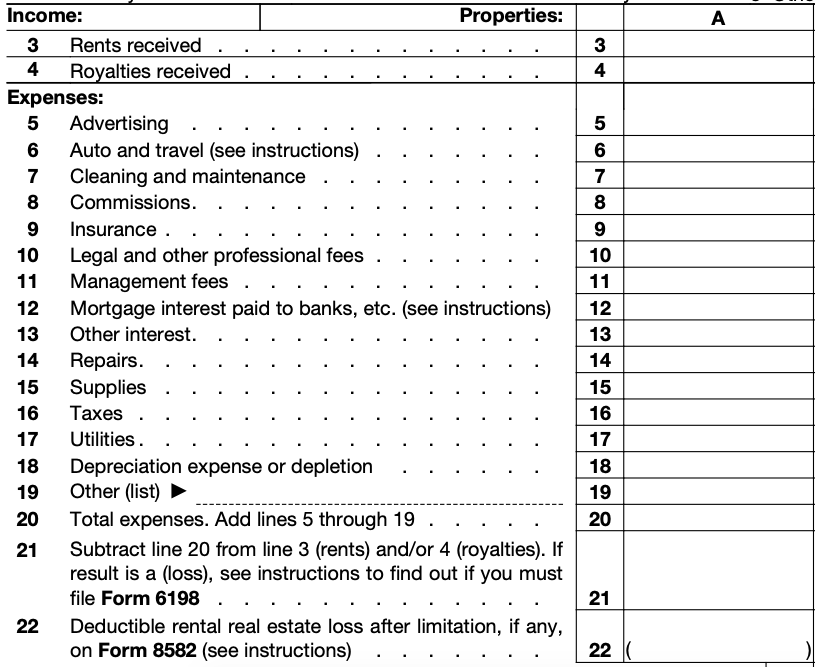
I create a new workbook every year with each house having its own spreadsheet. Schedule E is going to require you to put your income and expenses, per property, not as a whole, so it’s important to have expenses assigned to a particular house. I set up each spreadsheet in an Excel workbook to identify all known costs for the coming year. Not all of these apply, but these are typically the categories of my known costs for each year: property management, HOA, utilities (City of Richmond bills the owner (not tenant) for sewer fees), property taxes, insurance, annual mortgage interest, cost basis depreciation, and prepaid points depreciation. There’s also a chance that you’re carrying appliance depreciation costs (meaning, the purchase of a washer, dryer, refrigerator, etc. aren’t recorded as an actual expense in the year purchased, but are required to be depreciated over its useful life).

As the year goes on, I record any mileage (record the actual miles along with the mileage cost) and maintenance costs. The IRS posts the standard mileage rate for each year here. If a roundtrip to a rental property is 40 miles, then the expense is calculated as 40 miles multiplied by the standard mileage rate, which is $0.56 for 2021. I’ve learned over the years that the software systems just request your miles and do the calculation for you (which is smart and safer on the calculation side), but we want to know what the calculation is going to be, so I enter it as $22.40 in my spreadsheet.

You’ll be expected to input the days your property was vacant, so record that once it’s known.

Each spreadsheet is linked to a master sheet at the beginning of the workbook that shows the net income and expenses for each property. The difference of these amounts are what Mr. ODA uses to adjust his W4 deductions.

I personally assign costs month by month so I can keep track of them, but it doesn’t even need to be that fancy. A running list of these expenses are enough.

The categories are based on what’s going to be requested through Schedule E.

Then in January/February of the following year, I go through my filing cabinet and my email to ensure I’ve captured all of the expenses that I have receipts for, and vice versa to ensure that if I’ve recorded an expense, I have a receipt for it. Having already captured the expenses throughout the year serves as ‘checks and balances’ and doesn’t make the task feel too overwhelming.