Buying versus Renting

I have a tenant who, in the same day, told me that she couldn’t pay rent on time and asked whether she could buy the house. She said she paid $60,000 to me and that could have gone towards owning a house. While I understand the lump sum of what you paid being a pain point, owning a house isn’t that simple. I thought I’d break down a comparison of what she would have done to own this house versus her renting it over the last several years.

RENT HISTORY

Based on the proximity to Main St and the comps in the area, we went into the purchase expecting about $1,000 per month in rent. At the 1% Rule (where you set monthly rent at 1% of your purchase price), we should have been at $1,020. Knowing that it was October/November by the time we would get it rented (there aren’t as many people looking for a new rental in the Fall, after school has started and holiday activities are ramping up) we chose to list it at $975 and keep it below that 4 digit threshold. It sat for 3.5 weeks with hardly any activity, and we dropped it to $875. We found a tenant in under 2 weeks then, but we weren’t thrilled amount our cash flow on it.

The tenant’s lease started on November 1, 2019. Her rent was $875. My property manager incorrectly established a one-year term lease instead of an 18-month lease like she was supposed to, so we had to do a 6-month extension after the first year. Then in March 2021, we tried to increase the rent to $900, and she complained that due to the pandemic, she couldn’t afford that. We let it go and she renewed a year lease at $875.

Come February 2022, we were significantly under market value for rent and she hadn’t been a friendly tenant, so we were content pushing a raise to $950. If she didn’t want to pay that, she was free to leave and we would take the vacancy hit to fix it up and get it re-rented. She complained about the increase, and our property manager told her to take a few days to look around to see if she could find somewhere to rent that was at a price she would feel more comfortable with. She came back and said she couldn’t find anything and accepted the increase to $950.

Not including a few late fees she has owed over the last nearly-five-years, she’s paid us $52,850. While in total that appears to be a significant number, that number does not mean that you’d have $52k in equity in a home had you paid towards a mortgage.

OUR PURCHASE INFORMATION

We paid $102,000 for the house in 2019. We asked for several options for the loan structure. We asked about putting 20% versus 25% down, and whether the rate for a 15 year, 20 year, or 30 year loan would have the best rate. Going through those details is something I’ve done in the past, so for this purpose I’ll just note that we chose to put 25% down because then we didn’t need to “buy down” the rate. The rate for each loan length was 4.55%. With no incentive to do a shorter loan term (and therefore increase our monthly payment), we chose the 30 year term. I do want to note that our interest rate is higher than the average for 2019 (3.9%) because it was an investment property and not a loan for a primary residence.

Based on the 25% down and the closing costs, we had to come to the table with $26,589.12.

Our mortgage was $538.46, which includes escrow. We paid off this loan fairly soon after we closed on it, so we don’t have a monthly mortgage payment. However, I do need to plan for our current mortgage and insurance payments each year, which is currently over $2,000.

FACTORS TO CONSIDER

To keep this more consistent in the message, note that the loan discussed will be based on the purchase price of $102,000.

First, you need to have favorable credit to qualify for the mortgage. In an example, the lowest credit score I could plug in was 620. However, in much of what I’ve read, anything below 680 is questionable on qualification. Our requirement to rent a property is to have a credit score of 600. Perhaps there are lenders that will process a mortgage if your credit score is below 620, but you’re going to pay a premium via the interest rate.

With a credit score of 780, say you’ll have a rate of 6%. But then with a score of 680, you’re looking at 6.5%. At 6%, your principal and interest payment (doesn’t include the escrow required) would be $599.19. At 6.5%, it goes to $631.69. That’s only $32.50 per month extra; over 30 years, that’s an extra $11,700 paid to the bank. I have some tenants where an extra $32 per month is a big deal.

Without at least 20% down on a loan, you’ll likely have to pay private mortgage insurance (PMI). This amount could add a monthly premium to your mortgage payment anywhere from 0.2% to 6%. I did a quick calculator with the example of $102,000 purchase price, $3,060 down (typically the lowest available without any special loan structures is 3%), and a credit score of 620 (lowest it allowed). The PMI was calculated as $187 each month.

I mentioned that our final closing costs were over $26k. If I remove our down payment, that leaves $1,089 in closing costs. I will note though, that our contract had $2,000 in seller subsidy (a credit). Without that purchase agreement structure, that means your closing costs are actually $3,089. This means that you need to come to the table with $6,149. Buying a house is not like buying a car where you can roll all the costs into the loan, and I feel like people don’t realize this.

Your debt to income ratio also plays a factor in whether you can qualify and what your interest rate would be. So even with a decent credit score, you need to show a low debt-to-income ratio, meaning you can’t have your credit cards maxed out. The lender wants to see that you don’t have high monthly costs that would prevent you from paying your mortgage.

That brings me to the flexibility of paying rent. She paid $475 worth of August rent (due August 1st, with a grace period to August 5th before a late fee is owed) on August 20th. If you pay your mortgage late, there’s a late fee and it gets reported to the credit bureaus. Your late payment of rent doesn’t get reported to anyone. She also has the extra advantage that I’m willing to work with her on late payments. An apartment complex type owner is going to immediately file for eviction on the 6th without full rent payment, regardless of your story.

SUMMARY

While a mortgage payment of $538.46 looks favorable against a rent payment of $950, it’s not that simple. I was able to qualify for the mortgage, qualify for a favorable interest rate, and put significant money down.

If I add a premium to the rate we were able to get, assuming my tenant’s credit score is similar to what it was when she rented our house, and then add the PMI that would be applied by not having 20% down, then the mortgage payment (including escrow) would have been $903.02. PMI stays on the mortgage until you reach 78% loan to value ratio (unless you pay for an appraisal and can prove 80% earlier than that). That threshold in this example is $79,560. That principal balance would be achieved in over 11 years, which means you’ve paid $25,058 for essentially nothing.

Then on top of paying these premiums for the mortgage, she would need to pay for the maintenance of the property herself, which is included in my rent factors. I’ve paid over $3,000 for repairs and maintenance on the house over the last 5 years (which is fairly low). However, that includes a deck replacement that we did ourselves and probably would have cost $4,000 instead of the $400 we paid in materials.

So the next time you think that you could be paying half of your rent with a loan, know that you’re not looking at the whole story. There are many factors that go into a mortgage, especially the initial ability to qualify for such loan.
Mortgage Evaluations

Rate Sheet Options from your Lender

When reaching out to a loan officer, there are a lot of options to choose from. I’m hoping to break down the decision-making here. I’ll share how we ended up with several different options, too.

Basically, it boils down to: 

  • Put enough down to avoid paying Private Mortgage Insurance (PMI)
  • Don’t pay more than 20% unless there’s a decent incentive. 
  • Don’t pick a loan term shorter than 30 years unless there’s a decent incentive. 
  • Carefully evaluate any Adjustable Rate Mortgages (ARMs).

PMI

I broke down PMI in a previous post: PMI – Private Mortgage Insurance. We suggest doing whatever you can to meet the requirements to avoid paying this. The cost of PMI can be a couple hundred dollars per month, which is money that can be put towards the principal balance of your loan or other bills, rather than in the bank’s pockets. There are also hoops to jump through to remove PMI early, which may include paying for another appraisal on the house ($400-$700!).


LOAN TERMS

A conventional loan will likely require 20% to avoid paying PMI. There are some loan options out there that may allow a smaller down payment without a ‘penalty’ (e.g., PMI, higher interest rate), but 20% is the standard, and is usually required when purchasing an investment property.

There may be an option to put down more than 20% or you may think you can afford to pay a higher mortgage each month, so you’re interested in a shorter loan term. Unless there’s an incentive (e.g., lower interest rate, better closing costs), stick with the bare minimum to get the loan.

If there is an incentive, you’ll need analyze the math and your goals to determine if committing extra money to a higher down payment or a larger monthly payment is worth it. If you have extra cash each month, you can pay more towards your principal rather than pigeon holing yourself into a higher monthly payment. Plus, if you have more cash liquid, you may be able to purchase another rental property, which will increase your monthly cash flow.

While we evaluate the loan terms on every house purchase, I’ll share the details of the two most “unconventional” options we chose. Two things to note: 1) lenders add a ‘surcharge’ to the rate for it being an investment property, typically around 0.75%, which means the rates aren’t going to be the great, super-low, rates being advertised; and 2) the term “point” means a fee of 1% of the loan amount.

HOUSE #2

For House #2 (purchased in 2016), we were informed that if we put 20% down instead of 25%, the rate would increase 0.25% on average. If we assume a 30 year conventional loan, 20% down at 4.125% equates to about $69,700 paid in interest (assuming no additional principal payments); 25% down at 3.875% equates to about $60,800 paid in interest. By putting an additional $5,850 as part of our down payment, we saved about $9,000 in interest over the life of the loan.

Once we determined that we’ll put 25% down, we then had to figure out the appropriate loan length. On this particular offer, 30 year amortization wasn’t an option for us because we would have had to pay a point to get a competitive rate. We chose a 20 year amortization because the house already came with a well qualified tenant, we didn’t expect a lot of maintenance and repair costs due to the house’s age, and we didn’t have an immediate need for a higher monthly cash flow based on our place in life at the time.

While our long term goal was to have rental property cash flow replace our W2 income, this house was early in our purchasing. At the time, we were focused more on paying off House #1 (higher rate and a balloon payment after 5 years). Frankly, we didn’t truly understand the power of real estate investing at this time, and didn’t know how much it would accelerate the timeline for us to meet our goals. By decreasing our loan length, we increased our monthly payment, but also lowered the total interest paid over the loan’s life by over $22k. Since more of our monthly payment is going towards principal reduction than had it been a 30 year amortization, this loan isn’t on our priority list to pay off early.

HOUSE #3

For House #3, we evaluated the rate sheet for the loan term, interest rate, and down payment percentage again. This house was purchased a few months after House #2, so those rate decisions were fresh on our minds. We were quoted several options: 1) 20% down at 4.25% for 20 or 30 years, 2) 25% down at 3.75% for 20 or 30 years, or 3) 25% down at 3.25% with 0.5% points for 15 years.

As you can see, there’s no incentive to pick the 20-year term because it’s the same rate as a 30-year term. If we have additional cash, we can make a principal-only payments against the 30-year term rather than unnecessarily tying up our money.

At first, we thought paying points was an absolute ‘no.’ However, points aren’t a bad thing. Paying down your rate up front can save you an appreciable amount in interest. Plus, points are tax deductible.

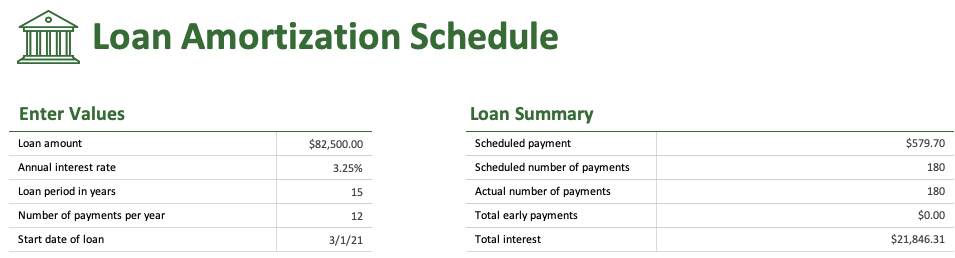
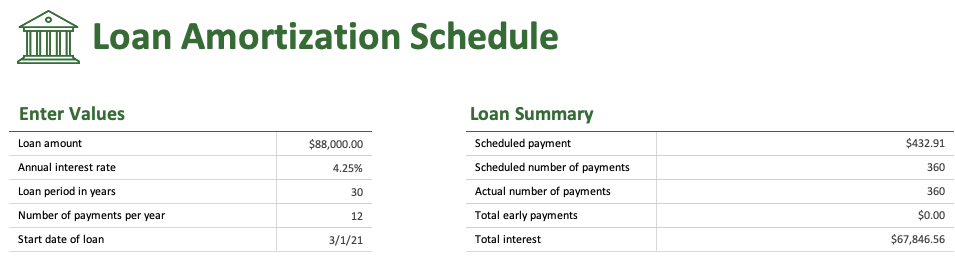
Now for the breakdown of each options. Let’s say the house purchase was $110,000 (because it wasn’t an exact number, and it’ll just be easier to use a ‘clean’ number like this). Microsoft Excel has an amortization template where you can plug in the loan terms and see the entire amortization schedule. 

Option 1: 20% down payment equates to a loan amount of $88,000; the annual interest rate is 4.25%; the loan is for 30 years, with 12 payments per year. If we make no additional payments, this totals about $67,800 worth of interest paid over the life of the loan.


Option 2: 25% down payment equates to a loan amount of $82,500 at 3.75%. If we make no additional payments, this totals $55k worth of interest paid over the life of the loan. This requires an additional $5,500 brought to the closing table, but saves almost $13k in interest. It also decreases our monthly principal and interest payment (i.e., not including escrow) from Option 1 by $50.


Option 3: 25% down payment, 3.25% interest, and 15 years (instead of 30 years) equates to just under $22k paid in interest. To obtain the 3.25% rate, it required “half a point.” If a point is 1% of the loan amount, that would be 1% of $82,500. This rate only required 0.5%, so that meant paying $412.50 as part of closing costs along with the additional $5,500 of down payment required for 25%. However, the shorter loan length means that monthly payment is increased (between Option 2 and Option 3, the difference is $197.63).

For about $6k, we pay a higher monthly payment, but we also save a significant amount of interest over the life of the loan. The short loan term of 15 years means this one is also not on our radar to pay off while we focus on paying down other, higher interest and higher balanced, mortgages. In this case, the benefits of the big picture math outweighed the increase in monthly payment.

We are five years in on this mortgage and are already seeing significant reduction in the outstanding principal due to the amortization schedule becoming favorable more quickly. In 10 short years more, our house will be fully paid for, through rent collection, without a single dollar of extra principal payments from our other financials. What a great feeling.


ADJUSTABLE RATE MORTGAGES (ARMs)

An adjustable rate mortgage can be beneficial depending on the terms and how long you expect to own the house. For us, we expect to hold our investment properties for a long time, so it wasn’t worth the risk of an ARM. Many times lenders won’t even offer an ARM on an investment. However, when we purchased our DC suburb home, we knew we didn’t expect to be there for more than 5 years, so we chose a 5 year ARM.

After a positive experience with that decision, we also chose an ARM on our second primary residence. We chose a 5 year ARM, even though we expected to be there longer than 5 years. We figured we would either accept the new rate, if there was one, at the end of the 5th year, or we would refinance when necessary. As a result, Mr. ODA monitored rates and refinance options over the last year or so. Unexpectedly, we sold that house 3.5 months shy of the end of the initial ARM term so we didn’t have to do anything.

I break down all the details of an ARM and our decision making in a recent post.


SUMMARY

When I reach out to my lender to ask what the rates of the day are and begin the process of locking a rate on a new loan, I ask for options. These options are in the form of a “rate sheet.” When you ‘lock’ a rate, you’re actually locking the ‘rate sheet,’ not the individual decisions of loan length and percent down. For every house, we evaluate the rate savings that can come from doing something less “conventional” than a 30-year fixed at 20% down mortgage. Our decision is based on what’s best for our goals and our cash in-hand.

As shown above, in our early decisions, we favored shorter loan terms for rate savings. but since House #3’s purchase, we noticed how much more we cared about low monthly payments and low down payments to allow us to buy more properties along the way. Every investment property loan since House #3 has been the ‘standard’ 30-year fixed at 20% down. Because of this perspective shift, we were able to buy six properties in 2017, which gives us about $2,000 in monthly cash flow that we can then use to pay down mortgages.

PMI – Private Mortgage Insurance

Don’t pay it. Get creative for your down payment. Here’s a brief on how PMI works and how we avoided paying it.

What is PMI?

A lender typically requires PMI when the loan is greater than 80% of the loan-to-value (LTV) ratio because it’s higher risk for them. If a buyer has less of their own money as equity in the property, the bank views this as a higher probability the homeowner will default on their loan. With that, the PMI is required until the borrower reaches at least 80% for the LTV ratio and the loan is in good standing for at least 5 years. This typically means that a borrower needs 20% of the purchase price as a down payment. There are a few exceptions, but overall, if you don’t have a 20% down payment, you’ll be paying PMI.

PMI can be up to 2% of the loan balance. The lender uses your credit score/history, the down payment amount, and the loan term to evaluate your risk and set the PMI rate.

While there are requirements that the PMI must be removed when your loan hits 78% and 5 years in good standing, you can request the removal of PMI earlier if your house value has risen (e.g., market fluctuation, improvements you made). If you request the removal of PMI, you may be required to pay for the new appraisal, which is an added cost. You should weigh the cost of the appraisal against the remaining payments. In a broad example, if the appraisal costs $450, and your monthly PMI is $120, then as long as you have more than 3 months left before hitting the 78% LTV ratio, it’s worth paying the appraisal fee to have PMI removed. There is also a risk that the appraisal doesn’t come back with a high enough house value, so you should be confident in your home’s value before requesting said action.

How did we avoid paying PMI?

While we were more than qualified to purchase a home in the D.C. suburbs based on our debt-to-income ratio, we restricted ourselves to what we could afford as the down payment.

A bank qualifies you based on your debt-to-income ratio. If you have low recurring monthly bills, then you’re qualified for a larger loan. At the time, our only recurring monthly payment was on my vehicle, at about $350/month. The bank pre-qualified us for about $700,000. Sure, we could “afford” a monthly payment on a $700,000 mortgage, but then we couldn’t eat, sit on furniture, or do anything else. 😉 We’d also be paying PMI because we didn’t have 20%, or $140,000, to put down.

Also due to our low debt-to-income ratio, we couldn’t qualify for any programs that would allow anything less than a 20% down payment for a mortgage. We set our purchase limit at $350,000, which meant we would need $70,000 for the down payment, plus closing costs. Due to the limited inventory at that price in the DC suburbs and the knowledge that we were pre-qualified for double what we were searching for, our Realtor kept pushing us to raise our purchase price. However, we advocated for ourselves and kept our focus on what we could afford as our down payment so we wouldn’t pay PMI. After months of searching and seeing places that were literally missing floors and walls, we increased our search to $400,000, hoping that if we found something in the 350k-400k range, we could negotiate it to 350k.

Our move to the D.C. area was not in our original plans. Mr. ODA had been saving through high school and college, expecting to buy a house in a lower cost of living locality. When we moved to D.C., we knew that we would need to change our expectations and day-to-day actions. We rented an apartment in Fairfax, but we didn’t want to be putting over $1600 per month towards rent for long, and we’d prefer to be paying towards a mortgage and building equity in a home. Positives to owning a home: mortgage tax deduction, appreciation, and the equity building that you get back when you sell the home.

While we rented, we were conscious of our spending. We aimed to spend less than $10 per day on food between the two of us, and we limited how much we ate out. We did activities with Groupons or restaurant.com coupons.

We moved to DC in December, and over the summer, we put an offer on a flipped foreclosure. The listing was $384,900; our offer was $380,000 with $2,000 in closing costs. It was denied by the bank, as we were told we were the 2nd best offer of 3. The next day, we got a call that the bank countered our offer. Apparently, the first offer attempted to negotiate their offer further, and the bank moved on to us. They countered $380,000 with no closing costs; we accepted. We now had to scrounge up about $80k for closing. 

We looked into a Thrift Savings Plan (Federal government’s 401k) loan. Many warned us against the idea, but our research showed it wasn’t as much of a concern as others let on. The details of this loan option are on another blog post. We decided to each take a residential loan from our accounts. I took a $15,000 loan and Mr. ODA took a $25,000 loan. We also borrowed $5,000 from Mr. ODA’s parents and paid it back within a couple of months. We avoided PMI.

An argument heard about not owning a home is that it costs a lot to maintain a home. While owning the home for 3.5 years, we gutted the main floor bathroom ($4,000), replaced the AC ($3,600), replaced the hot water heater ($1,100), resolved termite issues with treatment and wall replacements ($2,000), laid carpet in the basement living area, improved the yard through grass maintenance and purchased a shed, and painted a few rooms. We sold the home for over $60,000 more than we purchased it for (tax free since it was our primary residence the whole time), far more than the minimal expenses we put into it.

Key takeaways from our experience:

  • The efforts we put in to avoid paying PMI meant we had another $100-200 in our pockets per month. Instead of padding the bank’s ‘pockets,’ we paid ourselves back with interest into our retirement account.
  • We lived below our means, saved, and kept focus on the big picture.
  • We pushed ourselves to our financial limits to begin building equity in a home, rather than paying rent to a landlord (or in our case, an apartment company). The efforts put in that year have paid off time and time again, starting with selling the home 3.5 years later for a profit that led to some of our first rental purchases.