April Financial Update

We started getting emails about end of school year activities, and boy was that a surprise that we’re at that point. The middle one is done mid-May and the big kid is done at the end of May. Less than 2 months until summer break.

Mr. ODA took the second round of the government’s offer for administrative leave, which means he would only have a few weeks left working. I’m still working my part time job, which is taking way more hours than we had planned for. I’m enjoying it, but it’s been a juggling act with the family, which is probably why my son who absolutely loves school begged me to stay home because his belly hurt last week.

Buckle up because apparently I have a lot to share this month.

RENTALS

We received about $600 in tax payment reimbursements from one of our localities, so that was a fun surprise this month. Really helps my psyche that I have a tenant who hasn’t fully paid, didn’t tell us why ahead of time, and hasn’t been up front with when she’s going to actually pay us.

I executed 2 short term leases. Both included a rent increase for their short term period; one house is increased by $75 and the other by $25. Luckily, both are here in the Central KY area, so we can flip it between tenants. One is scheduled to leave June 30th. That house will need new carpet in the bedrooms, and it’ll need probably a whole-house paint job again. They smoked in there, even though we covered the lack of smoking rule multiple times. I’d be more upset about it if the carpet hadn’t reached its useful life years ago. The other house leaves July 31, and I can’t even tell you where we’ll need to begin with that one. She made a wood feature wall without permission. She had a giant fish tank without permission. She spent a lot of time doing things that really weren’t an improvement, so I’m definitely worried about what we’re going to uncover in that house. Mr. ODA and I are talking about fixing it up and selling it. We may look for a short term renter so that we can sell it in the Spring instead of this Fall.

I had 2 other properties accept a rent increase that will go into effect later this year. I require 60 days notice for changes so that starting at the 30 day mark I can begin advertising it if needed. One house goes up by $25 per month as of June 1, and the other goes up by $50 per month as of July 1. I also have another property that has a rent increase of $50 per month going into effect next month.

I have 4 houses that renewed another year, and I didn’t change their monthly rent rate. There are 4 more houses that haven’t been discussed. My intent is to have them renew for a year at their current rate. There are 2 of those 4 that could leave at the end of this term, but time will tell.

We have multiple maintenance issues to address. One house requires a tree trimmed off the roof, the siding cleaned, and the back deck stained/painted. We still have termite damage we’re dealing with at a house in Richmond. I have a leaking toilet that was just addressed, and then they hit me with a faulty HVAC unit during a heat wave. Then we have some houses that really need eyes on them to see what condition they’re in at some point this summer back in Richmond. It’s amazing to me how people just don’t care to tell a landlord that something is broken. I woke up this morning to a text that one of the houses here has a flooded basement due to a water heater failure.

I spent some more time fighting my insurance guy here. It irks me so much when I see him offer up his services on the local facebook group for property owners. He’s quite terrible. I sent him photos of a house that had some issues with a cluttered backyard and had the tenant clean that up. I had to fight him last month on an increase where he changed one house from a crawl space to a basement when I assure you that the vines growing through the windows solidify it should not be deemed a “basement.” When the dust settled from that debacle that he was insanely unresponsive to, I ended up owing $9.68. When I asked why my account wasn’t put back the way it was found before this mess he created, he said he didn’t know but it’s probably from the audit and changing square footage. HIs guessing and not actually answering infuriated me. I gave up and paid it, but then I ran to get quotes from other people. I hadn’t done that before because our 4 claims in a 12 months period are killing us (again, because I really wanted trees to fall on us!). I hate when people make the claim that because it’s not a lot of money, I should just give up and accept it. That’s a ridiculous way to treat people.

PERSONAL

Our electric bill is almost double what it was this time last year thanks to the vehicle charging and hot tub. Our electric bill is relatively low, so that’s not all that surprising. We also have 5 full people in this house now (as much as you can count a 2 year old as a full person… but he knows how to control light switches and eats a ton of food that we need to cook him, so I’m sure he’s a factor there!).

I’ve been working at my new part time job for over a month now. Mr. ODA was making fun of my hourly rate, but I’ll tell ya, it felt good to receive a paycheck that wasn’t $45 like it was for a day of subbing at the preschool.

I took the kids to get haircuts. My middle has had her hair cut once before, but I’ve cut the boys’ hair forever. I had family coming into town and the oldest was looking really shaggy. So I swallowed my pride and threw money at the problem, which is very out of character in this household. I just didn’t have the time to cut their hair, clean them, and clean up the mess. For $66 and 45 minutes from the time I left home until I got back, it was well worth it to me.

I had a medical procedure done this month. We haven’t met our deductible. In February, they said I had to pay my deductible to them. I said that didn’t make sense and refused to have them hold $2800 of my money for 2 months. They gave me an attitude and said I could never ever ever ask for a payment plan in the future, so that I could pay $500 to hold the date. I then showed up for the procedure, knowing I haven’t met my deductible, and they didn’t take any money from me. Another business model that bullies the customer into illogical money decisions. I also had an eye doctor appointment that was frustrating in itself, but I’ll spare you those insurance and communication details.

On top of everything else I’m juggling, Mr. ODA is coaching our kids’ t-ball team. Coaching means that I am team mom. That means that I’m responsible for communicating updates from the league (in the slow and haphazard fashion I receive information), gather value card sales that are required of every team member, organizing a basket for a raffle, and the best one – raising $350 for team sponsorship. What the heck, man?! Where did I say that my signing up of two children to play in the league means I have history or ability to gather money from businesses?? Well, I did it. I raised $350 and another mom raised $200 for the team.

No financial impact, but I’m also juggling our HOA board duties. I released our longstanding property manager and hired a new company, which took effect April 1. That’s taken a lot of time to get them stood up and make sure we stay on track for our annual meeting schedule in June.

NET WORTH

And with all of that said, that doesn’t even address the giant reduction in our investments that continues to happen. To counter some of the loss, I updated our property values for our houses. I don’t do that every month because they don’t move very much, but I can usually count on a few increases as the spring market ramps up. Our net worth did slightly increase (based on yesterday’s market closure, not today’s) from last month, which was a nice surprise.
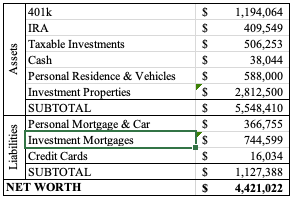
I wonder why I’m tired and bogged down, but that post outlining what I’ve done recently made me realize all I was able to accomplish even though I felt like I was a jack of all trades and master of none. Hopefully things will settle down in our lives going forward now, even if I know there are definitely two house turnovers in my future.

5% Rent Cap

The President issued a statement calling on Congress to cap rent increases at 5%, specifically for corporate landlords. The statement appears to define corporate landlords as those owning over 50 units in their portfolio. This was not an executive action that is implemented. And while my numbers are different than the numbers of a “corporate landlord,” I do think it’s worth hearing a landlord’s side. I feel that there’s a lot of spite against landlords without a lot of knowledge about their actual financials.

I admit that there is a possibility that some of these companies with large complexes could be raking in on the fees or “utilities” that are in the unit, without actually providing a properly maintained building, but that’s not the case for everyone that’s labeled as a landlord. No one seems to step back and see that this is a business model for landlords, and while everything else around us is increasing in costs, rent needs to as well.

No one predicted such a significant rise in product costs or housing costs in such a short period of time, but here we are. And landlords aren’t in the business to graciously eat the costs of homeownership for renters.

LANDLORD COST INCREASES

The Presidential statement released refers to a press release that starts with, “Today’s U.S. Labor Department Consumer Price Index (CPI) report revealed costs remained largely unchanged in May, with overall inflation cooling faster than economists expected as the Fed considers finally reducing interest rates below a 23-year high.” Is there a comparison to costs that landlords had to take on because the costs of everything increased faster than expected back in 2020-2022? Increases have been seen on small things like a maintenance call for a technician, but also big things like property taxes and insurance.

That same article goes on to state, “Since 2019, the cost of rent has risen 31.4%, with wages only increasing 23%, as tenants on average need to earn nearly $80,000 to not spend 30% or more of their income on rent.” In 2019, on one of my properties, the taxable assessment was $95,000, which equated to about $1,200 per year in taxes. In 2024, the taxable assessment was $242,000, which equates to about $3,000 per year in taxes. That’s a 61% increase in just my taxes over that same period of time where they’re complaining that the cost of rent increased by 31.4%. If rent had been set based on the 1% rule in 2019, rent would have been $950 per month. Had I increased 5% each year from 2019, it would be $1,212 in 2024. If I set rent based on the 1% rule now, it would be $2,420. However, the rent on the property is $1,750. So while it’s more than 5% each year since 2019 (the baseline the government is using), it’s set at an amount where I capture my expenses for owning the house, while also turning a small profit.

It’s taboo for a landlord to turn a profit, but that’s why we’re here. It’s an income stream that we’re establishing for profit. I don’t get to pay myself an hourly rate for managing the property. So this “profit” can actually be looked at like a salary. Every time I need to show the property to a prospective tenant, the lease signing, the walk through, every call or text you make, every trade that I need to schedule and coordinate with the tenant on, any fixes or improvements that I do myself. All of these minutes in a day add up, and I’m not directly paid for any of them.

On the particular house that I’m using for the example, we are assuming $300 per month in profit, which comes to $3,600 per year. Would you work as a manager of a company (e.g., hiring trades to fix things, performing maintenance, making sure all bills are paid timely, general management of having liabilities), for only $3,600 per year?

I wrote a post last Fall about the changes in my rental fixed costs from a year prior. I plan on doing the same this fall when more tax information comes due. The house I’m referring to has been at $1,750 for the past two years. However, between 2022 and 2023, my taxes and insurance have increased by $255 per year. That’s a cost that I’ve “eaten” from my “profits.” I could have said that equates to $22 per month increase, and I could have projected a similar increase for the year coming. I could change their monthly rent to be $1,790-$1,800 to keep my profits on a similar path. However, I didn’t, because they’re good tenants that haven’t had many maintenance calls.

However, if I don’t increase every year, then I could find myself in a sudden deficit like I did during the pandemic because costs increased faster than projected. A 5% cap could actually incentivize annual increases because I wouldn’t want to be caught behind and not able to catch up down the road.

LEASE TERMS

The Federal Housing Finance Agency announced protections for renters in multifamily properties that are financed with loans backed by Fannie Mae and Freddie Mac. The protections include: (a) requiring 30 day notice before rent increases; (b) requiring 30 day notice on lease expirations; and (c) providing a 5 day grace period before imposing late fees on rentals. I know for a fact that every single lease I’ve executed personally already has all of these requirements in it, at a minimum. In many cases, there’s a clause for 60 day notice of a potential rate increase, with negotiations being completed before 30 days from lease expiration.

Some states already have this codified. Other jurisdictions have landlord/tenant agreements that give the tenants rights (and awareness of rights) that can be lobbied against if the landlord is noncompliant.

There’s a clause that I’ve seen that requires expired leases to auto-renew on a month-to-month basis instead of for another year. I would argue that a requirement to renew a lease month-to-month instead of annually actually hurts a tenant. A landlord then only needs to give 30 days notice of a rent increase, and they could technically increase it month after month.

SUMMARY

If the ‘cap’ were to apply to me, then I’d be more inclined to increase rent every year. As a general rule, I increase rent for long term renters by $50 every two years. When we turnover a property, we will evaluate market rent in the area and set the monthly rent at what we see (which could be more than $50). In some cases, the evaluation ends up being too high, and we set the rent at something we think more people can afford. For example, there were comparable houses renting at $2,200 near a house we had listed. We’d rather get the property rented than shoot for top dollar, so we listed it at $1,600. While lower than “market value” probably called for, it was $400 higher than what we had it previously rented at, which covered cost increases that weren’t previously covered.

In the post that I previously linked, I highlight that our standard for increases barely offsets our increase in expenses. While we manage each house individually on setting the rates (asking ourselves: do we think the tenant can absorb the increase, do we have to increase to cover actual costs now), our monthly income among all houses was increased by $475. If you add up the cost increases for taxes, insurance, and property management (increased rent means increased fees because fees are based on the rent price), our costs went up $415 (and that’s before any service calls). On a whole, we’ve offset the ‘fixed cost’ increases. We’re taking ‘losses’ on houses where our routine for increases is slower. Therefore, having 13 properties affords us the ability to be more lenient with tenants and to keep good tenants in the house instead of forcing them out with hgher rent increases.

I support having protections in place for tenants. I’m sure there are landlords out there that aren’t interested in playing ‘by the book’ and just being decent human beings like I intend to. However, landlords are people too, and they’re running a business. Creating boundaries without fully understanding both sides of the situation and focusing on data points that only support your theory is unfair. I’ve joined the Landlord/Tenant Advisory Committee in my city. I hope to bring more awareness to the landlord side of things and bridge the gap between landlords and tenants when it comes to responsibilities.

Year in Review: Part 1

Just over a year ago, I decided it was time to put more effort into sharing what we’ve been through. When I’m looking to learn something new, I like to find examples of how other people handle it. I want to know the places they struggled and how they learned. I find it a better way to form my opinion than by reading an article that doesn’t have any meat in it, only providing an outline.

In the last year, I learned that blogging wasn’t as easy to keep up with as I thought it would be. I have a list of topics still to cover, so it wasn’t a matter of content. But raising two kids hinders my ability for an uninterrupted thought process to write an article, unless I get to it before they wake up.

The blog was started by Mr. ODA in 2018. He wrote a few posts, and then it sat for two years. I decided to pick it back up in January 2021. During 2021, we published 65 posts. Each month, I wrote a post about our financial update; I included any major expenses, how management of rental properties was going, and how our personal spending may have changed month-to-month. I shared our purchase of 11 out of 13 of our properties, our sale of one property, refinancing mortgages, paying off mortgages, renting properties, maintaining properties, etc. I also shared just general life decision making along the way.


Part 1 for my year in review will address what happened with our rental properties. I’ll dive into our personal finances in Part 2.

As a quick recap, we have 12 rental properties. Nine of them are in Virginia, and three of them are in Kentucky. Two of the houses in Virginia are owned with a partner because we still had cash available to buy more houses, but at the time we had the maximum number of mortgages allowed by Fannie/Freddie (max is 10). The houses were purchased between February 2016 and September 2019. All 3 houses in Kentucky are managed by a property manager, who gets 10% of the monthly rent each month. I manage 5 of the Virginia houses personally, and then we have a property manager who manages the remaining 4, who also gets 10% for each house.

RENTAL PROPERTY MORTGAGES

In January 2021, we completed a refinance of one property, and then in December, we completed three cash-out refinances. The loan balances on these 4 properties increased; one increased because closing costs were rolled into the loan balance, and the other 3 included $190k worth of equity taken out from the houses and creating new loans.

We went from 11 mortgages (two of which are actually owned by a partner) down to 8. House 6 had a balance of $26,447 coming into 2021, and that was paid off by June. Two other houses had a total balance of $157,500 at the beginning of the year. Their balances dwindled through regular monthly payments and one lump sum payment right before we completed the cash-out-refis and completely paid them off.

We have been working on paying down another mortgage that is owned with a partner. Between the two of our families, we paid off about $44,000 additional principal for that mortgage. We’re matching each other’s additional principal payments so that the math is easier to follow, so we can only make additional payments in line with what he can do also. We each owe about $10k on this mortgage now.

Even though there were so many mortgage-related transactions in the year, our overall loan balance only decreased by $6,000.

The market has continued to rise due to the limited supply, and so our home values on the rentals actually increased over $500k over the last year.

RENTAL PROPERTY LEASES

We turned over 1 property the whole year! The tenant that was living there had already told us that they were renting until they found a place to buy, so we knew they wouldn’t be long term tenants. We had a relationship with them from a previous house, when they had moved out of the area and then back. They had a poor experience renting in another area and reached out to us since they appreciated us as landlords. They found a house towards the end of their first year, but we let them out of the lease early. Their lease was slated to end October 31, 2021. We don’t usually have leases that start/end in the Fall if we can help it, but we had let the previous tenant out of her lease early to purchase a house also. The tenant said she was able to be out at the end of August, and we preferred moving the lease closer to the summer months anyway.

We raised the rent on 6 properties.
– The one house that was turned over went from $1200 to $1350 per month. However, we added a property manager who gets 10%, so our cash flow only increased by $15 per month.
– Two of our properties have long term tenants; the rent is significantly below market value, but we value not having to turn over the house. These houses are on a cycle where we increase the rent $50 every two years.
– Our KY property manager tried to increase rent on the 3 properties she manages. One was increased by $25, another by $5, and the other one cried that she couldn’t afford an increase. That’s the one where we plan to increase by $75 next month, and if she doesn’t accept, we’ll turn it over and get $75-$100 more per month.
– We increased rent by $150/month for one of our properties that we have with a partner. It was a risk, but this is a house that claims 3 people live there, but they have 5 queen size beds in the house. We figured either they leave and we get several big things fixed up that have been deferred because of all their things in the way, or we make up for all the years that we didn’t manage their rent and didn’t increase it. They accepted the increase.

RENT COLLECTION

We were very grateful that we made it through those initial months of the pandemic without tenants not being able to pay rent. We had a few people let us know that they were laid off or unable to work (e.g., restaurant business), but we learned most of our tenants worked in the health care field. So while we made it through 2020 without many issues, 2021 brought more challenges. Nothing was insurmountable, and it wasn’t debilitating financially, but it was still something to manage.

We had some big struggles with non-payment of rent on one house. She was 31 days late paying August rent, then she didn’t pay September’s rent, and then she applied for rental assistance to cover September, October, and November, which we didn’t receive until February 2022. That was all on top of her generally being a week late in paying through the beginning of the year too. She doesn’t maintain employment, she doesn’t communicate, and we’ve just had something new and different pop up as an issue every few months. We eventually received January 2022’s rent, but we still haven’t received all of February’s rent – just in time for March rent to be due.

We have another property (the one that was raised $150 per month) that is perpetually late. They eventually pay, and they’re getting better about actually paying the late fee (when they pay rent 20+ days late…), but they were late for 10/12 months of the year.

Everyone else paid their rent on time. In general, we’re lenient with late fees and issues. If you reach out to us and mention that there was a hiccup and you’ll need one more pay check to pay rent, our response is typically: please pay what you can now, pay the rest next week, and don’t worry about the late fee. However, when you don’t communicate and/or you’re consistently weeks late and we’re having to carry the expenses, there needs to be a consequence to incentivize you getting back on track.

RENTAL EXPENSES

We replaced the flooring in House3 ($4,000), hot water heater in House9 ($1,500), HVAC in House10 ($3,300), washing machine in House10 ($250), and HVAC in House12 ($3,900). We also had various electrical and plumbing work that needed to be done in several houses. We also spend about $7k per year in property management fees.

Usually turn over is an area that requires us to put a lot of money into a house. Luckily, the one house that we turned over this year only required some paint work, and we didn’t have any other turnovers.

While it’s nice that our assessments have increased and our housing values have increased in our net worth calculation, it comes at a price. Our taxes have increased on all the properties. In total, they’ve increased over $2,500 in just the one year (meaning, that doesn’t include all the previous years worth of assessment increases that have occurred!).

GOALS

In this year, we hope to add one more rental property to our portfolio. We’ve been actively working on it, but this market is crazy! We’re not willing to overpay on a property and get into a bidding war just to be done with the search. It’s interesting to see that we haven’t bought a new rental property in almost 2.5 years, when we had purchased so many all at once. We had gone back and forth with saving for another down payment or just paying off more mortgages after we paid off House6 in June. Once the cash-out-refi was a possibility, we decided to go ahead with purchasing another property. We’ll self-manage whatever we acquire. We had been looking in Virginia and Kentucky, but have started to settle into a Kentucky property (I like the laws for tenant/landlord relationships better in Virginia) so that we can save the 10% management fee and the expensive leasing fee, since housing prices are significantly higher than what we’d prefer for the rent ratio we’d be getting.

We have 8 houses that still need negotiation and/or lease termination coming this year. Two houses have already agreed to their rent increase, and we just need to get the new lease signed. Five houses will be offered a new lease term with a rent increase (averaging about $50 per month on the increase). One tenant will be asked to leave at the end of her lease term.

We want to remove the tenant from House2 at the end of her lease term. She has been a concern in numerous legal ways, does not hold steady employment, and the house is well under market value rent. Turning over that property will require us to go to Virginia to work on it. It’ll need repainted, the carpet will probably have to be replaced, and I worry that she’ll do some damage when we tell her we’re not interested in renewing her lease.

SUMMARY

I like to look at the details of the rental properties all at once in this format. Sometimes, I get caught up in all the things that I need to get done, and I feel like it’s so much work. In those moments, I forget that there are most days of the year where I don’t even think about the properties. Even when expenses seem to be piling on top of themselves, to look back and see that our expenses totaled less than $15k over 12 houses is encouraging. We’ve also reached the point where we’ve replaced most HVACs and several roofs, which are areas that can create problems that compound on themselves, whereas a replacement is expensive, but then I don’t have to get all the calls that something went wrong.