Lack of Rental Payment

I was going to include this in a financial update post, but it was too long and complicated to include there. I really want this to be a lesson for anyone reading this – mostly on the renter end, but perhaps for a budding landlord as well. We tried really hard to work with the tenant, but we can’t work with someone who doesn’t communicate up front and doesn’t keep her word constantly. When using statements like “I need to keep the water and electricity on for my kids,” understand that the roof over their head isn’t a given. I’m a private landlord and be lenient, but an apartment complex type situation isn’t going to allow you to not pay for months on end; they’re going to file for eviction on the first day 6.

THE DETAILS

After this house was flooded by a tenant, we got it fixed up and on the market. The options at the time were limited; plenty of people were interested, but they weren’t qualified. The area called for $2,200, but I wanted it to move quickly, so we listed at $1600. The previous tenant was paying $1200, so this felt like a huge jump. No one qualified for the property. We had two options that were close enough to our requirements.

We chose a single mom who worked two jobs herself to be able to afford this place. Honestly, kudos to her for her effort. She lost both those jobs (we knew about one, but not both) and ran into some other troubles. She has worked hard to get herself back on track. I commend all that. She’s wonderful like that. Her communication (or lack thereof) was infuriating.

At the beginning of October, she said she’s back on track now with a steady income (replacing both jobs), but with all the outstanding bills, she’s going to need time to catch up. I’m a very understanding person and work with my tenants as long as they work with me. Instead of telling me WHEN I should expect to see payments, she left it open ended with “sometime in October.” I gave her the benefit of doubt. Then two Fridays passed with $0 paid. I asked for an update through our property manager.

On the 16th, she sent over $300 (after we had to ask for payment), and wrote, “I will be sending another payment this upcoming Friday and typically Fridays going forward.” Typically. She reiterated that October would be paid before the end of the month, and then she’d need about two weeks to pay November’s after that. She did pay $500 that following Friday, and then missed the next Friday.

My property manager had to follow up with her 3 times before she actually received an answer. The tenant claimed she had been too busy to respond. Excuse me, but keeping a roof over your head should be a priority in your life (this will be a theme). I asked for a payment plan instead of this open-ended concept of payment. On November 1st, she finally responded that she was going to pay $400-700 every Friday, going forward, unless she needed to pay other bills. Again. “I’ll pay you when I pay you, unless I don’t pay you.” This isn’t appropriate.

She paid $700, as goods and services, on November 3rd. All fees are the tenant’s responsibility, so now she owed another $15. She ended up sending $50 over that same day. At this point, it’s November 3rd, and she’s still $60+ short on October’s rent and $0 towards November. As expected, Friday November 10th came and went with no communication and no payment. She ended up sending an email in the early morning hours of the 11th stating she’s waiting on a deposit to clear, so she’ll pay something on Monday. She did pay that Monday. However, she had said she’d pay every Friday, and the 17th came and went with no payment. Again.

On the morning of the November 18th, I sent the notice of default. It said she had 5 days to pay the entire balance or we’d file for eviction. She threw a little tantrum, claiming she wanted to end her lease. It doesn’t work like that. My property manager had a good idea and was able to articulate our frustration sternly, yet professionally. The property manager said that “forgetting” and “life” getting in the way were not acceptable responses, and it was time to be responsible for herself and her bills, perhaps by setting alarms or utilizing her calendar for reminders. The offer included our waiving of December and January late fees ($160 each) if the tenant continued to pay every Friday without us having to follow up. I thought the incentive was great. The tenant then paid $700 on the 24th and $600 on 12/1. At that point, she was caught up on October and November (sans late fees though), while paying into December’s rent owed.

She paid the first two Fridays in December, missed the 22nd, and paid on the 29th. At the end of December, she had a balance owed of just over $500, which included all late fees, so that was a decent position. Then things went downhill again. She paid nothing until January 17th, and it was only $100 that day. She claimed an issue with the amount she was able to send over, but stopped trying. When we asked why she mentioned $400 in $50 increments, but only sent over $100, she acted like we did something wrong. Over the next week, she ended up sending $300. At the end of January, she owed $1,863.40.

TENANT VACATES THE PROPERTY

In mid-January, seeing that communication was getting worse, and payments weren’t even being made, we asked her to leave. I was really trying to get through February so that we’d have a more favorable market time to list it. She said she didn’t want to leave. That’s a bold statement from someone who owes a lot. On January 25th, we sent her the 5 day notice until eviction document, which showed her balance due. We offered her the ability to leave the house by the end of the month with minimal damages, and we’d just keep her security deposit. Her initial response was that she wants to finish interviews she has scheduled, and she didn’t want to leave.

Within 24 hours, she decided she did want to leave. For the first time in all of this, she fully explained her situation. She gave good reason to have until February 4th to leave (instead of the end of January). We allowed it, but she’d be responsible for those days of rent in February.

As a final goodbye, she told us she would be able “to make another payment that first week of February.” As I suspected, she meant the week of February 5th, and not the 1st or 2nd. She didn’t pay. On February 9th, she “kindly” asked for an extension for the final payment, since she was expecting her tax refund in the next two weeks.

I don’t need to tell you at this point – two weeks came and went. She did end up paying over $500 on 2/29 though. That was more than I ever expected. I don’t know how she arrived at her number (she did email an explanation, but the numbers didn’t add up), but I’m accepting it.

TURNOVER

She actually left the house in great condition. She had sticking LED light strips in a bedroom that said they were easily removed. However, when she removed them, paint came with it. I had to have someone touch that up. She bought blinds, but didn’t hang them, for ones that were damaged (she had asked us to pay for them when she first moved in, so that was a nice gesture to uphold the integrity of the request), so I had to have someone do that. Then I paid someone to clean the house, which is normal. Overall, she was difficult to communicate with, but I do believe she meant well.

BACKGROUND & EXPECTATIONS

I have a track record of being very lenient and very understanding. I promise. I can provide lots of examples where I’ve let people know to take their time, prioritize back to school necessities, waive the late fee, etc. I can not work with you if you don’t talk to me. I don’t know what you need. I don’t know you as a person and whether you’re “good for it.” I need to know your expectations, needs, and plan. Talk to me without me hunting you down for information. I don’t know where I’ve said this before in this blog, but I’m positive you can find that or a very similar statement made throughout. Understand that in nearly all other scenarios, a landlord is not going to be patient for 4 full months to try to get you to pay rent owed.

She said phrases to me that were generally that she has kids so keeping the water and electricity current is her priority (isn’t keeping a roof over their heads equally important?), or that she asked for grace and patience (what have I been doing? I could have issued you the first step of the eviction process on October 6th, and I didn’t, even though you didn’t pay a penny towards rent until the 16th). It’s things like that get under my skin and make my efforts feel unappreciated, making not want to work with you going forward. Take the time to acknowledge how gracious I HAVE been, that I have bills to pay in addition to you having bills to pay, that I deserve to be given regular updates and information without having to follow up and beg for information.

My property manager says “she’s young” and “she’s learning.” There have been learning opportunities, but it’s also not my role to mentor a tenant on how to be an upstanding citizen and uphold your commitments. There were two other late rent moments this summer where my property manager said that if there’s any issues with rental payment, we need to know ASAP, without us having to make phone calls or send emails. My property manager reiterated this expectation on October 31st over the phone – don’t miss a Friday rent payment, assume we know you’re not paying anything, and leave it at that (I already played the “benefit of doubt” game through October when we received $0 for half the month).

LESSON

Communicate with the landlord. Don’t put the landlord in a position where they’re having to keep track of your financials and whether you’re paying timely. Pay regularly or communicate up front. All of my leases state that rent is due without demand. My having to regularly ask for an update or why you haven’t paid a single penny halfway through a month is not in any realm an acceptable way of doing business.

Renters need to understand that landlords have bills to pay. Those bills (that mortgage) are not as lenient as I’m trying to be with you. If I don’t pay my mortgage, there’s a late fee and it’s immediately reported on my credit. They also don’t accept partial payments. If I don’t pay for long enough, it becomes a foreclosure. As a tenant, you don’t know if I have funds to cover that payment. Assume I don’t. If I don’t pay my mortgage, the house is foreclosed, and you’re kicked out anyway. You’re getting by without any credit hits, as you’re now two to four months behind on rent. I’m floating mortgage payments on your behalf. Lucky for you, I’m on top of my credit and paying these bills even if you’re not paying me, but that isn’t an assumption you should make.

Your actions have consequences. You can mitigate those consequences by upholding your word and keeping in regular communication on what’s happening (again, up front, not after the deadline passes).

Funds Management in Excel

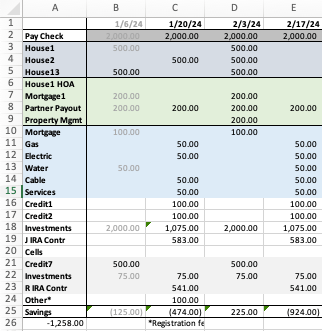
At the beginning of every year, I set up two spreadsheets in Excel. One is for our personal money management, and one is for each property’s expenses in the year (that will eventually be put into Schedule E in our taxes). I regularly mention using Excel to track your income and bills, so here’s a quick snapshot of what I do.

These are all dummy numbers, but otherwise, this is my spreadsheet set up (with several lines eliminated to reduce your visual clutter). The top purple section is rental income per house, the green section is rental property expenses, the blue section is our home’s bills, the gray section is what affect’s Mr. ODA’s account instead of our main checking account (Mr. ODA has his original account from before our marriage (I have access to view it) because of benefits associated with the linked credit card, and it was never worth closing it or adding my name to it). The white is what’s left over. The blue section is not necessary to be a different color and is left over from another way I tracked bills, but I’ve left it to differentiate home bills versus credits and investments.

The final line of “Other*” captures items that only occur once or twice a year, but have a significant impact on the checking account or is a deadline I want to be aware of. I keep the preschool registration fees on there so that it’s on my radar that registration comes due at about this time. In future months, I have taxes that are due for houses we have not escrowed, which is about $1500 worth in June and about $4000 worth in October.

The columns are organized by Mr. ODA’s pay check date. His pay check appears in the account every other Saturday, so that’s the date at the top. Then I’ve put all the income or expenses that align between that pay check’s date and the next pay check’s date in that column. This helps me project whether I’ll need a transfer from savings to cover the checking account balance. This particular section of the spreadsheet doesn’t show account balances, but you get the gist of the organization.

Each year, this is tweaked a little. I eliminate lines that are no longer necessary (for instance, our HOA is now paid annually, so I don’t need a line taking up space for a once-per-year bill). I add lines that become necessary (cable used to be paid by credit card, but now there’s a fee for that; since it affects our checking account monthly, it gets a line). It would probably be better to separate out my “investments” line into the specific transactions that happen each month, but I didn’t want more lines on my spreadsheet.

When rent is received or a bill is paid, I change the font color to gray. This indicates that it’s done and helps eliminate visual clutter for me. I can focus on the black font, which indicates to me it’s still due.

As I get closer to each pay check column, I update the projections. For example, a credit card may have had more than average expenses on it. This could happen because one credit card has a quarterly bonus for gas purchases. So while it’s typically $100 for a statement, it may be more like $200 because of the gas purchases on it. I update the projected payment because I need to monitor the checking account balance too. I also keep last year’s utility bill amounts in each column. I use this to track whether this year’s payment is comparable to last year’s at this time, so I know whether to look further into a bill because it’s significantly different than last year’s (for example, if last year’s June gas bill was $30, and this year’s June gas bill is $60, I want to check to see why it doubled, whether that means a leak or error in billing).

Every person’s tracking is going to look different. You may just have rent and utility bills to pay, and you can manage it via email notifications. You may want a more active approach to the tracking and use a spreadsheet in some fashion. This is just a start for you to have a visual in how a spreadsheet may be helpful in your money management, and may even help eliminate late fees or billing errors because you’re more actively managing your money.

Reaching Goals

Whether you have a lofty goal of paying off a mortgage or a short term goal of not struggling to pay rent each month, it helps to establish a plan. The first step should be learning your relationship with money instead of mindless spending paycheck to paycheck. Last month, I mentioned budgeting and how it can lead to overspending instead of spending wisely. I also mentioned the envelope system and not liking it.

The envelope system is where you establish your spending categories and put cash in the envelope each month. When the money is gone from the envelope, that’s it. Don’t borrow from another envelope. If there’s money left over in an envelope, it can be added to next month’s envelope to increase your spending, or you can use that money to treat yourself to something. In few articles that I read did I see that the extra money should be put towards your goal.

THE GOAL

The first step is to write your goal down. What is it? How long do you think it will take to reach it? I’ve learned that establishing interim goals helps reach the bigger goal that may seem too lofty.

The second step is to track your expenses. Look at what you’re spending your money on. Start categorizing your spending. Can you see that you’re spending more than you thought on something other than essentials? Is hitting up the drive through several times a week costing you more per month than you realized? Have you purchased decorations for your home that aren’t on display, but you’re scraping together rent or mortgage for the beginning of each month? Are you paying up-charges and delivery fees for a meal delivery service instead of going to pick it up yourself (or cooking your own meal)?

MONEY RELATIONSHIP

I have experience living paycheck to paycheck. It’s not like we’ve always been in a position where we’re not worried about how to pay our bills. I thought if I shared two defining stories from our finances, it may trigger an idea for you.

College

I lived on campus for the first two years of college. My parents were paying my tuition, and they said that either I needed to take out a loan to pay the following year’s room and board, or I had to be a Resident Assistance to get free boarding. I didn’t want the responsibility and having to be in my dorm so much to be an RA (I never researched it; I was just 20 and knew everything.). I decided the best approach was to live off campus because I’d be able to pay my living costs monthly instead of in two large chunks at the beginning of each semester. If I broke down the monthly cost of the ‘room and board,’ it was $1533 per month (and only for 9 months of the year). I figured I could live for less than that, while paying month-to-month as I earned income, if I moved to an apartment. My rent off campus that first year was $650/month. My utilities were about $150/month in the winter. I don’t know how much I spent on food, but I know it was the bare minimum. It wasn’t that I was purposely trying to be debt-free and a hero; I just simply didn’t know how to get a loan, so that wasn’t an option to me.

I had a job at JCPenney. I was making 5.15/hour (minimum wage in 2006), and I worked outside of my school schedule as much as I could. I was able to pay my rent every month because that was my priority. I dipped into my savings from my summer jobs, but I mostly changed my lifestyle. I packed my meals with peanut butter and jelly sandwiches for when I was working. I ate pasta for dinner. I didn’t go to restaurants often. I wasn’t in a phase of life where I wanted to go to bars, so my social life was hanging at my boyfriend’s house, where he lived with 3 other guys, drinking cheap beer and watching tv. I made sacrifices in my spending so that I could pay rent every month. I didn’t want to pay a late fee every month. If I could just barely afford $650, I certainly didn’t want to owe an extra $65 because I couldn’t pay rent by the first of the month.

There is one caveat in my story that first year. Since I was making just what it took to have a roof over my head and food in my stomach, I chose to forego heat. Do you know where Albany, NY is? It’s into freezing temperatures in October. It was fine – I had sweatshirts, sweatpants, socks, slippers, blankets. I lived on the first floor of a two story home, so that helps keep the temperature reasonable into October, but I knew I couldn’t last through the days of teen temperatures without eventually turning the heat on. My parents found out that I didn’t have my heat on, and they sent me $100/month to cover that. So I did get assistance. They sent me that for 6 months to cover my utilities, and that was the last assistance I received.

My parents paid my tuition, which was $2,175 per semester in 2004. Yes, less than $5,000/year for my college education.

Buying a House

Mr. ODA and I wanted to buy a house and settle down. We had each been part of a training program at work that would end with our placement anywhere in the country, so we weren’t in a good position to purchase a house in Albany, NY. Mr. ODA got placed in Pennsylvania, while I was still employed in their NY office. It wasn’t handled well, so we started looking for other options. I accepted a job in Washington DC, and Mr. ODA went to Sterling, VA; we moved to an apartment in Fairfax, VA to live in between those two places. We chose an apartment because we didn’t know anything about Virginia and needed a place to live while we scoped it out.

This wasn’t a scenario where we couldn’t afford to live, like my college example. This was a situation where we set a goal, and to achieve that goal, we needed to spend less.

Mr. ODA was saving and preparing for a house in the $150-200k range, not the $350-500k range as a first time home buyer. So we needed a plan to come up with over $70k worth of the downpayment and closing costs.

We set a goal of spending no more than $5/day/person on food. We ate a lot of peanut butter and jelly sandwiches, pasta sides, chicken nuggets, canned vegetables, etc. That threshold meant we weren’t paying to go out to lunch at work. We were eating the bare minimum at dinner. We were eating any leftovers that were in the refrigerator. We didn’t have a desire or lifestyle where we would want to go out for a drink or buy a lot of things, so it wasn’t hard to scale back in that area. After a month or so of doing this, we decided that happiness should be part of the equation too, and we started going out to a restaurant no more than once per week.

This isn’t a magical story where we went from $10k in savings to $75k in 6 months, but we were able to increase our savings a decent amount. We each took a residential loan from our retirement accounts, and we borrowed $5,000 from Mr. ODA’s parents. We didn’t expect to find all the funds needed, but we were able to decrease the amount of money we had to borrow from our retirement accounted by changing our spending pattern.

Our rent at the apartment, including utilities, was over $1800/month. When we purchased our house, our mortgage was $1576 and our utilities averaged $150/month.

REACH THE GOAL

If you don’t know where your money is going, you don’t know how to get your money to work for you. If you don’t take the time to evaluate whether or not you’re spending wisely, then you don’t know if there’s wiggle room in your budget to put you in a position that you’ll be more comfortable. Create a relationship with money. Know where each dollar is going. Determine if you should make changes to your spending to reach the goal, or if you should find a way to create additional income.

There’s usually a way to create more room in your budget with your spending. Some examples are to eliminate alcohol purchases, reduce your restaurant spending (whether it’s not going to restaurants as often or it’s changing how you order – do you need the steak; do you need a soda, or could you get by with water and drink a soda at home), reduce your home decor type purchasing, put your heat down a degree or two.

Instead of complaining that there are bills to pay, change your mentality to take control of your money instead of it controlling you.

Escrow Payments

A theme I stick to in this blog is that you need to watch your money. I’ve talked about ways that I’ve fought to get money back where it wasn’t billed correctly (e.g., medical bills), and today’s warning is about escrows.

An escrow account, in the sense that I want to talk about it, is tied to your mortgage. Your monthly payment includes an amount that goes into a separate account held by your mortgage company, and they manage paying out your taxes and insurance on your behalf.

The benefit of an escrow is that you don’t have to manage your insurance and tax payments. You don’t have to pay out a large sum of money once (or twice) a year because you’re paying towards this account every month that will manage that billing for you. The downside is that this escrow account requires you to maintain a balance, so it’s holding your money where your money isn’t working for you. Another downside is that your money movement is less transparent, and you just expect that the payments will be made accurately. The bank basically takes on the administrative burden of paying these bills on your behalf, in exchange for continually holding this money without paying you interest.

Each month your mortgage payment includes principal, interest, and escrow. For example, I have a mortgage payment that is $615.34. The P&I total will remain the same amount each month, but the principal portion of each payment will slowly increase while the interest slowly decreases. In my example, the total P&I is always $428.11, but the breakdown of what’s principal and what’s interest changes (e.g., October’s payment due included principal of $119.58 and interest of $308.53; November’s was $120.03 of principal and $308.08 of interest). The escrow amount each month for this mortgage is now $187.23; this number stays the same until there’s an escrow re-analysis.

An escrow analysis is conducted once per year to verify that the escrow account will have sufficient funds to pay out the bills received (typically taxes and insurance), while maintaining the required minimum balance. Sometimes the increase is known ahead of time because you can see that the estimates for the initial escrow contributions were off (or in our case, new construction uses estimates based on last year’s tax payment, which only included land value and not the final sale of the home, so we know there will be an escrow shortfall in our future). A shortfall may also occur when there’s been a drastic change in your property value assessment, causing taxes to increase more than an expected amount (like in 2021!), or when insurance costs change more than projected.

Below is an escrow analysis of one of our accounts. The highlighted row shows that when our taxes are paid, the balance will fall below the required minimum. The document says that the minimum “is determined by the Real Estate Settlement Procedures Act (RESPA), your mortgage contract, or state law. Your minimum balance may include up to 2 months cushion of escrow payments to cover increases in your taxes and insurance.” If you are projected to dip below the required minimum, they’ll offer you the opportunity to make a one-time contribution to the escrow account or your monthly payment will increase to cover that projected shortfall.

The increase is calculated in the image below. My payment to escrow at the time of this analysis was $126.18. They take my insurance and taxes owed, divide by 12, and come up with my monthly base escrow payment ($149.81). At the lowest point in my escrow balance (highlighted in yellow above), the account will be -149.43. The difference between this balance and the required balance of $299.62 is $449.05. Divide this number by 12 to get the $37.42 in the image below indicating the monthly shortage for the account.

The new escrow payment is added to my P&I payment (which stays the same), and this is my new monthly mortgage payment.

An escrow analysis showing that we’ll fall below the balance required inevitably means that my monthly cash flow will decrease (because we always opt for the change in monthly payment instead of a one-time contribution). As taxes and insurance increase, so does your requirement to fund your escrow account. While the reason for the escrow increase is to cover the taxes and insurance, which I would have to pay anyway, the escrow increase is higher because of the required minimums. One of our houses started with $766.96 as the monthly payment, and it is now $802.96 due to the escrow analysis. Another one started at $477.77, and it’s now at $537.60.

SO WHAT HAPPENED?

Honestly, the only way I’ve checked my escrow balances in the past is at the end of the year when I’m verifying the insurance and tax payments “make sense.” I’m not even verifying the details behind the numbers, just that it was similar to last year’s amount as I update my spreadsheet. Well this time, I logged in to update my spreadsheets with the new mortgage balances for the October Financial Update, and I saw my escrow account was negative by over $1000! That makes no sense because these accounts are reviewed annually through an escrow re-analysis to ensure you’re not projected to dip below their required minimum balance, and if it were to be negative, it would only be by a much smaller amount.

We had recently changed our insurance. Usually when we change insurance providers, we pay the current year on our credit card (to get those points!), and then all future billing goes to our escrow account. I don’t know why we didn’t do it this way for the most recent change, but I’m inclined to blame the fact that the process took months to get new insurance because this company hasn’t been responsive, so we just wanted it done and weren’t thinking. Since we didn’t get the new policy issued before our old policy was billed, both insurances were paid out by our escrow. Sure, that should have affected our escrow balances, but still not by $1000.

One house had a policy that cost $573.31 and the other had a policy that cost $750.06. The new policy includes both houses under one policy (this becomes annoying and it makes me uncomfortable for reasons I can’t seem to articulate to the agent) and costs $1,180.87. Each mortgage escrow paid out the original policy amounts since we didn’t execute the new policies timely. After these were paid out, the mortgage company received a bill for $1,180.87. For reasons I can’t quite figure out, the company paid $1042 from each of our escrow accounts, and then one escrow account paid $138.87 (which is the balance of 1180.87-1042). The $138.87 covers the policy fees; so someone realized that there was a separate line item for policy fees, but didn’t realize that the $1042 should have been split between two houses (even though they knew there were two houses because they took from both escrows).

I questioned the process with the new insurance company, but he didn’t take responsibility for it. He claimed that the mortgagee had to know to split it and they don’t manage any of that. I explained that I’ve had multiple houses insured by one company and have never been given one policy number for it. He acted surprised. My gut says this is wrong and isn’t going to work, both for future billing and the possibility of a need for a claim. We did receive a check in the mail for $903.13 (the difference of $1042-138.87), but we still have paid the $138.87 and want it reimbursed. I sent an email this morning explaining again that I’ve confirmed with my mortgage company that this insurance company was paid $1042+$1042+$138.87. He again responded that the $138.87 is the fees portion of the bill, and I again said that I know, but it’s been paid twice, and I’d like it back. So now I’ll stay on top of that $138.87 to make sure we get it back.

You need to fight for yourself. You need to know what companies are owed and know what you’ve paid. Then don’t back down to keep asking for an update. I recently discussed how I had to fight for medical bills (multiple times) for a year at a time to get the money reimbursed that I was owed. I even recently had to call on another medical bill that I paid before realizing it hadn’t been submitted to insurance (I would love to understand why this keeps being an issue that my medical bills aren’t submitted to my insurance before billing me). Then they submitted it to insurance and sat on my reimbursement until I called twice asking for the reimbursement (that both times they agreed I was owed and it was “in process.”). Manage your money. Especially because that $138 that I’m waiting for now could mean a big difference to a family in need or living paycheck to paycheck.