Rental Cost Changes

In November 2023, I posted about rental changes that had occurred over the previous year. I wanted to update that analysis a few months ago, but I didn’t have all the KY data. I recently shared that my rent increases aren’t covering my cost increases, and my portfolio’s cash projections are lower now than when we first purchased all the houses. Here’s more of a breakdown of those changes per house.

ESCROW

Escrow is an account that your mortgage company holds money to pay your insurance and taxes on your behalf. I have little faith in their management, as I’ve had to follow up on balances in the account and payments made incorrectly.

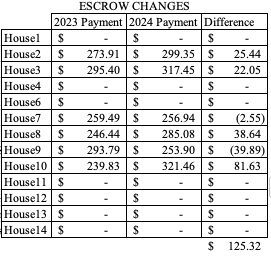
I created this table to show the differences between escrow payments over the two years. I kept the houses that don’t have an escrow because it can be compared to a future table in this post. There is no House5 in this table because we sold it several years ago (houses didn’t get renumbered because House5 still exists in terms of tax documentation).
INSURANCE

We had 3 insurance claims last year, and a big one the year before. It turns out, our portfolio is looked at as a whole, so 4 claims in a 12 month period doesn’t look good, especially when one of those was 6 digits and one was 5 digits. None of it was egregious, and they were each necessary. We were just a victim of poor timing (and for some reason, the 12 years prior to that with 0 claims of any kind mean absolutely nothing). While our own history is to blame in some aspects, insurance costs as a whole are increasing quickly over the few years. Here’s Google’s AI response:

And with that between payments made in 2023 and payments made in 2024, insurance is costing us almost $2,000 more for the year. I also just made my first 2025 payment, which increased that one house by $343. The total increase from 2022 and 2024 is over $3,000.

From the initiation of insurance on each house (so, when we first bought the house, which were mostly between 2015/2016) to today, we’re paying over 43% more in total for insurance.

TAXES

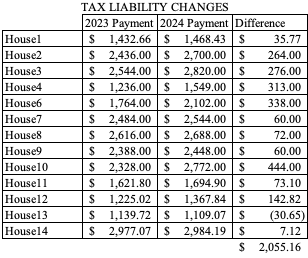
The table below shows the change between 2023 and 2024 for our tax payments. Last year, many jurisdictions that hadn’t captured the assessment changes since the pandemic made up for it last year, when we saw about a $3,500 increase for the year. This year, our increase was over $2,000. Fifty-five hundred over two years is nearly $230 per month, spread over 13 rental properties is $17 each. So for those that I didn’t increase rent last year, they’re not capturing that cost increase for our portfolio.
RENT INCREASES

So far this year, I’ve missed two opportunities to increase rent. I had planned on increasing one house by $25 to keep up with inflation costs, but it didn’t register that their notice had to be given by 1/1 (every one else is by the end of the month). The second is above market at this time, which was by design since they’re not easy to work with (tried to phase them out, but they accepted the rent increase). We last raised their rent in September 2022, so it’s been two years. But I couldn’t bring myself to do it. Next year we’ll increase them by $50 per month.

My plan is to increase the rent for 5 of our other houses. Four of these houses are planned to be $50 per month of an increase, and one is planned to be $75. Our management is generally to increase rent by $50 every two years if you’re a long term renter. There have been a few that we didn’t increase for a while, and the carrying costs have drastically increased, so we’re behind now.

SUMMARY

For our cost increases between taxes and insurance, we have over $4,000 that was paid out last year (and it’s really more than that in cases where the house has escrow, so our escrow was increased more drastically that the specific amount of change in bills).

We had 3 houses turnover from long term tenants, so we were able to increase the rent to market value. I prioritize keeping long term tenants, so I don’t always do rent increases. That means that sometimes the rent is stuck below market value, but I’d rather keep a good tenant than push them out with large annual rent increases.

By bringing those houses up to market rent, I’ve made up a good amount of our deficit. Now remember, these rent increases are catching up on multiple years of drastic increases. So even though it seems we’ve brought in more, we’re both making up for previous years that didn’t have such large rent increases and paying for more large scale improvements to these houses, in addition to larger contractor costs.
Escrow Analysis Update

I posted about how one of our houses updated the escrow calculation and claimed our new mortgage payment needed to be $185 more than it had been to cover an escrow shortfall. Our escrow balance was negative, so it wasn’t a surprise that the amount was increasing, but that seemed to be a drastic increase. Most of what I said was right, but I did the increasing math incorrectly. The concept was there, but not the details.

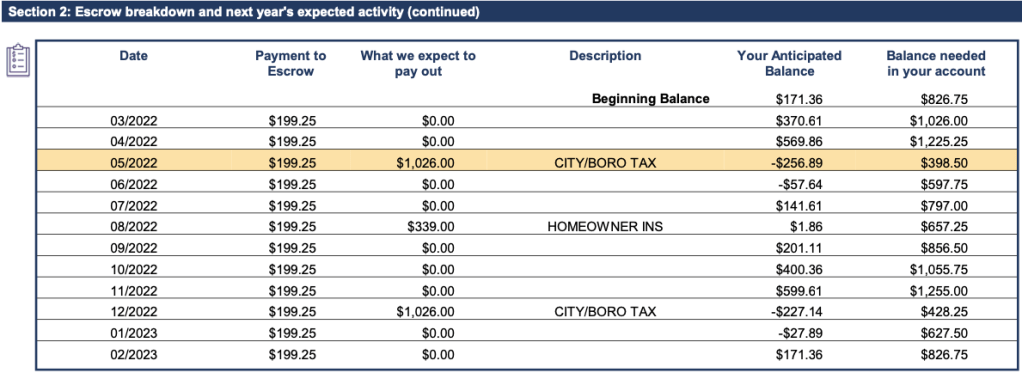
Here’s the current escrow analysis from the mortgage company. It’s similar to what I did on my own. I knew that the new escrow amount to cover just what we owe in the year is $199.25, which is the same. I knew that there would be a shortfall in May of $256.89. This next step is where I was wrong in my calculation.

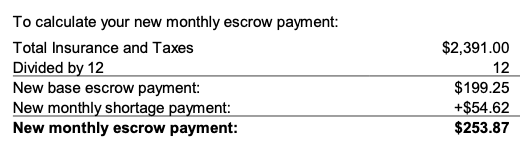
I took $256.89 and divided that specific shortfall by 12 months to come up with $16.60. Instead, I needed to take that shortfall and add it to the required balance of 2 months worth of the escrow payment. Therefore, $199.25*2+$256.89=$655.39. Take that number and divide by 12 to get the monthly payment to cover the shortfall, which comes to $54.62 (rounded).

The new payment is the new base amount plus the shortfall coverage. So our payment actually increases by a total of $96.95 because our previous escrow payment was only $156.92.

House7 Escrow Analysis

We received a notice that our escrow needed to be increased by $185 on this account. That seemed to be a huge jump, considering this was a new account for this year (we refinances January 2021). Our taxes went up about $35 per month, so the $185 increase stood out.

Mr. ODA’s brain works best in these scenarios, and he quickly noted that the analysis double counted our tax payment (they claimed it to be paid in December 2021 and January 2022). My brain can figure it out, but I need to write down every step of the math to understand it. 🙂 Since I took the time to analyze the escrow changes, I thought I’d share it in case anyone was interested in knowing how their analysis works.

They double counted our tax payment, so the increase truly should only be $58*. As someone who needs to see the details and can’t think in the abstract when it comes to math, I ran my own escrow analysis.

First, you need to know your taxes and insurance total for the year. Take that total, and divide it by 12 to get your monthly expense. This is because your escrow additions occur monthly. For this property, our monthly cost of our taxes and insurance comes to $199.25 (green). The old escrow amount of our monthly mortgage payment was $156.92 (orange).

The ‘Escrow Needed’ column is increased each month by $199.25. The ‘Required Balance’ is double the monthly expense for our account (199.25*2). Then the difference between the ‘Escrow Needed’ and the ‘Required Balance’ is the column in blue. The escrow shortfall is determined by the greatest negative. Therefore, I took the difference for that month (May 2022) and divided it by 12, getting $16.60*.

The escrow analysis then results in an escrow increase of $199.25 (the amount needed to cover projected expenses), minus the old escrow contribution amount of $156.92, plus the shortfall amount of $16.60*, bringing the increase to $58.93 per month and making the new monthly escrow payment $215.85.

EDIT: *These numbers are not right. For a detailed edit, see this post: https://onedollarallowance.com/2022/02/14/escrow-analysis-update/.

Escrow Payments

A theme I stick to in this blog is that you need to watch your money. I’ve talked about ways that I’ve fought to get money back where it wasn’t billed correctly (e.g., medical bills), and today’s warning is about escrows.

An escrow account, in the sense that I want to talk about it, is tied to your mortgage. Your monthly payment includes an amount that goes into a separate account held by your mortgage company, and they manage paying out your taxes and insurance on your behalf.

The benefit of an escrow is that you don’t have to manage your insurance and tax payments. You don’t have to pay out a large sum of money once (or twice) a year because you’re paying towards this account every month that will manage that billing for you. The downside is that this escrow account requires you to maintain a balance, so it’s holding your money where your money isn’t working for you. Another downside is that your money movement is less transparent, and you just expect that the payments will be made accurately. The bank basically takes on the administrative burden of paying these bills on your behalf, in exchange for continually holding this money without paying you interest.

Each month your mortgage payment includes principal, interest, and escrow. For example, I have a mortgage payment that is $615.34. The P&I total will remain the same amount each month, but the principal portion of each payment will slowly increase while the interest slowly decreases. In my example, the total P&I is always $428.11, but the breakdown of what’s principal and what’s interest changes (e.g., October’s payment due included principal of $119.58 and interest of $308.53; November’s was $120.03 of principal and $308.08 of interest). The escrow amount each month for this mortgage is now $187.23; this number stays the same until there’s an escrow re-analysis.

An escrow analysis is conducted once per year to verify that the escrow account will have sufficient funds to pay out the bills received (typically taxes and insurance), while maintaining the required minimum balance. Sometimes the increase is known ahead of time because you can see that the estimates for the initial escrow contributions were off (or in our case, new construction uses estimates based on last year’s tax payment, which only included land value and not the final sale of the home, so we know there will be an escrow shortfall in our future). A shortfall may also occur when there’s been a drastic change in your property value assessment, causing taxes to increase more than an expected amount (like in 2021!), or when insurance costs change more than projected.

Below is an escrow analysis of one of our accounts. The highlighted row shows that when our taxes are paid, the balance will fall below the required minimum. The document says that the minimum “is determined by the Real Estate Settlement Procedures Act (RESPA), your mortgage contract, or state law. Your minimum balance may include up to 2 months cushion of escrow payments to cover increases in your taxes and insurance.” If you are projected to dip below the required minimum, they’ll offer you the opportunity to make a one-time contribution to the escrow account or your monthly payment will increase to cover that projected shortfall.

The increase is calculated in the image below. My payment to escrow at the time of this analysis was $126.18. They take my insurance and taxes owed, divide by 12, and come up with my monthly base escrow payment ($149.81). At the lowest point in my escrow balance (highlighted in yellow above), the account will be -149.43. The difference between this balance and the required balance of $299.62 is $449.05. Divide this number by 12 to get the $37.42 in the image below indicating the monthly shortage for the account.

The new escrow payment is added to my P&I payment (which stays the same), and this is my new monthly mortgage payment.

An escrow analysis showing that we’ll fall below the balance required inevitably means that my monthly cash flow will decrease (because we always opt for the change in monthly payment instead of a one-time contribution). As taxes and insurance increase, so does your requirement to fund your escrow account. While the reason for the escrow increase is to cover the taxes and insurance, which I would have to pay anyway, the escrow increase is higher because of the required minimums. One of our houses started with $766.96 as the monthly payment, and it is now $802.96 due to the escrow analysis. Another one started at $477.77, and it’s now at $537.60.

SO WHAT HAPPENED?

Honestly, the only way I’ve checked my escrow balances in the past is at the end of the year when I’m verifying the insurance and tax payments “make sense.” I’m not even verifying the details behind the numbers, just that it was similar to last year’s amount as I update my spreadsheet. Well this time, I logged in to update my spreadsheets with the new mortgage balances for the October Financial Update, and I saw my escrow account was negative by over $1000! That makes no sense because these accounts are reviewed annually through an escrow re-analysis to ensure you’re not projected to dip below their required minimum balance, and if it were to be negative, it would only be by a much smaller amount.

We had recently changed our insurance. Usually when we change insurance providers, we pay the current year on our credit card (to get those points!), and then all future billing goes to our escrow account. I don’t know why we didn’t do it this way for the most recent change, but I’m inclined to blame the fact that the process took months to get new insurance because this company hasn’t been responsive, so we just wanted it done and weren’t thinking. Since we didn’t get the new policy issued before our old policy was billed, both insurances were paid out by our escrow. Sure, that should have affected our escrow balances, but still not by $1000.

One house had a policy that cost $573.31 and the other had a policy that cost $750.06. The new policy includes both houses under one policy (this becomes annoying and it makes me uncomfortable for reasons I can’t seem to articulate to the agent) and costs $1,180.87. Each mortgage escrow paid out the original policy amounts since we didn’t execute the new policies timely. After these were paid out, the mortgage company received a bill for $1,180.87. For reasons I can’t quite figure out, the company paid $1042 from each of our escrow accounts, and then one escrow account paid $138.87 (which is the balance of 1180.87-1042). The $138.87 covers the policy fees; so someone realized that there was a separate line item for policy fees, but didn’t realize that the $1042 should have been split between two houses (even though they knew there were two houses because they took from both escrows).

I questioned the process with the new insurance company, but he didn’t take responsibility for it. He claimed that the mortgagee had to know to split it and they don’t manage any of that. I explained that I’ve had multiple houses insured by one company and have never been given one policy number for it. He acted surprised. My gut says this is wrong and isn’t going to work, both for future billing and the possibility of a need for a claim. We did receive a check in the mail for $903.13 (the difference of $1042-138.87), but we still have paid the $138.87 and want it reimbursed. I sent an email this morning explaining again that I’ve confirmed with my mortgage company that this insurance company was paid $1042+$1042+$138.87. He again responded that the $138.87 is the fees portion of the bill, and I again said that I know, but it’s been paid twice, and I’d like it back. So now I’ll stay on top of that $138.87 to make sure we get it back.

You need to fight for yourself. You need to know what companies are owed and know what you’ve paid. Then don’t back down to keep asking for an update. I recently discussed how I had to fight for medical bills (multiple times) for a year at a time to get the money reimbursed that I was owed. I even recently had to call on another medical bill that I paid before realizing it hadn’t been submitted to insurance (I would love to understand why this keeps being an issue that my medical bills aren’t submitted to my insurance before billing me). Then they submitted it to insurance and sat on my reimbursement until I called twice asking for the reimbursement (that both times they agreed I was owed and it was “in process.”). Manage your money. Especially because that $138 that I’m waiting for now could mean a big difference to a family in need or living paycheck to paycheck.