Lease Break Agreement

Last March, it was time to make a decision on renewing the tenant’s lease on House9. There were several variables at play, and we ended up adding “lease break” terms to the renewal agreement. Here’s how and why we did such a thing.

LEASE BREAK CLAUSE

All of my leases are set up as a lump sum fee. This means that if the rent is $1,000 per month, then the lease is a legal binding agreement for $12,000 for the year. If you wanted to leave 6 months into the agreement, I could hold you accountable for the entire sum. In reality, this wouldn’t happen. I’d have to show a good faith effort to re-rent the property once the tenant vacated the property, and they’d only be responsible for the time it was vacant, at most.

The point here is that there is no section of my lease agreement template that allows the lease to be “broken,” and the tenant to leave “early.” In some instances, a tenant will request the flexibility to leave early, and we typically charge up to a month’s rent for that ability. We most often use this for tenants that expressed interest in buying a home. There are some other fee structures that we use depending on the circumstances, but this will focus on those instances where we know in advance that this is a possibility.

ORIGINAL LEASE AGREEMENT TERMS

The tenants had signed their original lease in June 2020. From the beginning, they were clearly money savvy. They had said from the beginning that they were looking for a place they could live until he finished his schooling, which was about 2 years away. They negotiated a two year lease for $1,280. In September 2021, so 6 months before their lease was set to expire, he reached out with an offer. His program was set to end in May 2023, but they didn’t want to commit to any longer than that since he could be placed anywhere upon graduation. He asked to go month-to-month after that.

We agreed to extend their lease until May 2023, but it would be $1,300 (instead of $1,280) between 7/1/2022 and 5/31/2023. We decided not to engage in the month-to-month conversation that far in advance, which he understood.

In March 2023, we started discussions on their status. They were about to have a baby, the market had cooled for buyers, interest rates were high, etc. They didn’t want to rush their buying process. Instead of paying the premium for a month-to-month lease, we decided on another year-long lease, but it would have a “lease break clause.”

NEW LEASE AGREEMENT TERMS

The new lease was executed for $1,350 per month, which was still a bargain for their property. However, we added lease break provisions, as seen below.

The thought process here was that we were protecting our financial interests based on the time of year. First, we required a month’s notice. Our original lease already states that we can have access to the property to show it to prospective tenants, so that wasn’t repeated here (although it is worth noting that this in our lease agreement, since renting while a unit is occupied is not always a given; we struggled with our property manager in KY getting access to our properties (that was a property manager issue)).

I don’t know if there are facts to back this up, but it seems (through my own years of renting, as well as all these years as a property manager) that most people are looking for a rental to be somewhere between May 1 and July 1 as the start. A quick search tells me that the common months are May to September. However, in the south, we start school in mid-August. If you’re not moved by August 1st, I’d venture to say you’re not preferring a September 1st start date.

If the tenant left in the summer months, then the fee was only 1/2 of a month’s rent. We had a good chance of being able to re-rent the property if it was during the summer and before everyone focusing on back-to-school in the end of August/September. If they requested a lease break between September and the end of March, then it was a full month’s rent. This was due to the fact that the turnover process was going to be longer than our typical turnaround, and it would put us at a disadvantage in re-renting the property down the road. We then put that there would be no fee if they left in the last two months of their agreement because 1) we’d likely be able to rent it quickly, and 2) as a way of showing that we’d meet in the middle since they were such great tenants.

EXECUTION OF THE LEASE BREAK AGREEMENT

The tenant had used our property manager as their Realtor for a new home purchase. She tipped me off that they’ve be giving their notice shortly, sometime at the beginning of November. I naively thought that meant they were newly under contract, but by the time their notice was given, they had already closed on their new home. They purposely waited to give their notice so that they had time to move their belongings without being rushed (which is fine; I don’t know why that reads negatively). On November 24th, they let us know that they’d be leaving by 12/31.

While the fee was due upon notice, per the lease agreement, it wasn’t something I was willing to fight. If you’re a good tenant and hold the lines of communication open, I’m happy to treat you as an equal. They paid the fee on 11/29, and then they paid their December rent on 12/4.

LESSONS LEARNED

Honestly, it worked just as planned. We weren’t able to rent the house for January. The lease break fee alleviated the pressure to settle for a tenant just to fill the house because we had the month’s income already accounted for. We’ve done something similar in the past, and this set-up has worked well for us. It gives a little grace to the tenants and real life needs, while still protecting our interests as business owners.

We put the same type of clause in another tenant’s lease. They executed the clause on February 23rd, letting me know they’ll be leaving by the end of March. If they broke their lease in March or April, there was no fee (their lease was set to expire April 30th, so it’s one month early).

Their are times where a tenant doesn’t know up front that they’re going to find a house they love or a job is going to move them. We handle each on a case-by-case basis. Generally, it’s either going to be a month’s worth of rent as the fee or it’s going to be a fee of $250 (the amount I pay to the property manager) and they pay rent until we find a new renter (which has never taken more than 6 weeks, and is typically a few days turn around for me).

February Financial Update

RENTALS

The rentals were expensive this month with $4600 paid out. This doesn’t include work that’s currently under way, but not paid for yet.

I paid for a water heater replacement, which was $1,904. I had to pay insurance on a larger property ($793). I paid the balance of the window replacement at one property, which was $1,064. I also paid for a plumber to address a leaking toilet and a rotted faucet ($325). We had a new tenant move into a vacant property, so we had that cleaned before her arrival ($165).

I had to pay for a plumber’s service call ($95) for clogged drains, for them to refer me to a rooter company ($250). I emailed that tenant that preventive measures need to be taken because I’ve not had so many calls to one property. She assured me they have taken appropriate measures and it’s just old pipes. The only problem being that we have several other properties with old pipes that never call for clogs.

We’ve turned over two properties and are about to turnover another property in the dead of winter. It’s so frustrating to be in such a position. All of those stories will be elaborated on in future posts.
– On one property, we charged a lease break fee of one month’s rent to cover our losses (the fee was different based on the month in which they broke the lease). Luckily, that covered our entire month of January being vacant, but we found someone for 2/1.
– Another tenant asked to leave a property because he lost his job. That was handled a bit different because we didn’t know in advance that this tenant would want to leave mid-lease. We told them there’s a fee of $250 (which is what it costs us to pay the property manager to find a new tenant), and that they had to pay rent until we found a new tenant. We didn’t lose any rent on that property.
– Now, we have a newly vacant property because the tenant can no longer afford it. I’m not expecting to recover her unpaid rent at this point. We approved a tenant to start 2/28, leaving us with 27 days of lost rent. However, we sent a lease over for them to sign. They’re currently dragging their feet on signing because they want to pay with their tax return. I don’t love that idea. They’ve been easy to communicate with up until this point, just slow. I’m hoping this gamble works out.

PERSONAL FINANCES

I had to transfer money to Mr. ODA’s account to cover the purchase of our new back door and a new treadmill (although that was only $400). This is an interesting concept for us. Mr. ODA had an account before we met. His account was grandfathered in to new terms and conditions at this bank. He’s kept his checking account and credit card for the rewards (I have access to the account; my name just isn’t on it). Any online purchases go on that credit card. However, that account only receives $250 every other week from Mr. ODA’s pay check (occasionally it’ll receive rent via Zelle). So sometimes, we need to transfer money from our main checking account to cover that credit card payment. All our security deposit accounts are with that bank too. So I had to then transfer from a security deposit account into his checking account, and then have him send that money to our main account. It wasn’t our finest money management moment.

Not much else happened this past month. We’ve gone skiing with the kids some more, I went on a moms’ cruise (which was amazing), took a small trip to piggyback Mr. ODA’s work trip, and have done activities around town. We’re gearing up for a procedure at a local children’s hospital next week, which I’m expecting will wipe out our deductible. Luckily that’s only $3,000, but I’m sure we’ll hit it. We’ll actually be late hitting it this year; it’s usually done in January.

NET WORTH

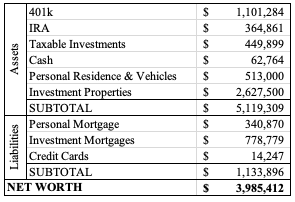
One of this year’s goal is to hit $4 million net worth. I thought it was going to be a ways away, but the market has been up big recently. We’re only about $14k away from that goal now!

House 2 Turnover & Flooding

This is long; I understand. It’s a detail account of our experience dealing with a catastrophic event and navigating the insurance process and tenants.


Over the winter, I received a call from one of my tenants letting me know that water was pouring out of the house next door (that’s also ours). The tenants had turned off the heat… when it was 6 degrees for 3 days straight. The water heater is in the attic and a pipe cracked during the freeze. When it started to thaw, the constant water running filled up the house. Our property manager went to the house and found two inches of water throughout the entire house, along with a collapsed ceiling in the master bathroom. Over the next two days, the ceiling in the adjacent laundry room and the master bedroom also collapsed. 

We took immediate action on the water remediation process. The clean up company had to put several fans throughout the house and crawl space after sucking out the standing water. The next step was to purge the damaged drywall, insulation, cabinetry, flooring, etc. However, the tenant was in our way.

TENANT ACTION

The tenant’s renters insurance was responsible for removing their belongings. They created quite the speed bump, and the tenant’s items weren’t removed for 5 weeks. FIVE! The insurance company [supposedly] was requiring the use of a specific moving and storage company, who had no availability. Eventually, the tenant had the insurance company agree to them removing their own belongings to begin moving forward. They finally got their belongings out a week or so after that process started.

When we started going through the process of remediation, the tenant asked to speak with us over their concerns regarding mold. We refused because we have a property manager, and the relationship is between her and the tenant. We asked them to write us an email expressing their concerns, and we’d respond to that. They didn’t write the email. We told the property manager to relay the message that we want the house restored back to the condition (or better) that we kept the house in, and we have no expertise in this area, which is why we hired a remediation company to handle it, and I’m to trust that they do their jobs correctly to dry out the house. After that message, they didn’t push any further on the subject.

There was a nuance in the lease that if there was a catastrophic event, the tenant could choose to be let go from the lease agreement with 14 days; after that timeframe, they’re still considered responsible for the lease. The tenant read this and wrote us an email to enact it about 6 weeks after the event. Technically, we could have held them to their responsibility. However, there wouldn’t have been anything good to come from that. The tenant went from being understanding to quickly being nasty and unreasonable; it was best to cut ties.

We had told them not to turn off any electric (they were worried that water and electric don’t mix, so they shouldn’t keep the electric on; we shared that we need the house kept a reasonable temperature, so that’s not the right answer). However, they did turn off the electric shortly after that conversation. They ended up not getting their security deposit back to cover the utilities incurred and lost rent for their lack of payment through their notice. We also charged them for leaving the refrigerator in poor condition and us needing to get extra cleaning for that (which didn’t work and we ended up needing to replace it, but that wasn’t within enough time for us to know before the security deposit notification was due).

REMEDIATION CONTRACTOR

We hired a company to come out and dry out the space right away. I don’t know the details of this process because I trusted the company to know what needed to happen. They sucked up the water and put big fans throughout the house and crawl space to dry everything out. Their process was at least a week long.

They submitted their bill and dry logs to the insurance company for about $22k. The insurance company rejected their process and everything they did, and they agreed to pay out about $16k. The contractor balked at it, but we said we didn’t know how to help, and he had to speak to the insurance agent himself. They went back and forth for weeks. The contractor submitted a new invoice for $25k (why more than what it was originally?!). The insurance company eventually agreed to their $22k figure.

I tried to pay him in July for work done in January (that’s how long it took!). My bill pay system flagged the check because of the amount, but never told me. They claim it was quickly released and delivered as expected and on time, but the company never received it. I had my bank place a stop payment on it. Then I went to the bank to get a cashier’s check and mailed that to the company. That was 3 weeks ago, so I’m assuming he got the check since I haven’t heard from him.

REBUILD CONTRACTOR

We received three quotes for cleaning out the damage and rebuilding those parts of the house. None of the quotes were close to what the insurance adjuster gave us as an estimate. One of the three companies that gave us a quote asked to speak to our insurance company. They went through all the line items, and the insurance adjuster agreed to the contractor’s price for the work, which was about a $6k difference. 

The initial contract with this company required 50% of the estimate up front. However, we didn’t feel comfortable handing over $25k. I spoke to the contractor, and he agreed to three payments. Their first payment was allowed via credit card, so we were able to capture $340 worth of credit card rewards on that $17,000 purchase. The second $17,000 was due upon flooring completion, and it had to be paid via check. The final amount was due upon substantial completion.

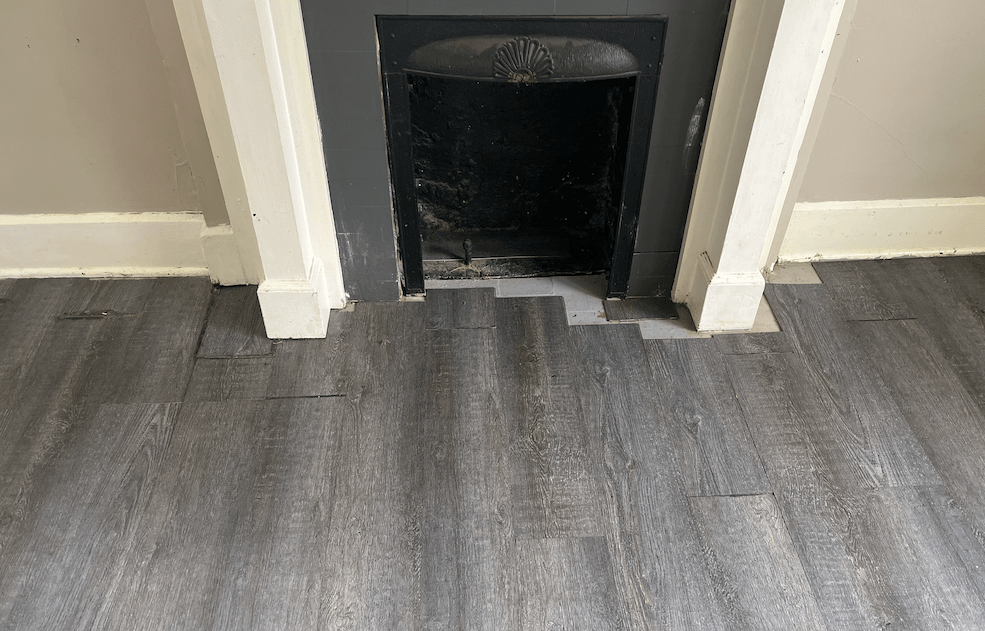
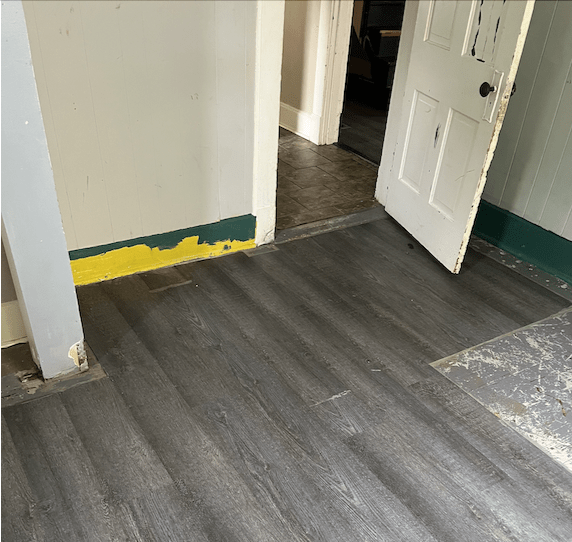
I spoke to the contractor about the vinyl floor in the bathrooms, and he actually said they’d be willing to lay the luxury vinyl plank for the rest of the house through the bathrooms also. While I’m sure it cost them less to handle such a change, it was nice that he didn’t charge us for a contract adjustment.

Once the contract was executed, we had to pick out all the replacement things. This sounded overwhelming, but it was pretty straight forward! I only had to tell him the paint color I wanted, and then pick out the cabinets and flooring. I went with a white cabinet for the lowers in the kitchen and the bathrooms. The upper cabinets in the kitchen are a brown, but I wanted to “upgrade” where I could instead of trying to match the existing. I figure eventually the upgrades will come if we ever want to sell, so I may as well do it nicely now and only have to change a few things down the road.

There were a few more selections during the process – little things like knobs and light fixtures. Again, I chose nice light fixtures, even if they didn’t match the brass that was already in the house.

There were some hiccups along the way. They painted the house the wrong color. I specifically discussed changing the color from the what was there since the whole house was being painted. The original house was built with brown carpet and yellow walls. We kept it the same color all along because we didn’t want to go through the effort of changing it (cutting in, two coats, etc.). This was our chance to change it to the color we’re using on our houses to make it more consistent. With a grayish floor, it worked better to have a light green than a yellow anyway. They also threw away our bathroom vanity counter tops, so they had to replace those at no charge to us because they were supposed to be salvaged.

All in all, everything went well with the contractors.

OTHER REPAIR WORK

Our previous tenant had burned the kitchen countertop. We decided to just keep the burnt counter and re-rent it for the time being (we didn’t have a good amount of time to add another contractor into the mess we were cleaning up at that time). Well, with the bottom cabinets needing to be replaced, here was an opportunity to replace the counter. I asked the rebuild contractor what he could charge. He was going to charge over $2k to replace the two bathroom counters and the kitchen counter.

He made the mistake of giving me the link to the countertop he would use for the bathrooms. It was $119. He charged $221.50. He also had a labor charge, plus a 10% charge for overhead, plus a 10% charge for profit. Once I saw all those details, I was put off. We said we’d just keep the bathroom counters and sinks – they were cultured marble, so they were fine, just more yellow than white. Then his guys ended up throwing away our counters by accident, and we ended up getting new bathroom countertops and sinks anyway for no charge to us.

We asked our handyman if he could do kitchen counters. He was able to get the new countertop installed and the sink set for under $500.

INSURANCE COMPANY

Our insurance company was actually really difficult to work with. They were willing to hand out money, but they weren’t there to communicate. Several voicemails and emails were left unanswered. Sometimes we’d get a random email that would say “I put a check in the mail,” but mostly, we just kept making phone calls that went nowhere.

Depreciation

As someone who worked in finance, the term depreciation makes no sense to me. The insurance company kept about $6k of our total amount they agreed to pay on the estimate. Once all the work was completed, we provided receipts of the work, and they paid out the rest of the estimate.

Because we had the rebuild contractor not do some of the activities from the original estimate (the washer and dryer were thrown away, so they weren’t hooked back up), or we had our handyman handle some of the items because they weren’t getting done (hooking up the dishwasher), the final estimate was lower than the original amount. Then I included the invoice from our handyman for the work that he accomplished. The total between these two invoices ended up being more than the original estimate from the rebuild contractor, which I expected was our loss, but the insurance company actually paid out on it.

Lost Rent

The insurance policy covered the lost rent for our vacancy. They took our lease agreement, determined the per diem amount, and then agreed to cover until the work was completed. There was a disagreement on when the work would be completed (they took a date off some paperwork that we had never seen, while we were told by the rebuild contractor that he’d be done by April 20th). Once we got that sorted, they sent us a check to cover all of March and most of April. We were able to get the house rented at the end of April, so it was only truly considered vacant for 3 days of the year, which I find impressive.

Utilities

The tenant turned off the electricity about a week after the incident (although we told him not to). Luckily, I have a program set up where the utilities aren’t actually ever turned off, but they’re reverted back to my name. We submitted receipts to the insurance company, who agreed to pay the excess amount of charges due to the house being open to the elements (missing ceiling and insulation). Their calculation was based on an average of bill total. Mr. ODA is a math wizard and didn’t accept that. He performed a calculation that equated to an average daily use of electricity, along with separating out the bills by days (because one of the bills was half a month of normal activity and half with the house open). The insurance agent said he wasn’t going to fight us over $50, so he just sent it to us. It was an interesting statement, considering all the calculations Mr. ODA did was in the original submission, and he decided to do his own math instead of accepting what Mr. ODA had said in the original email (granted, looking back, he may have never even read the email because that was the norm).

The water was turned off at the street when the initial report of an issue came in. Once everything was dried out and we had the pipe repaired (a $350 activity caused tens of thousands of dollars worth of damage .. gosh), we needed the water turned back on. That was a horrific process with the City of Richmond that ended with me screaming at a lady on the phone in some random street in my neighborhood during a walk. In order to speak to the City, you have to wait on hold for at least an hour; you can’t schedule water to be turned on via an online account. So after waiting 90 minutes for the first time to get it scheduled and being told no one needed to be home, they showed up, no one was home, and they left. There was no notice. No phone call. No voicemail. No email. No note on the door that they were there and tried to get in touch with us. Nothing. I was livid. So I called again. I waited over an hour. Then the woman who answered was very much not helpful. The conversation went quite poorly. I yelled, she wouldn’t give me a supervisor. Horrific. I finally got a new time scheduled for days out (and their window was 8 am to 5 pm – a lot of anger for that). They unlocked whatever it was that needed to be unlocked and our contractor handled it from there because it was done so poorly in the scheduling sense.

NEW TENANT

We actually struggled to find a new tenant. We were able to list it while the final clean up was happening. We had a lot of interest, but not a lot of people qualified. A neighbor had watched the rebuild happen, and she wanted the house. She didn’t qualify. And instead of accepting that information (and we’re pretty lenient), she started threatening us for not selecting her. Our initial choice fell through – and that’s why you should always be nice. She may have been a runner up, but she squandered all opportunities because of the way she handled herself and treated us. The new tenant was able to move in at the end of April. At the time that she moved in, she had two jobs. Unfortunately, she was laid off unexpectedly in June from one of the jobs, so she has struggled to pay rent in July and August. I’m understanding, but I didn’t appreciate that we had to ask where the rest of rent was and she didn’t send the late fee. Again, I’m lenient and understanding, if you’re nice. We had another tenant say that she needed another week to pay August rent because sickness kept her out of work, and I had no problem with that and waived the late fee. She told me up front; I didn’t need to go asking questions and wait all day for a response.

The new tenant did complain upon move in that the house wasn’t clean. We knew that may be an issue. The contractor’s cleaners didn’t do a great job, but the house was generally clean. The new tenant did mention that there was just a little too much dirt from the renovation to be acceptable, so we hired a cleaner to come in and get it done. Other than that, we haven’t had any maintenance requests or complaints from her.


For how big of an issue this was, I’m impressed by how easy it felt to come out the other side. We were lucky to have insurance cover lost rent and expenses, and they didn’t give us a hard time on nearly anything (we’re currently trying to manage a claim on our own how that is far from easy). We were able to re-rent the house for $150 more than it had been rented at. So while we had the house vacant and being worked on for 4 months, it really wasn’t too bad.