2020’s Expenses and Activity

When people talk about having rental properties, usually the first thing we hear is, “I don’t want to hear about a clogged toilet at midnight.” Does your toilet clog at midnight? No. So why do people think that tenants have issues that you wouldn’t typically see in your own house? A tenant can’t expect service faster than you’d get on your own property.

Even when there’s a month that requires a lot of our attention to be on rental properties, it’s still always worth the income/expense ratio. 2020 was a year of big expenses. However, I kept the perspective that we had several properties that we didn’t even hear from, and this was just one year of 4 so far.

Here’s a look back at what happened with our rental properties in 2020.


House #7 required a roof replacement. We have dealt with leaks since we purchased the house, and the time finally came that the replacement was more cost effective. This house also required HVAC repairs and plumbing replacement. Since we purchased the house, we had issues with the upstairs bathroom sink not draining properly. After several attempts to unclog it, our plumber finally made the call – it wasn’t a matter of cleaning a clog, it was time to replace corroded copper pipes… from the second floor to the crawl space. And so we did that. We then had to pay someone else to repair the drywall. All together, this house cost us $7,600. However, about $4k of that was the roof, which has to be depreciated over 27.5 years, so we only claim about $75 of that cost this year.

House #1’s roof has also troubled us from the start, but it’s under HOA control. We had a leak that was bad enough to require the HOA’s attention. It was a multi-week process to get them to even acknowledge me, and I have no intention to ever own a townhome again. I like having more control over my property than being in a position to hound an HOA to address a water-related issue as I watch more rain in the forecast. In the end, they repaired it, but we’re responsible for the drywall repair, which was $76.

House #6 required the main sewer line from the street to the house to be replaced, which was $4k including the scoping trip to put a camera in the pipe and see how deteriorated it was.

We had quite a few HVAC issues this year, after only having 1 issue on all our houses (well 2, but that second one was someone driving over our unit and insurance covered it). We had House #3 require a new fan, which was $635. House #9 had an entire HVAC replacement at $5k, depreciated 27.5 years. House #12 required HVAC work at $500.

We had to replace a dishwasher, stove, washing machine, and refrigerator among the properties as well. These were the major purchases and don’t account for several smaller plumber and electrician trips that were needed among the properties.


On the positive side of things, we paid off one loan, paid $23,500 paid towards another, and refinanced a property (reducing our monthly payment by $104).


Of 12 properties, we had to turnover 3. Turnover is the most time consuming to us personally because it requires our attention to touch up paint, fix things, order appliances, and coordinate any other maintenance issues. Then we need to handle listing the property and showing it when we don’t have a property manager, which was the case for 2 of our properties.

In March, we had the tenant at House #11 request a renewal of their lease. A couple of weeks after signing the renewal, they requested to be released from the lease because they were moving to another state. We worked with them, for a fee, to be released from the lease, and they vacated the house as of April 30. I had to repaint, clean the bathrooms and kitchen, fix a few things, and clean the carpet (which was only a year old at this point). We listed the house, had several inquiries, and had it rented on May 7.

In September, we had the tenant at House #7 request to be released from her lease because she was buying a house to take advantage of low interest rates. The Fall isn’t a good time to be listed a house for rent, but it’s hard to not help someone help themselves like that! We agreed to release her from the lease for 2 months worth of rent. Shortly after that agreement, an old tenant of ours reached out asking if we had something coming available in October or November, and this house fit her request perfectly. I met her to show her the house and had a November 1st lease signed the next week. We asked the new tenant if she could move out before October 31st, and we would refund her for the days she left early. We spent two days touching up paint, fixing an old water leak patch (the roof had since been replaced by the drywall work in the laundry room hadn’t been addressed), and cleaning the house. Our paint touch up was far from perfect, but we didn’t have time to repaint the whole house. I offered the new tenant an incentive of $50 per room and $25 per paint can if she wanted to paint herself, and she actually did 3 rooms so far.

The final house that had turnover is managed by a property manager. Our house was the first the tenants had rented, and they didn’t quite understand all the details of having to give notice that they were leaving. We worked with them while they went back and forth deciding if they wanted to renew or leave. While our lease stipulates that we require 60 days notice if they plan to leave at the end of the lease, we wouldn’t typically post the house for rent more than 3 weeks out. They eventually decided they wanted to leave the house, but then at the last minute asked for more time. We had a lease lined up for two weeks after they were going to vacate, so we were able to give them an extra 10 days in the house. Once they left, we had the carpet and house professional cleaned, and I touched up some paint. The property manager handled the listing, showing, and background checks. The new tenants haven’t asked for anything since they moved in back in July.


We were not heavily impacted by the pandemic. We hadn’t realized it until the Spring, but nearly all our tenants work in health care, which is just an interesting coincidence. During 2020, we only had one tenant that we had to constantly keep up with regarding her employment and ability to pay rent. She didn’t always pay on time, but we would have all the month’s rent before the end of the month each time. Then we had a tenant here or there that needed another week or two to pay rent in full, which we had no problem allowing. We didn’t collect any late fees in 2020.


While a year of several big expenses can be overwhelming, it’s helpful to know that this has not been our norm and the issues were centralized to a few houses. It also helps that 5 of our houses have long term renters (renewed more than once). Having a tenant renew their lease saves us time and money.


Doing Your Own Taxes: Set Yourself Up for Success

I manage all the financials for my family. Mr. ODA makes the maneuvers, and I record them. Excel is where our organization lives and dies. Sure, I have a degree in Finance and Information Technology Management (i.e., Excel), but it doesn’t need to be complicated or difficult to make tax prep easy for you.

This level of organization allows us to do our own taxes. After the first year of purchasing rental properties, we thought we’d have to hire someone to do our taxes because it would be complicated. It’s not any different than filing your own personal taxes. The software systems available online walk you through the entire process. Each property’s income and expenses have to be entered separately, which is time consuming if you have several properties, but it isn’t difficult.

The most important thing to be ready for your taxes is to make it a whole year activity. If you record income and expenses as they occur, it’s less of a hurdle when the year is over. By recording the activity all year, it then becomes a verification process when the year is over, thereby reducing the possibility of missing something or recording something wrong.

At the beginning of each year, I create a projection of income and expenses, which helps Mr. ODA adjust his W2 tax bracket throughout the year so that we break as close to even or owe very little when it comes to tax filing. Let me dive into that aside quickly.

Go back to Mr. ODA’s tax posts:
TAXES! Part 1 – What are Marginal Tax Brackets?
TAXES! Part 2 – Is Your Bonus at Work “Really” taxed more?

Taxes Part 2 is what I’m particularly referring to, but you may need the lesson in Part 1 to know what that means. There are IRS penalties if you fail to pay your proper estimated tax (when you don’t pay enough taxes due for the year with your quarterly estimated tax payments, or through withholding, when required). Title 26 of the United States Code covers the penalties. Essentially, the IRS is saying, “You have to estimate your annual taxes owed, and you’re not allowed to only pay us taxes on April 15th every year, but you have to pay the taxes over the course of the year.” People get excited to receive a refund from their taxes, but really that’s just an interest-free loan you’ve given the government. Perhaps some people do need that forced savings, but wouldn’t it be nicer to have that extra money in your pocket throughout the year?

Back to the point…

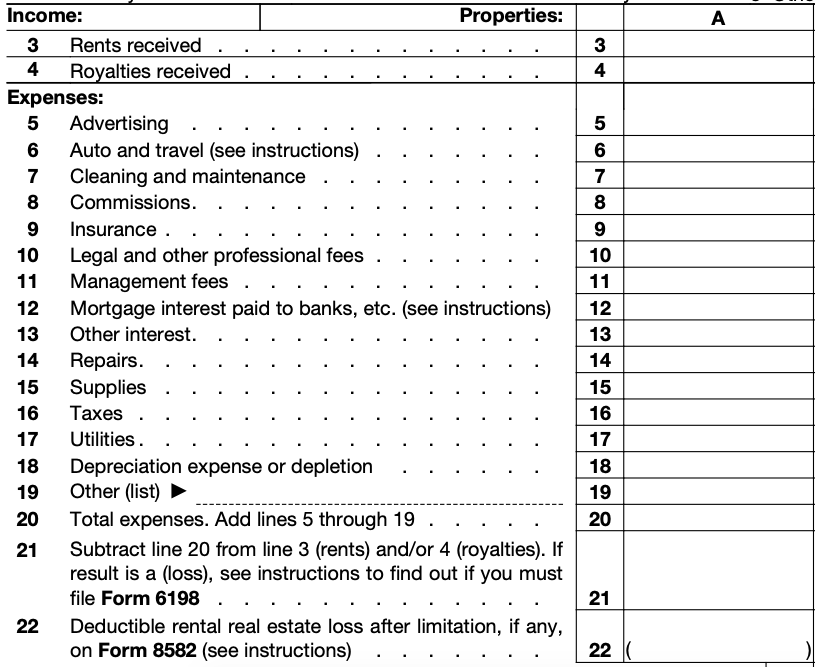
I create a new workbook every year with each house having its own spreadsheet. Schedule E is going to require you to put your income and expenses, per property, not as a whole, so it’s important to have expenses assigned to a particular house. I set up each spreadsheet in an Excel workbook to identify all known costs for the coming year. Not all of these apply, but these are typically the categories of my known costs for each year: property management, HOA, utilities (City of Richmond bills the owner (not tenant) for sewer fees), property taxes, insurance, annual mortgage interest, cost basis depreciation, and prepaid points depreciation. There’s also a chance that you’re carrying appliance depreciation costs (meaning, the purchase of a washer, dryer, refrigerator, etc. aren’t recorded as an actual expense in the year purchased, but are required to be depreciated over its useful life).

As the year goes on, I record any mileage (record the actual miles along with the mileage cost) and maintenance costs. The IRS posts the standard mileage rate for each year here. If a roundtrip to a rental property is 40 miles, then the expense is calculated as 40 miles multiplied by the standard mileage rate, which is $0.56 for 2021. I’ve learned over the years that the software systems just request your miles and do the calculation for you (which is smart and safer on the calculation side), but we want to know what the calculation is going to be, so I enter it as $22.40 in my spreadsheet.

You’ll be expected to input the days your property was vacant, so record that once it’s known.

Each spreadsheet is linked to a master sheet at the beginning of the workbook that shows the net income and expenses for each property. The difference of these amounts are what Mr. ODA uses to adjust his W4 deductions.

I personally assign costs month by month so I can keep track of them, but it doesn’t even need to be that fancy. A running list of these expenses are enough.

The categories are based on what’s going to be requested through Schedule E.

Then in January/February of the following year, I go through my filing cabinet and my email to ensure I’ve captured all of the expenses that I have receipts for, and vice versa to ensure that if I’ve recorded an expense, I have a receipt for it. Having already captured the expenses throughout the year serves as ‘checks and balances’ and doesn’t make the task feel too overwhelming.

Two Years of Changes

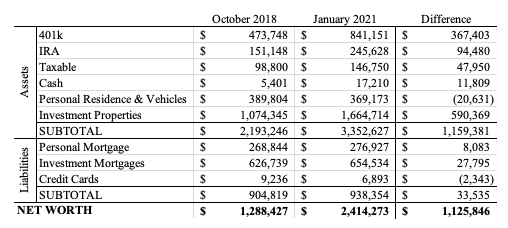
On the surface, a jump of $1.1 million in just over 2 years seems impossible, but here’s the break down of how things changed in our finances during our child-rearing hiatus.

The highlights:
– Mrs. ODA left her job;
– We purchased three new properties;
– We sold one property;
– We paid off two mortgages and significantly paid down two others;
– Our investments grew based on market fluctuation, as well as our continued investment; and
– The value of the properties we own appreciated.


401K

Since I met Mr. ODA, I maxed out my Thrift Savings Plan (TSP, the Federal government’s 401k) contributions each year. Before that, I had been putting money into the TSP, but hadn’t maxed it out. I left my career position in May 2019, at which point I stopped contributions to my TSP. However, we put in as much as we could for the year before I quit (if Mr. ODA has his way, we’d have maxed out my contributions); I contributed $13,070 over the first 4 months of 2019. My balance on June 30, 2019 (it’s a quarterly report) was $300k. I have gained $127k over 19.5 months based on my investment strategy for the account with no new contributions. Mr. ODA continues to max out his contributions of $19,500 per year. His account balance has increased due to annual contributions, a loan repayment, and market fluctuations.


IRA AND TAXABLE

A Roth IRA has maximum contribution limitations per year. For 2019, 2020, and 2021, that amount is $6000. We each put $500 per month into the Roth IRA to max out the contributions. We have maxed out the contribution limitation every year we’ve known each other (10 years), and Mr. ODA had done so before Mrs. ODA knew such a thing. We don’t time our contributions throughout the year because we don’t want to stress about when the perfect time is and then possibly end up throwing five grand in when December rolls around. We have taken the ‘set it and forget it’ (essentially dollar cost averaging) approach to the Roth IRA investment.

Dollar Cost Averaging – Since we know we want to put $6,000 in for the year, we break it down into $500 a month and contribute on the 30th of every month regardless of individual pricing. This eliminates the need to pay attention to, and the effect of, volatility in the market. Some may say that dollar cost averaging is not a prudent idea because the market always goes up over time (essentially you’re setting yourself to pay higher and higher per share as the year progresses, on average), but I just can’t handle the psychology of dropping $6k on January 1 and not having anxiety for the rest of the year that it was the right decision.

As for the taxable accounts, this includes accounts we have set up for our children – UTMAs (however, the growth of these funds are not taxable to us because they are taxed at the minor’s rate – 0% for us). An UTMA is the Uniform Transfers to Minors Act. It allows an account to be set up in the child’s name without the child carrying the tax burden of the money. The IRS allows an exclusion from the gift tax up to $15,000. We put $50 per month, per child, into the account. This is also ‘set it and forget it’ with automatic deductions from our checking account.


CASH

Our cash balance really has no meaning. We bring in income and we pay our bills. We don’t purposely keep a savings account balance (as I shared in the Leveraging Money post, we’re not interested in maintaining 3x our monthly income in a savings account at 0.01% interest rate). We don’t purposely project how much to put towards mortgage principal.

We currently have a larger-than-normal cash balance, which is left over from selling our primary residence in September. It hasn’t been dwindled lower yet because we have a fence install that needs cash and we were paying down the last of our large credit card. Now that most of these things have happened, we’ll put more of our cash balance towards the investment property mortgage we’re currently paying down.


PERSONAL MORTGAGE

In October 2018, we had been living in our previous house for just under 3 years. In January 2021, we had only made 1 mortgage payment on our new home. While our current home cost slightly less than our last home and we put 20% down for each house, we had more years of principal pay down in October 2018 than we currently have.


PERSONAL RESIDENCE AND VEHICLES

We sold our Virginia home for $400k in September 2020. The valuation of that home rose significantly over the 2019-2020 years due to lower inventory with high demand in the Central Virginia area (probably all over the country, but I don’t know those details).

Also in September 2020, I traded my vehicle in for a van (and I couldn’t be happier :)!). That increased our vehicle valuation since the van is 3 years newer and a higher cost than my previous vehicle.

Even though my vehicle value rose slightly, Mr. ODA’s vehicle’s value continued to decline, and we purchased a home in a lower cost of living area, therefore having a lower value.


INVESTMENT PROPERTY VALUES

Since October 2018, we’ve purchased 3 properties, increasing the total property value of our portfolio. Additionally, all of our properties continue to increase in value. The Virginia homes have increased significantly over the last two years. In the table below, I’ve provided each property’s change in value from January 2020 (oldest snapshot per property I have) to February 2021.

Note that this is a projection based on the internet’s valuation and not an exact science. The only house that we have a recent appraisal on is the one that we refinanced in January 2020. That house’s appraisal was $168,000; we paid $112,500 in July 2017.


INVESTMENT MORTGAGES

Of the three most recent purchases, one was purchased with a partner, split 50/50, and the other two were the last two KY houses purchased. These three added $215k of new debt. However, you see that our mortgages on investment properties have only increased by $27k, which doesn’t exactly say “we bought 3 new houses.” That’s because we’ve paid down (and sold) about $150k of mortgages in addition to 2+ years worth of mortgage payments going towards these loans.

In May 2020 and January 2021, we refinanced two properties. Quick tidbit – we signed the refinance papers in May under a tent in a parking lot, and we signed the January refinance at our kitchen table with a traveling notary. While the interest rate and monthly payment decreased, the loan balances increased because we rolled closing costs into the principal and took $2,000 cash out (the maximum allowed) in each case.

We sold one property that we had been paying down the mortgage on; in October 2018 it had a balance of $11,142, and we sold it in January 2019. We had been paying down the mortgage because it was our lowest balance. When we made that decision, selling the house wasn’t in the immediate future. An opportunity presented itself, and we sold it.

We’ve paid off two mortgages during this period. One was in January 2019 with a balance of about $44k, and another was in April 2020, which also had a balance of about $44k in the October 2018 calculation. Our intent to paying off mortgages was two-fold. It increases our monthly cash flow that helps Mrs. ODA stay home with the kids, and it gets Mr. ODA closer to being able to leave his job. Plus, due to Fannie/Freddie requirements of having no more than 10 conventional loans, it creates the opening for us to get a new mortgage if the opportunity arose. The downside is that it de-leverages the house’s financials and creates a smaller cash-on-cash return for the property.

We have also paid down 2 mortgages over the last two years that aren’t completely paid off.
– One of those properties is the one that we purchased after October 2018 with a partner. It has our highest mortgage rate. The affect on the numbers here just shows that the principal balance of that mortgage is smaller than it was originally, thereby not increasing the mortgage total ‘fully,’ if you will. The principal pay down on that mortgage has been $44k total, but we’re only responsible for half of that.
– On the other mortgage, we’ve paid almost $28k towards principal between October 2018 and now.


CREDIT CARDS

We open new credit cards with 0% interest for an introductory period when we have large purchases looming. Not only is the 0% interest beneficial to us for an introductory period of 12-15 months, but we strategically choose new cards that come with a welcome bonus (points or cash) when you reach a moderate spend level in the first several months. Given the strategic timing of a new card before a large purchase, this bonus is easy to achieve. When we have large balances on credit cards, it’s because we’re purposely carrying a balance month-to-month at 0% interest. We have never paid interest on a credit card balance.


LIFESTYLE

Despite Mrs. ODA leaving the workforce, our net worth increased for all the reasons listed above. The one unmentioned piece, because its not directly tied to any accounts, is lifestyle. While our net worth, rents, and investments have increased, our lifestyle has not creeped. We still make strategic decisions, spend money mainly on needs, look for wants that provide our happiness without breaking the bank, and generally keep our financial future at the forefront of our daily lives. We live like no one else does so eventually we can live like no one else can.

Living intentionally allows us to get to where we want to be.