There’s a company in Virginia that advertises no-closing-cost-refinances. If it’s your personal residence, then this holds true. For investment properties, there are some closing costs, but it’s cheaper than the usual refinance. We used them for two other loans – one at the beginning of the pandemic when we signed the paperwork in a tent in the parking lot, and another where we signed the paperwork at our kitchen table in Kentucky with a traveling notary (that’s a thing!).
There was a threshold requirement in order to qualify for this refinance, and that was the new loan had to be at least $100,000. Only 2 of our houses had a loan originated for over $100k originally, so that limited our abilities.
Mr. ODA came to me and said he wanted to do a cash-out-refinance. This company had changed their policy, and they’d allow a cash-out-refinance to get us to the 100k threshold. The first two Virginia houses we purchased (2016) had balances of about 70k and 60k. We had enough equity in these houses that we could take a substantial amount out in the refinance, but Mr. ODA chose $50k each.
Here’s a run through of the thought process on how to do this and why it’s a benefit. I personally like seeing the details behind other’s decisions, so hopefully this will help someone or help make the concept click and open up an opportunity. This process was only just initiated, so I’ll do an update after we execute the plan to see how it changed.
The original goal was to use that money to pay off another loan. We’ve made our decision on which loan to pay off based on the highest interest rate. Right now, our highest interest rate is a loan with our partner at 5.1%, but this is also the loan that we’re actively paying off (leaving a balance right now of 26k, which we’re responsible for half). Since we need to time our principal payments to be matched with our partner, we can’t just dump money into this loan without really complicating things. So our second-highest interest rate is 4.625%. This loan originally was $89k in 2017 and has a balance of $62k. If we paid this off, that would leave about $35k in cash (based on the other two loan refinances that we’d take $50k out of each) that we could use to pay towards another loan or earmark for another purchase. As this discussion happened, Mr. ODA pivoted.
This company is only available to refinance loans in Virginia. Instead of paying off that $62k loan for a Virginia property, what if we also refinanced that loan and paid off one of two loans remaining on our Kentucky houses? I’m a visual person and needed to see how this would actually play out.
The terms were that if we picked a 15 year loan, that brings the interest rate down to 2.5%. With a 30 year loan, it’s 3.125%. I compared the current amortization schedule to the proposed amortization schedule, and here they are. Note that the interest isn’t a one-to-one comparison because we’ve already paid 4-5 years of interest on these loans.
HOUSE 2
The original loan terms were a 20 year at 3.875%.
The new terms would create a new 15 year loan, reduce the rate to 2.5%, and increase the loan to about $123k (pay off old loan, fees for closing, and $50k cashed out). This decreases our monthly cash flow, on this property, by $294.38.
HOUSE 3
The original loan terms were a 15 year at 3.25%.
The new terms would create a new 15 year loan, reduce the rate to 2.5%, and increase the loan to about $113k (pay off old loan, fees for closing, and $50k cashed out). This decreases our monthly cash flow, on this property, by $155.89.
HOUSE 8
The original loan terms were a 30 year at 4.625%.
The new terms would create a new 30 year loan, reduce the rate to 3.125%, and increase the loan to about $ (pay off old loan, fees for closing, and $35k cashed out). This is slightly off because the new loan isn’t showing at exactly $100k, but for all these the final numbers will be slightly different. This decreases our monthly cash flow, on this property, by $84.87.
In these projections, we’ll receive $135,000 cash in hand. With that, we’ll pay off the higher loan in Kentucky, which has a balance of about $81k. That mortgage has a monthly payment of $615.34. These three loans have increased their monthly mortgage payments by $535.14 in total. Since we’ve eliminated a monthly mortgage with the cash from these new loans, our total monthly cash flow actually has a net increase of $80.20. In addition to this net positive cash flow, we also have over $53k in cash in our account.
Now, if you know us, cash in our account isn’t a preference by any means. In my last monthly update, you can see that we have almost 20k in cash and that’s abnormal. Add $53 to that, and that’s just too much money sitting in a checking account. At this point, the goal is to buy another house. With the way the market is, we’re probably not going to hit the 1% Rule we strive for (the expected monthly rent will be at least 1% of the purchase price – $1000 rent for $100,000 purchase), and we’re not going to see the margins that we’re used to. It’s going to take a lot of effort to get our psychology right for this next purchase. We’ll have to hold strong in knowing that our other houses have great margins, and at least it won’t be negative cash flow.
At this point, we’ve started the refinance process by signing our initial disclosures and providing all the many, many documents needed to originate a loan.
I started including this information in my monthly update post, but it got to be really long. I thought I’d separate it out as a way to share what has been happening and how I’ve been managing the properties over the last month.
RENT RELIEF PROGRAM
We’re still waiting for a check from the Rent Relief Program for one of our houses, and that’s to cover September, October, and November. So that’s fun. The program volunteered to pay for 2 extra months after the tenant only applied for September. We had already entered into a payment plan for September and October, and she was going to be able to pay November on her own. Instead, the program volunteered this, and all we’ve received for these 3 months of rent is $550. Technically, this now goes towards December rent, so maybe I should see it as we’re ahead for that one month and pretend I haven’t floated 3 mortgage payments on this house after this tenant was extremely irresponsible? I was especially frustrated that she received approval, and then 3 weeks later we were told that our payment hadn’t been made yet because there was an issue with one of the forms (how did approval happen if the forms weren’t complete???). A week ago, I learned that we should hopefully see the check in two weeks.
We actually found out on Wednesday that another tenant applied for the program. Luckily though, they applied for assistance with December’s rent. The program will probably approve two more months. Hopefully, we’ll get December, January, and February from the program before Christmas (I expect it to not be in time for December’s rent).
The tenant is using an organization that will help gather the information and apply to the Rent Relief Program on behalf of them. I’m sure their intentions are good and they’re all good people, but I was put off that they identified themselves as “with the RRP.” You’re not employed by the State. You’re not employed by the RRP. You’re an organization that helps tenants pay their rent. I refused to give them my W9 – both because I didn’t want my tenant to have my social security number and because I knew I could email the RRP directly so they wouldn’t have access to my social security number. They fought me on it, but I won and submitted my W9 directly to the program.
They didn’t identify their connection to the RRP until I mentioned they silence on the matter. I finally got “non-profit organization working in partnership with the Department of Housing and Community Development to help administer the Rent Relief Program.” But I still don’t agree that they’re directly related to the program, just that they work with tenants to get the money. And as with the other tenant and her girlfriend’s desire to guilt me with prayer for expecting rent to be paid, this person guilted me with “Hope all goes well to ensure [the tenant] receives the help she needs.” I was forthcoming with the documents that they asked for, giving them that same day. I was overly polite on the phone call where this person didn’t even know why she was getting in touch with me for several minutes. I even completed forms that she didn’t directly ask for, but that I knew would be asked for eventually, and I created other forms that I had made another tenant do on her own (If you’re nice to me, I’m super helpful. If you leave the country, get sick, and then never tell us when you’re back in the country, while still not paying rent, right after I had just given you an entire month to pay rent the month before, then I’m going to make you do the forms that you’re supposed to be doing).
I clearly am not looking to prohibit the tenant’s application or slow things down, but I am looking to protect my identify and personally identifiable information as much as possible. As far as I know, the tenant’s application was fully submitted yesterday, so hopefully we’ll here soon for an approval.
OTHER RENT COLLECTION
We also had a tenant, who usually pays late, pay on time! It sure helps when the 5th of the month happens on a Friday, so most people get paid that day and pay their rent. I don’t mind getting paid on the 5th because I usually get a few who pay before the 1st or on the 1st. I also don’t pay my mortgages until the 10th of the month, so I maintain that wiggle room.
We have a tenant who usually pays half of the rent before the 1st, and sometimes even all the rent before the 1st of the month due. She’s been in the house since we bought it in 2017 and has always paid. Sometimes she has to pay late, but she always communicates that to the property manager, and we’ve actually waived her late fees in these instances. Last month, she told the property manager that she was going to struggle to pay November’s rent on time, but she’d pay by the 12th. She ended up paying rent in full before the 1st. She’s just the sweetest.
HIGH UTILITIES
We had a tenant in Kentucky ask if we’d help them pay towards a high water bill. At first, I was given a copy of the last water bill and then a copy of May’s water bill, which was the lowest water bill she had in the last year – interesting, and I don’t appreciate that approach that appears to be trying to ‘pull a fast one.’ I asked for more water bills and more details on the issue being claimed.
The tenant reported that the toilet was running constantly on 9/16. The property management company went to fix it on 9/20. Then on 10/11, the tenant reported that the toilet was still running and shut off the water valve. The property management company went back out to “rebuild” the toilet on 10/15.
While it’s unfortunate that the toilet was running during that time and could have affected the water bill, this wasn’t adding up to being our responsibility. I was trying to wrap my head around why I was responsible for paying for two separate visits by the management company, materials that were probably useless for the first visit, pay the management company’s monthly fee, and then also pay towards the tenant’s water bill. I agreed that it would be a nice gesture to help the tenant out, since she’s been there for two years and doesn’t ask for much. I asked the property management company if they’d be willing to chip in on the concession granted to the tenant since it’s their work that wasn’t timely or complete after that first visit. They politely said that their technician made a good faith effort to fix the toilet on the first visit and then agreed that the second call on 10/11 wasn’t timely. “Our techs do well most of the time, but statistically, we will not have success 100% of the time. The tenant should have reported earlier that the problem was not fixed.” He also said, “In the end, I don’t think anyone is really at fault.” Again, if no one is at fault, why am I the one having to carry all the financial burden?
I looked through the bills that were provided to us. I saw that recently, the tenant’s water usage probably was accurate because it fluctuated up and down (versus it continuously climbing from the lowest point in the year). Plus, water usage tends to increase in the summer, and a toilet running is unlikely to double your water bill on its own. The tenant’s bill was probably $50 more than expected, so I offered the tenant to take $25 off next month’s rent. I didn’t receive a response from the property manager, but I assume she’ll take me up on it. That should equate to $2.50 less taken by the management company, but if they don’t adjust their commission for that, I wouldn’t be surprised nor would I fight it.
PEST CONTROL
We have a new tenant in one of our houses. That tenant has been difficult. She complained of a mouse and roaches. I completely agree that there shouldn’t be an infestation of bugs and rodents. For some reason, we’ve had issues with this house and mice from day 1. I don’t know why. The neighborhood is nice, with mostly original owners in the houses. There are a lot of trees behind the property, and then there’s retail stores behind that. I don’t know if that somehow contributes, but every tenant has had a mouse or two scurry across the floor. I’ll note for anyone reading – mice show up everywhere. It’s not a matter of cleanliness.
The roaches on the other hand, I just don’t get it. This house has never been dirty with all our tenants. There aren’t dirty people or junk piled up in the neighboring houses. I will happily call pest control to manage any bugs like that. Since October 1, the pest control company has been out there seven times. Seven. I just can’t understand what is happening and how they can’t get this under control (and I’m questioning whether there’s really an issue). Luckily, I’ve only paid for the initial treatment and haven’t had to pay for each additional visit, but phew that’s a lot in basically one month, especially when this hasn’t been an issue with any previous tenant. I’ve digressed.
LEASE RENEWAL
In the meantime, we had a tenant reach out requesting to renew their lease. Their lease doesn’t expire until June 30, 2022 so this was not on our radar! They’re very bright people. They offered a lease renewal to 5/31/2023, which is the end of his schooling program. We agreed to extend the lease until then, but at $1300 instead of $1280. We had the property listed at $1300 originally, and he had negotiated to $1280 for a longer term lease. He agreed to the extension, and we had the lease addendum signed on 10/30.
He had asked for it to go month-to-month after that while they search for houses. We shared that we weren’t willing to take on that risk because we don’t want to be left with a December 1 lease that we never intended to have. Our property manager did share with him that we’ve been reasonable in the past with other tenants, and that when it came time, we’re going to work with them to get them released from the lease and into home ownership.
MORTGAGE CHANGES
I discovered that a couple of our mortgages changed due to escrows this month (which I mentioned in a post earlier this month actually). Even recently, I was pulling information for some refinances we have underway and discovered that the payment made by our partner on one of those houses was less than what I had verified just a few months ago. Since it’s not our mortgage, I don’t see the month-to-month transactions. I updated a future payment to account for the $5 he would owe us based on the mortgage change, and then I updated future payments out to reflect the new mortgage amount.
While that seems like a lot, it really hasn’t been much time in the month. I collected everyone else’s rent, paid the mortgages, and made sure my spreadsheets were up to date. This month I had to field more texts and phone calls than usual, but it wasn’t too much. I’ve even received a partial payment for December rent from a tenant already.
Last month, I mentioned that there would be a lot of rental property expenses and bills being paid this month. Well, they will hit in November, but they don’t hit until the end of the month. I scheduled all the payments to be made right after our current credit card cycle closes, which is around the 20th of the month for most of our credit cards.
I had to update our 401k numbers with more recent data (usually the data I’m using is a couple of weeks old since updating those accounts involves an unnecessary amount verifications). I also updated one of the balances on our mortgages (one with a partner that I don’t have access to the account to see regular updates).
I’ve been working the second half of October and a few days in November, which has kept our spending low. This month I have the last of my Christmas shopping to do (hopeful for deals on Black Friday for items already in my cart!) and several insurance payments that will cause our credit cards to increase more than usual, but we’ll stay on top of paying them off.
We have yet to receive September, October, and November rent from one of our tenants (more information in the next post in a few days). Otherwise, everyone is paid up on rent, and we even had a tenant pay part of December’s rent!
We had several reimbursements come through this month that increased our cash on hand. Mr. ODA purchased things for our HOA on his credit card, so that was reimbursed. We had issues with our escrows and insurance payments, so the overages were reimbursed to us. I also worked, serving beer, in October, which increased our cash balance more than usual.
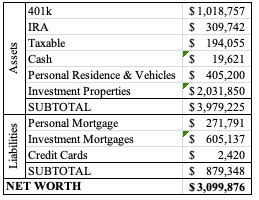
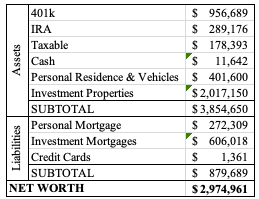
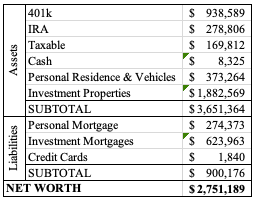
There are a few line items that were changed significantly because I wasn’t working with clear data the past few months. We may have hit $3 million net worth before this update, but I know that it’s official now! At 35 and 34, that’s a fun accomplishment. It doesn’t feel like we have money to throw around, and we certainly don’t live lavishly. You can see that $2 million of this is tied up in the appraisal value of homes we own, and most of the other parts of this is tied up in accounts that we can’t access until retirement. We still make decisions for the longevity of our net worth because, well let’s face it, we’re only in our mid-30s and there’s a lot of life to live.
We’ve been busy, which has kept our expenses down in our personal life. I’ve been working a few days at our local racetrack, which has been for my entertainment and a good way to bring in some money for our household. While our busy schedule has kept us from eating at restaurants and spending money on activities, the last quarter of the year brings big expenses on the rental front for insurance and taxes.
I still haven’t decided how to format these financial updates, but I did work on categorizing all the expenses for our year. I’d like to see how our spending changes through the year, and if I keep a running tally of the information, I’ll be able to consistently categorize expenses. At this point, I’ll just report for the whole year later in January, but it feels good to have that process started since there are a lot of transactions (already at 786 line items!).
RENTALS
We paid an extra $2000 towards the mortgage that we’re trying to pay off (we paid $1000 and our partner paid the other thousand). That mortgage balance is about $26k, which we’re responsible for half.
Kentucky taxes are due in October. Well, they’re actually due in November, but they give you a 2% discount if you pay before 11/1, so we of course do that. Two of our houses are still escrowed, so I don’t need to worry about that, but I had to pay one of the houses, which was about $1300. As an aside, I put it in the mail on 10/6 and it was taken out of our account on 10/8; I’ve never seen the mail and processing of taxes happen so quickly!
We had someone do the work on a house (fix bedroom doors and replace a missing section of fence) that was left over from my July walk throughs, and that was $490 (split with our partner). This house has been notoriously late on payments with very little communication, but they’ve turned a corner. They’re still late with payments, but they pay the late fee without prompting and give us advanced notice, which is all we ask for! They say they’ll be back on track with on time payments next month.
We’ve had issues with another rental, which I shared in my last post. They were approved for state assistance, so I’m expecting September, October, and November rent from the state here soon. Since there’s no timeframe for when that will come in, I’ve told her that she has to keep paying on the payment schedule we agreed to, and anything she pays will just go to December rent at this point.
PERSONAL EXPENSES
We had all the drywall for the basement delivered in September for $788. Several pieces arrived damaged from the strap that held them down. Mr. ODA called Home Depot since the delivery fee was $75 for this convenience, and they were super nice. She refunded us for the broken sheets and the delivery fee ($125!).
Only $130 spent in gas (that will probably go up next month since I’m driving to/from Lexington 3 times per week for work, plus a few more personal trips there). Only $92 spent in restaurants!
SUMMARY
While some of the expenses for rentals have trickled in, the next month is when most of them are going to hit. We’ll also have an annual medical bill come due in November.
Our net worth increased by $21k from last month. Our credit card balances are low, and then our cash balance is higher than usual because we used to just put any extra cash towards mortgages, but right now we’re trying to pay off that mortgage we have with a partner and rethink our approach (do we want to save for another down payment.. type question).
Cooler weather is here! We have a full calendar these days with pre-school and sports. I’ve been managing that by setting a lot of alarms giving me a half hour warning that we need to leave the house for something. We also celebrated our son’s 3rd birthday with both sides of our family, which was so much fun. He knew all about a birthday and the traditions, did a great job at being grateful for his gifts, and hasn’t stopped playing with all those new toys. This month, his birthday party and a long weekend trip to Virginia were our big expenses, while the sports and activities kept us home and not eating at restaurants in between those things! On top of all this craziness, Mr. ODA went on a work trip, then I picked up a few shifts at the race track to help them out. And so, here we are, two-and-a-half weeks since my last post.
NET WORTH
About once a month, we have a meeting with our financial advisor. During last month’s meeting, his software system said that we hit $3 million net worth! Unfortunately, my numbers last month didn’t say that, and they still don’t, but we’re right there. I didn’t think it worth it to line up my information against how the software is reporting the number because a lot of our net worth is based on the current market value of our real estate, which isn’t necessarily an exact amount. I know Mr. ODA had a goal for the first million in net worth, but I wouldn’t say that we had a goal to hit this particular number. With the financial advisor, we’re working on our mentality. We’re basically trying to figure out what’s our true goal (instead of just this number), and if we had (and did) everything we wanted, what would that cost difference be? I’m working on two other posts about our mentality, and I’ll have to include this side of the thought process as well.
DETAILS
One of our credit cards has a balance of over $2,200 in this net worth update. That includes almost $1,000 of a hotel that Mr. ODA had for a work trip, the hotel for Richmond at $450, and an AirBnB charge for an upcoming trip of $424. It also includes Mr. ODA’s food purchases while on travel, which amount to about $180, and an Uber trip of $10. The work expenses will be reimbursed, but that’s not yet accounted for in the math since the payment hasn’t hit our checking account yet.
With the child tax credits coming in, our investments have gone up each month. We’re putting some of that into the kids’ investment accounts. We’ve also had other unexpected income, which led to another $500 transfer into Mr. ODA’s investment account. Usually, we see an automatic contribution of $1100 between our Roth accounts and the kids’ accounts. This month, we had $1,900.
All of our housing expenses were about the same. This coming month has a trip planned, a day to hang drywall in the basement, and me working at the race track nearly every weekend.
Back in May, I was a guest on Maggie Germano’s Podcast, “The Money Circle.” I shared some of our background and how we started investing in real estate. We brushed on topics like establishing an LLC, tax advantages, and how you don’t need to start big to just get started. It was a brand new experience for me, but I’m passionate about our real estate experiences, and I loved being able to share. I hope you’ll check it out!
I just shared the details of the home inspection contingency in the real estate purchase agreements in my last post. I was laying the foundation to share what we’ve encountered to invoke the termination clause of the home inspection contingency.
COMMERCIAL PORTFOLIO
There was a time where we were trying to grow fast. We wanted to work smarter not harder, so we investigated commercial portfolios instead of buying one single family house at a time. We worked with our Realtor’s office’s commercial team to find an off-market deal of several houses. The owner of all these single family houses had lumped several houses in his portfolio by geographic area of Richmond, VA. He had provided us with 13 ‘sub-portfolios’ to review, but he was willing to sell individual houses.
We went through the entire portfolio to decide which houses we were interested in. We were able to eliminate several from the start because his rent to purchase price ratio were far from the 1% Rule we aim for (the monthly rent amount (e.g., $1000) is 1% of the purchase price (e.g, $100,000). We identified 10 houses we wanted to see and met up with the owner’s property manager to get into each house. Afterwards, we went through the list of houses, the comps we could find for purchase price, and discussed the condition of each house as we saw it. We ended up making an offer on 5 houses.
We received the ratified contracts on May 9th of that year, and we immediately contacted our home inspector to come through the houses with us. We met with the property manager, our home inspector, and our Realtor to inspect the 5 houses in one day. We negotiated with our home inspector that he didn’t need to write a report for each of the houses; I would take notes as we went through everything, and he wouldn’t charge us full price for the inspections.
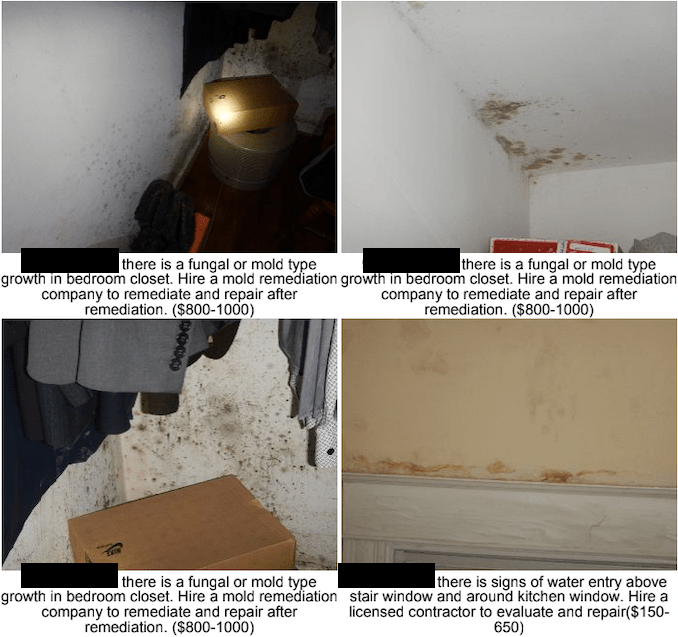
We knew the houses weren’t in great shape, but we weren’t prepared for all the details we found in the home inspections. During our time at the houses, the tenants were quick to complain about the maintenance on the properties, saying things would take a long time to get fixed or they wouldn’t ever be addressed. The inspection found strong evidence of mold, patch jobs in structural beams in the crawl space, appliances not in full working order, windows screwed shut, and several other minor things.
We attempted to negotiate by the seller providing $10,000 per house in seller-paid closing costs. We didn’t ask for anything to be fixed because we saw the work that had been done in these houses, and we wanted it done right. The seller denied our request for funds to address the home inspection issues, and we walked away from all of the contracts.
FIRE DAMAGE
This was a hard one for me to walk away from. The house itself was in a high-crime neighborhood of Richmond. However, only THREE! parcels away, houses were being torn down, rebuilt, and sold for significantly higher than purchased. I saw the potential of the area’s revitalization. But we were not in the business of flipping houses nor doing major repairs. Not only were we not interested in that because we wanted to be able to create the cash flow as fast as possible, we also want to be able to hold these properties as rentals instead of flipping them so we maintained a continuous income stream.
There were several concerns when we walked through the property. The kitchen was a mess, there were signs of water damage in multiple places, the floor felt soft upstairs, the upstairs deck didn’t seem stable, the house needed a lot of TLC with the overgrowth, and then best of all – clear fire damage to the structure of the home when we went in the basement.
This isn’t a picture from when we were looking at the house, but this is the condition 3 years later, which shows just how ‘great’ of a house it was. 🙂 This is the backyard.
We were under contract for $72,500 in May 2017. The house recently sold for $296,000. Although it seems we missed the opportunity that I felt was there, I found pictures of a failed flip attempt in 2019/2020 that uncovered even more damage behind the walls than we even knew (although we suspected), and none of the houses around it have sold for nearly $300k. Therefore, we don’t believe that was a reasonably-expected sale price had we taken this beast on. And what’s not known in those numbers is just how expensive the flip was to that owner, both in headaches and wallet!
A KENTUCKY MESS
Mr. ODA went to see a house in Winchester, KY without me (it was easy because he was working near there, and it wasn’t worth me packing up our baby to go walk through a house that we may not even want). He and our Realtor walked the house and decided it was worth putting an offer in. The house had two units set up inside it, which was a goal of ours (duplex = one building the maintain with two income streams). The cash flow on it was great, so he probably turned a blind eye to too many negative issues during that first visit.
The inspection was $500. I was there for the event, but didn’t walk the house with the inspector. He ran through everything with me after he was done, but the tenants were present, and I didn’t want to bring my baby into their smoke-infested house (first red flag because we don’t allow smoking in any of our properties).
The first thing the inspector said was that the roof needed replaced. He pointed out that several tree limbs were in contact with the roof, and the roof had considerable algae growth on it. Basically, everything on the outside of the house needed repaired or replaced: siding, decks, roof, gutters, removal of vines on the house, negative slope of ground towards the house. The doors and windows were old and broken, so none had the proper seal to prevent water infiltration, in addition to not being able to maintain temperature.
On the inside, there were several code violations with how the kitchens were built (e.g., venting for range), and several large cracks in the walls, some of which were patched poorly and never repainted. There were five or six electrical issues that needed to be addressed immediately because they were a fire hazard. There were signs of water damage in the ceilings, as well as in the bathrooms where the peel and stick tiles were ‘floating’ and warped.
As if that wasn’t enough, the straw that broke the camels back for me was the head room given for the upstairs unit entrance. The required head space by code is apparently 6’6”, and we only had 5’6”. This seemed to be a big problem because an average man is 5’9”, and the average height of women at 5’4” doesn’t exactly give much wiggle room.
I was worried about all the work that needed to be put into this house. The tenants weren’t taking good care of the house, so it wasn’t worth putting a lot of money into it, just for them to destroy it. They had been there for a while, so it wasn’t like they were going to leave voluntarily any time soon. The neighborhood wasn’t in great condition, so a fully renovated house wasn’t called for when it came to resale or the type of client looking for a rental there.
It was a difficult balance, but the house had way too much deferred maintenance, way too many things poorly fixed/maintained when there was an attempt, several unfinished projects, and too many code violations to move forward. Mr. ODA really wanted to buy a house in this area before the summer was up, and he was pushing for the cash flow side of it since it had two separate units bringing in income. But that cash flow is non-existent if you’re having to put it back into the house.
These are the three main stories that have stuck with me. We learned a lot about houses through the process, and we feel we made the right decision on each of them to walk away. Through these experiences, we solidified our decision-making to focus only on houses that have been properly maintained and require little work to get rented. Having a unit already rented with long-term tenants isn’t always the “diamond in the rough” that you think it is.
The inspection is buying you information. Once you find out that information, the money is a sunk cost, and you should use it to now choose if the house is still worth owning or not. While inspections aren’t exactly cheap and aren’t tax deductible if we don’t buy the property (if you have a legal strategy, drop it in the comments please!), that information gained is important. That $500 “lost” is better off because you’re not buying a money pit that will cost a lot more in the long run. Remember, this is a business, and it’s best to keep your emotions out of it. Don’t pinch pennies and end up costing yourself big dollars later on.
Most times you’ll do an inspection, find some things to fix or negotiate down on the purchase price, and even find yourself in a situation where the inspection “pays for itself.” Other times, it doesn’t work like that. Life lessons can cost money, and inspections can help point out duds so that those lessons don’t end up costing a lot more.
The common goal in the FI/RE (Financial Independence, Retire Early) community is to reach a point where your net worth is 25x your annual spending, meaning your expenses are 4% of your net worth. This is an extreme oversimplification of things because of the number of variables associated with where your net worth might be, and how to access it. For example, retirement accounts have requirements to be met before drawing funds; while you may have hit the 4% expense to net worth ratio, it may not mean that you have that money liquid to cover your spending.
When the ODAs started down the path of FI/RE, we did it with a real estate rental portfolio. This path of net worth growth really doesn’t fit the traditional mold. It provides regular cash flow, rather than an account with a balance that’s drawn down.
As mentioned in previous posts, there are numerous ways to make money in real estate. The path we have taken is probably one of the simplest and most repeatable for anyone. We own a portfolio of single family rental houses, most of which were bought straight from the MLS. These basic properties are in basic neighborhoods with regular tenants. Nothing special. We acquired these properties by focusing on the 1% rule in real estate – try to secure 1% of the property’s purchase price in monthly rent. Another oversimplification of how things really go, but if we were able to find a $100k property that rents for $1,000 a month, we know we’re going to make money long term.
For these properties, we typically put 20%-25% down and finance the rest through a conventional mortgage. We find a tenant, and then the 4 ways to make money in real estate go to work for us: appreciation, tenant mortgage pay-down, tax advantages, and most importantly for our situation and FI/RE – cash flow.
I want to talk about how we can reach a FI/RE number through real estate cash flow differently and more quickly than using traditional stock market investing.
The $100k house had a 20% down payment and mortgage rate at 5% interest, which brings the monthly principal and interest payment to $429. Add another $121 for taxes and insurance (using round numbers here!), $100 for maintenance and capital expenditures savings, and $100 for a property manager; this comes to $750 worth of monthly expenses. At $1,000 per month of income, you have $250 per month of cash flow in your pocket. $250 per month equates to $3,000 per year of cash flow. With the $20,000 down payment and about $5K in closing costs, it means that our $25k investment nets us $3k per year in cash flow.
Circling back to the 4% rule for stock market investments, $3k in cash flow requires a savings of $75k. But we only had to invest $25k! We’re banking on the monthly cash flow, rather than a “stagnant” savings.
We took that math and ran with it. Our rental portfolio has 12 houses in it. While we’ve shown in prior posts that each house’s numbers aren’t as clean and simple as this example (some better, some worse), if we take that $3k annually and multiply by the 12 properties, we have $36k in annual cashflow for only $300k invested.
What would you rather need to produce $36k income – $300k or $900k?
Can you scale a rental portfolio to reach enough annual cashflow such that you can live off the cash flow?
Rental property investing is not completely passive. We have tenants to manage, properties to maintain, property managers to manage, income and expenses to track for taxes, lending efficiencies to explore, and the list goes on. But if you’re willing to put in a little work to reach financial independence (the FI part), you can do it substantially faster by finding strong properties to provide significant cash flow than if you were to take the totally passive route of simple stock market (index fund) investing.
Note, there’s nothing wrong with that – we have a substantial position in the stock market due to the tax free growth benefits of retirement accounts. The power of real estate investing saw our net worth grow faster than we’d have ever dreamed since we bought our first rental in 2016. The proof is in the pudding and we advocate to anyone to just get started!
We’re continuing our spring/summer of travel and activity, which is why there are fewer posts and lots more spending.
The stock market has increased, which has been the main factor in our net worth change. We paid $2,000 towards the mortgage we’re paying down, leaving a balance of $3,300. This mortgage will be paid off once all our rent is collected for July; it was pushed back a little bit because of the flooring replacement that occurred in one of our rentals, which is why our credit card balance is much lower than last month. We’re also still waiting for half of one property’s rent, which is the norm these days.
Utilities: $250. This includes internet, cell phones, water, sewer, trash, electric, and investment property sewer charges that are billed to the owner and not the tenant.
Groceries: $518
Gas: $268
Restaurants: $165. Our credit card reimburses for many of these expenses; we received credits totaling $120.13 in the last month.
Entertainment/Medical: $1,093
Investment: $1,100
Insurance Costs (personal and rentals): $845
VIGILANCE ON CREDIT CARD REWARDS
Mr. ODA discovered that our PNC credit card rewards balance was decreasing, despite earning new rewards this cycle. He investigated further and noticed that we had been losing rewards for a few months now. PNC has a policy that they don’t issue their rewards until you hit $100 worth of rewards. Once we hit $100, PNC sends us a check in the mail. Since they send a check, we still receive paper statements, even though we regularly check our financial accounts online. Over the past few months, both of us checked the balance to see “ok, we’re nearing $100,” but didn’t put any more effort into knowing the details of the balance. Mr. ODA happened to notice that the statement didn’t make sense.
$89+3 somehow equals $82. There isn’t a single section on our statement or via our online account that identifies the loss of rewards Mr. ODA called PNC to ask for more details and learned that our rewards expire after 2 years, despite their policy of not issuing a check until you hit $100. They basically said, it doesn’t matter that your account is over 10 years old, or that credit has been used less in the last year due to the pandemic, or that they don’t clearly identify the expiration of rewards and just identify a lower balance. As a comparison, and I keep going back to Chase, but Chase changed up their reward categories to allow the consumer to earn more rewards during the pandemic (e.g., in addition to giving rewards in the travel category, since consumers weren’t traveling, they added grocery and home improvement stores as major reward categories).
The PNC customer service representative reinstated 60 days worth of lost rewards and issued a statement credit. We don’t want a statement credit because we no longer want to use this credit card, earning rewards that we’ll never be able to capture. If we use this credit card to use up the statement credit, that’s rewards that could be earned on a different credit card. Now Mr. ODA is fighting for the credit to be applied to our checking account or to have a check sent to us (which is the preference on our profile) and fighting for the reinstatement of the rest of the rewards lost.
Without PNC, we’re down to 4 credit cards in our regular rotation. We have 3 cards that we use for categories (gas, grocery, restaurants, travel, home improvement stores), and then we have the Citi Double Cash card that is for “everyday purchases.”
This is a good one. This is the one we use when people say “how can you handle all those properties,” and I respond, “if we survived this one tenant, we know we can handle whatever gets thrown at us.” Hoarding, mice, court dates, eviction. But its not always like that. The sun shone down on us for the current tenant though, who signed a two year lease and take care of the house (like, even power washed it on their own accord). The stories below show that you need a thick skin and a smooth temperament to be a landlord. Treat this as a business.
LOAN
This house was purchased ‘as-is,’ but we still had a home inspection contingency in the contract. It was listed at $139,500; we purchased for $137,500 with $2,500 in seller subsidy. We went under contract on 8/14/2017 and closed on 9/22/2017. The appraisal came in at $141,000, so we were content with our decision.
We refinanced the loan in May 2020. Our original loan had a balance of $105,800 at the time of the refinance. We rolled closing costs into the new loan and cashed out $2,000, making our new loan amount be $111,000. The refinance reduced our interest rate from 4..875% to 3.625%, shaving $104.25 off our monthly payment. I went into detail about the refinance in my Refinancing Investment Properties post.
Following the 1% Rule, we would be looking for $1,340 in rent (net of seller subsidy), but we haven’t received that yet. The first tenant’s rent was $1,150 and the second at $1,250. For the third potential tenants, we listed at $1,300, but the new tenants negotiated to $1,280 for a 2-year lease.
TENANT #1: OUR WORST
The application. It’s hard to not give someone a chance when their application is borderline, but I suggest letting the information on the screen speak to their character. Before the official application was run (which includes a background check), she admitted to a felony that she served 2.5 years for, and she filed bankruptcy due to a stolen identity while she was incarcerated. It seemed like she paid her dues and was building a new life. We got her application about two weeks after closing, so it wasn’t like we were desperate to rent it at that point. But she was quick to fill out an application and provide necessary documentation, so we decided to give her a chance. She moved in on 10/1/2017 with her 3 children, one of which was born days after she moved in. Her rent was $1,150.
We didn’t have any unreasonable situations with her in the first year. We did have a maintenance call for a leak under the kitchen sink, and we noted that the house wasn’t tidy. It seemed like she was a coupon-er, where she stocked up on a few items and probably resold them, which supported how she kept wanting to pay us in cash. The house wasn’t to my standard, but I didn’t look close enough to notice that it was dirty in addition to cluttered. I wanted to say something, but didn’t know my place at that point. Hindsight: I should have told my property manager and had her issue a written notice. This won’t matter down the road for legal proceedings, but perhaps we could have saved ourselves some headaches if she took the notice to heart; I was just afraid of offending her. But, other than that small concern at the time, we had no issue renewing her lease for another year.
The tenant complained about seeing a mouse around February 2018. We informed her at that time that pest control was up to her because of her living style that was attracting the pests. She claimed to have a quarterly treatment through Terminex. She complained further of mice in November 2018, but I wasn’t part of that conversation. It appeared to be that she was upset that there were still pest issues while she was paying Terminex. Well, that’s an issue to take up with the pest control company, not us. Our property manager gave her the information to our pest control company and shared that it would be a bit cheaper for the quarterly plan too. We heard nothing more until all hell broke loose in April 2019.
She sent pictures of mice poop all over the house on April 9, claiming that she had been out of the house from March 31 through April 8 and came back to this sudden mouse infestation and would be leaving the house. Well, that’s not how it works. She claims that was her ‘prompt’ notification, as if mice set up camp in a lived-in house that’s well maintained out of nowhere (news flash: it wasn’t well maintained and clean). She claimed that because of the living conditions (that she perpetuated), this would be her last month in the house. We knew we had the lease to fall back on, so we continued to remind her that this wasn’t on us and she couldn’t leave us with the financial burden and walk away. We had our pest control company go to the house as soon as possible, and we received their report on April 12.
But wait! While complaining about the condition of the house (that she caused), she wanted to know if she could buy the house!!!! Logic always seems to abound in these situations; it’s hysterical. We offered her to purchase the house from us at $148,000. She ignored it after that offer.
Both the pest company and our HVAC person noted a dog on the premises, which was in violation of the lease. HVAC was called out to fix a wire on the outdoor HVAC unit that the dog had chewed through. She also wasn’t taking care of the yard, and the City of Richmond was fining houses that violated their weed and grass clauses, which we notified her of on May 9.
She didn’t pay April or May rent, so we had a court date set for May 10. We had told her that she had to pay all overdue rent and late fees for us to cancel the May 10 court date. She didn’t pay, so our property manager went to court. The judge awarded us possession of the property, but since there was such outstanding rent and damages, another court date was set for July 1 to award us the money owed. In front of the judge, the tenant handed the keys over to our property manager, saying she was moved out. Immediately after leaving the court house, the property manager arrived at the house to do a walk through, only to find several people inside. She called the police.
The officer assessed the situation. He said that since they’re still moving things out (and there was a lot to move out), that it was a benefit to us that they were still working on it. He suggested asking their input on when they thought they would be done. One guy said at 3 pm. We agreed to let them stay, and I would go by after work to change the locks.
I showed up at 4 pm to change the locks, only to find people still coming in and out of the house. I called the non-emergency police line and waited for the cops to show up. It’s officially trespassing, and we were prepared to press charges. The officers knocked on the door and asked the people inside (none of whom were the tenant on the lease) to leave. One woman started a whole spiel about how she’s on probation and everything that she’s been arrested for, so she didn’t want to be arrested. The officer was funny to watch, and he just kept saying, “I’m not arresting you. I just want you to leave.”
After they drove away, the officers let me walk the property to ensure everyone was out. The place was destroyed!
By Virginia law, we are required as landlords to make every attempt possible to get the unit re-rented and let the old tenant “off the hook” for unpaid rent. Meaning, we can’t hold them to the entire term of the lease and have a vacant house. Regardless of this, we wanted to get everything fixed and replaced in the house so that we had an exact amount to claim during the July 1 court date.
The linoleum replacement was the critical path. She had destroyed it (looked like some chemical ate through it) beyond repair and it had to be replaced before we could re-rent the house. Home Depot’s timeline was really behind, and they weren’t able to get us scheduled for installation until June 20th (after she had “vacated” May 10th).
I compiled a list of lease violations with my documentation to support the claims in which she violated the lease on top of the obvious (e.g., dog on premises, smoking in the house). We had invoices from the pest company, the HVAC company, the trash removal company (over 40 cubic yards of garbage was left in the house when they finally vacated), and the “hazmat” cleaning company, all corroborating an unclean and unkempt living condition.
We went into court with a claim of $9,250. This was unpaid rent for 3 months, late fees, junk removal, pest control, HVAC fixes, professional cleaning that included a ‘hazmat’ charge, and all our paint and flooring charges.
We won the first judgement in court, simply because the defendant didn’t show up. We were awarded $9,250 plus the court fee and 6% interest. Well, somehow the court accepted her plea of needing another court date after not showing up to this one, and that was on July 10th. The judge that day reduced our rent and late payment owed by one month, and reduced our reimbursement total by a bit more than the security deposit we had already kept, bringing the judgement to about $6,600 plus the court fee and 6% interest.
Per the court process, we were required to work with the ex-tenant to develop a payment plan. We offered her a payment plan via email that was never responded to. From there, the next step is to retain an attorney for wage garnishment.
I contacted the attorney we use to help with wage garnishment, but he wasn’t experienced. He referred me to someone, who let me know that he’s already representing someone who has a claim against her. He said that he could still represent me, but I’d be second in line to any money they get from her. He offered me another attorney’s name to see if that one could help me instead, but that attorney said he couldn’t represent me because he already has another client looking for money from this woman. Interesting that two attorneys had different answers, but we went with that first. We haven’t seen a dime. Once the money was spent and we paid off the credit cards, it wasn’t on our radar anymore. Anything we get from this woman will be a bonus at this point.
TENANT #2: BLISSFULLY UNAWARE OF HOW LIFE WORKS
Two kids just out of college were our tenants that came in after that mess. They were great tenants, but a bit unaware of how the world works. They didn’t get the utilities into their name timely, so we charged them for the bills that came to us. After that, they paid their rent on time, and even when their restaurant jobs shut down at the beginning of the pandemic, they prioritized paying rent over other things they could have spent their limited income on; I was impressed. At the end of their lease, they were a bit lost too. Our lease requires 60 days notice of your intentions – either leave, or renew. Our property manager reached out to them at the 60 day mark, and they said they weren’t sure what they wanted to do, but were looking for other places. Since, realistically, we weren’t going to list the house for rent at 45 or 60 days, we told them that was fine. They came back after a week and said they were going to move out.
We moved forward with listing the house for rent and vetting new tenants. We had our property manager show the house on June 10 for what would be a July 1 lease. About a week later, the current tenants asked if they could stay longer because they didn’t get the place they were looking for. Sorry, but that’s not how it works and it’s already rented. The new tenants were OK with moving in July 15, so we allowed the college guys to stay until July 10. Then we hustled to get the house put back together before the new tenants. Specifically, one of the tenants was an artist, and he hung a huge canvas on one of the bedroom walls to paint on. Well, the paint bled through.
They also didn’t tell us that the range wasn’t working. When we asked about it, they said something to the effect of, “oh yea, we smelled gas, so we just cut it off. That was back in March.” Goodness!! So we quickly ordered a new range. We also had to have the carpets professionally cleaned, which was especially frustrating since they were only a year old. Luckily, the ladies who came to clean the carpets worked their magic, and they came out looking good as new. The microwave handle was broken off, and when we looked to buy a replacement, it was essentially the same cost as a new microwave, so we installed a new one.
While we were working in the house, we noticed that the air conditioner wasn’t keeping the house cool. We had an HVAC tech come out to the house, and it was either $1,400 to repair (after we had already previously put money into the HVAC unit), or $5,000 to replace it. We decided to replace it after it died shortly after the third tenants moved in.
TENANT #3: SOME OF THE BEST
These tenants have been wonderful. They’re both pharmacists at the local college and have been very self-sufficient. They’re great about alerting us of issues, but not in a way that it seems like they’re nitpicking. For instance, they wanted to store their lawn mower and other things in the shed out back, but the handle was broken off it. We told them that if they wanted to purchase a replacement, we would reimburse for the cost. Then they noted that the closet dowel was broken and they replaced it. I told them I would pay for that, so just take it off the next month’s rent. When they sent me the receipt, they had only taken the rod itself off the rent, but not the brackets to hang the rod. I immediately sent them the rest of the cost!
They’re one year into a two-year lease, and we’re very happy with them. They always pay their rent on time, they communicate regularly, and they’re taking care of the house.
MAINTENANCE AND REPAIRS
Since I’ve covered a great deal of the repairs we’ve managed in this house through each of the tenant stories, here’s a quick summary of other items.
Shortly after the third tenants moved in, they politely let us know that their dishwasher wasn’t cleaning the dishes. They very clearly identified the problem and the steps they had already taken to attempt to fix it, but it wasn’t working. We purchased a new dishwasher the day after they let us know. So in the matter of a month, we replaced the built in microwave, range, dishwasher, and HVAC. The only appliance we haven’t replaced in this house now is the refrigerator.
There was an electrical issue that we had sort of noticed before, but hadn’t pinpointed it without having things to plug into all the outlets. We had an electrician go out and fix the switches and outlets that weren’t working in master bedroom.
AN OVERALL LOOK AT THIS HOUSE AS AN INVESTMENT
Remember how real estate investing provides multiple avenues for wealth building? Here’s how they’re looking for this property.
Cash Flow – As we have had to replace nearly all appliances, including HVAC, and all the flooring among several other smaller issues, our total cash flow on this property is nearly nothing. But, like mentioned before, we shouldn’t have any big purchases coming and will start to be able to pocket the profits on this house once again.
Mortgage pay-down – The tenants have paid our mortgage for us, but due to closing costs of refinancing and choosing to take $2,000 cash back from that refi, our principal is actually higher than when we bought it.
Tax Advantages – We always depreciate the cost of the structure for paper losses that help offset profit on properties for tax purposes. All those repairs and appliance replacement expenses that eat into the profit margins are written off. So come April 15, the silver linings of those expenses are realized.
Appreciation – This one is good for us. This house is in a developing neighborhood and the area around it is being revitalized. Coupled with standard appreciation and the *hot* real estate market we’re in now, the value of the house is 150% of what it was when we bought, in less than 4 years.
SUMMARY
We’ve put about $10,000 into this house at this point. But that means we have a lot of brand new things in it. Now isn’t the time to give up on the house, since we should be in a position to not deal with many maintenance requests. Rent continues to climb, increasing our cash flow, while we just brought our mortgage payment quite low with the refi, and the property will continue to appreciate in value.
We learned a lot about the eviction process, even dealing with local police officers in the process. The court system and law enforcement are fairly simple to work with, as long as you are a fair and respectful landlord, keep documentation, and follow landlord-tenant laws. When the tenant doesn’t live up to their end of the bargain, justice will be served.















 One Dollar Allowance