Home Sale Proceeds

*This post was started in November 2022, but our son was born 3 weeks early (and on Thanksgiving), so it fell off my radar for a long time while I caught back up. Let’s dive in now.

We sold our primary home at the beginning of November to move a half hour away and closer to family. It was a new construction home, and we purposely sold when we did to avoid capital gains taxes. If you call it your primary residence for 2 of the last 5 years, you’re exempt from capital gains. Considering the market over the last two years (2020-2022), we were slated to owe a hefty penny if we sold before that 2 year mark.

Had we sold earlier or perhaps waited for the spring, we could have made more. Instead, we opted to be rid of the home, not try to rent, and be able to have that behind us. We were extremely fortunate that we were under contract by the end of the first weekend we listed. The market had cooled significantly from the multi-bid, exorbitant pricing, with appraisal waiving language days.

We only had 2 showings. The first politely let us know they wanted a walk-out basement. We had an amazing basement with 9′ ceilings and no soffits, but it didn’t have a door due to the floodplain. We don’t really understand why, but the backyard was definitely low enough for it to have been a walk out basement. It was one of the red flags that made me uncomfortable living there, along with a long delay for construction on our lot and a few around us due to extensive sink hole surveying. The second showing made us an offer 10k below asking. We sort of split the difference at $495k, and they accepted.

There were several houses listed in that neighborhood for weeks after we closed, that were listed the same weekend as us, so I am eternally grateful that the stars aligned for what we wanted/needed.

PROCEEDS CALCULATION

We purchased the home for $346,793 in November 2020. The contracted purchase price when we sold was $495,000, which was completed in November 2022. That’s a difference of $148,207, but that’s not “take away” money.

As the seller, you’re typically responsible for paying out the Realtor commissions. They’re typically 6%. We asked our Realtor if she would drop it to 5% (buyers agent gets 3%, sellers agent gets 2%) since we had drawn up our purchase contract sight unseen and this was the 4th commission based transaction she had from us in less than 2 years. She agreed. I truly don’t like asking someone to take a lower commission, but due to there being several transactions in a short period of time, many not even needing much effort (showings, phone calls, etc.), I accepted Mr. ODA’s plea to ask. That comes to $24,750 paid in Realtor commissions.

We then have to pay off any loans that used that property as collateral. We had a mortgage and a Home Equity Line of Credit (HELOC). We had put 20% down on the purchase, so the mortgage had about $266k left as the balance. The HELOC had been used for a couple of other things than just the down payment on a new home, and it didn’t require principal payments on it while we had it, so that balance was about $86k.

We walked away from the closing table with about $117,000 after tax offsets and such.

PAST DETERMINATIONS FOR WHAT TO DO WITH THE PROCEEDS

In July 2012, we purchased our first home for $380,000. We put 20% down; it was a foreclosure, but the only work we had to do was on the main floor bathroom. When we sold that home Fairfax, VA for $442,500 in October 2015, we paid off a car loan and bought our second two rental properties in Richmond, VA. The car loan was only at 0.9% interest, so it didn’t meet Mr. ODA’s requirements to pay down loans with higher interest rates, but it did alleviate one monthly payment I had to manage. The irony of that statement, now that I manage 14 houses worth of payments all year. We also used those proceeds to put 20% down on the purchase of a new primary home outside of Richmond, which had a purchase price of $359,743. We paid off House1’s mortgage because the loan had a balloon payment that we needed to be ahead of.

When we sold that Richmond home for $399,000 in September 2020, we took about $109k away. We used those proceeds to put 20% down on the purchase of our new home, at $346,793, outside of Lexington, KY. We paid off House4, House6, and House13. Since paying towards a mortgage and not paying it off doesn’t change your monthly cash flow, we focused on where we could eliminate a mortgage payment. We’ve since paid off House11 and House12. House12 had a high interest rate, so we were interested in eliminating that as fast as possible, even though we were paying for it with a partner.

WHERE DID THE MONEY GO THIS TIME

We purchased our current primary home last summer and put work into it. Since we purchased it before selling our house, we used a HELOC to pay for the down payment. That meant that when we walked away from the closing table, the money we were putting in our bank account had no distinct purpose (like in the previous cases where we had to use some of the sale proceeds to buy another primary house).

The first thing we did was open a high yield savings account. At the time, it was necessary because our savings account wasn’t paying market rate. I remember Mr. ODA complaining that interest rates on loans were increasing, but it wasn’t being shown on savings interest side. He found a high yield savings account that gave a sign on bonus (we like that ‘free’ money!). We put $50,000 into that account, earning over 4% interest. The money in that account was removed and put into our regular savings account, which is now earning over 4%.

Since the money didn’t have a purpose, we needed to get it into the market. If we put it all in the market at once, then we’re subject to a lot more fluctuation. To hedge our volatility, we planned to schedule regular investments. It seemed crazy to me, but our financial advisor and Mr. ODA decided on $5,000 per week. That would take 20 weeks to accomplish. To my chagrin, this was set up as an auto transfer. Even with a large balance sitting in the account, it didn’t hurt any less watching $5,000 every week be taken out. This plan didn’t last long though because Mr. ODA found Treasury accounts that act as short term certificates of deposit. My next post will go into this in more detail.

Not an immediate need, and we didn’t rush to buy something for the sake of buying it, but we earmarked about $20k for the purchase of a new van. I love the van we bought in 2019 (which was a used 2017), but it had a few kinks in it. I also felt pretty good about the deal I got on it. However, I didn’t put the time into test driving and looking at this van that I really should have because one of us had to stay in the show room with the kids while the other went for a drive. I also know what I’m looking for in a used car now (that was our first used car experience), versus buying a brand new car that hadn’t been driven by others. It helped that I was looking to buy the same exact van, just newer, so I know how it’s supposed to work and what to test. We ended up finding a van about 2 hours away from us in early 2023. We’re almost a year into this van, and I absolutely love it.

In the back of our minds, we’re still looking for another rental property. There’s an area in town near us that would work for short term rentals, which I’d like to dabble in. We have seriously considered a few, but interest rates have shot it down. A 1500 square foot house, with a $200,000 mortgage, comes to a monthly payment (of just principal and interest) of about $1,400. That’s just not good margins with such high interest on it. We’ll keep an open mind, but so far it isn’t panning out.

SUMMARY

Our savings account is currently earning 4.22%. Mr. ODA is also managing that balance by using the short-term Treasury bills. Since we started with the Treasury bills, we’ve made about $500, which is on top of the interest we’ve earned to date on the savings account, which is over $1600.

We started off with paying the mortgage that had a balloon payment. It was a commercial type loan, so it was amortized over 30 years, but was really only a 5 year loan. We decided to pay it off instead of re-mortgaging it at the end of the 5 years. After we took care of the balloon payment approaching, we started paying off mortgages where we could eliminate a payment (we had multiple houses with $30-60k worth of a balance), and then moved onto paying off high interest rate mortgages (for reference, a high interest rate was 5% … which is much different than today’s mortgage rates being “good” at 7.5%). We went through the process to refinance several mortgages, so we’re at a point where we’re happy with the mortgages that are left. If we wanted 100% cash flow, we’d start paying towards principal balances. However, we don’t feel that’s necessary for our current situation. We have 6 mortgages left (including our personal residence) out of 14 houses.

We definitely are more hands on with our money management than most people are going to be interested in. Now that we’re happy with our mortgage situation, we are focused on the interest side of our money working for us. With multiple Treasury bills that are reinvested for short periods of time (4 week and 8 week bills), then we’re able to earn quick interest while we don’t have a purpose for that money.

One of our houses has a balloon payment again (commercial loan). That will come due in about 3.5 years. Considering what current interest rates are, it doesn’t appear that refinancing is as enticing as just paying off the balance or selling the house. We’ll have to keep that in mind as we work on investments and having enough liquid cash over the coming years, because that loan’s balance is going to be about $173k at the end of the 5 year term.

For now, we’re in a good money management state with several short term bills and a savings account rate over 4%.
July Financial Update

Welp, I haven’t posted in a month. We have been so busy and exhausted.

We bought a house on June 15. That process was not smooth in the week before closing, even through the day of. Our attorney had to come to our house the next day to have us sign other papers. Our lender was great, great, great, until they weren’t at the 11th hour. As always, everything went through, and we have ownership of the house. And that week will be a distant memory soon. But why does the mortgage industry get away with operating this way? I feel like there hasn’t been a single transaction we’ve done where there wasn’t a “where’s my paperwork????” or “why’s this wrong the day before closing???” moment (or my favorite, when we begged for the HUD-1 to review it before closing, and a traveling notary showed up at our house, only for the HUD-1 to be different than the closing disclosure and the numbers to be wrong on both documents).

We used our HELOC on our current house to pay the downpayment and closing costs on the new house, so that was a quick debt addition. We started with a balance of about 86k and have paid it down to 75k. We didn’t necessarily need to take the whole amount from the HELOC, but it was easier to get one cashiers check from the HELOC and immediately pay towards it than to transfer some from the HELOC and do a wire from our checking account.

This new house will be our personal residence, but it requires work. We’ve gutted the master bathroom, and I’ve been painting nearly all my free waking moments. I have the first floor mostly done (including making a ceiling go from navy to white.. ugh) and the kids’ bathroom done.

We opened two new credit cards in the last month, but I’ll get into that in the next post. Just note that our credit card balances are higher than our usual, and will remain that way.

We had opened a checking account for rewards a while back, and the account required $500 of direct deposits each month. It was one more account to manage, and it was no longer serving a purpose, so we finally closed that. Now we just manage two checking accounts.

RENTAL HOUSES

We have a vacant rental house as of June 30th, which I’ll also get into in a future post. The good news is that one of our houses that’s a repeat offender of not paying rent is now out of the picture. We still have one house that never pays on time, but I’ve at least got them paying half the rent by the 5th so that we aren’t constantly floating their mortgage and bills until the last Friday of every month.

We had two rental increases go into effect this month. One was for $20 (good tenants, long term, told us in advance they wanted to renew, but we also needed to cover our cost increases) and another was for $50.

Our property manager in KY hasn’t been easy. We’ve had to do a lot of managing the manager. All of our paperwork says not to charge the 10% fee on contractors. The document that they put in our file says it, and that’s the same document they put the charge on. I keep having to ask for all the documentation. Once I ask, they note the 10%, but it’s not until I ask.

We paid a plumber to fix a shower handle in one of our houses. On June 1st, she texted that it was loose. She didn’t really explain the situation, and I asked her to tighten the screw and let me know. She texted me on July 8th that it didn’t work. Where have you been for a month?! Then she said “let me know when the plumber is coming so I can wake my husband.” Um, you waited 5 weeks to tell me that it’s still broken, I’m not rushing a plumber out there today.

One of our insurance companies dropped us once they found out we don’t live within a certain radius of the houses. We have a property manager, so this rule doesn’t make sense to me. They let us finish out our policies, but they wouldn’t renew. Our agent quoted one company that doubled the cost we had been paying because the roof “may have been last replaced in 2000” (and we couldn’t prove otherwise). I said nope, and I asked another agent to give a quote. Their increased our cost by about $100, but it was better than $300. I executed that at the beginning of this month.

We had an HVAC go out, but luckily it was able to be fixed (for 225) than replaced.

NET WORTH

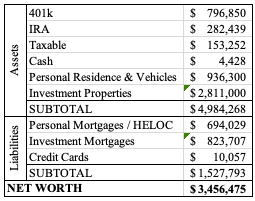
Well, even though our investments are declining and we took on a lot more debt, our net worth increased by 75k from last month. Truly, I’ve focused on the work we’ve had to do over the last month, and not necessarily on the spending or the market. At some point I’ll need to get through all our expenses and identify how our spending has changed, but perhaps that’s a job for another season while we continue to work on a new house and work towards moving our family in the coming months.

HELOC

HOME EQUITY LINE OF CREDIT or HELOC

A HELOC is a line of credit secured by the equity in your home. This is different from a loan or mortgage.

What is equity? It’s the appraised value of your home that is not mortgaged. You may have put 20% down when you bought the house, and now you’re looking to tap into that equity along with the principal of the mortgage you’ve paid down. Or perhaps your home value has increased drastically, and you want to utilize the equity.

What is a line of credit? It is a revolving account of credit. This means that when you close on a HELOC, you don’t get a check cut for that amount right then. You need to “draw” on the account, as needed, which is essentially writing checks from that account to either yourself or another entity. As you make principal payments, the amount of principal becomes available again for a future draw, as long as you’re within the draw period of the line of credit.

Do you have to disclose the purpose of the HELOC? There are no parameters on what you can use the money for when you draw it from the HELOC. You may want to pay off a credit card that has a higher interest rate, do home improvements, do other construction projects, medical bills, etc. While you’d want to utilize this for larger purchases, you can draw smaller amounts as long as you draw the minimum required by your terms (e.g., no less than $100). You earn interest from day 1, so this isn’t more beneficial than a credit card that gives you a short-term “loan” for your statement period (you don’t pay interest on a credit card balance that is paid off by the due date).

TYPICAL TERMS

The application process is similar to applying for a mortgage. A bank wants to see your credit report, along with some backup documentation (e.g., tax returns, account statements). We also had to update our homeowners insurance to show the HELOC as a mortgagee.

A HELOC will typically only cover a portion of the equity in your home, depending on the bank’s terms. If your appraisal value is $400,000, and your mortgage balance is $250,000, then the equity in your home is $150,000. While there may be instances where a bank would approve a HELOC for the full amount of $150,000, most are going to approve 80% or 85% of that amount.

There are no closing costs associated with the HELOC. Typically, the bank processing the HELOC will cover the costs associated with the line of credit initiation up front. However, they will require those fees to be paid back to them if the HELOC is closed within a certain period of time (usually 36 months). For our first HELOC, when we closed it within the 36 months, we paid back a prorated amount of the fees (e.g., if the fees were $300, and we closed it after a year, we owed $200). For our current HELOC, if we close it within the 36 months, we’re required to pay back 100% of the fees they covered, not the prorated amount.

A HELOC has a variable interest rate, which may adjust monthly or quarterly based on the lender’s terms. A variable interest rate can adjust up or down. But this is something to be aware of because it’s not like a loan or mortgage that has a fixed rate made known up front. The rate, in our case, is set at the index rate with a margin. However, there’s a floor to the bank’s rate. What does this look like? The index rate is 3.50%. The margin is -1.00%. However, the bank’s floor is 3.00%. Therefore, even though 3.5-1=2.5, the minimum interest rate they’ll lend at is 3.00%. Therefore, our current rate is 3.00%.

There is a “draw period,” which means you can only take funds from the line of credit for a certain period of time (e.g., 10 years). When you do draw from the line of credit, you’re charged interest on the principal balance. During the draw period, you must make the minimum required monthly payments on the account, which is typically the monthly accumulated interest owed, but some banks may require principal payments during this period also. When the draw period is over, it enacts the principal repayment period, meaning you have a certain amount of time (e.g., 10 more years) to repay the principal balance of the HELOC. There is no charge for the HELOC existing though; it can be there and never drawn on.

OUR PROCESS

The most recent HELOC we closed on had a different process than the first. We expressed our interest, and since they already had our documentation on hand from a commercial loan, they didn’t ask for supporting documentation (e.g., account statements). However, for some strange reason, she said she couldn’t use the credit report from our commercial loan, and she had to pull our credit again. At the time we were applying for another mortgage, so the hit on our credit counted as “mortgage shopping,” so we gave up the fight and let it happen.

This company would have given us 100% of the equity available in our home. However, two weeks after initiating the HELOC process, we told them we needed a pre qualification letter for an offer we made on another personal residence. They then told us that since we’re on record as wanting to sell our home, they would only approve 80% of the equity.

The loan officer asked for two references for each of us. There was no information given on what this personal reference had to know about us. We both handed over our people, but they were never contacted, so we won’t know the purpose.

Finally, they asked for our homeowners insurance to show them as a mortgagee on our policy, which I was able to do with one quick phone call to that office.

Typically, the process will include an appraisal. This bank had a valuation system that they used. Based on this woman’s inputs into the system (which were all wrong), she said that she could approve us for $100,000 without paying for a full appraisal. We don’t need more than that, so that was sufficient to us.

We closed the HELOC a month after expressing interest. Our process may have been slower than the typical period it would take because we were fighting the credit pull for a while (not to mention the company we were working with is notoriously slow at responding to inquiries). Mr. ODA expressed our interest in pursuing the HELOC on April 12th. We were cleared to close as of May 11th, but we chose to close on that following Friday. We went to a local bank branch, and a relationship banker went through the documents with us as we signed them.

WHY THE HELOC FOR US?

My general plan was that we’d have a HELOC initiated, so that when we found a new personal residence, we could use the HELOC for the down payment of that house without having to sell our current house first. In the past, we’ve sold our home, went into temporary housing, and then moved into a new home. Granted, all our past home purchases were in a completely different locale than where we were living, but I really didn’t want to manage storage of goods or go into temporary housing with two kids and a dog again.

We initiated the conversation on the HELOC without having any intent to move yet. Not to go into too much detail on this topic, but we need to be residents of this house for two years to avoid paying capital gains. Our 2-year mark isn’t until November, so we weren’t in a rush to move before then. A home with the same floor plan around the block from us sold for $190k more than what we bought this house for less than two years ago, so we expect there to be a hefty chunk going to capital gains if we don’t meet the two year requirement.

I was keeping an eye on the market, but clearly had no plans to move. To me, a regular check on Zillow lets me know what I can get for my money. However, there are some things related to our current personal residence that are concerning, and we had decided that this wouldn’t be a long term location for us. With the market right now, I knew we’d either be paying a higher mortgage than I ever anticipated in life, or I’d be compromising on my wish list. Well, a house that met a lot of our wish list popped up in the area we liked for less than $500k, so we jumped on it. The house needs work, so even though we’ll close on it over the summer, we aren’t in a rush to move into a construction zone.

Once we close on the new house with funds from the HELOC, we’ll start accruing and paying interest on the balance. We’re not required to make principal payments until after the draw period, which is 10 years. When we eventually sell our current home, the proceeds from the sale will pay off the HELOC seamlessly through the closing process.

May Financial Update

This has been a whirlwind of a month. Our crashing investment accounts have been offset by home values, so we’re still over $3 million net worth. But those investments are very low; it’s the first time I’ve seen a negative in my 12-month performance history for my ‘401k.’

HELOC

A couple of months ago, we were standing outside playing with the kids when a neighbor walked by and introduced themselves. Being that we easily have $150k worth of equity in our house, we started talking about how we should open a Home Equity Line of Credit to be able to float a future purchase. The process was initiated, but not really started, when we made an offer on another house to be our personal residence. More to come on that. But we close on the HELOC today at $100k, which was the maximum she could do as an “administrative authorization” (for lack of a better term, and to pull on my government background), which essentially just meant no appraisal cost.

NEW HOME PURCHASE

We’re about 3 weeks in being under contract on a new house. We’ve submitted all our files to an online bank that we’re using as our loan, and we’ve locked our rate at 4.0% on a 5 ARM. Closing is expected to be 6/15. We’ll need about $75k or 80k out of the HELOC for closing on that.

We found out that our appraisal that was ordered for this house got cancelled. A quick inquiry to our lender and we found out that they decided our credit profile doesn’t need one! They’re going to refund us what we already paid, which was a pleasant surprise.

PART TIME WORK

I worked the weekends in April at the local racetrack. It’s good money and only required 8 days of me actually working. This meet’s experience was slightly different, and I didn’t enjoy it as much as the Fall meet, but I made more than I did in during that meet.

RENTAL UPDATES

We had a tenant abandon a property on April 1st, so that was a lost month of rent that we weren’t expecting. Our finances aren’t in a position that we need that money. It also helps that we don’t have a mortgage on the property. But we still put over $2,000 into the house (including two appliances) and a week’s worth of our time in turning it over since it was left in poor condition. We’ve been fighting Home Depot on getting a dishwasher delivered and installed, and that still isn’t resolved.

We had our usual suspects not pay rent on time. One did manage to pay in full (not the late fee though) by the 7th. The other I finally told that paying on the last Friday of every month is no longer acceptable, and it needs to change. She sent a nice email back, but we still haven’t seen a dime from them this month.

We had one rent increase go into effect; it went from $1025 to $1100. That also increases our property management cost by $7.50 going forward.

We had an insurance company drop us by not renewing us since they found out we moved out of state. We told them we have a property manager, so there is someone available taking care of the houses, but they didn’t care. Luckily, not all insurance companies have such a requirement, and our agent was able to find someone with nearly the same price that accepted a property manager.

We have officially paid off one of the loans that we had with our partner. We had intended to pay the loan off this month, on our terms. Instead, because the balance was about $400, the loan company took it upon themselves to use our escrow and close the account. We were purposely waiting until after escrow paid the taxes due this month, and now we need to scramble and figure out the tax payment.

NET WORTH

SUMMARY

We now commence a very busy time of life. We have several trips planned, we expect to turnover a rental that we’re kindly asking a tenant to vacate, and we have a lot of work we want to do on our new personal residence. Hopefully the turnover of the one house goes smoothly, we get the house that was abandoned in April re-rented, and that there are no more surprises in our rental world. We also had our AC go out in our 18 month old house, so here’s to hoping there are no more surprises in the personal expense world too.