Rental Options

There are options that give the tenant flexibility, while protecting your financial interests in a rental property. I talk about this in some fashion about once per year, but I like to give the reminder.

In January, I ran all my usual numbers to determine if any properties needed a rent increase. The last few years have really hit our margins – insurance has drastically increased, taxes have increased significantly, and the regular trades costs have increased over time as well. During this process, I determined that 5 houses needed some sort of increase in their rent. One was the responsibility of my property manager, and the other four I wrote up the notifications, put them in the mail, and then emailed them also.

I’ve had two tenants respond back that they intend to move in the next year, and they wanted month to month. We don’t agree to month to month options. Well, I should point out that for significant financial compensation, we would consider month to month. However, the expectation is that having a long term tenant renew their lease is less work month over month. If they’re on month to month, I’m constantly watching and waiting for their 30 day notice. Additionally, there’s a concern that their 30 day notice comes in October or November, leaving me with a mid-winter lease that I’m trying to get filled.

Instead, I provide a few options that protect me. I’ve done the “buy out” or “penalty” option multiple times in the past, and that has served me well. I haven’t needed a short term lease option, but since there are certain circumstances with these houses, I put that offer out there.

In both cases, the tenant said she wants to be able to leave sometime in July/August. This is manageable to me because I can likely rent it under a fairly quick turnaround.

  1. Short-term lease
    While I would typically require an increase in rent to cover a short term lease, I was already in conversation about rent increases, so I let it be. I offered a July 31st or August 15th move out. In both cases, I know the house is going to require work. I’d like to have the last two weeks of August available to me for construction activities, instead of going into September and trying for an October 1 lease start date.
  2. “Buy out” options (e.g., penalty payments)
    In this case, I have the tenant sign a year lease. However, the lease comes with “lease break clauses.” The penalty for breaking the lease ranges based on the time of year. In all cases, I require 30 days notice and full payment of rent through the date given as notice. If the tenant wants to leave before 8/15, then there’s no penalty.

    If they want to leave between 8/15 and 9/30, then they have to pay the equivalent of one-month’s rent.

    If they want to leave between 10/1 and 1/31, there’s a two month penalty. This is because finding a renter during this period is difficult. There aren’t as many people looking during the winter because most leases are spring to spring, so the turnover is fairly cyclical, and because most people are distracted with starting school and all the holidays happening during that time rather than looking to rent (or even buy) a house.

    If they want to leave between 2/1 and 3/31, there’s a one-month penalty. Again, this is to cover the longer time it will take me to find someone to take over the lease period, and it provides me with a year-long lease (which most people are looking for) that ends at another inconvenient time for turnover in the next year.

    If they want to leave between 4/1 and 5/31 (which is the end of their lease term), then there’s again no penalty just as there wasn’t for the first few months of the lease term. I’ll be able to get work done on the house and list it for rent, expecting a decent pool of people interested in a rental.
  3. Lease transfer option
    As a final option, which was offered to us when we lived in an apartment building, a tenant can agree to a year-long lease with no extra terms. They then have the knowledge that if they want to “break” the lease agreement at any time in the next year, they are responsible for paying rent until a new tenant is found. They can move out, but they’re on the hook for paying rent until a new tenant has sign a lease.

    This is risk on their end. In some cases, I may be able to get someone in just a week or two. However, if it’s the winter, it could mean that they’re paying a month or two months worth of rent while they’re also living and paying rent somewhere else.

    The only time that I’ve used this option, the tenant provided notice on December 1st, which as I’ve pointed out is not a great time to be searching for a new tenant. Since he was already not living in the house (he had moved back in with his parents), he agreed to empty the house of his furniture so that we could still show it during that time. He paid rent on January 1st per our agreement, and luckily we found someone to take over the lease as of January 7th or 8th, so I refunded him the prorated amount of rent.

The “lease take over” concept was done by a management company in a fancy apartment building outside Washington D.C. It never hurts to ask for options if you’re the tenant. Just understand that managing the rental is work that the landlord has to do, and their “profit” is how they’re paying themselves for that. Especially in today’s environment, that margin is quite small. So when they tell you they don’t want to have a lease fall through in the Fall or Winter, understand how this is their investment and their income, so they need to protect themselves, even if it’s not necessarily what works for you or is your preference. And as for landlords, treat your tenants nicely and be as flexible as you can; it always pays off for me.
January Financial Update

We’ve done a good job at enjoying time together this past month. We haven’t had a lot of expenses pop up, which was a nice reprieve. However, the market is much lower at this time this month than it was last month, so our net worth actually decreased. I keep focusing on the long term picture though, and our net worth is much higher than a year ago.

RENTALS

We have 13 rental properties. They were mostly purchased in 2016-2019, with one purchased in 2022. Most of them have sustained very little tenant turnover.

I had 4 houses not pay their full rent on time this month. As of this post, only 1 is still outstanding. They’ve had car troubles and have communicated regularly with me. While I’d prefer to see at least something paid towards rent by now, they’ve been with us for 8 years, and I know they’ll eventually be whole. They never take more than the month to get rent fully paid. Of the other 3 that were late, I only charged one a late fee. The others aren’t usual offenders and communicate up front, but this one has been more difficult to get rent paid from the time we purchased the house.

While looking back at last year’s January post, I must note that this past year has been fairly easy on the rental front. We’ve had a lot of frustrations and things to manage, but it hasn’t been as time consuming in the “people management” side of things. We had a few issues with a tenant that first moved in last winter, but they’ve been quiet since. We had 4 houses turnover tenants in 2024, with fairly little loss of rent.

PERSONAL

We have been battling snow for almost two weeks now, which is very unusual in Central KY. We’ve already taken the kids skiing twice this year. Even the baby got on skis! He’s 2, so I guess he isn’t such a baby anymore, but that’s the earliest we’ve put a kid on skis. He’ll slide down the mountain, but he doesn’t stand on the skis; he’s just squatting the whole way.

NET WORTH

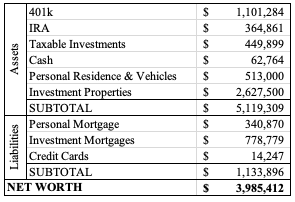
Last year at this time, I was sharing that our goal was to reach $4 million. We were at $3.869 million.

Our net worth is about $66k less than last month. I don’t always update the value of our assets, so that’s a fairly static number. Everyone few months, I’ll check on the ‘zestimates’ though. Typically, we expect to see the total decrease in the winter months because there are less sales and less activity to raise the sale prices like you see in the Spring months. On top of that, all of our investment accounts (except one that increased by $22) decreased a bit.

We have a 0% interest credit card that has a balance over $12k on it. We also added a car payment, which we haven’t had since about 2015. Tesla was offering a 0% interest loan, so that monthly payment isn’t going away for nearly 5 years. Overall, our credit cards balances total more than $3k less than last month’s, which makes me happy to see.

5% Rent Cap

The President issued a statement calling on Congress to cap rent increases at 5%, specifically for corporate landlords. The statement appears to define corporate landlords as those owning over 50 units in their portfolio. This was not an executive action that is implemented. And while my numbers are different than the numbers of a “corporate landlord,” I do think it’s worth hearing a landlord’s side. I feel that there’s a lot of spite against landlords without a lot of knowledge about their actual financials.

I admit that there is a possibility that some of these companies with large complexes could be raking in on the fees or “utilities” that are in the unit, without actually providing a properly maintained building, but that’s not the case for everyone that’s labeled as a landlord. No one seems to step back and see that this is a business model for landlords, and while everything else around us is increasing in costs, rent needs to as well.

No one predicted such a significant rise in product costs or housing costs in such a short period of time, but here we are. And landlords aren’t in the business to graciously eat the costs of homeownership for renters.

LANDLORD COST INCREASES

The Presidential statement released refers to a press release that starts with, “Today’s U.S. Labor Department Consumer Price Index (CPI) report revealed costs remained largely unchanged in May, with overall inflation cooling faster than economists expected as the Fed considers finally reducing interest rates below a 23-year high.” Is there a comparison to costs that landlords had to take on because the costs of everything increased faster than expected back in 2020-2022? Increases have been seen on small things like a maintenance call for a technician, but also big things like property taxes and insurance.

That same article goes on to state, “Since 2019, the cost of rent has risen 31.4%, with wages only increasing 23%, as tenants on average need to earn nearly $80,000 to not spend 30% or more of their income on rent.” In 2019, on one of my properties, the taxable assessment was $95,000, which equated to about $1,200 per year in taxes. In 2024, the taxable assessment was $242,000, which equates to about $3,000 per year in taxes. That’s a 61% increase in just my taxes over that same period of time where they’re complaining that the cost of rent increased by 31.4%. If rent had been set based on the 1% rule in 2019, rent would have been $950 per month. Had I increased 5% each year from 2019, it would be $1,212 in 2024. If I set rent based on the 1% rule now, it would be $2,420. However, the rent on the property is $1,750. So while it’s more than 5% each year since 2019 (the baseline the government is using), it’s set at an amount where I capture my expenses for owning the house, while also turning a small profit.

It’s taboo for a landlord to turn a profit, but that’s why we’re here. It’s an income stream that we’re establishing for profit. I don’t get to pay myself an hourly rate for managing the property. So this “profit” can actually be looked at like a salary. Every time I need to show the property to a prospective tenant, the lease signing, the walk through, every call or text you make, every trade that I need to schedule and coordinate with the tenant on, any fixes or improvements that I do myself. All of these minutes in a day add up, and I’m not directly paid for any of them.

On the particular house that I’m using for the example, we are assuming $300 per month in profit, which comes to $3,600 per year. Would you work as a manager of a company (e.g., hiring trades to fix things, performing maintenance, making sure all bills are paid timely, general management of having liabilities), for only $3,600 per year?

I wrote a post last Fall about the changes in my rental fixed costs from a year prior. I plan on doing the same this fall when more tax information comes due. The house I’m referring to has been at $1,750 for the past two years. However, between 2022 and 2023, my taxes and insurance have increased by $255 per year. That’s a cost that I’ve “eaten” from my “profits.” I could have said that equates to $22 per month increase, and I could have projected a similar increase for the year coming. I could change their monthly rent to be $1,790-$1,800 to keep my profits on a similar path. However, I didn’t, because they’re good tenants that haven’t had many maintenance calls.

However, if I don’t increase every year, then I could find myself in a sudden deficit like I did during the pandemic because costs increased faster than projected. A 5% cap could actually incentivize annual increases because I wouldn’t want to be caught behind and not able to catch up down the road.

LEASE TERMS

The Federal Housing Finance Agency announced protections for renters in multifamily properties that are financed with loans backed by Fannie Mae and Freddie Mac. The protections include: (a) requiring 30 day notice before rent increases; (b) requiring 30 day notice on lease expirations; and (c) providing a 5 day grace period before imposing late fees on rentals. I know for a fact that every single lease I’ve executed personally already has all of these requirements in it, at a minimum. In many cases, there’s a clause for 60 day notice of a potential rate increase, with negotiations being completed before 30 days from lease expiration.

Some states already have this codified. Other jurisdictions have landlord/tenant agreements that give the tenants rights (and awareness of rights) that can be lobbied against if the landlord is noncompliant.

There’s a clause that I’ve seen that requires expired leases to auto-renew on a month-to-month basis instead of for another year. I would argue that a requirement to renew a lease month-to-month instead of annually actually hurts a tenant. A landlord then only needs to give 30 days notice of a rent increase, and they could technically increase it month after month.

SUMMARY

If the ‘cap’ were to apply to me, then I’d be more inclined to increase rent every year. As a general rule, I increase rent for long term renters by $50 every two years. When we turnover a property, we will evaluate market rent in the area and set the monthly rent at what we see (which could be more than $50). In some cases, the evaluation ends up being too high, and we set the rent at something we think more people can afford. For example, there were comparable houses renting at $2,200 near a house we had listed. We’d rather get the property rented than shoot for top dollar, so we listed it at $1,600. While lower than “market value” probably called for, it was $400 higher than what we had it previously rented at, which covered cost increases that weren’t previously covered.

In the post that I previously linked, I highlight that our standard for increases barely offsets our increase in expenses. While we manage each house individually on setting the rates (asking ourselves: do we think the tenant can absorb the increase, do we have to increase to cover actual costs now), our monthly income among all houses was increased by $475. If you add up the cost increases for taxes, insurance, and property management (increased rent means increased fees because fees are based on the rent price), our costs went up $415 (and that’s before any service calls). On a whole, we’ve offset the ‘fixed cost’ increases. We’re taking ‘losses’ on houses where our routine for increases is slower. Therefore, having 13 properties affords us the ability to be more lenient with tenants and to keep good tenants in the house instead of forcing them out with hgher rent increases.

I support having protections in place for tenants. I’m sure there are landlords out there that aren’t interested in playing ‘by the book’ and just being decent human beings like I intend to. However, landlords are people too, and they’re running a business. Creating boundaries without fully understanding both sides of the situation and focusing on data points that only support your theory is unfair. I’ve joined the Landlord/Tenant Advisory Committee in my city. I hope to bring more awareness to the landlord side of things and bridge the gap between landlords and tenants when it comes to responsibilities.

April Financial Update

I had this post mostly written by Wednesday, but we traveled earlier this week, and I haven’t kept track of the day very well. This is the first I’ve been able to update our net worth and get this done. Ironic, considering how I started this post when I expected it to be on time. And now..

This past month has been exhausting on me. I knew March was going to be busy. We had a bunch of sports schedules to manage, lots of kids birthday parties, hosting my dad for a long weekend that coincided with 3 family birthdays and the first anniversary of my mom’s passing, an assortment of Easter activities, a trip, and random other events. On top of managing these day-to-day things for our family, our deck replacement started, and we had to work on a massive turnover of a rental property. I’m in a perpetual state of tired these last few weeks.

DECK REPLACEMENT

On July 2nd of last year, a storm blew threw that destroyed our neighborhood. Honestly, we’re surprised by how little actual structure damage there was for our neighborhood because it looked like a war zone with the amount of trees down. A couple of houses had a tree fall on their roof, but only cause minimal damage that resulted in shingle replacement. We appeared to bear the brunt of the worst, which was a tree falling on our deck, crushing our furniture, moving all the supports, and cracking the concrete blow it. Another tree missed falling on one of our cars by centimeters, but that limb ended up cracking our driveway apron. We struggled communicating the extent of the damage with our insurance company, and they eventually realized what was needed and paid out on it five months after the incident. Our construction started on March 18th.

It hasn’t been an easy process. It’s emotionally draining on me because there were communication issues with our contractor that he wasn’t taking responsibility for. Then there were minor issues, but issues nonetheless. For instance, they installed waterproofing so the patio would be a dry area, but they cut through one of the barriers. Instead of realizing that was going to be an issue and fixing it themselves, I had to point it out. Then we went out there while it was raining to check it, only to see that there are 3 spots where water is just pouring through the seams. That just takes a lot out of me to have that conversation. They cracked off the top of our sewer cleanout, which not only made a mess in the yard, also caused a backup into our basement tub and toilet once it was glued back on because of a pressurizing issue (we think).

Then there are those hidden things that take energy, such as managing how to move money out of savings (while not exceeding the maximum of six transfers) and keeping track of all the bills, while ensuring the checking account has the right amount of money to cover the bills paid.

RENTAL PROPERTIES

Everyone paid rent on time! I had two technically pay on the 6th, but I sat waiting to see if it showed up before reaching out that morning. One of our tenants bought a house and vacated as of March 31st. They actually had left the house a little early, which was really helpful to us because the house needed a lot of work. The house had been flipped before we bought it. We knew everything was going to eventually need attention, but we hung on as long as possible. The neighborhood is really nice, so it was time to bring the state of the house up to a better standard. It had been “good enough” all these years, but there were definitely some items that should be replaced. This ended up being a huge overhaul, costing us over $10k. I’ll go into all the details in a future post.

NET WORTH

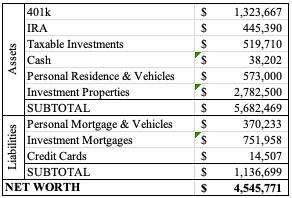
We’ve made a few substantial payments on the deck. We had been investing the money from the insurance company, while we waited for them to finish their estimates and then while waiting for the contractor to begin. Our taxable investment accounts have decreased a bit from that, and they’ll continue to decrease as this project finishes up in the next 2-3 weeks. The market is lower than it was a month ago, but our house values are starting their upward Spring trend, offsetting some of that loss. Overall, our net worth increased over the last month, but only by about $4,500 instead of the drastic increases we had been seeing month-to-month.

March Financial Update

We’re just going to cut to the chase – $4 million net worth! I mentioned that this was a goal for this year. Unlike other years worth of large jumps because of purchasing houses, this was less in our control (granted, our market allocation decisions are what’s driving it…. and by “our,” I absolutely mean only Mr. ODA’s because I don’t do anything in that realm).

RENTALS

Well, we’ve had a quiet month. What’s going to be funny is, I’m going to list the things that we did. Quiet doesn’t mean silent or without effort, but we’ve had a rough go of it over the last year, so this was a welcomed break.

We had termites at a property. We pay $98 annually for their termite warranty program, since we found extensive termite damage and live termites when we bought the house. We’ve had to treat the house several times, so this $98 is a steal. However, I’m wondering why we keep needing to treat the house.

We paid $125 for a plumber to go out to a clogged sink. When we received the invoice, it was for 2 plumbers to go. Between the phone call that they were on their way and the tenant saying they were great, only 35 minutes had elapsed. The company charged us almost $300. Mr. ODA called to ask why they choose to send two plumbers to do a one-man job, while also charging us for it. The owner said it was for liability purposes, which Mr. ODA fought back on. They agreed to a reduced rate, but we were only charged $125, which was less than agreed upon.

We had our third tenant move in, after we unexpectedly had to turnover three houses in the middle of winter. We also were given notice by another tenant that she’s vacating by the end of March. We handled increases for two houses (one handled by a property manager to increase $50/month, and one handled by me to increase by $25/month).

We had one tenant pay on the morning of the 6th with no communication, so I did have our property manager let them know that’s not going to be ok. We also had a usual suspect pay late, with the late fee. However, their communication was frustrating. They said they’d pay on the 6th. At the end of the 6th, they said the money hadn’t cleared like they expected. No communication on the 7th. I asked for an updated on the morning of the 8th, and they said it would be that day. At 11 pm, I hadn’t received anything and reached out. I was then told that money was going into the ATM right then so that she could pay. Sometimes I wish I could do a deep dive into tenant finances so that I could help them out.

PERSONAL

Mr. ODA has a trip in July where a group of guys will hike in the Rockies. Our family is going out before that trip is scheduled to do our own exploring. We booked 4 round trip plane tickets, and Mr. ODA handled the lodging booking for the guys’ portion. That’s almost $3,000 worth of purchases, so our credit cards are higher than usual.

Speaking of the plane tickets. We purchased gift cards from Costco for Southwest. The gift cards are essentially $450 for $500 worth of purchasing power at Southwest. We bought two, therefore saving $100 on the tickets. For an extra few clicks on the computer, and the 15 minutes waiting time before the e-gift cards were delivered to my email, that’s $100 that can be used somewhere else.

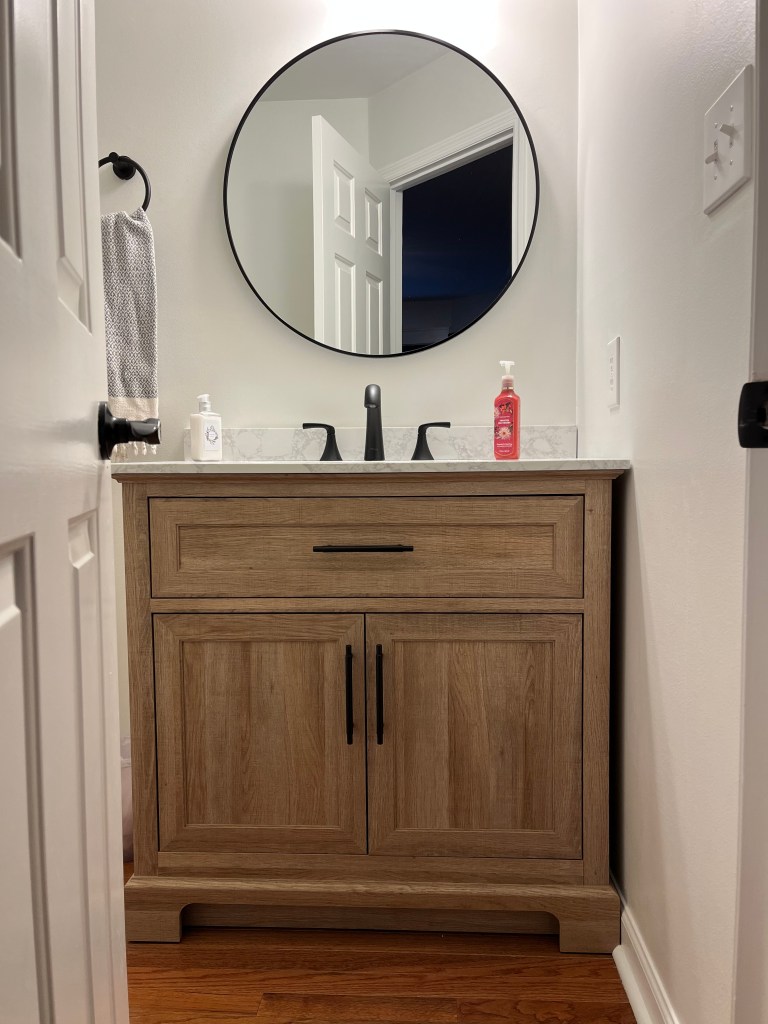
We bought a new vanity for our bathroom. That was about $700 for the vanity, faucet, toilet flusher, and mirror. I sold the old vanity (in rough shape) for $30. And because I’m proud that I did most of it on my own, here’s a picture. I needed Mr. ODA’s help with the supply lines because I lost patience with how tightly they were screwed on and my lack of progress. I cut the baseboards down to size, except I somehow measured wrong on one quarter round cut (I was cutting while it was on the wall). Mr. ODA cut and installed the replacement piece for me.

We finished up the ski season. The kids did great. I was really proud of them for sticking with it. We used our season pass well (i.e., exceeding the cost had we bought individual tickets for each visit). I took two of the three kids to the aquarium, and we took the baby for a procedure at a local children’s hospital. We’ve started tee ball for our oldest. Our March is very full and busy, so we’re getting into the swing of things and keeping track of the schedule.

NET WORTH

Well, we far exceeded that $4 million goal. The market went up big, with our biggest changes being in our retirement account, IRAs, and cash. Our cash increase is offset by the lower amount in our Treasury account. Some of the short term bonds were transferred back into our savings account, and we’ve kept that money in savings since our deck replacement is slated to begin.

Lease Break Agreement

Last March, it was time to make a decision on renewing the tenant’s lease on House9. There were several variables at play, and we ended up adding “lease break” terms to the renewal agreement. Here’s how and why we did such a thing.

LEASE BREAK CLAUSE

All of my leases are set up as a lump sum fee. This means that if the rent is $1,000 per month, then the lease is a legal binding agreement for $12,000 for the year. If you wanted to leave 6 months into the agreement, I could hold you accountable for the entire sum. In reality, this wouldn’t happen. I’d have to show a good faith effort to re-rent the property once the tenant vacated the property, and they’d only be responsible for the time it was vacant, at most.

The point here is that there is no section of my lease agreement template that allows the lease to be “broken,” and the tenant to leave “early.” In some instances, a tenant will request the flexibility to leave early, and we typically charge up to a month’s rent for that ability. We most often use this for tenants that expressed interest in buying a home. There are some other fee structures that we use depending on the circumstances, but this will focus on those instances where we know in advance that this is a possibility.

ORIGINAL LEASE AGREEMENT TERMS

The tenants had signed their original lease in June 2020. From the beginning, they were clearly money savvy. They had said from the beginning that they were looking for a place they could live until he finished his schooling, which was about 2 years away. They negotiated a two year lease for $1,280. In September 2021, so 6 months before their lease was set to expire, he reached out with an offer. His program was set to end in May 2023, but they didn’t want to commit to any longer than that since he could be placed anywhere upon graduation. He asked to go month-to-month after that.

We agreed to extend their lease until May 2023, but it would be $1,300 (instead of $1,280) between 7/1/2022 and 5/31/2023. We decided not to engage in the month-to-month conversation that far in advance, which he understood.

In March 2023, we started discussions on their status. They were about to have a baby, the market had cooled for buyers, interest rates were high, etc. They didn’t want to rush their buying process. Instead of paying the premium for a month-to-month lease, we decided on another year-long lease, but it would have a “lease break clause.”

NEW LEASE AGREEMENT TERMS

The new lease was executed for $1,350 per month, which was still a bargain for their property. However, we added lease break provisions, as seen below.

The thought process here was that we were protecting our financial interests based on the time of year. First, we required a month’s notice. Our original lease already states that we can have access to the property to show it to prospective tenants, so that wasn’t repeated here (although it is worth noting that this in our lease agreement, since renting while a unit is occupied is not always a given; we struggled with our property manager in KY getting access to our properties (that was a property manager issue)).

I don’t know if there are facts to back this up, but it seems (through my own years of renting, as well as all these years as a property manager) that most people are looking for a rental to be somewhere between May 1 and July 1 as the start. A quick search tells me that the common months are May to September. However, in the south, we start school in mid-August. If you’re not moved by August 1st, I’d venture to say you’re not preferring a September 1st start date.

If the tenant left in the summer months, then the fee was only 1/2 of a month’s rent. We had a good chance of being able to re-rent the property if it was during the summer and before everyone focusing on back-to-school in the end of August/September. If they requested a lease break between September and the end of March, then it was a full month’s rent. This was due to the fact that the turnover process was going to be longer than our typical turnaround, and it would put us at a disadvantage in re-renting the property down the road. We then put that there would be no fee if they left in the last two months of their agreement because 1) we’d likely be able to rent it quickly, and 2) as a way of showing that we’d meet in the middle since they were such great tenants.

EXECUTION OF THE LEASE BREAK AGREEMENT

The tenant had used our property manager as their Realtor for a new home purchase. She tipped me off that they’ve be giving their notice shortly, sometime at the beginning of November. I naively thought that meant they were newly under contract, but by the time their notice was given, they had already closed on their new home. They purposely waited to give their notice so that they had time to move their belongings without being rushed (which is fine; I don’t know why that reads negatively). On November 24th, they let us know that they’d be leaving by 12/31.

While the fee was due upon notice, per the lease agreement, it wasn’t something I was willing to fight. If you’re a good tenant and hold the lines of communication open, I’m happy to treat you as an equal. They paid the fee on 11/29, and then they paid their December rent on 12/4.

LESSONS LEARNED

Honestly, it worked just as planned. We weren’t able to rent the house for January. The lease break fee alleviated the pressure to settle for a tenant just to fill the house because we had the month’s income already accounted for. We’ve done something similar in the past, and this set-up has worked well for us. It gives a little grace to the tenants and real life needs, while still protecting our interests as business owners.

We put the same type of clause in another tenant’s lease. They executed the clause on February 23rd, letting me know they’ll be leaving by the end of March. If they broke their lease in March or April, there was no fee (their lease was set to expire April 30th, so it’s one month early).

Their are times where a tenant doesn’t know up front that they’re going to find a house they love or a job is going to move them. We handle each on a case-by-case basis. Generally, it’s either going to be a month’s worth of rent as the fee or it’s going to be a fee of $250 (the amount I pay to the property manager) and they pay rent until we find a new renter (which has never taken more than 6 weeks, and is typically a few days turn around for me).

February Financial Update

RENTALS

The rentals were expensive this month with $4600 paid out. This doesn’t include work that’s currently under way, but not paid for yet.

I paid for a water heater replacement, which was $1,904. I had to pay insurance on a larger property ($793). I paid the balance of the window replacement at one property, which was $1,064. I also paid for a plumber to address a leaking toilet and a rotted faucet ($325). We had a new tenant move into a vacant property, so we had that cleaned before her arrival ($165).

I had to pay for a plumber’s service call ($95) for clogged drains, for them to refer me to a rooter company ($250). I emailed that tenant that preventive measures need to be taken because I’ve not had so many calls to one property. She assured me they have taken appropriate measures and it’s just old pipes. The only problem being that we have several other properties with old pipes that never call for clogs.

We’ve turned over two properties and are about to turnover another property in the dead of winter. It’s so frustrating to be in such a position. All of those stories will be elaborated on in future posts.
– On one property, we charged a lease break fee of one month’s rent to cover our losses (the fee was different based on the month in which they broke the lease). Luckily, that covered our entire month of January being vacant, but we found someone for 2/1.
– Another tenant asked to leave a property because he lost his job. That was handled a bit different because we didn’t know in advance that this tenant would want to leave mid-lease. We told them there’s a fee of $250 (which is what it costs us to pay the property manager to find a new tenant), and that they had to pay rent until we found a new tenant. We didn’t lose any rent on that property.
– Now, we have a newly vacant property because the tenant can no longer afford it. I’m not expecting to recover her unpaid rent at this point. We approved a tenant to start 2/28, leaving us with 27 days of lost rent. However, we sent a lease over for them to sign. They’re currently dragging their feet on signing because they want to pay with their tax return. I don’t love that idea. They’ve been easy to communicate with up until this point, just slow. I’m hoping this gamble works out.

PERSONAL FINANCES

I had to transfer money to Mr. ODA’s account to cover the purchase of our new back door and a new treadmill (although that was only $400). This is an interesting concept for us. Mr. ODA had an account before we met. His account was grandfathered in to new terms and conditions at this bank. He’s kept his checking account and credit card for the rewards (I have access to the account; my name just isn’t on it). Any online purchases go on that credit card. However, that account only receives $250 every other week from Mr. ODA’s pay check (occasionally it’ll receive rent via Zelle). So sometimes, we need to transfer money from our main checking account to cover that credit card payment. All our security deposit accounts are with that bank too. So I had to then transfer from a security deposit account into his checking account, and then have him send that money to our main account. It wasn’t our finest money management moment.

Not much else happened this past month. We’ve gone skiing with the kids some more, I went on a moms’ cruise (which was amazing), took a small trip to piggyback Mr. ODA’s work trip, and have done activities around town. We’re gearing up for a procedure at a local children’s hospital next week, which I’m expecting will wipe out our deductible. Luckily that’s only $3,000, but I’m sure we’ll hit it. We’ll actually be late hitting it this year; it’s usually done in January.

NET WORTH

One of this year’s goal is to hit $4 million net worth. I thought it was going to be a ways away, but the market has been up big recently. We’re only about $14k away from that goal now!