House 9: Hoarding leads to mice and eviction

This is a good one. This is the one we use when people say “how can you handle all those properties,” and I respond, “if we survived this one tenant, we know we can handle whatever gets thrown at us.” Hoarding, mice, court dates, eviction. But its not always like that. The sun shone down on us for the current tenant though, who signed a two year lease and take care of the house (like, even power washed it on their own accord). The stories below show that you need a thick skin and a smooth temperament to be a landlord. Treat this as a business.

LOAN

This house was purchased ‘as-is,’ but we still had a home inspection contingency in the contract. It was listed at $139,500; we purchased for $137,500 with $2,500 in seller subsidy. We went under contract on 8/14/2017 and closed on 9/22/2017. The appraisal came in at $141,000, so we were content with our decision.

We refinanced the loan in May 2020. Our original loan had a balance of $105,800 at the time of the refinance. We rolled closing costs into the new loan and cashed out $2,000, making our new loan amount be $111,000. The refinance reduced our interest rate from 4..875% to 3.625%, shaving $104.25 off our monthly payment. I went into detail about the refinance in my Refinancing Investment Properties post.

Following the 1% Rule, we would be looking for $1,340 in rent (net of seller subsidy), but we haven’t received that yet. The first tenant’s rent was $1,150 and the second at $1,250. For the third potential tenants, we listed at $1,300, but the new tenants negotiated to $1,280 for a 2-year lease.

TENANT #1: OUR WORST

The application. It’s hard to not give someone a chance when their application is borderline, but I suggest letting the information on the screen speak to their character. Before the official application was run (which includes a background check), she admitted to a felony that she served 2.5 years for, and she filed bankruptcy due to a stolen identity while she was incarcerated. It seemed like she paid her dues and was building a new life. We got her application about two weeks after closing, so it wasn’t like we were desperate to rent it at that point. But she was quick to fill out an application and provide necessary documentation, so we decided to give her a chance. She moved in on 10/1/2017 with her 3 children, one of which was born days after she moved in. Her rent was $1,150.

We didn’t have any unreasonable situations with her in the first year. We did have a maintenance call for a leak under the kitchen sink, and we noted that the house wasn’t tidy. It seemed like she was a coupon-er, where she stocked up on a few items and probably resold them, which supported how she kept wanting to pay us in cash. The house wasn’t to my standard, but I didn’t look close enough to notice that it was dirty in addition to cluttered. I wanted to say something, but didn’t know my place at that point. Hindsight: I should have told my property manager and had her issue a written notice. This won’t matter down the road for legal proceedings, but perhaps we could have saved ourselves some headaches if she took the notice to heart; I was just afraid of offending her. But, other than that small concern at the time, we had no issue renewing her lease for another year.

The tenant complained about seeing a mouse around February 2018. We informed her at that time that pest control was up to her because of her living style that was attracting the pests. She claimed to have a quarterly treatment through Terminex. She complained further of mice in November 2018, but I wasn’t part of that conversation. It appeared to be that she was upset that there were still pest issues while she was paying Terminex. Well, that’s an issue to take up with the pest control company, not us. Our property manager gave her the information to our pest control company and shared that it would be a bit cheaper for the quarterly plan too. We heard nothing more until all hell broke loose in April 2019.

She sent pictures of mice poop all over the house on April 9, claiming that she had been out of the house from March 31 through April 8 and came back to this sudden mouse infestation and would be leaving the house. Well, that’s not how it works. She claims that was her ‘prompt’ notification, as if mice set up camp in a lived-in house that’s well maintained out of nowhere (news flash: it wasn’t well maintained and clean). She claimed that because of the living conditions (that she perpetuated), this would be her last month in the house. We knew we had the lease to fall back on, so we continued to remind her that this wasn’t on us and she couldn’t leave us with the financial burden and walk away. We had our pest control company go to the house as soon as possible, and we received their report on April 12.

But wait! While complaining about the condition of the house (that she caused), she wanted to know if she could buy the house!!!! Logic always seems to abound in these situations; it’s hysterical. We offered her to purchase the house from us at $148,000. She ignored it after that offer.

Both the pest company and our HVAC person noted a dog on the premises, which was in violation of the lease. HVAC was called out to fix a wire on the outdoor HVAC unit that the dog had chewed through. She also wasn’t taking care of the yard, and the City of Richmond was fining houses that violated their weed and grass clauses, which we notified her of on May 9.

She didn’t pay April or May rent, so we had a court date set for May 10. We had told her that she had to pay all overdue rent and late fees for us to cancel the May 10 court date. She didn’t pay, so our property manager went to court. The judge awarded us possession of the property, but since there was such outstanding rent and damages, another court date was set for July 1 to award us the money owed. In front of the judge, the tenant handed the keys over to our property manager, saying she was moved out. Immediately after leaving the court house, the property manager arrived at the house to do a walk through, only to find several people inside. She called the police.

The officer assessed the situation. He said that since they’re still moving things out (and there was a lot to move out), that it was a benefit to us that they were still working on it. He suggested asking their input on when they thought they would be done. One guy said at 3 pm. We agreed to let them stay, and I would go by after work to change the locks.

I showed up at 4 pm to change the locks, only to find people still coming in and out of the house. I called the non-emergency police line and waited for the cops to show up. It’s officially trespassing, and we were prepared to press charges. The officers knocked on the door and asked the people inside (none of whom were the tenant on the lease) to leave. One woman started a whole spiel about how she’s on probation and everything that she’s been arrested for, so she didn’t want to be arrested. The officer was funny to watch, and he just kept saying, “I’m not arresting you. I just want you to leave.”

After they drove away, the officers let me walk the property to ensure everyone was out. The place was destroyed!

By Virginia law, we are required as landlords to make every attempt possible to get the unit re-rented and let the old tenant “off the hook” for unpaid rent. Meaning, we can’t hold them to the entire term of the lease and have a vacant house. Regardless of this, we wanted to get everything fixed and replaced in the house so that we had an exact amount to claim during the July 1 court date.

The linoleum replacement was the critical path. She had destroyed it (looked like some chemical ate through it) beyond repair and it had to be replaced before we could re-rent the house. Home Depot’s timeline was really behind, and they weren’t able to get us scheduled for installation until June 20th (after she had “vacated” May 10th).

I compiled a list of lease violations with my documentation to support the claims in which she violated the lease on top of the obvious (e.g., dog on premises, smoking in the house). We had invoices from the pest company, the HVAC company, the trash removal company (over 40 cubic yards of garbage was left in the house when they finally vacated), and the “hazmat” cleaning company, all corroborating an unclean and unkempt living condition.

We went into court with a claim of $9,250. This was unpaid rent for 3 months, late fees, junk removal, pest control, HVAC fixes, professional cleaning that included a ‘hazmat’ charge, and all our paint and flooring charges.

We won the first judgement in court, simply because the defendant didn’t show up. We were awarded $9,250 plus the court fee and 6% interest. Well, somehow the court accepted her plea of needing another court date after not showing up to this one, and that was on July 10th. The judge that day reduced our rent and late payment owed by one month, and reduced our reimbursement total by a bit more than the security deposit we had already kept, bringing the judgement to about $6,600 plus the court fee and 6% interest.

Per the court process, we were required to work with the ex-tenant to develop a payment plan. We offered her a payment plan via email that was never responded to. From there, the next step is to retain an attorney for wage garnishment.

I contacted the attorney we use to help with wage garnishment, but he wasn’t experienced. He referred me to someone, who let me know that he’s already representing someone who has a claim against her. He said that he could still represent me, but I’d be second in line to any money they get from her. He offered me another attorney’s name to see if that one could help me instead, but that attorney said he couldn’t represent me because he already has another client looking for money from this woman. Interesting that two attorneys had different answers, but we went with that first. We haven’t seen a dime. Once the money was spent and we paid off the credit cards, it wasn’t on our radar anymore. Anything we get from this woman will be a bonus at this point.

TENANT #2: BLISSFULLY UNAWARE OF HOW LIFE WORKS

Two kids just out of college were our tenants that came in after that mess. They were great tenants, but a bit unaware of how the world works. They didn’t get the utilities into their name timely, so we charged them for the bills that came to us. After that, they paid their rent on time, and even when their restaurant jobs shut down at the beginning of the pandemic, they prioritized paying rent over other things they could have spent their limited income on; I was impressed. At the end of their lease, they were a bit lost too. Our lease requires 60 days notice of your intentions – either leave, or renew. Our property manager reached out to them at the 60 day mark, and they said they weren’t sure what they wanted to do, but were looking for other places. Since, realistically, we weren’t going to list the house for rent at 45 or 60 days, we told them that was fine. They came back after a week and said they were going to move out.

We moved forward with listing the house for rent and vetting new tenants. We had our property manager show the house on June 10 for what would be a July 1 lease. About a week later, the current tenants asked if they could stay longer because they didn’t get the place they were looking for. Sorry, but that’s not how it works and it’s already rented. The new tenants were OK with moving in July 15, so we allowed the college guys to stay until July 10. Then we hustled to get the house put back together before the new tenants. Specifically, one of the tenants was an artist, and he hung a huge canvas on one of the bedroom walls to paint on. Well, the paint bled through.

They also didn’t tell us that the range wasn’t working. When we asked about it, they said something to the effect of, “oh yea, we smelled gas, so we just cut it off. That was back in March.” Goodness!! So we quickly ordered a new range. We also had to have the carpets professionally cleaned, which was especially frustrating since they were only a year old. Luckily, the ladies who came to clean the carpets worked their magic, and they came out looking good as new. The microwave handle was broken off, and when we looked to buy a replacement, it was essentially the same cost as a new microwave, so we installed a new one.

While we were working in the house, we noticed that the air conditioner wasn’t keeping the house cool. We had an HVAC tech come out to the house, and it was either $1,400 to repair (after we had already previously put money into the HVAC unit), or $5,000 to replace it. We decided to replace it after it died shortly after the third tenants moved in.

TENANT #3: SOME OF THE BEST

These tenants have been wonderful. They’re both pharmacists at the local college and have been very self-sufficient. They’re great about alerting us of issues, but not in a way that it seems like they’re nitpicking. For instance, they wanted to store their lawn mower and other things in the shed out back, but the handle was broken off it. We told them that if they wanted to purchase a replacement, we would reimburse for the cost. Then they noted that the closet dowel was broken and they replaced it. I told them I would pay for that, so just take it off the next month’s rent. When they sent me the receipt, they had only taken the rod itself off the rent, but not the brackets to hang the rod. I immediately sent them the rest of the cost!

They’re one year into a two-year lease, and we’re very happy with them. They always pay their rent on time, they communicate regularly, and they’re taking care of the house.

MAINTENANCE AND REPAIRS

Since I’ve covered a great deal of the repairs we’ve managed in this house through each of the tenant stories, here’s a quick summary of other items.

Shortly after the third tenants moved in, they politely let us know that their dishwasher wasn’t cleaning the dishes. They very clearly identified the problem and the steps they had already taken to attempt to fix it, but it wasn’t working. We purchased a new dishwasher the day after they let us know. So in the matter of a month, we replaced the built in microwave, range, dishwasher, and HVAC. The only appliance we haven’t replaced in this house now is the refrigerator.

There was an electrical issue that we had sort of noticed before, but hadn’t pinpointed it without having things to plug into all the outlets. We had an electrician go out and fix the switches and outlets that weren’t working in master bedroom.

AN OVERALL LOOK AT THIS HOUSE AS AN INVESTMENT

Remember how real estate investing provides multiple avenues for wealth building? Here’s how they’re looking for this property.

Cash Flow – As we have had to replace nearly all appliances, including HVAC, and all the flooring among several other smaller issues, our total cash flow on this property is nearly nothing. But, like mentioned before, we shouldn’t have any big purchases coming and will start to be able to pocket the profits on this house once again.

Mortgage pay-down – The tenants have paid our mortgage for us, but due to closing costs of refinancing and choosing to take $2,000 cash back from that refi, our principal is actually higher than when we bought it.

Tax Advantages – We always depreciate the cost of the structure for paper losses that help offset profit on properties for tax purposes. All those repairs and appliance replacement expenses that eat into the profit margins are written off. So come April 15, the silver linings of those expenses are realized.

Appreciation – This one is good for us. This house is in a developing neighborhood and the area around it is being revitalized. Coupled with standard appreciation and the *hot* real estate market we’re in now, the value of the house is 150% of what it was when we bought, in less than 4 years.

SUMMARY

We’ve put about $10,000 into this house at this point. But that means we have a lot of brand new things in it. Now isn’t the time to give up on the house, since we should be in a position to not deal with many maintenance requests. Rent continues to climb, increasing our cash flow, while we just brought our mortgage payment quite low with the refi, and the property will continue to appreciate in value.

We learned a lot about the eviction process, even dealing with local police officers in the process. The court system and law enforcement are fairly simple to work with, as long as you are a fair and respectful landlord, keep documentation, and follow landlord-tenant laws. When the tenant doesn’t live up to their end of the bargain, justice will be served.

Moving States: Part III

There are a lot of factors that go into a home purchase. There are the simple ones, like the number of bedrooms and bathrooms your family desires. Then there are more complicated ones, like what compromises are you willing to make on your wish list to get to the price and location you want.

HOME CRITERIA

I started looking at real estate options in central KY just out of curiosity in June. I knew we wanted 4 bedrooms and at least 2 bathrooms, but it would probably be more like 2.5 bathrooms (master bathroom, kids’ bedroom bathroom, and a powder room on the first floor for guests). We knew we wanted a 2 car garage, which worked out well for us in our RVA house.

Then there’s more trivial things that I learned from experience. I preferred the master bedroom to be on the second floor with the kids bedrooms. When we built our RVA house, we didn’t think it would be too much to have the kids on a separate floor. Well, we made that decision before we had kids, and it turns out that having infants doesn’t make it easy to sleep on a separate floor. Yes, I had monitors. But kids are noisy. So once I ‘kicked’ them out of my bedroom, I didn’t want to have a monitor right next to my head to still be kept up by all their little squeaky noises through the night.

Our RVA house had a loft upstairs. It had a ‘wow’ factor to it, but it wasn’t practical. We used it as a den before we had kids, and then it was hard to keep it organized and clean once kids came around. Therefore, we put a basement on our must have list, and we weren’t going to compromise on that. We knew from our living style that a basement was going to be something we’d enjoy for a long time and didn’t want to take that off our list just yet.

We had a lot of criteria associated with the lot. We wanted about 0.25 acres. We felt that 0.5 an acre was more land than we really wanted, but anything less than 0.25 acres wasn’t going to leave enough room for multiple kids and a large dog to enjoy. We want to be in a neighborhood with several neighbors close, but we want more room than a garbage can width between the houses.

One of the sad parts of the house we were leaving behind was the backyard. We had a really nice natural area in the back half of our yard. We had put a firepit in and had a beautiful tree-scape back there, but still had a decent size grassy area for the kids and dog to play. Another downside for leaving was that the playground and pavilion (hang out space) for the HOA were two lots away.

FINANCIAL CRITERIA

When Mr. ODA and I got pre-approved for our first home back in 2012, we were approved for $750,000. Sure, we could afford that monthly payment, but then we couldn’t afford food or furniture or electricity. We had set our spending limit based on our down payment available at the time because we didn’t want to pay PMI. For this purchase, we could have afforded a monthly payment associated with a $500k house (or more), but that size house isn’t necessary for our life right now and we didn’t want to be saddled with that down payment.

I’ve already quit my job. Mr. ODA expects to quit his job in the near future. We don’t want to have him quit his job to hang out in an expensive house and never be able to do anything else because we need to pay $2,500 per month for a mortgage.

When looking at houses, we’re fluid in the cost. We preferred to stay below $400k, unless there was something we could get for more than that making it worth it (e.g., more land, more amenities). We found out that we could get everything we wanted for $350-400k, so it would have been hard for us to go higher than that.

When you’re pre-approved by a bank, they’re looking at your debt to income ratio. Your debt is categorized by your routine monthly payments (e.g., car loan). We don’t have any loans or debt payments in that sense, so they’ve set our pre-approval almost solely based on our income. This is a faulty expectation in a homeowner’s reality, since we all have fairly fixed monthly costs: cable, internet, cell phone, electricity, gas, water, etc. Then you have the cost of groceries and entertainment that may or may not be on a credit card and able to be tracked against your credit. Essentially, we don’t need a bank to tell us what we can afford, and we set our own expectations.

We know what we have for a down payment and closing costs, and we know that we’d prefer to pay $1200-1500 per month for our mortgage, which includes our escrowed real estate taxes and insurance.

OUR HOME

We got a 5 bedroom, 3 bathroom (with another bathroom roughed in for the basement), 2,750 square foot house with an unfinished basement, on about a 8,500 square foot lot. The basement is not a walk-out, which we were bummed about, but at least we have the space we wanted. The lot is slightly smaller than we set out looking for, but because our house is really wide and not deep, we actually ended up with a nice size back yard, which was really the intention of our lot size desire. Our house cost about $346k.

FINDING THE HOUSE

We looked in Lexington, KY first, and we explored resales and new construction. The neighborhood I was really interested in was sold out in one section or over $500k for a new-build in another section, so I started over. For resales in Lexington, we were looking at houses that were about 30 years old and needed updating. I really wish I had an eye for the potential in some homes. When I started investigating the new construction market, I realized that we could have a new build house for the same price as the resales that needed work. Most of the neighborhoods in Lexington have the houses on top of each other too, which we really didn’t want. We like neighbors, but we also want to be able to walk between the houses.

Through July, I tried to figure out the new construction market in the area. I thought I had a head start since we had built our house in Virginia a few years ago, but the process for these Central KY builders was much different. It was hard to stomach the fact that their build time was 11-12 months, and growing. We had built our house in Virginia in less than 4.5 months from contract signature to move in.

I looked up the different floor plans for as many builders as I could find. One builder had very large, but partitioned off, floor plans. Another builder had options available in Richmond, KY, and another builder had those options available for a year from now. I found a deal being offered by one of the builders in Richmond, KY that said “last basement lot of this section – free finished basement.”

I reached out to the listing agent. She took me on a virtual tour of the floor plan I liked, and it was by far my #1 contender. I asked her what “free finished basement” meant, and she said they’d cover the basement and finishing it. I verified several times – a $50k value??? Well, Richmond, KY wasn’t my preferred location, but hard to beat this deal. Plus, that neighborhood was just starting to be built, and we really liked being at the beginning of our last neighborhood’s build out. The listing agent put together a contract, but didn’t mention this deal. I said I wasn’t signing anything that didn’t have that in there. She added it, and then said she had to wait for her boss (the company owner) to come back to town in a couple of days to go over the details. Well, the deal was too good to be true. The deal was that we paid for the basement pour, but they paid to finish it. This deal was going on because the lot was less than favorable, so between the poor lot and less of an incentive, we walked away. That floor plan is still my favorite though, and if we ever move again, it’ll be hard not to go back to that builder. Also, they have the laundry room connected to the master closet or bathroom in their floor plans, and this is the most logical, amazing thing that I had even pointed out in our last house as something that should have been done.

Well, now I was getting desperate. How are we going to find something that we can move into? Maybe we’ll have to wait to list our house in Spring of 2021 because we’ll only find something to build that’s several months out. I’m very grateful that we found something when we did and didn’t have to wait until Spring of 2021 when housing prices have risen so much!

I had tried to get more information for a house that was under construction. We couldn’t change anything, but it was mostly ok. I didn’t love the tile in the bathrooms. The house layout was manageable, but it had a lot of wasted space (we don’t need a sitting room in the master bedroom or a formal living room). The house had a walk-out basement and was part of a neighborhood that had golf and a pool. It was also $393k. Affordable, but not what we were looking for. The lot was over 10k square feet, which is something we wanted. We asked Mr. ODA’s parents to go check it out. They went to see it and were quick to say no. I’m glad they did, and that I didn’t settle. We want our kids to ride their bikes in the driveway and street, and this house is on a greatly sloped hill (like recently rode our bikes down it, and I was scared).

I kept looking. We mostly were looking around Lexington, KY, but not within Lexington because of the lot spacing. We considered several re-sales in Winchester, Georgetown, and Richmond. They all were about $400k and not perfect, so it was hard to jump in.

At the end of July, a house popped up on my search. It was new construction and had been under contract, designed by someone that had to go with a different house because this one was significantly delayed. It was being built by the builder that had 11-12 month lead time on newly constructed homes, a builder without a good reputation, even to me, someone who didn’t grow up in the area. I requested the ‘spec list’ so I could see if there were any deal breakers in the design and selections.

I had hoped for white kitchen cabinets, and these were dark. I loved that there was a covered deck and that the already-selected upgrades to the floor plan were exactly what I would have selected (e.g., mudroom, guest suite, laundry room location, master bathroom layout). It had a pit basement. It was in the area we wanted; it was on a flat part of the road; and it could be ready before next year. The light fixtures were more eclectic than we would have chosen, but those weren’t a deal breaker.

We were told that it was probably going to be ready at the beginning of November. We figured a mid-August list on our home may take a week or 2 to get under contract, and then usually you see a 45 day close (versus our push for 25-30 days usually on rental purchases). We thought we may have a couple of weeks to bridge between selling our home and getting into the new house. Nope.

This was just as the bidding wars were really ramping up and people were losing out on 20-bid type offers on listings. Our house was under contract at the end of the first weekend. They wanted a 3 week close, and we pushed it to 4 weeks. That left 7 weeks of us being ‘homeless,’ which I covered in Part I.

SUMMARY

This is very specific to our needs and desires, but I hope that the thought process and ‘give and take’ in the decision making can be helpful to some. This information is also geared towards the Central KY market, and what you get for the price of a house in different areas of the country varies.

While we’ve had several issues with our home in the first six months, we’re happy to be in KY with family, the location of our house, and the general feel and functionality that it’s given us.

Amortization Schedules

An amortization schedule is a document that is a huge spreadsheet of numbers that tells banks and their software how to apply your monthly mortgage payment. It defines the amount of each payment going to principal to pay off the loan balance, and the amount going to interest for the bank allowing you to borrow their money.


Let’s rewind. How does the bank figure out how much your monthly principal and interest payment is going to be? This is a function of several things:

  • Loan amount (purchase price minus down payment)
  • Interest rate
  • Loan term (length)

Want to see a formula for that?

  • loan amount = x
  • interest rate = y
  • loan term (months) = z

Looks like a blast doesn’t it? I saved this formula into my spreadsheet for evaluating properties so that once I fill in the purchase price, expected down payment, loan length, and the predicted rate from my lender, it will auto-populate the monthly mortgage payment amount. I then take that number and can calculate predicted cash flow based on a rent estimate.


Back to the point of the post. Loans with long terms borrow the money for a long time. Loans with high rates borrow the money more expensively. In both cases, the early stages of the amortization schedule give much more money to the bank as your fee for borrowing (interest) than they do to pay down the loan. This is because every dollar of that loan principal is being borrowed and needs paid for.

In the first payment, the entire principal amount borrowed is in that formula above, so it’s expensive to the bank to give you that money. Fast forward 15 years of a 30 year loan and you have far less outstanding principal left, so the interest charge associated with that is less. Since your total monthly mortgage payment (principal and interest, ignoring escrows) total doesn’t change, the interest applied towards a smaller balance leaves more ‘room’ to pay toward more principal. Basically, the bank gets its money out of your monthly payment first, and what is left over can go to principal pay-down.

DAILY INTEREST

To better explain the cost of borrowing each dollar over time, it’s likely easier to break it down into daily interest. An amortization schedule calculates the cost to the borrower for giving you the bank’s money on a per day basis. So while I have access to $X for the whole month, I owe the bank for every day I’m carrying that principal. Multiply by 30 and that’s what the bank charges me for interest for the month. Then, remember that the leftover is what goes to the principal pay-down.

How to calculate. Divide your annual interest rate by 365 to get your daily interest rate. Multiply that rate by the outstanding principal to get your daily interest charge. Multiply that by the days in the month (or most banks use a standard month length = 365/12) and come up with the interest the amortization schedule charges you for that month’s payment.

We mentioned the different types of amortization we’ve seen in the House 1 post. This loan calculated your monthly principal part of the payment by the exact number of days in the month so each month’s proportion of principal to interest varied up and down. This is in contrast to what most banks do that I mention above.

THEORETICAL EXAMPLES

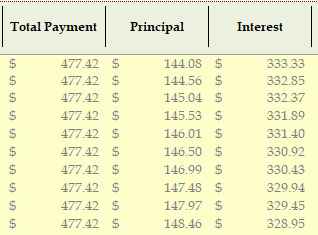
A pretty standard rate in the last decade is 4% on a 30 year fixed mortgage. Lets say the loan amount is $100k. Plugging that into my formula above, we get a monthly payment of $477.42. Above are the first 10 payments on that loan. Only about 30% of your monthly payment is actually paying down principal at the beginning. It takes 153 payments (i.e., months) before the amount of each payment going to principal is actually more than paying interest. Total interest on the full loan in this scenario is $71,869.


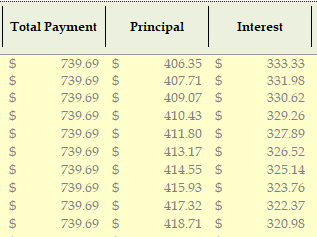
Now lets look what happens when we change it to a 15 year loan. The total payment jumps to $739.69 because you are paying the principal down twice as fast. But, the first payment you make is already $406.35 worth of principal pay down. Compare it to the first loan example in the terms of daily interest. The rate is the same. The amount is the same. So the interest due for the month is the same. But because your amortization schedule knows that you’re paying the loan off much earlier and requires a larger total payment, the leftover for principal pay-down is far more substantial.

Next, look how much quicker the interest charge drops after just 10 payments compared to the first example. $320.98 vs $328.95. This is because you are paying principal down more quickly, so the outstanding balance decreases and the daily interest is then lower too. Total interest in this scenario is $33,143.


In this example, we move back to a 30 year loan, still at $100,000, but we bumped the rate to 6%. The total payment rises to nearly $600, and the principal to interest ratio of the beginning payments is quite poor. Only 17% of the payment is going to principal pay down, which means that the daily interest is high, and stays high for many months. It’s not until month 223 (18 years later!) before the amount of principal in each payment is higher than the interest payment. Total interest in this scenario is $115,838.


Side story – Mr. ODA’s parents paid off their 30 year mortgage on their residence in 12 years. As a child, Dad would explain to me their process. They printed out the amortization schedule and put it on the fridge. Each month, based on their regular cash flow of life, they would choose ‘how many months’ they wanted to pay to the loan. So they’d make their regular payment, then they’d pay the principal portion of the next 2-3 months on the amortization schedule also. They’d make some really gnarly extra payments with weird dollars and cents, but it was a calculated decision. Then they’d cross those months off the schedule, knowing that with that extra payment, the interest that was tied to that principal portion on the schedule was simply avoided/canceled, by paying that principal early. This was a powerful tool to help me understand how the loan process worked, and one that help create the foundation for me to look at time value of money, opportunity cost, guaranteed return vs potential invested return, etc. Dad missed a lot of stock market gains by accelerating a 30 year mortgage to 12 years, but very few people ever regret owning the roof over their head free and clear – with a byproduct of NO MORTGAGE PAYMENTS for the 18 years that would’ve been remaining! Now he can make more investments with that leftover cash flow of life.


Amortization schedules are one of the largest “gaps” in understanding for the typical mortgage customer. They typically get told what to pay each month and ascribe to a “set it and forget” mantra that they know in 30 years, their house will be owned free and clear. Anytime before that, why bother understanding the background math?

As you can see in the examples, a shorter loan means faster pay down with less interest overall, and a lower interest rate means a smaller payment. When looking at loan options, understanding how the math operates to get to your options can help you determine what your priorities and goals are, and how to execute them.

In our recent refinancing post we talked about analyzing when was a good time to refinance our existing loans and which ones we’d target first. Simple advice you can find on the internet is that it’s a good idea to refinance if you plan to keep the property for longer than the result of closing costs divided by monthly payment. Most times this was about 2 years for us. You can see above that the 6% example had a $123 larger monthly payment than the 4% example (30 year term). So if closing costs are $2,000, it would only take 16 months (2000/123=16) to “break even” on a refi to go from a 6% loan to a 4% loan. No brainer!

There’s another hidden benefit there too, that gets missed to make it even shorter than 16 months. Look at the principal portion of the monthly payment. On the 6% example, it’s only $99 on payment 1, but on the 4% example it’s $144. That’s another $45 benefit! You’re paying down the principal at a faster rate. Add that extra principal portion embedded within the monthly payment to the $123 lower payment savings ($123+45=$168) and you get a “break even” point of only 12 months ($2000 closing costs/$168=11.9)!

Understand how your mortgage math works so that you can speak intelligently to a lender, ask good questions, and set yourself up with the best scenario for your finances and your future.

Refinancing Investment Properties

When we purchased the majority of our investment portfolio in 2016/2017, primary mortgages with excellent credit were sitting around 3.5% and investment property mortgages were about 4.5-5%. We thought these were amazing rates. Fast forward to a once-in-a-lifetime pandemic. A new baseline for low rates is created: We closed on our primary residence in November 2020 at 2.625% with nothing special about getting that rate.

Let’s go back to early pandemic days in the spring of 2020. Mr. ODA is always watching the market, but was particularly interested in the mortgage interest rates because we were coming up on the 61st month on our primary residence’s 5/1 ARM. Just a couple of months into the pandemic, we decided to move, so the ARM refinance (refi) became moot. But since rates were so low, he looked into refinancing our investment properties.

There are a few caveats. With the first company, we couldn’t refinance loans that had a balance less than $100k and be able to maximize the pricing structure they advertise so proudly ($0 closing costs). There was also an investment property fee, and took a long time for both of these to close.

As with the original loan, you’ll want to weigh the financial cost of refinancing against what the new rate will save you. When we looked at the variables, only 2 of our loans were worth pursuing a refinance.


In 2020, we refinanced House 9 from 4.875% to 3.625%. Our monthly payment went from $778.80 to $674.55.

The original loan amount on this property was $110k originated on 9/22/2017. We had paid it down to about $105,800 (shows how slowly the amortization schedule works for you in the early years), but with the closing costs rolling into the new loan (and cashing out $2,000), the balance became $111k. Eek, seems counterintuitive to refinance to a higher balance, but it’ll save us in the long run. We have greater cash flow each month with the lower mortgage payment, a larger percent of the monthly payment goes toward principal vs interest (amortization schedule again!), and we’ll save ourselves over $9k in interest over the life of the loan, if we make no additional principal payments.

We refinanced through a “zero closing costs” type entity. However, there are stipulations to what counts as $0, and investment properties aren’t exactly that. We had to pay an ‘Investment Property Fee’ of $2,358.75. The company paid the closing costs (e.g., credit report fee, title fees, recording fees) worth $548.91. We paid our prepaids, but also received a lender credit of $300. Essentially, we paid a slightly higher rate than the market would offer because the company rolls its closing costs into that rate, akin to paying points or receiving lender points to shift your rate up and down.

Mr. ODA initiated the refinance through an application in the beginning of March. We were quickly informed that we wouldn’t even be assigned a loan officer for two weeks. At the end of those two weeks, we were told they still didn’t know if they could move forward with our refinance. A week later, Mr. ODA followed up, and they had approved us to move forward. We were patient through the process, but it wasn’t until mid-May that we finally closed (in a parking lot, under a tent = pandemic closing #1!).

We rent this property for $1,280 and pay a property manager 10% of that. Minus the $674 mortgage and we’re still sitting quite pretty. While we reset the payoff clock by 3 years by starting a new 30 year mortgage, the extra money working for us in future years will far outweigh the costs of refinance.


In January 2021, we refinanced House 7 from 5.05% to 3.375%. Our monthly payment went from $664.31 to $559.34.

Our loan balance was $85,616, and the closing costs of $3,108 were rolled into the new mortgage. We also cashed out $2,000, so our new loan amount was $91k. The $2,000 was the most that could be cashed out during the refinance; we chose to take the cash out because we could make that money work elsewhere (e.g., pay down a mortgage with a higher interest rate). Even with the higher loan amount, the interest rate is so much lower that we’ll save over $15k in interest.

An appraisal was required as part of the refinance, which is how we learned that the house that we purchased for for $110,500, is now appraised at $168,000!

So, we rent it for $1,200 and self manage but only have to pay a $559 mortgage now? HELLO cash flow!

This closing was done at our kitchen table in KY through a VA-based loan officer. Mr. ODA initiated this loan in November, and we closed in January. A notary came to our house to go through all the paperwork, but it was all wrong. I enjoyed the “we never make mistakes” type of response from the Title company, and I pointed out that their paperwork did not match the lender’s paperwork that we had sitting at the table. Since the closing was at 6 pm, it was after hours for everyone and we couldn’t get an answer quickly, so we sent the notary home. We spoke with the loan officer an hour or so later and pointed how how each closing document had different numbers on it, and she went to work fixing it.


Theoretically, every investment property we own could’ve benefited from a refinance. And we would have with the “zero closing cost” company over time without their own pandemic policies getting in the way. If the loan amount was less than $100k, they would make you pay the closing costs AND would arbitrarily add 0.375% to the advertised rate. BUT, they wouldn’t let you pull equity out as cash to get the loan back up to $100k. So, that crushed our dreams a bit.

With options limited to “traditional” lenders’ pricing structures, we had to evaluate our future goals for the property and where the loan balances and rates already stood. Not to mention, there’s the time and complexity that comes with refinancing while hoping rates continue to stay low.

The lender we normally use has closing costs around $3k. This means that with the extra principal proportion and smaller monthly payment resulting from a refi, we need to balance against $3k to determine how long it will take to break even. Properties with small balances and properties with decent rates (mid 4%) would take longer to break even. Since we pay down our mortgages relatively systematically to achieve greater portfolio cash flow, some of our 30 year loans won’t be around for 30 years. And what if we wanted to sell the property to ‘1031’ to a different one? Our portfolio also has 15 and 20 year loans with great rates that wouldn’t be beneficial for us to pay to lower that rate.

There are a lot of moving parts when deciding whether or not to refi, and its very rarely free, especially with rental properties. But if the numbers work, it should be a no-brainer to pull the trigger and make it happen. Your future self will thank you!

ARM – Adjustable Rate Mortgages

An ARM is when the interest rate applied to the loan balance varies throughout the loan. The loan is typically amortized over 30 years like a conventional loan would be, but the interest rate is variable. There is an initial fixed interest rate for a pre-determined period of time (e.g., 5, 7, 10 years). The rate then adjusts based on prime rates, with a maximum amount allowed for the increase each period of time (e.g., a maximum 1% increase each year for 5 years). This is where people find ARMs alarming, but note these two important points: 1) an ARM can’t jump an egregious amount at the end of the initial fixed term (usually no more than 1% or 2% in one year, outlined by the lender at the beginning), and 2) the rate is based on interest rates at that point in time.

Usually, the benefit of an ARM is a much lower interest rate during the initial term. If you know that your ownership in the property will only be for 5, 7, 10, etc. years, then this is where the benefit is realized. Amortization schedules ‘front-load’ the interest** (e.g., your monthly payment is the same total ($500); your payment in year 1 will be broken out as $375 interest and $125 principal; year 20 will be broken out at $150 interest and $350 principal).

**Every dollar of your loan is being borrowed for a length of time determined by the outstanding principal on the loan. At the beginning of your loan, all 30 years are being borrowed, so the proportion of principal to interest of each monthly payment results in far more interest being paid. Every month you pay a little bit of principal, gradually decreasing your outstanding principal amount, meaning you are no longer borrowing it and will pay slightly less interest with each monthly payment.**

Therefore, if your interest rate for the initial term is less with an ARM than it would be with a fixed rate loan, you’re saving considerable interest for the time that you own the property. You’ll need to compare the interest rate savings during the discounted initial term of an ARM with the 30-yr fixed quote your lenders offers. Also evaluate an ARM based on how long you anticipate owning the house. If you’re looking to hold a property for more than 7 or 10 years, an ARM’s benefit is probably too risky since interest rates after that timeframe are unknown. Also, the more years your ARM offers for an initial fixed period, the less the discounted interest rate is.

In our current very low interest rate environment of 2020/2021, ARMs are rarely beneficial compared to a 30 year fixed rate.

An ARM is identified by 2 numbers. A 5/1 ARM means that the initial rate period is 5 years, and it can change every year thereafter for the life of the loan. A 5/5 ARM means that the initial rate period is also 5 years, but it can only change the interest rate every year for the 5 years after the initial term expiration. Here’s an example of a 5/1 ARM quote. It shows that the initial period is 60 months (5 years) and the maximum the rate could ever be is 5% more than the initial term, but that doesn’t mean there’s a guarantee of an increase since the interest rate is still based on the rate sheet at that time.


We found ARMs to be beneficial for our primary residences. We had several people try to talk us out of locking in an ARM. However, once we investigated the loan terms, we learned that there are strict parameters around your rate changes that absolved some of the risk others were using to dissuade us from the option. Yes, it’s a gamble, but interest rates have remained fairly steady or decreased over the last 10 years of our home ownership.

When we moved just outside of DC, the move was solely to get back to living together because our jobs had separated us. Being in the Federal government, the easiest way for both of us to get a job was the DC area, but we didn’t want to live in that metro area with the higher cost of living and a lot of traffic for very long. The rate terms offered were 4% on a 30 year fixed, or 2.5% on a 5 ARM. We owned the house for 3 years and 2 months. Over 38 months, we paid just over $23k in interest. Had it been the 4% on a 30 year fixed, it would have been over $37k in interest, which is a $14k savings. By paying less interest, that means that more of each monthly payment went towards principal than it would have, resulting in $4,700 more to principal. Additionally, by having a lower interest rate, our monthly payment was $250 less. Over 38 months that’s $9,500 less we had to pay, freeing it up to save and invest in other ventures.

For our second primary residence, we also had an ARM. We expected our time outside of Richmond, VA to be longer than the DC area, but not forever. I was uncomfortable with a 5/1 ARM and wanted the 7/1 ARM, but Mr. ODA picked the 5/1. We owned this house for 4 years and 9 months. Our interest rate was 2.875%. At the 61st month, it could have risen by 2% for the first year and 1% for each of the next 4 years. Had we gone with a conventional 30 year loan, the interest rate was going to be 4.125%; we would have paid $54k in interest during our ownership. With the ARM, we saved $17k in interest, put $5,300 more towards principal, and paid over $11k fewer in monthly payments.

We purchased our current residence a few months ago. We have a 30 year fixed conventional mortgage at 2.625%. Since interest rates are so low now (you can see how previously, we’d be around 4% for a conventional and got lower than 3% by choosing an ARM, whereas now interest rates are less than 3%) and we plan on being here for a much longer time, we didn’t pick an ARM.

As illustrated in the examples for the first two properties we lived in, ARMs can be a powerful option in strategizing your mortgage to work most efficiently for you. They are not without risk, so pros and cons must be weighed along with future forecasting of your life situation. If used in the best circumstances, they can help you shift tens of thousand of dollars away from interest and towards principal and other investments to aid in reaching financial freedom.