5% Rent Cap

The President issued a statement calling on Congress to cap rent increases at 5%, specifically for corporate landlords. The statement appears to define corporate landlords as those owning over 50 units in their portfolio. This was not an executive action that is implemented. And while my numbers are different than the numbers of a “corporate landlord,” I do think it’s worth hearing a landlord’s side. I feel that there’s a lot of spite against landlords without a lot of knowledge about their actual financials.

I admit that there is a possibility that some of these companies with large complexes could be raking in on the fees or “utilities” that are in the unit, without actually providing a properly maintained building, but that’s not the case for everyone that’s labeled as a landlord. No one seems to step back and see that this is a business model for landlords, and while everything else around us is increasing in costs, rent needs to as well.

No one predicted such a significant rise in product costs or housing costs in such a short period of time, but here we are. And landlords aren’t in the business to graciously eat the costs of homeownership for renters.

LANDLORD COST INCREASES

The Presidential statement released refers to a press release that starts with, “Today’s U.S. Labor Department Consumer Price Index (CPI) report revealed costs remained largely unchanged in May, with overall inflation cooling faster than economists expected as the Fed considers finally reducing interest rates below a 23-year high.” Is there a comparison to costs that landlords had to take on because the costs of everything increased faster than expected back in 2020-2022? Increases have been seen on small things like a maintenance call for a technician, but also big things like property taxes and insurance.

That same article goes on to state, “Since 2019, the cost of rent has risen 31.4%, with wages only increasing 23%, as tenants on average need to earn nearly $80,000 to not spend 30% or more of their income on rent.” In 2019, on one of my properties, the taxable assessment was $95,000, which equated to about $1,200 per year in taxes. In 2024, the taxable assessment was $242,000, which equates to about $3,000 per year in taxes. That’s a 61% increase in just my taxes over that same period of time where they’re complaining that the cost of rent increased by 31.4%. If rent had been set based on the 1% rule in 2019, rent would have been $950 per month. Had I increased 5% each year from 2019, it would be $1,212 in 2024. If I set rent based on the 1% rule now, it would be $2,420. However, the rent on the property is $1,750. So while it’s more than 5% each year since 2019 (the baseline the government is using), it’s set at an amount where I capture my expenses for owning the house, while also turning a small profit.

It’s taboo for a landlord to turn a profit, but that’s why we’re here. It’s an income stream that we’re establishing for profit. I don’t get to pay myself an hourly rate for managing the property. So this “profit” can actually be looked at like a salary. Every time I need to show the property to a prospective tenant, the lease signing, the walk through, every call or text you make, every trade that I need to schedule and coordinate with the tenant on, any fixes or improvements that I do myself. All of these minutes in a day add up, and I’m not directly paid for any of them.

On the particular house that I’m using for the example, we are assuming $300 per month in profit, which comes to $3,600 per year. Would you work as a manager of a company (e.g., hiring trades to fix things, performing maintenance, making sure all bills are paid timely, general management of having liabilities), for only $3,600 per year?

I wrote a post last Fall about the changes in my rental fixed costs from a year prior. I plan on doing the same this fall when more tax information comes due. The house I’m referring to has been at $1,750 for the past two years. However, between 2022 and 2023, my taxes and insurance have increased by $255 per year. That’s a cost that I’ve “eaten” from my “profits.” I could have said that equates to $22 per month increase, and I could have projected a similar increase for the year coming. I could change their monthly rent to be $1,790-$1,800 to keep my profits on a similar path. However, I didn’t, because they’re good tenants that haven’t had many maintenance calls.

However, if I don’t increase every year, then I could find myself in a sudden deficit like I did during the pandemic because costs increased faster than projected. A 5% cap could actually incentivize annual increases because I wouldn’t want to be caught behind and not able to catch up down the road.

LEASE TERMS

The Federal Housing Finance Agency announced protections for renters in multifamily properties that are financed with loans backed by Fannie Mae and Freddie Mac. The protections include: (a) requiring 30 day notice before rent increases; (b) requiring 30 day notice on lease expirations; and (c) providing a 5 day grace period before imposing late fees on rentals. I know for a fact that every single lease I’ve executed personally already has all of these requirements in it, at a minimum. In many cases, there’s a clause for 60 day notice of a potential rate increase, with negotiations being completed before 30 days from lease expiration.

Some states already have this codified. Other jurisdictions have landlord/tenant agreements that give the tenants rights (and awareness of rights) that can be lobbied against if the landlord is noncompliant.

There’s a clause that I’ve seen that requires expired leases to auto-renew on a month-to-month basis instead of for another year. I would argue that a requirement to renew a lease month-to-month instead of annually actually hurts a tenant. A landlord then only needs to give 30 days notice of a rent increase, and they could technically increase it month after month.

SUMMARY

If the ‘cap’ were to apply to me, then I’d be more inclined to increase rent every year. As a general rule, I increase rent for long term renters by $50 every two years. When we turnover a property, we will evaluate market rent in the area and set the monthly rent at what we see (which could be more than $50). In some cases, the evaluation ends up being too high, and we set the rent at something we think more people can afford. For example, there were comparable houses renting at $2,200 near a house we had listed. We’d rather get the property rented than shoot for top dollar, so we listed it at $1,600. While lower than “market value” probably called for, it was $400 higher than what we had it previously rented at, which covered cost increases that weren’t previously covered.

In the post that I previously linked, I highlight that our standard for increases barely offsets our increase in expenses. While we manage each house individually on setting the rates (asking ourselves: do we think the tenant can absorb the increase, do we have to increase to cover actual costs now), our monthly income among all houses was increased by $475. If you add up the cost increases for taxes, insurance, and property management (increased rent means increased fees because fees are based on the rent price), our costs went up $415 (and that’s before any service calls). On a whole, we’ve offset the ‘fixed cost’ increases. We’re taking ‘losses’ on houses where our routine for increases is slower. Therefore, having 13 properties affords us the ability to be more lenient with tenants and to keep good tenants in the house instead of forcing them out with hgher rent increases.

I support having protections in place for tenants. I’m sure there are landlords out there that aren’t interested in playing ‘by the book’ and just being decent human beings like I intend to. However, landlords are people too, and they’re running a business. Creating boundaries without fully understanding both sides of the situation and focusing on data points that only support your theory is unfair. I’ve joined the Landlord/Tenant Advisory Committee in my city. I hope to bring more awareness to the landlord side of things and bridge the gap between landlords and tenants when it comes to responsibilities.

Rental Property Work

We have several rental properties in Richmond, VA. However, we moved away from the area in September 2020, leaving the properties under a property manager’s oversight. My goal was to make it back to the houses annually to do walk throughs of properties. It’s surprising how many people don’t tell landlords about issues timely. Since most of our properties keep long term tenants in them, we don’t get eyes on the condition of the house regularly like we would if we were turning over the house between tenants.

Generally, I check to make sure their HVAC filters are changed out, that they don’t have any piles of garbage or old food (or the gigantic pile of laundry that was blocking one tenant’s second form of egress), that the yard is maintained, and simple things like that. I also take this as an opportunity to fix or improve things that I know need attention, but weren’t necessarily worth the up-charges of hiring the action out to a contractor.

We did a walk through of the Richmond houses in July 2022. At that time, nearly all our properties had long term tenants in them. A few small items came out of those walk throughs (e.g., change out filter, re-caulk the tub). While we hoped to get there last summer, it just wasn’t in the cards with our 3rd baby.

Based on the rest of our summer schedule (and soon to be constriction of school schedules), we were only able to get there for 2 full days. None of the work that I wanted to get done is a high priority; it’s mostly work that would improve the aesthetic of the house or help the longevity of an investment (like a new porch).

PROPERTY 7

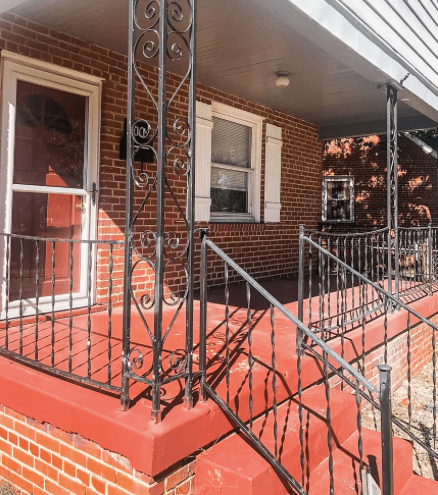
This house recently turned over. The house was flipped when we purchased it 7 years ago, and we knew that everything that was done before we owned it would just be a bandaid. We had a couple of long term tenants in the house, and we even had quick turnovers because people needed a place to live, so we didn’t have time to do major renovations. It was time. We put a lot of effort into fixing up the place (e.g., all new paint, new flooring and fixing of subflooring). The front porch and front door were red, and it just made the house look dingy. I wanted to make it look better. See: not a priority, but something worth looking into eventually.

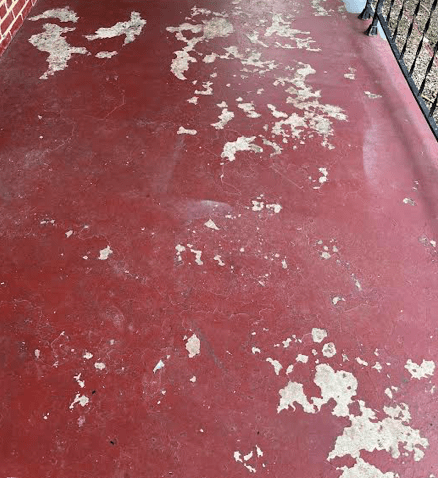
I arrived on the evening of the 4th to pressure wash the porch so it would dry by morning when I would paint it. I did not account for how bad the condition of the paint was. It appears someone just painted over peeling paint years ago. There were several layers of gray, purple, and red colored paint. The latest paint job had several places where that was the only layer of paint on the concrete. Very odd, but that meant that I had to scrape as much flaking paint away as I could. I spent over 10 hours on this. Not exactly what I had in mind. I scraped and scraped and scraped. I then put two coats on. I’m nervous how long it will hold up though. I did this during an extreme heat advisory so it likely didn’t cure correctly by drying in mere minutes.

I also did 3 coats of black over the red door. I don’t think it’s going to hold up against her animals, but at least it looks better from the street.

This house still needs the back deck pressure washed and painted. However, this is something I’ll do either with tenant turnover or if we sell it. It’s really worn down and places are missing paint because we removed the covered portion of it. The porch railing had also been painted at some point and is peeling, but I hadn’t budgeted time for that. I did a few touch up areas with black paint to cover where previous owners had painted it red.

PROPERTY 3

The tenant here reached out to me a couple of months ago to tell me that a salesman broke their doorbell. Fascinating. They claimed “well, it’s old.” My thought was “well, it’s meant to be outside, and the house next door was built the same time without any doorbell breakage now.” But instead of sending someone out to fix that, I put it on our to do list. It took Mr. ODA about 2 minutes worth of work, and the new doorbell cost $10.

While there, we cleaned out the gutters. That’s been a known issue throughout the life of this house because there are a lot of trees around the perimeter. We also cleaned the mildew growing on the house.

PROPERTY 2

This house is a mirror image of Property 3, but the trees in the backyard are much closer to the house. The back of this house had significant mold growth on the siding. We got all the siding cleaned up there too. Mr. ODA got on the roof to clean out the gutters. While up there, he also cut some trees off the roof.

The first picture is a ‘during’ picture because I didn’t get a ‘before.’ The part at the top that is dark is actually better than what was there, and it was over the entire back of the house. We soft washed with a mold and mildew cleaner and got it looking almost brand new.

PROPERTY 9

During the last turnover period of this house, we had the front porch jacked up (it was sinking), had the front stairs redone (they were sinking too), and had the back decking replaced. I had intended to stain the new wood for this house, but it being well over 90 degrees precluded that action. Instead, Mr. ODA got the siding on this house all cleaned up, and he cut/pulled several large weeds that were growing.

DRIVE BYS

We did drive by the other Richmond properties that we have. I didn’t have the time (or energy) to schedule walk throughs of everything. Once you do a walkthrough, you inevitably end up with a list of things to do to the house. I already had a lengthy list of things to do, so I didn’t want to manage that right now. Just by driving by, I did add to my to do list that one house needs its gutter replaced (how does a gutter, with no trees around, twist away from the house), and that their back deck really needs to be replaced (just the deck boards and railing; the substructure is fine).


I’ll need to make it back there to walk through the properties. If nothing else, it gets the tenants to clean things up once a year. One of our property managers offered a filter check quarterly, which was really used as a way to get into a house and make sure things were being kept clean and orderly. While a filter should be changed that often, I think that’s too much time being in someone’s place they call home. However, once per year is worth it to keep things moving in the right direction and to make sure there aren’t any maintenance issues that hadn’t been reported.

2023 in Review: Rentals

After several years of very minimal time having to be put into rentals once they were rented, 2023 made up for it. We had a lot of damage to properties, a lot of tenant payment issues, and just a general “can we not talk about rentals for ONE week please” moments. But even with that frustration, this is still the best.

All of these stories were elaborated on in posts throughout the year. This is meant as a summary of all our activities. You can search for the stories through keywords on the website, or just email me, and I’ll elaborate.

PROPERTY MANAGEMENT

In January, I took over management of our Kentucky properties. When we moved here in 2020, it was easier to maintain status quo. In Virginia, we had established contacts in the trades we’d need, and we felt comfortable there. In Kentucky, since we hadn’t lived there, nor did we have direct management of the properties (plus, the property manager did a lot of work in house), we just left it alone and kept paying the management fees. We bought a 4th property in Kentucky in 2022, and I kept it under my management. Through that process, I grew more comfortable with the area and any trades people I would need. Then over the course of 2022, the property management issues finally were painful enough that we cut ties.

We had cut ties with our first management company who was doing zero of the work they were supposed to do. In the process, we learned a few ways we wanted to see a future management company operate. We negotiated some of the fees that this company had. I didn’t foresee how frustrating that would be. For instance, they’d charge us 10% of the contracted price when hiring a company if they couldn’t do something in house. I said, “that’s what management is, and what I’m paying you for monthly.” They agreed to not add 10% to contractor payments. But I never saw the invoices, even when I asked for them, so it was hard for me to know whether I was being charged by them correctly. It turns out, I was always charged that extra 10%, and I needed to request the refund, every single time.

Problems really got bad when a single employee claimed we didn’t pay something we had and immediately charged us for it (over $1,000). We had to get the owner of the company involved. It was a mess. I finally said that’s enough, and even though I had a one month old baby, I took over management. Luckily, we had a clause in our contract that allowed us to cancel the contract (by either party) with 30 days notice.

I met with each of the 3 properties’ tenants they had under management, and I executed my own leases with them. First, their lease was a mess and disorganized (and had errors that were crossed out and initialed). Second, I like having my template in place so that I know what it says, and how it’s laid out. I recently learned that my VA property manager’s lease didn’t have some key information I would have preferred to see there, so I even started using my leases for the properties she manages.

INSURANCE CLAIMS

After having no insurance claims for all our homeownership years, we had three this year. One was on our personal house, and two were rental properties. I covered our own issues in a previous post; a wind storm caused a tree to fall on our deck, one (well, one and a half) on the fence, and a few limbs on the driveway.

We had a bad wind storm come through in March. The tree fell from the back of the property and hit the roof of a rental property. By some miracle, there was not a single puncture of a limb into the house. The roof sustained the fall and weight of the tree. We didn’t even need to fix the roof, just the fascia board and gutter. Insurance was super easy to work with. An adjuster came out, reviewed the damage, and issued a check.

We had another rental property with the water heater in the attic (instead of the crawl space or just anywhere better conditioned than the attic). A 2-week freeze came through in December 2022, and it froze the pipes. When it thawed, water just poured through the ceiling and into the house. There was 2 inches of water everywhere. The ceiling in the master bedroom, master bathroom, laundry room, and part of the kitchen caved in. The walls in the master bedroom and bathroom needed to be taken down to the studs and rebuilt. The bottom 2′ of all the walls in the house had to be torn out and put back together. All the flooring (that we had put in 5 months earlier) had to be replaced. And with all of that said, it actually wasn’t that bad of a process. Since insurance covered everything, it was just what it was. If I had to pay for each step, it would have been more painful (in time, contractor management, and cost). We were “out of commission” for about 3 months, but insurance even covered lost rent.

I sit here and type this while my back deck is still damaged. By the time we got through our claim with the insurance company, we were months out from the contractor getting to us. I’m hoping it’ll be replaced by May.

MAINTENANCE CALLS

I was surprised to realize that we only replaced two dishwashers and one refrigerator this year. Then I realized it’s probably because we’ve replaced almost all the other ones in the last few years – yikes.

We had a house cited by the City for unsightly conditions in the front yard. The tenant mowed and cleaned up some things right away, and we hired someone to come cut up a fallen tree limb that we didn’t know about.

We had another house cited by insurance for not having a handrail on the front stoop (even though we’ve owned this house for 6 years at that point, with the same insurance). We had our handyman install one for us. While he was there, he fixed the ceiling in a bedroom where there had been water damage.

We paid for a flat roof to be fixed, after several years of fighting it and it continuing to leak (it’s so hard to find a roofer to work on a flat roof). That was a debacle because he was delayed for weeks, didn’t communicate, and then took it upon himself to change the scope of work. I wasn’t happy with the new scope and forced him to uphold the contract and do it right.

One house was completely painted during the turnover. We also had the tile and cast iron tub in that house newly epoxied (and then learned that it didn’t even last a year and is flaking).

We also had a new one – wildlife traps. A tenant had a raccoon living in her attic. The management company “fixed” it, but didn’t actually. I hired a professional when I took over management. They didn’t catch anything over the course of a few days, so they were confident nothing was in the attic. They then repaired the hole.

And then the usual – several plumbing/HVAC issues that were resolved throughout the year. Those will always be there. We had a big one with a water main line leak due to trees infiltrating the pipes (and unfortunately, that wasn’t the first time we’ve done that type of work).

We spent $15k across the 13 properties (some had $0 spent) on maintenance calls.

INCREASE IN TAXES AND INSURANCE

In November, I had posted about how our taxes and insurance charges have increased over the previous year. Our escrow accounts increased by $312 in payments. Our taxes were over $3,400 more than the previous year’s payments, and our insurance policies increased by over $1,000. Both the tax assessments and the replacement value costs were increased by these entities to reflect the higher home prices over the last few years, and that caused a higher-than-expected increase in all these costs. Some tax jurisdictions took their time in catching up their assessments to the skyrocketing prices of 2020/2021, but some took advantage of it right away. We have two houses where the taxes over the last 4 years have hardly changed, but we have others where the costs increased significantly.

INCREASE IN RENTAL INCOME

Our total income in 2023 increased from 2022 by almost $12,000. Although, I’ll note that we had over $4,000 paid from a rent relief program in January 2023 that really counted some towards 2022 amounts owed.

Most of my rent increases went into effect in 2022, just based on how the years played out. I had two properties increase by $50/month each in May 2023.

When the tenant flooded the house, we were able to upgrade a few things in there. In that time, the market rent always increased. So we went from $1200/month to $1600/month in rent over that time. It ended up being a problem because the new tenant lost her job, but that becomes a problem in 2024, after we struggled with her paying rent from October 1 through February.

We also had tenant turnover in another property, where the rent went from $800/month to $925/month. The previous tenant had been there several years. We had decent numbers (e.g., covering of expenses) on the house, and she kept struggling to pay on time, so I didn’t have the heart to increase the rent on her. It was my way of giving her a break because she had done something really big/difficult in her life. When we put it on the market, it wasn’t an ideal time of year, so we went low at $925. This tenant asked to leave mid-lease. We ended up re-renting the house at $995.

We had another tenant buy a house and vacate their lease early, leaving us to re-rent it for January 1. We were able to get someone in by February. Luckily, their lease break fee for that time of year was a month’s worth of rent, so we technically weren’t out of any income for that month-long gap. We were able to re-rent the house at $1,650 (from 1,350); that’s not realized until 2024 income though. We also took a leap of faith on this new tenant, who didn’t completely meet our criteria, but she asked for a chance; hopefully when I’m making this post next year, I haven’t regretted the decision to rent to her.

SUMMARY

This year, we had one tenant egregiously not pay rent on time, another tenant continuously pay late by a few days (although for their track record, paying 33% of payments due late is actually low), and a few who needed a bit more time (and communicated in advance) so we didn’t charge them a late fee. We had two houses with insurance claims, two major expenses (main water line replacement and flat roof repairs), and about $9k worth of other maintenance expenses on the houses.

I took over management of 3 of the 4 properties in Kentucky that were under a property manager. We added a house to the Virginia property manager’s portfolio. We had to turn over two properties in the winter wasn’t ideal, but we made it work. Technically, it was 3 properties over the winter, but one gave notice in 2024. We increased the rent on two houses by $50/month each to cover large increases in taxes and insurance payments.

Overall, this was a time-consuming year. We spent more time managing these properties and dealing with issues than any previous year. I can’t say that there was a single month where we just collected rent without any calls or discussion with a property manager. Heck, I could handle the “is it ok if I pay rent on the 9th” type messages, but this year was more than that. Here’s to hoping that everything is moving smoothly in 2024.

Rental Cost Changes from One Year Ago

I keep updating my investment property tracking spreadsheet to reflect the current costs of insurance and taxes. My tracking shows last year’s amount, which I use as an indicator on whether I need to look further into this year’s bill (e.g., is the amount a reasonable increase?). For so many years, most of our insurance policies changed by a few dollars; now, I’m seeing large swings in what’s being charged. Where jurisdictions were slow to change property assessments, they’re now catching up, which increases the taxes.

As a renter, your rent is increasing to cover these costs of the landlord/owner. Here’s a comparison of my fixed cost increases against my rent rate increases. As you’ll see, I’m not trying to get top dollar out of these properties because the market has increased so much (and that leaves me more exposed if someone doesn’t pay their rent on time). My rent increases barely cover the cost increases that are happening on some of these houses. Remember that while I’m showing fixed costs, this isn’t covering the maintenance calls that I receive and how they’re more expensive than they once were also.

ESCROW, CONCEPTUALLY

In most cases, for a traditional mortgage, an escrow account is set up. It calculates your taxes and insurance payments for the year, divides by twelve, and is added to your principal and interest payment for the mortgage. In addition to covering the total payments to be made, there’s also a requirement that the balance of the account never falls below twice the required monthly payment.

If your taxes owed for a year are $1500, and the insurance is $300, then your monthly breakdown is $150 ($1500+$300=$1800; $1800/12=$150). The minimum monthly required balance is $300 (twice the $150).

As taxes and insurance increase each year (typically), there’s an analysis done to ensure the projected monthly balance never falls below that $300 threshold. If the balance is projected to fall below the required minimum amount, then it triggers an increase in your escrow payment. Your escrow payment will increase to cover the shortfall, but also to cover the new projected costs to be paid. So while you may be offered the ability to make a one-time payment to cover the shortfall, your mortgage payment may still increase to cover the projected costs. For example, if last year, your tax payment increased to $1750, and your insurance to $350, then your monthly payment to cover those charges is $175 ($1750+350=$2100; $2100/12=$175). Your mortgage will increase by $25 per month because now your escrow agent knows the projected costs to cover are higher.

The analysis uses the current year’s amounts owed to project the coming year’s monthly balances; it doesn’t account for the probability that these amounts increase each year, which essentially means that there’s perpetually a shortfall. In other words, while in Year3, they know that there was an increase in costs from Year1 to Year2, they don’t inflate the costs of Year2 to cover Year3 projected payments.

I prefer to not have an escrow, but at this point, for any mortgages we have, they’re all escrowed. We have six of thirteen houses with escrow. While I pay more as my mortgage to feed into that escrow account, it means I don’t have to manage the annual or semi-annual payments. On the contrary, this means I need to be managing our finances to prepare for large outlays throughout the year on seven houses (in the last quarter of the year, I’m paying out over $8,000 to cover taxes owed).

ESCROW REANALYSIS

This post was prompted by a notification that an escrow reanalysis was done on a mortgage that was just transferred to a new company. I thought that their break down was the most clear I’ve seen. A quick note – your escrow will pay the bills that come due, regardless of the balance in the account, even if it means it’ll overdraw the account.

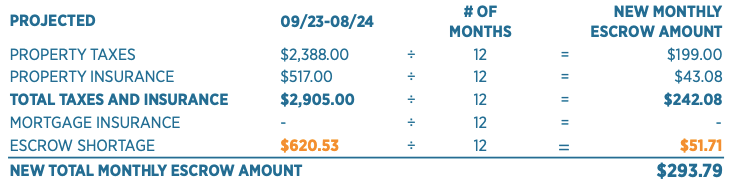
They clearly showed that the anticipated property taxes are projected at $199 per month (although, I’ll reiterate that this is based on last year’s actual outlay numbers, which aren’t accurate for the coming year). Then they show that the taxes are $43.08 per month. They then go as far to show the total of these two required outlays. There’s verbiage that explains the required minimum in the account must be twice the total taxes and insurance ($242.08 * 2 = $484.16).

There’s another detailed breakdown of each month’s escrow income and outlay (that I don’t have pictured here) that shows the month that is projected to fall below the required minimum. That month’s account balance is -$136.37. The difference between the required amount of $484.16 and the negative balance of $136.37 is $620.53 (pictured above). When that’s broken down by month, it’s $51.71. Take the total taxes and insurance payments and add the shortage amount to get the new monthly escrow amount of $293.79, a change from $222.25.

Below, they show you that there is no change in the principal and interest payment, then it shows how the current escrow payment is adjusted to the new escrow payment, along with the shortage amount.

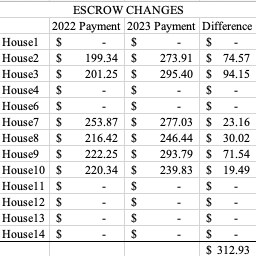
I created this table to show the differences between escrow payments over the two years. I kept the houses that don’t have an escrow because it can be compared to a future table in this post. There is no House5 in this table because we sold it several years ago (houses didn’t get renumbered because House5 still exists in terms of tax documentation).

TAX AND INSURANCE UPDATES

Each year, we see an increase in these amounts. Usually it’s across the board, but Kentucky districts had kept the housing assessments the same through the pandemic. As housing prices increase, your property assessment can be increased by your tax jurisdiction. The assessment increasing leads to an increase in taxes. This is why people getting excited that house prices in their neighborhood are selling higher than expected isn’t great if you’re not planning on selling any time soon; those increases in values means you’re paying higher in taxes.

In Richmond, VA, the property taxes are $1.20 per each $100 of the assessed value. In 2022, House2’s value $163,000. In 2023, the value was increased to $203,000. And let’s not forget that we purchased the house for $117,000. While it’s nice that the home values in the neighborhood are increasing significantly (and we knew the area was going to get better and better based on development happening), we can’t realize this gain until (and if) we sell. So in the meantime, we’re paying higher taxes on this amount. Although, I suppose the assessment could be even higher because the actual value of this house is probably more like $260,000.

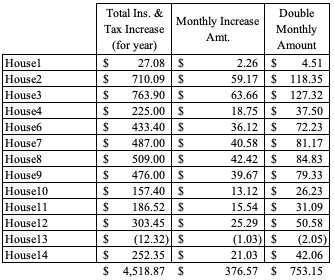
Among 13 houses (don’t get confused – there’s no House5 up there because we sold it), I need to cover a total cost increase for taxes and insurances of over $4,500. This doesn’t include the higher costs of trades people if there are any maintenance calls, so this increase is the bare minimum for me to keep my same income.

RENT INCREASES

I constantly see complaints about the cost of rent, or that a landlord is increasing rent. Unless we’re looking for a tenant to move, our general philosophy is to increase rent $50 every two years. This worked fine because home assessments increased at a slow, reasonable rate until recent years. Now jurisdictions are capturing these larger increases based on those inflated sale numbers when competition was high in from 2020 through 2022.

In some cases, the rent for the area brought it in a higher amount than compared to our purchase price of a house. In those cases, we went several years without increasing the rent. Looking back, that probably wasn’t the best idea because now we’re behind on capturing how significant these last few year’s fixed costs have increased. However, the trade off to that is that we’ve kept great tenants in the house, haven’t had to pay to turnover the unit, and have minimal maintenance calls.

This table shows the total increase in insurance and tax payments from 2022 to 2023 in the first column. I divided that by 12 to get the monthly amount of that increase (second column). Then, since I said we typically increase our rent by $50 every two years for the same tenant, I multiplied that monthly amount by 2. I’m showing that if we want to only increase rent on long term tenants every other year, then I need to plan ahead on how much my costs are increasing.

This isn’t a perfectly accurate capturing of our cost increases since I’m not going back to 2021 to capture those changes in amounts, but it’s a general estimate. This shows that if I were to increase all houses by only $50 every two years, it’s cutting into my bottom line. Only 6 of the houses have increases less than $50 for two years.

SETTING THE RENTAL RATE

Let’s pause and talk about “bottom line.” Landlords have investment properties to make a profit. They’re looking for an income stream.

I regularly hear people say they can own a house for less than their rent, which is likely if you’re speaking only on principal and interest of a loan. However, you need to qualify for that loan. You may not have 20% down, so you may be required to pay private mortgage insurance (PMI). You may not have good credit, which means you’re probably going to pay a higher interest rate than I’m currently paying. You need to be able to cover taxes and insurance, which means you’ll have an escrow account set up, which increases your monthly mortgage payment. Then there’s all the other costs of home ownership.

That’s where people forget. When your hot water goes out, you call me. I spend $1,500 for about 2 hours worth of someone’s work to replace that. When you have a water leak, I spend $3,000 for a day’s worth of 2 plumbers’ work. When a storm drops a tree on your house, I’m the one spending hours on the phone with insurance, finding a contractor, getting quotes, and paying the contractor $3,700 before I get insurance reimbursement. Those are the big unexpected expenses. That doesn’t include all those smaller plumbing problems that cost $200 or $500 at a time.

Then in some cases, I probably put time and money into the house to even get it ready to rent to you. I didn’t always buy a house that was ready to live in. You may have projects that need to be done when you first move in also, so which costs money. Those are expenses that I’m trying to recoup through my rent rate also.

There may be other costs to my ownership that I’m trying to recoup through the rent, such as property management. I may have to pay someone else 10% of the rent, every month. I am projecting that there are going to be costs that I need to pay for also (e.g., water heater, roof replacement, plumbing issues). When I need to pay a plumber $3,000, I’m not coming to the tenant to say “I now need $3,000 to cover this cost.” Instead, I’ve set my rental rate the expect such a large payout on my part.

Not only am I trying to make sure that my rent is set at the right about to cover the costs that I’m putting into owning and maintaining the house, I’m also hoping that I’m going to make some money off owning this house so that I can live. I don’t get to pay myself for the hours I put into managing the property. Whether or not I have a property manager, there is still time that I put into managing the houses. Would you want to work for free?

BACK TO RENT INCREASES

While we manage each house individually on setting the rates (asking ourselves: do we think the tenant can absorb the increase, do we have to increase to cover actual costs now), this shows that our monthly income was increased by $475. If you look back at our total monthly increase in expenses of just taxes and insurance, it’s about $375; add in the cost increases for property management (increased rent means increased fees because fees are based on the rent price), and our fixed costs went up $415. On a whole, we’ve offset the increases.

However, you can see if we had one or two houses, some of those increases could be significant. House3 is costing us $64 more for each month, but our increases are typically about $50 at a time. We’ve had the same tenant in this house since we bought it. A $50 increase every two years hasn’t kept up with our costs. Since we have other houses, it helps cover the costs on House3.

House2 and House3 are identical in layout. House2 has been upgraded to all LVP, whereas House3 has carpet everywhere except the kitchen and bathrooms (granted, it’s new carpet two years ago). Since we purchased these two homes with tenants, rent was already set for us. House3 has been the same tenant since we bought the house, and the increases have brought us to $1200 per month in rent. House2 has been turned over 3 times: the first was a divorced lady who moved back in with her ex-husband; the second was there for several years, but we began having a lot of issues with her, and we told her the lease was up; the third was the one who flooded the house in December, and causing the need for the fourth. Now we’re renting that house at its market value of $1600. That means House3 is operating at a much lower rent than we could get if we rented to new tenants. However, the tenants are wonderful, and we’ve purposely not raised the rent on them in significant ways because we don’t want to cause them to move.

SUMMARY

Cost increases in rental properties can be significant over the years. With the rising costs of all goods and services, property values weren’t immune. The increase in property values leads to an increase in an assessment, which means an increase in taxes. That cost is relayed to the tenant, as this is a for-profit business. I’m trying to make an income for my family with rental properties.

I’m not trying to price gouge tenants, but make a fair living based on the costs of owning these houses. My first goal is to not turnover tenants, so I do what I can to make my tenants happy by taking care of the houses and not creating drastic rent increases each year. Secondly, I’m not going to set a price that my tenant can’t afford, thereby putting me in a hard position where I don’t have rent paid. Having multiple properties helps to offset the costs so I don’t have to play catch up on one or two houses worth of higher expenses, by putting my long-term tenants in an uncomfortable position where they can’t afford the rent.

Hiatus Update

Over the past year, I tried really hard to stay on top of sharing content here, until I finally had to throw in the towel. It started because we were renovating a house while I was pregnant and had two kids to take care of, so my posts dwindled down to just the net worth updates. Then Mr. ODA started investing in treasury accounts. There was so much movement of money in so many different accounts, that I couldn’t quickly update our net worth anymore. Other than updates of the net worth and rental property work, my last post was August 2022. I feel like I have the bandwidth to finish several posts that I’ve started, so I’m back.

NEW HOME

In May 2022, a house went on the market in our desired area of town. We weren’t ready to leave our house since we hadn’t owned it for two years yet, but this was an opportunity that was hard to pass up. We closed on the new house in June 2022. We floated the down payment through a Home Equity Line of Credit that was paid off through the sale of our house.

We spent the whole summer traveling back and forth between our then-current house and the new house because we had a lot of work to do on the new house. We demolished the master bathroom and started rebuilding that. I painted almost the entire house. We did a lot of little projects. It was a tiring time that culminated in having to do the physical move in the Fall and get the new house organized and set up.

NEW BABY

I was pregnant through all of the home renovations and move. Our son came 3 weeks early on Thanksgiving day. He was generally healthy, but he required extra medical attention than we weren’t used to with the first two. On top of that, he wanted to be held to be asleep; babies sleep a lot. Mr. ODA and I were taking turns holding the baby and sleeping. The two older kids basically survived on tv shows and chicken nuggets during this blur of life. Going from 0 to 1, and from 1 to 2 kids was pretty easy, but this 3rd kid was a new ballgame. Once he was 5 months old, I started working on getting him to sleep independently. Now that he’s 7 months old, he sleeps well in his crib for his naps and through the night; he’s happy during the day and plays well; and now I feel like a new person for actually getting rest and not being tied to a couch all day everyday. Mr. ODA took a lot of time off to help me through that phase. As he started working again, it was an adjustment for me to learn how to manage all 3 kids and the household.

PERSONAL

We had several trips last summer on top of the renovations that we were working on. Those created delays in us having the house ready for us to move. Then our oldest got sick and it turned into an issue in his leg so he couldn’t walk at all for about 2 weeks and couldn’t walk right for about 8 weeks. It was a rough time. He got better just as I was about to have the baby.

As we started to get into the swing of things with all 3 kids and coming out of winter, my mom got sick. She went downhill quickly in March and ended up passing away on my birthday this year. That was unexpected and emotionally draining. We just got back from a trip to see my family, and I feel like I’m more put together than I had been over the last 3 months.

In April, we had to submit our taxes. This is always a several hour process. I had documented in the past, but I just didn’t have time to juggle it this year. I have to verify that I’ve recorded all expenses, that I haven’t recorded expenses that aren’t supported by documentation (e.g., receipt), that my summaries are logical, and then it takes Mr. ODA and I 5-6 hours worth of entering data to actually submit.

Then we added swim lessons and soccer for the kids. We quit soccer early because it just wasn’t fun for our oldest (or us), and 3 months of swim lessons are over. Now our only commitment is whether or not we want to attend library story time for a half hour each week, and I’m appreciating the open schedule.

BUSINESS

The rentals have required a lot more than usual attention from us in the past year. We had a house flood from a burst pipe, so that had to be cleaned out, renovated, and re-rented. We had several plumbing and HVAC issues among multiple houses, as well as a raccoon removal issue. We had roof damage to a house, a tree fall on a house, and another tree fall in the yard of three different houses, all because of storms. We had to turnover a house, where the tenant had lived there for several years, had made changes that were not appropriate, and would not communicate effectively on her status of leaving. It has been a lot more than usual, requiring a lot of time to manage.

On top of the maintenance requests and the usual management of the properties, I also took over the management of the properties that are in Central KY in February. I was spending so much time managing the property manager, that it was finally time for me to just handle it.


Not that you needed all this background, but I felt weird just jumping back into content. We’ve been very busy in general, but adding a 3rd kid into the mix was the straw that broke the camel’s back. I finally feel like I can manage everything again, and I’ve had more and more thoughts for things to share.

Rental Work

Every once in a while, I’m juggling a few rental property items, and I like to share the effort being put in. While it may be taking some of my energy now, it’s not something that happens often. Usually, Spring is our busy time because we have to manage leases ending or renewing. We have upticks in maintenance requests at the change of seasons each Fall and Spring (usually a plumbing or HVAC issue). For most months though, we don’t have to do much. I’m currently in a season (somewhat self-imposed) where we are busy and the rentals are requiring more-than-usual attention. Here’s that story.

RENT COLLECTION

One of the houses that I took over management for didn’t pay rent. I had to reach out to her on the morning of the 6th. She then asked to have until the end of the day. I told her that was fine, but if she didn’t pay by the end of the day, she’d have to pay a late fee (which is technically required after the 5th); she paid a few minutes after that message.

Another tenant let me know that they were sick last month, so they needed more time for rent. I let them know that was fine, and not to worry about the late fee. They paid a day earlier than when they expected to be able to pay.


LEASE ACTIVITY

Interestingly, several lease-related actions have been taken. I had to get 3 leases executed because I took over management of those properties (more on that below).

I had one tenant let me know that she won’t be renewing. She has been in that house since July 15, 2018. She sent me a text letting me know that she’ll be moving out on April 30th. Funny because her lease goes through June 30th of each year. But since she’s been there for so long, gave us ample notice, and so politely picked the end of a month, we’ll just go with it. It’s a 2 bedroom house, so we were surprised she spent as long as she did there. The first tenant we had in this house put us in contact with the current tenant. Ironically, the first tenant had recently asked if we had any 2 bedrooms coming available. At the time, I didn’t. But now we have the same house coming available, so I let her know. The person she knows looking for a house is interested in living there, so we’re going through the application process now!

I had another tenant tell me that they want to renew for another year. It’s for a house that I just took over management for. Since I don’t know them at this point, I didn’t want to agree immediately. Their notification deadline is March 31st, so we’ll revisit that renewal next month.

Then I had another tenant ask if they could renew. Their lease term isn’t up until April 30th, and their notification deadline is the end of February. Every year, they let me know their status some time in January. We reviewed their lease terms and decided to keep their rent at the same rate for another year. We typically increase $50 every two years, and their increase was at the beginning of this current term. She did play their hand and tell me they wanted to stay because rent is so expensive elsewhere, but we’re nice people. 🙂


WATER HEATER ISSUE

At the beginning of January, we received notice from a tenant in VA that their hot water wasn’t working. Being that it was really cold, it wasn’t surprising. However, the unit was installed in August 2021, so we weren’t happy to hear that. We called the company that installed the unit. They scheduled an appointment for the next morning. When the tech didn’t show, our property manager called them and was told they suspended all plumbing jobs and the scheduler shouldn’t have scheduled the job. So our manager got another guy out there that afternoon and discovered that the wires weren’t installed correctly. His report stated: Dispatched to home due to home not having hot water. Found burnt wires in electrical access due to improper installation. Two unlike wire materials, not joined together correctly. Cut and removed burnt wires and reinstalled the correct way.

Now I’m trying to get in touch with someone at the installation company to address this. We’d like our $200 reimbursed for having to call a different plumber out. I called to complain on 1/20. I was told that a service manager would have to call me back. No one did. I called this morning and was told I’d get a call back in a half hour. No one called this morning. At 1:15, I got a call from some guy who poorly introduced himself and wanted into the property right now. Um, no. I politely told him that I didn’t appreciate the way he was talking to me and that I’d speak with someone else. I called someone back in the office, and she had a different guy call me. I emailed him the paperwork from the other plumber. He agreed to process the reimbursement, and am now waiting on that confirmation.


PROPERTY MANAGEMENT

We’ve had some issues with our property manager in KY. Perhaps their actions are completely normal, but they haven’t met our expectations. We were asked to reimburse a tenant for a high water bill because they dragged their feet on timely fixing it, and then took two attempts to even fix it. Our contract deleted the automatic 10% uncharge on all contracted services (meaning, if they hired a plumber, and the plumber charged them $100, then they’d charge me $110). We argued at contract negotiation that their hiring of a plumber is covered in their monthly management fee and removed it from the contract. Their system automatically adds the 10%, which is understandable, but I would have to review every single invoice and ask for the 10% to be returned. That’s a lot of managing-the-property-manager.

Then we had a huge issue with them last May. I covered the first part of the issue through the Tenant Abandonment post. The second part of the issue was how their accounting manager handled the rest of the conversation. They took their management fee off of the security deposit. I had questioned this on the last property turnover, and they agreed to give me that money back. I thought it was the same across the board – that it was an accident in their system, with it counting as “income” so they took their share. The conversation disintegrated from there. They claimed that since the security deposit was being applied as rent for the month the tenant abandoned, so they could take their share. I said that a security deposit’s purpose is to cover damages, and there was A LOT of damage that I need to pay for, so I shouldn’t be at their whim to decide how the security deposit is going to be applied (not to mention it was their lack of management and effort that created the vacancy). He then started to claim that their level of effort was more than the $90 I was arguing over (1. false. 2. that’s not how my paying you works… what about all those months I paid you $90 for you to do literally nothing). It turns out that I put all my effort to respond to this person’s initial statement of “This security deposit for the tenant has been applied toward rent.” While he said that, that wasn’t actually the reason they took a fee from it, and in actuality, our agreement would have allowed them to take their commission out of the security deposit. But where the relationship really went sour was when this accounting manager started looking through all our charges and decided to hit us with two $500 charges, that we had already paid. We got the owner involved, stating we didn’t appreciate this “desk audit” to try to “get us” on something, even though we had already paid it. Mr. ODA went to meet with them, and everyone apologized for this one person’s brash actions, but that was the last straw for me.

We now live here, so I can take on management of the houses instead of paying people who I have to argue with every time a charge comes in. Unfortunate for the timing, we then purchased a house that we put a lot of work into over the summer, and then I was very pregnant, so we didn’t terminate the agreement immediately. Mr. ODA decided that the beginning of the new year would be a clean break, but by the time I got the letter out, it didn’t terminate until January 31st. They’ve been great about turning over all the finances and information thus far.

So as of February 1st, I took on 3 more properties to manage. I had to establish my own KY lease agreements, which meant referring to the leases currently in place through the property manager and my own templates from VA. I then had to meet the tenants for their signatures. I went to each of the houses, which was a reason to see their living conditions. I didn’t call it an inspection, and I didn’t require a tour of the house. I simply used the initial experience as a gauge on how they’re treating the property. For one, we turned it over after the tenant abandonment, so we didn’t expect it to be too bad. But we hadn’t seen the other two houses since 2019.

Over two days, I met with the tenants and executed the new leases. Two of the meetings were a half hour each, and one was a while longer because we were talking about some of the issues they had with the management company’s maintenance. Of course, meeting with tenants in person usually ends with a to-do list on my end. So once I got home, I put together their leases and the to-do lists for me. I now need to schedule going out there to do their fixes.


BURST PIPE

On December 27th, I received a call from one of my tenants letting me know that water was pouring out of the house next door (that’s also ours). The tenants had turned off the heat… when it was 6 degrees for 3 days straight. The water heater is in the attic and a pipe cracked during the freeze. When it started to thaw, the constant water running filled up the house. Our property manager went to the house and found two inches of water throughout the entire house, along with a collapsed ceiling in the master bathroom. Over the next two days, the ceiling in the adjacent laundry room and the master bedroom also collapsed.

The tenant’s renters insurance was responsible for removing their belongings. They created quite the speed bump, and the tenant’s items weren’t removed for 5 weeks. We finally got their things out, and now we’ve been working with contractors to get the house put back together. We agreed to a contractor who worked with our insurance to get their full amount of work covered (there was about a $6k difference between the insurance adjuster’s estimate and the contractor’s estimate). The insurance company agreed to the new estimate.

We’re now working on the contract with the company who will put the house together. The initial contract required 50% payment up front, which we didn’t feel comfortable doing. Now we’re waiting on an updated contract with a new pay schedule that will split the payment into thirds.

Our next step once the contract is executed is to pick out all the replacement things. On top of them fixing the bottom 2′ of drywall throughout the entire house and all the ceilings that collapsed, along with replacing insulation, fixing the crawl space, etc., we have to make selections for new bottom cabinetry in the kitchen, new vanities in the bathrooms, and new flooring throughout the whole house. I’m hoping that once these selections are made, it’ll be smooth sailing. The contractor is 3 weeks out to begin, and the contract says it’ll take 40 days to complete.


While there’s a lot of things being juggled right now, it’s still not equivalent to a full time job. Since insurance is paying for the replacement of damaged items in the one house, it’s not a high spending month. It’s just requiring more brain power than usual.

January Financial Update

Life is different these days. Our 3rd child was born on Thanksgiving, and we’ve been finishing up some projects around the house. We’ve had a few things happen with rentals, and, basically, I’m just tapped out to keep up with blogging. Mr. ODA asked me what our net worth is at these days, and so I’m updating our spreadsheet.

“JANUARY”

It’s January, so that means I have to create my two main Excel workbooks for the year: the paycheck to paycheck monitoring of our expected income and expenses, and the management of each rental property. The paycheck to paycheck spreadsheet is where I have a line item for each house’s rental income each month, each house’s mortgage payment (where applicable), and then all our bills owed (credit cards, utilities, investments). I break this down by paycheck because that’s the easiest way for me to make sure I have enough income to offset the bills owed during that two-week period. That worksheet in that workbook feeds my net worth calculations, where I also update loan balances. There is actually several tabs in this workbook, but those are the main two. I finally got that all set up today. I haven’t even started creating the investment property workbook.

January also means I have to go through last year’s investment property workbook to verify all the expenses listed are supported by receipts, that all receipts I have are recorded, and that my income is accurate. Then I read off the data to Mr. ODA, who enters it into an online tax portal to file our taxes. I haven’t started that daunting task either.

RENTALS

We had one of our properties flooded by a burst pipe. That’s a mess and is hardly making progress because the tenant’s renters insurance can’t get the tenant property out of the house. We had an electrical issue with a hot water heater in another property. That got fixed, but now I am in a position where I have to fight Home Depot about their shoddy installation a year ago and have them reimburse the cost of rewiring. I finally moved forward with the judgement against a tenant for destruction of property, and our attorney established that collections account.

Surprisingly, we didn’t have any issues with rent payments in December or January. Usually I hear from one or two houses that they need a couple of weeks to pay all of rent. While not everyone was on time, they communicated well and were only a few days late. One tenant reached out and asked if they could pay rent on the 6th (since that’s Friday, and pay day); I told them not to worry about the late fee and that would be fine. Little gestures like that can make a big difference for your tenant’s life.

I sent a letter to our property manager for the KY houses that we’re releasing them at the end of this month, so that’s a new development that is taking my time as well. You’d think my property management company would have a way to communicate this change with the tenants, but alas, that would be too logical. Wish me luck while I add 3 more houses under my own purview. While we moved to KY two years ago, it was easier to maintain status quo with having a property manager. Unfortunately, it has taken too much of my effort to manage the property manager and to fight for our money.

PERSONAL

We finished our master bathroom in the home we bought over the summer (and the room we gutted immediately… only took 6 months to get us to the finish line… and by finish line, there’s still paint touch ups to be had). We bought all the supplies to gut and renovate the basement bathroom in this house. Mr. ODA built a bench for our kitchen table so that we have more seating easier. We made the plans to get the mudroom bench and shelves in, and hopefully those supplies will be bought this weekend.

Truthfully, while I updated most of my net worth spreadsheet in December, I never posted it because I don’t even know where all our money is. When we sold our personal residence at the beginning of November, we were handed a large check. In the past, that check type mostly went towards a downpayment on a new house, but that wasn’t the case this time. Mr. ODA immediately started investing that money in short term treasury accounts that I can’t even begin to explain. Between that account, another savings type account, and our regular investment account, I can update what I see online, but I don’t know what I may be missing. I’m hoping Mr. ODA will chime in soon to describe the type of investment decisions he’s made.

NET WORTH

Several property value assessments declined over the last couple of months. So while our investments are on the upswing from November’s update, those updates to property values have caused a decrease to our net worth.

House 12 & 13

Surprisingly, I didn’t cover all our houses in posts last year. I was going to say, “let’s finish this up,” but we’ve since purchased #14! This is a long post. I tried to separate the stories, but since they were part of the same purchase, it was too convoluted to decide which story went with which house.

We spent the summer of 2019 living in Lexington, KY. Mr. ODA took a temporary job for 3 months, and we spent our summer looking for more rental properties to try another market. The housing costs in central Kentucky were less than central Virginia, but the rental rates were also lower.

We drove around with our Realtor for quite some time. We were hoping to find a multi-door complex. However, 4-8 door units have just not been well taken care of. We take care of our houses, and I didn’t want to inherit all the deferred maintenance of a poor landlord. Many of the places had long-term tenants, so there wouldn’t be a vacancy to ease getting work done either. Additionally, there were several that we saw where the tenant was home, smoking and telling us all that was wrong with the property. It was abysmal.

So after searching through many other options, we settled on two houses at the same time.

FIRST OFFER

Mr. ODA actually made an offer on a house in Winchester that I hadn’t seen. It was a large house that had been converted into 2 units. Mr. ODA and our Realtor went after work one day, and it wasn’t worth me packing up the baby and driving a half hour to meet them for one house. However, I did get to see some of it because I took on the home inspection appointment. Since I had never walked through the house, it was easy for me to objectively see the information on the inspection and convince Mr. ODA to walk away. There was just too many big-ticket items (e.g., not enough head room for stairs, water damage not properly cleaned up in multiple rooms, several code violations) and deferred maintenance that it wasn’t worth us putting the money into it. The tenants were sitting on the porch smoking during the inspection, and I didn’t love the idea of inherited tenants that were allowed to smoke in the house.

SECOND OFFER

I can’t tell the history of these purchases without this gem of a story. Mr. ODA found a house that was in a decent shape in Winchester.

Aside: We focused on Winchester because while the rent income was low, the housing cost was also low. Whereas in Lexington, the rent was low, but the housing prices were higher.

We made an offer on the house. In the offer, it lists the seller’s name. It was a State Senator! When we sent over the offer, the seller’s agent agreed to our details, but asked for a pre-approval letter before he’d sign. The amount of weight the people in Kentucky put on a pre-approval letter is absurd, in my opinion. We went through the effort to get the letter and send it over. About that same time, the seller’s agent said someone else came in with a better offer, so we could either submit our highest and best offer, or lose the deal. The sketchiness of the action floored us.

The house had been on the market for a month. We had a verbal agreement (that had even been put in writing, but not yet signed). What are the odds that someone came in at the same time as us with an offer over asking for a house on the market a month? We called his bluff, and we were wrong.

THIRD AND FORTH OFFERS – UNDER CONTRACT

In August 2019, we went under contract on two houses in Winchester, KY.

Property12 had been owner occupied and flipped to sell. The owner had lived there long enough that she wouldn’t Docusign the contract, and we had to wait for her to initial, sign, and date all the pages by hand. The house had been listed for 36 days when we made the offer. It was listed at $115,000, and we went under contract at $112,000 with $2,000 in seller subsidy (closing costs) on 8/7. It’s a 3 bed, 2 bath ranch at 1120 sf.

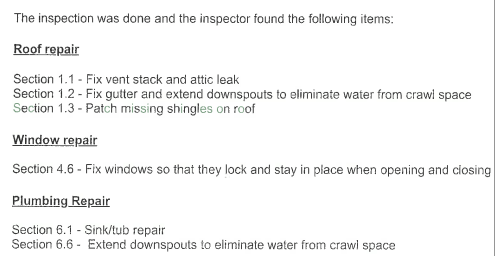
We received the home inspection on 8/14. We asked for the items below to be addressed, or to take $1000 off the purchase price. They agreed to fix the issues.

Property13 had been listed for nearly 3 months before we made an offer. It had been most recently listed at $105,500. Our offer was for $102,000 with $2,000 seller subsidy. We also included the following requirement in the contract: Seller agrees to remediate the water and mold in the crawl space, fix the down spout next to the crawl space door so that it channels the water away from the home, replace the missing gutter on the front of the house, and repair the rotted facia and sheathing on the front of the house.

Additionally, we had a home inspection on the house and identified the following items for them to repair.

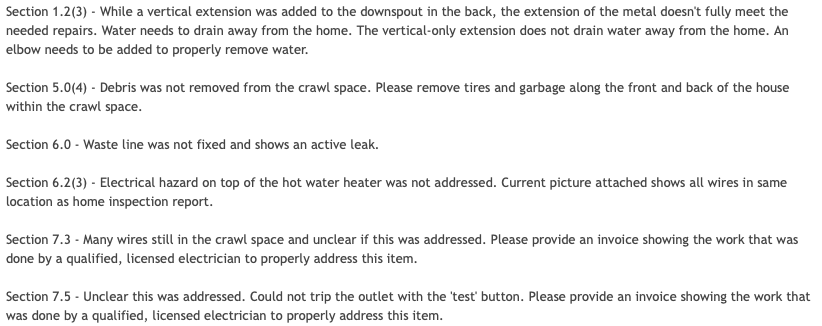
Getting the sellers to identify that these items were done before closing was not an easy task. We checked the day that closing was originally schedule for and noted that several things were not complete.

Then, at 7:30 pm the night before closing (which had already been delayed a week), we received one receipt identifying a couple of things were done. Eventually we received documentation that it was taken care of.

LOAN DETAILS

The options we typically ask for when considering the direction of our loan are as follows.

We chose the 25% down – 30 yr fixed option for both properties. Our goal is to not pay points, so that led us to the 25% down options. Since there was no incentive to take a shorter term (thereby increasing your monthly mortgage payments and decreasing your cash flow), we chose the 30 year option.

These loans were originated in September 2019. We processed multiple cash-out-refinances on some of our properties in December 2021; we used it to pay off about $66k on Property12 and about $74k on Property13.

LOAN PROCESSING & DELAYED CLOSING

We had a lender that we loved in Virginia. She couldn’t cover loans in Kentucky, but the company itself had a branch that could do it. She referred us to someone in Kentucky. It was the worst experience I’ve had in closings. Our closings are always annoyingly stressful in that last week, but this was bad throughout the month and then bad enough that our closing was delayed a week – completely due to the loan officer’s inability to manage the loan.

We had multiple issues over the course of the week we initiated our relationship just accessing the disclosures. They kept telling us to sign things we didn’t receive, or they’d tell us our access code and then when I say it doesn’t work, act like they never told us different information and give new information.

On August 16, I had to tell the loan officer that one of the addresses was wrong. THE ADDRESS. On August 26, we received conditional approval of our loan from underwriting. On August 27, we received our appraisal with no issues noted. But at that point, our August 30 closing was delayed a week already.

That’s where the problem was – our appraisal was ordered late, had to be rushed, and still didn’t make it in time for them to develop the Closing Disclosure (CD) and get us to a closing on August 30. The loan officer never once acknowledged that he ordered the appraisals late, causing this delay. It took asking for timelines from his supervisor, and piecing together emails we had on hand, to show that it was his fault.

On August 29, I finally made contact with the loan officer’s supervisor and was rerouted to someone else to get the job done. I had to repeat all of our issues and the errors that were found on the CDs.

On September 3, I was given disclosures that were still wrong. The new loan officer claimed that what she put in the system was correct, so she wasn’t sure what was wrong, causing me to once again outline all the errors.

On September 4, I was asked for more documentation that wasn’t caught during underwriting. I was furious.

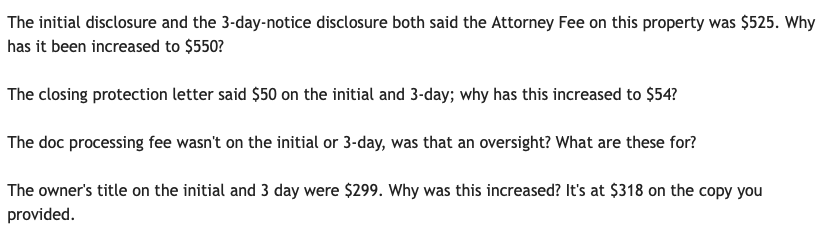
On September 5, I gave up talking to our lender about issues on the CD and spoke directly to the Title Attorney’s office, who was much more knowledgable and responsive. Here’s an example of what I’m questioning when I look over a CD. Some of these seem small (e.g., $4 difference, $25 difference), but you can see how these add up, both on a single transaction and when we’re processing several homes in one year. Not to mention – why pay more for something than you were quoted or you’re supposed to?

Another surprise that came our way was a “Seller Agent Fee” for $149 per transaction. At no point in time was an additional fee disclosed to us by our Realtor. A typical transaction has 6% commission paid by the seller, which is traditionally split 3% and 3% for the buyer and seller representation. Being that these were Rentals #12 and 13, in addition to 2 personal residences we had purchased, imagine the surprise when we, as buyers, were being charged for representation. We questioned why this wasn’t disclosed to us up front as a Re/Max requirement, and it was taken off our CD.

CLOSING DAY

I had planned to leave town the Friday after the original closing date because that was the last date that we had our apartment. I didn’t want to move me and the baby into my in-laws house and continue the poor sleep we had been dealing with by not being at home. So even though closing was delayed, I left. Mr. ODA had to be my power of attorney. He had to sign his name, write a blurb, and then sign my name on ALL those papers that are part of a closing….. times two. Eek. I didn’t know that at the time (but baby went back to sleeping perfectly once we were home, so it was worth my sanity 🙂 ).

At 11:30 am on closing day, the lender claimed that the power of attorney documents (from the lawyer…) were not complete enough to be counted as filed on their end. I appreciated the snip from the attorney when questioned.

I always wondered why tv shows always showed both at the closing table with a ceremonious passing of the key. We’ve had our share of weird closings (in a closet, in a parking lot, at our dining room table), but we never sat at the table with the seller in Virginia. We were so confused about how specific the closing attorney was being about the closing time options, and then we found out that the seller and buyer are at the table together in Kentucky. The seller for Property12 was so rude to Mr. ODA through the transaction! She kept grilling him on whether he addressed the utilities. The seller shouldn’t be allowed to talk to the buyer! We’ve since been able to process 3 transactions in Kentucky and avoid the seller at the table, but I’d like to advocate that Kentucky move away from this buyer/seller meeting process!

RENTAL HISTORIES

Property12 was listed at $895 on 10/2. Based on my birds-eye-view of the area, I thought $1000 was going to be easy to rent it at. Based on the 1% Rule that we had followed in Virginia, we should have a goal of $1,100 per month. However, we were trying for a Fall lease, which is more difficult than a Spring lease, so I thought listing at $995 would get quick movement instead of letting it sit for too long. Our property manager disagreed. She also said we were limited our pool of candidates by not allowing smokers; but, the whole house is carpeted and I was not budging on that.

We found a tenant on October 16 and allowed her to move in right away, but not start paying rent until November 1 if she agreed to an 18 month lease (we really wanted to be on a Spring renewal going forward). That was an unfortunate blow to our expectations – nearly two whole months without rental income on a house we didn’t need to do any work to.

We increased rent to $950 as of 6/1/2022 after no previous increases.


Property13 was listed for rent at $995 with no movement. We dropped to $875 and offered free October rent for however long was remaining in the month. A lease was established on 10/18/2019. Our property manager was supposed to establish an 18 month lease and didn’t. Luckily, the tenant agreed to a 6 month extension.

Property13 renewal came in April 2022. She had balked about the state of our economy in 2021, and we backed off the proposed increase at that time. Well, all the jurisdictions finally jumped on the increased assessments, and we saw a drastic increase in our costs. We told her that the new offer for a year lease is $950, which is higher than we’d typically increase in one year ($75 instead of $50). But we told her that we were willing to let her walk if she didn’t agree to it since she originally negotiated a lower cost and argued an increase at the 18 month mark, which we let go. She tried to fight it, but our property manager told her to check the rental options in the area to see that she’s still getting a deal. She agreed to the increase.

MAINTENANCE HISTORIES

Property12 requires a new heat pump in June 2021. We paid $3900 for a whole new system, which is a funnily low number just a year later.

The tenant there complained of high water bills. I asked to see a history of the water bills to know how much was considered higher than their average usage. The property manager agreed that the toilet was running and causing higher bills, but also admitted that they attempted to fix the toilet twice over a 3 week period, with multiple days between receiving a maintenance request and taking action. While I agreed that we could compensate her for the issue, I couldn’t quite pinpoint why this was my financial burden and neither the tenant’s nor the property manager’s. I followed up with more information from the property manager with questions like: Why did it take the tenant from 9/20 until 10/11 to identify the issue still remained and that there was a waste of water? They indicated that they believe they made a good faith effort to address the issues as reported. I eventually settled on a $25 concession on one month’s rent.

Property13 had several issues with the hot water installation that were eventually resolved, which was frustrating after we tried to manage issues with the hot water heater through the home inspection process and received documentation as if it was complete. The tenant requested pest control in July 2020 claiming that a vacant house next door caused an increase in pests. I was frustrated because that’s not how it works. I approved treatment at that time, and then she came back with another request in October. Luckily, I haven’t heard about pests since then. In my Virginia leases, we’ll handle some pest control requests, but if there are roach issues once a tenant has been there for some time, we don’t typically pay for that type of treatment.

SUMMARY

All in all, these tenants have been pretty quiet. They ask for random maintenance things here and there, but they’re not usually big-ticket items (except that HVAC replacement!). Our property manager has been more difficult than the tenants.

Being that we were used to the 1% Rule when we purchased these houses, it’s unfortunate that even at 3 years in, we’re not renting it at 1% of our purchase prices. Our cash-on-cash isn’t completely accurate right now because I won’t see our taxes for this year for another month or two. Being that jurisdictions kept the tax amount steady through the pandemic, I’m expecting to see an increase in assessments for this year. I’ve also seen big increases in our home insurance policies, so that will probably eat into our cash flow as well. Our cash-on-cash analysis on Property12 is about 6.5%, and it’s about 7.5% on Property13. These numbers are only slightly lower than our expectation/desire, with our average being about 8%.

In the upcoming year, we’re going to look to get rid of our property manager, so these houses may begin needing more attention from us. It’s been hard to take on more when paying a property manager has been a sunk cost at this point. However, the frustration of managing their management (e.g., making sure charges are correct, not getting a full picture of what work is being done, and then paying them a significant amount of management money and leasing money only for them to claim that checking on the property requires additional fees) has led to us wanting to take it on since we’re in town now. The current lease terms are up in April and May, so if we’re going to take on management, it should be before the possibility of paying them half a month’s rent for leasing it (not to mention they’re notoriously 4-6 weeks out in every leasing attempt they’ve done for us, whereas I’ve never had an issue getting a property leased within a week).

Property 2 Turnover

BACKGROUND

Unlike the other property we turned over this year, we knew this one was coming. The tenant living at this house moved in back in 2017. A few years ago, there was a domestic violence incident that led to a restraining order against one tenant from the other. Legally, we had to let the one tenant out of the lease. At the time, we didn’t have an immediate reason to release the second tenant from the lease, so we offered her a new lease in just her name. That was our downfall.

Since January 1, 2020, she paid rent on time in only 3 instances. I can think of only one instance where she told us up front that rent would be late. Every single month, I was stuck chasing her down. She’d say she would pay on the 17th, and then on the 18th, I’m asking where rent is again with another lie coming my way. She had quite the array of excuses. They were always elaborate. After getting stuck in Costa Rica for half a month in September because of a positive c-19 test, she didn’t even bother letting us know when she was back in the states or when we’d see rent. She applied for rent assistance. They paid 3 months of her rent for her (which was of course was significantly late from the state), and yet the month she had to pay, she still couldn’t.

Her lease was expiring June 30th this year. We provided her notice that we would not be continuing the lease and she was to vacate by 5 pm on the 30th and no later. Since we live 500 miles away, and I don’t trust her one bit, I hired my property manager that we use on other properties to take this one over. I wanted her to be the one to check that the tenant turns over keys and has the house empty before I drove 8 hours out there to find out the tenant is squatting.

THE LAST DAY

Sure enough, the tenant had a few more games to play. At 3 pm on the last day, she texted my property manager that she needed a bit more time, and asked if they could meet at 5:30 instead of 5. At 5:15, my property manager texted her saying she hit unexpected traffic, so she wouldn’t be there until about 5:35. My property manager pulled up to no people at the house, but there was at least one dog (not on the lease). The tenant didn’t show up until 6:50 pm.

My property manager means well, but she always seems to be advocating for the tenant while I’m the one paying her for services. The tenant asked if she could stay for a little while longer and remove the rest of her stuff. Well, based on the pictures, this wasn’t a “one more load” type situation; there were hours and hours of removing clothes and crap. All her furniture was out, but there was still garbage, dog feces, clothes, and some decor items left behind. My property manager was trying to say that she should be allowed to stay to remove her things and then she’d lock up on her way out. Nope. She absolutely didn’t have a place to stay that night, and it wasn’t my responsibility to keep catering to her. There was nothing that showed me allowing her access any longer was going to leave me in a position that was any different than I was currently in (meaning, hiring a junk removal company and having to pay someone for extra cleaning services).

Burned counter top
All of the cabinets still had things in them.
Just one of the rooms
Carpet eaten and ripped through the pad and to the subfloor.
Just part of the post destruction.

Oh, let’s not forget that she didn’t pay a dime of June rent. She claimed it was to be able to secure another place to live. However, she left her mail as garbage laying in the living room where we found she had been rejected due to her record. Sometimes I wish I could say, “we were giving you a chance; perhaps you should have paid your rent and communicated issues timely so you still had a place to live.”

I stuck to my guns and said get the keys. My husband was more compassionate and said that she could come back over the weekend to get her stuff while someone was there working on the house and supervising her actions.

TURNOVER WEEKEND

Her last day was a Thursday. She couldn’t come back on Friday because she was working the whole day. She said she’d be there first thing Saturday morning. At 9:20 am, nothing. She said she couldn’t get her trailer until 10:30 or something like that. At lunch time, still nothing. When questioned on her whereabouts, she made a list of things that she wanted us to put outside for her so she could grab on her own time. HAHAHA. She showed up at 1:10 claiming her dad was right behind her. Mr. ODA let her in the house, she grabbed a handful of things, and then left. That’s the last we’ve communicated with her.

TURNOVER ACTIONS

Mr. ODA and his dad went to Virginia to handle the turnover. I was going to go by myself, but being pregnant and alone inched out over my desire to make sure things were handled correctly. They arrived Friday evening and left Sunday evening. I was quite impressed with how much they got done.

All the stuff left behind had to be moved out of the way to get to work. Mr. ODA and his dad put it all in the living room so they could start painting. We paid a junk removal company $625 to get rid of her stuff and the old carpet.

The front porch post had been torn off the brick porch. Our untrained assessment seemed like someone had backed into the post. Mr. ODA was able to raise the porch roof back up to get the post back in place. He replaced the post tops and it looked good as new, surprisingly. There are still broken bricks, but that’s not a structural concern like the post itself was.

The entire interior of the house got a new coat of paint.

Mr. ODA had to replace missing and broken nuts in the bathroom faucet (how does this happen?!).

Blinds had to be replaced, as usual.

All the carpet had to be replaced. We didn’t have time to lay luxury vinyl planks (LVP) like we’d have preferred, so we settled on new carpet. While we were telling our handyman this, he said he’d lay the LVP for us, so we jumped on that. It’s more expensive up front, but we won’t have to do a full floor replacement in 3-5 years like we’d have to do with carpet or have to replace everything for a section damaged beyond repair. Mr. ODA and his dad pulled up the carpet, pad, and most tack strips.

We paid a cleaning company to clean the kitchen and bathrooms. She was supposedly there for 5 hours. That was $250.

We had to pay our handyman $100 to “paint” our countertops because there was a huge burn mark in the counter. They paired nicely in the multiple burn holes in the kitchen floor vinyl, which got covered by LVP.

We also had to pay someone $45 to mow the lawn. That seemed like an astronomical price, but we don’t have a lawn mower there, and it was easier to just let this guy do it when he asked.

After the new tenant moved in, they let us know the washer and dryer weren’t working. A diagnostic test of the washer seemed to say it wasn’t a user error and just coincidental timing, but then finding out that the dryer didn’t work right after that was interesting. The new tenant had their own washer in storage. We offered them the ability to buy their own dryer for $20 per month off the rent, which they accepted.

After we subtract out her security deposit, we’ll go to court for just under $10k worth of expenses. About $2,250 of that is unpaid late fees, so I don’t expect that to actually go anywhere once it gets to court. The first step is to send her a letter outlining all these details. Since the balance owed is so high, I preemptively offered a payment plan over 6 months. While $1650 per month is high for someone who couldn’t pay me $1150 each month, I don’t want to drag this out for a whole year. She’s not reliable, and I don’t want to be tracking and fighting her for a year to come. I also expect no response or resolution via this letter, and that we’ll have to go to court eventually anyway. Once it goes to court, she becomes responsible for court filing fees, and the judge will award interest on the balance, which adds up quickly.

SILVER LININGS

We bought the house with renters at $1050. We had worked on raising it $50 every two years (approximately), but rent was only at $1150. We recently refinanced the house, and the rental appraisal on it came in at $1600! If we don’t count that the tenant never actually paid June rent, we only dealt with a vacant house for 21 days and got it rented at $1,450. We probably could have pushed higher, but we were happy to get movement on it as soon as it was listed. To only be vacant for 21 days with the extensive damage and work to get it turned over is impressive to me.

While it was $6,000, the whole house got new flooring. Instead of trying to patch the vinyl in the kitchen and get new carpet installed for it to only last a few years, we were able to get LVP throughout the house. LVP will last much longer, and if there are damaged boards, they can be replaced individually instead of having to replace rooms and rooms worth of carpet.

CONCLUSION

This could be a horror story. However, we have 13 houses that help float expenses on the one or two where someone doesn’t pay rent timely or we have higher expenses. While we had to manage her month-to-month to track down rent, she did eventually pay all but that last month. In the end, for it to be a few things to address and it to take less than 21 days is great. This doesn’t go down as a reason to not hold rentals!