House 11

Our 11th purchase was a 4 bedroom and 2 bathroom house, which we were excited about. We only had one other 4 bedroom, and it only had 1.5 baths, so this was a new demographic we could meet. We again needed a mortgage, but we were tapped out (max of 10 mortgages allowed per Fannie Mae), so we went to our partner. I went through the process of establishing the partnership in the House 10 post.

The house had been listed for sale in July 2018, dropped the price in October 2018, and we went under contract on it on December 1, 2018. We went under contract at $129,000, which meant, according to the 1% Rule, we would look to rent it for at least $1290.

The house required a lot of cosmetic work (relative to our usual purchases) before we could rent it. The biggest hold up was the carpet replacement, but we had to do a lot of cleaning and painting also. We closed on February 4, 2019; got to work on the house on the 6th; and then had it rented on March 3, 2019. That’s a longer turnaround time than we’d like, but we thought the long-term benefits of a 4/2 house would be worth it. Plus, with our goal being $1290 based on the 1% Rule, we were happy that we rented it at $1300 and through March 31, 2020.

LOAN TERMS

We were given two options from the loan officer. Both options required 25% down. We could do a 15 year mortgage at 5.05% or a 30 year mortgage at 5.375%. The 15 year mortgage payment was $865, while the 30 year was $640. Since both options required 25% down and we aren’t concerned with our monthly cash flow (as in, we’re not living off of every dollar that comes out of these houses right now), we chose the 15 year. Escrow changes over the last few years have increased the mortgage to $941, unfortunately. However, we’ve been paying off this loan with pretty substantial chunks of money thrown at it. The loan started at $96,750, and the current balance is $21,350. We would have liked to have this paid off a few months ago, but we need to time our payments with our partner, who recently paid for a wedding, renovations to a new house, and a new tear-down property adjacent to his personal residence that he’s going to build a garage-type thing (city living = street parking for him).

We went under contract at $129,000, and the house appraised at $140,000, so that was a nice surprise. The current city assessment is at $148k, but it would likely sell for more than that.

PARTNERSHIP

Since the LLC was already under way when we purchased House 10, we needed to add this one to the LLC. We contacted our attorney. He processed all the paperwork, and we showed up just to sign everything in a quick meeting. At this time, we also requested an EIN be established for the LLC. To process adding this to an established LLC, it cost us $168 (which we paid half of since we’re split 50/50 with our partner).

PREPARING TO RENT

This house was probably the second most effort we had to put in to prepare it for renting. We had to replace quite a few blinds that were broken, do a deep clean of everything, install smoke alarms, paint, replace the carpet, and do some subfloor work.

We had to paint nearly every room (one room we even painted the ceiling the same color as the walls because the ceiling was in rough shape, and it wasn’t worth the time for precision of the edges).

The floor at the front door was rotted by termites. The guys had to cut out the floor and replace the wood before the new carpet could be ordered. We needed the house treated for termites at that point since there was an active infestation that we found. Depending on time and price, I’d rather replace carpeted areas with hard surface flooring for easier maintenance. Since we were already losing time with all the maintenance on this house to get it ready to rent and it was a small area, we just went the easy way out and put new carpet in. The carpet was only in the living room and hallway; all the bedrooms have hardwood flooring.

FIRST TENANTS

We were able to get a family in the house fairly quickly after we finished our work. We rented it at $1300. They signed it on March 3rd, and I had set the terms until March 31, 2020 (this comes into play later). The family had been renting with a roommate (and the husband’s boss!), and that guy had wanted to leave the house. In January 2020, the tenant said, “we signed the lease on March 3rd, so we want to be out at the end of February.” That’s not how leases work. The lease signed said until March 31, 2020. Some time between us telling him that he was in our lease until the end of March, not February, and the end of February actually coming, they decided they wanted to renew their lease. They signed a new lease with us on March 11 to cover 4/1/2020 through 3/31/2021.

In April 2020, the tenant received a job offer in Texas. He asked about a lease break, and we offered an option. All the communication was done via text message, so it was technically in writing, but there was never a “wrap up” text that identified all the agreed upon terms to allow for the lease break. I used this as a teaching opportunity for the 3 of us in the LLC that clearly documenting agreements in writing (preferably with signatures) is important.

The tenant offered to pay May rent without prompting, so we thought that was covered. The part that needed to be detailed was what was considered a “lease break” fee. We had agreed to 60 days worth of rent, and the security deposit couldn’t be used to pay that. Mr. ODA tried to contact the husband on multiple occasions to get rent paid at the beginning of May, but there was no response. I finally sent an email, detailing that they agreed to pay May’s rent, and that technically, they were on the hook for the entire year’s worth of the lease (quick aside: while that’s what the lease says, I think a caveat in the law actually means they’re not really liable for the whole amount because once the house is vacant for 7 days, it defaults back to our ownership, and then we have to show due diligence to re-rent it, leaving them liable for only the gap period). Well, as usual, the landlord gives us a guilt trip (their daughter was in the hospital in TX) instead of separating that from the concept of “pay your debts owed.” As a person, I feel for you on this; as a business owner, it’s not my responsibility to manage your finances and personal life.

The tenant called Mr. ODA and yelled at him. A few hours later, presumably with a more clear head, we received a fair response via text. He even apologized for yelling on the phone. He paid the last few hundreds that were owed, and we all moved on.

SECOND TENANTS

After our first tenants vacated the house, we had to get the house turned over. There was a good bit of work that needed to be done for just a year of someone living there. They had also left stuff behind that became our responsibility to get out of the house. We listed the house for rent. Our partner showed it to 3 younger people who would rent it together. They seemed great until we ran their background and credit check. They had evictions they didn’t disclose (claimed they didn’t know), so we shared the report with them and continued showing it.

We ended up showing it to a couple, and they liked it. After we accepted their application, we were able to get the lease signed on May 7, 2020. Since this was at the very beginning of the pandemic, we had to get creative. I signed this lease on a street corner (hadn’t realized that the place I had selected with outdoor seating was closed!), and they paid their first month’s rent, security deposit, and pet fee in cash that he handed to me in a sock (with a warning that told me this wasn’t the first time he handed someone cash like this haha). They’ve been great tenants, and they renewed their lease.

MAINTENANCE

The new carpeting when we first bought the house cost us $700. Between the termite treatments and other general pest control, we’ve spent $950.

Once the first tenant moved in, we learned of some other issues that weren’t apparent by us just working there and not living there. We had the plumber come out to fix several issues with the hot water that cost us $1450! Then we found out that the master bathroom shower wasn’t installed properly, and it was missing a p-trap; that cost us $325.

Our insurance carrier didn’t like that there wasn’t a handrail for the front steps of the property, so in March 2020, we had to have one installed at $190.

We had to replace the washing machine in April 2020 for about $500. As I’ve shared, we try to not include any ‘extra’ appliances because then maintenance and replacement are our responsibility. This was a fun one – we replaced it just to make the tenants happy and not deal with maintaining it, and then those tenants left right after that, and our new tenants brought their own appliances (so they just have two washers and two dryers in their kitchen).

We had an electrical issue with the master bathroom that cost us $150.

Luckily, I did the inspection over the summer, and nothing came of that initially. We did end up replacing a fan in the master bedroom because the light part of it stopped working with the switch. Since we don’t live near the house anymore, and our partner was in the middle of getting married, we went through Home Depot to have it installed, so all together (fan/light and install) it was about $175.

SUMMARY

This has been a good house. We didn’t realize that the house is located outside the city limits, so we needed to figure out trash pick up in the county (not included in the taxes). Other than a few maintenance hiccups, things have been smooth sailing. We’re happy with the tenants who are there, that they’re maintaining and cleaning the house, and we’re getting our desired rent amount (that they pay on time every month). The street is in a decently nice neighborhood with a lot of original owners, which helps it keep (and increase) its value.

Cash out refi

There’s a company in Virginia that advertises no-closing-cost-refinances. If it’s your personal residence, then this holds true. For investment properties, there are some closing costs, but it’s cheaper than the usual refinance. We used them for two other loans – one at the beginning of the pandemic when we signed the paperwork in a tent in the parking lot, and another where we signed the paperwork at our kitchen table in Kentucky with a traveling notary (that’s a thing!).

There was a threshold requirement in order to qualify for this refinance, and that was the new loan had to be at least $100,000. Only 2 of our houses had a loan originated for over $100k originally, so that limited our abilities.

Mr. ODA came to me and said he wanted to do a cash-out-refinance. This company had changed their policy, and they’d allow a cash-out-refinance to get us to the 100k threshold. The first two Virginia houses we purchased (2016) had balances of about 70k and 60k. We had enough equity in these houses that we could take a substantial amount out in the refinance, but Mr. ODA chose $50k each.

Here’s a run through of the thought process on how to do this and why it’s a benefit. I personally like seeing the details behind other’s decisions, so hopefully this will help someone or help make the concept click and open up an opportunity. This process was only just initiated, so I’ll do an update after we execute the plan to see how it changed.

The original goal was to use that money to pay off another loan. We’ve made our decision on which loan to pay off based on the highest interest rate. Right now, our highest interest rate is a loan with our partner at 5.1%, but this is also the loan that we’re actively paying off (leaving a balance right now of 26k, which we’re responsible for half). Since we need to time our principal payments to be matched with our partner, we can’t just dump money into this loan without really complicating things. So our second-highest interest rate is 4.625%. This loan originally was $89k in 2017 and has a balance of $62k. If we paid this off, that would leave about $35k in cash (based on the other two loan refinances that we’d take $50k out of each) that we could use to pay towards another loan or earmark for another purchase. As this discussion happened, Mr. ODA pivoted.

This company is only available to refinance loans in Virginia. Instead of paying off that $62k loan for a Virginia property, what if we also refinanced that loan and paid off one of two loans remaining on our Kentucky houses? I’m a visual person and needed to see how this would actually play out.

The terms were that if we picked a 15 year loan, that brings the interest rate down to 2.5%. With a 30 year loan, it’s 3.125%. I compared the current amortization schedule to the proposed amortization schedule, and here they are. Note that the interest isn’t a one-to-one comparison because we’ve already paid 4-5 years of interest on these loans.


HOUSE 2

The original loan terms were a 20 year at 3.875%.

The new terms would create a new 15 year loan, reduce the rate to 2.5%, and increase the loan to about $123k (pay off old loan, fees for closing, and $50k cashed out). This decreases our monthly cash flow, on this property, by $294.38.


HOUSE 3

The original loan terms were a 15 year at 3.25%.

The new terms would create a new 15 year loan, reduce the rate to 2.5%, and increase the loan to about $113k (pay off old loan, fees for closing, and $50k cashed out). This decreases our monthly cash flow, on this property, by $155.89.


HOUSE 8

The original loan terms were a 30 year at 4.625%.

The new terms would create a new 30 year loan, reduce the rate to 3.125%, and increase the loan to about $ (pay off old loan, fees for closing, and $35k cashed out). This is slightly off because the new loan isn’t showing at exactly $100k, but for all these the final numbers will be slightly different. This decreases our monthly cash flow, on this property, by $84.87.


In these projections, we’ll receive $135,000 cash in hand. With that, we’ll pay off the higher loan in Kentucky, which has a balance of about $81k. That mortgage has a monthly payment of $615.34. These three loans have increased their monthly mortgage payments by $535.14 in total. Since we’ve eliminated a monthly mortgage with the cash from these new loans, our total monthly cash flow actually has a net increase of $80.20. In addition to this net positive cash flow, we also have over $53k in cash in our account.

Now, if you know us, cash in our account isn’t a preference by any means. In my last monthly update, you can see that we have almost 20k in cash and that’s abnormal. Add $53 to that, and that’s just too much money sitting in a checking account. At this point, the goal is to buy another house. With the way the market is, we’re probably not going to hit the 1% Rule we strive for (the expected monthly rent will be at least 1% of the purchase price – $1000 rent for $100,000 purchase), and we’re not going to see the margins that we’re used to. It’s going to take a lot of effort to get our psychology right for this next purchase. We’ll have to hold strong in knowing that our other houses have great margins, and at least it won’t be negative cash flow.

At this point, we’ve started the refinance process by signing our initial disclosures and providing all the many, many documents needed to originate a loan.

A ‘month’ in the life managing properties

I started including this information in my monthly update post, but it got to be really long. I thought I’d separate it out as a way to share what has been happening and how I’ve been managing the properties over the last month.

RENT RELIEF PROGRAM

We’re still waiting for a check from the Rent Relief Program for one of our houses, and that’s to cover September, October, and November. So that’s fun. The program volunteered to pay for 2 extra months after the tenant only applied for September. We had already entered into a payment plan for September and October, and she was going to be able to pay November on her own. Instead, the program volunteered this, and all we’ve received for these 3 months of rent is $550. Technically, this now goes towards December rent, so maybe I should see it as we’re ahead for that one month and pretend I haven’t floated 3 mortgage payments on this house after this tenant was extremely irresponsible? I was especially frustrated that she received approval, and then 3 weeks later we were told that our payment hadn’t been made yet because there was an issue with one of the forms (how did approval happen if the forms weren’t complete???). A week ago, I learned that we should hopefully see the check in two weeks.

We actually found out on Wednesday that another tenant applied for the program. Luckily though, they applied for assistance with December’s rent. The program will probably approve two more months. Hopefully, we’ll get December, January, and February from the program before Christmas (I expect it to not be in time for December’s rent).

The tenant is using an organization that will help gather the information and apply to the Rent Relief Program on behalf of them. I’m sure their intentions are good and they’re all good people, but I was put off that they identified themselves as “with the RRP.” You’re not employed by the State. You’re not employed by the RRP. You’re an organization that helps tenants pay their rent. I refused to give them my W9 – both because I didn’t want my tenant to have my social security number and because I knew I could email the RRP directly so they wouldn’t have access to my social security number. They fought me on it, but I won and submitted my W9 directly to the program.

They didn’t identify their connection to the RRP until I mentioned they silence on the matter. I finally got “non-profit organization working in partnership with the Department of Housing and Community Development to help administer the Rent Relief Program.” But I still don’t agree that they’re directly related to the program, just that they work with tenants to get the money. And as with the other tenant and her girlfriend’s desire to guilt me with prayer for expecting rent to be paid, this person guilted me with “Hope all goes well to ensure [the tenant] receives the help she needs.” I was forthcoming with the documents that they asked for, giving them that same day. I was overly polite on the phone call where this person didn’t even know why she was getting in touch with me for several minutes. I even completed forms that she didn’t directly ask for, but that I knew would be asked for eventually, and I created other forms that I had made another tenant do on her own (If you’re nice to me, I’m super helpful. If you leave the country, get sick, and then never tell us when you’re back in the country, while still not paying rent, right after I had just given you an entire month to pay rent the month before, then I’m going to make you do the forms that you’re supposed to be doing).

I clearly am not looking to prohibit the tenant’s application or slow things down, but I am looking to protect my identify and personally identifiable information as much as possible. As far as I know, the tenant’s application was fully submitted yesterday, so hopefully we’ll here soon for an approval.

OTHER RENT COLLECTION

We also had a tenant, who usually pays late, pay on time! It sure helps when the 5th of the month happens on a Friday, so most people get paid that day and pay their rent. I don’t mind getting paid on the 5th because I usually get a few who pay before the 1st or on the 1st. I also don’t pay my mortgages until the 10th of the month, so I maintain that wiggle room.

We have a tenant who usually pays half of the rent before the 1st, and sometimes even all the rent before the 1st of the month due. She’s been in the house since we bought it in 2017 and has always paid. Sometimes she has to pay late, but she always communicates that to the property manager, and we’ve actually waived her late fees in these instances. Last month, she told the property manager that she was going to struggle to pay November’s rent on time, but she’d pay by the 12th. She ended up paying rent in full before the 1st. She’s just the sweetest.

HIGH UTILITIES

We had a tenant in Kentucky ask if we’d help them pay towards a high water bill. At first, I was given a copy of the last water bill and then a copy of May’s water bill, which was the lowest water bill she had in the last year – interesting, and I don’t appreciate that approach that appears to be trying to ‘pull a fast one.’ I asked for more water bills and more details on the issue being claimed.

The tenant reported that the toilet was running constantly on 9/16. The property management company went to fix it on 9/20. Then on 10/11, the tenant reported that the toilet was still running and shut off the water valve. The property management company went back out to “rebuild” the toilet on 10/15.

While it’s unfortunate that the toilet was running during that time and could have affected the water bill, this wasn’t adding up to being our responsibility. I was trying to wrap my head around why I was responsible for paying for two separate visits by the management company, materials that were probably useless for the first visit, pay the management company’s monthly fee, and then also pay towards the tenant’s water bill. I agreed that it would be a nice gesture to help the tenant out, since she’s been there for two years and doesn’t ask for much. I asked the property management company if they’d be willing to chip in on the concession granted to the tenant since it’s their work that wasn’t timely or complete after that first visit. They politely said that their technician made a good faith effort to fix the toilet on the first visit and then agreed that the second call on 10/11 wasn’t timely. “Our techs do well most of the time, but statistically, we will not have success 100% of the time.  The tenant should have reported earlier that the problem was not fixed.” He also said, “In the end, I don’t think anyone is really at fault.” Again, if no one is at fault, why am I the one having to carry all the financial burden?

I looked through the bills that were provided to us. I saw that recently, the tenant’s water usage probably was accurate because it fluctuated up and down (versus it continuously climbing from the lowest point in the year). Plus, water usage tends to increase in the summer, and a toilet running is unlikely to double your water bill on its own. The tenant’s bill was probably $50 more than expected, so I offered the tenant to take $25 off next month’s rent. I didn’t receive a response from the property manager, but I assume she’ll take me up on it. That should equate to $2.50 less taken by the management company, but if they don’t adjust their commission for that, I wouldn’t be surprised nor would I fight it.

PEST CONTROL

We have a new tenant in one of our houses. That tenant has been difficult. She complained of a mouse and roaches. I completely agree that there shouldn’t be an infestation of bugs and rodents. For some reason, we’ve had issues with this house and mice from day 1. I don’t know why. The neighborhood is nice, with mostly original owners in the houses. There are a lot of trees behind the property, and then there’s retail stores behind that. I don’t know if that somehow contributes, but every tenant has had a mouse or two scurry across the floor. I’ll note for anyone reading – mice show up everywhere. It’s not a matter of cleanliness.

The roaches on the other hand, I just don’t get it. This house has never been dirty with all our tenants. There aren’t dirty people or junk piled up in the neighboring houses. I will happily call pest control to manage any bugs like that. Since October 1, the pest control company has been out there seven times. Seven. I just can’t understand what is happening and how they can’t get this under control (and I’m questioning whether there’s really an issue). Luckily, I’ve only paid for the initial treatment and haven’t had to pay for each additional visit, but phew that’s a lot in basically one month, especially when this hasn’t been an issue with any previous tenant. I’ve digressed.

LEASE RENEWAL

In the meantime, we had a tenant reach out requesting to renew their lease. Their lease doesn’t expire until June 30, 2022 so this was not on our radar! They’re very bright people. They offered a lease renewal to 5/31/2023, which is the end of his schooling program. We agreed to extend the lease until then, but at $1300 instead of $1280. We had the property listed at $1300 originally, and he had negotiated to $1280 for a longer term lease. He agreed to the extension, and we had the lease addendum signed on 10/30.

He had asked for it to go month-to-month after that while they search for houses. We shared that we weren’t willing to take on that risk because we don’t want to be left with a December 1 lease that we never intended to have. Our property manager did share with him that we’ve been reasonable in the past with other tenants, and that when it came time, we’re going to work with them to get them released from the lease and into home ownership.

MORTGAGE CHANGES

I discovered that a couple of our mortgages changed due to escrows this month (which I mentioned in a post earlier this month actually). Even recently, I was pulling information for some refinances we have underway and discovered that the payment made by our partner on one of those houses was less than what I had verified just a few months ago. Since it’s not our mortgage, I don’t see the month-to-month transactions. I updated a future payment to account for the $5 he would owe us based on the mortgage change, and then I updated future payments out to reflect the new mortgage amount.


While that seems like a lot, it really hasn’t been much time in the month. I collected everyone else’s rent, paid the mortgages, and made sure my spreadsheets were up to date. This month I had to field more texts and phone calls than usual, but it wasn’t too much. I’ve even received a partial payment for December rent from a tenant already.

November Financial Update

Last month, I mentioned that there would be a lot of rental property expenses and bills being paid this month. Well, they will hit in November, but they don’t hit until the end of the month. I scheduled all the payments to be made right after our current credit card cycle closes, which is around the 20th of the month for most of our credit cards.

I had to update our 401k numbers with more recent data (usually the data I’m using is a couple of weeks old since updating those accounts involves an unnecessary amount verifications). I also updated one of the balances on our mortgages (one with a partner that I don’t have access to the account to see regular updates).

I’ve been working the second half of October and a few days in November, which has kept our spending low. This month I have the last of my Christmas shopping to do (hopeful for deals on Black Friday for items already in my cart!) and several insurance payments that will cause our credit cards to increase more than usual, but we’ll stay on top of paying them off.

We have yet to receive September, October, and November rent from one of our tenants (more information in the next post in a few days). Otherwise, everyone is paid up on rent, and we even had a tenant pay part of December’s rent!

We had several reimbursements come through this month that increased our cash on hand. Mr. ODA purchased things for our HOA on his credit card, so that was reimbursed. We had issues with our escrows and insurance payments, so the overages were reimbursed to us. I also worked, serving beer, in October, which increased our cash balance more than usual.

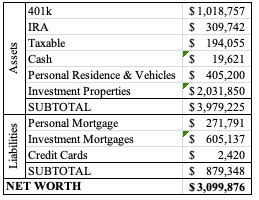
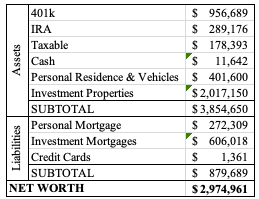
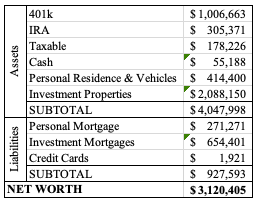
There are a few line items that were changed significantly because I wasn’t working with clear data the past few months. We may have hit $3 million net worth before this update, but I know that it’s official now! At 35 and 34, that’s a fun accomplishment. It doesn’t feel like we have money to throw around, and we certainly don’t live lavishly. You can see that $2 million of this is tied up in the appraisal value of homes we own, and most of the other parts of this is tied up in accounts that we can’t access until retirement. We still make decisions for the longevity of our net worth because, well let’s face it, we’re only in our mid-30s and there’s a lot of life to live.

Escrow Payments

A theme I stick to in this blog is that you need to watch your money. I’ve talked about ways that I’ve fought to get money back where it wasn’t billed correctly (e.g., medical bills), and today’s warning is about escrows.

An escrow account, in the sense that I want to talk about it, is tied to your mortgage. Your monthly payment includes an amount that goes into a separate account held by your mortgage company, and they manage paying out your taxes and insurance on your behalf.

The benefit of an escrow is that you don’t have to manage your insurance and tax payments. You don’t have to pay out a large sum of money once (or twice) a year because you’re paying towards this account every month that will manage that billing for you. The downside is that this escrow account requires you to maintain a balance, so it’s holding your money where your money isn’t working for you. Another downside is that your money movement is less transparent, and you just expect that the payments will be made accurately. The bank basically takes on the administrative burden of paying these bills on your behalf, in exchange for continually holding this money without paying you interest.

Each month your mortgage payment includes principal, interest, and escrow. For example, I have a mortgage payment that is $615.34. The P&I total will remain the same amount each month, but the principal portion of each payment will slowly increase while the interest slowly decreases. In my example, the total P&I is always $428.11, but the breakdown of what’s principal and what’s interest changes (e.g., October’s payment due included principal of $119.58 and interest of $308.53; November’s was $120.03 of principal and $308.08 of interest). The escrow amount each month for this mortgage is now $187.23; this number stays the same until there’s an escrow re-analysis.

An escrow analysis is conducted once per year to verify that the escrow account will have sufficient funds to pay out the bills received (typically taxes and insurance), while maintaining the required minimum balance. Sometimes the increase is known ahead of time because you can see that the estimates for the initial escrow contributions were off (or in our case, new construction uses estimates based on last year’s tax payment, which only included land value and not the final sale of the home, so we know there will be an escrow shortfall in our future). A shortfall may also occur when there’s been a drastic change in your property value assessment, causing taxes to increase more than an expected amount (like in 2021!), or when insurance costs change more than projected.

Below is an escrow analysis of one of our accounts. The highlighted row shows that when our taxes are paid, the balance will fall below the required minimum. The document says that the minimum “is determined by the Real Estate Settlement Procedures Act (RESPA), your mortgage contract, or state law. Your minimum balance may include up to 2 months cushion of escrow payments to cover increases in your taxes and insurance.” If you are projected to dip below the required minimum, they’ll offer you the opportunity to make a one-time contribution to the escrow account or your monthly payment will increase to cover that projected shortfall.

The increase is calculated in the image below. My payment to escrow at the time of this analysis was $126.18. They take my insurance and taxes owed, divide by 12, and come up with my monthly base escrow payment ($149.81). At the lowest point in my escrow balance (highlighted in yellow above), the account will be -149.43. The difference between this balance and the required balance of $299.62 is $449.05. Divide this number by 12 to get the $37.42 in the image below indicating the monthly shortage for the account.

The new escrow payment is added to my P&I payment (which stays the same), and this is my new monthly mortgage payment.

An escrow analysis showing that we’ll fall below the balance required inevitably means that my monthly cash flow will decrease (because we always opt for the change in monthly payment instead of a one-time contribution). As taxes and insurance increase, so does your requirement to fund your escrow account. While the reason for the escrow increase is to cover the taxes and insurance, which I would have to pay anyway, the escrow increase is higher because of the required minimums. One of our houses started with $766.96 as the monthly payment, and it is now $802.96 due to the escrow analysis. Another one started at $477.77, and it’s now at $537.60.

SO WHAT HAPPENED?

Honestly, the only way I’ve checked my escrow balances in the past is at the end of the year when I’m verifying the insurance and tax payments “make sense.” I’m not even verifying the details behind the numbers, just that it was similar to last year’s amount as I update my spreadsheet. Well this time, I logged in to update my spreadsheets with the new mortgage balances for the October Financial Update, and I saw my escrow account was negative by over $1000! That makes no sense because these accounts are reviewed annually through an escrow re-analysis to ensure you’re not projected to dip below their required minimum balance, and if it were to be negative, it would only be by a much smaller amount.

We had recently changed our insurance. Usually when we change insurance providers, we pay the current year on our credit card (to get those points!), and then all future billing goes to our escrow account. I don’t know why we didn’t do it this way for the most recent change, but I’m inclined to blame the fact that the process took months to get new insurance because this company hasn’t been responsive, so we just wanted it done and weren’t thinking. Since we didn’t get the new policy issued before our old policy was billed, both insurances were paid out by our escrow. Sure, that should have affected our escrow balances, but still not by $1000.

One house had a policy that cost $573.31 and the other had a policy that cost $750.06. The new policy includes both houses under one policy (this becomes annoying and it makes me uncomfortable for reasons I can’t seem to articulate to the agent) and costs $1,180.87. Each mortgage escrow paid out the original policy amounts since we didn’t execute the new policies timely. After these were paid out, the mortgage company received a bill for $1,180.87. For reasons I can’t quite figure out, the company paid $1042 from each of our escrow accounts, and then one escrow account paid $138.87 (which is the balance of 1180.87-1042). The $138.87 covers the policy fees; so someone realized that there was a separate line item for policy fees, but didn’t realize that the $1042 should have been split between two houses (even though they knew there were two houses because they took from both escrows).

I questioned the process with the new insurance company, but he didn’t take responsibility for it. He claimed that the mortgagee had to know to split it and they don’t manage any of that. I explained that I’ve had multiple houses insured by one company and have never been given one policy number for it. He acted surprised. My gut says this is wrong and isn’t going to work, both for future billing and the possibility of a need for a claim. We did receive a check in the mail for $903.13 (the difference of $1042-138.87), but we still have paid the $138.87 and want it reimbursed. I sent an email this morning explaining again that I’ve confirmed with my mortgage company that this insurance company was paid $1042+$1042+$138.87. He again responded that the $138.87 is the fees portion of the bill, and I again said that I know, but it’s been paid twice, and I’d like it back. So now I’ll stay on top of that $138.87 to make sure we get it back.

You need to fight for yourself. You need to know what companies are owed and know what you’ve paid. Then don’t back down to keep asking for an update. I recently discussed how I had to fight for medical bills (multiple times) for a year at a time to get the money reimbursed that I was owed. I even recently had to call on another medical bill that I paid before realizing it hadn’t been submitted to insurance (I would love to understand why this keeps being an issue that my medical bills aren’t submitted to my insurance before billing me). Then they submitted it to insurance and sat on my reimbursement until I called twice asking for the reimbursement (that both times they agreed I was owed and it was “in process.”). Manage your money. Especially because that $138 that I’m waiting for now could mean a big difference to a family in need or living paycheck to paycheck.

October Financial Update

We’ve been busy, which has kept our expenses down in our personal life. I’ve been working a few days at our local racetrack, which has been for my entertainment and a good way to bring in some money for our household. While our busy schedule has kept us from eating at restaurants and spending money on activities, the last quarter of the year brings big expenses on the rental front for insurance and taxes.

I still haven’t decided how to format these financial updates, but I did work on categorizing all the expenses for our year. I’d like to see how our spending changes through the year, and if I keep a running tally of the information, I’ll be able to consistently categorize expenses. At this point, I’ll just report for the whole year later in January, but it feels good to have that process started since there are a lot of transactions (already at 786 line items!).

RENTALS

We paid an extra $2000 towards the mortgage that we’re trying to pay off (we paid $1000 and our partner paid the other thousand). That mortgage balance is about $26k, which we’re responsible for half.

Kentucky taxes are due in October. Well, they’re actually due in November, but they give you a 2% discount if you pay before 11/1, so we of course do that. Two of our houses are still escrowed, so I don’t need to worry about that, but I had to pay one of the houses, which was about $1300. As an aside, I put it in the mail on 10/6 and it was taken out of our account on 10/8; I’ve never seen the mail and processing of taxes happen so quickly!

We had someone do the work on a house (fix bedroom doors and replace a missing section of fence) that was left over from my July walk throughs, and that was $490 (split with our partner). This house has been notoriously late on payments with very little communication, but they’ve turned a corner. They’re still late with payments, but they pay the late fee without prompting and give us advanced notice, which is all we ask for! They say they’ll be back on track with on time payments next month.

We’ve had issues with another rental, which I shared in my last post. They were approved for state assistance, so I’m expecting September, October, and November rent from the state here soon. Since there’s no timeframe for when that will come in, I’ve told her that she has to keep paying on the payment schedule we agreed to, and anything she pays will just go to December rent at this point.

PERSONAL EXPENSES

We had all the drywall for the basement delivered in September for $788. Several pieces arrived damaged from the strap that held them down. Mr. ODA called Home Depot since the delivery fee was $75 for this convenience, and they were super nice. She refunded us for the broken sheets and the delivery fee ($125!).

Only $130 spent in gas (that will probably go up next month since I’m driving to/from Lexington 3 times per week for work, plus a few more personal trips there). Only $92 spent in restaurants!

SUMMARY

While some of the expenses for rentals have trickled in, the next month is when most of them are going to hit. We’ll also have an annual medical bill come due in November.

Our net worth increased by $21k from last month. Our credit card balances are low, and then our cash balance is higher than usual because we used to just put any extra cash towards mortgages, but right now we’re trying to pay off that mortgage we have with a partner and rethink our approach (do we want to save for another down payment.. type question).

[Lack of] Rent Payments

We have one house that seems to always have a story. Well, we have two that are consistently late, but the one just says, “it’ll be late,” while this other one has a crazy story. While trying to gather my information on how we’ve worked with her so much, I thought I’d share some of these stories. Perhaps if you’re a tenant, you can see the landlord’s perspective on how this just doesn’t add up and there’s eventually an end to the rope. So just for fun, it’s story time.

This person has a history of fraud. She also had domestic abuse and restraining orders against her that caused us to lose one of the tenants at the beginning of 2020. There are the typical excuses like car maintenance issues, and then there are interesting ones.


March 2020

We started the pandemic off with a “furlough” letter. Knowing the history we have with this tenant, I didn’t take it at face value. I struggled to find a contact for the company that the letter was from, and then I eventually found a way to get in touch with a local office (as in… where she works and not the one in Florida where this letter seemed to come from). I asked for an employment verification for the tenant’s name and whether she was furloughed. The woman on the other end did a laugh/sigh thing and said, “She’s not furloughed. We’ve been over this several times. Her hours were reduced, but she is still employed and expected to show up to work.” I let her know that I received a letter from the company stating a furlough, which she said she was unaware of.


January 2021

Virginia has a Rent Relief Program for tenants that were affected by the virus and lost income. The program is for unpaid, past due rent. I pretended to be a tenant and went through the application process; it very clearly only let me input unpaid rent that’s past due (i.e., I couldn’t claim that I wouldn’t be able to pay a future rent owed). I even went through the trainings available on the system. I was very thorough. The tenant paid January rent, and then I received notification that the tenant applied for assistance. I can’t remember how I knew it was for this tenant (because in the future, I’ll get emails from the system that I can’t tie to any tenant), but I knew. I called the hotline and asked what month was being claimed as unpaid and was told January. I sent the tenant an email letting her know that she was not eligible and that I had done my due diligence acknowledging the information. I had actually also called because I didn’t appreciate that the documentation on file required my social security number to be on paperwork that the tenant had access to. For some reason, this didn’t bother any other landlords, but it’s not something I want this person having! When I told her she was ineligible for the assistance, she said it was because she expected February’s rent to be late, which she then paid without the assistance.


August 2021

She paid August’s rent on August 31. Why? She was in a car accident. When? On April 24, 2021. How is this related to August rent? I don’t know.

This doesn’t exactly explain why she doesn’t have income or what happened to her job. She said in passing that she would start a new job on August 30th, but we don’t know what happened to her last job or how long she had been unemployed.


It’s now October 6, and she hasn’t paid September or October rent yet. Why? Because she went to Costa Rica on September 1 (or 3rd?) and tested positive for COVID, so she had to quarantine. She shared several pieces of correspondence related to the car accident, which told us that she received over $5,000 in the insurance settlement. Questions that I have, which have not been asked and/or gone unanswered:
1) If you don’t have any money to pay rent until a car accident settlement check arrives, how are you affording to go on a trip?
2) If you received the settlement check in time to pay August rent on 8/31, why didn’t you pay rent with the rest of that check on 9/1?
3) Why didn’t you pay rent before you left town?
4) If you were unemployed for a while, and were starting a job on August 30, how and why did you leave the country (during a pandemic)?
5) Through communication with her girlfriend, we learned that she went to Costa Rica on 9/1, but she tested positive on 9/3. How did you get into the country and not get tested for 2 days?
6) I received an email on 9/6 stating she couldn’t get the payment to go through. What were you doing between 9/1 and 9/5 that I’m receiving this email on 9/6?
7) I responded to that email and gave other electronic options for payment. I received no answer or acknowledgement. Why couldn’t you respond to this email or attempt to pay rent again?
8) Assuming internet issues, I let it go for two days before sending a follow up email. No response to that email. Why?
9) At this point, I got stern. I very rarely get stern with people.

10) I received a response from someone stating they were her girlfriend and monitoring her email. If you’re monitoring her email, did you not find it urgent to address the lack of rent payment emails you’ve been seeing?
11) This person says she’s working with the family to get rent paid timely. I receive no rent nor do I receive an update.
12) Even though I had said I’d give until the 13th for an update, I ended up being responsible for my household while my husband traveled and didn’t get to the follow up until the 15th. I sent an email asking for an update. No response.
13) I don’t handle the text communication, so I waited until Mr. ODA was unoccupied with his work tasks, and asked him to text her on Friday. She responds! She says she’s been back for several days. Really? Why didn’t you get in touch with us? Why didn’t you let us know your status?
14) She says she can’t pay rent until Wednesday (the 22nd) because she had to pay for the extra costs for staying in Costa Rica for longer than anticipated. What if you had paid rent before you left? How would you have been able to pay for that hotel stay and getting out of the country? Why is it on me to float this financially?
15) Mr. ODA texted and asked about payment on the 22nd, we got no response, and I sent a notice of default. She suddenly was able to share that the person she was going to get the money from didn’t have it, and she couldn’t pay rent. Then she responded to my email and said she wanted a payment plan (Virginia requires me to offer a payment plan once every 12 month cycle).
16) I put together a payment plan to start payment on 10/1. She responded that she wouldn’t be paid until 10/8 because of the start date after she returned to the country. So she can’t pay anything towards TWO MONTHS worth of rent until it’s late for both months.

PAYMENT PLAN

I front-loaded the payments in the plan. First, I need to pay my mortgage, which I’ve now paid twice without offset from a tenant living in my house. Second, I’m not offering a payment plan for the next six months worth of rent, so come November 1st, she needs to pay rent in full. She can’t have evenly spaced payments while also paying full rent in future months. I put the due dates as every other Friday, starting 10/8, as she claimed she had no money until then.

I stated several times that the money is due on the date that we have agreed upon, and there is no five-day grace period like there is in the lease. Too many people think rent is due on the 5th because there’s a grace period. It’s due on the 1st, but there’s a grace period to allow for payment without penalty. October 1st was a Friday, and I still received rent on the 4th and 5th. Since this is overdue rent, I wasn’t going to play the follow up game that I’ve already had to play far too much in the last two months, so it was due that day, and that’s it.

During this process, she applied for assistance from the State for COVID relief. I also included the following:
Any monies received from the State’s program will eliminate the last payments first. If and when I receive money from the State, I will let you know, and I will update the schedule accordingly. Do not assume any payments received; adhere to this schedule until told otherwise. If you can pay more than the amount throughout this timeframe, please do. Any and all payments received will work to eliminate the latest payments due first. 

Since I didn’t find any requirements on the how the payment plan was to be set up, I didn’t extend it very long. The final payment is scheduled for 12/17, so that’s just 6 payments. As I mentioned, I front-loaded the payments, so the first two are $550. Then they taper to $350. The payments to be made also include the two months worth of late fees.

If she doesn’t adhere to the payment plan that she had to agree to, then I can seek possession from the court for default on the lease. Hopefully we’ll have some money here by the end of the week!


There’s really no point to this except to share in our experiences. The excuses are creative and entertaining. We’re lucky that we have the ability to float one house under the payments of all the other houses, but it doesn’t make it any less frustrating to be two months behind on income.

Should You Use a Property Manager?

The key to financial freedom is passive income or cash flow so that you don’t have to work, right? Well, managing rental real estate isn’t truly passive, so a hiring a property manager to do that work on your behalf is enticing. But are the benefits worth the cost?

We have 12 rental properties, and 5 of those are self-managed. While I’ve mentioned the benefits of a property manager, I wanted to run through the reasons we don’t have a property manager on all of our properties. It comes down to time management and cash flow.

THE DETAILS ON SELF-MANAGED HOUSES

The very first property we bought was in Kentucky, while we lived in Virginia, so we needed a manager on that one. But then we bought two houses in Virginia. They were right next door to each other, and I worked about 10 minutes away. Without kids, I had the time and flexibilities to manage them. Plus, both houses had active leases on them when we took possession. Without having the immediate need and learning curve of finding a new tenant, it was easy to manage the rent collection and any minor issues that came up on the houses. A property manager would have cost us $105 each month on each of these houses. Even now that we don’t live near them, the houses are newer and we know they don’t have any major issues, and the tenants keep renewing their lease, so it’s [relatively] easy to manage from afar. There are some maintenance hiccups – like the flooring debacle – but mostly I just collect the rent electronically. One house is routinely late on the rent, so I have to manage that property more than the norm, but it’s all via electronic communication and doesn’t require me to be on site.

Our third purchase in Virginia was of a vacant 2 bedroom house. Still, no kids meant that I could manage listing and showing the property to prospective tenants. This was the first time that we had to figure out the tenant search process, but we were able to show it to a couple and have it rented the first weekend it was listed. Again, the house requires very little attention, and I just collect rent. Even when the house had to be turned over, the tenant leaving put us in contact with a friend of their family’s, and that’s been who’s living there for several years.

Our last two that are self-managed are the two that we have with a partner. I handle the rent collection and paperwork. When we have an issue, we’re more likely to call a handyman than do the work ourselves anymore, but again, phone calls and emails aren’t that difficult. We just had a handyman go out to look at two broken doors and to replace a missing fence panel. While I was there over the summer, I had secured the railing that was loose, but I didn’t want to do any of the other work. It also helps that we have a partner, so the cost of any work to be done is only half for us.

For the past year, we took over management of a property that had been with our property manager in Virginia. We knew the tenants from a previous house of ours, and we felt that our management of that house from afar would be easy as compared to the $120/mo we were saving by self-managing. We didn’t have any issues we couldn’t manage during the year. However, they’re now purchasing a home. We’re obviously not there to manage showings, so we gave this property back to our property manager. She listed the house and showed it for us. It’ll cost us $300 for the listing and 10% of the monthly rent for her management ($135). For the last 11 months, it has been rented at $1200. That means that we’ve had an extra $1620 worth of income for the year than we would have ($120 for 11 months, and the $300 listing fee).

PROPERTY MANAGEMENT

For our Kentucky houses, we are very hands off. We don’t weigh in on costs less than $200, and we don’t get any updates regarding rent payments or tenant searches. Sometimes it’s too hands-off for me. For instance, I don’t even get a copy of the executed leases until I ask for it, and I don’t get a copy of any receipts (I just get a summary of charges taken out of our proceeds). It has been hard on me psychologically, but I’ve learned to let it go over the past few years.

For our Virginia houses, we’re more hands on, and sometimes it’s too much. We still discuss all the details when an issue arises, so it’s just saving me the time of calling and coordinating contractors, which is rarely necessary. Then there are times that I even handle ordering and contractors; for instance, I just handled replacing the hot water heater and refrigerator at one of our houses. All of our tenants pay rent electronically, so that’s not even on our property manager’s radar (she used to collect rent and then deposit it in a joint account we gave her access to). Since she’s not responsible for rent collection, it’s then on me to let her know if someone hasn’t paid, and she handles the follow-up communication.

However, our Virginia property manager has been worth her weight in gold because she has handled multiple lease defaults for us (with one actually leading to an eviction), which involves going to the court house to file the motion and then showing up for the hearing(s). We had one tenant who had to be served multiple notices, but she eventually left on terms mutually agreed upon. We had another tenant vacate a house because his kids were attending a school out of the address’s district (and blamed us for that.. I don’t know!), but we took him to court to require payment of past due rent from before he vacated. Then we had a true eviction, where the tenant stopped paying rent and had to be taken to court multiple times. The judge ruled in our favor and told her to vacate the premises, which involved police officers escorting them out of the house. We have been very lucky that the houses we manage haven’t ventured into the realm of taking them to court (although one in close), and that our property manager has been able to handle everything on our behalf for these instances.

SUMMARY

We can get caught up in the “we’re paying for nothing to happen” mentality with our property managers. Each month, we pay out $720 for property management. In Virginia, our property manager doesn’t even collect rent, so most months there’s no action from her for the houses. In Kentucky, the property manager collects rent, holds it, and pays out our share the next month. It can be hard to see that total number that we’re paying, but for those months that involve a lot of coordination in receiving quotes, going to court, or meeting contractors, it’s nice that we don’t have to deal with it.

Sometimes it’s worth paying for peace of mind and relaxation, knowing someone else is handling your problems for you, but you need to choose where that balance is for you. Do you want to manage it yourself to know your money is being spent fully at your own discretion; do you want to have a manager while maintaining a lot of the decision making; or do you want to be fully hands off with a management company who you can trust to handle your property with your best interests at the forefront? It’s all a balance of how much you think that’s worth compared to your time spent and knowledge on managing rentals.

September Financial Update

Cooler weather is here! We have a full calendar these days with pre-school and sports. I’ve been managing that by setting a lot of alarms giving me a half hour warning that we need to leave the house for something. We also celebrated our son’s 3rd birthday with both sides of our family, which was so much fun. He knew all about a birthday and the traditions, did a great job at being grateful for his gifts, and hasn’t stopped playing with all those new toys. This month, his birthday party and a long weekend trip to Virginia were our big expenses, while the sports and activities kept us home and not eating at restaurants in between those things! On top of all this craziness, Mr. ODA went on a work trip, then I picked up a few shifts at the race track to help them out. And so, here we are, two-and-a-half weeks since my last post.

NET WORTH

About once a month, we have a meeting with our financial advisor. During last month’s meeting, his software system said that we hit $3 million net worth! Unfortunately, my numbers last month didn’t say that, and they still don’t, but we’re right there. I didn’t think it worth it to line up my information against how the software is reporting the number because a lot of our net worth is based on the current market value of our real estate, which isn’t necessarily an exact amount. I know Mr. ODA had a goal for the first million in net worth, but I wouldn’t say that we had a goal to hit this particular number. With the financial advisor, we’re working on our mentality. We’re basically trying to figure out what’s our true goal (instead of just this number), and if we had (and did) everything we wanted, what would that cost difference be? I’m working on two other posts about our mentality, and I’ll have to include this side of the thought process as well.

DETAILS

One of our credit cards has a balance of over $2,200 in this net worth update. That includes almost $1,000 of a hotel that Mr. ODA had for a work trip, the hotel for Richmond at $450, and an AirBnB charge for an upcoming trip of $424. It also includes Mr. ODA’s food purchases while on travel, which amount to about $180, and an Uber trip of $10. The work expenses will be reimbursed, but that’s not yet accounted for in the math since the payment hasn’t hit our checking account yet.

With the child tax credits coming in, our investments have gone up each month. We’re putting some of that into the kids’ investment accounts. We’ve also had other unexpected income, which led to another $500 transfer into Mr. ODA’s investment account. Usually, we see an automatic contribution of $1100 between our Roth accounts and the kids’ accounts. This month, we had $1,900.

All of our housing expenses were about the same. This coming month has a trip planned, a day to hang drywall in the basement, and me working at the race track nearly every weekend.

A Second Home & Summer of Travel

Why did we do so much traveling and activities this spring and summer? Most people probably assume all our travel was making up for a year of not traveling during the pandemic, but we came at it from a different perspective.

We’ve had a long term goal of a beach/lake/mountain home. After another failed search to make this dream come true this past Spring, we decided to redirect that money to trips this summer. I’ll run through the background, the financial decision, and how we spent our travel “budget.”

BACKGROUND

We first looked into a vacation rental in Snowshoe, WV – six years ago. Snowshoe is a ski resort, and one of the better available ones to those of us south of the Mason Dixon. It also has a draw during the summer with hiking and mountain biking, albeit not as constant of a stream of people needing a rental. The draw for us was that it was halfway between our home in VA and Mr. ODA’s family in KY.

We went as far as meeting a Realtor and looking at properties. If the house was off Snowshoe proper, it was a good distance from the ski lifts and not in great condition. If the house (condo) was on Snowshoe proper, it came with a lot of rules and regulations and costs. Everything near the ski lifts had to be under Snowshoe’s management, which included their cleaning costs, and their booking process. This meant that someone couldn’t necessarily go onto the website to book our unit. Someone would go on their website and book “a 2 bed and 1 bath unit” and the system would cycle through the bookings. With the high condo costs and the uncertain bookings for those units, as well as the distant location of the units that weren’t subject to the condo process and cost (plus finding a management and cleaning company for that), we stopped the search.

Since then, it’s been on the wish list, but we weren’t sure what direction we wanted to go. 

When we moved to KY, we decided to look into a lake house. We want it to be close enough that we could just pick up and go (e.g., trying to keep it under 2 hours), we want it to be on a lake that allows motor sports (so this rules out anything that’s “no wake” or prohibits motors of any kind), and we want it to be lake front (we learned this during our recent search, and hadn’t fully realized how much we wanted this until we saw a house that wasn’t on the lake directly). 

We looked at parcels of land and kept an eye on a few houses listed in the March/April timeframe of this year. Our initial thought was that we would purchase land and hold it until we were ready to have a house built. The parcels of land we looked at didn’t meet the criteria we wanted (good size, on the water, ability to build a dock). I started to feel like we were pressuring ourselves to make a decision for something that we didn’t actually need. 

We took a break and just kept an eye on Zillow. We went to see a new construction house on Herrington Lake, but it wasn’t actually on the lake. It was next to the community pool, across the street from the community’s dock, had 3 bedrooms and 2 bathrooms with a loft, and it was brand new. It even had a two car garage, which wasn’t something on our wish list. However, the price tag was high; it had been listed for many months, and we didn’t feel the comps supported such a cost for it not being literally on the lake. We spent a lot of time mulling it over, but decided to not even put an offer in. Lucky for the seller, they did get a full price offer shortly after that. 

I decided that we should wait at that point. I figured we may have better luck waiting until the end of the summer (perhaps people will think they’ll spend their last summer on the lake and then unload it?), and that we shouldn’t force this decision to not get exactly what we want for something that isn’t a necessity. 

THE FINANCIAL DECISION

If we purchased a $250,000 second home, and I assume an interest rate at 4.5% (even with excellent credit, the rates you see advertised are for primary residences), we’re looking at a mortgage payment of $1,200. On top of that, we’ll have escrow costs, HOA costs, the possibility of management fees, and then even PMI costs. That was another big factor; we’ve been throwing any ‘extra’ money towards paying off two rental property mortgages, so we don’t have $50,000 liquid to cover a 20% down payment. Without having the 20% down payment, it wasn’t even guaranteed that we’d be able to get a loan for a vacation house.

Knowing $250,000 was even more than we expected to spend, I conservatively assumed $1,200 in monthly house costs. Instead of spending $1,200 each month to go to the same destination over and over again, why don’t we just mentally allocate $1,200 each month to travel and go to all different places? And so, months of a crazy amount of travel began.


HOW DID WE SPEND OUR ENTERTAINMENT ALLOCATION?

MAY: $618

We started with a last minute trip to Atlanta to see the Braves. We spent 4 nights in Atlanta, went to two baseball games, met up with family for lunch, visited Stone Mountain, and explored the city parks. We stayed in a 2-bedroom hotel room because it was cheaper than any AirBnB options, and I was highly focused on giving the kids separate sleeping spaces. The hotel experience was less than favorable (dirty, AC broken, limited breakfast, roaches … and a good name hotel!), and after some conversations with the hotel, we ended up not paying for it. They had credited us one night without us asking after the AC continued to not work after their “fix.” Mr. ODA then had a casual conversation with the manager about the stay as he was checking out, and the manager credited a second night. I thought we paid for the rest of the nights, but it never showed up on the credit card. Our total trip cost was $460.

Later in May, we went camping in the Daniel Boone National Forest with some family. We booked a “cabin” (I used that term loosely; it was walls, a roof, and platforms for sleeping bags, but it had electricity and AC!) for two nights. We went swimming, rode bikes, and hung out under a canopy while it poured on us for most of the main day we were there. Our dog got to come on this trip, so we didn’t have any pet fees. We brought groceries to cover our meals since there’s nothing close by. Since we’d be buying groceries anyway and gas is negligible since it’s an hour away, I’ll just focus on lodging, which cost us $158.

JUNE: $200

Almost a year ago, we planned a trip with the extended family to Hocking Hills. This shouldn’t really count against our “monthly allowance” mentality since it was going to happen regardless, but I’m including it anyway since we didn’t do any other June trip. Mr. ODA’s parents covered the cost of lodging, and the rest of us covered the cost of food and our canoe rentals. We went hiking, got rained on, and played games at our rental. On the last full day, we rented canoes and went down the Hocking River, which was a great experience. We went with 6 kids, 3 of which were under 3 years old. So if you’re a beginner or looking for something to do with little ones, this was a fun time for $52 per canoe! This trip cost us about $200.

JULY: $690

Before we left Virginia, we discussed doing walk throughs of our properties and being more present with them. There were some properties that we hadn’t seen since we bought it because they don’t have maintenance requests or we call someone else for the work. Well, it was a whirlwind to move, and we didn’t do that last summer. After the debacle with the flooring replacement at one of the houses, we knew we needed to get back there to tie up loose ends. We have a wedding to attend in the area in September, but decided this couldn’t wait until then. The first weekend we could go ended up being the 4th of July. Being in Richmond, VA, there isn’t a large AirBnB market for a normal sized family. All of the options that were available were meant for multiple families in a large house, and we just aren’t interested in paying $700 per night for ourselves. We went with a hotel halfway between Richmond and our old neighborhood, and because we stayed for 5 nights, it was considered “long term,” and it only cost us $525, which included $75 for the dog being with us. Since our entertainment was either working on rental houses or visiting with our old friends, we just had food and gas costs. The total trip cost was $690 (and most of that was tax deductible!).

AUGUST $1069

We learned that St. Louis is only about 4.5 hours away from us, so we looked to see the Braves’ schedule. They were scheduled for mid-week games for the first week of August, so we marked it down. Unfortunately, things were busy, and I didn’t make the plans in advance. I struggled to find pet care for our dog, and I ended up booking an AirBnB the morning before we left. We searched and searched, and this one randomly popped up that morning, and it worked out well. Lodging cost us $585. Our entertainment (tickets and parking) cost us $135. Food and gas cost us $213. Total trip cost was $933.

My plan to visit my family in NY in July didn’t come to fruition because we had to manage 4 days worth of our builder being here to fix things in the house, and then I had a doctors appointment pop up that had to be a specific time. Instead of driving there and back (12+ hours each way), we booked some flights. We’re able to go from Cincinnati to JFK directly (such a blessing with 2 kids under 3!). The flight was 2 hours, plus an hour on each side for driving (although, it took us an hour and a half to get to my parents’ house when we landed at JFK because a 3:20 arrival, plus what felt like a 2 mile walk from the gate to passenger pickup, put us at getting on the Belt Parkway at 4 pm – that’s not good for that area!), and getting to the airport an hour early. We left out of LGA, but it was still a direct flight, and we arrived 25 minutes early! We had hardly any wait at TSA for either leg, no issues with boarding or the flight, and we got our gate checked bags easily. I’ll take 5-6 hours of travel over 12+ hours. The flights were booked through our Chase Travel Portal, costing us the equivalent of $833 in points. The parking is $9 per day, the gas to get there is negligible, and we actually didn’t spend anything on food (I very much owe my parents for that!). Our entertainment goal was to go swimming in my parents’ pool the whole time, and that’s just what we did! The trip cost us $36 in parking and $100 for our dog’s boarding.


On top of these long trips, we also did a lot more activities that were just for one day. We went to 2 Reds games, the Cincinnati Zoo several times, a UK baseball game, Bernheim Forest, and random family/friend activities. It turns out we didn’t spend the $1200 per month we had mentally allocated, but we kept ourselves really busy and had a great time making memories! 

Now it’s time to enter a new phase of life: preschool and sports! I’m pretty excited!