School Lunch

I grew up in a private school setting, and we didn’t have a cafeteria that made us food to purchase. Everyone once in a while, we’d have “pizza day,” where we could bring in a dollar or two and buy pizza that they had delivered from somewhere. My high school had a full cafeteria that prepared breakfast and lunch to purchase. It was a private school, so there weren’t any state subsidies. All that to say, bringing my lunch to school wasn’t even a thought. I packed a lunch and a snack every morning. In 2nd grade, I started doing that for myself and my sisters because my mom was really sick, and it just stuck as a chore I did.

I have a child who just started Kindergarten last month. Since my background was bringing my lunch to school, I expected to pack his lunch too. He’s bought school lunch just once so far, and it was for his birthday. I figure there will be a few days throughout the year that he’ll want to buy lunch, but so far he’s content with my packing it.

Last week, I was volunteering at the school, and another mom said “I don’t bother packing anything. For $2 they get breakfast and $2.75 they get lunch; I can’t make meals for that little.” And so, this post was born. Now, I don’t know the outcome, but my hypothesis is that what I pack for his meal is less than that. So let’s dive in.

BREAKFAST

First, breakfast for my kids nearly every day is cereal. That’s their preference. For all the things we don’t buy name brand, cereal is one we keep name brand. We buy it on sale on Kroger. Mr. ODA likes to stock up, even though he admits that the sales are every other week and we may not need 5 boxes of Honey Nut Cheerios in our pantry at any given time. ๐Ÿ™‚

We paid $2 per regular-sized box. The box says a kids serving size will get 12 servings per box. That would come to $0.17 per bowl. Regardless, I do know that $2 per box is less than $2 for one breakfast though.

My kids don’t eat much for breakfast. At home, they have a snack around 10, a hearty lunch, another snack, and then dinner. They’re really good about eating when they’re hungry and not eating when they’re not. Even when my son got free breakfast at the orientation events, he ate a partial bowl of cereal and some fruit. We go through a lot of fruit in this house. But mornings before school don’t have the time to get fruit and cereal into him. I forced it on testing mornings, but he still wanted to eat just the fruit and nothing of more substance, so I had to bribe him.

LUNCH

This is where fruit comes in. We also have fruit as part of the after school snack.

Here are some options that I mix and match throughout the week (though not exhaustive). I’m also taking suggestions!

  • Yogurt Covered Raisins: $2.97/pack, 6 in a pack = $0.50 each.
  • Clementines: $3.50 per bag. I’m estimating there’s about 20 in a 3 lb bag. $0.18 each.
  • Grapes: We purchase these at $0.98-1.98 per pound. At the high end, for what I pack, I’m going to assume $0.20 per serving I give.
  • Oreos: Family size is $5.28 with maybe 48 cookies (that was a quick google). I put two in his lunch box if I put any at all, so that’s $0.22.
  • Fruit snacks: Honestly, we have a gigantic box that was given to us at some event, and that’s lasted us since the end of last year’s school year. But I’ll include this cost anyway because eventually I’ll buy more. $15.99 at Costco for 90 = $0.18.
  • Applesauce pouches: I buy Walmart’s version of this. $5.68 for 12 pouches = $0.47 each.
  • Peanut butter and jelly sandwich: A jar of peanut butter is $1.94, jelly is $2.74, and bread is $1.42 for 20 slices. The bread is $0.14 per sandwich clearly. The other two are harder to quantify, but both are minimally used per sandwich I make, so let’s say $0.15 total for those, bringing a sandwich to $0.19.
  • Chicken nuggets: $5.97 for a 32 ounce bag. I have no idea how many are in there. The package says 4 nuggets are a serving and there are 12 servings in the bag, so let’s say there are 48 nuggets. That seems low though. That means each nugget is $0.12.
  • Pizza: We seem to have pizza once per week, and there always seems to be 1 or 2 slices left over. $4.97 for the pizza, where we get 8 slices, so $0.62.

If I pack a peanut butter and jelly sandwich, grapes, clementine, and oreos, that’s a total of $0.79. Today I put a PBJ, raisins, grapes, and oreos. He actually got 3 oreos because there were only 3 left in the package; that total came to $1.22. Yesterday’s lunch was 7 nuggets, an applesauce pouch, grapes, and a clementine; that came to $1.69 (actually, that doesn’t include the bit of ranch I put in there, so perhaps add a few cents).

The first few weeks of school, I had been putting more food than this in his lunch box. He had told me he was eating everything, but grandparents day had grandma eating with him so she saw he was throwing some things away. I had asked him repeatedly to tell me what he likes or doesn’t, or if there’s not enough or too much food so that we can make adjustments.

There are other things like puffed corn, chips, and cheez-its that I buy for his snack. He eats lunch at 10:30, so they give him a snack in the classroom at 1:30. There’s no option to buy a snack at the school at this time, so everyone needs to pack their own snack.

SUMMARY

By the time my child gets home from school, I’ve spent approximately $1.80 to feed him for breakfast, lunch, and snack. On the high end, it may be about $2.25. This also assumes that the child is happy to eat all the options presented for the meal. When my son bought his lunch, he ate the orange slices, bread, and half the spaghetti. He didn’t touch the broccoli (that I put on his tray for myself), and he didn’t even pick from all the options presented in the cafeteria line. Whereas I know what I’m packing includes things that he eats regularly at home.

While I agree that $2.75 for a meal is cheap relative to buying at a restaurant or fast food, the assumption that it’s cheaper than what you could pack a lunch for doesn’t appear accurate.

September Financial Update

We have two kids in school now, and my days are chaotic to say the least. I have not figured out my organization of all the “required” activities I have. I’ve written our schedule out several times over the last few weeks. It seems so easy because nothing overlaps, but my days are full of stress. I have 3 little humans’ emotions to manage on top of the organization of activities. Everyone’s tired because this is a change from the summer process. I keep hoping that “next week” will be better, but better isn’t coming. So, I missed last week’s post. I am taking several days to write this post. We’ll see how it goes.

Kid1 went to kindergarten this year, and Kid2 moved up to Pre-K. She went to school two days per week last year, which was $175 per month. Now she goes 5 days per week, which is $375. Since Kid1 is in public school now, I saved $175 per month, right? Mr. ODA is going to hate that line. ๐Ÿ™‚

We got hit hard with charges this credit card cycle. I purposely held an insurance payment until our main credit card’s statement started over so that I could feel like it was a less expensive month. I paid that the day $1500+ that the new statement started. Unfortunately, the remaining payment to the electrician also came due on that day, and that was $1,766 hitting the card at the same time. Mr. ODA went on a work trip, which gets reimbursed, but that hotel is still increasing the credit card balance. A gift for the grandparents keeping the kids while we went to NY last month, three invoices for rental work, and our YMCA membership are all on there. Our actual spending on things outside these costs is quite low, but it doesn’t look that way with the credit card balance.

I hit 100% of August rent paid as of August 30th. So I knew that I wasn’t going to be at 100% for September right away. I have one tenant who still owes half her rent, which is hopefully be paid over the next week and a half. They have blue collar jobs and seem to be caught up in layoffs. But they get a ton of credit because they always get right back up. They just ask me for a few weeks during that transition period, and I can’t respect that enough. They’re late a few times each year, but I’ve never charged them a late fee.

NET WORTH

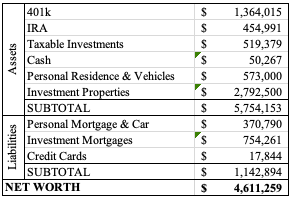
Our net worth is up almost $600k from this time last year. From last month, it has increased by about $50k. Our credit card balance is similar to last month. Our cash has decreased a good amount as we had a roof replacement get paid out, but otherwise most line items moved in the ‘right’ direction.

Summer Trips

In 2021, we looked to buy a lake house. We tried so hard to find something, and we almost settled on something that didn’t fully make us happy. It was March or April of that year, and we finally stepped back and said, “instead of buying a house here that we feel pressured to come to every weekend, what if we just went on vacation more.” Up until that point, we traveled a good bit, but it was typically with a purpose instead of just traveling for the sake of seeing somewhere new (e.g., one of us tagging along on work travel). We calculated that our mortgage payment on that second house would be $1200 per month. That was our budget for travel each month. I wrote a whole post about it.

Then I got pregnant and we bought a new primary residence in the summer of 2022. Almost all our ‘travel’ that summer was just us going to the new house to work on it before we moved in. Then the summer of 2023 was spent recovering from the newborn phase of that third kid that was unbelievably painful. I was just happy to be sleeping and in a routine again, and I wasn’t willing to leave home much and risk lack of sleep.

We made up for it this summer.


JUNE: MD, NY, OH, MI $1,251

Our first trip of the summer was two weeks long. I was so nervous to manage 3 kids (one of which is still a high maintenance sleeper) and a dog for that long, but I had hoped it would be fine if I prepared correctly. We hit four states.

Our son was on the Oriole’s for his baseball team this spring, so that became his favorite MLB team. It just so happened that they were playing at home on our drive from KY to NY (meaning, if we really wanted to, Baltimore could be on the way). As an added bonus, they were playing the Braves, which is Mr. ODA’s favorite team. So we made that work. We booked a hotel in Baltimore that was pet friendly and walking distance to the stadium, and then we bought the tickets. Actually, we bought two tickets for 5 of us to go. The Oriole’s stadium has a program where if you buy a ticket in the upper section, you can have up to two free tickets for kids up to 9 years old. It’s an incredible program. The detour cost us more in tolls than we’d typically spend on our route. It was worth it. Our son watched the whole game and was so happy with it.

Then we traveled to NY. There’s no lodging cost there because we stay at my dad’s house. We went to the local team’s baseball game one night, hung out at the beach one night, had two cookouts, and went to my cousin’s bridal shower. The bridal shower was the reason for the trip. The Michigan component then was booked as the other side of the family’s annual trip. It didn’t make sense for us to drive home from NY and then back up to MI, so we just buckled up for the two weeks gone. We didn’t eat at any restaurants while we were in NY, so our costs were a couple of grocery trips and our family cookouts.

The trip from NY to MI was 13.5 hours without any stops, so we didn’t want to push the kids that far. We typically do the KY to NY trip in one day. That takes 13-14 hours depending on traffic and our stops. It would take about 11.5-12 hours without kids. We usually do two quick stops and one longer meal out of the car when we drive straight through. But with it starting at 13+ hours, I didn’t want to risk it. Plus, I wanted to arrive in Michigan around check in time, which would have us leaving NY at about 2 am. I covet my kids’ sleep too much to risk that one!

Our stop on the way was Cuyahoga Falls, OH. Again, we needed to find something that was pet friendly without charging us $175 to have the dog there for 14 hours. We found a hotel that didn’t charge for a pet, and it appears that’s because they don’t really care about cleanliness. The room was disgusting. The mirrors looked like they’d never been cleaned, the counters had someone’s old rice on them, the door wasn’t fully attached to its hinges, and the sinks didn’t drain. At least the bedding was clean (I inspected closely). I was grateful to only be there for 14 hours.

We went hiking that morning and then headed to MI, dropping the dog off at a sitter on the way there. We use Rover to find a sitter, which is where the sitter takes the dog into their house. I appreciate this type of care/attention than a kennel; we’ve used this service for 11 years now.

Our MI trip was Mr. ODA’s family trip for the year. His parents treat us to the house, and the kids’ families cover the food. Usually our trip doesn’t involve many extra expenses, but this year we sought out a place with activities, so there was a lot of money spent. We went on a dune buggy ride, walked a windmill island, went to a little ‘dutch village’ theme park, picked cherries, and spent a lot of time at the beach. We usually eat all our meals at the AirBnB, but we did have two meals out and lots of ice cream this time around. Honestly, it was the best trip we’ve taken in a while. I appreciated the ‘vacation’ aspect of it, where we did things around the area and had fun with activities.


JULY: VA $570

This was actually a work trip. Last summer, we didn’t make it to Richmond to do property walk throughs because our baby was such a handful. We’ve had a lot of work done over the last year, and there were a few things noted by tenants that are just easier for us to handle in a few minutes than pay someone hundreds to handle.

We cleaned the siding on multiple houses, checked some gutters, replaced a few things, and painted a front door and front porch. It was a 3 night trip, and we put about 20 hours worth of work into it. It was hard to juggle the work that needed to be done, having 3 kids in tow, and a heat index of over 110 each day, but we got what we could get done. I wrote a post about the work we did earlier this summer. Our expenses were the hotel ($401), gas, and food. We actually had a surprisingly low food expense on this trip considering we stayed in a hotel (lack of kitchen and time).

While there, we were able to see a few of our old friends. However, we planned this trip fairly last minute and had to fit it around other activities already scheduled at home, so we didn’t get as much ‘play’ time as we’d prefer.


JULY: CO $3,350

Mr. ODA’s brother wanted to celebrate his 40th birthday by hiking 14-ers in Colorado. He invited a few people to join, and Mr. ODA spent the first half of this year getting in shape for that activity. Honestly, in January, this idea seemed so far away, so it was exciting when the moment arrived. Mr. ODA wanted to go out earlier than the trip’s original itinerary to acclimate to the change in elevation. That’s where I came in.

We booked a flight for all 5 of us to fly out there on the 18th (well, the baby was free). We spent the weekend around the Denver area, and then I flew home with the kids on the 22nd, while he stayed to hang out with his brother’s crew.

We had to buy flights, rent a car, book lodging, and buy groceries/meals. We did more-than-average entertainment for this trip with a concert and baseball game, so that increased our expenses.

On our first full day, we visited Mount Blue Sky, which is a drive up to the top of a 14er (a summit above 14,000 feet). It was a really unique and cool experience. On Saturday, we hiked at Red Rocks and went to a concert at Ball Arena. On Sunday, we went to a Rockies game and walked around Denver. It was a great trip, and the kids were troopers through all the fun.


AUGUST: NY $430

My cousin got married in NY. Typically, I’d take this opportunity to get my whole family to NY to see my side of the family. However, our oldest started school already, and I didn’t want him to miss any of that, especially on day 3. The whole family flying to NY is expensive, plus we’d have to figure out the babysitting need for while we’re at the wedding. While I have a few people I could call on, it’s more difficult when the intent is for the closest adults I know to be at the wedding.

We booked direct flights for Mr. ODA and me to fly out Friday afternoon and come back Sunday afternoon. We had the kids stay with grandparents for the two nights, and this way the grandparents didn’t have to manage any kid activities except getting our oldest off the bus. Our two flights cost $376.40, and it included a checked bag if we wanted it because of our American Airlines credit card rewards. Parking at the airport is $11 per day, so that was $33. Our original plan was to take the train from JFK to where my dad’s house is, but we pivoted because he offered to pick us up and take us out to dinner. Our meals were covered except for on the way out and the way back, and one coffee I purchased while there. It was a nice little trip where we had fun and could just focus on that versus managing the kids’ schedule, so I appreciated that.


Mr. ODA had two work trips this summer on top of all that we did as a family. Those net us income instead of expenses, so I won’t go into them. I mention it just to point out how busy and entertained we were. I’d say we’re looking forward to winding down, but now baseball and gymnastics start up on top of managing kids at two different schools. But I’m loving it and looking forward to what this next season brings.

Buying versus Renting

I have a tenant who, in the same day, told me that she couldn’t pay rent on time and asked whether she could buy the house. She said she paid $60,000 to me and that could have gone towards owning a house. While I understand the lump sum of what you paid being a pain point, owning a house isn’t that simple. I thought I’d break down a comparison of what she would have done to own this house versus her renting it over the last several years.

RENT HISTORY

Based on the proximity to Main St and the comps in the area, we went into the purchase expecting about $1,000 per month in rent. At the 1% Rule (where you set monthly rent at 1% of your purchase price), we should have been at $1,020. Knowing that it was October/November by the time we would get it rented (there aren’t as many people looking for a new rental in the Fall, after school has started and holiday activities are ramping up) we chose to list it at $975 and keep it below that 4 digit threshold. It sat for 3.5 weeks with hardly any activity, and we dropped it to $875. We found a tenant in under 2 weeks then, but we weren’t thrilled amount our cash flow on it.

The tenant’s lease started on November 1, 2019. Her rent was $875. My property manager incorrectly established a one-year term lease instead of an 18-month lease like she was supposed to, so we had to do a 6-month extension after the first year. Then in March 2021, we tried to increase the rent to $900, and she complained that due to the pandemic, she couldn’t afford that. We let it go and she renewed a year lease at $875.

Come February 2022, we were significantly under market value for rent and she hadn’t been a friendly tenant, so we were content pushing a raise to $950. If she didn’t want to pay that, she was free to leave and we would take the vacancy hit to fix it up and get it re-rented. She complained about the increase, and our property manager told her to take a few days to look around to see if she could find somewhere to rent that was at a price she would feel more comfortable with. She came back and said she couldn’t find anything and accepted the increase to $950.

Not including a few late fees she has owed over the last nearly-five-years, she’s paid us $52,850. While in total that appears to be a significant number, that number does not mean that you’d have $52k in equity in a home had you paid towards a mortgage.

OUR PURCHASE INFORMATION

We paid $102,000 for the house in 2019. We asked for several options for the loan structure. We asked about putting 20% versus 25% down, and whether the rate for a 15 year, 20 year, or 30 year loan would have the best rate. Going through those details is something I’ve done in the past, so for this purpose I’ll just note that we chose to put 25% down because then we didn’t need to “buy down” the rate. The rate for each loan length was 4.55%. With no incentive to do a shorter loan term (and therefore increase our monthly payment), we chose the 30 year term. I do want to note that our interest rate is higher than the average for 2019 (3.9%) because it was an investment property and not a loan for a primary residence.

Based on the 25% down and the closing costs, we had to come to the table with $26,589.12.

Our mortgage was $538.46, which includes escrow. We paid off this loan fairly soon after we closed on it, so we don’t have a monthly mortgage payment. However, I do need to plan for our current mortgage and insurance payments each year, which is currently over $2,000.

FACTORS TO CONSIDER

To keep this more consistent in the message, note that the loan discussed will be based on the purchase price of $102,000.

First, you need to have favorable credit to qualify for the mortgage. In an example, the lowest credit score I could plug in was 620. However, in much of what I’ve read, anything below 680 is questionable on qualification. Our requirement to rent a property is to have a credit score of 600. Perhaps there are lenders that will process a mortgage if your credit score is below 620, but you’re going to pay a premium via the interest rate.

With a credit score of 780, say you’ll have a rate of 6%. But then with a score of 680, you’re looking at 6.5%. At 6%, your principal and interest payment (doesn’t include the escrow required) would be $599.19. At 6.5%, it goes to $631.69. That’s only $32.50 per month extra; over 30 years, that’s an extra $11,700 paid to the bank. I have some tenants where an extra $32 per month is a big deal.

Without at least 20% down on a loan, you’ll likely have to pay private mortgage insurance (PMI). This amount could add a monthly premium to your mortgage payment anywhere from 0.2% to 6%. I did a quick calculator with the example of $102,000 purchase price, $3,060 down (typically the lowest available without any special loan structures is 3%), and a credit score of 620 (lowest it allowed). The PMI was calculated as $187 each month.

I mentioned that our final closing costs were over $26k. If I remove our down payment, that leaves $1,089 in closing costs. I will note though, that our contract had $2,000 in seller subsidy (a credit). Without that purchase agreement structure, that means your closing costs are actually $3,089. This means that you need to come to the table with $6,149. Buying a house is not like buying a car where you can roll all the costs into the loan, and I feel like people don’t realize this.

Your debt to income ratio also plays a factor in whether you can qualify and what your interest rate would be. So even with a decent credit score, you need to show a low debt-to-income ratio, meaning you can’t have your credit cards maxed out. The lender wants to see that you don’t have high monthly costs that would prevent you from paying your mortgage.

That brings me to the flexibility of paying rent. She paid $475 worth of August rent (due August 1st, with a grace period to August 5th before a late fee is owed) on August 20th. If you pay your mortgage late, there’s a late fee and it gets reported to the credit bureaus. Your late payment of rent doesn’t get reported to anyone. She also has the extra advantage that I’m willing to work with her on late payments. An apartment complex type owner is going to immediately file for eviction on the 6th without full rent payment, regardless of your story.

SUMMARY

While a mortgage payment of $538.46 looks favorable against a rent payment of $950, it’s not that simple. I was able to qualify for the mortgage, qualify for a favorable interest rate, and put significant money down.

If I add a premium to the rate we were able to get, assuming my tenant’s credit score is similar to what it was when she rented our house, and then add the PMI that would be applied by not having 20% down, then the mortgage payment (including escrow) would have been $903.02. PMI stays on the mortgage until you reach 78% loan to value ratio (unless you pay for an appraisal and can prove 80% earlier than that). That threshold in this example is $79,560. That principal balance would be achieved in over 11 years, which means you’ve paid $25,058 for essentially nothing.

Then on top of paying these premiums for the mortgage, she would need to pay for the maintenance of the property herself, which is included in my rent factors. I’ve paid over $3,000 for repairs and maintenance on the house over the last 5 years (which is fairly low). However, that includes a deck replacement that we did ourselves and probably would have cost $4,000 instead of the $400 we paid in materials.

So the next time you think that you could be paying half of your rent with a loan, know that you’re not looking at the whole story. There are many factors that go into a mortgage, especially the initial ability to qualify for such loan.

August Financial Update

Many of our activities over this last month were already paid for or minimal cost. We went to Colorado, and we’ve been doing back to school type activities. Mr. ODA was in Colorado longer than the rest of us (I flew home on my own with 3 kids!), and he went on a work trip for a week, so my goal has been activities outside of the house as much as possible in this final stretch before school starts. We’ve had quite a few activities on rental properties too.

RENTAL PROPERTIES

Historically, if the 1st through 5th of the month falls on a Friday, that’s the day that I receive rent. Meaning, if the 3rd is a Friday, then I get rent that day. This month, the 2nd was on Friday. I received very little rent. Going into the 5th, I was still waiting on 60% of rent payments; I was already told by 3 tenants (making up 23% of that amount I’m waiting on), that rent will be late this month. Luckily, 2 of those 3 tenants had paid partial rent already. That left 4 houses going into the 5th that hadn’t paid and I hadn’t heard from. That’s more than normal and was a bit worrisome. By the time of this post, I’m missing nearly $2,000 worth of rent, which is over 10%.

We’ve had several small actions that needed attention from our handyman, so I paid out on that. We had an AC go out before a hot weekend, so we had our technician go out and fix that (I haven’t seen that bill, but it’s expected to be around $1,000). Mr. ODA went out to a local house to properly fix their kitchen cabinets that were apparently never installed correctly (before we owned the house) to install them into the studs.

I was called for a garbage disposal that wasn’t working, and I attempted the fix on my own. I was nervous going into it, but I successfully fixed it in about two minutes. That felt good. I also went out to check on a roof replacement at a local house, and Mr. ODA replaced their deck. This tenant doesn’t communicate well whatsoever with us. She said “the deck is in bad shape.” That was it. Didn’t send a picture, didn’t give any details. I went out to check on it, and the deck stairs were hardly sturdy and none of the pickets were installed anymore around the decking part (it’s more of a landing than a deck when you think of size). It’s infuriating that people could not communicate such a dire issue. Most of my tenants do a great job, but this is why annual inspections are necessary.

PERSONAL ACTIVITIES

It has been a crazy month! I have thrived with the busy scheduled and a sense of accomplishment.

I was elected to our Homeowner’s Association board of directors this past month. I’ve spent a significant amount of my time going through that information and trying to get things organized and back on a schedule. I had my first meeting on the Landlord/Tenant Advisory Committee. And I joined on with a start-up school to be their financial consultant.

We signed our oldest kid up for Fall Ball and our second for gymnastics. She did acro last year, but I said all year that she would thrive better in actual gymnastics where they do more activities than dance. Our oldest started kindergarten, which is really exciting. That also required a lot of attention between back-to-school activities and paperwork to be filled out. I ran a 5k with zero training (I had run 1.4 miles the week leading up to the race), but my friend and I beat last year’s time by 5 minutes!

We worked on our own deck. A tree fell on it last July. We had to get our insurance company to understand our issue and fully cover the repairs that were necessary (it took them forever to get an engineer involved instead of all different adjusters). We finally got started in March on the replacement. After weeks and weeks and weeks of our contractor working on it, he finally ghosted us because he couldn’t get the waterproofing to be waterproof. So this past weekend, we tore up our deck boards and repairs the waterproofing issue. It’s supposed to rain this weekend, so hopefully we’ll see that our fix worked finally. Once we prove to ourselves that no water is getting down there, we can have the electricity finished. We also built a little wall to hide the storage being kept under the stairs under the deck, which was cool.

NET WORTH

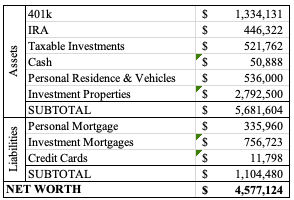
Obviously, our investment accounts diminished slightly since last month, as the stock market has been a constant discussion point recently. Last August, my updated said: Our overall net worth went down slightly from last month because of market fluctuation. So this seems to be a typical cycle! Last year it was offset by a large insurance check we received, while this year our cash balance is much lower from last month to this month.

I have about $9k to still pay out on a roof replacement (insurance is covering most of it), about $1k to pay to a plumber, and a couple of other odd jobs that are waiting on invoicing. Our net worth isn’t 100% accurate this month because I don’t have access to a few accounts (well, I have the log in and password, but it requires either text or email verification to get logged in, and Mr. ODA holds those and isn’t available – annoying!). I also have a $1500+ insurance payment to make, but I’m purposely holding off until this credit card statement cycle ends so that I can feel like one month isn’t a crazy high balance.

To update our net worth, I have spreadsheets set up that I overwrite from last year. Last year’s August update had our net worth at $3.78 million. So even though this month is over $27k less than last month, we’re still up over $500k from a year ago without any drastic changes in investment portfolio.

5% Rent Cap

The President issued a statement calling on Congress to cap rent increases at 5%, specifically for corporate landlords. The statement appears to define corporate landlords as those owning over 50 units in their portfolio. This was not an executive action that is implemented. And while my numbers are different than the numbers of a “corporate landlord,” I do think it’s worth hearing a landlord’s side. I feel that there’s a lot of spite against landlords without a lot of knowledge about their actual financials.

I admit that there is a possibility that some of these companies with large complexes could be raking in on the fees or “utilities” that are in the unit, without actually providing a properly maintained building, but that’s not the case for everyone that’s labeled as a landlord. No one seems to step back and see that this is a business model for landlords, and while everything else around us is increasing in costs, rent needs to as well.

No one predicted such a significant rise in product costs or housing costs in such a short period of time, but here we are. And landlords aren’t in the business to graciously eat the costs of homeownership for renters.

LANDLORD COST INCREASES

The Presidential statement released refers to a press release that starts with, “Todayโ€™s U.S. Labor Department Consumer Price Index (CPI)ย reportย revealed costs remained largely unchanged in May, withย overall inflation coolingย faster than economists expected as the Fed considers finally reducing interest rates below a 23-year high.” Is there a comparison to costs that landlords had to take on because the costs of everything increased faster than expected back in 2020-2022? Increases have been seen on small things like a maintenance call for a technician, but also big things like property taxes and insurance.

That same article goes on to state, “Since 2019, the cost of rent hasย risenย 31.4%, with wages only increasing 23%, as tenants on average need to earn nearly $80,000 to not spend 30% or more of their income on rent.” In 2019, on one of my properties, the taxable assessment was $95,000, which equated to about $1,200 per year in taxes. In 2024, the taxable assessment was $242,000, which equates to about $3,000 per year in taxes. That’s a 61% increase in just my taxes over that same period of time where they’re complaining that the cost of rent increased by 31.4%. If rent had been set based on the 1% rule in 2019, rent would have been $950 per month. Had I increased 5% each year from 2019, it would be $1,212 in 2024. If I set rent based on the 1% rule now, it would be $2,420. However, the rent on the property is $1,750. So while it’s more than 5% each year since 2019 (the baseline the government is using), it’s set at an amount where I capture my expenses for owning the house, while also turning a small profit.

It’s taboo for a landlord to turn a profit, but that’s why we’re here. It’s an income stream that we’re establishing for profit. I don’t get to pay myself an hourly rate for managing the property. So this “profit” can actually be looked at like a salary. Every time I need to show the property to a prospective tenant, the lease signing, the walk through, every call or text you make, every trade that I need to schedule and coordinate with the tenant on, any fixes or improvements that I do myself. All of these minutes in a day add up, and I’m not directly paid for any of them.

On the particular house that I’m using for the example, we are assuming $300 per month in profit, which comes to $3,600 per year. Would you work as a manager of a company (e.g., hiring trades to fix things, performing maintenance, making sure all bills are paid timely, general management of having liabilities), for only $3,600 per year?

I wrote a post last Fall about the changes in my rental fixed costs from a year prior. I plan on doing the same this fall when more tax information comes due. The house I’m referring to has been at $1,750 for the past two years. However, between 2022 and 2023, my taxes and insurance have increased by $255 per year. That’s a cost that I’ve “eaten” from my “profits.” I could have said that equates to $22 per month increase, and I could have projected a similar increase for the year coming. I could change their monthly rent to be $1,790-$1,800 to keep my profits on a similar path. However, I didn’t, because they’re good tenants that haven’t had many maintenance calls.

However, if I don’t increase every year, then I could find myself in a sudden deficit like I did during the pandemic because costs increased faster than projected. A 5% cap could actually incentivize annual increases because I wouldn’t want to be caught behind and not able to catch up down the road.

LEASE TERMS

The Federal Housing Finance Agency announced protections for renters in multifamily properties that are financed with loans backed by Fannie Mae and Freddie Mac. The protections include: (a) requiring 30 day notice before rent increases; (b) requiring 30 day notice on lease expirations; and (c) providing a 5 day grace period before imposing late fees on rentals. I know for a fact that every single lease I’ve executed personally already has all of these requirements in it, at a minimum. In many cases, there’s a clause for 60 day notice of a potential rate increase, with negotiations being completed before 30 days from lease expiration.

Some states already have this codified. Other jurisdictions have landlord/tenant agreements that give the tenants rights (and awareness of rights) that can be lobbied against if the landlord is noncompliant.

There’s a clause that I’ve seen that requires expired leases to auto-renew on a month-to-month basis instead of for another year. I would argue that a requirement to renew a lease month-to-month instead of annually actually hurts a tenant. A landlord then only needs to give 30 days notice of a rent increase, and they could technically increase it month after month.

SUMMARY

If the ‘cap’ were to apply to me, then I’d be more inclined to increase rent every year. As a general rule, I increase rent for long term renters by $50 every two years. When we turnover a property, we will evaluate market rent in the area and set the monthly rent at what we see (which could be more than $50). In some cases, the evaluation ends up being too high, and we set the rent at something we think more people can afford. For example, there were comparable houses renting at $2,200 near a house we had listed. We’d rather get the property rented than shoot for top dollar, so we listed it at $1,600. While lower than “market value” probably called for, it was $400 higher than what we had it previously rented at, which covered cost increases that weren’t previously covered.

In the post that I previously linked, I highlight that our standard for increases barely offsets our increase in expenses. While we manage each house individually on setting the rates (asking ourselves: do we think the tenant can absorb the increase, do weย haveย to increase to cover actual costs now), our monthly income among all houses was increased by $475. If you add up the cost increases for taxes, insurance, and property management (increased rent means increased fees because fees are based on the rent price), our costs went up $415 (and that’s before any service calls). On a whole, weโ€™ve offset the ‘fixed cost’ increases. We’re taking ‘losses’ on houses where our routine for increases is slower. Therefore, having 13 properties affords us the ability to be more lenient with tenants and to keep good tenants in the house instead of forcing them out with hgher rent increases.

I support having protections in place for tenants. I’m sure there are landlords out there that aren’t interested in playing ‘by the book’ and just being decent human beings like I intend to. However, landlords are people too, and they’re running a business. Creating boundaries without fully understanding both sides of the situation and focusing on data points that only support your theory is unfair. I’ve joined the Landlord/Tenant Advisory Committee in my city. I hope to bring more awareness to the landlord side of things and bridge the gap between landlords and tenants when it comes to responsibilities.

Expense Analysis

Back when I spent my days working in front of a computer, it was easy for me to analyze our spending. These days, with 3 kids in tow, I’m lucky to record our finances timely. There’s no time for analyzing. But over the past two years, I haven’t been happy with our spending total for the year, so it was time to look into it a bit more. It’s hard to know what has changed since I don’t have month over month, or year over year, trends to compare this data to, but it’s a start.

There are some caveats.

  • I don’t include any spending that isn’t on a credit card here. That means some of our rental property bills aren’t captured (they’re paid via Venmo or check), but I decided that’s ok because I can see that in a different way (a separate spreadsheet). Those expenses are reactive and a necessity to running the business, so it’s not like I can change a spending trend there. I’m more curious about our actual expenses and where our money is going for personal decisions. There will be some rental expenses captured here though.
  • I’m doing this analysis for the first half of the year. If this was for a month at a time (which is a goal), then I’d be able to dive deeper into spending at each place. For instance, at Walmart, those expenses aren’t always ‘grocery.’ However, I don’t have the time to go through all the purchases and siphon out non-food purchases. I did go through most of the Amazon purchases and categorize them.
  • If a purchase was made at Lowe’s or Home Depot, it’s classified as home improvement. It may have been rental property work, but generally it’s related to something we’re doing at our house.
  • If a purchase was made while on vacation (such as amusement park, tolls, hotels, dog sitting) , it’s categorized as ‘vacation.’ If we were on vacation and purchased food, it wasn’t labeled as vacation. All fast food or restaurant purchases for the first half of the year are categorized as ‘restaurant.’
  • If we did an activity from home, it’s labeled as ‘entertainment.’ If we did something related to sports (this includes swim lessons, ticket purchases for performances, etc.), then it’s labeled as ‘sports.’ The entertainment versus sports delineation is because something like a single tournament could be considered entertainment, but I kept all sports items as ‘sports.’
  • None of this includes whether we were reimbursed by someone else for a purchase. For example, we purchased tickets for 15 of us to go to an amusement park on vacation, but we only paid for 4 tickets of that personally. Mr. ODA is a personal shopper for restaurants, so much of our restaurant shopping around town is actually later reimbursed in that process (but not captured here because it’s not a credit card line item).

In the process of going line-by-line on my expenses, I discovered that I never received a refund for something. I placed an order on Etsy for a personalized gift for my niece’s birthday. A few days later, I went to check the status of the order, and I discovered that the shop I ordered from was no longer selling on Etsy. I was frustrated that I received no email that told me my order wouldn’t be fulfilled. I contacted Etsy customer service. At the time, I misunderstood Etsy’s billing process. I assumed it was charged when the item shipped. As I was just going through charges, I realized that the amount was charged on the date of purchase (e.g., not when shipped), and I had never received a response from Etsy. After another frustrating round of attempting to contact customer service this morning, I finally received a resolution. Now my ‘to do list’ has to keep track of this refund appearing. It’s $10.01, so it’s not the end of the world. However, it would be nice if Etsy shuts down a seller (their words), that they manage the outstanding orders without me having to take my time to get it corrected. Plus, if I let every “it’s just $10” go, it could add up quickly.


FIRST HALF OF THE YEAR SPENDING

By far, our largest slice of the pie up there is for rental expenses. Honestly, I’m happy to see that so much of our credit card expenses are taken up by rental expenses we had. I pay our insurance premiums (where they aren’t escrowed) via credit card, and I can pay our county taxes for one house with a credit card, which I do for the cash back rewards. There was flooring replaced at one house, which was a significant amount of that slice.

The ‘home improvement’ category includes new patio furniture we purchased, but were reimbursed by insurance (a tree fell on our deck). It also includes the electrician work and dirt fill purchases that we needed for the deck rebuild. Our house has a few more fairly large projects we want to complete, so I expect that to continue being a larger chunk.

I know that our “grocery” expense isn’t completely groceries. I’d like to focus on this category of spending more in the second half of the year. I want to quantify what’s purchased at Walmart that is actually grocery versus personal shopping type purchases. I think that our grocery purchases are higher than they should be, but I can’t put my finger on exactly why. Historically, I’ve blamed it on ‘bulk’ shopping; Mr. ODA will go to Kroger for the “buy 5” type sales. I’m not sure that’s it though.

We don’t eat at restaurants very often. We usually eat at fast food places while we travel or are away from home at an inopportune time. When we’re at home, we’re usually eating at a “personal shopper” experience where our food cost is mostly reimbursed (although that’s not captured in the chart).

Our health insurance deductible is $3,200 per year, so we expect slightly more than that each year in the medical expense category (and based on how deductibles work, that expense is front loaded in the year). I actually pre-paid a bill at a child’s urgent care visit. I paid them $50, but that visit, along with two more visits since then, came to a total of $12. I’m waiting for their reimbursement of that difference.


PERSONAL SPENDING

I’m going to dig deeper into the ‘personal’ category. I labeled a bunch of things as ‘personal’ as a means of not having too many small slivers of the overall spending pie. This includes all gifts, needs for kids (new shoes), clothing for kids, gym membership, sports, etc. It includes a ‘shopping’ category. I spent some time going through my Amazon orders and categorizing them, but the ‘shopping’ category was too daunting and difficult to parse out further. About a third of the ‘shopping’ category is Amazon orders through Mr. ODA’s account that I didn’t pull up to categorize. The rest is random purchases that were probably related to gifts or kids clothing.

For entertainment, this is small things like going to the movies (which we go for $2 per ticket), bowling, and aquarium. The largest chunk of this pie part here is actually 4 season pass lift tickets for our family’s future winter season. I put the ‘mom’ category to see what I’ve purchased for myself that wasn’t a necessity (e.g., a travel cosmetic bag, baseball shirts to wear to my son’s games), as well as my one hair cut and one pedicure that I’ve gotten this year so far. The ‘other’ category is boring stuff – utilities, car maintenance, professional fees, etc.

Had I gone through my Walmart orders in detail, I would have been able to identify some more purchases that could be removed from ‘shopping’ and put into other categories. For instance, the ‘dog’ category is actually higher because I order his glucosamine and tooth cleaning treats from Walmart most of the time, and that’s a monthly expense. His annual vet appointment is in the Fall, so this will be a larger slice of the pie for the end of the year.


SUMMARY

Our annual credit card payment total for the last three years have been about the same. While it’s a ‘win,’ that it isn’t increasing, it’s still at a number that I don’t like. Mr. ODA has been working towards a ‘retirement’ date. We’ve pushed it back just because his job hasn’t significantly impeded our lifestyle, but the day will eventually come. If it’s next year, I’d feel better if our credit card payments weren’t as high.

I went into this expecting my grocery category to be higher than I’d prefer. I didn’t identify much of what is causing that, so I’ll try to focus heavily on watching that expense each time it hits the credit card, rather than trying to remember what each purchase entailed six months later.

I was surprised to see the gas category such a small sliver of the pie. We’ve done a lot of trips (although, I suppose a majority were in July, which isn’t captured in this data). It appears living in a smaller city and doing things mostly on this side of town means we’re not having to fill up our tanks too often.

Overall, I didn’t notice any egregious spending. We don’t spend for the sake of spending. This year we traveled more than we had the previous two years, but mostly our spending is the same. Now that we’re two years into our house, there are less projects that we’re putting money towards. I’m encouraged that now that I’m looking at this, I’ll be able to identify areas to scale back.

Thermostats and Finances

There has been a lot of talk about thermostat temperatures recently because of how hot it has been where I live. There are Department of Energy images circulating that say keep your home at 78 when you’re home, 82 when sleeping, and 85 when away from home. Personally, I need it colder at night than during the day, but that’s not the point. My goal here is to make you stop and think about your actions. This applies to several areas of your financial life, but this post specifically will be regarding your heating and cooling process.

THERMOSTAT SETTINGS

In our house in the summer, we keep the thermostat at 75 or 76 during the day on the 1st floor. It usually starts at 76 and then if someone feels hot, they bump it down to 75. Upstairs, it sits at 77 for the day, is put at 76 for when the kids go to bed, and then 74 when we go to bed. When we leave the house, the thermostats are at 78; if we leave for extended periods of time, it’s set in the 80s. In the winter, the heat is set at 65 during our waking hours and 64 or 63 at night.

As a quick aside, our third son was born early and was having trouble breathing and regulating his temperature those first few weeks. We were told to keep the house at 70 or greater for him. We struggled! We made it to 69, but everyone was uncomfortable and hot. I mentioned this to the doctor and he said it was fine to be at 68 if that’s what everyone felt more comfortable at.

While we know these numbers now, we spent a lot of years working on different settings. We didn’t just assume that these were the numbers we wanted to be at. There were winter months where we set it at 63, but my fingers were hurting because they were so cold while I typed on my keyboard, working from home. I was at a friend’s house recently; they had it set at 70, and I was cold.

That brings me to another point. What’s the thermostat temperature where you’re comfortable in the summer while wearing shorts and a tshirt? If you’re wearing a sweatshirt and have the temperature set at 70, is that worth the extra cost to run the air conditioning at that temperature?

TIPS TO SAVE MONEY

This image was shared by a local meteorologist, but a citation wasn’t given, and it differs slightly from the numbers that the Department of Energy published. According to this, we’re saving 19% in the winter by keeping our heat at 65, but then we’re spending 32% more in the summer based on the recommended setting.

While you may have your expected temperature setting, you may want to consider is how hot (or cold) it is outside. If it’s going to be 100 degrees, maybe set the thermostat slightly higher on those days. It’ll feel comfortable at a higher temperature because the unit is going to be running more, therefore pumping more air into the room than on an 80 degree day.

In the summer, another option is to keep the blinds closed. If you keep the sun from peering into the house, especially during the heat of the day, it’ll help keep the temperature lower so the unit won’t want to kick on as often.

My local electricity company provided suggestions to keep your bill lower. Their article said to grill, use a slow cooker, and make sandwiches instead of using the oven and stove, which create more heat for the air conditioner to have to counteract. You can also use fans in rooms where you’re sitting so that you feel cooler while the thermostat is kept a degree or two higher. Make sure your filters are changed regularly so that your unit is working efficiently.


I implore you to increase your cooling temperature by one and see how that feels. Live with that for a week and see if going one more degree helps too. It could be that the cost to run your heating/cooling is worth the level of comfort you feel, but it could be that you find a setting that is still comfortable and it’s worth the savings you reap.

Rental Property Work

We have several rental properties in Richmond, VA. However, we moved away from the area in September 2020, leaving the properties under a property manager’s oversight. My goal was to make it back to the houses annually to do walk throughs of properties. It’s surprising how many people don’t tell landlords about issues timely. Since most of our properties keep long term tenants in them, we don’t get eyes on the condition of the house regularly like we would if we were turning over the house between tenants.

Generally, I check to make sure their HVAC filters are changed out, that they don’t have any piles of garbage or old food (or the gigantic pile of laundry that was blocking one tenant’s second form of egress), that the yard is maintained, and simple things like that. I also take this as an opportunity to fix or improve things that I know need attention, but weren’t necessarily worth the up-charges of hiring the action out to a contractor.

We did a walk through of the Richmond houses in July 2022. At that time, nearly all our properties had long term tenants in them. A few small items came out of those walk throughs (e.g., change out filter, re-caulk the tub). While we hoped to get there last summer, it just wasn’t in the cards with our 3rd baby.

Based on the rest of our summer schedule (and soon to be constriction of school schedules), we were only able to get there for 2 full days. None of the work that I wanted to get done is a high priority; it’s mostly work that would improve the aesthetic of the house or help the longevity of an investment (like a new porch).

PROPERTY 7

This house recently turned over. The house was flipped when we purchased it 7 years ago, and we knew that everything that was done before we owned it would just be a bandaid. We had a couple of long term tenants in the house, and we even had quick turnovers because people needed a place to live, so we didn’t have time to do major renovations. It was time. We put a lot of effort into fixing up the place (e.g., all new paint, new flooring and fixing of subflooring). The front porch and front door were red, and it just made the house look dingy. I wanted to make it look better. See: not a priority, but something worth looking into eventually.

I arrived on the evening of the 4th to pressure wash the porch so it would dry by morning when I would paint it. I did not account for how bad the condition of the paint was. It appears someone just painted over peeling paint years ago. There were several layers of gray, purple, and red colored paint. The latest paint job had several places where that was the only layer of paint on the concrete. Very odd, but that meant that I had to scrape as much flaking paint away as I could. I spent over 10 hours on this. Not exactly what I had in mind. I scraped and scraped and scraped. I then put two coats on. I’m nervous how long it will hold up though. I did this during an extreme heat advisory so it likely didn’t cure correctly by drying in mere minutes.

I also did 3 coats of black over the red door. I don’t think it’s going to hold up against her animals, but at least it looks better from the street.

This house still needs the back deck pressure washed and painted. However, this is something I’ll do either with tenant turnover or if we sell it. It’s really worn down and places are missing paint because we removed the covered portion of it. The porch railing had also been painted at some point and is peeling, but I hadn’t budgeted time for that. I did a few touch up areas with black paint to cover where previous owners had painted it red.

PROPERTY 3

The tenant here reached out to me a couple of months ago to tell me that a salesman broke their doorbell. Fascinating. They claimed “well, it’s old.” My thought was “well, it’s meant to be outside, and the house next door was built the same time without any doorbell breakage now.” But instead of sending someone out to fix that, I put it on our to do list. It took Mr. ODA about 2 minutes worth of work, and the new doorbell cost $10.

While there, we cleaned out the gutters. That’s been a known issue throughout the life of this house because there are a lot of trees around the perimeter. We also cleaned the mildew growing on the house.

PROPERTY 2

This house is a mirror image of Property 3, but the trees in the backyard are much closer to the house. The back of this house had significant mold growth on the siding. We got all the siding cleaned up there too. Mr. ODA got on the roof to clean out the gutters. While up there, he also cut some trees off the roof.

The first picture is a ‘during’ picture because I didn’t get a ‘before.’ The part at the top that is dark is actually better than what was there, and it was over the entire back of the house. We soft washed with a mold and mildew cleaner and got it looking almost brand new.

PROPERTY 9

During the last turnover period of this house, we had the front porch jacked up (it was sinking), had the front stairs redone (they were sinking too), and had the back decking replaced. I had intended to stain the new wood for this house, but it being well over 90 degrees precluded that action. Instead, Mr. ODA got the siding on this house all cleaned up, and he cut/pulled several large weeds that were growing.

DRIVE BYS

We did drive by the other Richmond properties that we have. I didn’t have the time (or energy) to schedule walk throughs of everything. Once you do a walkthrough, you inevitably end up with a list of things to do to the house. I already had a lengthy list of things to do, so I didn’t want to manage that right now. Just by driving by, I did add to my to do list that one house needs its gutter replaced (how does a gutter, with no trees around, twist away from the house), and that their back deck really needs to be replaced (just the deck boards and railing; the substructure is fine).


I’ll need to make it back there to walk through the properties. If nothing else, it gets the tenants to clean things up once a year. One of our property managers offered a filter check quarterly, which was really used as a way to get into a house and make sure things were being kept clean and orderly. While a filter should be changed that often, I think that’s too much time being in someone’s place they call home. However, once per year is worth it to keep things moving in the right direction and to make sure there aren’t any maintenance issues that hadn’t been reported.

July Financial Update

RENTAL EXPENSES

We took a trip to Richmond, VA to work on rental properties. It was fairly last minute. I had a schedule of work at each house that I planned. However, I didn’t plan on the heat index being 113 and 112 for the two main days we were there. I was able to get everything on my list done except for staining the new deck at one of the houses. I didn’t want to risk it not applying or curing correctly because it was too hot and in direct sun. Plus, the tenant didn’t even clear it off so I could work on it.

I had multiple houses pay rent late this month. I was surprised. One let us know on the 5th that they had an emergency, so they wouldn’t be able to pay until the 17th. I had someone pay half their rent early in June, but then haven’t received an answer as to why the rest of her balance ($345) hasn’t been paid yet. Another tenant misunderstood her maternity leave pay, so she asked for more time to pay rent. She paid $800 on the 7th. I told her not to worry about it, and just pay when she can, without the late fee; she only has $150 remaining.

I’m currently working through two roof replacements. One of them will be covered by insurance, but then I’ll be paying to have vents added, the chimney torn off and capped, and the soffits repaired on top of what insurance can do. Then the other one we’re paying out of pocket for. It’s original to the house, which was built 24 years ago. There has been storm damage to it over the last year, and it’s just generally time to address the age even though it hasn’t caused any problems yet.

PERSONAL EXPENSES

Our medical insurance company had some glitches in their claim processing through the first half of the year. Now they’ve caught up, meaning I’m paying large sums of medical bills. Mr. ODA took on booking lodging for his guys trip later this month, which meant that the second half of AirBnB payments were applied to the credit card.

Mr. ODA increased each kid’s UTMA from $75 to $100 per month. That means we’re investing $3,300 each month into accounts, on top of maxing Mr. ODA’s TSP contributions and both of our Roth IRA contributions for the year.

Our contractor has ghosted us on our own deck build. We bought some new furniture for the main deck area. Once it’s not 100 degrees outside, we’ll work on doing the waterproofing of the deck ourselves so that we can start living on the patio under the deck and get that hot tub ordered this fall.

NET WORTH

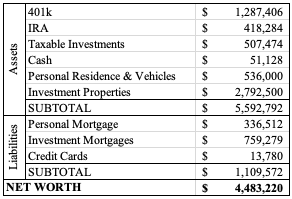
I updated the valuation of the houses this month. I typically only do that 3 or 4 times per year. I try to account for the big increases we see at the beginning of the spring, and then adjust slightly around this time of year once the comparable houses have closed and sold. This update added $140k worth of equity into the equation. All of our liabilities decreased since last month, and all our assets increased since last month. That has equated to an increase of over $200k in our net worth.