Rental Profit Calculations

When we consider purchasing a house to be used as a long term rental unit, we perform a “cash on cash” analysis. I’ve discussed this in the past, and I regularly share this with other people for their use. The gist of this calculation is to determine whether we would get a return on the cash put into the house.

The calculation considers the cost of taxes, insurance, homeowners association fees, vacancy expectation, maintenance expectation, costs to get the place rented, property management, etc. This is compared to the projected rental income. The upfront costs are compared to the annual cash flow projection. That ratio is hopefully in the 8%-10% range to be considered a reasonable cash flow to look further into the purchase.

Since we’re not really looking to purchase properties these days, I use this spreadsheet to consider changes in a tenant’s rent when it’s time for renewal. I kept all the original cash flow amounts to see how things change over the years. As I sat down to determine what changes, if any, are needed in the rents I charge, it was disheartening to see how our portfolio has dwindled in profitability over the years.

A few years back, housing prices skyrocketed, which drastically increased our taxes owed. Unfortunately, I hadn’t increased everyone’s rent consistently. I kept many people level or did small increases every two years, but that means I’m now “behind the 8 ball” in trying to make up for those drastic increases that happened in 2021-2022. In addition to tax increases, we’ve also seen huge insurance premium increases that weren’t projected in our portfolio.

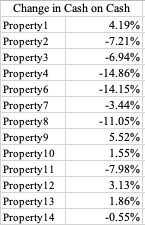
Our total “cash on cash” started at 11.42%. It’s now projected to be 7.58% – if the increases I project actually go into effect over the next few months.

We historically increased long term tenant’s rent by $50 every two years. Some of these tenants have been with us for over 5 years, and the $100-200 changes in their rent have not covered the increases we’ve seen. I hadn’t worried too much about it because the losses on those houses were offset by houses where we saw greater margins. Now, everything has leveled out, so those losses are felt harder.

The table above shows the change from our original “cash on cash” to our current status. In some instances, we’ve been able to increase our margins. But there are 8 instances our margins decreased, with some being drastic. Even though some are drastic decreases, there are only 5 properties that fall below the 8% goal we have.

For Property2, the projection shows that rent would need to be at $2,500 for us to hit our cash flow goal. The rent is currently at $1,600. The neighborhood doesn’t call for $2,500. I also don’t want to be in a position where I’m floating someone’s rent at that price. From the time we bought the house to now, our taxes and insurance have increased by $1575. That number only continues to grow. Our insurance started at $390 and is now at $765. Our taxes started at $1,500 and are now at $2,700.

On top of the obvious ones like that, our maintenance costs have also increased. As one example, our HVAC technician first was charging $125 per site visit. He now charges $325 just to show up. I’ve found someone who charges $200, so I’ve been going with that guy, but just knowing that there’s been such a change in pricing structure needs to be factored into our costs.

These are really big affects on our houses that a tenant and the average public opinion don’t seem to grasp. I don’t get paid hourly or per transaction I perform to manage these properties, so that decrease of 3.8% in our cash-on-cash analysis is actually a net loss in my “income.” In many cases, we catch up when there’s tenant turnover, but watching the rent compared to our expenses are things that I need to be more on top of year-to-year.

Rental Cost Changes from One Year Ago

I keep updating my investment property tracking spreadsheet to reflect the current costs of insurance and taxes. My tracking shows last year’s amount, which I use as an indicator on whether I need to look further into this year’s bill (e.g., is the amount a reasonable increase?). For so many years, most of our insurance policies changed by a few dollars; now, I’m seeing large swings in what’s being charged. Where jurisdictions were slow to change property assessments, they’re now catching up, which increases the taxes.

As a renter, your rent is increasing to cover these costs of the landlord/owner. Here’s a comparison of my fixed cost increases against my rent rate increases. As you’ll see, I’m not trying to get top dollar out of these properties because the market has increased so much (and that leaves me more exposed if someone doesn’t pay their rent on time). My rent increases barely cover the cost increases that are happening on some of these houses. Remember that while I’m showing fixed costs, this isn’t covering the maintenance calls that I receive and how they’re more expensive than they once were also.

ESCROW, CONCEPTUALLY

In most cases, for a traditional mortgage, an escrow account is set up. It calculates your taxes and insurance payments for the year, divides by twelve, and is added to your principal and interest payment for the mortgage. In addition to covering the total payments to be made, there’s also a requirement that the balance of the account never falls below twice the required monthly payment.

If your taxes owed for a year are $1500, and the insurance is $300, then your monthly breakdown is $150 ($1500+$300=$1800; $1800/12=$150). The minimum monthly required balance is $300 (twice the $150).

As taxes and insurance increase each year (typically), there’s an analysis done to ensure the projected monthly balance never falls below that $300 threshold. If the balance is projected to fall below the required minimum amount, then it triggers an increase in your escrow payment. Your escrow payment will increase to cover the shortfall, but also to cover the new projected costs to be paid. So while you may be offered the ability to make a one-time payment to cover the shortfall, your mortgage payment may still increase to cover the projected costs. For example, if last year, your tax payment increased to $1750, and your insurance to $350, then your monthly payment to cover those charges is $175 ($1750+350=$2100; $2100/12=$175). Your mortgage will increase by $25 per month because now your escrow agent knows the projected costs to cover are higher.

The analysis uses the current year’s amounts owed to project the coming year’s monthly balances; it doesn’t account for the probability that these amounts increase each year, which essentially means that there’s perpetually a shortfall. In other words, while in Year3, they know that there was an increase in costs from Year1 to Year2, they don’t inflate the costs of Year2 to cover Year3 projected payments.

I prefer to not have an escrow, but at this point, for any mortgages we have, they’re all escrowed. We have six of thirteen houses with escrow. While I pay more as my mortgage to feed into that escrow account, it means I don’t have to manage the annual or semi-annual payments. On the contrary, this means I need to be managing our finances to prepare for large outlays throughout the year on seven houses (in the last quarter of the year, I’m paying out over $8,000 to cover taxes owed).

ESCROW REANALYSIS

This post was prompted by a notification that an escrow reanalysis was done on a mortgage that was just transferred to a new company. I thought that their break down was the most clear I’ve seen. A quick note – your escrow will pay the bills that come due, regardless of the balance in the account, even if it means it’ll overdraw the account.

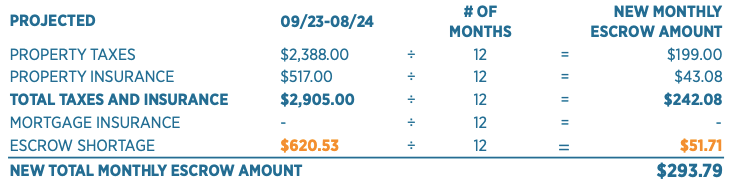
They clearly showed that the anticipated property taxes are projected at $199 per month (although, I’ll reiterate that this is based on last year’s actual outlay numbers, which aren’t accurate for the coming year). Then they show that the taxes are $43.08 per month. They then go as far to show the total of these two required outlays. There’s verbiage that explains the required minimum in the account must be twice the total taxes and insurance ($242.08 * 2 = $484.16).

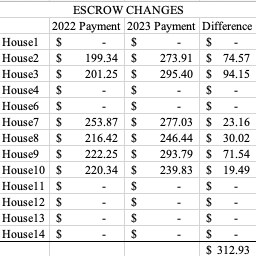
There’s another detailed breakdown of each month’s escrow income and outlay (that I don’t have pictured here) that shows the month that is projected to fall below the required minimum. That month’s account balance is -$136.37. The difference between the required amount of $484.16 and the negative balance of $136.37 is $620.53 (pictured above). When that’s broken down by month, it’s $51.71. Take the total taxes and insurance payments and add the shortage amount to get the new monthly escrow amount of $293.79, a change from $222.25.

Below, they show you that there is no change in the principal and interest payment, then it shows how the current escrow payment is adjusted to the new escrow payment, along with the shortage amount.

I created this table to show the differences between escrow payments over the two years. I kept the houses that don’t have an escrow because it can be compared to a future table in this post. There is no House5 in this table because we sold it several years ago (houses didn’t get renumbered because House5 still exists in terms of tax documentation).

TAX AND INSURANCE UPDATES

Each year, we see an increase in these amounts. Usually it’s across the board, but Kentucky districts had kept the housing assessments the same through the pandemic. As housing prices increase, your property assessment can be increased by your tax jurisdiction. The assessment increasing leads to an increase in taxes. This is why people getting excited that house prices in their neighborhood are selling higher than expected isn’t great if you’re not planning on selling any time soon; those increases in values means you’re paying higher in taxes.

In Richmond, VA, the property taxes are $1.20 per each $100 of the assessed value. In 2022, House2’s value $163,000. In 2023, the value was increased to $203,000. And let’s not forget that we purchased the house for $117,000. While it’s nice that the home values in the neighborhood are increasing significantly (and we knew the area was going to get better and better based on development happening), we can’t realize this gain until (and if) we sell. So in the meantime, we’re paying higher taxes on this amount. Although, I suppose the assessment could be even higher because the actual value of this house is probably more like $260,000.

Among 13 houses (don’t get confused – there’s no House5 up there because we sold it), I need to cover a total cost increase for taxes and insurances of over $4,500. This doesn’t include the higher costs of trades people if there are any maintenance calls, so this increase is the bare minimum for me to keep my same income.

RENT INCREASES

I constantly see complaints about the cost of rent, or that a landlord is increasing rent. Unless we’re looking for a tenant to move, our general philosophy is to increase rent $50 every two years. This worked fine because home assessments increased at a slow, reasonable rate until recent years. Now jurisdictions are capturing these larger increases based on those inflated sale numbers when competition was high in from 2020 through 2022.

In some cases, the rent for the area brought it in a higher amount than compared to our purchase price of a house. In those cases, we went several years without increasing the rent. Looking back, that probably wasn’t the best idea because now we’re behind on capturing how significant these last few year’s fixed costs have increased. However, the trade off to that is that we’ve kept great tenants in the house, haven’t had to pay to turnover the unit, and have minimal maintenance calls.

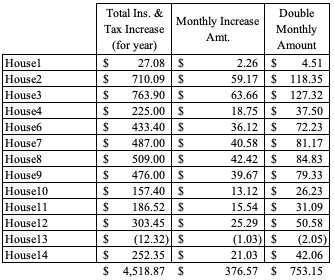
This table shows the total increase in insurance and tax payments from 2022 to 2023 in the first column. I divided that by 12 to get the monthly amount of that increase (second column). Then, since I said we typically increase our rent by $50 every two years for the same tenant, I multiplied that monthly amount by 2. I’m showing that if we want to only increase rent on long term tenants every other year, then I need to plan ahead on how much my costs are increasing.

This isn’t a perfectly accurate capturing of our cost increases since I’m not going back to 2021 to capture those changes in amounts, but it’s a general estimate. This shows that if I were to increase all houses by only $50 every two years, it’s cutting into my bottom line. Only 6 of the houses have increases less than $50 for two years.

SETTING THE RENTAL RATE

Let’s pause and talk about “bottom line.” Landlords have investment properties to make a profit. They’re looking for an income stream.

I regularly hear people say they can own a house for less than their rent, which is likely if you’re speaking only on principal and interest of a loan. However, you need to qualify for that loan. You may not have 20% down, so you may be required to pay private mortgage insurance (PMI). You may not have good credit, which means you’re probably going to pay a higher interest rate than I’m currently paying. You need to be able to cover taxes and insurance, which means you’ll have an escrow account set up, which increases your monthly mortgage payment. Then there’s all the other costs of home ownership.

That’s where people forget. When your hot water goes out, you call me. I spend $1,500 for about 2 hours worth of someone’s work to replace that. When you have a water leak, I spend $3,000 for a day’s worth of 2 plumbers’ work. When a storm drops a tree on your house, I’m the one spending hours on the phone with insurance, finding a contractor, getting quotes, and paying the contractor $3,700 before I get insurance reimbursement. Those are the big unexpected expenses. That doesn’t include all those smaller plumbing problems that cost $200 or $500 at a time.

Then in some cases, I probably put time and money into the house to even get it ready to rent to you. I didn’t always buy a house that was ready to live in. You may have projects that need to be done when you first move in also, so which costs money. Those are expenses that I’m trying to recoup through my rent rate also.

There may be other costs to my ownership that I’m trying to recoup through the rent, such as property management. I may have to pay someone else 10% of the rent, every month. I am projecting that there are going to be costs that I need to pay for also (e.g., water heater, roof replacement, plumbing issues). When I need to pay a plumber $3,000, I’m not coming to the tenant to say “I now need $3,000 to cover this cost.” Instead, I’ve set my rental rate the expect such a large payout on my part.

Not only am I trying to make sure that my rent is set at the right about to cover the costs that I’m putting into owning and maintaining the house, I’m also hoping that I’m going to make some money off owning this house so that I can live. I don’t get to pay myself for the hours I put into managing the property. Whether or not I have a property manager, there is still time that I put into managing the houses. Would you want to work for free?

BACK TO RENT INCREASES

While we manage each house individually on setting the rates (asking ourselves: do we think the tenant can absorb the increase, do we have to increase to cover actual costs now), this shows that our monthly income was increased by $475. If you look back at our total monthly increase in expenses of just taxes and insurance, it’s about $375; add in the cost increases for property management (increased rent means increased fees because fees are based on the rent price), and our fixed costs went up $415. On a whole, we’ve offset the increases.

However, you can see if we had one or two houses, some of those increases could be significant. House3 is costing us $64 more for each month, but our increases are typically about $50 at a time. We’ve had the same tenant in this house since we bought it. A $50 increase every two years hasn’t kept up with our costs. Since we have other houses, it helps cover the costs on House3.

House2 and House3 are identical in layout. House2 has been upgraded to all LVP, whereas House3 has carpet everywhere except the kitchen and bathrooms (granted, it’s new carpet two years ago). Since we purchased these two homes with tenants, rent was already set for us. House3 has been the same tenant since we bought the house, and the increases have brought us to $1200 per month in rent. House2 has been turned over 3 times: the first was a divorced lady who moved back in with her ex-husband; the second was there for several years, but we began having a lot of issues with her, and we told her the lease was up; the third was the one who flooded the house in December, and causing the need for the fourth. Now we’re renting that house at its market value of $1600. That means House3 is operating at a much lower rent than we could get if we rented to new tenants. However, the tenants are wonderful, and we’ve purposely not raised the rent on them in significant ways because we don’t want to cause them to move.

SUMMARY

Cost increases in rental properties can be significant over the years. With the rising costs of all goods and services, property values weren’t immune. The increase in property values leads to an increase in an assessment, which means an increase in taxes. That cost is relayed to the tenant, as this is a for-profit business. I’m trying to make an income for my family with rental properties.

I’m not trying to price gouge tenants, but make a fair living based on the costs of owning these houses. My first goal is to not turnover tenants, so I do what I can to make my tenants happy by taking care of the houses and not creating drastic rent increases each year. Secondly, I’m not going to set a price that my tenant can’t afford, thereby putting me in a hard position where I don’t have rent paid. Having multiple properties helps to offset the costs so I don’t have to play catch up on one or two houses worth of higher expenses, by putting my long-term tenants in an uncomfortable position where they can’t afford the rent.
October Financial Update

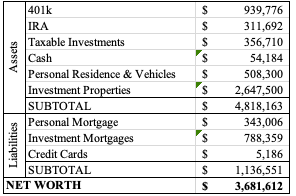
Our net worth took a hit this month, over $96k less than last month. I updated the value of each house we own. I don’t do this regularly anymore because it doesn’t change significantly month-to-month and it’s very time consuming. The market is cooling from the multiple-bid market we were in over the last few years, so home values are starting to come down ever so slightly. They’re still much higher than what they were 3 years ago (and I have tax assessments to prove the pain of that), but it does affect our net worth this month since it’s lower than it had been.

Also affecting our net worth is the market itself. It’s down, which it does around this time every year (confirmed through the history of my financial update posts). Our investment accounts are slightly down, our cash is significantly down because I paid off a large credit card balance and because Mr. ODA has transferred to a Treasury account for some of it, and our investment property values are down.

We opened a new credit card this month because we have purchased new carpet for our house (our entire second floor except 2 bathrooms, the stairs, and the living room all add up very quickly). As I’ve shared numerous times, when we’re about to have a large purchase, we look to open a new credit card that we can use as a loan. Sure, we have the cash available to pay this immediately, but wouldn’t it be nice to earn interest on your cash balance for 12-15 months and get some sort of sign-on bonus from the company?

I paid off our last 0% interest credit card at the end of September. But our credit card balance is still slightly higher than I’d expect because I haven’t paid last month’s statement on one, which is almost $3,000. I used to try to pay off all balances before doing a net worth update so that it was the most accurate, but now that we’re keeping Mr. ODA’s paycheck separate and trying to capitalize on interest to earn, credit cards aren’t paid until the last minute. We’re also still carrying about $30k worth of insurance money that we can’t seem to spend because State Farm is doing their hardest to drag their feet and restart our claims process each week.

I have a house that hasn’t paid a penny towards rent this month. She did let us know that it’ll be paid in October some time (no date or expectation given to me is infuriating). If she doesn’t pay something tomorrow (assuming we’re two Fridays into the month for pay checks), I’ll give a warning about the notice of default being given.

September Financial Update

Whew, we’ve been busy. Son turned 4. Lots of traveling. Kids started school. Managing two houses. Managing the rentals. Being 7 months pregnant.

We’ve been working on our old house to get a lot of the things moved to the new house, while keeping enough there to live. A slow move sounded great in concept, but dragging this out for 3 months now, with another 6-8 weeks to go probably, has been rough. We unload the car, put it in the new house dining room, and then I need to unpack all that and find it a home. Then we come with another dump of things right after I clear that out. It’s been exhausting. Meanwhile, I’ve been painting almost all of the new house, changing out light fixtures, changing out some electrical switches/outlets that were dated, etc. Mr. ODA has started working on the rebuild part of the bathroom renovation, so we happily have gotten all the electrical work that we wanted to do done (we need to hire an electrician to run a line for the dryer), and then got the shower framed. He’s also been working on the yard and landscaping, which is a big project because the original owner of the house put in a lot of landscaping, and then the people who owned the house for about a year before us didn’t maintain any of it.

We’re listing the house this week, and we’re hoping for a reasonable offer ASAP and a closing at the beginning of November. That closing will pay off our mortgage (~$265k) and our HELOC (~$82k).

RENTAL PROPERTIES

October brings a lot of rental bills. KY’s property taxes are due in October and November, and none of the houses we have here are escrowed, so I need to plan on about $6,500 outlay. Right now, we have a HELOC on our last primary residence, so I have that to fall back on. Typically, I project out 2 months of expenses, and I know how much I have “left over.” The “left over” usually is paid towards a mortgage or, currently, our HELOC balance; in the Fall, I plan to have that “left over” go towards the taxes. Luckily, our houses in Virginia that aren’t escrowed have the tax payments due half in December and half in June.

While our credit card balances are high (we’re carrying a large balance on one that’s 0% interest), we didn’t have a lot of expenses this past month. Mr. ODA’s work trip hotels and restaurants are on the credit cards that will get paid this week, and we’ve had higher gas expenses because of my driving to/from NY and then capitalizing on Kroger incentives so filled up one car. Other than that, we’ve only eaten at restaurants sporadically and have been focused on getting projects done, so haven’t gone out much.

This is the first month of the newly executed lease with a tenant who paid late every month. Their rent total increased for the convenience of paying twice a month (although the total owed now is still less than their rent and late fee they had been paying). They paid the first half on time, and they haven’t paid the second half, which if it’s not paid by the end of today will incur a late fee. Rent was $1450, so they were paying $1595 every month. Rent is now $750 twice a month. If they pay on time, it’s $1500 per month. If they pay half late, then it’s now $1575 per month.

I submitted the security deposit charges to the tenant that moved out. She asked a question about the charges on the list, but then didn’t acknowledge by the deadline. We need to have our property manager file the charges in court. Somehow it’s the 19th of the month, and we haven’t pursued that yet because we’ve been so busy.

Other than that, we didn’t have any service calls on any of the houses, and everyone else has paid their rent.

NET WORTH

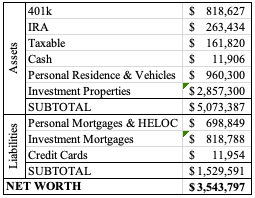
We have a busy October planned. I hope we’ll finish the projects at the new house and be close to closing the chapter of our last house. Our investments have declined significantly (almost $91k!) from last month. Our cash is higher than usual because of the cycle timing for this update compared to the bill due dates. And finally, the credit cards are higher than usual, and they’re higher than last month, but that’s because we’re purposely carrying a balance on a 0% interest card. So while our overall net worth has decreased over $33k since last month, the stock market issues have been offset by paying down mortgages and increased property values.

May Financial Update

This has been a whirlwind of a month. Our crashing investment accounts have been offset by home values, so we’re still over $3 million net worth. But those investments are very low; it’s the first time I’ve seen a negative in my 12-month performance history for my ‘401k.’

HELOC

A couple of months ago, we were standing outside playing with the kids when a neighbor walked by and introduced themselves. Being that we easily have $150k worth of equity in our house, we started talking about how we should open a Home Equity Line of Credit to be able to float a future purchase. The process was initiated, but not really started, when we made an offer on another house to be our personal residence. More to come on that. But we close on the HELOC today at $100k, which was the maximum she could do as an “administrative authorization” (for lack of a better term, and to pull on my government background), which essentially just meant no appraisal cost.

NEW HOME PURCHASE

We’re about 3 weeks in being under contract on a new house. We’ve submitted all our files to an online bank that we’re using as our loan, and we’ve locked our rate at 4.0% on a 5 ARM. Closing is expected to be 6/15. We’ll need about $75k or 80k out of the HELOC for closing on that.

We found out that our appraisal that was ordered for this house got cancelled. A quick inquiry to our lender and we found out that they decided our credit profile doesn’t need one! They’re going to refund us what we already paid, which was a pleasant surprise.

PART TIME WORK

I worked the weekends in April at the local racetrack. It’s good money and only required 8 days of me actually working. This meet’s experience was slightly different, and I didn’t enjoy it as much as the Fall meet, but I made more than I did in during that meet.

RENTAL UPDATES

We had a tenant abandon a property on April 1st, so that was a lost month of rent that we weren’t expecting. Our finances aren’t in a position that we need that money. It also helps that we don’t have a mortgage on the property. But we still put over $2,000 into the house (including two appliances) and a week’s worth of our time in turning it over since it was left in poor condition. We’ve been fighting Home Depot on getting a dishwasher delivered and installed, and that still isn’t resolved.

We had our usual suspects not pay rent on time. One did manage to pay in full (not the late fee though) by the 7th. The other I finally told that paying on the last Friday of every month is no longer acceptable, and it needs to change. She sent a nice email back, but we still haven’t seen a dime from them this month.

We had one rent increase go into effect; it went from $1025 to $1100. That also increases our property management cost by $7.50 going forward.

We had an insurance company drop us by not renewing us since they found out we moved out of state. We told them we have a property manager, so there is someone available taking care of the houses, but they didn’t care. Luckily, not all insurance companies have such a requirement, and our agent was able to find someone with nearly the same price that accepted a property manager.

We have officially paid off one of the loans that we had with our partner. We had intended to pay the loan off this month, on our terms. Instead, because the balance was about $400, the loan company took it upon themselves to use our escrow and close the account. We were purposely waiting until after escrow paid the taxes due this month, and now we need to scramble and figure out the tax payment.

NET WORTH

SUMMARY

We now commence a very busy time of life. We have several trips planned, we expect to turnover a rental that we’re kindly asking a tenant to vacate, and we have a lot of work we want to do on our new personal residence. Hopefully the turnover of the one house goes smoothly, we get the house that was abandoned in April re-rented, and that there are no more surprises in our rental world. We also had our AC go out in our 18 month old house, so here’s to hoping there are no more surprises in the personal expense world too.

2021 Rental Terms and Lease Expirations

Spring is a time for lease renewals or preparing to re-rent a house.

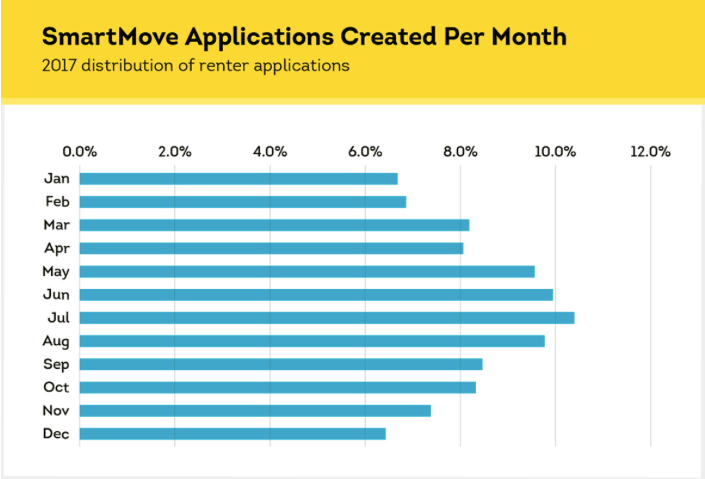
Spring and Summer are times when people are most active in the real estate market. It’s the best time to be listing your house for sale and for rent, which may yield you a better sale/rent amount because of greater competition. This timeframe is likely most active because of the better weather for moving and the school year – if a family is looking to move, they’re more likely to do it when they don’t have to transfer their kids to a different school district mid-school-year. Personally, when I was in college, nearly all the rentals were available in May or June. I remember being frustrated that I couldn’t get an August lease and had to pay for the summer months even though I’d be back living at my parents’ house. Now that I’m older and have more experience, it all makes sense. Below, you can see the increase in applications processed by SmartMove (the way we process tenant applications) that occur during the summer months, which indicates the most active time in the market.

We have seen this reflected in our days-on-the-market and rent prices. When we can list a house in the Spring months, we’re able to get it rented with very few days vacant. Houses that we’ve closed on at the end of the Summer (when school starts) and in the Fall have taken us more time to find a tenant, and we’ve had to reduce our asking monthly rent amount.

For those houses that we had purchased in a less-opportune time of year, we’ve worked to get them back to a Spring-time market for renewal.

  • We purchased two in September 2019 that we weren’t able to get rented until November 1st that year; we offered those tenants an 18 month lease so that their lease expiration would become May 31st.
  • We did similar with a house that we purchased in August. After that first year, a prospective tenant tried negotiating the list price for rent, and we said we were willing to reduce the rent a bit for an 18 month lease; they agreed, and we got our rental on a Spring renewal.
  • We recently had a tenant break their lease (with our concurrence), so that house has a lease expiration of October 31st now. We intend to offer a 6 month lease term to that tenant when the time comes.

With that said, we have lots of activity at this time of year.

We have 9 houses in Virginia and 3 in Kentucky. These markets are so different for us. We do our best to work with our tenants to encourage them to continue renting with us. I wrote about this in detail in my Tenant Satisfaction post.

Here’s a break down of how we handled all the leases that are expiring at this time of year.

In Kentucky, one lease was set to expire at the end of April and another at the end of May. These two properties are under a property manager. She attempted to increase the rent for a new lease term, but the tenants pushed back. Landlords don’t have a lot of leverage in a pandemic. Since the property manager is the one who handled the communication, I don’ t know what the details were. We believe both these houses are rented for less than market value, so that’s unfortunate. But, we’re grateful that both tenants renewed their lease for a year, so we don’t have to work to turnover the houses. Within reason, we’d always rather rent for a few bucks under market value than to handle turnover and lost rent (vacancy) by trying to maximize monthly cash flow.

In Virginia, we have an array of situations. Richmond was quick to acknowledge the property value increases that have occurred over the last year or so. This means that they increased our assessments, which effectively increases our property taxes.

We have the first two properties that we bought in that market, which are next door to each other and both have long term tenants (one since we before we purchased it, and the other is the second tenant who moved in a year after we purchased). We inherited their rent at $1,050, and then we increased it to $1,100 two years ago. With the property assessment increases, it was time to raise their rent again for this July. I initiated a letter to each of them stating the rent will increase as of July 1, which gave two options: they could leave the property by June 30th in accordance with their lease, or they could sign on for another year at the increased rent rate. Both chose to stay in the property, and they signed another year at $1,150. This is still below market value for the houses, but we’re happy with the lack of maintenance needs in these houses over the last 5 years. We’re in the middle of replacing the flooring in one of the houses. That house has a family of 5 and a dog living in it, so it’s not surprising that it’s worn out faster than the identical one next door with one person in it.

We have a 2 bed, 1 bath house that rents at $795. She’s been in the house since July 2018, which means that her lease ends June 30th of this year. Based on the 1% Rule (i.e., we’re looking for the monthly rent to be 1% of the original purchase price) for this house, our rent goal is $635. Since we’ve exceeded that goal for the life of our ownership, and the house hasn’t cost us much in maintenance, we chose to not increase her rent if she wanted to renew for another year, which she did. She has also spent some of her own money to spruce up the house and make it her home, and we recognize the value to us that her efforts also bring.

Another house reached out to us and asked if we were willing to renew her lease for another year. She’s been there since we purchased the house in 2017, and we’ve never increased her rent. She usually pays rent early and doesn’t ask for anything. The 1% Rule puts us at $660, and we’ve been collecting $850. Since we’ve been lenient on rent increases, I thought it a good idea to re-evaluate her terms. I plugged all the numbers into Mr. ODA’s calculation sheet to see how we were doing since the taxes increased so much on this house. Our cash-on-cash return (which we aim to be at 8-10%) came back at 19.8%. A rent increase for the sake of increasing rent isn’t worth it for such a good tenant, so we agreed to renew her lease for another year at the same rent. She wrote back: “omg thanks so much for the good news!” Happy tenants = good tenants, remember?

As for the others that I haven’t mentioned:

  • Two of our houses were put under a two year lease last year, so they didn’t require any action from us this year.
  • We have another house in KY that has a lease ending 7/31 and is under a property manager. We’ll offer a renewal option for them (i.e., we’re not interested in asking them to leave), but we haven’t worked out those details yet. Since we’re very hands off for our KY houses, we don’t know the satisfaction level of those tenants to gauge. Historically, we’ve had trouble renting this unit, costing us long vacancy times, so if we can renew their lease for even the same rent, we’re happy. Plus, having a 7/31 end date starts pushing us closer to the Fall for any future year-long rental agreements.
  • One of the houses that we have with a partner has a difficult tenant. I mention the tenants almost every month in the financial updates because they don’t pay their rent on time, and getting information out of them is like pulling teeth. They’ve rented there long before we owned the property, and their rent has always been $1,300, which is well below market value. We plan on offering them a drastic rent increase and a new lease term (we’re still managing under the previous owner’s lease agreement) in July for their September 30th expiration term.

While we don’t have any houses to turn over, we’re going to get into each house this summer. Since so many of our houses don’t typically have turnover, we don’t get into them as often as we should to make sure things are running correctly (i.e., don’t want small issues to go unnoticed and cost us in the long run). Specifically, we need to make sure that the HVAC filters have all been changed and verify there aren’t any red flags. I plan to give the tenants at least a month’s notice before we enter, so that if there are any maintenance activities they should have been performing, they have time to get it situated. I’ll walk through with our typical move in/out inspection form and note any concerns or areas of interest. I also understand that by being visible, I’m opening myself up to being asked for things that a tenant may not necessarily ask for via email or text, but I’ll cross that bridge when I come to it. For now, we’re just grateful that we have no houses to turn over and no expected loss of rental income for the year thus far!