House15 Purchase

We last purchased a rental property in 2022, after most of our purchasing was done in the the 2019 era. We were busy with 3 kids, and I recently felt like I was coming out of the fog. Mr. ODA and I went to a wealth building seminar in the Spring; my intention was to have that seminar reinvigorate our desire to build our portfolio. It worked well for Mr. ODA, but once options started to show up, I started to panic.

We first went to an open house. It was a bit further away that I’d prefer to maintain a house, and there were a few red flags. For one, it frustrates me that landlords can fill out a seller disclosure claiming they know nothing about the house. I can tell you if I had any roof issues or major system issues in any of my houses, even though I haven’t physically lived there. Mr. ODA wanted to pursue it, but I couldn’t bring myself to get on board.

We were then sitting with his parents one night, telling the story of this open house, and his mom said that she saw a townhouse posted on Facebook that she thought we’d be interested in. It was owned by the son of an old friend of her’s. We asked our real estate agent if she’d show it to us, but she was out of town. So then his mom texted her friend to see if they were there and we could go look. They weren’t there, but they gave us the contractor box code (which is surprising in itself that there wasn’t a sentribox on the door). We went over and the house looked to be in good order, so we put an offer in. We like to surprise our agent with these types of things where all she needs to do is get the contract ratified.

UNDER CONTRACT

The house had been listed for some time when we came across it. It was was listed at $182,500. We offered $182,000 with $2,000 worth of seller subsidy on September 2, 2025. They agreed that day. We ended up needing to redo the contract because the wife wasn’t on the deed of the house, but she had signed the contract, but that wasn’t a big deal.

We had the inspection scheduled for September 10th. There was hardly any issues in the report, and we picked a few of the bigger things to ask for them to fix. They agreed to our list. They gave our agent a receipt showing they had paid someone to fix the items on our list. We did our final walk through the afternoon before closing and were disappointed to find that two of the bigger items (leaks) were not addressed properly and the house was dirty (including things left in the fridge and freezer). Our agent reported that to their agent, and they addressed everything that evening. We swung by the next morning before closing to see it all cleaned up and the leaks addressed.

The appraisal was ordered by our lender and came back at $188,000. That was a pleasant surprise to see we had immediate equity in it.

COMMERCIAL LOAN

We chose to go a commercial loan route. Interest rates aren’t falling as quickly as we expected to see. We have a commercial loan on one of our other properties in town, and I was still surprised to see how easy this process is. The loan qualifications are mostly based on the cash flow of the property. I filled out an application, submitted a ledger of our other property cash flows, and sent in 3 years worth of tax returns.

We were quoted at 6.74% interest. The loan terms are a bit different. Our last commercial loan was amortized over 25 years, but there’s a balloon at 5 years. This time around, it’s amortized over 25 years, but the balloon is at 15 years. A commercial loan also means that the taxes and insurance are not escrowed, and I’m responsible for paying them on my own.

The loan is an Adjustable Rate Mortgage (ARM) too. There was no different to us in the 3 year or 5 year ARM, so for the first time, we picked a 3 year ARM. In the past, it was related to securing our low rate. This time around, we’re expecting rates to drop in the near future, so we locked in our rate for only 3 years. It only changes on 3 year increments (some of the others will change every year after the initial lock period). It also has a clause that indicates the rate has a floor of 4%. I also don’t see a maximum adjustment that can happen (we have other ARMs that state an adjustment can’t be more than 2% at the change date).

We were expected to put 25% down. That would be $45,500 based on the $182,000 purchase price, and would leave 136,500 worth of a loan. They ran some numbers and determined that we could only qualify for a loan of $132,000 based on a rent of $1,400. They only us the cash flow to determine the eligible amount and not the rest of our portfolio. Let’s break that down to the fact that a loan of $136,500 equates to a monthly loan payment of 942.23, and a loan of $132,000 equates to a monthly payment of 911.17. So at a rent rate of $1,400, we could cover the monthly payment of $911.17, but we could not cover a monthly payment $31.06 higher. We pushed back for a second, but in the end it didn’t matter and we accepted the loan of $132,000.

PROS

When I look at this place, it feels like a place someone will rent. It’s clean, feels like home, and has a good layout. It has a closet available for a washer and dryer, which is a plus. Both bedrooms are upstairs and each has its own bathroom, and there’s a powder room on the main floor. It’s more secluded than other units in the complex, giving the occupant more grass area to hang out in the front and back.

CONS

We do have some concerns. The townhouse is at the back of the neighborhood. The entire rest of the community has parking right outside their front door. This group of 4 townhomes is separated from the parking lot, so you have to walk a bit further. The trade off there is that it’s secluded, you have a front “yard” (instead of pavement), and you’re more secluded from your neighbors.

I didn’t want another townhouse in our portfolio. With a townhouse, your value is strongly dictated by what your neighbors have done (or not done) to the property. As much as we don’t plan to resell these properties in a short time frame, I do have the thought that I want to be able to sell it when the time comes.

Also with a townhouse, you’re also at the whim of a community manager that is likely not putting utmost effort in. We asked about the HOA at closing and the previous owner said the cost used to be $35 per month. When it was that cheap, they weren’t paying their bills, so the lawn wasn’t mowed and the trash wasn’t removed. They increased the price to $95 two or three years ago, and that has made a difference in the community’s upkeep.

The HOA is due monthly, which is an inconvenience and a surprising process on their part. I plan to pay it monthly until I have confidence in their ability to process my payment and apply it to my account timely. After some time, I may pay in advance. I just went to process the first payment and planned to pay 3 months worth, but then realized that will create a harder tracking mechanism on me right now.

CLOSING

We had our closing on October 16th. It was super quick and easy. I listed the house for rent that evening.

SUMMARY

At this point, we have the house listed for rent at $1375. We had determined the range for rent during our purchase evaluation. Unfortunately, I hadn’t looked at the current market by the time we went to list, and there’s quite a bit out there. I’ve shown it to 2 people and have another showing today. One of the people from the weekend said they were seeing other places on Wednesday, so I’ll hold out on any changes to the rent price until this weekend.

July Financial Update

Well, we started the month with way too many things hitting the credit card: 2 insurance policy renewals, a new insurance policy, air conditioning fix at a rental, and bathroom replacement at a rental. That eventually led to a $1500 charge for bat removal at another rental.

PERSONAL

My big news this month was handling my HOA’s annual meeting. We’ve been working so hard for the last year, and I tried really hard this year to increase communication between the Board and community. I think I did a good job because there wasn’t any contentious point of this meeting and there were very little questions. I received nice feedback on how I presented the budget and that I did a good job throughout the year. It was a welcomed win since there was a lot of heat in the previous couple of years.

The family’s big news is getting passports for a trip this Fall. The parents already have theirs, but we got the kids their pictures and submitted their application. So our credit card balance is higher than normal because we paid for flights and the cruise itself.

It took us until the last week of June to meet our deductible on our health insurance. It’s only $3,300, so that’s quite the impressive feat. I’d point out that my March surgery took until then to get processed correctly, but at least we eventually got there. I have very little faith that it’s all processed correctly though, so it’s on my to do list to verify that we’re not overpaying into that deductible, which they don’t make easy because they don’t show me prescription fills clearly.

We went on a trip for a long weekend to visit Mr. ODA’s aunt in WV. They have a vacation house there, so we didn’t pay for lodging. Unexpectedly, they provided all our meals. I bought them a gift card and some beer. So between that gift, gas, and the meals on either end of the trip, we spent about $200 for a trip, and it was one of the best vacations I’ve been on.

Two of the kids spent this past week at camps. One was 3 hours per day at a dance studio, and the other was 9.5 hours of all outdoor time for the week. He had a blast, and I’m kind of jealous that he got to play all those games and have a great week.

RENTALS

This month, I received an email from Rent App that a tenant was paying their rent. She didn’t give me a heads up, so I wanted to verify things with her. She said this app pays me in full, but it takes the first half of the payment from her account at the beginning of the month and then the second half of the payment in the middle of the month. They’ve lived with me for for 8 years, so I’m surprised she sought out this option instead of talking to me about a payment plan. The program was extremely sketchy and I didn’t feel good about a single step of it. I gave up the registration process at the point that it required untethered access to my phone, but I wish I would have followed my gut at the first personal information step, as if it wasn’t bad enough I had to give my bank account details for the transfer to happen. The payment eventually came through on the 10th, but I didn’t feel good about it.

Another tenant paid late with the late payment. And another tenant paid late with little to no communication and several follow up conversations. I can’t stand when I have to hunt down money. I’m willing to work with everyone who reaches out. She paid the first one with a (1/3), so clearly she knew the plan. And yet, on the 6th, I had to ask where the rest of the rent was. She said it would be done that day. A partial payment was made on the 7th. Then another partial payment on the 8th to finish it out.

We hired someone to clean out the gutters at two houses. Both houses are inundated with trees over the roof, so it’s something we need to stay on top of because they back up every 6 months. We could add gutter guards, but just didn’t see the point since we could do it. Now we don’t live there. He is also going to cut trees 10′ back from the roof on one of those houses.

And then the bats. One house had a bat show up last Monday. My property manager didn’t think much of it, so we didn’t do anything (I wasn’t even told about it at that point). Another bat showed up on Saturday. The tenant went for rabies shots and got boosters for her dogs. She then took a bat to get tested, which came back negative. She said she wasn’t comfortable staying there, so she stayed with a friend. We had traps set so bats could get out of the attic, but they couldn’t get back in. The pest people will go back next week to check on things.

We have two houses that will be vacant at the end of this month. We were supposed to have one at the end of June and one at the end of July, but the June one asked for an extension. I let them have it, but I’m not thrilled about my timing now. We won’t be able to truly get to work in there until mid-August, and it’s going to require a lot of work (not hard work, just time consuming). Then for the other one vacating at the end of the month, we don’t intend on renting it again. We’re going to let it sit over the winter and sell it in the spring.

NET WORTH

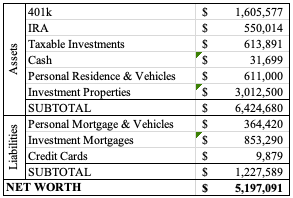
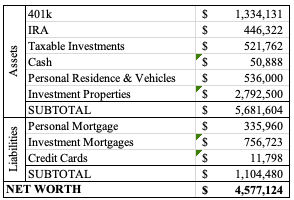
The way that I update our net worth each month involves overwriting the numbers from last year. So I can easily see that we’ve gained over half a million net worth since July 2024’s update. What’s nice about that is that it’s all appreciation, paying down mortgages, and the stock market with continued savings. We didn’t make any large financial moves that would have adjusted our net worth in one large move like buying a house. I had a conversation with someone about our net worth and goals recently. It would be nice to cross the $5 million threshold, but we’re not actively managing our funds in a way that will cause drastic swings outside of market movement. We crossed $4 million in March 2024.

We’re over $200k from last month’s update. Our credit cards are much higher than last month because of trip purchases and rental work that was unexpected, but needed. Here’s to the last month of summer.

November Financial Update

We bought a hot tub! It’s something that we’ve been talking about for almost a year, went looking at in May, and then finally ordered it last month. It was delivered and set up this week.

RENTALS

We replaced the roof on one of the houses. I go into that a little more in the ‘insurance’ section, but that was a $6,300 payment that was made.

INSURANCE

The fact that I have a separate category to cover my insurance efforts is just frustrating.

Last month, I complained that we were threatened with our liability policy being dropped because we didn’t provide the necessary documentation … that. we. were. never. asked. for. So I dropped everything and got the documentation as fast as I could, while being praised for my organization and response time as usual. Then a few weeks later, I was told that our policy has expired because they couldn’t get to our documentation review fast enough. Awesome. I love the one way street. We were finally informed that everything was reviewed and our policy was reinstated with no lapse in coverage. I paid that policy.

During that process, we were informed that one of our policy providers does not qualify to be covered under our liability policy because their company rating fell below A. Ironically, we had already pulled all but this one policy from this company. We requested a quote from another agent, but she said they couldn’t write a policy on the account at this time. It’s frustrating to me that once you file claims on your insurance (which it’s there for), you’re blacklisted. There were no claims for 8 years of rental properties and 12 years of homeownership, but that doesn’t matter. Since 3/4 of our claims in the last year are all in the same location … all those houses were hit by the same wind storms to cause damage. I certainly didn’t request trees to fall on two houses. Add in that the damage to our house was severe, making our policy pay out high for the last year, so getting new insurance policies where necessary (and on houses with no claims) has been difficult. There’s nothing to say we can’t keep this policy on this house even though the rating declined (which I would have never even known about), so we’re not stressing about it.

One of the wind damaged houses with a claim caused that company to drop us. That’s fine. I have been working on this replacement since September 23rd and finally got everything squared away on October 31st. One of the frustrations on that was that I’d ask multiple questions, and this guy would either not respond to an email or respond to half of it. One of my complaints was that my original request was for $500k of liability coverage (which is higher than offered on most policies I’ve had written, but is the minimum required for our liability policy), but he wrote it at $1 million. I asked for it to be lowered no less than 4 times. He finally responded when I got stern and called out the lack of action; he said that since it’s only about $25-30, they just go ahead and do it. I finally said (again) that I have liability policies that give me extra coverage, so I don’t want my individual ones to give extra coverage “just because,” and that it’s up to me to decide whether that $30 is worth it. He finally reduced it. The new policies are $510 more than the policy we were covered with that got dropped.

Oh – the original policy that we got dropped from included two houses. It wasn’t clear whether the company was dropping both houses, but I went ahead and switched both. I was hoping that the new policies would be written like all my other houses – individually. Unfortunately, it’s under one company and they handle things the same way, so both houses are tied together under one policy number again. I have multiple houses covered by Travelers, and they’re each on their own policy. I don’t understand why these houses get lumped together.

Another house of ours was given “high risk” insurance because of our roof condition. Our partner didn’t tell us about the transfer of insurance or the reason why. I discovered it when I received weird paperwork for our liability policy (which, ironically, now that I think of it, my liability coverage didn’t call out as odd, but they weren’t happy about that company getting downgraded…hmm). I discovered this on September 6th. I started getting quotes for roofers immediately, but that process took forever. I finally got the roof replaced on October 18th, and then I requested her to find us new insurance on October 31st. We have a new policy being issued effective November 15th, which will cancel the higher insurance. The total savings equates to about $450, but it’s still over $300 more expensive than the original one that we walked away from.

TAXES

Central KY taxes were due this past month. I paid 4 houses worth of taxes. 3 were cashed immediately. I pay via online bill pay, where they send the check on my behalf, instead of online because there are fees associated with that. Well, now one of them is floating out there without my knowing what to do next. There’s a 2% discount if you pay before 11/2, and that check didn’t get cashed by that deadline. So now I have to make phone calls to track down why the check I sent via bill pay didn’t arrive, even though another one arrived just fine. I also have a city that I have to pay a small amount of taxes to, and I’m waiting for those two checks to cash as well.

NET WORTH

Our net worth is almost $100k over last month’s. Not reflected in the credit card yet is the payment for the hot tub that just happened this week. By next month’s update, I’ll have to pay off the 0% interest credit card, so the total credit card number probably won’t change drastically.

Thermostats and Finances

There has been a lot of talk about thermostat temperatures recently because of how hot it has been where I live. There are Department of Energy images circulating that say keep your home at 78 when you’re home, 82 when sleeping, and 85 when away from home. Personally, I need it colder at night than during the day, but that’s not the point. My goal here is to make you stop and think about your actions. This applies to several areas of your financial life, but this post specifically will be regarding your heating and cooling process.

THERMOSTAT SETTINGS

In our house in the summer, we keep the thermostat at 75 or 76 during the day on the 1st floor. It usually starts at 76 and then if someone feels hot, they bump it down to 75. Upstairs, it sits at 77 for the day, is put at 76 for when the kids go to bed, and then 74 when we go to bed. When we leave the house, the thermostats are at 78; if we leave for extended periods of time, it’s set in the 80s. In the winter, the heat is set at 65 during our waking hours and 64 or 63 at night.

As a quick aside, our third son was born early and was having trouble breathing and regulating his temperature those first few weeks. We were told to keep the house at 70 or greater for him. We struggled! We made it to 69, but everyone was uncomfortable and hot. I mentioned this to the doctor and he said it was fine to be at 68 if that’s what everyone felt more comfortable at.

While we know these numbers now, we spent a lot of years working on different settings. We didn’t just assume that these were the numbers we wanted to be at. There were winter months where we set it at 63, but my fingers were hurting because they were so cold while I typed on my keyboard, working from home. I was at a friend’s house recently; they had it set at 70, and I was cold.

That brings me to another point. What’s the thermostat temperature where you’re comfortable in the summer while wearing shorts and a tshirt? If you’re wearing a sweatshirt and have the temperature set at 70, is that worth the extra cost to run the air conditioning at that temperature?

TIPS TO SAVE MONEY

This image was shared by a local meteorologist, but a citation wasn’t given, and it differs slightly from the numbers that the Department of Energy published. According to this, we’re saving 19% in the winter by keeping our heat at 65, but then we’re spending 32% more in the summer based on the recommended setting.

While you may have your expected temperature setting, you may want to consider is how hot (or cold) it is outside. If it’s going to be 100 degrees, maybe set the thermostat slightly higher on those days. It’ll feel comfortable at a higher temperature because the unit is going to be running more, therefore pumping more air into the room than on an 80 degree day.

In the summer, another option is to keep the blinds closed. If you keep the sun from peering into the house, especially during the heat of the day, it’ll help keep the temperature lower so the unit won’t want to kick on as often.

My local electricity company provided suggestions to keep your bill lower. Their article said to grill, use a slow cooker, and make sandwiches instead of using the oven and stove, which create more heat for the air conditioner to have to counteract. You can also use fans in rooms where you’re sitting so that you feel cooler while the thermostat is kept a degree or two higher. Make sure your filters are changed regularly so that your unit is working efficiently.


I implore you to increase your cooling temperature by one and see how that feels. Live with that for a week and see if going one more degree helps too. It could be that the cost to run your heating/cooling is worth the level of comfort you feel, but it could be that you find a setting that is still comfortable and it’s worth the savings you reap.

HELOC

HOME EQUITY LINE OF CREDIT or HELOC

A HELOC is a line of credit secured by the equity in your home. This is different from a loan or mortgage.

What is equity? It’s the appraised value of your home that is not mortgaged. You may have put 20% down when you bought the house, and now you’re looking to tap into that equity along with the principal of the mortgage you’ve paid down. Or perhaps your home value has increased drastically, and you want to utilize the equity.

What is a line of credit? It is a revolving account of credit. This means that when you close on a HELOC, you don’t get a check cut for that amount right then. You need to “draw” on the account, as needed, which is essentially writing checks from that account to either yourself or another entity. As you make principal payments, the amount of principal becomes available again for a future draw, as long as you’re within the draw period of the line of credit.

Do you have to disclose the purpose of the HELOC? There are no parameters on what you can use the money for when you draw it from the HELOC. You may want to pay off a credit card that has a higher interest rate, do home improvements, do other construction projects, medical bills, etc. While you’d want to utilize this for larger purchases, you can draw smaller amounts as long as you draw the minimum required by your terms (e.g., no less than $100). You earn interest from day 1, so this isn’t more beneficial than a credit card that gives you a short-term “loan” for your statement period (you don’t pay interest on a credit card balance that is paid off by the due date).

TYPICAL TERMS

The application process is similar to applying for a mortgage. A bank wants to see your credit report, along with some backup documentation (e.g., tax returns, account statements). We also had to update our homeowners insurance to show the HELOC as a mortgagee.

A HELOC will typically only cover a portion of the equity in your home, depending on the bank’s terms. If your appraisal value is $400,000, and your mortgage balance is $250,000, then the equity in your home is $150,000. While there may be instances where a bank would approve a HELOC for the full amount of $150,000, most are going to approve 80% or 85% of that amount.

There are no closing costs associated with the HELOC. Typically, the bank processing the HELOC will cover the costs associated with the line of credit initiation up front. However, they will require those fees to be paid back to them if the HELOC is closed within a certain period of time (usually 36 months). For our first HELOC, when we closed it within the 36 months, we paid back a prorated amount of the fees (e.g., if the fees were $300, and we closed it after a year, we owed $200). For our current HELOC, if we close it within the 36 months, we’re required to pay back 100% of the fees they covered, not the prorated amount.

A HELOC has a variable interest rate, which may adjust monthly or quarterly based on the lender’s terms. A variable interest rate can adjust up or down. But this is something to be aware of because it’s not like a loan or mortgage that has a fixed rate made known up front. The rate, in our case, is set at the index rate with a margin. However, there’s a floor to the bank’s rate. What does this look like? The index rate is 3.50%. The margin is -1.00%. However, the bank’s floor is 3.00%. Therefore, even though 3.5-1=2.5, the minimum interest rate they’ll lend at is 3.00%. Therefore, our current rate is 3.00%.

There is a “draw period,” which means you can only take funds from the line of credit for a certain period of time (e.g., 10 years). When you do draw from the line of credit, you’re charged interest on the principal balance. During the draw period, you must make the minimum required monthly payments on the account, which is typically the monthly accumulated interest owed, but some banks may require principal payments during this period also. When the draw period is over, it enacts the principal repayment period, meaning you have a certain amount of time (e.g., 10 more years) to repay the principal balance of the HELOC. There is no charge for the HELOC existing though; it can be there and never drawn on.

OUR PROCESS

The most recent HELOC we closed on had a different process than the first. We expressed our interest, and since they already had our documentation on hand from a commercial loan, they didn’t ask for supporting documentation (e.g., account statements). However, for some strange reason, she said she couldn’t use the credit report from our commercial loan, and she had to pull our credit again. At the time we were applying for another mortgage, so the hit on our credit counted as “mortgage shopping,” so we gave up the fight and let it happen.

This company would have given us 100% of the equity available in our home. However, two weeks after initiating the HELOC process, we told them we needed a pre qualification letter for an offer we made on another personal residence. They then told us that since we’re on record as wanting to sell our home, they would only approve 80% of the equity.

The loan officer asked for two references for each of us. There was no information given on what this personal reference had to know about us. We both handed over our people, but they were never contacted, so we won’t know the purpose.

Finally, they asked for our homeowners insurance to show them as a mortgagee on our policy, which I was able to do with one quick phone call to that office.

Typically, the process will include an appraisal. This bank had a valuation system that they used. Based on this woman’s inputs into the system (which were all wrong), she said that she could approve us for $100,000 without paying for a full appraisal. We don’t need more than that, so that was sufficient to us.

We closed the HELOC a month after expressing interest. Our process may have been slower than the typical period it would take because we were fighting the credit pull for a while (not to mention the company we were working with is notoriously slow at responding to inquiries). Mr. ODA expressed our interest in pursuing the HELOC on April 12th. We were cleared to close as of May 11th, but we chose to close on that following Friday. We went to a local bank branch, and a relationship banker went through the documents with us as we signed them.

WHY THE HELOC FOR US?

My general plan was that we’d have a HELOC initiated, so that when we found a new personal residence, we could use the HELOC for the down payment of that house without having to sell our current house first. In the past, we’ve sold our home, went into temporary housing, and then moved into a new home. Granted, all our past home purchases were in a completely different locale than where we were living, but I really didn’t want to manage storage of goods or go into temporary housing with two kids and a dog again.

We initiated the conversation on the HELOC without having any intent to move yet. Not to go into too much detail on this topic, but we need to be residents of this house for two years to avoid paying capital gains. Our 2-year mark isn’t until November, so we weren’t in a rush to move before then. A home with the same floor plan around the block from us sold for $190k more than what we bought this house for less than two years ago, so we expect there to be a hefty chunk going to capital gains if we don’t meet the two year requirement.

I was keeping an eye on the market, but clearly had no plans to move. To me, a regular check on Zillow lets me know what I can get for my money. However, there are some things related to our current personal residence that are concerning, and we had decided that this wouldn’t be a long term location for us. With the market right now, I knew we’d either be paying a higher mortgage than I ever anticipated in life, or I’d be compromising on my wish list. Well, a house that met a lot of our wish list popped up in the area we liked for less than $500k, so we jumped on it. The house needs work, so even though we’ll close on it over the summer, we aren’t in a rush to move into a construction zone.

Once we close on the new house with funds from the HELOC, we’ll start accruing and paying interest on the balance. We’re not required to make principal payments until after the draw period, which is 10 years. When we eventually sell our current home, the proceeds from the sale will pay off the HELOC seamlessly through the closing process.

The Mentality from an MLM

These days, you’re probably not immune to being asked to join or buy from a multi-level-marketing (MLM) business. Also known as network marketing, it a way for companies to sell their product through individuals who market product(s) to their sphere of influence. It gets a bad reputation with “pyramid scheme” and the like, but it’s legitimate and makes sense if you take the time to step back and learn about it instead of repeating the rhetoric you’ve heard from your parents.

Our experience with an MLM led to being open to buying rental properties, which eventually led to me quitting my job and being happy outside of a career. Here’s what I learned by keeping an open mind to an MLM, even though we make $0 from that business today.

This is my experience with our time in an MLM. Mr. ODA would probably have something different to say. ๐Ÿ™‚

AMWAY

BACKGROUND

By now, you may have seen the documentary on LulaRoe. Our experience was with Amway, and it was different from how LulaRoe operates. Now, Amway is the black sheep of the MLM world if you go just based on name. They’re one of the original MLMs. But they sell good products in the health, beauty, and home cleaning genres. As a “consultant,” you’re called an “independent business owner” or IBO. I thought the best part was that there’s no inventory you need to hold. If you want to do “parties,” then you need products on hand. However, it’s much different than how LulaRoe would have hundreds of leggings on hand and makes direct sales out of their on-hand inventory. To earn money, you can recruit more business owners, or you can have customers who just order directly from the Amway website each month. You make money off of what your customers buy, as well as the income that your IBOs below you generate.

TEAM SUPPORT

There are multiple “teams” associated with Amway. It’s the education arm of the business. Our team met once a week, and you were expected to be there if you really wanted to be in-the-know and considered serious about growing. They helped you structure your business to take advantages of bonuses offered by Amway, and they taught a lot about having the right mentality. Their goal was to foster personal and business growth, provide mentoring and coaching, and provide the tools to grow your business through conferences and seminars.

This is where we got our start. I know it’s hard to believe, but we both were exposed to a lot of growth through this team. The things we learned through the meetings and books we read during these couple of years gave us the courage to make the big decisions we did, getting us to currently having 13 rental properties.

THE CASHFLOW QUADRANT

Our introduction to the business was started by being given Rich Dad, Poor Dad by Robert Kiyosaki. The book references an earlier book of his, the Cashflow Quadrant. Each quadrant has its strengths and weaknesses.
– The upper left corner of the quadrant is for those who have Employee mentality. This is someone who is trading time for money. You work an hour and earn $20. If you’re not working, you’re not earning. You’re making money in someone else’s system, and there are people over you who are making more than you (e.g., a supervisor is making more than a secretary).
– The upper right corner is for Business Owners. You own a system that works for you. You have passive income in this quadrant. You may have an employee that is generating income that you earn.
– The lower left corner is for Self-employed people. Here you’re still trading time for money, but you have control over how much you earn based on how much effort and time you put in. This is a risky area because you don’t have security and may not have an established system to rely on and project your income.
– The lower right corner is for Investing. Your money makes money for you. This can also be risky because you’re not guaranteed positive returns on your investments. If you want to make a lot of money, you need to take on more risk.

The point here, according to the team we were on, was that you want to be a business owner. You want to generate passive income so that you’re not trading time for dollars. While someone else is selling to a new customer, you’re earning a percentage of that sale while not doing anything. As you grow your Amway business, you have more and more people generating income through these sales, which you get a percentage of. The kicker is that you need to hit a certain level within your own business before you earn. We set up recurring purchases to use the products we were selling, and had customers set up with recurring orders, so that we could hit that threshold to be eligible for the passive income.

OUR MOVE FROM MLM TO REAL ESTATE

The biggest hurdle to our success was the price of the products. We aren’t someone who values a better quality to be able to justify the higher price. There are people out there that value this, but it’s not our passion. A peanut butter meal bar comes to $3.14 per bar as a customer order (as an IBO, you get the product at cost, which would be $2.82 per bar). The peanut butter granola bars we buy are $0.50 per bar. Clearly, this isn’t a marginal difference in our expenses. The products were good, but not good enough for our finances to take such a hit. I tried to focus on the beauty side of the business and held parties where I recommend products and let women try it. I had passion behind it, but I wasn’t someone who washed my face regularly and put lotion on. I could see the benefits, but I wasn’t practicing what I preached, and I lost my drive.

The next hurdle was location. Our original meeting was with our specific team within the larger team (based on your “pin level,” you had a meeting with the people who were your “downline.”). We moved down to Richmond, and our closest meeting was Fredericksburg. It wasn’t insurmountable, but it was a 40 minute drive there and back once a week. The larger team would all come together in DC every quarter for a conference. We felt like time started moving faster, and we weren’t close enough to make these our friends between conferences, and so we stopped attending the big conferences. Then we stopped attending the weekly meetings. Then we cancelled our team membership. We still maintain our Amway IBO number, since it’s just $62 per year to do that.

The thought process that we learned from their weekly teachings and reading books we probably wouldn’t have read otherwise led to our desire to generate passive income. Mr. ODA had already been interested in the concept, and then when we were talking about venturing down that path with our Realtor selling our Northern Virginia home, he really got the urge to pursue it.

When we sold our Northern Virginia home, we had about $120,000 in our bank account. About $70k of that went to the downpayment and closing costs of our new house. The remaining went to finding a rental property… or two.

REAL ESTATE, PASSIVE INCOME, AND NO JOB

Real estate is in the business quadrant, but it’s not completely passive income. Truly, the Amway business wasn’t completely passive because you still needed to have the sales (either through your purchases or customer purchases) to be eligible to earn all the passive income available to you in the business. Most months with real estate, I take the rent money, pay out our mortgages, and that’s it. Sometimes I need to make some phone calls to contractors. However, we have to do very little to maintain our business of investment properties. We can also decide that we don’t want to field the phone calls and hand off the rest our properties to a property manager for 10% of rent. If we don’t have a new property or a property to turn over, then we probably put about 100 hours per year into managing the houses.

We knew we didn’t want to be in the employee mentality for the rest of our lives. Funny, because my goal when I was in college was to work for a “big 4” accounting firm and spend 80s hour per week at work. Then I started working for the government, and my goal was to be CFO in my 30s. Then I got to the headquarters office in my late 20s and hated the environment, so I decided I wanted to be no more than a state office’s financial manager. Then we had kids, and I decided I wanted to be home with them to see all the little moments. Things sure did evolve.

I believe that the time we spent with our Amway team changed my heart. I believe that time was important for me to see a different lifestyle and a different mentality. I don’t know that I would have seen the benefits of pushing ourselves to buy more rental properties had I not seen a lifestyle of entertainment.

I started to realize it would be nice to spend time with my family while the kids were little. Who wants to wait until retirement to spend time at home, when your kids are grown and moved out of your house? Why not spend the quality time in their early years? Let’s travel more and experience more in life. Let’s have more time with the kids than the hellish hours of 5 pm to bed time.

Our cash flow each month is about $7k, just based on the rental properties. That doesn’t include expenses that come up, and every once in a while we get hit with a major system that needs replacement, but most of the charges are a couple of hundred dollars here and there. Some days, I wish I could still do what I loved to do in the transportation world, but I don’t miss the office politics and the moderately strict work schedule.

I’m happy for all the experiences that have led me to this point in life. Perhaps you can read Rich Dad, Poor Dad or Cashflow Quadrant and learn a little bit more about all the options out there. Perhaps you just didn’t know that there are opportunities out there where you’re not trading time for money, or where you’re not cushioning the pockets of an executive while you make a certain salary. Perhaps you just needed your eyes opened to the chance to make your money work for you. Or, perhaps you’ll learn that you like the stability of being an employee, and you don’t want to change. But I urge you to take a look at the options and see what works best for you, now that you’re away that there are options.