Rental Cost Changes

In November 2023, I posted about rental changes that had occurred over the previous year. I wanted to update that analysis a few months ago, but I didn’t have all the KY data. I recently shared that my rent increases aren’t covering my cost increases, and my portfolio’s cash projections are lower now than when we first purchased all the houses. Here’s more of a breakdown of those changes per house.

ESCROW

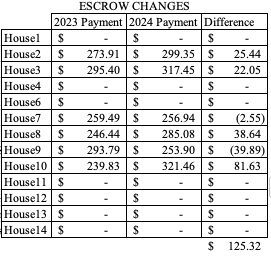
Escrow is an account that your mortgage company holds money to pay your insurance and taxes on your behalf. I have little faith in their management, as I’ve had to follow up on balances in the account and payments made incorrectly.

I created this table to show the differences between escrow payments over the two years. I kept the houses that don’t have an escrow because it can be compared to a future table in this post. There is no House5 in this table because we sold it several years ago (houses didn’t get renumbered because House5 still exists in terms of tax documentation).
INSURANCE

We had 3 insurance claims last year, and a big one the year before. It turns out, our portfolio is looked at as a whole, so 4 claims in a 12 month period doesn’t look good, especially when one of those was 6 digits and one was 5 digits. None of it was egregious, and they were each necessary. We were just a victim of poor timing (and for some reason, the 12 years prior to that with 0 claims of any kind mean absolutely nothing). While our own history is to blame in some aspects, insurance costs as a whole are increasing quickly over the few years. Here’s Google’s AI response:

And with that between payments made in 2023 and payments made in 2024, insurance is costing us almost $2,000 more for the year. I also just made my first 2025 payment, which increased that one house by $343. The total increase from 2022 and 2024 is over $3,000.

From the initiation of insurance on each house (so, when we first bought the house, which were mostly between 2015/2016) to today, we’re paying over 43% more in total for insurance.

TAXES

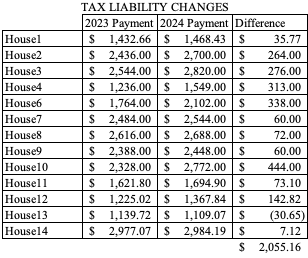
The table below shows the change between 2023 and 2024 for our tax payments. Last year, many jurisdictions that hadn’t captured the assessment changes since the pandemic made up for it last year, when we saw about a $3,500 increase for the year. This year, our increase was over $2,000. Fifty-five hundred over two years is nearly $230 per month, spread over 13 rental properties is $17 each. So for those that I didn’t increase rent last year, they’re not capturing that cost increase for our portfolio.
RENT INCREASES

So far this year, I’ve missed two opportunities to increase rent. I had planned on increasing one house by $25 to keep up with inflation costs, but it didn’t register that their notice had to be given by 1/1 (every one else is by the end of the month). The second is above market at this time, which was by design since they’re not easy to work with (tried to phase them out, but they accepted the rent increase). We last raised their rent in September 2022, so it’s been two years. But I couldn’t bring myself to do it. Next year we’ll increase them by $50 per month.

My plan is to increase the rent for 5 of our other houses. Four of these houses are planned to be $50 per month of an increase, and one is planned to be $75. Our management is generally to increase rent by $50 every two years if you’re a long term renter. There have been a few that we didn’t increase for a while, and the carrying costs have drastically increased, so we’re behind now.

SUMMARY

For our cost increases between taxes and insurance, we have over $4,000 that was paid out last year (and it’s really more than that in cases where the house has escrow, so our escrow was increased more drastically that the specific amount of change in bills).

We had 3 houses turnover from long term tenants, so we were able to increase the rent to market value. I prioritize keeping long term tenants, so I don’t always do rent increases. That means that sometimes the rent is stuck below market value, but I’d rather keep a good tenant than push them out with large annual rent increases.

By bringing those houses up to market rent, I’ve made up a good amount of our deficit. Now remember, these rent increases are catching up on multiple years of drastic increases. So even though it seems we’ve brought in more, we’re both making up for previous years that didn’t have such large rent increases and paying for more large scale improvements to these houses, in addition to larger contractor costs.
Rental Profit Calculations

When we consider purchasing a house to be used as a long term rental unit, we perform a “cash on cash” analysis. I’ve discussed this in the past, and I regularly share this with other people for their use. The gist of this calculation is to determine whether we would get a return on the cash put into the house.

The calculation considers the cost of taxes, insurance, homeowners association fees, vacancy expectation, maintenance expectation, costs to get the place rented, property management, etc. This is compared to the projected rental income. The upfront costs are compared to the annual cash flow projection. That ratio is hopefully in the 8%-10% range to be considered a reasonable cash flow to look further into the purchase.

Since we’re not really looking to purchase properties these days, I use this spreadsheet to consider changes in a tenant’s rent when it’s time for renewal. I kept all the original cash flow amounts to see how things change over the years. As I sat down to determine what changes, if any, are needed in the rents I charge, it was disheartening to see how our portfolio has dwindled in profitability over the years.

A few years back, housing prices skyrocketed, which drastically increased our taxes owed. Unfortunately, I hadn’t increased everyone’s rent consistently. I kept many people level or did small increases every two years, but that means I’m now “behind the 8 ball” in trying to make up for those drastic increases that happened in 2021-2022. In addition to tax increases, we’ve also seen huge insurance premium increases that weren’t projected in our portfolio.

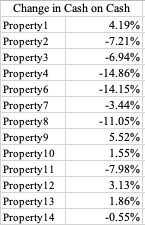
Our total “cash on cash” started at 11.42%. It’s now projected to be 7.58% – if the increases I project actually go into effect over the next few months.

We historically increased long term tenant’s rent by $50 every two years. Some of these tenants have been with us for over 5 years, and the $100-200 changes in their rent have not covered the increases we’ve seen. I hadn’t worried too much about it because the losses on those houses were offset by houses where we saw greater margins. Now, everything has leveled out, so those losses are felt harder.

The table above shows the change from our original “cash on cash” to our current status. In some instances, we’ve been able to increase our margins. But there are 8 instances our margins decreased, with some being drastic. Even though some are drastic decreases, there are only 5 properties that fall below the 8% goal we have.

For Property2, the projection shows that rent would need to be at $2,500 for us to hit our cash flow goal. The rent is currently at $1,600. The neighborhood doesn’t call for $2,500. I also don’t want to be in a position where I’m floating someone’s rent at that price. From the time we bought the house to now, our taxes and insurance have increased by $1575. That number only continues to grow. Our insurance started at $390 and is now at $765. Our taxes started at $1,500 and are now at $2,700.

On top of the obvious ones like that, our maintenance costs have also increased. As one example, our HVAC technician first was charging $125 per site visit. He now charges $325 just to show up. I’ve found someone who charges $200, so I’ve been going with that guy, but just knowing that there’s been such a change in pricing structure needs to be factored into our costs.

These are really big affects on our houses that a tenant and the average public opinion don’t seem to grasp. I don’t get paid hourly or per transaction I perform to manage these properties, so that decrease of 3.8% in our cash-on-cash analysis is actually a net loss in my “income.” In many cases, we catch up when there’s tenant turnover, but watching the rent compared to our expenses are things that I need to be more on top of year-to-year.

5% Rent Cap

The President issued a statement calling on Congress to cap rent increases at 5%, specifically for corporate landlords. The statement appears to define corporate landlords as those owning over 50 units in their portfolio. This was not an executive action that is implemented. And while my numbers are different than the numbers of a “corporate landlord,” I do think it’s worth hearing a landlord’s side. I feel that there’s a lot of spite against landlords without a lot of knowledge about their actual financials.

I admit that there is a possibility that some of these companies with large complexes could be raking in on the fees or “utilities” that are in the unit, without actually providing a properly maintained building, but that’s not the case for everyone that’s labeled as a landlord. No one seems to step back and see that this is a business model for landlords, and while everything else around us is increasing in costs, rent needs to as well.

No one predicted such a significant rise in product costs or housing costs in such a short period of time, but here we are. And landlords aren’t in the business to graciously eat the costs of homeownership for renters.

LANDLORD COST INCREASES

The Presidential statement released refers to a press release that starts with, “Today’s U.S. Labor Department Consumer Price Index (CPI) report revealed costs remained largely unchanged in May, with overall inflation cooling faster than economists expected as the Fed considers finally reducing interest rates below a 23-year high.” Is there a comparison to costs that landlords had to take on because the costs of everything increased faster than expected back in 2020-2022? Increases have been seen on small things like a maintenance call for a technician, but also big things like property taxes and insurance.

That same article goes on to state, “Since 2019, the cost of rent has risen 31.4%, with wages only increasing 23%, as tenants on average need to earn nearly $80,000 to not spend 30% or more of their income on rent.” In 2019, on one of my properties, the taxable assessment was $95,000, which equated to about $1,200 per year in taxes. In 2024, the taxable assessment was $242,000, which equates to about $3,000 per year in taxes. That’s a 61% increase in just my taxes over that same period of time where they’re complaining that the cost of rent increased by 31.4%. If rent had been set based on the 1% rule in 2019, rent would have been $950 per month. Had I increased 5% each year from 2019, it would be $1,212 in 2024. If I set rent based on the 1% rule now, it would be $2,420. However, the rent on the property is $1,750. So while it’s more than 5% each year since 2019 (the baseline the government is using), it’s set at an amount where I capture my expenses for owning the house, while also turning a small profit.

It’s taboo for a landlord to turn a profit, but that’s why we’re here. It’s an income stream that we’re establishing for profit. I don’t get to pay myself an hourly rate for managing the property. So this “profit” can actually be looked at like a salary. Every time I need to show the property to a prospective tenant, the lease signing, the walk through, every call or text you make, every trade that I need to schedule and coordinate with the tenant on, any fixes or improvements that I do myself. All of these minutes in a day add up, and I’m not directly paid for any of them.

On the particular house that I’m using for the example, we are assuming $300 per month in profit, which comes to $3,600 per year. Would you work as a manager of a company (e.g., hiring trades to fix things, performing maintenance, making sure all bills are paid timely, general management of having liabilities), for only $3,600 per year?

I wrote a post last Fall about the changes in my rental fixed costs from a year prior. I plan on doing the same this fall when more tax information comes due. The house I’m referring to has been at $1,750 for the past two years. However, between 2022 and 2023, my taxes and insurance have increased by $255 per year. That’s a cost that I’ve “eaten” from my “profits.” I could have said that equates to $22 per month increase, and I could have projected a similar increase for the year coming. I could change their monthly rent to be $1,790-$1,800 to keep my profits on a similar path. However, I didn’t, because they’re good tenants that haven’t had many maintenance calls.

However, if I don’t increase every year, then I could find myself in a sudden deficit like I did during the pandemic because costs increased faster than projected. A 5% cap could actually incentivize annual increases because I wouldn’t want to be caught behind and not able to catch up down the road.

LEASE TERMS

The Federal Housing Finance Agency announced protections for renters in multifamily properties that are financed with loans backed by Fannie Mae and Freddie Mac. The protections include: (a) requiring 30 day notice before rent increases; (b) requiring 30 day notice on lease expirations; and (c) providing a 5 day grace period before imposing late fees on rentals. I know for a fact that every single lease I’ve executed personally already has all of these requirements in it, at a minimum. In many cases, there’s a clause for 60 day notice of a potential rate increase, with negotiations being completed before 30 days from lease expiration.

Some states already have this codified. Other jurisdictions have landlord/tenant agreements that give the tenants rights (and awareness of rights) that can be lobbied against if the landlord is noncompliant.

There’s a clause that I’ve seen that requires expired leases to auto-renew on a month-to-month basis instead of for another year. I would argue that a requirement to renew a lease month-to-month instead of annually actually hurts a tenant. A landlord then only needs to give 30 days notice of a rent increase, and they could technically increase it month after month.

SUMMARY

If the ‘cap’ were to apply to me, then I’d be more inclined to increase rent every year. As a general rule, I increase rent for long term renters by $50 every two years. When we turnover a property, we will evaluate market rent in the area and set the monthly rent at what we see (which could be more than $50). In some cases, the evaluation ends up being too high, and we set the rent at something we think more people can afford. For example, there were comparable houses renting at $2,200 near a house we had listed. We’d rather get the property rented than shoot for top dollar, so we listed it at $1,600. While lower than “market value” probably called for, it was $400 higher than what we had it previously rented at, which covered cost increases that weren’t previously covered.

In the post that I previously linked, I highlight that our standard for increases barely offsets our increase in expenses. While we manage each house individually on setting the rates (asking ourselves: do we think the tenant can absorb the increase, do we have to increase to cover actual costs now), our monthly income among all houses was increased by $475. If you add up the cost increases for taxes, insurance, and property management (increased rent means increased fees because fees are based on the rent price), our costs went up $415 (and that’s before any service calls). On a whole, we’ve offset the ‘fixed cost’ increases. We’re taking ‘losses’ on houses where our routine for increases is slower. Therefore, having 13 properties affords us the ability to be more lenient with tenants and to keep good tenants in the house instead of forcing them out with hgher rent increases.

I support having protections in place for tenants. I’m sure there are landlords out there that aren’t interested in playing ‘by the book’ and just being decent human beings like I intend to. However, landlords are people too, and they’re running a business. Creating boundaries without fully understanding both sides of the situation and focusing on data points that only support your theory is unfair. I’ve joined the Landlord/Tenant Advisory Committee in my city. I hope to bring more awareness to the landlord side of things and bridge the gap between landlords and tenants when it comes to responsibilities.

July Financial Update

Welp, I haven’t posted in a month. We have been so busy and exhausted.

We bought a house on June 15. That process was not smooth in the week before closing, even through the day of. Our attorney had to come to our house the next day to have us sign other papers. Our lender was great, great, great, until they weren’t at the 11th hour. As always, everything went through, and we have ownership of the house. And that week will be a distant memory soon. But why does the mortgage industry get away with operating this way? I feel like there hasn’t been a single transaction we’ve done where there wasn’t a “where’s my paperwork????” or “why’s this wrong the day before closing???” moment (or my favorite, when we begged for the HUD-1 to review it before closing, and a traveling notary showed up at our house, only for the HUD-1 to be different than the closing disclosure and the numbers to be wrong on both documents).

We used our HELOC on our current house to pay the downpayment and closing costs on the new house, so that was a quick debt addition. We started with a balance of about 86k and have paid it down to 75k. We didn’t necessarily need to take the whole amount from the HELOC, but it was easier to get one cashiers check from the HELOC and immediately pay towards it than to transfer some from the HELOC and do a wire from our checking account.

This new house will be our personal residence, but it requires work. We’ve gutted the master bathroom, and I’ve been painting nearly all my free waking moments. I have the first floor mostly done (including making a ceiling go from navy to white.. ugh) and the kids’ bathroom done.

We opened two new credit cards in the last month, but I’ll get into that in the next post. Just note that our credit card balances are higher than our usual, and will remain that way.

We had opened a checking account for rewards a while back, and the account required $500 of direct deposits each month. It was one more account to manage, and it was no longer serving a purpose, so we finally closed that. Now we just manage two checking accounts.

RENTAL HOUSES

We have a vacant rental house as of June 30th, which I’ll also get into in a future post. The good news is that one of our houses that’s a repeat offender of not paying rent is now out of the picture. We still have one house that never pays on time, but I’ve at least got them paying half the rent by the 5th so that we aren’t constantly floating their mortgage and bills until the last Friday of every month.

We had two rental increases go into effect this month. One was for $20 (good tenants, long term, told us in advance they wanted to renew, but we also needed to cover our cost increases) and another was for $50.

Our property manager in KY hasn’t been easy. We’ve had to do a lot of managing the manager. All of our paperwork says not to charge the 10% fee on contractors. The document that they put in our file says it, and that’s the same document they put the charge on. I keep having to ask for all the documentation. Once I ask, they note the 10%, but it’s not until I ask.

We paid a plumber to fix a shower handle in one of our houses. On June 1st, she texted that it was loose. She didn’t really explain the situation, and I asked her to tighten the screw and let me know. She texted me on July 8th that it didn’t work. Where have you been for a month?! Then she said “let me know when the plumber is coming so I can wake my husband.” Um, you waited 5 weeks to tell me that it’s still broken, I’m not rushing a plumber out there today.

One of our insurance companies dropped us once they found out we don’t live within a certain radius of the houses. We have a property manager, so this rule doesn’t make sense to me. They let us finish out our policies, but they wouldn’t renew. Our agent quoted one company that doubled the cost we had been paying because the roof “may have been last replaced in 2000” (and we couldn’t prove otherwise). I said nope, and I asked another agent to give a quote. Their increased our cost by about $100, but it was better than $300. I executed that at the beginning of this month.

We had an HVAC go out, but luckily it was able to be fixed (for 225) than replaced.

NET WORTH

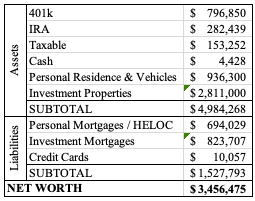
Well, even though our investments are declining and we took on a lot more debt, our net worth increased by 75k from last month. Truly, I’ve focused on the work we’ve had to do over the last month, and not necessarily on the spending or the market. At some point I’ll need to get through all our expenses and identify how our spending has changed, but perhaps that’s a job for another season while we continue to work on a new house and work towards moving our family in the coming months.