Rental Options

There are options that give the tenant flexibility, while protecting your financial interests in a rental property. I talk about this in some fashion about once per year, but I like to give the reminder.

In January, I ran all my usual numbers to determine if any properties needed a rent increase. The last few years have really hit our margins – insurance has drastically increased, taxes have increased significantly, and the regular trades costs have increased over time as well. During this process, I determined that 5 houses needed some sort of increase in their rent. One was the responsibility of my property manager, and the other four I wrote up the notifications, put them in the mail, and then emailed them also.

I’ve had two tenants respond back that they intend to move in the next year, and they wanted month to month. We don’t agree to month to month options. Well, I should point out that for significant financial compensation, we would consider month to month. However, the expectation is that having a long term tenant renew their lease is less work month over month. If they’re on month to month, I’m constantly watching and waiting for their 30 day notice. Additionally, there’s a concern that their 30 day notice comes in October or November, leaving me with a mid-winter lease that I’m trying to get filled.

Instead, I provide a few options that protect me. I’ve done the “buy out” or “penalty” option multiple times in the past, and that has served me well. I haven’t needed a short term lease option, but since there are certain circumstances with these houses, I put that offer out there.

In both cases, the tenant said she wants to be able to leave sometime in July/August. This is manageable to me because I can likely rent it under a fairly quick turnaround.

  1. Short-term lease
    While I would typically require an increase in rent to cover a short term lease, I was already in conversation about rent increases, so I let it be. I offered a July 31st or August 15th move out. In both cases, I know the house is going to require work. I’d like to have the last two weeks of August available to me for construction activities, instead of going into September and trying for an October 1 lease start date.
  2. “Buy out” options (e.g., penalty payments)
    In this case, I have the tenant sign a year lease. However, the lease comes with “lease break clauses.” The penalty for breaking the lease ranges based on the time of year. In all cases, I require 30 days notice and full payment of rent through the date given as notice. If the tenant wants to leave before 8/15, then there’s no penalty.

    If they want to leave between 8/15 and 9/30, then they have to pay the equivalent of one-month’s rent.

    If they want to leave between 10/1 and 1/31, there’s a two month penalty. This is because finding a renter during this period is difficult. There aren’t as many people looking during the winter because most leases are spring to spring, so the turnover is fairly cyclical, and because most people are distracted with starting school and all the holidays happening during that time rather than looking to rent (or even buy) a house.

    If they want to leave between 2/1 and 3/31, there’s a one-month penalty. Again, this is to cover the longer time it will take me to find someone to take over the lease period, and it provides me with a year-long lease (which most people are looking for) that ends at another inconvenient time for turnover in the next year.

    If they want to leave between 4/1 and 5/31 (which is the end of their lease term), then there’s again no penalty just as there wasn’t for the first few months of the lease term. I’ll be able to get work done on the house and list it for rent, expecting a decent pool of people interested in a rental.
  3. Lease transfer option
    As a final option, which was offered to us when we lived in an apartment building, a tenant can agree to a year-long lease with no extra terms. They then have the knowledge that if they want to “break” the lease agreement at any time in the next year, they are responsible for paying rent until a new tenant is found. They can move out, but they’re on the hook for paying rent until a new tenant has sign a lease.

    This is risk on their end. In some cases, I may be able to get someone in just a week or two. However, if it’s the winter, it could mean that they’re paying a month or two months worth of rent while they’re also living and paying rent somewhere else.

    The only time that I’ve used this option, the tenant provided notice on December 1st, which as I’ve pointed out is not a great time to be searching for a new tenant. Since he was already not living in the house (he had moved back in with his parents), he agreed to empty the house of his furniture so that we could still show it during that time. He paid rent on January 1st per our agreement, and luckily we found someone to take over the lease as of January 7th or 8th, so I refunded him the prorated amount of rent.

The “lease take over” concept was done by a management company in a fancy apartment building outside Washington D.C. It never hurts to ask for options if you’re the tenant. Just understand that managing the rental is work that the landlord has to do, and their “profit” is how they’re paying themselves for that. Especially in today’s environment, that margin is quite small. So when they tell you they don’t want to have a lease fall through in the Fall or Winter, understand how this is their investment and their income, so they need to protect themselves, even if it’s not necessarily what works for you or is your preference. And as for landlords, treat your tenants nicely and be as flexible as you can; it always pays off for me.

House 7 Turnover

Our turnover this year has been higher than usual. However, it’s been for good reasons, and not just because someone is looking to rent from a different landlord, so I’ll take that win. In this case, the tenant was house hunting. We knew that a year ago, and we had set up our lease to allow them to break it. Since April was their last month in this current lease term, there was no “lease break fee” associated with their notice. They gave us notice at the end of February, which requires 30 days worth of payment. March rent was paid.

They had moved out of the house early though, which ended up being very helpful. The house needed a lot of work. There was a lot of deferred maintenance on this house. We bought the house as a flip. It looked fine on the surface, but we knew it wasn’t going to hold up. Our last couple of turnovers happened really quickly, so we didn’t put much effort into the turnover process. With the extra time, we knew we needed to address some issues.

PAINT: $2,750

First, we finally got the flat roof addition fixed on this house last summer. The flippers before us had added a laundry room to the back of the house. They used the existing covered deck infrastructure, and it was horrible. They didn’t tie it into the house correctly, so we endured several leaks into the laundry room. We struggled for years to get a roofer who would address it for us. We even hired a roofer, highlighted the flat roof issue, and missed that his contract didn’t do anything except replace the shingles on the main house roof. There was plenty of saga once we finally found someone to rebuild it, but it’s done. We hadn’t fixed the drywall from the leaks, so that needed to be done now (a.k.a. deferred maintenance).

We found a painter who repaired the drywall, repainted the ceiling, and painted the walls. He also painted most of the trim in the house to white (there was some damage on the baseboards that needed fixed) and all the walls Green Tint by Benjamin Moore.

Two tenants ago, we had given an offer that if she wanted to paint any of the rooms, we’d offer a rent concession. That was part of the deferred maintenance; most of the house was dingy white that took a beating over the years, but we never had the time between tenants already lined up to paint everything. She took us up on that offer. She even painted the bathroom vanity and medicine cabinet. It was a beautiful robins egg blue, but we didn’t have the paint to do a few touchups on the side of the vanity that were needed. Our painter added that to the work at no cost. He absolutely didn’t need to do that! But everything has a fresh coat of paint now, and I’m so happy at the facelift it gave.

FLOORING: $6,613

When we first bought this house, the bedrooms on the first floor had dingy carpet in it. The prospective tenant we had requested we replace the carpet. I can’t remember the series of events, but we determined it was better to refinish the hardwoods underneath the carpet than to continuously replace the carpets every 3-6 years. They’ve held up pretty well, but they are starting to show wear at 7 years in.

Regardless, we didn’t touch the carpet on the stairs or on the second floor of the house. It’s blue indoor/outdoor carpet. I truly can’t believe we’ve been able to house renters in this place with this carpet still in place. We’ve put it off because re-carpeting stairs is just so expensive relative to doing a whole room. One of the bedrooms on the second floor even has wood paneling, which just made it even more amazing that anybody wanted this house. It was not the most aesthetically pleasing place.

We replaced all the carpet. With the fresh carpet and fresh paint, it’s looking so much more inviting.

Then we move on to the kitchens and bathrooms. The first floor bathroom and kitchen floor were clearly just lipstick-on-a-pig situations by the flippers. The subfloor was clearly bowing and making all the cheap tile crack. The humidity issues in the bathroom (I’ll touch more on in a moment) weren’t helping matters in there.

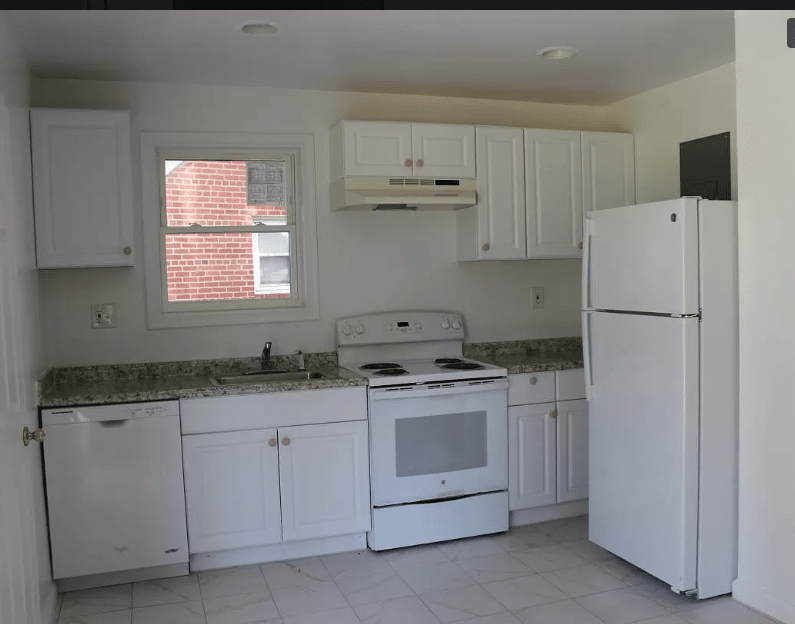
Here you can see the kitchen (and its pink knobs!) with the tile floor. The tile had all cracked by this time.

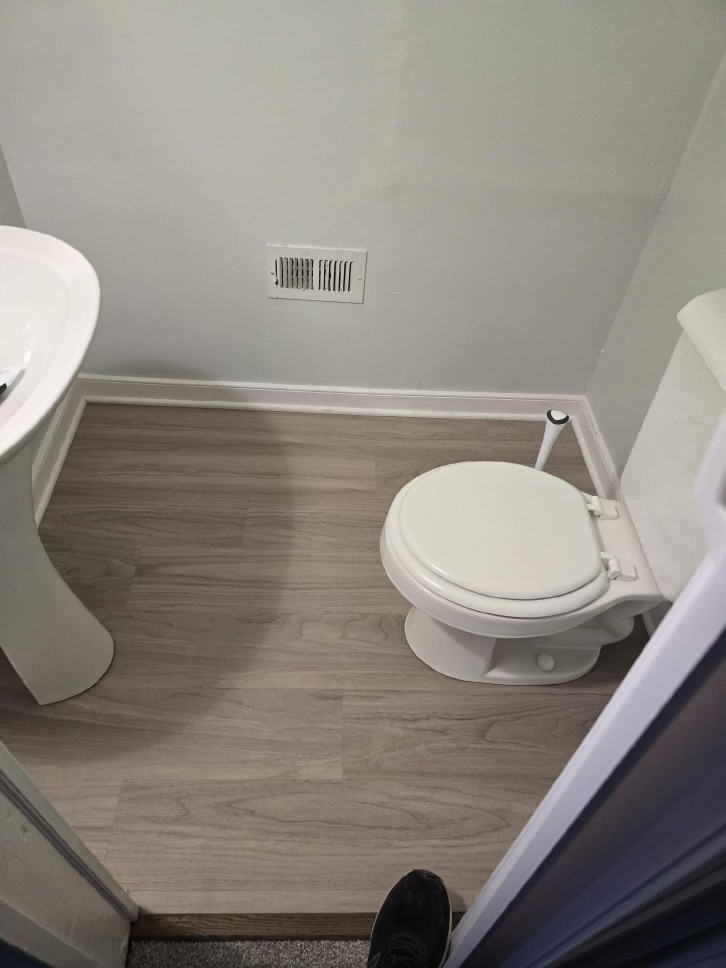
The upstairs bathroom was original 1970s linoleum. Here’s a snip of it in its glory.

Trying to match/add the hardwood was not an option. We considered ‘luxury vinyl tile,’ but that was more expensive than I wanted to put in a rental property. I didn’t want to retile it because I just personally don’t find tile floors to be warm and cozy for a house. The only reasonable option left is ‘luxury vinyl plank.’

We requested a quote from Home Depot. Their quote was cheaper than the one we ended up going with, but we didn’t use them for good reason. We had a subfloor issue in another house. Home Depot was extremely difficult to work with. Not only were they doing questionable work, they also just threw their hands up at the subfloor issue. Luckily, we had a friend that was able to help us repair it (because we didn’t live there). We know for a fact that there’s subfloor issues here (we can see the bow in the floor at the sliding door), so we wanted to go with a contractor who could handle everything.

We picked a local company. They did both the carpet and the LVP. They were so easy to work with. I didn’t love that they wanted me to pay for the entire job up front, but it ended up being great. They had to come back to finish a few tasks, and they did it all perfectly. I’m really happy with the process and their product.

Another miscellaneous flooring issue was that the vent covers were rotting. The finish on them were peeling. This could be explained by humidity in the bathroom, but that doesn’t really explain the issues in the kitchen and living room also. Our handyman was able to pop those out and get new, clean looking ones in for us.

RANDOM WORK

We had to call on our handyman for random jobs. He had to tighten the front porch banister. It’s likely the original banister and has just corroded at the connections. He also had to tighten up the screen door (which, if it were to break would be removed; having to maintain non-essential pieces of a rental is no fun). Some light fixtures needed major TLC. We replaced the light fixtures in both second floor bedrooms, the sconce type light fixture in the half bath upstairs, and the main bathroom’s vanity light (it was all corroded and looked bad).

The upstairs half bathroom had a brown accordion door. The pieces were falling off and it just generally looked bad. The space is tight, and an accordion door style was definitely the best solution for the area, so we had a white one put in. It’s still less than ideal, but it looks much better.

The previous tenant didn’t clean up the yard as they were supposed to, so we had to hire out that work. We also asked him to clear the gutters, which was very necessary because it looked like trees were growing out of them with how many twigs were stuck. He charged me $250 to rake the leaves from the yard and flower beds, mow the yard, and trim the bushes. Then he added on $50 for the gutter clean out. We also did a final mowing before the new tenants moved in, and he charged me $60 for that.

I’m not exactly sure what the issue is, but for some reason we had water damage in the main bathroom. It wasn’t water damage in the sense of standing water. It was just too much moisture. The mirror was corroded; the tub faucet handles were corroded; the caulk was all moldy (and we knew it was fine a year ago); the walls had water streaks on it. I don’t know how it was fine for years and now it’s not, but I’m guessing the only answer is that last tenant just liked really hot showers and didn’t use the vent or window. The tub knobs were so corroded that they had to be sawed off and new valves and such installed. Luckily our plumber was able to handle it timely and it looks better now, but that was a minor inconvenience.

The back sliding door had always been questionable. No one ever pushed us on it though, so we didn’t know just how bad it was. I don’t know that the door ever fully locked. There was a block used to hold it shut for security measures (although I feel like everyone who has a sliding door uses something like that). I finally wanted it replaced. It was likely the original door (think nickel type finish), and it was overdue. We did this through Home Depot because I knew their prices were reasonable and it should be an in/out job. It was $1063.

NEW TENANT

Our property manager showed the property to several candidates. Only two provided their interest form timely. An interest form is a way to gather background documentation on the potential tenant without the tenant having to spend any money. It’s a way for the prospect to divulge any negative remarks on their credit or background check. It’s a good gesture that we allow them to fill this out before spending money on an application fee that will identify disqualifying information. We have found that some people don’t tell us anything, and then they’ve spend $43 for us to say they don’t qualify.

Both prospects submitted their interest forms on April 18. Unfortunately, both of them were interested in a mid-May lease start date. They both offered to do a 2 year lease as a compensating factor though, which was a nice gesture. I also appreciated that both of them were well spoken and up front with a lot of information.

We chose someone and ran her background check. Several “unlawful detainers” (a.k.a. evictions) came through, which hadn’t been disclosed. We told her that her credit score was slightly below 600 and the unlawful detainers would disqualify her. She then wrote back a very nice note explaining all the data that we found and asked us to reconsider. We agreed to rent to her and to take a higher security deposit as a compensating factor. She agreed to the 1.5 times a month’s rent as a security deposit.

Unfortunately, the house was vacant for a month and a half. Luckily, during that time we were able to get a lot of work done in the house. I hope that this tenant takes good care of the home and that we’re pleasantly surprised with her tenancy regardless of her history of late payments and court filings.

House 9 Turnover

I recently posted “Lease Break Agreement,” where I went into the concepts we used to determine a lease break clause in our renewal with a tenant. The purpose of our fee structure was directly correlated to the time of year and probability of turning over the unit quickly. As I suspected, it took us an entire month to find a tenant. The lease break fee was one month’s rent, so we didn’t go without income during that time, but we also didn’t net a positive.

The tenant gave us notice on November 24th. Our property manager listed the property on November 26th at $1700. The higher price points are worrying me. While the market may claim that this is a fair rate, it doesn’t mean that we have a large pool of qualified candidates for this amount per month.

TURNOVER WORK

The house was painted before the current tenant moved in a few years prior. Unfortunately, some of the rooms were addressed, but not all of them. And the ware of time hit the walls all differently, so it looked like different colors of paint. I asked our property manager to get her painter over there and give all the walls a fresh coat. It looks great. That was $2,000.

I had a carpet cleaner come out and a cleaning company come out. The cleaners forgot about the refrigerator and had to come back. But otherwise everything looked great for less than $500 together.

The front porch was starting to sink. So while this wasn’t an activity done before someone moved in, we do have our handyman working on replacing the back deck, the trim around the back door, and the front porch (he jacked up the supports and is replacing the railing and stairs). I don’t even know what this final cost is yet, but it’s a lot.

APPLICANT #1

We had a lot of interest; hardly anyone qualified. After getting through some of the weeds, we did have a couple interested that appeared to be a good fit. They viewed the property twice over a week to be sure it was a good fit. The application was received on December 13, but it only listed one of the two adults who would be living there. We require all residents 18 years and older to complete a background check. We didn’t expect an issue with that since she works at a school, but it didn’t go well. Due to the holidays, their applications weren’t received until December 26th. She had several collections on her history. However, since he qualified on his own without her income, we agreed to overlook her lower credit score and collections history. I set up the lease with their names and sent them over.

We were excited because they wanted a January 1st rental, which meant we wouldn’t have any loss of income and would be able to put the lease break fee back into the house easily. They asked us if we would clean the carpets and clean the outside of the house. We agreed to the carpets and said that they outside of the house (mildew) would have to wait until warmer weather, but that we would address it.

Technically, all my tenants are supposed to clean the carpets and provide a receipt upon departure. However, I don’t hold this to anyone unless they were a real pain. A couple of hundred dollars out of my pocket and a happy ex-tenant is how I’d prefer to keep it (you’d be surprised at how many ex-tenant referrals we’ve had).

Suspiciously, they then withdrew their interest. I wish I knew why. I don’t know if their circumstances changed, if they were hiding information we hadn’t found on our own that caught up to them, or if something in the lease spooked them. If it was the lease, I wish they would have asked questions because we’re so easy going. I could have either explained why it’s there to protect them/us, or changed it.

So while we were a month ahead of schedule with being able to list the house, we now have a vacant house with no prospects. The goal is always to have the house ready to re-rent with little down time.

LISTING CHANGE

The market for the area called for $1600-1800 in rent. We originally listed it at $1700. It made me nervous. When the initial applicant backed out, I immediately adjusted the rent to $1650. We had plenty of interest at the $1700 amount, but it wasn’t worth weeding a few people out because they didn’t want to go that high. I decided to risk it with only a $50 decrease, since people would be able to see the decrease (and I try really hard to list it at the right price so I don’t have to do a price adjustment, but a December listing is hard to nail on the head). Again, we had a lot of interest, but few qualified.

APPLICANT #2

Two twenty-something men saw the property and asked to apply on January 11th. Neither of them had a job. Seriously. Neither had a single dime of true income, but wanted to commit to $1650/month in rent. Noteworthy was that they wanted us to consider that he had the potential to make $40k per year day trading stocks. We asked a few questions. They said they thought it better to find housing and then find a job. We suggested they try to find work and then live where they find a job (they had just moved ‘home’ from about an hour away).

APPLICANT #3

A woman showed interest who appeared to qualify on the surface. My broken record is to tell me things up front and be open with communication. I can’t help you if you don’t help me. Her information on paper looked fine. I’ve learned over the years to check the local jurisdiction court records myself, instead of relying on the background check. I’ve also tried to look things up before they submit their application; this way if there’s anything out there, they haven’t given us money for the application to not be used. During my search, I found several garnishment cases. Like a lot. An unreasonable amount of court records for a single person. We denied her interest form and did not pursue an application.

But on January 16, she asked for us to reconsider and explained the garnishment. There was one point deducted because the woman’s email asked if “he” as the landlord would reconsider her application (why can’t a friendly, reasonable woman be the landlord? 🙂 ). I didn’t appreciate that the garnishment wasn’t disclosed up front. However, she did explain what happened. It sounded like she was told that there was nothing due, made no payments, and then this debt showed up that she didn’t know she owed, but she’s been working a second job to pay it off. Honestly, the documentation didn’t clearly support the story, but my gut reaction was to believe her.

She also had three evictions recorded on top of this garnishment. The evictions appeared to be filed immediately upon unpaid rent by an apartment complex management company, and then the rent paid before the court date, thereby clearing the debt. I expect to have future issues with rent payments, but I suspect it won’t be anything more than I’m used to handling (e.g., where a tenant needs an extra week or so to make rent).

Our property manager appreciated the in-person interaction with this person, she was well written and well spoken when making her case to be accepted to apply, and overall it seemed worth giving her a chance. I’m also a sucker for giving borderline qualified individuals a chance. I think I’m 50/50 on it working out for me.

The lease was signed on January 18th. We agreed that she would pay the security deposit, first month’s rent, and last month’s rent. The last month’s rent was an additional way for us to hedge our bets with her unqualified application background. This is a “compensating factor.” Since she did not qualify according to our list of requirements, we’re taking an extra fee as insurance to our business interests in this property. We typically will work with someone on compensating factors so that they get a place to rent and we don’t lose out on too much in case our olive branch doesn’t work out.

She paid the security deposit with the lease agreement signature and paid first month’s rent on February 1st. We agreed to give her until February 17th for the last month’s rent. She was asking for a later move in date because she didn’t have all the money up front, but I didn’t want to cause extra stress on her moving plan/date over that.

FINAL THOUGHTS

I don’t even know how many people actually saw the property, since my property manager handled that. However, I know it was a good amount. I typically handle it where I set up an “open house” style visit window for people to come through (so many people claim they’ll show up to a scheduled appointment, and they don’t). I believe she tried to do this at the beginning, but it was taking so long to find a qualified applicant, that she ended up having to do one-on-one meetings.

She has them fill out an “initial interest” form after the showing. For the most part, I do that after the showings as well. However, it does help if you’re scheduling individual appointments to have people fill this out before hand. You want to know ahead of time if there’s even a chance of them qualifying. You don’t want to take time driving to/from an appointment and letting them looking around the house, only to find out they have a criminal background and/or less than favorable credit history.

THERE IS NO CHARGE FOR AN INTEREST FORM. If you are a tenant looking for a place to live, do not pay anyone anything until you’ve seen the property. There are a lot of scams out there where “landlords” are claiming they need an application before allowing you to see the property. They’re listing places “for rent,” that they have no vested interest in. People who recently sold their house, so pictures are available to use, are the ones finding out that people are driving by and looking around their house because someone claiming to be a landlord collected an “application fee,” with no intention of showing you the house or renting it to you.

So while this person didn’t expressly qualify based on our list of requirements to rent one of our properties, I felt like she deserved the chance. I feel bad when someone’s previous life choices immediately disqualify them, and I enjoy giving people a moment to voice their side of the story. Sometimes, their story is enough to solidify a denial from us. But sometimes, it appears worth giving them this opportunity to right their wrongs. I also feel good that I didn’t feel pressured into making a decision just to recoup vacant days on market, but that I made a logical decision. Now let’s see where we end up with this property in 18 months, and whether I still think it was a good decision!

March Financial Update

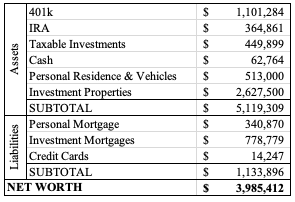
We’re just going to cut to the chase – $4 million net worth! I mentioned that this was a goal for this year. Unlike other years worth of large jumps because of purchasing houses, this was less in our control (granted, our market allocation decisions are what’s driving it…. and by “our,” I absolutely mean only Mr. ODA’s because I don’t do anything in that realm).

RENTALS

Well, we’ve had a quiet month. What’s going to be funny is, I’m going to list the things that we did. Quiet doesn’t mean silent or without effort, but we’ve had a rough go of it over the last year, so this was a welcomed break.

We had termites at a property. We pay $98 annually for their termite warranty program, since we found extensive termite damage and live termites when we bought the house. We’ve had to treat the house several times, so this $98 is a steal. However, I’m wondering why we keep needing to treat the house.

We paid $125 for a plumber to go out to a clogged sink. When we received the invoice, it was for 2 plumbers to go. Between the phone call that they were on their way and the tenant saying they were great, only 35 minutes had elapsed. The company charged us almost $300. Mr. ODA called to ask why they choose to send two plumbers to do a one-man job, while also charging us for it. The owner said it was for liability purposes, which Mr. ODA fought back on. They agreed to a reduced rate, but we were only charged $125, which was less than agreed upon.

We had our third tenant move in, after we unexpectedly had to turnover three houses in the middle of winter. We also were given notice by another tenant that she’s vacating by the end of March. We handled increases for two houses (one handled by a property manager to increase $50/month, and one handled by me to increase by $25/month).

We had one tenant pay on the morning of the 6th with no communication, so I did have our property manager let them know that’s not going to be ok. We also had a usual suspect pay late, with the late fee. However, their communication was frustrating. They said they’d pay on the 6th. At the end of the 6th, they said the money hadn’t cleared like they expected. No communication on the 7th. I asked for an updated on the morning of the 8th, and they said it would be that day. At 11 pm, I hadn’t received anything and reached out. I was then told that money was going into the ATM right then so that she could pay. Sometimes I wish I could do a deep dive into tenant finances so that I could help them out.

PERSONAL

Mr. ODA has a trip in July where a group of guys will hike in the Rockies. Our family is going out before that trip is scheduled to do our own exploring. We booked 4 round trip plane tickets, and Mr. ODA handled the lodging booking for the guys’ portion. That’s almost $3,000 worth of purchases, so our credit cards are higher than usual.

Speaking of the plane tickets. We purchased gift cards from Costco for Southwest. The gift cards are essentially $450 for $500 worth of purchasing power at Southwest. We bought two, therefore saving $100 on the tickets. For an extra few clicks on the computer, and the 15 minutes waiting time before the e-gift cards were delivered to my email, that’s $100 that can be used somewhere else.

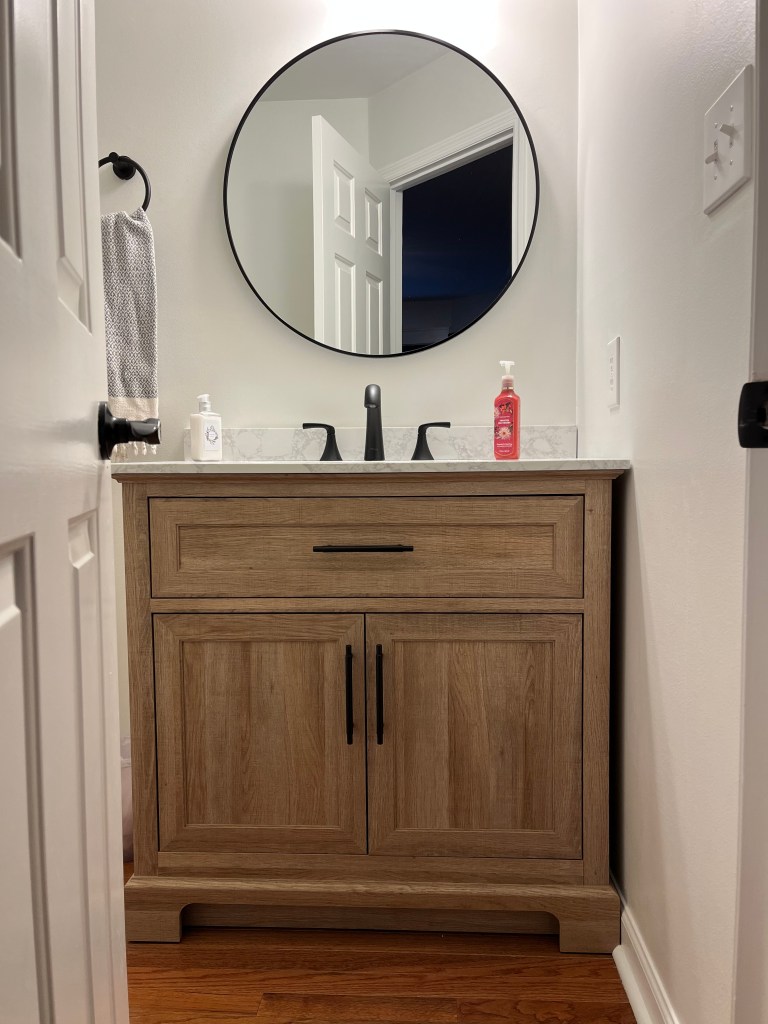
We bought a new vanity for our bathroom. That was about $700 for the vanity, faucet, toilet flusher, and mirror. I sold the old vanity (in rough shape) for $30. And because I’m proud that I did most of it on my own, here’s a picture. I needed Mr. ODA’s help with the supply lines because I lost patience with how tightly they were screwed on and my lack of progress. I cut the baseboards down to size, except I somehow measured wrong on one quarter round cut (I was cutting while it was on the wall). Mr. ODA cut and installed the replacement piece for me.

We finished up the ski season. The kids did great. I was really proud of them for sticking with it. We used our season pass well (i.e., exceeding the cost had we bought individual tickets for each visit). I took two of the three kids to the aquarium, and we took the baby for a procedure at a local children’s hospital. We’ve started tee ball for our oldest. Our March is very full and busy, so we’re getting into the swing of things and keeping track of the schedule.

NET WORTH

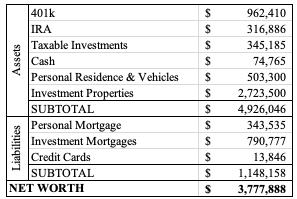
Well, we far exceeded that $4 million goal. The market went up big, with our biggest changes being in our retirement account, IRAs, and cash. Our cash increase is offset by the lower amount in our Treasury account. Some of the short term bonds were transferred back into our savings account, and we’ve kept that money in savings since our deck replacement is slated to begin.

February Financial Update

RENTALS

The rentals were expensive this month with $4600 paid out. This doesn’t include work that’s currently under way, but not paid for yet.

I paid for a water heater replacement, which was $1,904. I had to pay insurance on a larger property ($793). I paid the balance of the window replacement at one property, which was $1,064. I also paid for a plumber to address a leaking toilet and a rotted faucet ($325). We had a new tenant move into a vacant property, so we had that cleaned before her arrival ($165).

I had to pay for a plumber’s service call ($95) for clogged drains, for them to refer me to a rooter company ($250). I emailed that tenant that preventive measures need to be taken because I’ve not had so many calls to one property. She assured me they have taken appropriate measures and it’s just old pipes. The only problem being that we have several other properties with old pipes that never call for clogs.

We’ve turned over two properties and are about to turnover another property in the dead of winter. It’s so frustrating to be in such a position. All of those stories will be elaborated on in future posts.
– On one property, we charged a lease break fee of one month’s rent to cover our losses (the fee was different based on the month in which they broke the lease). Luckily, that covered our entire month of January being vacant, but we found someone for 2/1.
– Another tenant asked to leave a property because he lost his job. That was handled a bit different because we didn’t know in advance that this tenant would want to leave mid-lease. We told them there’s a fee of $250 (which is what it costs us to pay the property manager to find a new tenant), and that they had to pay rent until we found a new tenant. We didn’t lose any rent on that property.
– Now, we have a newly vacant property because the tenant can no longer afford it. I’m not expecting to recover her unpaid rent at this point. We approved a tenant to start 2/28, leaving us with 27 days of lost rent. However, we sent a lease over for them to sign. They’re currently dragging their feet on signing because they want to pay with their tax return. I don’t love that idea. They’ve been easy to communicate with up until this point, just slow. I’m hoping this gamble works out.

PERSONAL FINANCES

I had to transfer money to Mr. ODA’s account to cover the purchase of our new back door and a new treadmill (although that was only $400). This is an interesting concept for us. Mr. ODA had an account before we met. His account was grandfathered in to new terms and conditions at this bank. He’s kept his checking account and credit card for the rewards (I have access to the account; my name just isn’t on it). Any online purchases go on that credit card. However, that account only receives $250 every other week from Mr. ODA’s pay check (occasionally it’ll receive rent via Zelle). So sometimes, we need to transfer money from our main checking account to cover that credit card payment. All our security deposit accounts are with that bank too. So I had to then transfer from a security deposit account into his checking account, and then have him send that money to our main account. It wasn’t our finest money management moment.

Not much else happened this past month. We’ve gone skiing with the kids some more, I went on a moms’ cruise (which was amazing), took a small trip to piggyback Mr. ODA’s work trip, and have done activities around town. We’re gearing up for a procedure at a local children’s hospital next week, which I’m expecting will wipe out our deductible. Luckily that’s only $3,000, but I’m sure we’ll hit it. We’ll actually be late hitting it this year; it’s usually done in January.

NET WORTH

One of this year’s goal is to hit $4 million net worth. I thought it was going to be a ways away, but the market has been up big recently. We’re only about $14k away from that goal now!

Rental Cost Changes from One Year Ago

I keep updating my investment property tracking spreadsheet to reflect the current costs of insurance and taxes. My tracking shows last year’s amount, which I use as an indicator on whether I need to look further into this year’s bill (e.g., is the amount a reasonable increase?). For so many years, most of our insurance policies changed by a few dollars; now, I’m seeing large swings in what’s being charged. Where jurisdictions were slow to change property assessments, they’re now catching up, which increases the taxes.

As a renter, your rent is increasing to cover these costs of the landlord/owner. Here’s a comparison of my fixed cost increases against my rent rate increases. As you’ll see, I’m not trying to get top dollar out of these properties because the market has increased so much (and that leaves me more exposed if someone doesn’t pay their rent on time). My rent increases barely cover the cost increases that are happening on some of these houses. Remember that while I’m showing fixed costs, this isn’t covering the maintenance calls that I receive and how they’re more expensive than they once were also.

ESCROW, CONCEPTUALLY

In most cases, for a traditional mortgage, an escrow account is set up. It calculates your taxes and insurance payments for the year, divides by twelve, and is added to your principal and interest payment for the mortgage. In addition to covering the total payments to be made, there’s also a requirement that the balance of the account never falls below twice the required monthly payment.

If your taxes owed for a year are $1500, and the insurance is $300, then your monthly breakdown is $150 ($1500+$300=$1800; $1800/12=$150). The minimum monthly required balance is $300 (twice the $150).

As taxes and insurance increase each year (typically), there’s an analysis done to ensure the projected monthly balance never falls below that $300 threshold. If the balance is projected to fall below the required minimum amount, then it triggers an increase in your escrow payment. Your escrow payment will increase to cover the shortfall, but also to cover the new projected costs to be paid. So while you may be offered the ability to make a one-time payment to cover the shortfall, your mortgage payment may still increase to cover the projected costs. For example, if last year, your tax payment increased to $1750, and your insurance to $350, then your monthly payment to cover those charges is $175 ($1750+350=$2100; $2100/12=$175). Your mortgage will increase by $25 per month because now your escrow agent knows the projected costs to cover are higher.

The analysis uses the current year’s amounts owed to project the coming year’s monthly balances; it doesn’t account for the probability that these amounts increase each year, which essentially means that there’s perpetually a shortfall. In other words, while in Year3, they know that there was an increase in costs from Year1 to Year2, they don’t inflate the costs of Year2 to cover Year3 projected payments.

I prefer to not have an escrow, but at this point, for any mortgages we have, they’re all escrowed. We have six of thirteen houses with escrow. While I pay more as my mortgage to feed into that escrow account, it means I don’t have to manage the annual or semi-annual payments. On the contrary, this means I need to be managing our finances to prepare for large outlays throughout the year on seven houses (in the last quarter of the year, I’m paying out over $8,000 to cover taxes owed).

ESCROW REANALYSIS

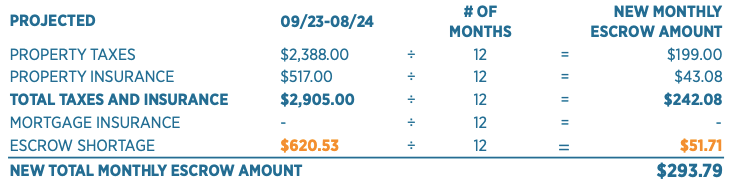
This post was prompted by a notification that an escrow reanalysis was done on a mortgage that was just transferred to a new company. I thought that their break down was the most clear I’ve seen. A quick note – your escrow will pay the bills that come due, regardless of the balance in the account, even if it means it’ll overdraw the account.

They clearly showed that the anticipated property taxes are projected at $199 per month (although, I’ll reiterate that this is based on last year’s actual outlay numbers, which aren’t accurate for the coming year). Then they show that the taxes are $43.08 per month. They then go as far to show the total of these two required outlays. There’s verbiage that explains the required minimum in the account must be twice the total taxes and insurance ($242.08 * 2 = $484.16).

There’s another detailed breakdown of each month’s escrow income and outlay (that I don’t have pictured here) that shows the month that is projected to fall below the required minimum. That month’s account balance is -$136.37. The difference between the required amount of $484.16 and the negative balance of $136.37 is $620.53 (pictured above). When that’s broken down by month, it’s $51.71. Take the total taxes and insurance payments and add the shortage amount to get the new monthly escrow amount of $293.79, a change from $222.25.

Below, they show you that there is no change in the principal and interest payment, then it shows how the current escrow payment is adjusted to the new escrow payment, along with the shortage amount.

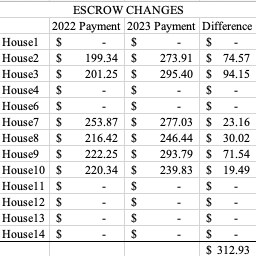
I created this table to show the differences between escrow payments over the two years. I kept the houses that don’t have an escrow because it can be compared to a future table in this post. There is no House5 in this table because we sold it several years ago (houses didn’t get renumbered because House5 still exists in terms of tax documentation).

TAX AND INSURANCE UPDATES

Each year, we see an increase in these amounts. Usually it’s across the board, but Kentucky districts had kept the housing assessments the same through the pandemic. As housing prices increase, your property assessment can be increased by your tax jurisdiction. The assessment increasing leads to an increase in taxes. This is why people getting excited that house prices in their neighborhood are selling higher than expected isn’t great if you’re not planning on selling any time soon; those increases in values means you’re paying higher in taxes.

In Richmond, VA, the property taxes are $1.20 per each $100 of the assessed value. In 2022, House2’s value $163,000. In 2023, the value was increased to $203,000. And let’s not forget that we purchased the house for $117,000. While it’s nice that the home values in the neighborhood are increasing significantly (and we knew the area was going to get better and better based on development happening), we can’t realize this gain until (and if) we sell. So in the meantime, we’re paying higher taxes on this amount. Although, I suppose the assessment could be even higher because the actual value of this house is probably more like $260,000.

Among 13 houses (don’t get confused – there’s no House5 up there because we sold it), I need to cover a total cost increase for taxes and insurances of over $4,500. This doesn’t include the higher costs of trades people if there are any maintenance calls, so this increase is the bare minimum for me to keep my same income.

RENT INCREASES

I constantly see complaints about the cost of rent, or that a landlord is increasing rent. Unless we’re looking for a tenant to move, our general philosophy is to increase rent $50 every two years. This worked fine because home assessments increased at a slow, reasonable rate until recent years. Now jurisdictions are capturing these larger increases based on those inflated sale numbers when competition was high in from 2020 through 2022.

In some cases, the rent for the area brought it in a higher amount than compared to our purchase price of a house. In those cases, we went several years without increasing the rent. Looking back, that probably wasn’t the best idea because now we’re behind on capturing how significant these last few year’s fixed costs have increased. However, the trade off to that is that we’ve kept great tenants in the house, haven’t had to pay to turnover the unit, and have minimal maintenance calls.

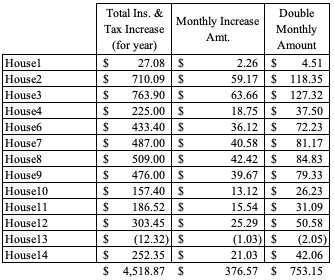
This table shows the total increase in insurance and tax payments from 2022 to 2023 in the first column. I divided that by 12 to get the monthly amount of that increase (second column). Then, since I said we typically increase our rent by $50 every two years for the same tenant, I multiplied that monthly amount by 2. I’m showing that if we want to only increase rent on long term tenants every other year, then I need to plan ahead on how much my costs are increasing.

This isn’t a perfectly accurate capturing of our cost increases since I’m not going back to 2021 to capture those changes in amounts, but it’s a general estimate. This shows that if I were to increase all houses by only $50 every two years, it’s cutting into my bottom line. Only 6 of the houses have increases less than $50 for two years.

SETTING THE RENTAL RATE

Let’s pause and talk about “bottom line.” Landlords have investment properties to make a profit. They’re looking for an income stream.

I regularly hear people say they can own a house for less than their rent, which is likely if you’re speaking only on principal and interest of a loan. However, you need to qualify for that loan. You may not have 20% down, so you may be required to pay private mortgage insurance (PMI). You may not have good credit, which means you’re probably going to pay a higher interest rate than I’m currently paying. You need to be able to cover taxes and insurance, which means you’ll have an escrow account set up, which increases your monthly mortgage payment. Then there’s all the other costs of home ownership.

That’s where people forget. When your hot water goes out, you call me. I spend $1,500 for about 2 hours worth of someone’s work to replace that. When you have a water leak, I spend $3,000 for a day’s worth of 2 plumbers’ work. When a storm drops a tree on your house, I’m the one spending hours on the phone with insurance, finding a contractor, getting quotes, and paying the contractor $3,700 before I get insurance reimbursement. Those are the big unexpected expenses. That doesn’t include all those smaller plumbing problems that cost $200 or $500 at a time.

Then in some cases, I probably put time and money into the house to even get it ready to rent to you. I didn’t always buy a house that was ready to live in. You may have projects that need to be done when you first move in also, so which costs money. Those are expenses that I’m trying to recoup through my rent rate also.

There may be other costs to my ownership that I’m trying to recoup through the rent, such as property management. I may have to pay someone else 10% of the rent, every month. I am projecting that there are going to be costs that I need to pay for also (e.g., water heater, roof replacement, plumbing issues). When I need to pay a plumber $3,000, I’m not coming to the tenant to say “I now need $3,000 to cover this cost.” Instead, I’ve set my rental rate the expect such a large payout on my part.

Not only am I trying to make sure that my rent is set at the right about to cover the costs that I’m putting into owning and maintaining the house, I’m also hoping that I’m going to make some money off owning this house so that I can live. I don’t get to pay myself for the hours I put into managing the property. Whether or not I have a property manager, there is still time that I put into managing the houses. Would you want to work for free?

BACK TO RENT INCREASES

While we manage each house individually on setting the rates (asking ourselves: do we think the tenant can absorb the increase, do we have to increase to cover actual costs now), this shows that our monthly income was increased by $475. If you look back at our total monthly increase in expenses of just taxes and insurance, it’s about $375; add in the cost increases for property management (increased rent means increased fees because fees are based on the rent price), and our fixed costs went up $415. On a whole, we’ve offset the increases.

However, you can see if we had one or two houses, some of those increases could be significant. House3 is costing us $64 more for each month, but our increases are typically about $50 at a time. We’ve had the same tenant in this house since we bought it. A $50 increase every two years hasn’t kept up with our costs. Since we have other houses, it helps cover the costs on House3.

House2 and House3 are identical in layout. House2 has been upgraded to all LVP, whereas House3 has carpet everywhere except the kitchen and bathrooms (granted, it’s new carpet two years ago). Since we purchased these two homes with tenants, rent was already set for us. House3 has been the same tenant since we bought the house, and the increases have brought us to $1200 per month in rent. House2 has been turned over 3 times: the first was a divorced lady who moved back in with her ex-husband; the second was there for several years, but we began having a lot of issues with her, and we told her the lease was up; the third was the one who flooded the house in December, and causing the need for the fourth. Now we’re renting that house at its market value of $1600. That means House3 is operating at a much lower rent than we could get if we rented to new tenants. However, the tenants are wonderful, and we’ve purposely not raised the rent on them in significant ways because we don’t want to cause them to move.

SUMMARY

Cost increases in rental properties can be significant over the years. With the rising costs of all goods and services, property values weren’t immune. The increase in property values leads to an increase in an assessment, which means an increase in taxes. That cost is relayed to the tenant, as this is a for-profit business. I’m trying to make an income for my family with rental properties.

I’m not trying to price gouge tenants, but make a fair living based on the costs of owning these houses. My first goal is to not turnover tenants, so I do what I can to make my tenants happy by taking care of the houses and not creating drastic rent increases each year. Secondly, I’m not going to set a price that my tenant can’t afford, thereby putting me in a hard position where I don’t have rent paid. Having multiple properties helps to offset the costs so I don’t have to play catch up on one or two houses worth of higher expenses, by putting my long-term tenants in an uncomfortable position where they can’t afford the rent.

September Financial Update

RENTAL FINANCES

It’s the calm before the storm with rental payments. We’ll owe multiple jurisdictions’ tax payments over the next month. We only have 5 houses with an escrow account, so I’m responsible for insurance and tax payments on my own. I don’t mind it because that means I don’t have to keep money tied up in an escrow account balance, but it does mean that there are large outlays multiple times a year that need to be properly accounted for.

I recently made a post about late rent payments this month. The one who I continue to charge late fees didn’t even pay on the day they said they would. I despise having to hunt tenants down for payment. She emailed me that “September 5th payment” would be late (ugh … it’s due on the 1st, maybe plan for that day instead), she said it would be paid on the 8th. I had to ask on the morning of the 9th where the payment was. I was giving her a few hours to respond and planned to send a notice of default. Lucky for them, I got distracted and busy, and I didn’t get around to it. They finally responded Saturday night that they had lost power and were distracted, but they sent payment then.

I paid out the invoice from our handyman that I had been waiting on, which was $810. I had mentioned that I’m waiting for an invoice from our HVAC guy, but I think he’s not charging me for the service since he had to go back after installing a new condenser. I’m STILL waiting on the roofer to complete the job on one rental. I signed the proposal on July 5th. He finally started the job at the end of August, but decided to change my scope of work without approval. That delayed the project another week. Then I have no idea what has happened over the past week and a half, but supposedly it’s finally done.

A plumber came out for a hot water heater issue at one of the properties. The tankless water heater wasn’t powered on. I don’t even know how that happens, but it seems like something that may become a bigger issue. The company even said they don’t service or work on electric tankless water heaters, so I don’t even know where we would go from here.

PERSONAL FINANCES

In my last financial update, I mentioned that our insurance adjuster had finally came out, three weeks after the tree falling on our deck. He took a week to get us the estimate. We then responded the next day with all the errors and omissions in the estimate. It then took 3 weeks for our email to be acknowledged (even with multiple phone calls). We finally escalated this two weeks ago (State Farm doesn’t make it easy to escalate beyond your desk adjuster answer the phone), had an estimate redone by our adjuster (supposedly) about 12 days ago, who then told us the supervisor approval process would be 3-4 days. Giving the holiday of Labor Day and benefit of doubt, we didn’t push it until Monday, hoping they’d do the right thing and get us information. Mr. ODA saw that we had been reassigned a field adjuster on their portal. So guess what? For an event that occurred over 10 weeks ago, we’re starting over! Lovely.

I paid the kids’ tuition for preschool late. Luckily there’s no late fee charged. The school “opens” links each month. I tried to pay it around the 20th of August for September because I knew the last two weeks were going to be crazy with visitors. When I couldn’t pay it that day, I completely forgot about it. I was part of the “hey, you didn’t pay” email from the director – so embarrassing. Our oldest is going 5 days a week, so now his tuition is $350 per month; our second’s tuition is $175 per month.

Our 0% introductory interest rate on our credit card we opened 15 months ago expires at the end of this month, so that’s over $5k that needs to be paid. Then our credit card statement balance owed on our regular card is about $4,800 because of large rental property expenses. I haven’t paid it yet because I need to transfer money from savings, so I’m waiting until the last minute to do that so we can earn interest on that amount.

NET WORTH

Nothing too exciting to note here. Credit cards are still high, but that will be significantly different next month with our 0% interest card being paid off.

I asked Mr. ODA for his 401k updated amount yesterday, and he made a comment that I should wait to update until today because the market went up yesterday. I had already done the majority of the work, but an ailment and children meant I didn’t get to posting yesterday. So this morning, I updated just our investment account totals to see the difference. The chart above is yesterday’s numbers. Today’s 401k, IRA, and taxable investment account totals are $10,000 higher today than yesterday. That means that if I had updated the numbers today instead of yesterday, we’d be showing an increase in net worth from last month’s update by about $6,000. Instead, I’m showing a slightly lower net worth by about $4,000. It just goes to show how much the market can affect the numbers on any given day, and my net worth in trending generally upwards, but it may not seem that way because of one day’s market closure.

Should You Use a Property Manager?

The key to financial freedom is passive income or cash flow so that you don’t have to work, right? Well, managing rental real estate isn’t truly passive, so a hiring a property manager to do that work on your behalf is enticing. But are the benefits worth the cost?

We have 12 rental properties, and 5 of those are self-managed. While I’ve mentioned the benefits of a property manager, I wanted to run through the reasons we don’t have a property manager on all of our properties. It comes down to time management and cash flow.

THE DETAILS ON SELF-MANAGED HOUSES

The very first property we bought was in Kentucky, while we lived in Virginia, so we needed a manager on that one. But then we bought two houses in Virginia. They were right next door to each other, and I worked about 10 minutes away. Without kids, I had the time and flexibilities to manage them. Plus, both houses had active leases on them when we took possession. Without having the immediate need and learning curve of finding a new tenant, it was easy to manage the rent collection and any minor issues that came up on the houses. A property manager would have cost us $105 each month on each of these houses. Even now that we don’t live near them, the houses are newer and we know they don’t have any major issues, and the tenants keep renewing their lease, so it’s [relatively] easy to manage from afar. There are some maintenance hiccups – like the flooring debacle – but mostly I just collect the rent electronically. One house is routinely late on the rent, so I have to manage that property more than the norm, but it’s all via electronic communication and doesn’t require me to be on site.

Our third purchase in Virginia was of a vacant 2 bedroom house. Still, no kids meant that I could manage listing and showing the property to prospective tenants. This was the first time that we had to figure out the tenant search process, but we were able to show it to a couple and have it rented the first weekend it was listed. Again, the house requires very little attention, and I just collect rent. Even when the house had to be turned over, the tenant leaving put us in contact with a friend of their family’s, and that’s been who’s living there for several years.

Our last two that are self-managed are the two that we have with a partner. I handle the rent collection and paperwork. When we have an issue, we’re more likely to call a handyman than do the work ourselves anymore, but again, phone calls and emails aren’t that difficult. We just had a handyman go out to look at two broken doors and to replace a missing fence panel. While I was there over the summer, I had secured the railing that was loose, but I didn’t want to do any of the other work. It also helps that we have a partner, so the cost of any work to be done is only half for us.

For the past year, we took over management of a property that had been with our property manager in Virginia. We knew the tenants from a previous house of ours, and we felt that our management of that house from afar would be easy as compared to the $120/mo we were saving by self-managing. We didn’t have any issues we couldn’t manage during the year. However, they’re now purchasing a home. We’re obviously not there to manage showings, so we gave this property back to our property manager. She listed the house and showed it for us. It’ll cost us $300 for the listing and 10% of the monthly rent for her management ($135). For the last 11 months, it has been rented at $1200. That means that we’ve had an extra $1620 worth of income for the year than we would have ($120 for 11 months, and the $300 listing fee).

PROPERTY MANAGEMENT

For our Kentucky houses, we are very hands off. We don’t weigh in on costs less than $200, and we don’t get any updates regarding rent payments or tenant searches. Sometimes it’s too hands-off for me. For instance, I don’t even get a copy of the executed leases until I ask for it, and I don’t get a copy of any receipts (I just get a summary of charges taken out of our proceeds). It has been hard on me psychologically, but I’ve learned to let it go over the past few years.

For our Virginia houses, we’re more hands on, and sometimes it’s too much. We still discuss all the details when an issue arises, so it’s just saving me the time of calling and coordinating contractors, which is rarely necessary. Then there are times that I even handle ordering and contractors; for instance, I just handled replacing the hot water heater and refrigerator at one of our houses. All of our tenants pay rent electronically, so that’s not even on our property manager’s radar (she used to collect rent and then deposit it in a joint account we gave her access to). Since she’s not responsible for rent collection, it’s then on me to let her know if someone hasn’t paid, and she handles the follow-up communication.

However, our Virginia property manager has been worth her weight in gold because she has handled multiple lease defaults for us (with one actually leading to an eviction), which involves going to the court house to file the motion and then showing up for the hearing(s). We had one tenant who had to be served multiple notices, but she eventually left on terms mutually agreed upon. We had another tenant vacate a house because his kids were attending a school out of the address’s district (and blamed us for that.. I don’t know!), but we took him to court to require payment of past due rent from before he vacated. Then we had a true eviction, where the tenant stopped paying rent and had to be taken to court multiple times. The judge ruled in our favor and told her to vacate the premises, which involved police officers escorting them out of the house. We have been very lucky that the houses we manage haven’t ventured into the realm of taking them to court (although one in close), and that our property manager has been able to handle everything on our behalf for these instances.

SUMMARY

We can get caught up in the “we’re paying for nothing to happen” mentality with our property managers. Each month, we pay out $720 for property management. In Virginia, our property manager doesn’t even collect rent, so most months there’s no action from her for the houses. In Kentucky, the property manager collects rent, holds it, and pays out our share the next month. It can be hard to see that total number that we’re paying, but for those months that involve a lot of coordination in receiving quotes, going to court, or meeting contractors, it’s nice that we don’t have to deal with it.

Sometimes it’s worth paying for peace of mind and relaxation, knowing someone else is handling your problems for you, but you need to choose where that balance is for you. Do you want to manage it yourself to know your money is being spent fully at your own discretion; do you want to have a manager while maintaining a lot of the decision making; or do you want to be fully hands off with a management company who you can trust to handle your property with your best interests at the forefront? It’s all a balance of how much you think that’s worth compared to your time spent and knowledge on managing rentals.