Expense Analysis

Back when I spent my days working in front of a computer, it was easy for me to analyze our spending. These days, with 3 kids in tow, I’m lucky to record our finances timely. There’s no time for analyzing. But over the past two years, I haven’t been happy with our spending total for the year, so it was time to look into it a bit more. It’s hard to know what has changed since I don’t have month over month, or year over year, trends to compare this data to, but it’s a start.

There are some caveats.

  • I don’t include any spending that isn’t on a credit card here. That means some of our rental property bills aren’t captured (they’re paid via Venmo or check), but I decided that’s ok because I can see that in a different way (a separate spreadsheet). Those expenses are reactive and a necessity to running the business, so it’s not like I can change a spending trend there. I’m more curious about our actual expenses and where our money is going for personal decisions. There will be some rental expenses captured here though.
  • I’m doing this analysis for the first half of the year. If this was for a month at a time (which is a goal), then I’d be able to dive deeper into spending at each place. For instance, at Walmart, those expenses aren’t always ‘grocery.’ However, I don’t have the time to go through all the purchases and siphon out non-food purchases. I did go through most of the Amazon purchases and categorize them.
  • If a purchase was made at Lowe’s or Home Depot, it’s classified as home improvement. It may have been rental property work, but generally it’s related to something we’re doing at our house.
  • If a purchase was made while on vacation (such as amusement park, tolls, hotels, dog sitting) , it’s categorized as ‘vacation.’ If we were on vacation and purchased food, it wasn’t labeled as vacation. All fast food or restaurant purchases for the first half of the year are categorized as ‘restaurant.’
  • If we did an activity from home, it’s labeled as ‘entertainment.’ If we did something related to sports (this includes swim lessons, ticket purchases for performances, etc.), then it’s labeled as ‘sports.’ The entertainment versus sports delineation is because something like a single tournament could be considered entertainment, but I kept all sports items as ‘sports.’
  • None of this includes whether we were reimbursed by someone else for a purchase. For example, we purchased tickets for 15 of us to go to an amusement park on vacation, but we only paid for 4 tickets of that personally. Mr. ODA is a personal shopper for restaurants, so much of our restaurant shopping around town is actually later reimbursed in that process (but not captured here because it’s not a credit card line item).

In the process of going line-by-line on my expenses, I discovered that I never received a refund for something. I placed an order on Etsy for a personalized gift for my niece’s birthday. A few days later, I went to check the status of the order, and I discovered that the shop I ordered from was no longer selling on Etsy. I was frustrated that I received no email that told me my order wouldn’t be fulfilled. I contacted Etsy customer service. At the time, I misunderstood Etsy’s billing process. I assumed it was charged when the item shipped. As I was just going through charges, I realized that the amount was charged on the date of purchase (e.g., not when shipped), and I had never received a response from Etsy. After another frustrating round of attempting to contact customer service this morning, I finally received a resolution. Now my ‘to do list’ has to keep track of this refund appearing. It’s $10.01, so it’s not the end of the world. However, it would be nice if Etsy shuts down a seller (their words), that they manage the outstanding orders without me having to take my time to get it corrected. Plus, if I let every “it’s just $10” go, it could add up quickly.


FIRST HALF OF THE YEAR SPENDING
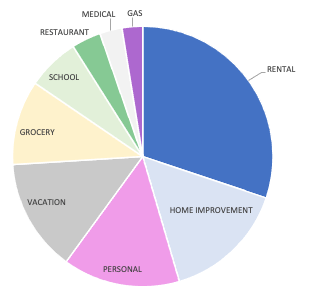
By far, our largest slice of the pie up there is for rental expenses. Honestly, I’m happy to see that so much of our credit card expenses are taken up by rental expenses we had. I pay our insurance premiums (where they aren’t escrowed) via credit card, and I can pay our county taxes for one house with a credit card, which I do for the cash back rewards. There was flooring replaced at one house, which was a significant amount of that slice.

The ‘home improvement’ category includes new patio furniture we purchased, but were reimbursed by insurance (a tree fell on our deck). It also includes the electrician work and dirt fill purchases that we needed for the deck rebuild. Our house has a few more fairly large projects we want to complete, so I expect that to continue being a larger chunk.

I know that our “grocery” expense isn’t completely groceries. I’d like to focus on this category of spending more in the second half of the year. I want to quantify what’s purchased at Walmart that is actually grocery versus personal shopping type purchases. I think that our grocery purchases are higher than they should be, but I can’t put my finger on exactly why. Historically, I’ve blamed it on ‘bulk’ shopping; Mr. ODA will go to Kroger for the “buy 5” type sales. I’m not sure that’s it though.

We don’t eat at restaurants very often. We usually eat at fast food places while we travel or are away from home at an inopportune time. When we’re at home, we’re usually eating at a “personal shopper” experience where our food cost is mostly reimbursed (although that’s not captured in the chart).

Our health insurance deductible is $3,200 per year, so we expect slightly more than that each year in the medical expense category (and based on how deductibles work, that expense is front loaded in the year). I actually pre-paid a bill at a child’s urgent care visit. I paid them $50, but that visit, along with two more visits since then, came to a total of $12. I’m waiting for their reimbursement of that difference.


PERSONAL SPENDING

I’m going to dig deeper into the ‘personal’ category. I labeled a bunch of things as ‘personal’ as a means of not having too many small slivers of the overall spending pie. This includes all gifts, needs for kids (new shoes), clothing for kids, gym membership, sports, etc. It includes a ‘shopping’ category. I spent some time going through my Amazon orders and categorizing them, but the ‘shopping’ category was too daunting and difficult to parse out further. About a third of the ‘shopping’ category is Amazon orders through Mr. ODA’s account that I didn’t pull up to categorize. The rest is random purchases that were probably related to gifts or kids clothing.
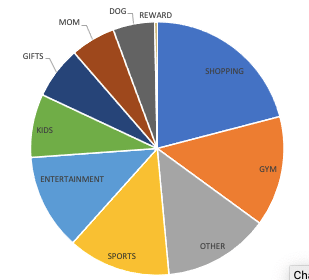
For entertainment, this is small things like going to the movies (which we go for $2 per ticket), bowling, and aquarium. The largest chunk of this pie part here is actually 4 season pass lift tickets for our family’s future winter season. I put the ‘mom’ category to see what I’ve purchased for myself that wasn’t a necessity (e.g., a travel cosmetic bag, baseball shirts to wear to my son’s games), as well as my one hair cut and one pedicure that I’ve gotten this year so far. The ‘other’ category is boring stuff – utilities, car maintenance, professional fees, etc.

Had I gone through my Walmart orders in detail, I would have been able to identify some more purchases that could be removed from ‘shopping’ and put into other categories. For instance, the ‘dog’ category is actually higher because I order his glucosamine and tooth cleaning treats from Walmart most of the time, and that’s a monthly expense. His annual vet appointment is in the Fall, so this will be a larger slice of the pie for the end of the year.


SUMMARY

Our annual credit card payment total for the last three years have been about the same. While it’s a ‘win,’ that it isn’t increasing, it’s still at a number that I don’t like. Mr. ODA has been working towards a ‘retirement’ date. We’ve pushed it back just because his job hasn’t significantly impeded our lifestyle, but the day will eventually come. If it’s next year, I’d feel better if our credit card payments weren’t as high.

I went into this expecting my grocery category to be higher than I’d prefer. I didn’t identify much of what is causing that, so I’ll try to focus heavily on watching that expense each time it hits the credit card, rather than trying to remember what each purchase entailed six months later.

I was surprised to see the gas category such a small sliver of the pie. We’ve done a lot of trips (although, I suppose a majority were in July, which isn’t captured in this data). It appears living in a smaller city and doing things mostly on this side of town means we’re not having to fill up our tanks too often.

Overall, I didn’t notice any egregious spending. We don’t spend for the sake of spending. This year we traveled more than we had the previous two years, but mostly our spending is the same. Now that we’re two years into our house, there are less projects that we’re putting money towards. I’m encouraged that now that I’m looking at this, I’ll be able to identify areas to scale back.

Thermostats and Finances

There has been a lot of talk about thermostat temperatures recently because of how hot it has been where I live. There are Department of Energy images circulating that say keep your home at 78 when you’re home, 82 when sleeping, and 85 when away from home. Personally, I need it colder at night than during the day, but that’s not the point. My goal here is to make you stop and think about your actions. This applies to several areas of your financial life, but this post specifically will be regarding your heating and cooling process.

THERMOSTAT SETTINGS

In our house in the summer, we keep the thermostat at 75 or 76 during the day on the 1st floor. It usually starts at 76 and then if someone feels hot, they bump it down to 75. Upstairs, it sits at 77 for the day, is put at 76 for when the kids go to bed, and then 74 when we go to bed. When we leave the house, the thermostats are at 78; if we leave for extended periods of time, it’s set in the 80s. In the winter, the heat is set at 65 during our waking hours and 64 or 63 at night.

As a quick aside, our third son was born early and was having trouble breathing and regulating his temperature those first few weeks. We were told to keep the house at 70 or greater for him. We struggled! We made it to 69, but everyone was uncomfortable and hot. I mentioned this to the doctor and he said it was fine to be at 68 if that’s what everyone felt more comfortable at.

While we know these numbers now, we spent a lot of years working on different settings. We didn’t just assume that these were the numbers we wanted to be at. There were winter months where we set it at 63, but my fingers were hurting because they were so cold while I typed on my keyboard, working from home. I was at a friend’s house recently; they had it set at 70, and I was cold.

That brings me to another point. What’s the thermostat temperature where you’re comfortable in the summer while wearing shorts and a tshirt? If you’re wearing a sweatshirt and have the temperature set at 70, is that worth the extra cost to run the air conditioning at that temperature?

TIPS TO SAVE MONEY

This image was shared by a local meteorologist, but a citation wasn’t given, and it differs slightly from the numbers that the Department of Energy published. According to this, we’re saving 19% in the winter by keeping our heat at 65, but then we’re spending 32% more in the summer based on the recommended setting.

While you may have your expected temperature setting, you may want to consider is how hot (or cold) it is outside. If it’s going to be 100 degrees, maybe set the thermostat slightly higher on those days. It’ll feel comfortable at a higher temperature because the unit is going to be running more, therefore pumping more air into the room than on an 80 degree day.

In the summer, another option is to keep the blinds closed. If you keep the sun from peering into the house, especially during the heat of the day, it’ll help keep the temperature lower so the unit won’t want to kick on as often.

My local electricity company provided suggestions to keep your bill lower. Their article said to grill, use a slow cooker, and make sandwiches instead of using the oven and stove, which create more heat for the air conditioner to have to counteract. You can also use fans in rooms where you’re sitting so that you feel cooler while the thermostat is kept a degree or two higher. Make sure your filters are changed regularly so that your unit is working efficiently.


I implore you to increase your cooling temperature by one and see how that feels. Live with that for a week and see if going one more degree helps too. It could be that the cost to run your heating/cooling is worth the level of comfort you feel, but it could be that you find a setting that is still comfortable and it’s worth the savings you reap.

Rental Property Work

We have several rental properties in Richmond, VA. However, we moved away from the area in September 2020, leaving the properties under a property manager’s oversight. My goal was to make it back to the houses annually to do walk throughs of properties. It’s surprising how many people don’t tell landlords about issues timely. Since most of our properties keep long term tenants in them, we don’t get eyes on the condition of the house regularly like we would if we were turning over the house between tenants.

Generally, I check to make sure their HVAC filters are changed out, that they don’t have any piles of garbage or old food (or the gigantic pile of laundry that was blocking one tenant’s second form of egress), that the yard is maintained, and simple things like that. I also take this as an opportunity to fix or improve things that I know need attention, but weren’t necessarily worth the up-charges of hiring the action out to a contractor.

We did a walk through of the Richmond houses in July 2022. At that time, nearly all our properties had long term tenants in them. A few small items came out of those walk throughs (e.g., change out filter, re-caulk the tub). While we hoped to get there last summer, it just wasn’t in the cards with our 3rd baby.

Based on the rest of our summer schedule (and soon to be constriction of school schedules), we were only able to get there for 2 full days. None of the work that I wanted to get done is a high priority; it’s mostly work that would improve the aesthetic of the house or help the longevity of an investment (like a new porch).

PROPERTY 7

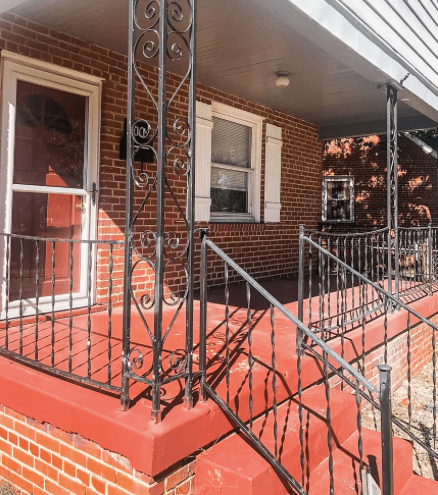
This house recently turned over. The house was flipped when we purchased it 7 years ago, and we knew that everything that was done before we owned it would just be a bandaid. We had a couple of long term tenants in the house, and we even had quick turnovers because people needed a place to live, so we didn’t have time to do major renovations. It was time. We put a lot of effort into fixing up the place (e.g., all new paint, new flooring and fixing of subflooring). The front porch and front door were red, and it just made the house look dingy. I wanted to make it look better. See: not a priority, but something worth looking into eventually.

I arrived on the evening of the 4th to pressure wash the porch so it would dry by morning when I would paint it. I did not account for how bad the condition of the paint was. It appears someone just painted over peeling paint years ago. There were several layers of gray, purple, and red colored paint. The latest paint job had several places where that was the only layer of paint on the concrete. Very odd, but that meant that I had to scrape as much flaking paint away as I could. I spent over 10 hours on this. Not exactly what I had in mind. I scraped and scraped and scraped. I then put two coats on. I’m nervous how long it will hold up though. I did this during an extreme heat advisory so it likely didn’t cure correctly by drying in mere minutes.

I also did 3 coats of black over the red door. I don’t think it’s going to hold up against her animals, but at least it looks better from the street.

This house still needs the back deck pressure washed and painted. However, this is something I’ll do either with tenant turnover or if we sell it. It’s really worn down and places are missing paint because we removed the covered portion of it. The porch railing had also been painted at some point and is peeling, but I hadn’t budgeted time for that. I did a few touch up areas with black paint to cover where previous owners had painted it red.

PROPERTY 3

The tenant here reached out to me a couple of months ago to tell me that a salesman broke their doorbell. Fascinating. They claimed “well, it’s old.” My thought was “well, it’s meant to be outside, and the house next door was built the same time without any doorbell breakage now.” But instead of sending someone out to fix that, I put it on our to do list. It took Mr. ODA about 2 minutes worth of work, and the new doorbell cost $10.

While there, we cleaned out the gutters. That’s been a known issue throughout the life of this house because there are a lot of trees around the perimeter. We also cleaned the mildew growing on the house.

PROPERTY 2

This house is a mirror image of Property 3, but the trees in the backyard are much closer to the house. The back of this house had significant mold growth on the siding. We got all the siding cleaned up there too. Mr. ODA got on the roof to clean out the gutters. While up there, he also cut some trees off the roof.

The first picture is a ‘during’ picture because I didn’t get a ‘before.’ The part at the top that is dark is actually better than what was there, and it was over the entire back of the house. We soft washed with a mold and mildew cleaner and got it looking almost brand new.

PROPERTY 9

During the last turnover period of this house, we had the front porch jacked up (it was sinking), had the front stairs redone (they were sinking too), and had the back decking replaced. I had intended to stain the new wood for this house, but it being well over 90 degrees precluded that action. Instead, Mr. ODA got the siding on this house all cleaned up, and he cut/pulled several large weeds that were growing.

DRIVE BYS

We did drive by the other Richmond properties that we have. I didn’t have the time (or energy) to schedule walk throughs of everything. Once you do a walkthrough, you inevitably end up with a list of things to do to the house. I already had a lengthy list of things to do, so I didn’t want to manage that right now. Just by driving by, I did add to my to do list that one house needs its gutter replaced (how does a gutter, with no trees around, twist away from the house), and that their back deck really needs to be replaced (just the deck boards and railing; the substructure is fine).


I’ll need to make it back there to walk through the properties. If nothing else, it gets the tenants to clean things up once a year. One of our property managers offered a filter check quarterly, which was really used as a way to get into a house and make sure things were being kept clean and orderly. While a filter should be changed that often, I think that’s too much time being in someone’s place they call home. However, once per year is worth it to keep things moving in the right direction and to make sure there aren’t any maintenance issues that hadn’t been reported.

July Financial Update

RENTAL EXPENSES

We took a trip to Richmond, VA to work on rental properties. It was fairly last minute. I had a schedule of work at each house that I planned. However, I didn’t plan on the heat index being 113 and 112 for the two main days we were there. I was able to get everything on my list done except for staining the new deck at one of the houses. I didn’t want to risk it not applying or curing correctly because it was too hot and in direct sun. Plus, the tenant didn’t even clear it off so I could work on it.

I had multiple houses pay rent late this month. I was surprised. One let us know on the 5th that they had an emergency, so they wouldn’t be able to pay until the 17th. I had someone pay half their rent early in June, but then haven’t received an answer as to why the rest of her balance ($345) hasn’t been paid yet. Another tenant misunderstood her maternity leave pay, so she asked for more time to pay rent. She paid $800 on the 7th. I told her not to worry about it, and just pay when she can, without the late fee; she only has $150 remaining.

I’m currently working through two roof replacements. One of them will be covered by insurance, but then I’ll be paying to have vents added, the chimney torn off and capped, and the soffits repaired on top of what insurance can do. Then the other one we’re paying out of pocket for. It’s original to the house, which was built 24 years ago. There has been storm damage to it over the last year, and it’s just generally time to address the age even though it hasn’t caused any problems yet.

PERSONAL EXPENSES

Our medical insurance company had some glitches in their claim processing through the first half of the year. Now they’ve caught up, meaning I’m paying large sums of medical bills. Mr. ODA took on booking lodging for his guys trip later this month, which meant that the second half of AirBnB payments were applied to the credit card.

Mr. ODA increased each kid’s UTMA from $75 to $100 per month. That means we’re investing $3,300 each month into accounts, on top of maxing Mr. ODA’s TSP contributions and both of our Roth IRA contributions for the year.

Our contractor has ghosted us on our own deck build. We bought some new furniture for the main deck area. Once it’s not 100 degrees outside, we’ll work on doing the waterproofing of the deck ourselves so that we can start living on the patio under the deck and get that hot tub ordered this fall.

NET WORTH

I updated the valuation of the houses this month. I typically only do that 3 or 4 times per year. I try to account for the big increases we see at the beginning of the spring, and then adjust slightly around this time of year once the comparable houses have closed and sold. This update added $140k worth of equity into the equation. All of our liabilities decreased since last month, and all our assets increased since last month. That has equated to an increase of over $200k in our net worth.

Mentality, Consistency, Follow Through

When I was little, we had friends come to our house a lot. When a certain crew came, they raided the candy drawer like they hadn’t eaten in a week. It was quite a binge. It’s because there was no candy in their house. They were fed 3 small meals each day, and that was it. They had the mentality that they needed to get everything they could in a small period of time. Because they hadn’t been taught self-regulation by having regular access to things, they didn’t understand moderation.

To me, I had access to the candy drawer in my house whenever I wanted. Therefore, it wasn’t exciting to me. It was there if I wanted something here and there, but it wasn’t something I felt the need to covet. I do the same with my kids. They have full access to the pantry. They know the things that are “good” for you, and they know they can take that without asking. They do ask if they can have any of the treats in there, and unless it’s close to a meal time, I try to give more “yes” responses than denials (and my denials always come with a reason).

I use this story regularly in my life it seems. It seems focused on a healthy relationship with food, but it’s really an overall concept of understanding the mentality it takes to make informed and beneficial decisions all day, everyday.

DELAYED GRATIFICATION

We did a stent with a multilevel marketing company. They preached “delayed gratification.” It was meant to say that you shouldn’t spend now because you’re going to produce a significant amount of income in the future, and you’ll be able to spend greatly at that point. Unfortunately, Mr. ODA and I are too cynical to watch that unfold. We took note of every “extra” our “upline” spent that wasn’t hitting that mark.

They who would go on a big trip with the statement, “well it’s ok because it’s for my birthday” or “it’s ok because it’s the last big trip that I’m going to take with my mom.” There was always another trip. Or the big, fancy, rent out a space, decorate to the nines, buy a new outfit, birthday party that happened almost annually. There were excuses to justify these actions that were clearly against their “delayed gratification” preaching, but they thought it was ok because they were “debt free.” They didn’t buy a house, continuing to throw money to rent year after year so that they wouldn’t have a mortgage.

There was a guise of having a “big picture” mentality, but the execution of the financials didn’t add up to us. If you were really in delayed gratification mode, the $3,000 you spent on a trip could have been saved towards a 20% down payment on a house at 2.5% interest rate. That’s what Mr. ODA and I did when we had to pay for a wedding and buy a house in the same year. We set a goal to spend no more than $5 per person, per day on food. We didn’t eat at restaurants. We didn’t go on huge trips (although we did do some weekend trips to visit family). Because of those years of ‘pain’ we went through, we bought a house with no mortgage insurance, and that house turned into 4 houses when we sold it.

I digressed. The point here was that creating a mentality of “delayed gratification” is setting yourself up for failure. If you created a habit of proper spending and a mentality of being able to discern whether the cost of something is worth it to you and your goals in real time, there wouldn’t be these “slip ups” of wanting to take that big trip or wanting to fill a void by throwing a lavish party.

In February, I started a diet. I was working out for a year at that point (after having our 3rd baby), and the number on the scale was exactly the same. I felt better, but I wanted that number to go down. I started reading up on diets, and this concept I found clicked with me. If you commit to a diet that is really restrictive, you’re going to fail. If you can’t have any carbs, then you end up having a binge day to make up for that desire. The concept of depriving yourself of something is more thought-consuming than if you had taught yourself moderation.

This diet concept was to alter your eating each day so that it keeps your metabolism on its toes. One day, eat a lot of protein. The next day, eat your carbs. Go back and forth. I was consistent on this for 3 months (see, best laid plans fail – between end of school things and travel, I haven’t put the effort in), and I lost 17 pounds with little effort. I haven’t been paying attention to this eating pattern, and I’ve been stagnant again. The whole point was that if you deprive yourself of something you want, then it’s going to consume you and make you unhappy. But if you eat in a thoughtful manner, then you’re happier and have an easier time reaching a goal and sticking with it.

RIPPLES

The decisions you make today affect tomorrow. The habit formed by thinking you had a hard day and deserve a “treat,” or that “it’s vacation so we should each have a $10 ice cream at the amusement park,” have ripple effects. I have another post about how people make fun of those who say don’t spend $5 on coffee everyday if you want a better life. Most people see it as a literal $5 per day (granted, it’s more like $7 or $8 at this point), do the math, and then say sarcastically “wow I’m a millionaire.” No, it’s the mentality. It’s the concept of teaching yourself that you don’t need to purchase an expensive coffee everyday, or you don’t need to buy lunch everyday at work, or you don’t need to overspend on treats once per week.

Someone once made fun of us because we like to go exploring new towns and find hikes, while his family goes to Disney at least once per year. I’d venture to say that our trips, where we spend time with our family and learn about new places and things, are more stimulating. I don’t hate Disney (Mr. ODA does though 😉 ), but I don’t see it as something to go to every year with no other experiences. But our trips that end up costing about $1,000 allow us to go do more things. We can do more activities when home, we can go on more trips, we can put money into savings accounts for our kids.

This summer, we have plans to be in 7 states outside of our home state. My kids are extremely happy with just the concept of staying in a hotel or “vacation house.” Add in swimming in a pool somewhere, and they’re ecstatic. I don’t have a desire to teach them that vacation is when you get to eat everything you see and buy whatever trinket you want. If you intentionally spend throughout the year, you end up with things that are more valuable to you than if you buy several trinkets just because you’re on vacation (really – when was the last time your kid played with that light up spinny stick from Disney on Ice). I want to teach them the value of their time, their money, and their family. I want to try my hardest to set them up for success because they understand the value of things in the big picture, and not just the instant gratification that lasts for a couple of days because they go that little toy we walked by.

June Financial Update

Welcome to summer, where we’re traveling and I’m not posting on time. This time it was because I had to figure out a few things with bills and health before I had the time to get to the update. I can schedule content in advance, but not this post where I need the most up to date numbers when talking about our net worth.

We’ve been busy with baseball and activities around the house, so our spending was lower than it had been. However, this time of year is typically where we see a lot of our rental property expenses come through. We purchased many houses around this time, which puts their insurance payments due now. Then the City of Richmond’s tax payments are due in June and December also. The City of Richmond doesn’t post our escrow payments timely, and it drives me crazy. Every 6 months, I get notification that I have unpaid taxes and it’s the due date. I have then go through every escrow and prove to myself that they were in fact paid out over 3 weeks ago, and then I have to go back and check that Richmond posts them eventually. I stopped sending checks into them for the accounts that aren’t escrowed because it took too long to monitor, so I pay the $0.95 fee to pay via their ACH option online.

Mr. ODA had been in a relationship with a financial advisor, which was $35 per month. Over the last 3 months, Mr. ODA has been working to become his ‘apprentice.’ He passed his Series 65 exam and will begin working on this guy’s team. Not that $35 is a huge amount, but that’s one less ‘subscription’ that we’re paying monthly.

Speaking of subscriptions, we did something that I’d venture to guess other people wouldn’t put the effort into. One of our credit cards (that we rarely use) had a promotion for a $15 statement credit if we had at least $100 worth of subscription and/or utility payments go through. Most of our utilities can’t be paid with a credit card without paying a fee. The fee for our internet service was low enough that we went ahead and switched that one over for one month. Then I went into our Y membership and switched the credit card on file for that payment. With a few button clicks in May and then later this month to switch everything back, we made $15. It doesn’t seem huge, but it’s the compound of that thought process and awareness that makes a difference in your finances.

The ‘bigger’ expenses of the month were one kid’s school registration fee ($175), purchased baseball tickets (the Oriole’s don’t charge for 2 kids per paying adult!), got an oil change ($65 ugh), paid two homeowners insurance policies that aren’t escrowed ($1,371), paid for pet sitting for a coming trip ($155), paid car insurances ($567), and built a few steps in a new walkway ($275). Our deck isn’t complete because the waterproofing isn’t waterproofed. We haven’t paid out the last $3,500 on that, but we also haven’t heard from our contractor in several weeks.

We initiated a homeowners insurance claim for one of our properties. The tenant wasn’t complaining about the house/roof, but we knew the roof and soffit were in rough shape. I was hesitant to contact a roofer because I wanted the job done right. I expected the house is really old, and there would be decking problems to fix. I dragged my feet on finding someone, but I did click with someone finally. He went out and actually suggested we go for a claim to cover the replacement. We’re in the process of that now. An adjuster has been out to see the damage, and now we wait for the estimate. In the meantime, another property had water spots on the ceiling show up. I had the roofer go out there to check it out, but he didn’t see anything glaring. That roof also needs replaced, but I’m going to get at least one more quote on that job since it’s not through insurance.

All the good things (assets) went up and all the bad things (liabilities) went down! Our net worth increased by $60k over the last month.

House 4 Turnover

We had a long term tenant in this house, who moved out last Spring. We luckily had someone lined up looking for a place to live. There were a few red flags from the beginning, but I went with him because he was a friend of an old tenant of ours. Rent was always paid on time, and everything went fine. Unfortunately, there was a public incident at work in the Fall and he was let go. He asked if he could be released from the lease so he could move back home.

I wasn’t interested in making anything more difficult for them. I didn’t ask for a lease break fee; I just asked that they continue to pay rent until we found someone who could take over the property. It was winter and holiday time, which is least favorable time of year to be finding a renter. They gave notice at the end of November and we listed to house right away. We did our due diligence to get someone in there as best we could, considering it was Christmas time and the middle of winter. The tenant paid January rent on the 1st, as required. Luckily, we were able to get someone moved in on January 5th. The tenant didn’t do anything wrong to the property, so I gave back his security deposit and the January rent they had paid.

TURNOVER

The original tenant had essentially vacated the property, so we were able to get in and do some work to it. The entire place was painted and had extensive maintenance needs met over last summer (after the long term tenant), so this was an easy task to get it ready for a new tenant.

We received a notice from the city that the yard needed to be cleaned up, so we had the tenant go over there and do the work. There was a tree limb that had fallen (and wasn’t reported), so we had someone go clean that up and the rest of the yard for $100.

Several years ago, we had replaced most of the windows in the house. There were 3 windows that were either fine or oddly shaped, so we didn’t replace them. That was a mistake. We ended up spending the same amount on 3 windows this year that we did several years ago for 6 windows.

The front porch of the house is seldom used. The driveway is in the back of the house and leads straight to the kitchen door. The entire front of the house is fenced in too (the house has a huge front yard and small back yard). Due to the age of the house, that it’s a rental, and that the front porch is rarely used, it wasn’t in great condition. It was finally time to replace it. We had our handyman rip out the stairs, banisters, and floorboards to replace it all; it cost us $1,640.

The kitchen faucet wasn’t working right, so we had our plumber replace it. He also tried to flush the water heater to extend the life, but it was broken enough to replace it. We needed a special size because it fits under the counter in the kitchen, so that was $1500.

Other than a clean from our cleaner, that was all that we needed to do.

TENANT SCREENING

We had 4 sets of people show interest in the property. One withdrew her interest form after checking the sex offender registry (understandable, but it is a city home, so that’s not surprising). I was interested in another guy who was retired and seemed handy, but as time wore on, there were several red flags. Another person tried to convince us that his day-trading of stocks qualified him to pay us rent each month, so he was disqualified for not meeting income requirements. Finally, a couple showed interest, and my property manager said they seemed like a decent option in person, so we went with them. At the time, I didn’t really comprehend that one of the tenants was only 20 years old. That comes into play when he shows his age and inability to handle a mature conversation about rent payments a couple of months later.

Due to the unexpected timing of turning over this house, we ended up with an 18 month lease. We didn’t want a 12 month lease, leaving us with another winter turnover. Even though their lease started January 5th, I counted the full month and ended the lease on June 30, 2025. I like a May 31 or June 30 lease ending the best because it seems to be when the most people are looking to move. Once you get to July 31st, most people (in the southern states, at least) are looking to have already been settled in the school district they wanted.

TENANTS THUS FAR

Well, since I had plenty of posts teed up, I’m only getting to post this now, months since they’ve moved in. That means I have a sample size of their tenancy to share, and it’s not good. They’ve had a lot of complaints, which is interesting to me since the previous tenants didn’t seem to have many issues with the house. It’s a 1943 house. It’s not perfect. It’s not spacious. But I assure you, the house is exactly what you see when you first tour it. It’s a cute, little, old house.

The tenants used Venmo to send the first sets of payments when moving in. For some reason, they decided to switch to Zelle; in doing so, they didn’t follow the instructions I gave them, and are sending them to an account I’d prefer them not to, but oh well. In March, rent arrived on the 6th. I was bothered by it, but I let it go. Then for May’s payment, we hadn’t received it by the 5th in the evening. Our property manager reached out to them to ask if they planned on paying that night. They said they had already paid on the 2nd. We explained that we hadn’t received it, and we still see no indication of it arriving electronically. He sent a screenshot of his bank’s information, which did confirm a payment on the 2nd. We said ok, thanks, and we’ll check in the morning.

He then went off the deep end. He attacked us, as if we just sit around pretending we don’t receive money so they’ll send more money. At no point did he stop, think, logically read our messages, and respond politely. He continued to berate us and the property manager over this, where we carefully explained that sometimes there’s an additional verification step required so that this 3-5 day hold doesn’t affect when rent is due. He kept saying he was completely verified and that it’s our bank not accepting the money. That’s not how banks work, but ok.

He eventually agreed to use Venmo. I went back to his January payments, liked them, and ‘friended’ him on the platform so that he’d have the right account in front of him. He did pay June’s rent on time and via Venmo.

In his berating of the house, he talked about how the house was awful. The house that they walked through and agreed to rent. The house that is very small and very old, but is clean and operational. The house is nothing special, but it’s a house with rent under $1000 in 2024 and decent access to the activities in the city.

They complained that the light in the oven was stuck on. They didn’t want to pay to run that electricity in a house that already had a high electric bill. It’s an 800 sf house; if you’re paying $350 per month for electricity, I’d say you’re doing something wrong. All systems in the house have been serviced and/or replaced recently. All the windows in the house are no more than 5 years old. We had our plumber lined up to handle this for us (he’s a good guy!), but they figured out what to do differently to get the light to turn off. What frustrated me the most about this complaint was that they acted like I purposely broke their oven 3 months after they moved in (and I live in a different state), and yet I’ve been very responsive to all their requests for maintenance.

SUMMARY

Overall, everything is fine. They have a lot of growing up to do. I hope at some point they learn that you catch more bees with honey. For now, they’re there until the end of April. We’ll see how the next several months go, but at this point, I’m interested in finding someone else. Based on their hatred of the house, I expect they’ll move out on their own accord regardless.

Property Assessments & Rent

At the end of last year, I received each property’s revised assessments for 2024 tax purposes. To no surprise, every single property drastically increased. A harder pill to swallow is to see how much it increased just from two years ago.

Higher home sales are great – if you’re in the market to sell. If not, it’s just fueling the local jurisdiction’s ability to increase their tax income. Again, this increase is great for a resale opportunity, but it’s not great when we’re content in our “buy and hold” at the moment.

Where I live, we received our property assessments recently as well. There was an uproar from the citizens. The Property Valuation Administration explained the increases and how they work, noting that home values in our area have exactly doubled since 2014. While their valuation process only occurs every few years, and home prices are increasing about 10% each year, people are seeing 30-50% valuation increases when they receive their notice.

COMPARABLE SALES

When determining a property’s assessed value, whether it’s for tax purposes or a bank loan or such, nearby home sales are used as the basis. Home sales denote what buyers are willing to pay (and likely what an assessor determined as fair market value) for a home. To determine your home value, you would need to look at sales in your neighborhood or close geographic area, for homes (and lots) that are of similar size with a similar number of bedrooms and bathrooms. There are factors that you can use to compensate for a different number of bedrooms and bathrooms, but it’s easiest if you find homes with similar data points.

In today’s market, you’re also going to focus on home sales in very recent months. The amount that a person is willing to pay, and the amount that a bank is willing to loan, is increasing regularly. A home value in 2021 is different than today’s.

HOW DOES A PROPERTY ASSESSMENT AFFECT YOUR RENT?

I wrote a post that went into the details of how our expenses have changed over the last year on these rental houses. It’s noteworthy, as a renter, to be aware of the changes in property assessments because it’ll help you anticipate and understand the need for rent increases that will be coming.

I recently saw someone complain that a landlord was raising rent with no improvements. Rent increases aren’t tied to improving the house (well, they can be). Rent increases are keeping up with the costs that are increasing for the landlord.

I’m a broken record on this, but I’ll continue to work to educate. When you rent a house, you see the one cost. You don’t see that the landlord is holding the mortgage. That mortgage likely has escrow that pays for insurance and taxes, which both increase every year. Even if it’s not escrowed, the landlord is taking the time to manage the income/expenses of the house and paying out the taxes and insurance.

You also don’t see the maintenance costs. When you call me to have a plumber come out, that’s an expense. I used to pay $125 for a service call and minimal work. Now that’s $200-375. Your rent is covering that possible future expense. Could you imagine if you found out you needed a new water heater in the house; would you have $1500 to hand over in a day’s time? As a renter, your rent is set to cover those future expenses.

We typically reserve rent increases for every other year, and it’s usually $50 per month. There have been some cases where a tenant has negotiated less, and a few other cases where we increased the rate more than $50 per month because of the drastic expense increases we incurred. I learned that if I don’t increase $50 every two years, I end up behind on the increases that are coming in future years. I don’t want to increase rent by $100 /month on a good tenant, so I try to keep with this schedule. I always explain that this increase is due to carrying costs. I also always provide a written documentation and give the tenant the option to move out. I’ve never had a tenant move out because of a proposed increase.

SUMMARY

If you’re interested in knowing more about these numbers, review the post that I linked. You’ll see that my annual costs increased by over $4,500 on these properties. You’ll also see that in some cases, where I prefer to only increase rent every two years instead of annually for tenant satisfaction, I’m not keeping up with the cost increases I’m incurring. House3’s two year cost increases of that property’s insurance and taxes total over $125 per month; I increased their rent $50 per month. I have other properties that can float that loss I’m taking there, but having happy, polite, and courteous tenants who take care of the property like its their own is more important to me than drastic rent increases and risking someone less vigilant moving in.

So the next time a landlord increases your rent when your lease term expires, understand that it’s to cover the expenses they’re covering for you to live there. When the property sales in the area increase, know that the landlord’s taxes are increasing, which equates to a higher rent needed to cover it.

House 7 Turnover

Our turnover this year has been higher than usual. However, it’s been for good reasons, and not just because someone is looking to rent from a different landlord, so I’ll take that win. In this case, the tenant was house hunting. We knew that a year ago, and we had set up our lease to allow them to break it. Since April was their last month in this current lease term, there was no “lease break fee” associated with their notice. They gave us notice at the end of February, which requires 30 days worth of payment. March rent was paid.

They had moved out of the house early though, which ended up being very helpful. The house needed a lot of work. There was a lot of deferred maintenance on this house. We bought the house as a flip. It looked fine on the surface, but we knew it wasn’t going to hold up. Our last couple of turnovers happened really quickly, so we didn’t put much effort into the turnover process. With the extra time, we knew we needed to address some issues.

PAINT: $2,750

First, we finally got the flat roof addition fixed on this house last summer. The flippers before us had added a laundry room to the back of the house. They used the existing covered deck infrastructure, and it was horrible. They didn’t tie it into the house correctly, so we endured several leaks into the laundry room. We struggled for years to get a roofer who would address it for us. We even hired a roofer, highlighted the flat roof issue, and missed that his contract didn’t do anything except replace the shingles on the main house roof. There was plenty of saga once we finally found someone to rebuild it, but it’s done. We hadn’t fixed the drywall from the leaks, so that needed to be done now (a.k.a. deferred maintenance).

We found a painter who repaired the drywall, repainted the ceiling, and painted the walls. He also painted most of the trim in the house to white (there was some damage on the baseboards that needed fixed) and all the walls Green Tint by Benjamin Moore.

Two tenants ago, we had given an offer that if she wanted to paint any of the rooms, we’d offer a rent concession. That was part of the deferred maintenance; most of the house was dingy white that took a beating over the years, but we never had the time between tenants already lined up to paint everything. She took us up on that offer. She even painted the bathroom vanity and medicine cabinet. It was a beautiful robins egg blue, but we didn’t have the paint to do a few touchups on the side of the vanity that were needed. Our painter added that to the work at no cost. He absolutely didn’t need to do that! But everything has a fresh coat of paint now, and I’m so happy at the facelift it gave.

FLOORING: $6,613

When we first bought this house, the bedrooms on the first floor had dingy carpet in it. The prospective tenant we had requested we replace the carpet. I can’t remember the series of events, but we determined it was better to refinish the hardwoods underneath the carpet than to continuously replace the carpets every 3-6 years. They’ve held up pretty well, but they are starting to show wear at 7 years in.

Regardless, we didn’t touch the carpet on the stairs or on the second floor of the house. It’s blue indoor/outdoor carpet. I truly can’t believe we’ve been able to house renters in this place with this carpet still in place. We’ve put it off because re-carpeting stairs is just so expensive relative to doing a whole room. One of the bedrooms on the second floor even has wood paneling, which just made it even more amazing that anybody wanted this house. It was not the most aesthetically pleasing place.

We replaced all the carpet. With the fresh carpet and fresh paint, it’s looking so much more inviting.

Then we move on to the kitchens and bathrooms. The first floor bathroom and kitchen floor were clearly just lipstick-on-a-pig situations by the flippers. The subfloor was clearly bowing and making all the cheap tile crack. The humidity issues in the bathroom (I’ll touch more on in a moment) weren’t helping matters in there.

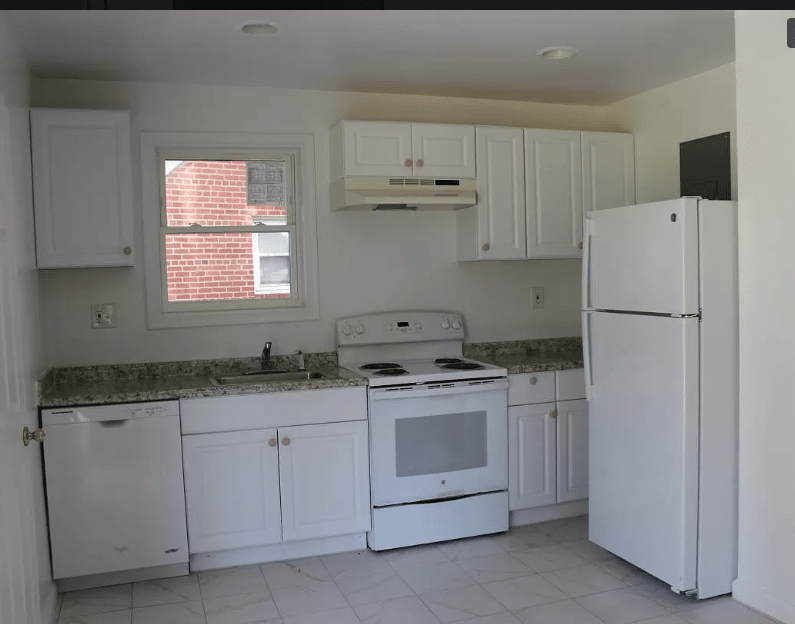
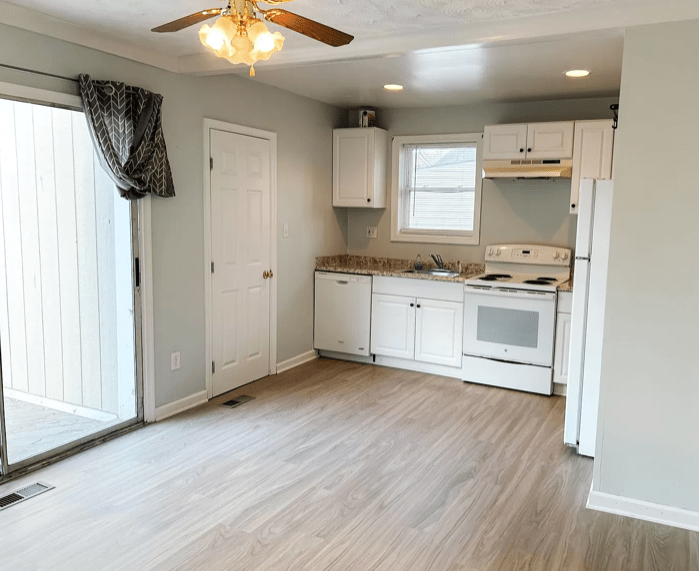
Here you can see the kitchen (and its pink knobs!) with the tile floor. The tile had all cracked by this time.

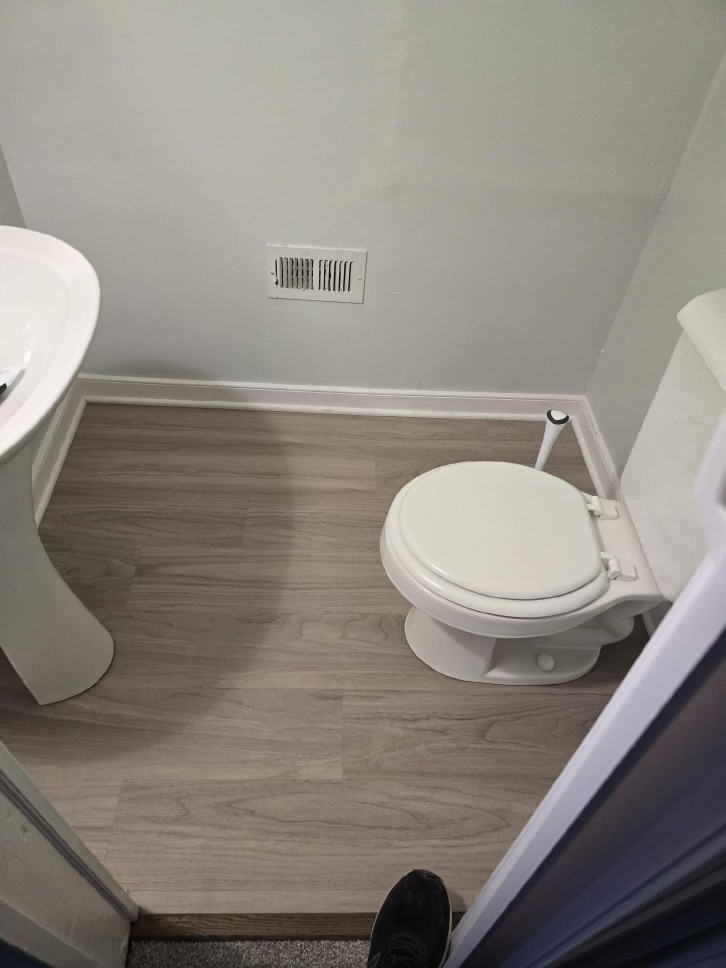
The upstairs bathroom was original 1970s linoleum. Here’s a snip of it in its glory.

Trying to match/add the hardwood was not an option. We considered ‘luxury vinyl tile,’ but that was more expensive than I wanted to put in a rental property. I didn’t want to retile it because I just personally don’t find tile floors to be warm and cozy for a house. The only reasonable option left is ‘luxury vinyl plank.’

We requested a quote from Home Depot. Their quote was cheaper than the one we ended up going with, but we didn’t use them for good reason. We had a subfloor issue in another house. Home Depot was extremely difficult to work with. Not only were they doing questionable work, they also just threw their hands up at the subfloor issue. Luckily, we had a friend that was able to help us repair it (because we didn’t live there). We know for a fact that there’s subfloor issues here (we can see the bow in the floor at the sliding door), so we wanted to go with a contractor who could handle everything.

We picked a local company. They did both the carpet and the LVP. They were so easy to work with. I didn’t love that they wanted me to pay for the entire job up front, but it ended up being great. They had to come back to finish a few tasks, and they did it all perfectly. I’m really happy with the process and their product.

Another miscellaneous flooring issue was that the vent covers were rotting. The finish on them were peeling. This could be explained by humidity in the bathroom, but that doesn’t really explain the issues in the kitchen and living room also. Our handyman was able to pop those out and get new, clean looking ones in for us.

RANDOM WORK

We had to call on our handyman for random jobs. He had to tighten the front porch banister. It’s likely the original banister and has just corroded at the connections. He also had to tighten up the screen door (which, if it were to break would be removed; having to maintain non-essential pieces of a rental is no fun). Some light fixtures needed major TLC. We replaced the light fixtures in both second floor bedrooms, the sconce type light fixture in the half bath upstairs, and the main bathroom’s vanity light (it was all corroded and looked bad).

The upstairs half bathroom had a brown accordion door. The pieces were falling off and it just generally looked bad. The space is tight, and an accordion door style was definitely the best solution for the area, so we had a white one put in. It’s still less than ideal, but it looks much better.

The previous tenant didn’t clean up the yard as they were supposed to, so we had to hire out that work. We also asked him to clear the gutters, which was very necessary because it looked like trees were growing out of them with how many twigs were stuck. He charged me $250 to rake the leaves from the yard and flower beds, mow the yard, and trim the bushes. Then he added on $50 for the gutter clean out. We also did a final mowing before the new tenants moved in, and he charged me $60 for that.

I’m not exactly sure what the issue is, but for some reason we had water damage in the main bathroom. It wasn’t water damage in the sense of standing water. It was just too much moisture. The mirror was corroded; the tub faucet handles were corroded; the caulk was all moldy (and we knew it was fine a year ago); the walls had water streaks on it. I don’t know how it was fine for years and now it’s not, but I’m guessing the only answer is that last tenant just liked really hot showers and didn’t use the vent or window. The tub knobs were so corroded that they had to be sawed off and new valves and such installed. Luckily our plumber was able to handle it timely and it looks better now, but that was a minor inconvenience.

The back sliding door had always been questionable. No one ever pushed us on it though, so we didn’t know just how bad it was. I don’t know that the door ever fully locked. There was a block used to hold it shut for security measures (although I feel like everyone who has a sliding door uses something like that). I finally wanted it replaced. It was likely the original door (think nickel type finish), and it was overdue. We did this through Home Depot because I knew their prices were reasonable and it should be an in/out job. It was $1063.

NEW TENANT

Our property manager showed the property to several candidates. Only two provided their interest form timely. An interest form is a way to gather background documentation on the potential tenant without the tenant having to spend any money. It’s a way for the prospect to divulge any negative remarks on their credit or background check. It’s a good gesture that we allow them to fill this out before spending money on an application fee that will identify disqualifying information. We have found that some people don’t tell us anything, and then they’ve spend $43 for us to say they don’t qualify.

Both prospects submitted their interest forms on April 18. Unfortunately, both of them were interested in a mid-May lease start date. They both offered to do a 2 year lease as a compensating factor though, which was a nice gesture. I also appreciated that both of them were well spoken and up front with a lot of information.

We chose someone and ran her background check. Several “unlawful detainers” (a.k.a. evictions) came through, which hadn’t been disclosed. We told her that her credit score was slightly below 600 and the unlawful detainers would disqualify her. She then wrote back a very nice note explaining all the data that we found and asked us to reconsider. We agreed to rent to her and to take a higher security deposit as a compensating factor. She agreed to the 1.5 times a month’s rent as a security deposit.

Unfortunately, the house was vacant for a month and a half. Luckily, during that time we were able to get a lot of work done in the house. I hope that this tenant takes good care of the home and that we’re pleasantly surprised with her tenancy regardless of her history of late payments and court filings.