Lease Break Agreement

Last March, it was time to make a decision on renewing the tenant’s lease on House9. There were several variables at play, and we ended up adding “lease break” terms to the renewal agreement. Here’s how and why we did such a thing.

LEASE BREAK CLAUSE

All of my leases are set up as a lump sum fee. This means that if the rent is $1,000 per month, then the lease is a legal binding agreement for $12,000 for the year. If you wanted to leave 6 months into the agreement, I could hold you accountable for the entire sum. In reality, this wouldn’t happen. I’d have to show a good faith effort to re-rent the property once the tenant vacated the property, and they’d only be responsible for the time it was vacant, at most.

The point here is that there is no section of my lease agreement template that allows the lease to be “broken,” and the tenant to leave “early.” In some instances, a tenant will request the flexibility to leave early, and we typically charge up to a month’s rent for that ability. We most often use this for tenants that expressed interest in buying a home. There are some other fee structures that we use depending on the circumstances, but this will focus on those instances where we know in advance that this is a possibility.

ORIGINAL LEASE AGREEMENT TERMS

The tenants had signed their original lease in June 2020. From the beginning, they were clearly money savvy. They had said from the beginning that they were looking for a place they could live until he finished his schooling, which was about 2 years away. They negotiated a two year lease for $1,280. In September 2021, so 6 months before their lease was set to expire, he reached out with an offer. His program was set to end in May 2023, but they didn’t want to commit to any longer than that since he could be placed anywhere upon graduation. He asked to go month-to-month after that.

We agreed to extend their lease until May 2023, but it would be $1,300 (instead of $1,280) between 7/1/2022 and 5/31/2023. We decided not to engage in the month-to-month conversation that far in advance, which he understood.

In March 2023, we started discussions on their status. They were about to have a baby, the market had cooled for buyers, interest rates were high, etc. They didn’t want to rush their buying process. Instead of paying the premium for a month-to-month lease, we decided on another year-long lease, but it would have a “lease break clause.”

NEW LEASE AGREEMENT TERMS

The new lease was executed for $1,350 per month, which was still a bargain for their property. However, we added lease break provisions, as seen below.

The thought process here was that we were protecting our financial interests based on the time of year. First, we required a month’s notice. Our original lease already states that we can have access to the property to show it to prospective tenants, so that wasn’t repeated here (although it is worth noting that this in our lease agreement, since renting while a unit is occupied is not always a given; we struggled with our property manager in KY getting access to our properties (that was a property manager issue)).

I don’t know if there are facts to back this up, but it seems (through my own years of renting, as well as all these years as a property manager) that most people are looking for a rental to be somewhere between May 1 and July 1 as the start. A quick search tells me that the common months are May to September. However, in the south, we start school in mid-August. If you’re not moved by August 1st, I’d venture to say you’re not preferring a September 1st start date.

If the tenant left in the summer months, then the fee was only 1/2 of a month’s rent. We had a good chance of being able to re-rent the property if it was during the summer and before everyone focusing on back-to-school in the end of August/September. If they requested a lease break between September and the end of March, then it was a full month’s rent. This was due to the fact that the turnover process was going to be longer than our typical turnaround, and it would put us at a disadvantage in re-renting the property down the road. We then put that there would be no fee if they left in the last two months of their agreement because 1) we’d likely be able to rent it quickly, and 2) as a way of showing that we’d meet in the middle since they were such great tenants.

EXECUTION OF THE LEASE BREAK AGREEMENT

The tenant had used our property manager as their Realtor for a new home purchase. She tipped me off that they’ve be giving their notice shortly, sometime at the beginning of November. I naively thought that meant they were newly under contract, but by the time their notice was given, they had already closed on their new home. They purposely waited to give their notice so that they had time to move their belongings without being rushed (which is fine; I don’t know why that reads negatively). On November 24th, they let us know that they’d be leaving by 12/31.

While the fee was due upon notice, per the lease agreement, it wasn’t something I was willing to fight. If you’re a good tenant and hold the lines of communication open, I’m happy to treat you as an equal. They paid the fee on 11/29, and then they paid their December rent on 12/4.

LESSONS LEARNED

Honestly, it worked just as planned. We weren’t able to rent the house for January. The lease break fee alleviated the pressure to settle for a tenant just to fill the house because we had the month’s income already accounted for. We’ve done something similar in the past, and this set-up has worked well for us. It gives a little grace to the tenants and real life needs, while still protecting our interests as business owners.

We put the same type of clause in another tenant’s lease. They executed the clause on February 23rd, letting me know they’ll be leaving by the end of March. If they broke their lease in March or April, there was no fee (their lease was set to expire April 30th, so it’s one month early).

Their are times where a tenant doesn’t know up front that they’re going to find a house they love or a job is going to move them. We handle each on a case-by-case basis. Generally, it’s either going to be a month’s worth of rent as the fee or it’s going to be a fee of $250 (the amount I pay to the property manager) and they pay rent until we find a new renter (which has never taken more than 6 weeks, and is typically a few days turn around for me).

Slider to French Door Replacement

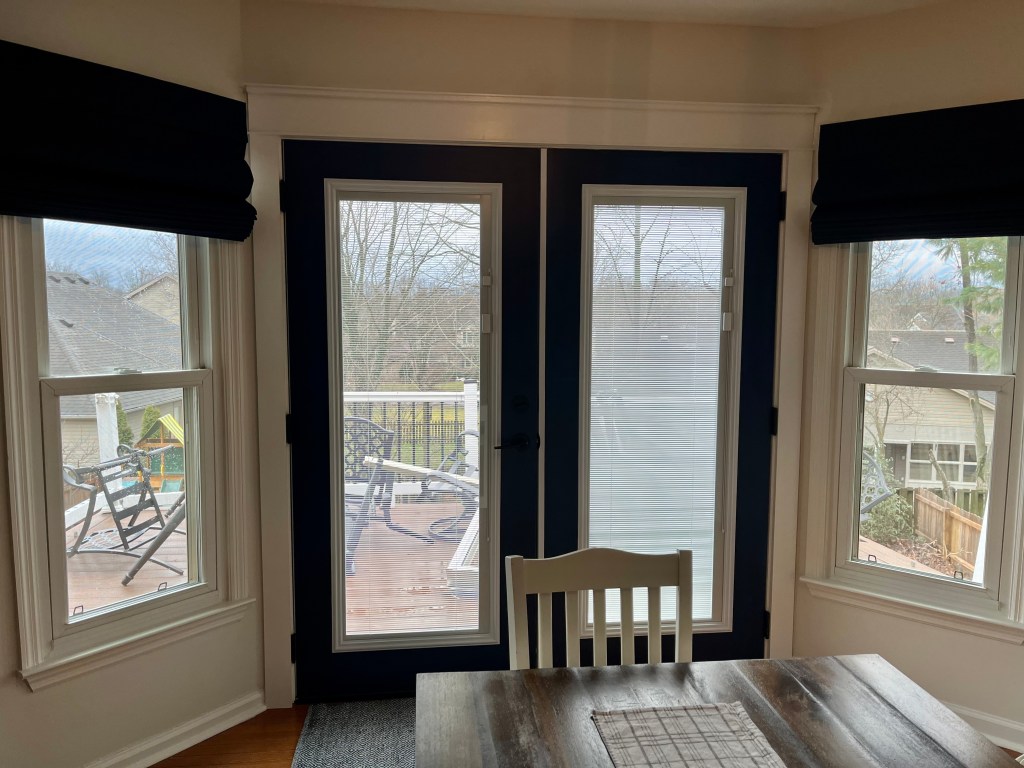
In my January financial update, I mentioned that we “somewhat on a whim” replaced our back door. I started to tell the story there, but I had more to share about the process and how we went about it.

We purchased our home in June 2022 with a sliding door out to the deck. This is the first house we’ve had with a slider. It’s not my preference, but it wasn’t worth putting any energy into.

Over the last year and a half, we’ve had trouble with it. The lock mechanism kept freezing on us, making it difficult to unlock the door to let the dog in and out. The door was also very heavy and/or hard to open. Our slider in the basement is much easier to move, but this one just wouldn’t budge without a lot of effort. On top of all that, there were vertical blinds over the door. I had no problem with how they looked. However, they weren’t installed correctly to begin with (the story of everything in this house, apparently), and the stick used to open and close them were on the wrong side. Then add in a one-year-old pulling on the blinds. Slats kept breaking, I was being blinding by the sun, and I was tired of fighting the baby to stop pulling at them.

In our Virginia home, we had a french door style (although one side was stationary) back door. Then in our last home, we had a regular back door, but there were blinds between the windows. That was my dream at this point: blinds between the glass so that they weren’t pulled or broken by kids, and a door instead of slider. I really didn’t want to hang curtains over the doors or manage blinds that get attached to the side of the door.

FINANCIALLY

We had a window company come out for a quote. He said that some work may need to be done to adjust the opening because it’s not a standard opening, but didn’t say much else. He went through all the details and finished out our meeting with a quote of $9,300. I can’t even begin to explain how that wasn’t even close to reasonable. He said it wasn’t a custom door and claimed that adding the blinds to the door was $2,100. No thanks.

The door I wanted was at Home Depot for $995. Seriously. It hit all the specs I wanted. The door was primed, not painted. To order the door painted white, it was going to be $2,200. I could paint the door myself for a lot less than $1,200. Both sides actually open, even though I was going to be happy with just one side opening.

I was hesitant to buy it because the window company made me feel like I had a custom opening. A few days later, my dad came to visit, so I asked him to measure the door. He confirmed that it is a standard size door. He said that before even measuring it, he knew it was going to be a standard opening because it would be way too much money to create a custom slider. He said I should get the door, and he’d help install it. I really only wanted the door measured. I planned on having our deck contractor install it, which he said he’d do for $500.

As I looked more into it, I was able to get the door scheduled for delivery for the next day for $79. By amazing luck, it was delivered at 9:30 am, meaning we could get to work right away.

INSTALLATION

The installation process was a lot more straight forward than I expected. It’s a job that requires heavy lifting and extra hands to hold things in place every now and then, but each step is logical.

My dad removed the interior moulding, and then he cut through any screws that were between the door frame and the house. We tipped the slider outward and moved it out of the way. We then cleaned out the opening, removing any extra foam insulation and sweeping out the sill. The next step was to put 3 caulk lines on the sill. The hardest part was keeping the kids and dog from stepping on this before the new door got moved into place. The door was then lined up on the bottom and tilted into place. A couple of screws were put in to hold it while we shimmed it.

The shimming process was time consuming, but it was straight forward. The screws went straight through the holes already in place for the hinges (one screw in each hinge was longer than the others so that it would hold the door in place). Once the screws were all in place, we then put spray foam around the door. It was important to keep an eye on the spray foam so that it wouldn’t creep out and attach (and stain) to the door.

The door that was removed didn’t have the brick mould on the exterior, so it sat further into the house. The door we installed did come with the brick mould, and my dad said it was best to keep it on. This meant that our gap between the floor and door frame was bigger than we’d prefer. My dad actually removed the last row of hardwood flooring (that had been ripped down to fit the original door) and installed a new, full row of flooring (we had some on hand in the basement). That was pretty impressive to me!

FINISHING TOUCHES

We could have used the moulding around the door that was already there, but I wanted to change the look of it. While I decided on the new look, it gave the spray foam almost 24 hours to expand and dry out before we cut it back. We cut it back and installed the moulding as I designed it. I painted the moulding, while deciding on the door color.

Everything around my house is a navy, even though I’m trying to push towards a black-and-white. The kitchen backsplash was navy when we bought it, the back of the living room bookshelves are navy, the dining room walls are navy, and all the roman shades are navy. I was afraid to pick a different color, so I went with navy on the doors. I used a metal-friendly paint to hopefully prevent chipping.

The door has moulding around the glass, with screws on the interior. The hardware bag should have included plugs for the screw holes, but it didn’t. I emailed the company asking for replacements, which they sent within 2 weeks.

COST BREAK DOWN

Door: $1,142
Paint: $22
Moulding: $71
Caulk: $14

Total tangible costs are ~$1,250. We then also bought my dad gifts to pay him for his services, knowing he wouldn’t take straight cash from us.


For now, I’m keeping the door navy. This picture only has 2 coats of the navy; I need to do the final coat with a roller. I think I’d prefer a lighter color on the door to compliment the navy, but also so you could see the black handle and black hinges I installed. I need more time to contemplate the change. Maybe once our deck is replaced (ignore the mangled deck railing and furniture that still hasn’t been replaced/fixed from the July 2nd storm where a tree fell on it) and the weather is nicer, I’ll have an epiphany moment. For now, I’m beyond thrilled with the replacement that was under $2000 for all of it.

Bathroom Renovation

We purchased a house in June 2022. Most of the house had been updated or was in good shape, but the master bathroom was the original from 1992. This isn’t a bad thing, but bathroom designs have changed a lot since that time. Aesthetically, the bathroom would have been fine. Functionally, I didn’t want to shower in a 2.5′ by 2.5′ shower stall, and the higher standard of vanity height is something I’ve gotten used to. The day we closed, we started gutting the bathroom.

BATHROOM EXPERIENCE

Our first ever renovation project was a bathroom that we gutted, redesigned, and rebuilt in our first home we owned, back in 2013. The house was a foreclosure, and it had been flipped by the bank. The place looked good, but it didn’t last. The bathroom shower tiles were cracking as soon as we moved in. We took walls down and rebuilt them because of mold, we moved the door to allow for a better vanity set up, and we moved the toilet so that you weren’t walking around the vanity to get to it. We had been quoted $25k for a contractor to do it. We spent $4k on materials.

Our last home was a new-build and had an unfinished basement with a bathroom rough-in. We had my dad’s help setting the plumbing, and then we finished it out ourselves. After we did the first bathroom, we said we wouldn’t do vertical tiling again. We really just learned not to use 12×12 tiles on the wall.

The bathroom cost us about $6k to complete. While everyone was being quoted $75k-120k for a finished basement with bathroom, we did almost all the work ourselves (dad’s help on bathroom and setting studs, hired a drywall finisher, and we didn’t lay our own flooring) for about $20k.

We also did a quick bathroom refresh in our current home. The basement bathroom here was forgotten. It hadn’t been cleaned or updated (most of the house had switches and outlets changed to white from yellow, but not this room). For less than $1,000, we laid a new floor, updated the trim, replaced the vanity and toilet, painted, updated the accessories and mirror, and replaced the switches and outlet. We didn’t touch the tub or the faucets in there.

BACKGROUND

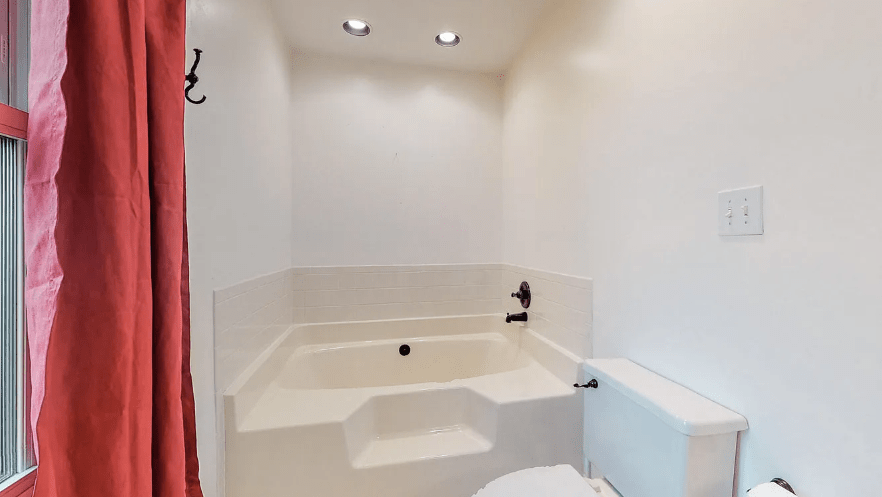
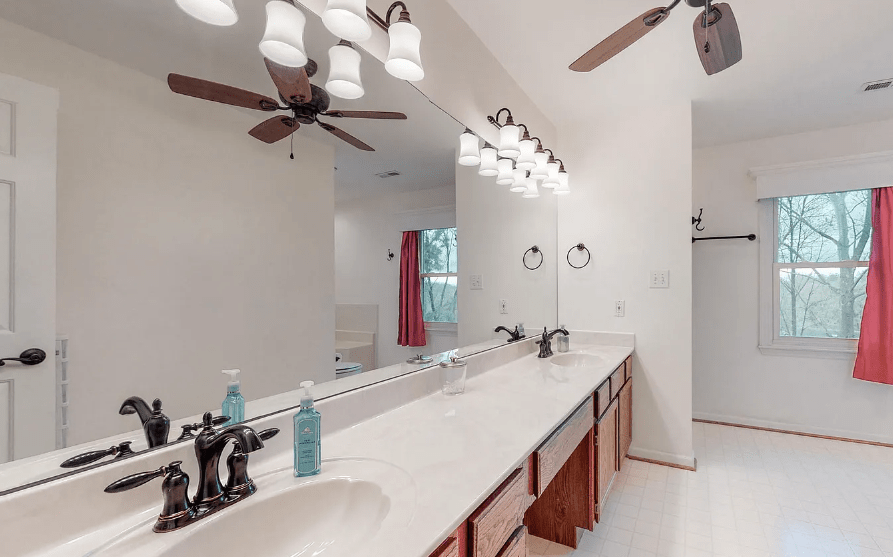
The bathroom was an L-shape. There was a 114″ vanity with a full length wall mirror over that. It also had 2 5-light wall mounted light fixtures over each sink (excessive!). Then the shower was your typical plastic molded shower stall with a frosted glass door. It was 2.5′ x 2.5′. Around the L was the toilet (awkward positioning, really), and beyond that was the soaking tub with built-in molded steps. Oh, and there was a ceiling fan over the vanity.

THE PLAN

We needed to take everything out so we could see our options. We gutted the bathroom pretty quickly, but we dragged our feet on the rebuild. It worked out in my favor though; I’ll come back to that.

The L-shape encompasses the master bedroom’s closet. It’s a walk-in closet, but it’s not spectacular. We tried to make a plan where we knocked down the closet walls and reconfigured the whole space, but the window placement hindered us, along with some of the desired sizes of fixtures. Once we gave up on incorporating the closet space, it was clear we just wanted to make the shower more functional.

As we started laying blue tape to map out the size of the shower, we realized we were hindered by the closet walls. If we made it too big, we lost the ability to walk around the L-shape comfortably. The whole point here was that we wanted a bigger shower. We settled on as wide as we could make it, while still being able to fit around the corner (generally looking at 3′ wide, which is standard hallway width).

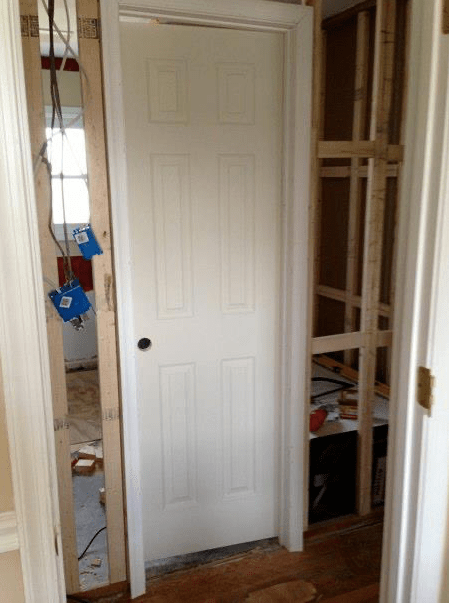
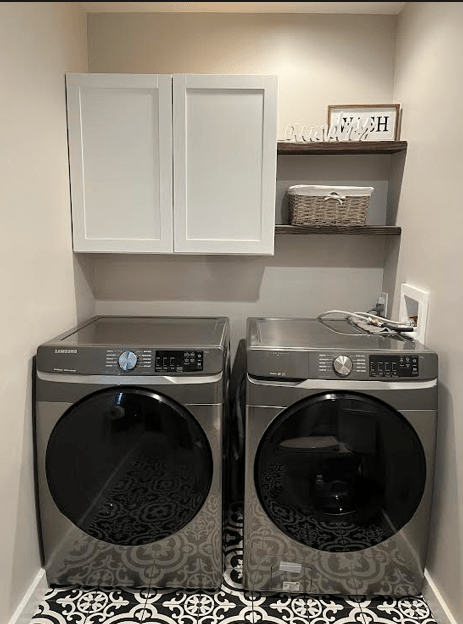
At the beginning, I mentioned that I wanted to washer and dryer moved from the garage entry. Mr. ODA said we’d do it “later.” But the walls were opened now… so why not now? He came around. We hired an electrician to move the dryer electric from the room off the garage, directly above it to our bedroom, and then up into the attic to move over and come down into the bathroom. That meant the width of the shower was now maxed at how wide our washer/dryer was to get through the hole.

We bought a waterproofing system to build the shower any size we wanted (versus a shower pan), and we ended up about 3.5′ x 5′. We dropped the vanity section to 7′, and dropped our lighting to 2 2-light fixtures. 🙂

We eventually will add glass to the shower area (there’s a curtain there for now). The master bathroom is the most infrequently cleaned area of my house (and I clean a lot!), so maintaining a glass shower enclosure that’s used daily is just not high on my priority list. Mr. ODA had built a shower bench for our last house’s shower, and by some miracle, it fit perfectly in this newly built shower. We also reused the floor tile option because we wanted a statement in here, but we were too scared to commit to a pattern and it not look right; we knew what this pattern looked like, so we kept it.

The plumbing for the washer and dryer was a concern. We were able to use the old tub’s drain to be the washer drain. We were also able to use the supply lines. However, since the supply lines were on an interior wall, and we were nervous about moving them to an exterior wall (so it would be behind the washing machine), we kept them there. The width of the room didn’t allow for clearance for the supply lines to be hidden down further, so the lines fall across the top of the washer. While not aesthetically great, everything else about this is so much more functional and makes me happy.

MUD ROOM

The washer and dryer moving to where the tub was in the master bathroom meant we could create a mud room. This was a really big deal to me. We park in the garage. Our garage door is basically always open and this is how people come and go. I wanted a functional space that wasn’t cramped by a washer and dryer that you were walking around.

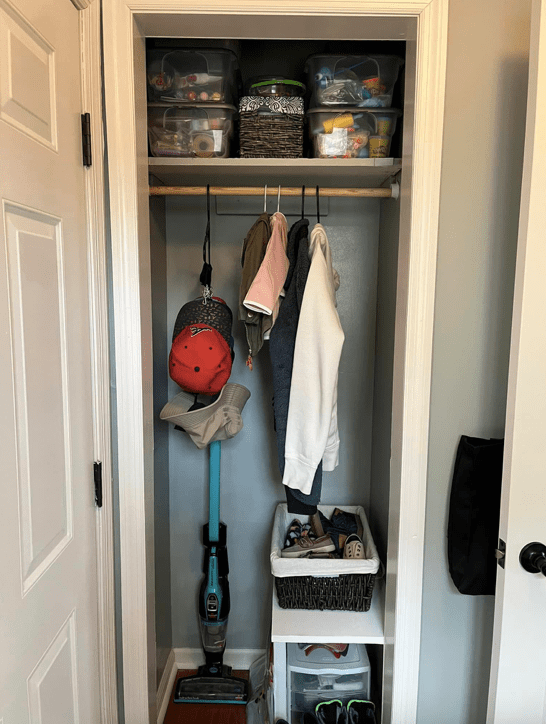
Additionally, the previous owner had changed the closet function to be 2 shelves. There was no hanging room for coats, and there was no storage for mops or vacuums on the first floor. We moved the middle-of-the-closet shelf to be a higher shelf, added the dowel so we could hang coats, and cut the bottom shelf in half to still allow for some storage options, but also allow for vacuum storage.

We’ve since added shelving over mini fridge, and there are bins for shoes in the cubbies. In our last house, we had a bar area in the basement where this fridge was. We had originally planned for it to be in the basement in our current house also, but we don’t spend as much time as we thought down there. It was a perfect fit to include it in the mud room and build the bench to incorporate it.

By moving the washer and dryer from this room (for our own labor and about $400 worth of an electrician), we made our house significantly more functional. As I grow older (and move an absurd amount of times), I’ve learned how much more important it is for my house to function.

SUMMARY

A quick facelift to a bathroom is a pretty easy project. Moving plumbing, electric, and walls creates a few more levels of difficulty. However, it’s not impossible. We’ve learned over the years that if we act as our own general contractor (hiring out piecemeal), we can save a lot of money. In this post-covid-world, contractor costs are high. If we hired out this entire bathroom, I don’t doubt that we could have been looking at $45-50k with all the things that were to be moved. Instead, it cost us about $5,000 worth of materials and our time.

Our time was definitely at a premium. We dragged our feet on decision making, while focusing on other areas of the house. The kids’ bathroom is directly outside our bedroom, so it wasn’t a hassle for us nor was there an immediate need for us to be back in our own bathroom. We got the floor tile down as fast as we could before we officially moved in, since our washer and dryer would need to be placed. That lit the fire for our toilet and vanity to be installed too. But the shower was a different story. We got it framed out, but didn’t start laying tile and grouting until after our 3rd was born. I thought I would feel better doing that work once I wasn’t pregnant anymore, but I didn’t factor in the baby needing to be help all day long, so that created quite a challenge. But we did it.

We gutted the bathroom in mid-June, and we had it completed done (well, except for the shower glass that I just don’t even want) by Christmas. While we took our time doing it, the best parts are how much more functional and comfortable the house is, and how it cost us about 10% of what it would have been if we hired it out.

Family Trip

We went on a trip to Indianapolis last month. We did more activities than we typically would have, so our spending was more than average.

The reason behind the trip was the Children’s Museum. We like visiting zoos around the country, so we used that to fill our other day there. The zoo was $91 for entry for 2 adults and 2 children, while our youngest was free. We had to pay for parking, bought lunch at the cafeteria, two kids rode the carousel, and we all rode the train; that came to $66.70 spent the day of our visit. The Children’s Museum was $90 for entry for the same group of us. It also had a carousel that we let the kids ride, I let them get a flattened penny (they used “their” $1 for it), and we bought lunch (parking in a parking garage was free); that came to an additional $35.88 spent on that day. The zoo’s meals were very reasonably priced, but the Children’s Museum’s meals were ridiculously expensive, so that free parking wasn’t exactly free.

We placed a grocery pick up order when we arrived, and that covered our breakfasts and dinners ($39.10, but we didn’t even use everything we purchased, so that’s inflated). We stopped at McDonald’s on the way there and as we left the city on the last day ($17.68). McDonald’s and Qdoba are sure fire ways to get our kids to eat and eat quickly, so they’re nice when we’re on the road.

On the first day, we went exploring the city. We had to pay to park in a parking garage, which was $5. On the last day, we did a Capitol tour and visited another museum (both of which were free), but we had to pay to park twice ($2.50).

We had booked an AirBnB for the trip. A series of events I won’t get into meant that we received a full refund from the originally booked location, had a coupon code for our inconvenience, and booked a new location right away. We ended up spending $574.32 for our lodging of 3 nights. We specifically didn’t book the cheapest place available because we wanted the comfort of multiple bedrooms for the kids. The two oldest can sleep together, but the youngest needs his own space so that it can be without a night light. We could have managed with two bedrooms because the youngest slept in the master closet, but I can never guarantee that there’s a closet big enough for a pack and play. This place had 4 bedrooms, but we didn’t use one of them. We also wanted a hot tub available, so Mr. ODA and I could hang out and watch tv after the kids went to bed. It’s an amenity we’ve grown fond of, and we even plan to purchase one for ourselves if our deck ever gets replaced.

In total, this trip cost us $922.18 (plus gas) for 3 nights away. This is a higher than normal 3-night trip for us, but we were ok with it since we hadn’t taken our usual amount of trips (newborn life). We could have planned ahead on our two big days to pack a lunch instead of buying there, but we chose the convenience of purchasing the meals over the potential savings, especially knowing that we weren’t spending anything outside the normal realm for our breakfasts (cereal) and dinners (easy, quick pasta meals). Although this wasn’t known at the time of booking, but it was once we started the activities, the concession from AirBnB more than covered our meals and extra activities on each day.

Our kids are 5, 3, and 10 months. The Children’s Museum was great for their ages. There were some exhibits for older kids that we bypassed. I thought the St Louis Science Museum was better at having interactive exhibits throughout (and is free!), but it didn’t mean that this place was bad. The zoo was nice too. There’s a lot of shade, which was appreciated on a very hot day, even in October. It felt smaller than the Cincinnati Zoo, which is where we usually go, but it was clean and the animal exhibits were nice. They had a lot of shows and “ranger talks” included with your admission too. There was a dolphin show that was included with admission that was significantly more than I would have ever expected as a free attraction!

The city of Indianapolis wasn’t great. We didn’t encounter a really nice area of the city; most of it is run down, and there was a lot of homeless downtown. It’s clear that there is a lot of updating underway, and that it’ll probably be a really cool place in a few years. I never felt unsafe, but it was noteworthy that we haven’t visited a city like this since Detroit (although we did find a nice place there, ironically).

All in all, we spent less than we originally projected. A 3 night trip where we were sufficiently entertained, but not overly exhausted (the kids got to bed on time!) for under $1000 was great.

Home Sale Proceeds

*This post was started in November 2022, but our son was born 3 weeks early (and on Thanksgiving), so it fell off my radar for a long time while I caught back up. Let’s dive in now.

We sold our primary home at the beginning of November to move a half hour away and closer to family. It was a new construction home, and we purposely sold when we did to avoid capital gains taxes. If you call it your primary residence for 2 of the last 5 years, you’re exempt from capital gains. Considering the market over the last two years (2020-2022), we were slated to owe a hefty penny if we sold before that 2 year mark.

Had we sold earlier or perhaps waited for the spring, we could have made more. Instead, we opted to be rid of the home, not try to rent, and be able to have that behind us. We were extremely fortunate that we were under contract by the end of the first weekend we listed. The market had cooled significantly from the multi-bid, exorbitant pricing, with appraisal waiving language days.

We only had 2 showings. The first politely let us know they wanted a walk-out basement. We had an amazing basement with 9′ ceilings and no soffits, but it didn’t have a door due to the floodplain. We don’t really understand why, but the backyard was definitely low enough for it to have been a walk out basement. It was one of the red flags that made me uncomfortable living there, along with a long delay for construction on our lot and a few around us due to extensive sink hole surveying. The second showing made us an offer 10k below asking. We sort of split the difference at $495k, and they accepted.

There were several houses listed in that neighborhood for weeks after we closed, that were listed the same weekend as us, so I am eternally grateful that the stars aligned for what we wanted/needed.

PROCEEDS CALCULATION

We purchased the home for $346,793 in November 2020. The contracted purchase price when we sold was $495,000, which was completed in November 2022. That’s a difference of $148,207, but that’s not “take away” money.

As the seller, you’re typically responsible for paying out the Realtor commissions. They’re typically 6%. We asked our Realtor if she would drop it to 5% (buyers agent gets 3%, sellers agent gets 2%) since we had drawn up our purchase contract sight unseen and this was the 4th commission based transaction she had from us in less than 2 years. She agreed. I truly don’t like asking someone to take a lower commission, but due to there being several transactions in a short period of time, many not even needing much effort (showings, phone calls, etc.), I accepted Mr. ODA’s plea to ask. That comes to $24,750 paid in Realtor commissions.

We then have to pay off any loans that used that property as collateral. We had a mortgage and a Home Equity Line of Credit (HELOC). We had put 20% down on the purchase, so the mortgage had about $266k left as the balance. The HELOC had been used for a couple of other things than just the down payment on a new home, and it didn’t require principal payments on it while we had it, so that balance was about $86k.

We walked away from the closing table with about $117,000 after tax offsets and such.

PAST DETERMINATIONS FOR WHAT TO DO WITH THE PROCEEDS

In July 2012, we purchased our first home for $380,000. We put 20% down; it was a foreclosure, but the only work we had to do was on the main floor bathroom. When we sold that home Fairfax, VA for $442,500 in October 2015, we paid off a car loan and bought our second two rental properties in Richmond, VA. The car loan was only at 0.9% interest, so it didn’t meet Mr. ODA’s requirements to pay down loans with higher interest rates, but it did alleviate one monthly payment I had to manage. The irony of that statement, now that I manage 14 houses worth of payments all year. We also used those proceeds to put 20% down on the purchase of a new primary home outside of Richmond, which had a purchase price of $359,743. We paid off House1’s mortgage because the loan had a balloon payment that we needed to be ahead of.

When we sold that Richmond home for $399,000 in September 2020, we took about $109k away. We used those proceeds to put 20% down on the purchase of our new home, at $346,793, outside of Lexington, KY. We paid off House4, House6, and House13. Since paying towards a mortgage and not paying it off doesn’t change your monthly cash flow, we focused on where we could eliminate a mortgage payment. We’ve since paid off House11 and House12. House12 had a high interest rate, so we were interested in eliminating that as fast as possible, even though we were paying for it with a partner.

WHERE DID THE MONEY GO THIS TIME

We purchased our current primary home last summer and put work into it. Since we purchased it before selling our house, we used a HELOC to pay for the down payment. That meant that when we walked away from the closing table, the money we were putting in our bank account had no distinct purpose (like in the previous cases where we had to use some of the sale proceeds to buy another primary house).

The first thing we did was open a high yield savings account. At the time, it was necessary because our savings account wasn’t paying market rate. I remember Mr. ODA complaining that interest rates on loans were increasing, but it wasn’t being shown on savings interest side. He found a high yield savings account that gave a sign on bonus (we like that ‘free’ money!). We put $50,000 into that account, earning over 4% interest. The money in that account was removed and put into our regular savings account, which is now earning over 4%.

Since the money didn’t have a purpose, we needed to get it into the market. If we put it all in the market at once, then we’re subject to a lot more fluctuation. To hedge our volatility, we planned to schedule regular investments. It seemed crazy to me, but our financial advisor and Mr. ODA decided on $5,000 per week. That would take 20 weeks to accomplish. To my chagrin, this was set up as an auto transfer. Even with a large balance sitting in the account, it didn’t hurt any less watching $5,000 every week be taken out. This plan didn’t last long though because Mr. ODA found Treasury accounts that act as short term certificates of deposit. My next post will go into this in more detail.

Not an immediate need, and we didn’t rush to buy something for the sake of buying it, but we earmarked about $20k for the purchase of a new van. I love the van we bought in 2019 (which was a used 2017), but it had a few kinks in it. I also felt pretty good about the deal I got on it. However, I didn’t put the time into test driving and looking at this van that I really should have because one of us had to stay in the show room with the kids while the other went for a drive. I also know what I’m looking for in a used car now (that was our first used car experience), versus buying a brand new car that hadn’t been driven by others. It helped that I was looking to buy the same exact van, just newer, so I know how it’s supposed to work and what to test. We ended up finding a van about 2 hours away from us in early 2023. We’re almost a year into this van, and I absolutely love it.

In the back of our minds, we’re still looking for another rental property. There’s an area in town near us that would work for short term rentals, which I’d like to dabble in. We have seriously considered a few, but interest rates have shot it down. A 1500 square foot house, with a $200,000 mortgage, comes to a monthly payment (of just principal and interest) of about $1,400. That’s just not good margins with such high interest on it. We’ll keep an open mind, but so far it isn’t panning out.

SUMMARY

Our savings account is currently earning 4.22%. Mr. ODA is also managing that balance by using the short-term Treasury bills. Since we started with the Treasury bills, we’ve made about $500, which is on top of the interest we’ve earned to date on the savings account, which is over $1600.

We started off with paying the mortgage that had a balloon payment. It was a commercial type loan, so it was amortized over 30 years, but was really only a 5 year loan. We decided to pay it off instead of re-mortgaging it at the end of the 5 years. After we took care of the balloon payment approaching, we started paying off mortgages where we could eliminate a payment (we had multiple houses with $30-60k worth of a balance), and then moved onto paying off high interest rate mortgages (for reference, a high interest rate was 5% … which is much different than today’s mortgage rates being “good” at 7.5%). We went through the process to refinance several mortgages, so we’re at a point where we’re happy with the mortgages that are left. If we wanted 100% cash flow, we’d start paying towards principal balances. However, we don’t feel that’s necessary for our current situation. We have 6 mortgages left (including our personal residence) out of 14 houses.

We definitely are more hands on with our money management than most people are going to be interested in. Now that we’re happy with our mortgage situation, we are focused on the interest side of our money working for us. With multiple Treasury bills that are reinvested for short periods of time (4 week and 8 week bills), then we’re able to earn quick interest while we don’t have a purpose for that money.

One of our houses has a balloon payment again (commercial loan). That will come due in about 3.5 years. Considering what current interest rates are, it doesn’t appear that refinancing is as enticing as just paying off the balance or selling the house. We’ll have to keep that in mind as we work on investments and having enough liquid cash over the coming years, because that loan’s balance is going to be about $173k at the end of the 5 year term.

For now, we’re in a good money management state with several short term bills and a savings account rate over 4%.

Roofing Lesson

Today’s post is going to be short and sweet. Well, that’s how I think to start every thought I have to share, and it turns into a novel with research and ‘citations.’ Let’s see how this goes. Update: It’s long, there’s a legal citation, and I ‘teach’ math. Sorry. 😛

We have two houses with flat roofs. They’re a pain. They always seem to leak, and no one wants to work on them.


In 2019, we had issues with a house that had an internal ice dam and gutter system, in addition to a flat roof over an extension. Water kept leaking in the kitchen. After two years of issues, we finally had a roofer respond to our request for help on a flat roof. As soon as a roofer hears “flat roof,” they seem to shut down and say they don’t work on flat roofs. Here was the quote.

So we had this work done for $1,900, and we haven’t heard about the roof since.


We have another house where there was a flat roof added to an addition. In 2017, we had a roofer replace the roof. Somewhere, something was lost in translation of the job. We thought he’d address the flat roof and fix it, incorporating it into the main roof line. He finished the job, and it was clear that was not part of the scope as we thought, even though that was the whole reason we called him out. He simply said “I don’t work on flat roofs.” That wasn’t clear when we asked you to give us a quote, and how do you just ignore that there’s another roof line as a roofer?

The more we spent time and money on this roof, the more it came to light what happened. It appears that there was a deck that eventually was covered with a corrugated metal sheet. Then someone decided they wanted a laundry room, so they built a laundry room under this metal sheet. The roof line wasn’t properly insulated from water infiltration. We had several issues of water leaking into the laundry room. Mr. ODA put silicone and caulk along the roofline as a stopgap because roofers weren’t acknowledging us. We thought we had fixed it, and I had put a lot of effort into fixing the wet drywall and repainting the room. After two years, the silicone finally gave way.

Our property manager was able to get 3-4 roofers to come look at the job, but only 2 gave us a quote (why is it a norm to just ghost customers and not have the decency to close the loop and say you don’t want the job?). One of the contractors didn’t appear to understand the job, and that concerned me. He seemed to want to redo the entire roof, and that was definitely not in our finances for this house because we replaced the roof 3 years ago. Then he also suggested a ‘TPO roof’ for the flat roof. I don’t know what that is, and I didn’t like that the explanation to me started with “it’s a flat roof that…” No. I’m done with “flat.” Did I give it a fair chance? No. Do I care? No. I wanted a pitched roof line. This is important for later in the story.

I had several concerns about the other roofer’s estimate, but they were less fundamental (or so I thought). First, I was concerned about the terminology being used as a porch. Perhaps it’s just me, but I call the open-air overhang on the front of the house the porch, and the open-air part attached to the back of the house a deck. I was concerned that the terminology “pitched roof” was not explicit enough to our end goal. I questioned that his removal of the corrugated metal roof would leave the deck exposed, so the gutters would need to be rerouted and added. I also questioned about how he was going to cover the sides once the pitch was created – would it be just painted or would it be sided, and if sided, how would he match it to look right.

I had my property manager call him, I called him, and I emailed him, but I received no response. I was trying to confirm the scope of work. Mr. ODA told me that these contractors are good at their job, but not good at the administrative side, so just let it go. I was an auditor; accurate documentation for a job is important to me. 🙂

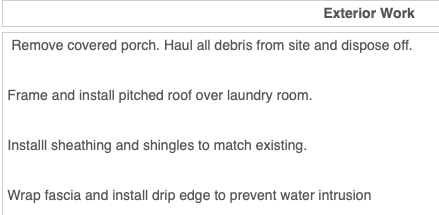
Here’s how it was written:

I decided to try to be easy going. There was a space for comments when I accepted the proposal. I added: I’m accepting this estimate based on the verbal agreement with [property manager] that the scope of work is confirmed as removing the flat roof over the DECK and laundry room (not sure ‘porch’ terminology), that the deck won’t be covered again and a lean-to roof will be put over the laundry room, and that all gutter systems will be appropriately rerouted to divert water from the house.

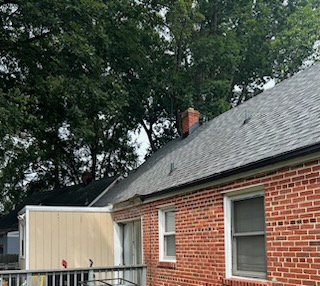
He gave me the quote on June 23rd. I accepted this work on July 5th. He kept delaying us. He would say “I’m going to get the materials today, so we’ll be there tomorrow.” Tomorrow never came. On August 25, he said he was going to 100% start the following Monday and be done by Wednesday. He finally called on Wednesday, and he said, “I got my guys out there today. I decided to do a TPO roof instead.” You’re kidding me, right? He kept pushing that it’s a “better” roof than a pitched roof, and I should be ok with it. Except, I signed a contract. The contract did not say their job was to install a TPO roof. I said that was unacceptable and I wanted a pitched roof. Here’s the picture that I received at that point. It looks really flat to me, and it has the point where it meets the main house still below the roof line (although you probably can’t tell there as well here).

On September 5th, he said they should be out the following day to finish it as a pitched roof. It took until September 11th for us to be told that the roof was done. As you can see, the gutters were not addressed. Luckily he said he’d get right out to fix that, and he did, which was appreciated.

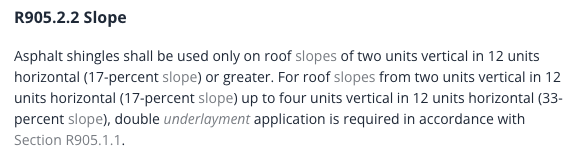
While you can see that there has been a slight pitch added, it is not a sufficient pitch as required for asphalt shingles. Did I know there was a minimum slope requirement for asphalt shingles before September? Nope. But you bet I read up on it and figured it out as fast as I could. Nearly all manufacturers of asphalt shingles have a minimum requirement of a 2:12 slope. On top of that, Virginia Code has the same slope requirement.

This means that for every foot, the rise of the tallest point must be twice that in inches. A 7 foot long distance from the top of the pitch to the outer wall requires a 14 inch rise at the tallest point. That’s the simplest way I’ve been able to describe it.

While the connection point in the second try is above the wall/roof intersection, and it may have been ‘fine,’ I wasn’t here to spend $3,800 on “fine.” He kept pushing that he guarantees his work for 5 years. He also pointed out that a tropical storm was on its way that coming weekend, so it would essentially be a good stress test. So, he was asking me to pay him for a job that was “good enough” and hope that if there was a problem, he’d come back and fix it. No thanks.

He got up on the roof, held up a piece of metal (with no level), and claimed that his zoomed in distance was 2″ off the roof, so it was 2:12. Once I finally got to the point of saying, “what’s the distance from the house?” He said 7′. I said “so the rise has to be double that, so 14″. Is it 14″?” He said no and that he’d fix it. He finally got it done last week. He took pictures along the way to prove that he did the job correctly since I called him on not doing it correctly (or let’s just do the work right to begin with instead of hoping a homeowner won’t question it – where’s integrity these days).


All that was to share that you should do your due diligence when hiring contractors. Don’t assume that they’re going to do the right thing because they’re probably going to assume you’re not well-educated in their field. By no means am I a roofing expert at this point, but I appreciate knowing something new. I just wish I didn’t have to learn things quickly in order to protect my ‘investments.’ So now you also know that there are manufacturer requirements, in addition to your expected state-wide requirements in most fields. Take the time to be educated just enough or have someone you can trust to point out where it went wrong. In this case, I said “that doesn’t look like what I expected,” and I had our handyman look at it. He said the pitch isn’t enough, and that’s where I learned that there are minimum slope requirements. It’s hard because I didn’t know what I didn’t know, but I appreciated having other trusted people to bounce questions off of.

Late Rent

Rent is due on the 1st of every month. There’s a grace period until the 5th. (Aside: I find it frustrating when someone says to me “rent is due on the 5th”) At 12:00 am on the 6th, rent is considered late. At that point in time, there’s a late fee applied to the amount owed. Typically, the late fee is 10% of the monthly rent. If your rent is $1000, then your late fee is $100. Legally, with no rent paid by the end of the day on the 5th, I can send a “notice of default” letter. This letter states that you have a certain amount of days (varies by state and/or local law) to pay rent, or I’ll file for eviction. Rarely, do I get to this point.

LATE FEES

There are two schools of thought (well, maybe more, but these are the main two I’ve dealt with). First, a late fee is free money. We had a handyman who was showing us a portfolio of houses say, “go ahead and let them be late; that just means more money for you.” Second, I wasn’t planning any of my finances on collecting late fees, so why collect them? This is the one I follow most of the time.

Sometimes, I feel that a late fee is a lesson. I typically follow through on charging a late fee if I had to “hunt” someone down to pay their rent or if they’re perpetually late and ignore that a late fee is owed when late.

RENT INCOME MANAGEMENT

I have 13 rental properties to manage. Each month, I record all the rent I collected with the date it was collected. I then do a simple “SUMIF” function in Excel to add up all the rent collected and attributed to each month, which I then compare to the total amount of rent I expected to collect for the month. This is how I manage who has paid and who hasn’t, and whether anyone is owed a letter of default (a letter stating rent is late, and if it’s not paid in X amount of days, I’ll file for eviction). I’ve had two tenants who were regularly late with zero communication, so I automatically sent the letter first thing on the 6th. More often, I have tenants who tell me that they’ve had some struggle, and they
1) Request a delay in rent payment;
2) Share their plan to get caught up (e.g., I’ll be able to pay $600 today, and then I’ll pay the remainder on Friday); and
3) Offer an apology.

If you communicate with me before the 6th, there is a 0% chance that I’ll be sending a “notice of default” or filing for eviction. Now, if you say you’ll pay by the 10th, and then you don’t pay and there’s no communication, then there would be a letter at that point.

If you communicate with me before the 6th, you’re not typically late with rent, and you have a plan to get caught up, I won’t charge the late fee. I have a chance to make someone’s day. In their head, I’ve “saved” them money at that point. Nearly all of my tenants are living paycheck to paycheck. If they’re late, that means they’re already worried and juggling bills. I don’t want to saddle them with another $100+ worth of a bill.

With that said, there are times that I stick to the late fee. I have a tenant who didn’t communicate up front, and then still had to be asked when we should expect payment. I held tight to a late fee on that one. I want it to be known that there are consequences. I can ease up on any future need for a late fee, but I’m setting a precedent there. If you don’t communicate nor pay rent, there’s a hefty consequence. In this case, it was $160.

THIS MONTH’S LATE PAYMENTS

Note that the 1st fell on a Friday. In these cases, I expect to see rent paid very timely. When the 5th falls on a Friday, then I expect to get the majority of my rent on the 5th. If the 6th is the 1st Friday, then I expect to receive a higher-than-average amount of late payments, and don’t charge late fees.

As I mentioned, I have 13 rental properties.
– I had 5 houses pay all or partial rent before the 1st of September (this is very unusual).
– I had 2 houses pay full rent on the 1st, and 2 of those who had prepaid rent paid the rest owed.
– I had 1 house pay full rent on the 3rd.
– I had 2 houses pay full rent on the 5th.
– I had 1 house pay partial on the 5th, with the intent to pay the rest on the 9th.

That leaves 2 houses that haven’t paid anything.

Here are texts or emails I’ve received.

  1. Good morning! We had a change in pay dates which of course affects everything. Can I pay $750 today and the remaining $1000 on Friday? What will the late fee be?
  2. I hope you’re doing well. I was wondering would it be okay if I paid rent on the 8th? …doc appointments have been a little more pricey than anticipated.
  3. Good evening, Sept 5th rent will be a few days late. We will have it to you on Friday 9/8/23 along with the late fee. Sorry for the inconvenience.

For the first two, I won’t charge a late fee. In #1, I let her know that it wouldn’t be an issue. I appreciated the advanced notice. She’s been late once before over 17 months, so it’s not a common occurrence. In #2, she’s been late once or twice before, but has always communicated well and is taking care of the house. I note though that I don’t expect tenants to share personal, health related information with me, but this is typical conversation with this tenant.

In the 3rd, this tenant will pay the late fee. Notwithstanding the “Sept 5th rent” part ;-), this tenant is routinely late. We’ve made excellent progress in the communication side of things though. Now I get an email that lets me know when rent will be late. Their routine late payments led us to change their lease set up. Their lease was $1450 per month. We offered them the chance to pay twice per month, $750 each. This would allow them to pay more related to their paychecks. Yet 5 of this year’s 17 payments owed are still late. They don’t take care of the property, and they don’t communicate well. We attempted to remove them from the house by drastically increasing their rent, but they accepted the increase. Since the change to rent being owed twice a month, their late fee is only $75 per late payment, instead of the $145 it could have been if they couldn’t pay every month in full.

SUMMARY

The original point of this post was to share that having multiple properties provides a luxury to allow for late rent payments without the collection of late fees. Outside of any abnormal maintenance charges, I owe 5 mortgages each month, totaling over $4,600, and property management fees worth over $700. I need 5 of 13 houses to pay their rent for me to cover those expenses. Note that this doesn’t mean the remaining 8 houses are all income for me; I still have other expenses in property management each month.

If you have to pay rent late, your landlord will appreciate anything you can put towards rent at that point in time. I shared with a tenant once that if they could pay something, that’s better than nothing because I still have a mortgage to pay, even when they don’t pay rent.

Understand that there are due dates and consequences for missing due dates all over life. If you don’t pay your mortgage by the due date, there’s a fee. There may even be larger consequences like losing a promotional rate. Similar with a credit card. There is interest accrued on credit card balances, late fees for lack of timely minimum payment, and the possibility of losing any promotional opportunities given.

Charging a late fee is completely within my legal ability, but I also understand that issues come up and that my tenants are humans. I’m not here to take advantage of them, so if I can “throw a bone,” I like to be that bright light in their day, especially when they were probably so timid about even sending the notice that they’d have to be late.

House 2 Turnover & Flooding

This is long; I understand. It’s a detail account of our experience dealing with a catastrophic event and navigating the insurance process and tenants.


Over the winter, I received a call from one of my tenants letting me know that water was pouring out of the house next door (that’s also ours). The tenants had turned off the heat… when it was 6 degrees for 3 days straight. The water heater is in the attic and a pipe cracked during the freeze. When it started to thaw, the constant water running filled up the house. Our property manager went to the house and found two inches of water throughout the entire house, along with a collapsed ceiling in the master bathroom. Over the next two days, the ceiling in the adjacent laundry room and the master bedroom also collapsed. 

We took immediate action on the water remediation process. The clean up company had to put several fans throughout the house and crawl space after sucking out the standing water. The next step was to purge the damaged drywall, insulation, cabinetry, flooring, etc. However, the tenant was in our way.

TENANT ACTION

The tenant’s renters insurance was responsible for removing their belongings. They created quite the speed bump, and the tenant’s items weren’t removed for 5 weeks. FIVE! The insurance company [supposedly] was requiring the use of a specific moving and storage company, who had no availability. Eventually, the tenant had the insurance company agree to them removing their own belongings to begin moving forward. They finally got their belongings out a week or so after that process started.

When we started going through the process of remediation, the tenant asked to speak with us over their concerns regarding mold. We refused because we have a property manager, and the relationship is between her and the tenant. We asked them to write us an email expressing their concerns, and we’d respond to that. They didn’t write the email. We told the property manager to relay the message that we want the house restored back to the condition (or better) that we kept the house in, and we have no expertise in this area, which is why we hired a remediation company to handle it, and I’m to trust that they do their jobs correctly to dry out the house. After that message, they didn’t push any further on the subject.

There was a nuance in the lease that if there was a catastrophic event, the tenant could choose to be let go from the lease agreement with 14 days; after that timeframe, they’re still considered responsible for the lease. The tenant read this and wrote us an email to enact it about 6 weeks after the event. Technically, we could have held them to their responsibility. However, there wouldn’t have been anything good to come from that. The tenant went from being understanding to quickly being nasty and unreasonable; it was best to cut ties.

We had told them not to turn off any electric (they were worried that water and electric don’t mix, so they shouldn’t keep the electric on; we shared that we need the house kept a reasonable temperature, so that’s not the right answer). However, they did turn off the electric shortly after that conversation. They ended up not getting their security deposit back to cover the utilities incurred and lost rent for their lack of payment through their notice. We also charged them for leaving the refrigerator in poor condition and us needing to get extra cleaning for that (which didn’t work and we ended up needing to replace it, but that wasn’t within enough time for us to know before the security deposit notification was due).

REMEDIATION CONTRACTOR

We hired a company to come out and dry out the space right away. I don’t know the details of this process because I trusted the company to know what needed to happen. They sucked up the water and put big fans throughout the house and crawl space to dry everything out. Their process was at least a week long.

They submitted their bill and dry logs to the insurance company for about $22k. The insurance company rejected their process and everything they did, and they agreed to pay out about $16k. The contractor balked at it, but we said we didn’t know how to help, and he had to speak to the insurance agent himself. They went back and forth for weeks. The contractor submitted a new invoice for $25k (why more than what it was originally?!). The insurance company eventually agreed to their $22k figure.

I tried to pay him in July for work done in January (that’s how long it took!). My bill pay system flagged the check because of the amount, but never told me. They claim it was quickly released and delivered as expected and on time, but the company never received it. I had my bank place a stop payment on it. Then I went to the bank to get a cashier’s check and mailed that to the company. That was 3 weeks ago, so I’m assuming he got the check since I haven’t heard from him.

REBUILD CONTRACTOR

We received three quotes for cleaning out the damage and rebuilding those parts of the house. None of the quotes were close to what the insurance adjuster gave us as an estimate. One of the three companies that gave us a quote asked to speak to our insurance company. They went through all the line items, and the insurance adjuster agreed to the contractor’s price for the work, which was about a $6k difference. 

The initial contract with this company required 50% of the estimate up front. However, we didn’t feel comfortable handing over $25k. I spoke to the contractor, and he agreed to three payments. Their first payment was allowed via credit card, so we were able to capture $340 worth of credit card rewards on that $17,000 purchase. The second $17,000 was due upon flooring completion, and it had to be paid via check. The final amount was due upon substantial completion.

I spoke to the contractor about the vinyl floor in the bathrooms, and he actually said they’d be willing to lay the luxury vinyl plank for the rest of the house through the bathrooms also. While I’m sure it cost them less to handle such a change, it was nice that he didn’t charge us for a contract adjustment.

Once the contract was executed, we had to pick out all the replacement things. This sounded overwhelming, but it was pretty straight forward! I only had to tell him the paint color I wanted, and then pick out the cabinets and flooring. I went with a white cabinet for the lowers in the kitchen and the bathrooms. The upper cabinets in the kitchen are a brown, but I wanted to “upgrade” where I could instead of trying to match the existing. I figure eventually the upgrades will come if we ever want to sell, so I may as well do it nicely now and only have to change a few things down the road.

There were a few more selections during the process – little things like knobs and light fixtures. Again, I chose nice light fixtures, even if they didn’t match the brass that was already in the house.

There were some hiccups along the way. They painted the house the wrong color. I specifically discussed changing the color from the what was there since the whole house was being painted. The original house was built with brown carpet and yellow walls. We kept it the same color all along because we didn’t want to go through the effort of changing it (cutting in, two coats, etc.). This was our chance to change it to the color we’re using on our houses to make it more consistent. With a grayish floor, it worked better to have a light green than a yellow anyway. They also threw away our bathroom vanity counter tops, so they had to replace those at no charge to us because they were supposed to be salvaged.

All in all, everything went well with the contractors.

OTHER REPAIR WORK

Our previous tenant had burned the kitchen countertop. We decided to just keep the burnt counter and re-rent it for the time being (we didn’t have a good amount of time to add another contractor into the mess we were cleaning up at that time). Well, with the bottom cabinets needing to be replaced, here was an opportunity to replace the counter. I asked the rebuild contractor what he could charge. He was going to charge over $2k to replace the two bathroom counters and the kitchen counter.

He made the mistake of giving me the link to the countertop he would use for the bathrooms. It was $119. He charged $221.50. He also had a labor charge, plus a 10% charge for overhead, plus a 10% charge for profit. Once I saw all those details, I was put off. We said we’d just keep the bathroom counters and sinks – they were cultured marble, so they were fine, just more yellow than white. Then his guys ended up throwing away our counters by accident, and we ended up getting new bathroom countertops and sinks anyway for no charge to us.

We asked our handyman if he could do kitchen counters. He was able to get the new countertop installed and the sink set for under $500.

INSURANCE COMPANY

Our insurance company was actually really difficult to work with. They were willing to hand out money, but they weren’t there to communicate. Several voicemails and emails were left unanswered. Sometimes we’d get a random email that would say “I put a check in the mail,” but mostly, we just kept making phone calls that went nowhere.

Depreciation

As someone who worked in finance, the term depreciation makes no sense to me. The insurance company kept about $6k of our total amount they agreed to pay on the estimate. Once all the work was completed, we provided receipts of the work, and they paid out the rest of the estimate.

Because we had the rebuild contractor not do some of the activities from the original estimate (the washer and dryer were thrown away, so they weren’t hooked back up), or we had our handyman handle some of the items because they weren’t getting done (hooking up the dishwasher), the final estimate was lower than the original amount. Then I included the invoice from our handyman for the work that he accomplished. The total between these two invoices ended up being more than the original estimate from the rebuild contractor, which I expected was our loss, but the insurance company actually paid out on it.

Lost Rent

The insurance policy covered the lost rent for our vacancy. They took our lease agreement, determined the per diem amount, and then agreed to cover until the work was completed. There was a disagreement on when the work would be completed (they took a date off some paperwork that we had never seen, while we were told by the rebuild contractor that he’d be done by April 20th). Once we got that sorted, they sent us a check to cover all of March and most of April. We were able to get the house rented at the end of April, so it was only truly considered vacant for 3 days of the year, which I find impressive.

Utilities

The tenant turned off the electricity about a week after the incident (although we told him not to). Luckily, I have a program set up where the utilities aren’t actually ever turned off, but they’re reverted back to my name. We submitted receipts to the insurance company, who agreed to pay the excess amount of charges due to the house being open to the elements (missing ceiling and insulation). Their calculation was based on an average of bill total. Mr. ODA is a math wizard and didn’t accept that. He performed a calculation that equated to an average daily use of electricity, along with separating out the bills by days (because one of the bills was half a month of normal activity and half with the house open). The insurance agent said he wasn’t going to fight us over $50, so he just sent it to us. It was an interesting statement, considering all the calculations Mr. ODA did was in the original submission, and he decided to do his own math instead of accepting what Mr. ODA had said in the original email (granted, looking back, he may have never even read the email because that was the norm).

The water was turned off at the street when the initial report of an issue came in. Once everything was dried out and we had the pipe repaired (a $350 activity caused tens of thousands of dollars worth of damage .. gosh), we needed the water turned back on. That was a horrific process with the City of Richmond that ended with me screaming at a lady on the phone in some random street in my neighborhood during a walk. In order to speak to the City, you have to wait on hold for at least an hour; you can’t schedule water to be turned on via an online account. So after waiting 90 minutes for the first time to get it scheduled and being told no one needed to be home, they showed up, no one was home, and they left. There was no notice. No phone call. No voicemail. No email. No note on the door that they were there and tried to get in touch with us. Nothing. I was livid. So I called again. I waited over an hour. Then the woman who answered was very much not helpful. The conversation went quite poorly. I yelled, she wouldn’t give me a supervisor. Horrific. I finally got a new time scheduled for days out (and their window was 8 am to 5 pm – a lot of anger for that). They unlocked whatever it was that needed to be unlocked and our contractor handled it from there because it was done so poorly in the scheduling sense.

NEW TENANT

We actually struggled to find a new tenant. We were able to list it while the final clean up was happening. We had a lot of interest, but not a lot of people qualified. A neighbor had watched the rebuild happen, and she wanted the house. She didn’t qualify. And instead of accepting that information (and we’re pretty lenient), she started threatening us for not selecting her. Our initial choice fell through – and that’s why you should always be nice. She may have been a runner up, but she squandered all opportunities because of the way she handled herself and treated us. The new tenant was able to move in at the end of April. At the time that she moved in, she had two jobs. Unfortunately, she was laid off unexpectedly in June from one of the jobs, so she has struggled to pay rent in July and August. I’m understanding, but I didn’t appreciate that we had to ask where the rest of rent was and she didn’t send the late fee. Again, I’m lenient and understanding, if you’re nice. We had another tenant say that she needed another week to pay August rent because sickness kept her out of work, and I had no problem with that and waived the late fee. She told me up front; I didn’t need to go asking questions and wait all day for a response.

The new tenant did complain upon move in that the house wasn’t clean. We knew that may be an issue. The contractor’s cleaners didn’t do a great job, but the house was generally clean. The new tenant did mention that there was just a little too much dirt from the renovation to be acceptable, so we hired a cleaner to come in and get it done. Other than that, we haven’t had any maintenance requests or complaints from her.


For how big of an issue this was, I’m impressed by how easy it felt to come out the other side. We were lucky to have insurance cover lost rent and expenses, and they didn’t give us a hard time on nearly anything (we’re currently trying to manage a claim on our own how that is far from easy). We were able to re-rent the house for $150 more than it had been rented at. So while we had the house vacant and being worked on for 4 months, it really wasn’t too bad.

Rental Work

We’ve owned rentals since February 2016. There have always been ebbs and flows on action needed by me to manage the rentals. Until this year. Suddenly we’re having a regular influx of maintenance needs; some are small like a leaking tub, while some are big like a tree falling on a house. So here’s the update of actions we’ve taken in 2023, with costs for each job (which is something I used to do and haven’t been on top of).

House 1

Roof Repairs

A wind storm came through at the beginning of March and caused extensive damage. There were shingles missing from this townhouse’s roof. The last update was that the roof was being repaired at the end of June, but I haven’t been by to see that yet. This is $0 to us, as our HOA insurance for the townhomes cover it.

Plumbing

The tenant called to complain that the tub in their second bathroom no longer would let hot water out. Hot water was coming out of the sink in that bathroom. I called a plumber, and he said it was going to be $600 to change the cartridge. Considering we’ve done two bathrooms and I had to buy a cartridge, I know that the cartridge is somewhere around $100. I called Mr. ODA while this man was in the house with the quote, and he agreed that was a crazy uncharge and labor charge. The man standing in the bathroom agreed with me and didn’t even charge me for the service call. ha! I called another company, and he came out to change out the cartridge for $245.

House 2

Burst Pipe

At the end of December, a pipe burst and the house flooded. This sounds like a really big deal. But it turns out, this big of a problem is handled relatively easily since insurance is covering the expense and there are companies that handle the whole ‘kit-and-caboodle.’

Our property manager had to manage the day to day activities for us. At first, it was finding a company to clean up the water. The water reached every single room of the house. The clean up of the water was about $22k.

Second step was finding someone to do the repairs and rebuild. The insurance company estimated the repairs around $40k. Our estimates came in well above that. One company said “give me your insurance agent’s contact, I’ll handle it.” That was amazing. They agreed to an amount for the work to be done, and the next we heard, our insurance agent said they’ll cut us a check for the remaining amount. The company was really easy to work with. I selected the flooring, cabinets, and paint color. Everything else was boiler plate otherwise (drywall repair, insulation, lighting installation). They quoted us to put sheet vinyl in the bathrooms, since that’s what was there, but they agreed to install the LVP all throughout the house (which was likely a cost savings to them anyway) at no charge. They also agreed to let our contractor go into the house to install new kitchen countertops (the previous tenant had burned our counters (drugs?!), but it was a hassle to replace them at that time.

We had a few hiccups along the way, but the company didn’t fight us on fixing them. For instance, they threw away the bathroom countertops, even though they were supposed to be put back in place. They painted the house with a paint bucket that was left over from our July renovation, even though I had given them a different color name to paint it (and then when I explained that in no realm would I have bought the paint for them to use when they’re charging me 10x the price of a bucket through the renovation because insurance is paying it); they repainted everything.

They allowed us to pay the first installment via credit card, so we received $340 worth of credit card rewards from that $17,000 purchase. Then our final amount paid (as reimbursed from insurance) was about $51k.

The insurance covered our increased costs for utilities (since we had to heat the house with no ceiling and insulation) and covered our lost rent for that period of time (I shared the tenant nightmare part of this in previous posts).

The cleaners the repair company used were awful. We waited to see what the new tenant thought about it, and she ended up complaining. So we called in another cleaner, which cost us $200. The refrigerator was disgusting and we ended up replacing it, for $760 (our choices were extremely limited to keep the cost down and to find something in stock since a new tenant was moving in 2 days later). We also had our handyman install new locks, new toilet paper holders, and two new blinds (none of that was covered by insurance), which was $180.

House 4

Tenant Turnover: Painting and repairs

We had a tenant move out of this house. She had lived there since 2018. She finally decided she needed more space (it’s a very small house) as her toddler was growing. I checked on the house a couple of years ago, and things seemed to be in order. She had said that she never wanted to move, so she treated it like her own house. She struggled to keep a job, although always seemed to have one to move on to. Well, over the last two years, she started making “improvements” to the house that weren’t improvements (like painting half the trim in the house black). We had to put a lot of work into that tiny house, and it isn’t even to my standard really.

Our handyman had to paint two coats on all the walls (after removing an excessive number of command hooks and such), 3-4 coats on all the trim to get it from black to white, install door knobs she had removed, and epoxied the bathtub and blue tile walls in the bathroom. That was $3,732.

House 9

Water Heater

The hot water heater stopped working. We had it installed less than a year ago. We called the company to come look at it, and they agreed. Then that morning, no one showed up. When our property manager called to ask where they were, they said they don’t do that anymore. We called another company to come fix it, and they pointed out that it was installed incorrectly and the wires were rubbing, creating a short. We had that company fix it, and then I called the original company and asked for a reimbursement. They agreed, but it was a two month process before I received the check. That was $200 out of pocket, but was then paid back to us in full.

House 10

This one. Goodness. They build up their maintenance needs and then lay a bunch of problems on us at once. It’s frustrating, especially when it involves leaking water. They also pay their rent at 2 am on the late day so it’s technically late, but not worth me fighting over. They don’t maintain the house very well, and we’re just ready to be done with them.

Ceiling Fans

I have our handyman going out to fix two ceiling fans. One has a screw missing from the blade, and one has disconnected from the ceiling. I don’t know his cost for those items yet.

Plumbing

There was an issue with water leaking from one of the tubs and following the pipe system into the basement. A plumber fixed the leak from the tub faucet for $425.

There was a back up in the HVAC condensate line that we had our HVAC tech go out for, and that was $125.

House 11

Pests

We had to have pest control come out to address swarming termites, which has been a longstanding issue in this house, unfortunately. That was $98, which was truly just the renewal for the termites warranty. Then we had another issue with powder post beetles, and that was $185.

Honestly, this is where having several houses creates a benefit – we use this company for all our houses and all our partner’s houses. We didn’t pay the termite warranty for a few years on it because I actually didn’t get that paperwork (the $98 fee), and they let me pay up the years I missed to cover treatments currently). I had called at another point to schedule an inspection, and they said I had a balance so they couldn’t schedule anything until I paid the outstanding balance. Again, an issue with paperwork getting to me. The lady even said “we know you’re good for it, and we’d get in touch eventually.”

HVAC

Over the winter, the HVAC unit wasn’t heating. On March 2, the HVAC technician went out and discovered a dirty filter and had to clean the flame sensor. That cost us $223.

Then the HVAC wasn’t cooling this month. The same tech went out and discovered the condenser needed replaced. He did that, but then he left town without invoicing us, so I don’t have that invoice in hand yet. But now we’re having an issue with the house “sweating” that he’s going to look at this week.

House 12

Storm Damage: Tree removal, shingle replacement

The wind storm at the beginning of March took shingles off the back of the roof. Mr. ODA got up there and replaced about 12 shingles, which is a new skill set! As part of that storm, a small tree at the curb of the house fell over, so Mr. ODA cut that up and got it ready to be picked up. That cost us our time and $37 at Lowe’s on shingles.

Wildlife Removal

When I first met this tenant, she told me about how she had a raccoon in the attic. The property management company came to remove the animal (supposedly) and patch up the entrance point. They didn’t do a great job; the animal came back. She said she hadn’t seen it, but she has 5 cats (yes, lease violation) that are very alert. We hired a company to set a trap. After a week, they didn’t find an animal, so they patched up the hole. Setting the trap was $279, and patching the hole was $150.

House 13

Storm Damage: Siding repair

During another March storm, a piece of metal siding came loose on the house. Mr. ODA was able to go put it back in place, so this didn’t cost us anything except the mileage and time.

Electric Work

The tenant complained that one outlet wasn’t working. That didn’t add up. I had Mr. ODA go check on the electrical box while he was working on the siding, but he also saw that nothing was tripped. I had an electrician go out there. Turns out, there’s a second electric box on the house, and that breaker was tripped. You win some, you lose some. He charged me $100.

Tree Removal

The tenant had a tree fall along the back fence line. It took down some wires. We had the power company go out to check on it all, but they confirmed they’re not power lines and they’re cable lines. Since her internet/cable is working fine, it’s not a priority to remove the tree. I had a tree removal guy go out and look at it. Most of the tree is on the other side of the fence. He tried contacting that owner (there’s a rental sign outside the house) to gain access to remove the debris, but they haven’t responded. We had a huge storm come through a few weeks ago, and that has put her tree removal even lower on the list. Plus, she was rude to the tree guy, wouldn’t put up her dogs, and wouldn’t clean up the dog poop in the yard, so it’s not high on my priority list to get her taken care of either. Be a good person.

House 14

Tree on Roof

That big wind storm at the beginning of March took a tree down at this house. I struggled to get someone to help us. I finally posted on the local mom’s group, and someone spoke up that her husband’s business prioritizes trees on structures and would get there tomorrow. And that he did. He had the tree gone in a few hours and cleaned up the yard great. We then had to wait for the insurance adjuster to come out. Once they cleared us, we were able to repair the roof and gutter. For how big the tree was, the twiggy branches at the top was all that hit the house, so the damage was fairly minimal. This was all covered by insurance, so it didn’t cost us anything.

Water Leak

The tenants reached out to me that their water bill went from $50 to $400. They’re pretty self-sufficient and handy, so it was definitely a problem. I trusted that they were able to diagnose a running toilet or leak under a sink. It turns out the link was at the main water for the house. The plumber had to excavate the front yard and replace the entire pipe from the street to the house. I just got the bill, and it was $3,060.


Others – With no costs incurred yet, but will need action

House 6 has repairs that are needed, but the tenant hasn’t been available for the repairs and she has 2 or 3 big dogs, so we really need her home for us to enter the property. I also received notice from the insurance company that they want a railing installed on the front steps, so our handyman will handle that also.

House 7 has a flat roof over the laundry room. Before we bought the house, someone built a room on a covered deck – very poorly. It has leaked several times, and we have tried to find a roofer to help, but they don’t want to handle flat roofs. Mr. ODA shoved a bunch of silicone at the roof line, and it actually held for over a year. It finally leaked again recently. We started making calls and very explicitly stated that we don’t want the flat roof repaired, we want it built as an actual roof (because no one will touch a flat roof, and I had someone come out for a roof replacement and we didn’t know enough at the time to realize he wasn’t going to touch that part of the roof). We finally got two roofers to give us quotes. One seemed to completely not understand the request, and the other said $3,800. So we agreed to that quote and will hopefully have this behind us in the next month or so.

The Quiet Ones

House 3 has had to pay rent late a few times, but they always let me know in advance and I always waive their late fee.

House 8 has required zero effort. They pay rent in the final hours it’s due consistently, but they never need a reminder or follow up. This house isn’t in great shape, so it’s mildly concerning that we don’t hear from them for months on end, but I have enough to keep myself occupied at the moment.


I plan to do walk throughs and address a few issues at some of the Richmond houses later this summer. The last time I went through some of the houses was July 2021, and there have been instances that say tenants need to be checked up on. While many houses have had our handyman in it recently, I want to be more consistent on checking on them and letting them know I care what is going on.

That’s almost $10k that I’ve paid out so far this year on rental properties, with more invoices waiting to come in.

Here’s to hoping the second half of the yard is quieter than the first.

Medical Bills – Part 2

I went to the emergency room on November 15, 2021. I resolved a bill from that day on June 30, 2023.

The provider submitted a claim to my insurance company immediately after my stay there. The submitted charges were $1526. My insurance adjusted the amount, paid about $1100, and said I was responsible for about $60. My explanation of benefits (EOB) even included a copy of the check they submitted to the provider, which is not typical. The check was date December 21, 2021.

The provider submitted a second claim, exactly the same as the first one, to my insurance company in December 2021. My insurance denied the claim because it was a duplicate. Simple enough.

The provider only received the denial, and not the check nor first EOB.

I received a bill from the provider in March 2022 for $1526. That didn’t make sense. I knew my insurance should cover most of a claim. I looked through my insurance coverage and confirmed I would only owe my co-insurance since our deductible had been long met. I reviewed my EOBs and noted the duplicate submission, so I called the provider. I told her the story, but she kept talking over me and not hearing that the denial was because it had first been paid. She said she was going to call my insurance company. I filed the paperwork and assumed it would get handled or that I’d receive another statement prompting me to take action.

In August 2022, I received a letter from a collections agency. I was pretty mad. Not only did I not receive information from this woman who had a job to do, they never sent another invoice/statement/bill to me.

On September 1, 2022, I called the collections agency as the letter told me to, plus I wanted a record that I had acknowledged the collections notice. The collections company told me to detach the part of my letter that had my information and mail it back to them asking for details. I did that immediately. I later received a letter that said “physician says you owe $1526 for services rendered on 11/15/21.” Thanks; that’s useless.

The same day that I called the collections agency, I called the provider. The man I spoke to told me he took my account out of collections status and would look into it. He told me to send an email to them with the EOBs and an explanation of what happened, which I did immediately that day.

On October 13, 2022, I hadn’t heard anything. I had sent two more emails since that time, trying to avoid a phone call, but at this point I had to call. I figured at any given moment, these people would just send my account to collections instead of put any effort in. The person I spoke to this time said they’d escalate this to the posting team for review, and they’d need 45-60 days to research it.

Nothing.

In December I called again. I asked for a supervisor immediately to avoid having to explain the story once again, but they made me explain it again. I got through to a supervisor who finally understood the story that there is a check out there for them. She said she sees that the issue is that the PO Box was wrong for where it was sent. She said she would contact my insurance about it. She emailed me the next day to say she tried 3 times to get to my insurance and couldn’t. That’s complete bull. I’ve never not been able to reach someone at my insurance agency via their 800 number.

I responded to her email 3 times asking for an update through December and January. At the beginning of February, I finally called again. This time, I called my insurance company and asked them what can be done. She called the provider via a 3-way call. The man said they’d resolve it and he escalated it. Same. Old. Story.

I gave them another 60 days and called them in April. Nothing different. This supervisor told me that she could see it being worked on and moving through the system. She said she really needed to allow it to work through the system and to give another 60 days.

I called on June 29, 2023. I was able to get through to the same supervisor as the April call. She kept me on hold a majority of the time. After a half hour, she came back and said “I’ve escalated this to the posting team. I appreciate your patience, but I really need to give them another 60 days.” No. Unacceptable. I’ve wasted hours of my life trying to get this resolved, and it’s not even my problem to resolve. It has only become my problem because they sent me to collections. I told her to send me to someone higher than her, and I was done being thanked for my patience.

A new person got on the phone. I said the only acceptable outcomes at this point are 1) you wipe the slate clean and call it a wash because you’ve had more than enough time to ‘find’ the payment from my insurance company, or 2) you call my insurance company and get them to stop payment on the previous check and reissue payment somehow. She said she’d look into it with the posting team. I said “clearly, the posting team doesn’t know how to do their job, and I’m tired of being told for an entire year now that we’re waiting on them to find the payment.” She agreed.

She looked at some screen and something clicked. She said that the payment was processed through a third party, so they take a cut of the check from the insurance. All this time, they’ve been looking for $1100, but they should be looking for something less than that. She called the company that processed the payment, found out the amount they sent to the provider, found the payment amount in suspense, and applied it to my account.

That left a balance of $60 owed from me, and she graciously zeroed that out for my troubles. I didn’t have a problem paying $60, but I did have a problem with their way of handling this issue.


I had heard from someone two other times that sounded like they were actually going to help me. I had no faith that this was the end of the road when I hung up the phone on 6/29. I started to look for alternative courses.

I submitted a claim to the Better Business Bureau. They accepted my complaint within a few hours, but I ended up calling to withdraw the complaint on the following morning since this woman fixed my issue finally.

I called the Federal No Surprises Help Desk. Truly, I didn’t think this counted because it wasn’t “surprise billing.” However, they have a system that asks you questions and gives you a course of action. In my case, they said to call and start a claim. Unfortunately, I did call, and she said that since the date of service is before the No Surprises Act was established, she couldn’t help me.

She suggested I call a number in Kentucky for my issue. I called and left a voicemail, but that felt weird. I looked up some options specific to my state, and there was a way to file a complaint with the Attorney General. I submitted that complaint, which I need to figure out how to withdraw now.

I’m skeptical that this is over. The lady I spoke with said she will send me a zeroed out statement in the mail, so I’ll be holding my breath until that actually shows up.

There are so many times where I, as a consumer, am just stuck. I don’t understand. The consumer has no help or protections that are easy to find or take advantage of. I just have to keep calling this company and hope that eventually they resolve it. Yet they could send me to collections and completely ding my credit worthiness, even though this was their issue and fault.

Nineteen and a half months after my date of service, I may actually have this resolved. This was a bill for $1526. A lot of people don’t have that kind of money to erroneously hand out. I hope that someone reads this and thinks before they pay their next medical bill to ensure that it’s accurate and truly the amount that’s owed.