Last year, Mr. ODA took the deferred resignation program offer. As part of this offer, we kept our insurance through the end of September as normal because his pay check continued as normal. After the separation, we kept our policy for 30 days and then could opt to keep the insurance policy for 18 months. Opting in meant that we had to pay 100% of the cost of the policy, which is $1,906 per month.
Around the time that this decision needed to be made, an opportunity came up in my office to join their insurance policy. With the coverage offered by my employer, it was still going to cost us over $1700 per month. There were several red flags from the insurance agent, and there was gap coverage, which would have required me to submit claim information to a 3rd party to get further coverage. As someone who has to fight nearly every EOB that comes through my mail, I really didn’t want to take on having to also submit it and manage that request. In the end, we decided it wasn’t worth the risk of losing the “enemy we know,” nor that I would eventually quit this job and we would lose that insurance.
Around the beginning of the year, Mr. ODA discovered that insurance premiums are only considered “pre tax” if they’re through an employer. So since we are paying our own insurance, it doesn’t count. That started a quest for Mr. ODA to find a part-time job that he could get insurance.
He interviewed several times with Lowe’s. There were several bumps in the road over the last couple of months, but he’s ended up with a cashier position near our house. He needs to work at least 13 hours a pay period to qualify for their insurance. Their insurance is not great. This is a gamble.
Here are the questions I asked myself during the process.
Are our current doctors in network? The website has a way for me to search by doctor names and practice names. We have moved a lot in our life. I had a few doctors I saw in Fairfax, VA. Then we moved to Richmond, VA, and I had a few other doctors I liked. Actually, when we decided to move to central KY, one of the biggest “against” items were the doctors. I loved my ob-gyn. I loved the kids’ pediatrician. I loved that there was a kid urgent care near our house, which we used when our oldest split his forehead open. We moved just outside Lexington for a few years, and I settled into a routine there. Less than 2 years later, we moved into Lexington, and I needed to start over with the doctors. It took me some time to get into a routine, but I now have myself and all the kids on routine check up schedules with a primary care, dentist, and eye doctor. So while I COULD get new doctors, it just isn’t something I’m all that interested in figuring out. At this time, it appears all our current doctors, except our eye doctor, is in network.
How much is it going to cost? Currently, we have a high deductible plan. Even with that statement, you’ll be surprised to find out the deductible is only $3,800. We haven’t hit that yet this year though. When the kids go to the doctor, it’s about $81 until we meet the deductible and it drops to about $5. Going forward, this policy has a $20 copay for all regular visits and no deductible. However, urgent care is a $100 copayment, and there is $0 covered for an ER visit. That’s scary. I use the kid’s urgent care pretty frequently. I also have used the urgent care by my house (although it’s terrible) more often than I use my doctor’s office. Having to gauge whether something can wait until tomorrow’s office hours or if it’s worth $100 copay is going to be a stressor I wish wasn’t there. I’m also expecting that everything will shake itself out.
What is the coverage like? There are a few key things I’m looking at in the summary of benefits. There are the simple ones like, “is it a copayment or coinsurance” and “is there a deductible?” Then there are more complicated ones like, “are routine dental visits covered,” and “are diagnostic lab work and imaging included?” Both of those are no. That’s concerning. However, there is supplementary insurance options that will get us vision, dental, and accident coverage (e.g., ER payment). This is less than ideal, as it was one of the reasons that I didn’t want my employer’s insurance, but I will figure out the process to submit claims for extra payment. If I’m not working, I’ll have better time to manage that.
The cost is a glaring win on this less-than-stellar policy. For $186 per pay check (every other week), we get this insurance. That’s about $372 per month, give or take those extra pay checks that shake out. Essentially, that’s $4,800 per year. Currently, our premium is $22,872 per year, plus a $3,800 deductible that has to be met. The difference is glaring. So I’m hopeful that our sick visits being a $20 copay and the occasional need for urgent care at $100 per visit will still not exceed the cost of the policy we currently have. Plus, the policy we currently have is painful to manage, so how bad can another option really be?
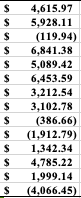
As we finished our taxes, I thought it would be fun to see the net of each property. The numbers are all over the place.
These numbers are the result of income less costs. This is not actual cash flow. It includes depreciation of assets, depreciation of the house, and all the actual costs that are occurring throughout the year. Costs include: property management, legal fees (e.g., LLC filing), mileage, maintenance, repairs, utilities, taxes, and insurance. For those properties that have a mortgage, the annual interest on the mortgage is also included.
The third line with a loss is because the tenant has been there since we purchased the house. Our taxes and insurance have risen drastically, but I haven’t had the heart to increase their rent drastically. The 2nd line above them is basically carrying them, as it’s the same floor plan and more accurately reflects our costs. It helps that these are newer houses, so their costs for maintenance and repairs are much lower than our others.
We had 3 houses to turnover for the year, so that equates to more spending than typical on a house. Two of our houses have HOAs, so that increases our cost more on those two. Most of our expenses (outside of appliance replacement) are related to HVAC repairs and tree/gutter clean up.
The last house is such a large loss because we had to put work into the house to get it ready for renting. We purchased it in October, but we only took in one month worth of rent, so the offset wasn’t great timing.
It’s also helpful to know that while this is our 2025 net on the houses, the positive may be carrying a larger cost and lower net from previous years, or it’s adding to the potential costs in the future.
It’s been a while since I’ve talked about the credit cards we have and how we manage using them. I seem to be caught in multiple conversations around me lately about how people feel credit cards are bad, so they use debit cards. I understand that some people have a bad history where they weren’t disciplined enough, but don’t you think after several years, you’re older and wiser and could likely teach yourself discipline? My last post was about how you could make $500 in a year just by putting an expense on a credit card and paying it off each month if you have 2% cash back. So let’s dive in to what we made in 2025. There is one caveat: we have a lot of credit cards and we put a lot of effort into using the categories; I fully understand this is more effort than nearly anyone else is willing to put in. But hopefully you can take just one thing away from this teaching and information.
You need to find your why. Your why is your driving factor on everything. Put things in perspective of “if I hadn’t spent $10 on that coffee, what could that have gone towards to provide me with longer term satisfaction?” I admit that I’ll go to Starbucks for a drink, but I buy about 5 of those $6 drinks (I get a very basic thing) in a year.
INTEREST EARNED: $1,191.42
The easiest way to make your money work for you is through interest on a bank balance. Currently, savings rates are hovering around 3.25%. I’ll just jump right into it: compound interest. Even if you have $500 extra, put this money in a savings account. At this interest rate, you’re earning $16 in a year, but that’s $16 more than you had at the beginning of the year. The mentality that $16 isn’t “worth it” is the type of thought process you need to move away from. If that balance was $5000 instead of $500, then that’s $162 in passive income.
TREASURY DIRECT: $2,098.14
This is more advanced interest income. You can create an account here and invest your money in short term securities (think CD type things at a bank). The rate is currently about 6.25%. You’re tying your money up for a period of time (4 weeks through 30 years), and the rate is tied to the term of investment, but we are actively managing our investments in 4-8 weeks segments, earning about $50 at a time.
CREDIT CARD REWARDS: $1,947.75
We have several credit cards. Some are a flat percentage for all purchases, and some have categories that earn an additional percentage back. The amount that I have here is only related to what we cashed out. More was earned, but we keep some in our Chase account balance so that we can get a bonus if we book travel through their portal.
If you don’t want to manage categories, go for the Citi Double Cash card. It gives you 1% on a purchase and 1% on a payment. The key here is that you can’t claim a statement credit because that doesn’t count as a payment, meaning you don’t get your 1% on that amount.
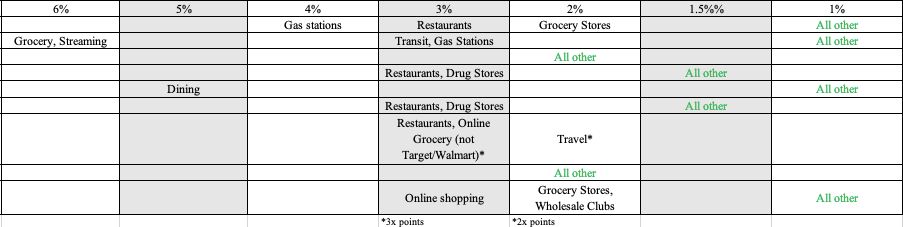
Without giving too much away on the cards we have, here’s a snapshot that I keep in my phone to remind myself what card to use for each purchase. The 5% category there changes quarterly. Usually, if I can’t use my Citi card, then I’m checking this graphic to see what the next best percent back for “everyday purchases” would be.
SUMMARY
This is “passive” income we’ve made. We had other avenues that brought in other income, but this is where we basically just spent money or kept money in certain accounts and brought in an extra $5,237.31. That’s a big number, and I’m sure that type of money can make a difference in your life or pay for a trip you want to go on.
We opened a new credit card to purchase windows for our house. When we bought our house, there were 3 windows that had the gas seal broken and were dirty looking (not cloudy like I’d think would happen). Three sashes were really bad. One is on the side of the house in our bedroom, so we never see it. The other is the window over the garage, so front and center. We just keep the black curtain drawn so hopefully you can’t notice it, but it’s definitely noticeable if you look for it. Over the past 3 years, more windows have started to go. Some are getting to the point of being that bad, and some just have a holographic look to it that you can catch at certain angles. We also have a couple of windows that are freezing if you get near them. In my daughter’s room, I line the bottom of the curtains with stuffed animals to keep some of the cold out and let the animals absorb the cold.
Well, it was time to open a credit card then.
All of these companies are happy to open a line of credit for you. You can make payments on your windows (or really anything) for 5, 7, 10 years. Well, if you have good credit and don’t open credit cards often, you can look into giving yourself an interest free loan for 12-18 months.
We look for a credit card that offers at least 12 months of 0% interest and a reward of some sort. Usually the reward is related to an amount of cash back if you spend a certain amount in a certain period (e.g., $300 cash back if you spend $5,000 in the first 3 months).
We’ve done this several times. We opened a credit card to pay for IVF to have our first child (~$30k). We opened a credit card for the new carpet we put in our current house (~$10k). Now we opened a new one for windows ($11k). We pay about $500 (at least the minimum monthly payment owed) per month and always by the due date. If you are late on a payment, you forfeit the free interest and may even owe the interest that would have been owed on previous payments. Then as the end date of the 0% interest gets closer, we make a plan on where money will be transferred from savings to pay it before that date.
That’s one of the keys. We’re not taking this because we don’t have the money to pay it right now. We’re opening a credit card to allow our money to earn interest in a savings account of some sort for all that time. So instead of spending that money and losing that income, we delay the payment as long as possible to keep our money working for us. If you need something and don’t have the money to pay it right now, but you think you’ll be able to make payments on it as you earn income, then make that the variable. Don’t open a credit card if you haven’t ever and don’t plan to have that amount of money within the term. We also don’t open a new credit card while we’re paying on the previously opened credit card. In this instance, we paid off the balance of the carpet this past October. While it would have been nice to delay opening a new card a bit longer, the windows are really in rough shape, so we only had 2.5 months without a large credit balance to think about.
We have been financially secure for Mr. ODA to quit working for years. In fact, the plan was that after he met the requirements for his paternity leave taken (which was essentially work the number of hours you took as leave), he would quit. That goal was met back in early 2023. The hold up for him quitting was always health insurance. Him working wasn’t a huge detriment to our life and things we wanted to do, and he was getting most of his health insurance cost covered by his employer.
Well, at the beginning of 2025, the deferred resignation program was introduced. While the first round was very questionable, our life was greatly affected by his employment and the government over the next few weeks, so it was a no-brainer to take the program during the second round. His last day of work was at the end of April, but he was considered employed and paid through September 30th.
As part of his separation, his health insurance was covered for about another month. He had the option to extend his current insurance for another 18 months after that, and that he’d be responsible for paying the full premium. At the time, it was about $1700, and the 2026 premium is $1900 per month.
MRS. ODA’S INSURANCE OPTION
Meanwhile (just coincidental timing), my current employer was investigating a new insurance policy for their employees across 4 offices. They were originating their insurance through the Ohio office. It was a really expensive policy for them. For the 5 people who were taking advantage of that insurance policy, they could have covered 23 employees on this new policy. We learned that Ohio is one of the most expensive states to originate insurance out of it, so we moved the policy to Kentucky.
Anyway, through that process, the insurance sales person was completely incapable of answering basic insurance type questions. Mr. ODA asked for the brochure of benefits. He said, “I emailed you the summary of benefits.” Mr. ODA pointed out that the summary of benefits was a summary of a much larger document, and we wanted those details. He said that didn’t exist. Mr. ODA called the actual insurance company, and that lady laughed and said they definitely have that.
The policy also required a gap coverage policy. The information given to me did not make me feel like it was going to be a smooth process. It sounded like the doctor’s office would submit the claim to my main insurance company. Once it was processed, I’d have to take my bill and EOB and submit it to the gap coverage company for payment. So I’d have to manage the paperwork processing and the payments between everyone.
Their quote for the family policy was about $1750. I told Mr. ODA that it wasn’t worth all that extra effort and the concern that this insurance policy would even work right (because this sales person was not able to answer questions or quell concerns), just to save about $150.
FINAL DECISION
So in the end, we decided to keep the enemy we know. All of our doctors are now solidly in place since we’ve been in Lexington for 3.5 years. I didn’t want to risk needing to switch to a different doctors office because of eligibility and coverage. I didn’t want to risk the coverage being a fight even more than my current policy creates. But mostly, in case something did end up going awry with this new policy option, we couldn’t get our old policy back. So while adding $1900 to our monthly expenses while losing Mr. ODA’s income isn’t the most ideal situation, this is where we’re at in life.
I wrote most of this post 5 months ago, but I’m going to finish it now for the longevity of what we’ve done with these rental houses. The house has been rented since September and was vacant for 43 days. She agreed to a shorter lease term, so it goes through June 30, 2026.
The tenants in this house moved in 3 years ago. They were good tenants. They hardly asked for things and were super understanding and gracious when we had the HVAC go out (granted it was their lack of filter changing). They brought a dog into the mix and tried to hide it (not well), and I eventually called them out on it to let them know they don’t need to keep finding a way to hide the dog every time I need to come over. They added a 3rd person on to their lease about a year ago. The only major issue I have is they smoked inside the house. I knew it constantly because (just like with the dog cover up) they weren’t great at hiding their evidence.
Earlier this year, I reached out that if they want to renew, I’d be raising their rent from $1200 to $1275. The girl who usually handled the bidding called me and explained they had intended to move to Georgia for a job, but they weren’t ready to move as fast as the end of the lease. I told them they could do month to month for a little, and we agreed to June 30th. I knew I had another lease ending July 31st, so I thought it would work out well that we could address the one house before the other became vacant. In theory. They ended up asking for another month, and we were busy with summer things at the end of June that I agreed, even though it meant two houses were vacating at the same time. I told them that I wouldn’t be able to extend any further though because it’ll be hard enough to rent end of August time frame, let alone into September or later.
On July 29th, they asked me what time they had to be out on the 31st. I said 5 pm. The next day, they asked me if they could have a couple more hours, but I let them know that I had already booked someone to meet them for their keys at 5 pm, and that’s all I could give without it costing them more. I was out of town for this vacancy and asked a friend to be my property manager to walk the property and gather the keys.
They ended up being out and basically cleaned up by 5 pm. I was impressed. The fridge was completely wiped down. The bathrooms were in rough shape, but overall, it was one of the cleanest vacancies we encountered.
THE TURNOVER
We had to have a friend go out to get their keys because we were out of town. I tried to get them to stay until the weekend to make it easier to move, and so that I could be the one to meet them (not that I said that), but they didn’t want to pay the per diem for that option. They ended up keeping their timeframe perfectly.
The turnover took longer than I had planned. I was working part time without a real ability to give up those hours because I had things that needed to get done, and it was summer, so we had 3 kids in the mix. Not to mention, we basically had back to back trips planned for the end of the summer. Overall, it was a learning experience.
We spent about $800 on supplies for the turnover, outside of the carpet, which was about $3,000. With the extra cleaning of the bathrooms and the time it took us to clean and paint the property, we kept their security deposit of $1,200. We could have gone after them for more because of the smoking (I have pictures from when I was doing work in the house of ashtrays with used cigarettes upstairs in the house), but it’s not worth the effort and cost.
FLOORING Before they moved in, we had ripped out the carpet and installed luxury vinyl planks (LVP). Conceptually, the goal was to not need to work on the floor anymore. We had limped along with the carpet, especially in the living room, since we bought the house, and it just wasn’t worth it anymore. We did the install over two days back then. Now that they were out, there were several gouges in the floor and the floor was separating in some spots. Mr. ODA handled fixing the separation, and he replaced a few boards that were damaged and noticeable.
The kitchen floor was so dirty and it’s the first thing you notice when you walk in. I spent many hours on my hands and knees cleaning out the grout to make it look less dingy. I didn’t get it perfect, but it was fixed. It’s one of those things that no one will ever know just how much time I put in for it to not be perfect, but it would have been so much worse had I not done anything.
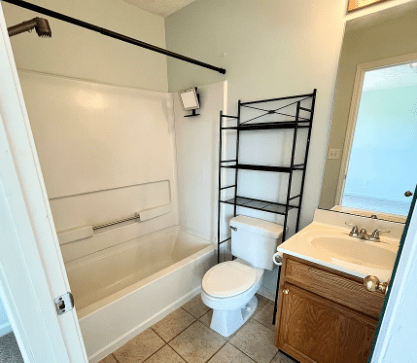
BATHROOMS The bathrooms were a wreck. I’m so lost when I walk into homes and the bathrooms are dirty. Do you want to sit on that toilet or clean yourself in a shower that is dirty? It seems counter productive to me. Mr. ODA had to take over with Bar Keepers in one of the bathrooms to remove the staining and soap scum build up, but we did pretty dang good.
I wish I had a ‘before’ picture easily available to show, because this picture does not do justice to how much time went into this tub.
CARPET We bought this house 9.5 years ago. The carpet was questionable when we bought it. We would have it professionally cleaned between tenants, and it would look amazing compared to what we saw at first, but the stains would always come back because they were deep in the pads. Before these tenants, we ripped out the carpet in the living room area and laid LVP because the living room was especially bad. Well that still left carpet in the 3rd floor bedrooms, hallway, 2 stairwells, and the whole basement. With the smoking by the tenants and knowing we had far surpassed the useful life, we went ahead and planned to replace the carpet.
There were delays in getting the appointment scheduled and making it all work. The lady who did the measure appointment said installations were 3-4 weeks out. That was disheartening because we had already lost over a week by having back to back trips at the beginning of August. We went into Home Depot to find something else. I ended up settling on something because it said 5 day install. Well, 5 days came and went. I was so frustrated that I had settled on this worse-off carpet just because I wanted to meet a timeline, and now the timeline meant nothing. Then suddenly, we got a call and they said “can we come install the carpet today? We’ll load it now and be there within the hour.” That they did. They installed it in 7 hours and that was behind us.
PAINTING This took forever. Two big stairwells really take a lot out of your time. Every surface needed to be painted just to work on covering the smoke smell. While we didn’t spend a lot on the turnover (outside of carpet), this house just took so many hours from us. We painted every wall. I painted some of the trim that had not been previously painted, but it was in rough shape. We also had to repair several walls because they had sticky things to hold shelves up and they didn’t remove it.
MISCELLANEOUS THINGS DONE
Replaced the dryer door handle (that had actually broken off before they moved in, and I thought this was an insurmountable task to fix/replace… well, it was a $6 plastic piece off Amazon that popped right in. Welp.)
Replaced window screens that were worn away and in disrepair.
Cleaned out all the air filter areas for the HVAC.
Replaced all the rusted and broken floor vent covers.
Installed a doorbell because they installed a Ring, took it with them, and didn’t put the old one back in.
Replaced the cabinet knobs (it appeared someone had spray painted over the original 90s brass with something to mimic a stainless steal look, and they were all worn and chipped).
Wiped down the cabinets and walls to get them to be less sticky. Wiped down all the doors, light switches, and outlets because they were so gross.
Replaced the broken light in a stairwell that they broke on their move in (and reported).
Repaired some ceiling areas that were damaged due to a roof leak before the HOA replaced the roof.
Replaced a shower curtain rod that they took with them instead of leaving behind.
Painted the front door. It looked like someone had taken steel wool to it to clean it.
LISTING TIMELINE
We got the property to “good enough” stage so we could get it listed. There was still things to get done, but we didn’t want to wait until it was perfect and lose interest as we got further into the school year under way.
We listed the property at the end of August for $1,400. I thought we were golden. The location of this property is excellent, and it’s on a bus route that takes you downtown and to the outskirts of the city for shopping. There were two other listings for $1,500. It didn’t move. I didn’t even get productive bites.
I dropped the price to $1,350 two weeks later. I did show it a few times. I was happy that when I made appointments, people actually showed up, but they didn’t qualify. Mr. ODA hosted an open house and had one person come through. That one person was our person though. I removed the listing two days after the open house and we have it rented at $1,350.
I offered her $1,325 for an 18 month lease or $1,350 for a lease through June 30th so I could get back on a Spring schedule. She agreed to the shorter timeframe. She was looking for a quick move because her landlord was selling her place. Our house seems too big for her needs, so I wouldn’t be surprised if she leaves at the end of June and we need to find a new tenant.
SUMMARY
We knew a September listing was going to be tough, but I didn’t expect it to be that tough. When we had a property managing on this place, they always took 5-6 weeks to get it rented and it drove me crazy. At least 3 weeks from start to finish isn’t terrible, but I’m definitely used to it moving faster. It’s also nice that had my tenants stayed, we’d be getting $1,275, and now we’re getting $1,350. Thus far, this lady hasn’t asked for much. We struggled with the utilities getting into her name. For some reason, the utility companies credited my accounts and billed it directly to her, so I didn’t even need to work on capturing that money from her, which was nice.
There was a time where we liked the idea of purchasing a new car, but we’ve since come around to buying a 2-3 year old car. We don’t eat that initial drop in value by driving it off the lot, and we can find a car that has mostly what we want for the right value. The point I want to make in this post is how we paid for the car and why, but the entire history of the purchase and thought process is detailed beyond that section, if you’re interested.
FINANCIAL DECISION
Once we decided on the van, we needed to figure out the price (more details are below). They offered $1,000 off the price if you financed, so we agreed to that. With our trade in value, taxes and fees adjusted, and the negotiation of work to be done, the net came to $9,000. The minimum to finance was $7,500. So instead of throwing the full $9,000 into the loan, we asked to put $1,500 on the credit card and finance the $7,500. By putting the $1,500 on the credit card, we made $30 in rewards.
The financing was 6.99% and we chose the option that allowed pay off after 4 payments. There was an origination fee of $175, which is rolled into the principle. Our payment is $151.94. The first 4 payments hold $175.07 worth of interest. So we will pay $175.07 of interest and the $175 origination fee as a means of taking $1,000 off the list price. That nets us, including the $30 of credit card rewards, $679.96 less on the list price. After the 4th payment is made in May, we’ll make a lump sum payment of about $7,134 to pay off the loan.
MINIVAN HISTORY
In 2020, we purchased a 2017 Chrysler Pacifica. It met so many of my wishlist items, and a dear friend of mine put a lot of effort into finding just what we wanted. Well, there were some things wrong with the sliding door, the steering wheel would get sticky at “10” and “2,” and there were a couple of small defects with the stow and go seating. The sticky steering wheel was a known issue, but we didn’t want to pay to fix it because they wouldn’t create a recall (for the record, it was pretty sticky… where I’d have to jerk the wheel to get it to move again).
In February 2023, with a 2 month old child in tow, we went to Ohio to look at another van. It was a red 2020 Pacifica. I didn’t love the red, but it came with an 8th seat and had a bunch of upgrades (heated seat) we didn’t have in the 2017 version. I have a clear memory of the car doing a little skip as we got on the highway multiple years ago, and ever since then, we’ve been watching some things with the engine. The car never had the ‘check engine’ light come on, but something wasn’t working smoothly in there. Mr. ODA mentioned a desire to get a new van, so we went looking.
He found several options nearby and we went out for test drives. Actually, we planned to do a lot of test drives, but it was a Sunday. Apparently car dealerships are closed on Sundays, and I had no idea.
First we tried driving other makes and models, but it’s hard to beat the value of the Pacifica. The other vans seem to be trying really hard to be fancy to compensate the stigma of being a minivan, but I’m not here for that. A van is extremely spacious and practical. I’m in a completely functional phase of life with 3 little kids and a dog.
PACIFICA TEST DRIVE #1
The first thing to note is that we went to two places and both places had the salesman drive with us in the van. I really thought covid killed that for us!
We went to the first one right in town. It was a silver van, and I don’t love that color. I thought I could live with that red van, but for 3 years it drove me crazy. When we got to it, it wasn’t so bad. It’s a really light silver. There were some broken things, and right off the bat, the salesman was gaslighting me that it wasn’t broken. Over the drive, I came to learn that he was proudly divorced with no kids. What a great job that the dealership assigned our online inquiry to this guy! He was super condescending about vans and kept cracking jokes about his awesome sports car and how we need one (or that we need a second Tesla). Mr. ODA shared a philosophy on debt, and he assumed he understood our position and wouldn’t let the wise-cracks go. Then to top it off, he handed our 3 year old a noise-making key chain. It took them 20 minutes to get us a quote on the van and our trade in, and I was on the verge of just walking out. The only thing keeping me there was knowing that our next stop was likely going to be a solid van, and I wanted this data point on what they were offering.
They have a required $1500-1800 certified pre-owned fee that’s on the car, and they weren’t willing to remove it. Their value for my car was low, and when I asked why the ‘good’ rating, he gave me some answer on what perfect meant and how no one is perfect. I tried to say, “so there’s nothing between good and perfect?” but people were too busy interrupting me, and I just shut down at that point. For the record, very good is in there, and my van was kept in great shape (outside of a possible transmission concern). They also tried to sell extras all over the quote, and our net was over what I wanted to pay. We got there at 10:40, and I was trying my hardest to run out of there by 11:45. Nothing about that experience should have had us there for over an hour.
PACIFICA TEST DRIVE #2
This vehicle was just under an hour from home. Ironically, this small town dealership was way nicer and the people were easier to deal with. A weird tidbit of us, but we prefer cloth seats over leather seats. The Tesla doesn’t even have a cloth option, so we have been living with the leather for over a year and it’s not so bad. I still would have preferred cloth seats, but there weren’t any on the market this week. After living without heated seats on that first van, that’s been a deal breaker for me. We also couldn’t find any vans with the 8th seat option. The 8th seat doesn’t make a difference to us as a family, but we did use it for guests visiting us fairly often. The possible transmission issue trumped our ability to serve others though.
Mr. ODA didn’t care to drive the first couple we drove, but he must have liked this one because he asked to be the one to drive it back to the dealership. That put me in the passenger seat, where I noted the visor’s clasp was missing. The visors were also swapped with each other (how does someone go about doing that with all the electric in there for the mirrors), and there was a clasp missing for the rear window shades. The outside has a dent on the side and couple of paint chips, so we asked for a paint pen also.
It was listed on their own website for higher than edmunds, but he pointed out that if we finance the vehicle, the final price was lower than edmunds by a little. They were offering $1000 off the list price for financing. We learned that concept on the drive out there. I thought saying, “I’ll hand you cash today” was better all this time. They take the financing because they make money off it. We learned they use a few banks, and one allows it to be paid off after 4 payments and the others require 6 payments before it can be paid off.
The salesman went to the ‘tower’ and got a quote. He didn’t show us. Instead, he pointed out what he purchased the car for, what they listed it at, and that they were already at a $651 loss. Um, I call BS. There’s no way your group made that type of business decision. He went back for the quote. He didn’t push the ‘loss’ concept, but he did keep mentioning it once in a while. I hope he noted we were seeing through the crap there. He was claiming they wouldn’t fix the things wrong because they’re already taking a loss. I said that was fine and we’d leave because I wasn’t about to put the time and effort into replacing a completely broken visor on a new-to-me vehicle. He went to get maintenance to look at the car and provide a quote. To their detriment, the tech put the quote on the salesman’s desk with just us in the room so we saw that the 3 things we asked for would cost under $100. Honestly, I’m wondering why they wouldn’t just go ahead and repair the visor. That’s a glaring thing that a drive would see daily, so why not just fix it so it doesn’t become a negotiation point of me, the potential buyer?
He came back with a net cost to us around $9,500. He said they’d take $200 off to fix those things. Mr. ODA said, “make the net $9,000, and we’ll take it.” And so, that happened. We walked in the dealership at 12:38 and had an agreed upon price at 2:30. We didn’t leave until 5:04. I was livid. The salesman said he could have us out of there in 45 minutes, which was a point to us taking the car off the lot that day because they’d have enough time to detail it. The car was detailed and I asked to look at it. It was not cleaned. All they did was vacuum and wipe down the leather seats. The cup holders and down the side of the walls were dirty and sticky, so I sent it back for more cleaning.
At about 4:30, I made a scene that I would have paid the $1000 to get out of there without waiting on financing for over 2 hours. At 4:40, we were taken into the financing office where he flew threw signatures and paperwork, apologized that there were 4 closings at the same time, and we were handed our key at 4:52. Since we hadn’t planned on actually finalizing a deal, we then had to throw all our stuff from our van into the new van while it was about 30 degrees and 25 mph winds (we had arrived in the sun and 50s!).
SUMMARY
We’ve learned over the years that our needs in vehicles change. Adding kids changed how things move. We drive to NY multiple times a year, plus all the driving we do for trips we take. We put one seat down so there’s room for the dog’s dog bed for trips. All 3 kids are in some sort of car seat or high back booster still. The youngest is annoyingly not independent on his car seat buckling and unbuckling (the other two were absolutely independent by this age). So for now, a van is still our need. By not investing in a brand new car, we don’t feel the need to keep it forever to protect an investment. This allows us the flexibility to switch what we have if we decide we don’t need something anymore (the dog is 13, there will be less car seat needs in a few years). Our trade-in net has been about the same each time, so I’m happy to pay about $3000 per year to own the car (in concept) without paying interest or a dealer for a lease agreement (along with the stress of issues when it’s a lease).
We last purchased a rental property in 2022, after most of our purchasing was done in the the 2019 era. We were busy with 3 kids, and I recently felt like I was coming out of the fog. Mr. ODA and I went to a wealth building seminar in the Spring; my intention was to have that seminar reinvigorate our desire to build our portfolio. It worked well for Mr. ODA, but once options started to show up, I started to panic.
We first went to an open house. It was a bit further away that I’d prefer to maintain a house, and there were a few red flags. For one, it frustrates me that landlords can fill out a seller disclosure claiming they know nothing about the house. I can tell you if I had any roof issues or major system issues in any of my houses, even though I haven’t physically lived there. Mr. ODA wanted to pursue it, but I couldn’t bring myself to get on board.
We were then sitting with his parents one night, telling the story of this open house, and his mom said that she saw a townhouse posted on Facebook that she thought we’d be interested in. It was owned by the son of an old friend of her’s. We asked our real estate agent if she’d show it to us, but she was out of town. So then his mom texted her friend to see if they were there and we could go look. They weren’t there, but they gave us the contractor box code (which is surprising in itself that there wasn’t a sentribox on the door). We went over and the house looked to be in good order, so we put an offer in. We like to surprise our agent with these types of things where all she needs to do is get the contract ratified.
UNDER CONTRACT
The house had been listed for some time when we came across it. It was was listed at $182,500. We offered $182,000 with $2,000 worth of seller subsidy on September 2, 2025. They agreed that day. We ended up needing to redo the contract because the wife wasn’t on the deed of the house, but she had signed the contract, but that wasn’t a big deal.
We had the inspection scheduled for September 10th. There was hardly any issues in the report, and we picked a few of the bigger things to ask for them to fix. They agreed to our list. They gave our agent a receipt showing they had paid someone to fix the items on our list. We did our final walk through the afternoon before closing and were disappointed to find that two of the bigger items (leaks) were not addressed properly and the house was dirty (including things left in the fridge and freezer). Our agent reported that to their agent, and they addressed everything that evening. We swung by the next morning before closing to see it all cleaned up and the leaks addressed.
The appraisal was ordered by our lender and came back at $188,000. That was a pleasant surprise to see we had immediate equity in it.
COMMERCIAL LOAN
We chose to go a commercial loan route. Interest rates aren’t falling as quickly as we expected to see. We have a commercial loan on one of our other properties in town, and I was still surprised to see how easy this process is. The loan qualifications are mostly based on the cash flow of the property. I filled out an application, submitted a ledger of our other property cash flows, and sent in 3 years worth of tax returns.
We were quoted at 6.74% interest. The loan terms are a bit different. Our last commercial loan was amortized over 25 years, but there’s a balloon at 5 years. This time around, it’s amortized over 25 years, but the balloon is at 15 years. A commercial loan also means that the taxes and insurance are not escrowed, and I’m responsible for paying them on my own.
The loan is an Adjustable Rate Mortgage (ARM) too. There was no different to us in the 3 year or 5 year ARM, so for the first time, we picked a 3 year ARM. In the past, it was related to securing our low rate. This time around, we’re expecting rates to drop in the near future, so we locked in our rate for only 3 years. It only changes on 3 year increments (some of the others will change every year after the initial lock period). It also has a clause that indicates the rate has a floor of 4%. I also don’t see a maximum adjustment that can happen (we have other ARMs that state an adjustment can’t be more than 2% at the change date).
We were expected to put 25% down. That would be $45,500 based on the $182,000 purchase price, and would leave 136,500 worth of a loan. They ran some numbers and determined that we could only qualify for a loan of $132,000 based on a rent of $1,400. They only us the cash flow to determine the eligible amount and not the rest of our portfolio. Let’s break that down to the fact that a loan of $136,500 equates to a monthly loan payment of 942.23, and a loan of $132,000 equates to a monthly payment of 911.17. So at a rent rate of $1,400, we could cover the monthly payment of $911.17, but we could not cover a monthly payment $31.06 higher. We pushed back for a second, but in the end it didn’t matter and we accepted the loan of $132,000.
PROS
When I look at this place, it feels like a place someone will rent. It’s clean, feels like home, and has a good layout. It has a closet available for a washer and dryer, which is a plus. Both bedrooms are upstairs and each has its own bathroom, and there’s a powder room on the main floor. It’s more secluded than other units in the complex, giving the occupant more grass area to hang out in the front and back.
CONS
We do have some concerns. The townhouse is at the back of the neighborhood. The entire rest of the community has parking right outside their front door. This group of 4 townhomes is separated from the parking lot, so you have to walk a bit further. The trade off there is that it’s secluded, you have a front “yard” (instead of pavement), and you’re more secluded from your neighbors.
I didn’t want another townhouse in our portfolio. With a townhouse, your value is strongly dictated by what your neighbors have done (or not done) to the property. As much as we don’t plan to resell these properties in a short time frame, I do have the thought that I want to be able to sell it when the time comes.
Also with a townhouse, you’re also at the whim of a community manager that is likely not putting utmost effort in. We asked about the HOA at closing and the previous owner said the cost used to be $35 per month. When it was that cheap, they weren’t paying their bills, so the lawn wasn’t mowed and the trash wasn’t removed. They increased the price to $95 two or three years ago, and that has made a difference in the community’s upkeep.
The HOA is due monthly, which is an inconvenience and a surprising process on their part. I plan to pay it monthly until I have confidence in their ability to process my payment and apply it to my account timely. After some time, I may pay in advance. I just went to process the first payment and planned to pay 3 months worth, but then realized that will create a harder tracking mechanism on me right now.
CLOSING
We had our closing on October 16th. It was super quick and easy. I listed the house for rent that evening.
SUMMARY
At this point, we have the house listed for rent at $1375. We had determined the range for rent during our purchase evaluation. Unfortunately, I hadn’t looked at the current market by the time we went to list, and there’s quite a bit out there. I’ve shown it to 2 people and have another showing today. One of the people from the weekend said they were seeing other places on Wednesday, so I’ll hold out on any changes to the rent price until this weekend.
After each trip, I typically summarize how much it cost us. I like talking about money, mostly to work towards eliminating the stigma about talking about money. The more information you have, the better informed you are when it comes to decisions, so here’s a reference point to file away. We sailed Royal Caribbean’s Oasis of the Seas. I loved it!
COST BREAKDOWN
Flights – 25,000 miles + $273 We looked at several different flight options now that we’re a family of 5 flying and that adds up quickly. The first night we were looking to book the cruise, there was a group of 5 tickets for just under $700, which we thought was a great deal, but once we were ready to book, it wasn’t there anymore. We ended up going with Frontier for one direction and using American Airline miles for the other direction. When booking with miles, you only need to pay the taxes on it, so that’s what we did.
The flight options were very limited for the way home. We ended up just sucking it up and picking a 9 pm departure. Not long after the booking, we received an email saying our itinerary was changed and now the departure is 12 pm. While that seemed concerning at first – to get off the cruise, through the airport, and to our gate before noon – I had hoped it would be just fine, and it was. We got off the ship around 8:30, took an Uber to the airport, and arrived too early to check in for our flight. They built the airport expecting this isssue, so they sent us to the waiting room. We sat there for about 45 minutes and then checked our bags and got to our gate. We sat at our gate for a couple of hours and got home on time.
On the way down, we each got a checked bag because of our American credit card. However, we still needed to prepare for “carry on” status on the way home with Frontier. Then, once we were already packed, Frontier offered us to upgrade all our bags to checked bags. Had I trusted that they wouldn’t have said “no, you have to check a carry on size,” I would have happily changed our 3 carry on bags to one big bag to make traveling through places with 3 kids easier. So while some parts were harder because we had 3 rolling suitcases to account for, it was nicer through the airport to not have suitcases to manage.
Hotel – 34,000 points If you’ve ever had to fly into a cruise port, you know it’s less stress-inducing to fly in the day before. I went on a cruise a year and a half ago, and we were flying out during a snow storm that was affecting travel all over the area. We ended up arriving at our hotel near midnight, so we were happy to know we were there for the cruise boarding time and not stressing about delays that morning. That means there’s a cost for a hotel one night.
The hotel was booked with points, so it wasn’t a literal cost to us. We stayed at the Tru in Dania Beach. They had a shuttle from the airport to the hotel, so when we arrived, Mr. ODA called the hotel to come pick us up, and it worked out well. We had to wait 20 minutes for a crib to arrive, even though it was on our reservation as a request. This isn’t a huge deal, but when it’s 10 pm and I’m just setting up a crib to get over tired kids to sleep, I’m not thrilled. Otherwise, the hotel was nice and it provided a good breakfast.
Uber – $58; Airport Parking – $70; Dog – $289 The hotel provided a shuttle from the airport to the hotel, so we didn’t have to pay for that part. Then we needed an Uber from the hotel to the port, and then from the port to the airport. We requested a car seat in the Uber on the way to the port, so that limited our options. Then she was 23 minutes late to our pick up time, didn’t get out of the car to greet us or help set up the car (pick up the 3rd row to fit our 5th passenger we disclosed ahead of time), didn’t acknowledge being late, and generally didn’t speak to us except to say get our IDs out for the port. That’s not an Uber issue, it’s a specific driver issue, but that was not a great experience. On our way from the port to the airport after our cruise, we got charged a wait fee, even though the wait was because security was stopping our Uber from getting to us. Uber removed that charge though.
The CVG airport parking is $10/day for economy. That’s my first economy experience instead of the ValuPark lot, which is $12/day. I didn’t really think anything of it, but it wasn’t a great experience. I always thought it odd that the ValuPark lot has shuttles that pick you up at exactly your car, but the economy lot has the shelters. I didn’t properly account for the time to wait for the shuttle and then to have the shuttle drive through all the shelters.
Food – $44 Obviously most of the food was part of our cruise fare. We had McDonalds on the way to the airport, Burger King during our layover, and then McDonalds on the way home.
Cruise – $3,099 The big one! We did not prepay gratuities, so that was billed as we left the ship. Gratuities are $18.50, per person, per day. We had $50 on board credit. Ironically, and just coincidentally, we spent $50.40 between drinks and child care (the babies room (0-3 years old) is $6 per house before 7 pm and $8 per hour after). Royal Caribbean only requires $100 per person as the deposit, and then the balance is due a few months before the cruise departure. We booked right at that threshold, so we paid our deposit and then a few days later paid the balance.
LOGISTICS
The booking of the cruise could have been a bit more forward. Cruises are not family-of-5-friendly. There’s an option on Royal Caribbean to book a “guarantee” or GTY room. You get a discount for allowing them to assign you in an open room (of the category you picked (e.g., interior, ocean view balcony)) about a week before the departure. I did this for a cruise I took in January 2024, and it worked out perfectly fine. So we see these prices quoted online for GTY rooms, but they always make you call to book for more than 4 people. We’re expecting the cost to be just the taxes and port fees for the 5th person, but when we call, the difference is over $500.
We tried to explain how that feels like a bait and switch and that there’s no indication of that on the website, and they basically said “well, that’s the way it goes.” They can’t guarantee a 5+ room available at the time of sailing. This makes sense, but it also eliminates our ability to use that cheaper booking option. We asked if there was something they could do to help make us feel whole since we were being forced to spend $500 more than if we could be put into the guarantee-pool, and they gave us $50 on board credit.
Mr. ODA’s parents book Celebrity (same parent company) all the time, and if they book their next cruise while on their current cruise, they are given OBC. Turns out Royal Caribbean doesn’t have the same philosophy, and they hardly give OBC. We tried to see if there was a special deal for a cruise if we book on the ship and they had nothing to offer.
Our departure experience was horrific, and I’m not even sure how we timed everything so poorly. At CVG, the kiosk jammed printing our tags, so we had to wait in line to get to the counter for the last luggage tag. Well, the line took forever because there was a large group in front of us that couldn’t speak English, so the workers couldn’t get everyone checked in quickly. Then we were too late for her to print checked bag tags because it was 30 minutes before the flight. So now we’re stressed trying to get through her attitude, us being late, and having to get through security and run through an airport with 3 little kids. This is the first time I’ve ran to my initial flight (ran for connections countless times!). I’ve never had this issue before, but everything along the way took just a few more minutes than I had planned for, and the luggage tag issue stole about 15 minutes of time from us (plus, our flight was delayed by 20 minutes and then 45 minutes before the original flight time, they said it was on time… we hadn’t delayed our departure from home, but it was wiggle room we thought we had and then suddenly didn’t). After the attitude from the ticket counter, then we encountered two more attitudes from the gate agents. It was a rough start, but the flight attendants were nice, and we had plenty of time to catch our breath at our connection.
Child care is provided on the ship. They have a few hours in the morning (maybe 9-12?), then 1-5 for the afternoon, and then 7-1 am. For the kids 3-12 (split between two rooms of 3-5 year olds and 6-12 year olds), it’s free until 10 pm; then it’s $10 per hour per kid after 10 pm. For the babies (0-3 years old), you need to make a reservation for times when you arrive on the boat. We prioritized the buffet, so by the time we got to the kids area, lots of time slots were booked already. She offered me 6 hours worth of booking, which I split between 3 days. Our youngest is 7 weeks shy of being 3, but he wasn’t 100% potty trained (although we did try) so they wouldn’t let him move up. If he was potty trained, they would have let him go up to the 3-5 room. The first 2 hour block, we only used 1.5 hours worth of it based on the activities we were trying to get done. The second 2 hour block, we only used 1 hour worth. And then we didn’t use our final day worth of time because he got sick, and I didn’t want to contribute to the spread of it. We dropped the big kids off a few times and just took the baby with us to activities, which worked out fine. He’s so good when he’s alone, but the 3 kids feed off each other!
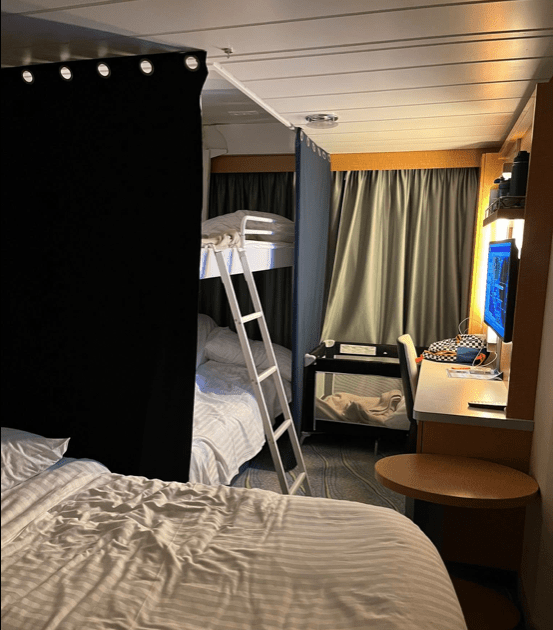
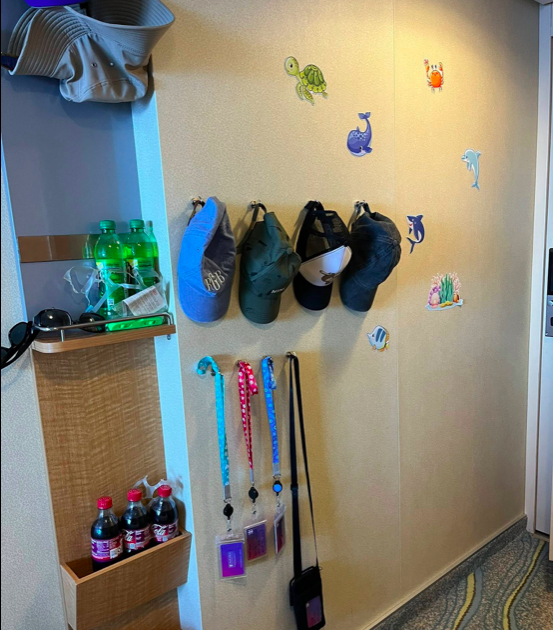
I brought lots of hook magnets. I used them to hang everyone’s lanyards with their seapass cards, hats, and to dry bathing suits. I also used them to hang from the ceiling and utilize curtains that I brought (actually, I bring these curtains everywhere we travel because a really dark room is important to getting the kids to sleep past sunrise when bed time is 2-4 hours later than usual). There were 2 hooks in the shower, 3 hooks on the bathroom door, 2 hooks in the bathroom with 2 towel bars, and 2 hooks outside the bathroom. We’re going on another cruise next year, and I’m going to bring more hooks because we could have used more space to dry out bathing suits. Having the curtains hanging to separate the kids from each other and then from us was great.
I also bought a pack of decorative magnets. This is very unlike me; I don’t like anything extra. But I put them on the stateroom door, and it helped the kids identify which one was ours. The door is textured, so they didn’t all fit. I put them inside the cabin on this big blank wall, and I actually really appreciated the decoration.
You’re allowed to bring on 12 cans/bottles that are less than 17 ounces each, so we did that for Mr. ODA’s sodas. We didn’t buy any drink packages. I don’t know what sodas cost on the ship. At the buffet, we have lemonade, iced tea, and water available. At some of the included restaurants, they have other flavored water type drinks like strawberry melon. At breakfast they had apple juice and orange juice. There are enough options for variety if you’re not looking to buy a package. I had Mr. ODA bring a non-diet/zero type drink in case I wanted some variety, but I was so full that I didn’t end up wanting any sodas and had a couple of lemonade and juice options throughout the week. The alcoholic mixed drinks are about $15 a la carte. They offer a happy hour special of margarita (and maybe one other option that’s $6-7) and have a drink of the day that’s $8. I didn’t know about the drink of the day special until day 3 and didn’t know about it at all on my last trip, so that’s a positive to know. I think the Truly/beer type option was around $8-9 each.
When buying the drink package, that’s your baseline. Are you going to drink 5 mixed drinks or 8 beers/Truly each day to make paying up front worth it? I’ve heard some people say “I just like not having to think about what I’m ordering.” But, do you enjoy paying $65 for 2 drinks? I understand it’s vacation and many people have the mentality that money is no object, but it is something to pause, have the perspective, and make an informed decision on.
The app is really good. There’s a little room for improvement, but everything you need is there. We’d like to see a search feature, where you can search “bingo” or “laser tag” and see the offerings instead of scrolling every day and hoping you catch the times. I like the daily tips they post about what’s happening that day and some good reminders. I also like how many activities are offered. I wish there were a few more things in the 6-8 timeframe for those with a 5:00 dining time, but I understand that’s not the worst problem. There is so much offered for other times, and I found myself juggling wanting to do all the things, but also not wanting to be on a schedule.
A few weeks before your cruise, the app will have most of the shows and activities available. One example that we didn’t have until we were on the ship was laser tag’s schedule. But you should get on your app a month in advance and keep checking for the show reservations to be opened. They seats go fast. We were able to reserve the ice skating show and Cats, but we weren’t able to get a seat at the aqua show. I was really bummed about that, but we went to the aqua theater at the beginning of the show and were able to get a seat.
We did not pay for a wifi package, nor did we set up our phones for an international plan. I was looking forward to being completely cut off from the world for 4.5 days. To my surprise, iMessage worked the whole trip. It wasn’t too bad, and I got to share stories as we went with some people.
LESSONS LEARNED
Book any 0-3 year old child care slots ASAP
Pack half the pajamas you need (our kids wear pajamas through breakfast at home, so there’s no re-wearing, but they don’t eat anything in the cabin, and they don’t leave the cabin once in pajamas, so don’t use up the space)
Prepare accordingly for theme nights (I may have not planned well for my oldest)
Bring as many magnets as you can hold (although you may get flagged for a bag check in security)
Read the daily tidbits in the app each morning
Don’t pack lots of snacks (I thought I’d be looking for breakfast faster than everyone being ready to go, so I packed granola bars. I also thought we’d want more snacks, but we’re so full from eating bigger meals and being on a different type of meal schedule that eating in the room was never a thought)
If you’re on the cusp of 52″, 48″, age 3, or age 6, I may wait until those milestones are hit. While it’s not the end of the world and doesn’t kill your cruise, we had kids disappointed they couldn’t do some things based on height (water slides) or age (rock climbing).
Drink the happy hour or daily special beverages if you don’t have the drink package
THE CRUISE
We took a 5-night cruise. It was more time than I had planned for originally. I didn’t want to be stuck on a boat in case the kids didn’t take to sailing well, but the price was $1000 less than the 3-4 night offerings, so we went for it. It worked out well. Everyone’s first question seems to be, “were you afraid of them going overboard?” Turns out, there are very limited options for that to even occur. We were in an ocean view balcony, but the glass goes higher than the littlest ones, so that wasn’t an issue. Most decks have the staterooms on the outside, so the only real place they could attempt to get overboard is on decks 15 and 16, and a little spot by rock climbing on deck 7. It was barely a thought of mine the whole week.
The biggest hurdle of the week was getting the kids through crowds. There’s a lot of people on the boat, and people tend to congregate in certain areas. Keeping 3 little ducklings together in a crowd could have been worse, but it wasn’t the easiest either. The cruise ship gives you bracelets for your kid to wear with their muster station on it. I wish there was more information on it, so I put their names and room number on the back. The youngest didn’t have a yellow bracelet, and I wasn’t happy about that. Luckily, I had packed a bracelet that I could put his information on. I used a regular sharpie and the lettering was legible until about the last day. I could have rewrote the information, but by then I was feeling more comfortable.
We did not push too hard to get to all the activities. We made a concerted effort for a few activities, but I didn’t want to be tied to an agenda all week. We generally started the day with breakfast. We ate in the main dining room twice, which was quieter and calmer, but also slower. One morning, I ordered a small breakfast, and the waiter pushed me to get the “express” breakfast. It came with 2 things I didn’t want, and I was frustrated that he pushed me to waste food. We usually then went to the pool or splash area (the splash pad is pretty cool with slides and activities within it for the kids). Ice cream opened at 11:30, so that worked well as a way to get out of the pool and start drying off for lunch. We ate lunch in the buffet (Windjammer). I personally liked the variety of options with the kids, but it wasn’t the easiest process. Apparently kids really struggle holding plates flat. We only lost one apple once, but it was stressful every time trying to make sure they kept the food on the plate while walking. Our afternoon was spent either with the kids in the kids club area (Adventure Ocean) while we did trivia, or they came to trivia with us. We rode the carousel, the big slide (Abyss), and participated in some random activities (family festival, scavenger hunt). We would get back to the room at about 4:55, rush to change, and then run to the main dining room for our 5:00 dinner. On my last cruise, there were only 2 dinner times, so being on time seemed less of a priority. This sailing had a 5:00, 6:45, and 8:00, so I felt the push to be as close to 5:00 as possible so we didn’t delay a 6:45 sitting. We ate all our dinners in the main dining room. I truly appreciated the themes, but perhaps only 50-60% actually participated.
At Cozumel, we got off the boat, had a beer at a tourist trap, and got back on the boat. I don’t think we were off the boat a full hour. There was swimming available in some pretty water just next to the cruise ships. There are shops for trinkets and a few places to eat or drink. It was an area that clearly catered to cruise ships and I felt perfectly safe.
Our second stop was Royal Caribbean’s island, CocoCay. I can’t sing enough praises about this concept. All your food is available. There are servers just like on the boat if you want a drink. It’s clean. There were some concerns about jellyfish while we were there, but we didn’t have any problems. My youngest was struggling with the sand concept (and not touching the sand and then rubbing his eyes or sucking his thumb), so we eventually moved over to the pool. The pool was packed, and I almost said lets just go, but we got in. Once you were in, it wasn’t uncomfortable at all, and there was plenty of room. There’s a 0 entry area with water fountains, which kept the kids entertained well. There are life vests on the island for your little swimmers. I did hear that snorkeling was sold out when we arrived around 10, so you could keep that timing in mind. The ship staff give you towels as you get off the boat (you sign them out with your seapass card), and there are towel stands on the island if you want to swap out your wet, sandy towel for a new one.
I will note that we had a medical emergency just hours into the cruise. It didn’t affect us at all. We heard the “alpha alpha alpha” call while we were at dinner, and about an hour later, the captain came on the loud speakers and announced the plan. We departed Ft. Lauderdale, but we were going to return to Miami to get this patient off the ship. They were making a plan on whether we’d have to fully dock or if the coast guard could come out to us. They announced a bit of time later that they decided the coast guard could come out. Then about a half hour after that, they said that the swells from the tropical storm we were near were too rough and the coast guard couldn’t get close to our ship to safely transport the patient between the two boats. So then they decided to send out a helicopter, and that happened just as the sky opened up on us at the aqua theater and we gave up and went to bed. So even though the course changed, it really didn’t affect anything we were doing on the ship. The patient actually got off and received emergency coronary bypass surgery that night and was recovering, so that was a blessing. There was also supposedly a death in another cabin, which I knew nothing about until after I got back home. I share this just to say – things happen, and there’s so many people, so it’s not surprising, and it didn’t affect the rest of the trip.
Getting on the ship and off the ship on the bookends of our cruise was extremely easy. I had a similarly easy experience at Cape Canaveral (actually probably easier). On the way there, we went through the security check points. I was flagged for my magnets, and in the process, they found my extension cord. Honestly, it wasn’t clear what the rules were about the extension cords. I wasn’t worried about the number of plugs as much as I was the extension to an outlet. They’re quick to say “there are plenty of outlets,” but they don’t address the fact that 3 outlets are on one end of the room and there’s only 1 at the bed. It didn’t matter though. We plugged in a phone overnight by the bed, and the sound machine was over by the kids with that 3 outlet option on the desk. They confiscated my extension cord, but they tagged it, and I got it back at the end of the cruise. After that, we went upstairs to a huge waiting room. We were told to sit in order as we entered. The place was packed; I expected this to take a while. It was less than 2 minutes. We scanned our boarding passes and walked right on. On the way off, everyone just left when they were ready. We walked right into the main dining room, scanned our seapass cards, and left the ship. There was luggage areas to pick up any luggage you had carried off the ship overnight, but we hadn’t done that. Then you go through the immigration check where they take your picture and approve you to continue. And that’s it. There was no queuing through either process except for the 2 minutes we sat in the waiting area at the port on the way on the ship. It’s incredible to me.
SUMMARY
I was a reasonable level of nervous taking 3 young kids on a cruise for 5 nights, but it went significantly better than I expected. Our next cruise isn’t until this time next year, but I wish it were sooner! I highly recommend cruising, especially with Royal Caribbean.
In November 2023, I posted about rental changes that had occurred over the previous year. I wanted to update that analysis a few months ago, but I didn’t have all the KY data. I recently shared that my rent increases aren’t covering my cost increases, and my portfolio’s cash projections are lower now than when we first purchased all the houses. Here’s more of a breakdown of those changes per house.
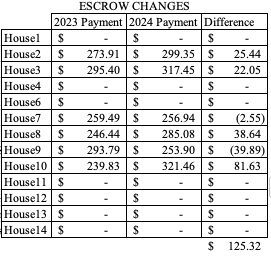
ESCROW
Escrow is an account that your mortgage company holds money to pay your insurance and taxes on your behalf. I have little faith in their management, as I’ve had to follow up on balances in the account and payments made incorrectly.
I created this table to show the differences between escrow payments over the two years. I kept the houses that don’t have an escrow because it can be compared to a future table in this post. There is no House5 in this table because we sold it several years ago (houses didn’t get renumbered because House5 still exists in terms of tax documentation).
INSURANCE
We had 3 insurance claims last year, and a big one the year before. It turns out, our portfolio is looked at as a whole, so 4 claims in a 12 month period doesn’t look good, especially when one of those was 6 digits and one was 5 digits. None of it was egregious, and they were each necessary. We were just a victim of poor timing (and for some reason, the 12 years prior to that with 0 claims of any kind mean absolutely nothing). While our own history is to blame in some aspects, insurance costs as a whole are increasing quickly over the few years. Here’s Google’s AI response:
And with that between payments made in 2023 and payments made in 2024, insurance is costing us almost $2,000 more for the year. I also just made my first 2025 payment, which increased that one house by $343. The total increase from 2022 and 2024 is over $3,000.
From the initiation of insurance on each house (so, when we first bought the house, which were mostly between 2015/2016) to today, we’re paying over 43% more in total for insurance.
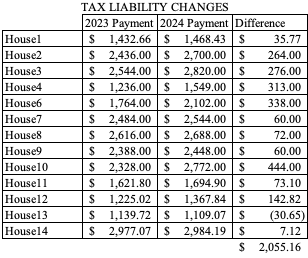
TAXES
The table below shows the change between 2023 and 2024 for our tax payments. Last year, many jurisdictions that hadn’t captured the assessment changes since the pandemic made up for it last year, when we saw about a $3,500 increase for the year. This year, our increase was over $2,000. Fifty-five hundred over two years is nearly $230 per month, spread over 13 rental properties is $17 each. So for those that I didn’t increase rent last year, they’re not capturing that cost increase for our portfolio.
RENT INCREASES
So far this year, I’ve missed two opportunities to increase rent. I had planned on increasing one house by $25 to keep up with inflation costs, but it didn’t register that their notice had to be given by 1/1 (every one else is by the end of the month). The second is above market at this time, which was by design since they’re not easy to work with (tried to phase them out, but they accepted the rent increase). We last raised their rent in September 2022, so it’s been two years. But I couldn’t bring myself to do it. Next year we’ll increase them by $50 per month.
My plan is to increase the rent for 5 of our other houses. Four of these houses are planned to be $50 per month of an increase, and one is planned to be $75. Our management is generally to increase rent by $50 every two years if you’re a long term renter. There have been a few that we didn’t increase for a while, and the carrying costs have drastically increased, so we’re behind now.
SUMMARY
For our cost increases between taxes and insurance, we have over $4,000 that was paid out last year (and it’s really more than that in cases where the house has escrow, so our escrow was increased more drastically that the specific amount of change in bills).
We had 3 houses turnover from long term tenants, so we were able to increase the rent to market value. I prioritize keeping long term tenants, so I don’t always do rent increases. That means that sometimes the rent is stuck below market value, but I’d rather keep a good tenant than push them out with large annual rent increases.
By bringing those houses up to market rent, I’ve made up a good amount of our deficit. Now remember, these rent increases are catching up on multiple years of drastic increases. So even though it seems we’ve brought in more, we’re both making up for previous years that didn’t have such large rent increases and paying for more large scale improvements to these houses, in addition to larger contractor costs.