Spring Break Trip

I like to do recaps of trips we take, highlighting our spending decisions. For spring break, we had planned on doing a big trip out west. Ultimately, we decided the kids were still too little to push such an itinerary. Along that timeframe, I also started a new job, where taking a week off just didn’t feel right, and then Mr. ODA had the weight of “what’s happening in the government” on us too. So we decided to do a long weekend to Columbus and Cincinnati Ohio, which aren’t extravagant, but met our needs with little kids.

We went to CoSI in Columbus, which was a perfect day. We explored that city one day, went hiking on another, and then went to a Reds game.

ENTERTAINMENT: ~$200

We went into this trip for a specific entertainment purpose, so we knew we’d spend money on those things. We bought 4 tickets for the 5 of us to get into the CoSI museum. It was well worth it. We were there before opening and closed the place down. The kids had a great day.

On day 2, we explored Columbus. It was a little chilly, so it wasn’t great being outside. We went to a nature center and walked around inside, doing their little coloring activities. Then we did an obstacle course that was meant for adults, but the kids gave it their all. Outside of lunch at McDonalds and ice cream at dinner, we didn’t spend anything this day. We were able to get back to the condo for the littlest to take a nap, so the day worked out really well.

On day 3, we packed up from our condo and went hiking at a state park. It was a really nice day and the kids did so well keeping up and walking the whole way (well, the 2 year old was in a pack). We checked into the hotel and then went to dinner at a sit-down restaurant, which killed some time.

On the final day, we ate breakfast and the kids went swimming at the hotel. Then we packed up, drove into KY to find free parking, walked across the Ohio River to the Reds stadium, and spent the afternoon at the baseball game. The Reds have a kids play area, which was right at our seats. Surprisingly that didn’t pose an issue with the kids; we went to our seats and watched the whole game. It definitely helped that it was barely more than 2 hours of game time! Then we all walked back over the bridge (this was impressive to me with 2 kids walking) and got home before bed time.

LODGING: ~$900

We like to pick an AirBnB type place for our trips. Our youngest still required a pitch black room for sleeping. We also just want to be able to put the kids to bed, but stay up ourselves. We booked a condo (which I try to avoid so I don’t have the stress of keeping kids quiet for neighbors), but it was awesome. There was a pool table in the lobby, it was easy to navigate, and we didn’t have any sound issues. It was walking distance to CoSI and we had a surprise art fair right outside one night. I just wish it had been a bit warmer so we could have used the pool they had open, but I really enjoyed.

We had paid $246 for a hotel night in Cincinnati. We booked it through our Chase travel portal, which becomes relevant later in this story. The itinerary of our trip meant that we wanted to leave Columbus, go hiking for a day halfway to Cincinnati, and then spend the night near the baseball stadium. We figured a hotel would be easiest because we’d get a pool to play in and breakfast handled for us. We checked in, got our things from our car, and THEN the front desk told us “oops – you booked two beds, but we only have a king.” We ended up making it work, but that was frustrating. Then the next day, they had told us they’d take $100 off, but our bill showed about $60 off. We tried to fight it, but they kept claiming they couldn’t do anymore because it was a third-party booking (and yet you could do something?).

FOOD: ~$150

We didn’t go into it pushing that we’d eat at the AirBnB, so that was a nice break from stress. We usually make sure to maximize our food budget by eating meals at our house, but it helped our itinerary this time around to eat at restaurants. We brought breakfast foods since we’re not extravagant breakfast people.

We stopped at Costco on the way up there, which gets us gas and a quick/cheap meal. We ate lunch at the museum on day 2 and made dinner after a long day at the AirBnB. On the third day, we ate lunch at McDonalds (which we’re well-versed in using the app for deals) and made dinner again after getting ice cream out. Then we packed lunch for a hiking day and ate at a restaurant that Mr. ODA was reimbursed for (doing ‘shops). For the final day, we ate breakfast at the hotel and then ate at the Reds stadium the last day. Mr. ODA bought one of the ‘all you can eat’ packages, which worked out well for us.

SUMMARY

I definitely recommend CoSI. Our kids were 6, 4, and 2. All 3 of them had fun, and we had no issue staying the whole day. I don’t think it’s necessary to do a second day. We did two planetarium shows and were able to hit all the sections except the indoor toddler play area (which I didn’t find necessary since we can do that outside a museum). The kids did great at the museum, walking around Columbus, hiking, and going to the baseball game. It was just the right pace that kept us occupied, but not overly busy and stressed.

May Financial Update

*I’ve been working on this post for a week, so my numbers are a week old, but I don’t want to re-update them. I’m also posting on a Tuesday just to get this ‘out the door.’*

I’m starting to pull myself out of the overwhelmed hole I felt I was in. There’s still a lot going on, but I feel better equipped to stay on top of things. I had just been so exhausted, that I didn’t have the energy to do anything extra each day, and I was just getting by. Last weekend, I was able to work on pressure washing our patio and deck furniture (which was long overdue), and then I stained our deck. That’s been a pretty good springboard to me getting a fire lit under myself to get other things done, so that’s felt really good.

Our middle child graduated pre-k on Thursday. That was a big milestone, and my poor girl is so sad that she’s going to miss her teachers. She’s really struggled with my going to work and not being home all the time (although my time not home, while she would be home, averaged about 10 hours per week). I have things better organized at work, and I’m feeling good about my tasks and role in the office, so the hours I’m spending there are dwindling. I had agreed to about 20 hours per week, but I was closer to 26/28 each week. The biggest issue was waiting for someone to be available to help me, and then that everyone else is full time, so they don’t realize I’m trying to get out of here by 2 pm each day. This week our oldest graduates kindergarten and has many events around end of school.

RENTALS

One of the mortgages has been paid enough that the balance dropped from 6 digits to 5 digits. It’s still a lot of money owed there, but that felt like a nice accomplishment when I went in to capture the balance!

June is Richmond tax season for these houses. That means I’ll be paying out large chunks of money for the houses we have no escrow on.

We had a few maintenance needs come up. One house had the water heater flood the basement. Luckily, I think we’re OK on that front. We replaced the water heater. The gas wasn’t hooked up right, so the tenant called the plumber to get that squared away. This happened while I was in a different state, and I’m so grateful it happened in a house with a handy tenant.

We had some flashing fall off a roof line. This wasn’t a priority to address at the time, but the tenant started claiming allergies were flaring up because birds were getting in the attic. Sometimes you just need to accept that’s the story you’re hearing. We had a handyman go over there and verify there are no birds anywhere. The “hole” she thought she saw was just where the soffit was hanging a bit, but there were no gaps in the wood structure itself. He tacked up the soffit, and I contracted with another company to repair the one piece of flashing.

That handyman also went out and handled a wasp nest. At that house, the tenant says a window won’t stay open when she opens it, and we let her know it’s on our radar now, but it won’t be fixed just yet as our people are spread thin and that’s not an emergency. That house had a temporary tenant in it (housing with our current tenant). To cover the tenant and us, I asked for a $500 deposit. When they moved out, I had our tenant sign that there was no damage, and I returned the deposit.

We’re still working on the major termite damage that occurred at another house. There was quite the domino effect. Leaks from bathrooms and the laundry room created a very wet environment, which created a breeding ground for termites, which feasted on our wood all over that place. The crawl space got cleaned up, but we’ve been waiting over a month for the bathrooms to get replaced and fixed. I’m hopeful that it’ll start next week, but frustrated nonetheless.

I had a leak from a toilet bolt at another house. I was frustrated because we had just been called out for water on the floor at this house recently, but it turns out this was necessary. When the house is a certain age, things just wear away and need replaced.

We also had a limb fall from a tree at another rental. The tenant explained how much of a liability it was for me. I love when tenants instruct me on my level of liability (that’s sarcasm). We have a tree guy that’s been super useful for many things and he handled it the next day with no problem.

PERSONAL

We haven’t been spending much money. Most of our money these days goes to grocery shopping. On our current statement for our main credit card, we only have 11 transactions recorded for over 3 weeks.

We paid our last month of pre-school for our second. They are closing the school and they didn’t want to add on days for the snow days that occurred, so they gave us $50 off the last month of tuition to cover the 2 days we were owed for make-ups. Since the school is closing, everyone scattered, and we ended up not getting into another preschool next year for our youngest. So at this point, that’s an extra $375 per month in our pockets next year – unless a spot opens up for the littlest.

Mr. ODA took the buy out, which I think I mentioned last month. His last day of work was April 30th. He said he’s settling into the not working concept and starting to get over the desire to know what’s happening at work and with his programs he worked so hard on. He’s done a lot of work around the house here, including treating for termites in a very intense fashion, but that was cool to see.

NET WORTH

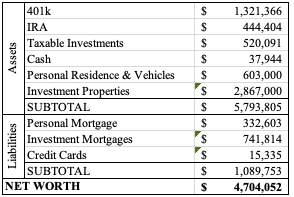
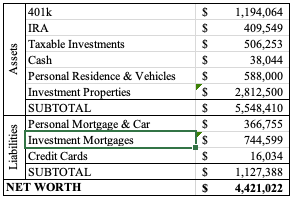
Two months ago, my job asked for my goals. It’s a specific document that I was to fill out. Someone else had mentioned their net worth goal, and our next big step would be $5 million net worth. Well, the market has been in shambles, and our net worth plummeted from where it was. I thought it prudent to not make such a goal when our net worth is completely reliant on the market actions right now (i.e., we’re not selling/purchasing or making any big moves that would drastically change our net worth outside of the market actions). We’re finally on the upswing and now at the highest net worth we’ve been, so that’s encouraging after those big dips recently.

Taxes are Done

On April 6, we submitted our taxes. Honestly, I think that’s the earliest we’ve ever done it. We usually owe a good amount, so there’s no incentive for us to do it early. After owing a penalty last year, we pushed to be on top of the projected tax liability. It looks like we’ll owe a bit on the Federal side and get a refund on the tax side.

And so here’s my annual reminder that if you take the time to manage your finances all year long, then tax season is not a hurdle. I find it much easier to maintain 13 houses worth of data if I do it during the time it’s happening. Life has gotten in the way a bit, and I find it hard to even make sure I have one or two months worth of things logged correctly. I hope to be more on top of it in this coming year.

I have a spreadsheet where I log all our income throughout the year. I set up a formula where I can track each month’s income to ensure I receive the total amount that I expect to receive. I found that since some of our houses pay the same dollar amount of rent, it’s harder for me to mentally track each month’s payments, and I like having the visual and verification through this sheet.

Then there is a tab for each property in that same workbook. The sheets are set up based on monthly expenses, and I plug in projected expenses (e.g., taxes, insurance, utilities). This helps give me a verification that expenses have been paid when owed. By now, I have nearly every invoice emailed to me, but I like having this ‘fail safe’ look at what may be owed that I hadn’t paid in a given month.

Then Mr. ODA enters our investment items, W2 income, and interest income into our tax software. Then I sit down next to him and dictate the numbers from my spreadsheets so he can enter them into the software. We have 13 rental properties, so this is time consuming. However, it’s really easy. We enter our data into the fields for each house. This year took us about 90 minutes to enter the rental property information.

I know multiple people who file extensions because it takes so much time and effort to gather the documents for their accountant to do their taxes. It’s like they don’t think about their taxes until April 1 and then decide it’s too much to do in two weeks. This is where being prepared all year long comes into play. Make it easier on yourself and put yourself in a position where it doesn’t feel overwhelming.

April Financial Update

We started getting emails about end of school year activities, and boy was that a surprise that we’re at that point. The middle one is done mid-May and the big kid is done at the end of May. Less than 2 months until summer break.

Mr. ODA took the second round of the government’s offer for administrative leave, which means he would only have a few weeks left working. I’m still working my part time job, which is taking way more hours than we had planned for. I’m enjoying it, but it’s been a juggling act with the family, which is probably why my son who absolutely loves school begged me to stay home because his belly hurt last week.

Buckle up because apparently I have a lot to share this month.

RENTALS

We received about $600 in tax payment reimbursements from one of our localities, so that was a fun surprise this month. Really helps my psyche that I have a tenant who hasn’t fully paid, didn’t tell us why ahead of time, and hasn’t been up front with when she’s going to actually pay us.

I executed 2 short term leases. Both included a rent increase for their short term period; one house is increased by $75 and the other by $25. Luckily, both are here in the Central KY area, so we can flip it between tenants. One is scheduled to leave June 30th. That house will need new carpet in the bedrooms, and it’ll need probably a whole-house paint job again. They smoked in there, even though we covered the lack of smoking rule multiple times. I’d be more upset about it if the carpet hadn’t reached its useful life years ago. The other house leaves July 31, and I can’t even tell you where we’ll need to begin with that one. She made a wood feature wall without permission. She had a giant fish tank without permission. She spent a lot of time doing things that really weren’t an improvement, so I’m definitely worried about what we’re going to uncover in that house. Mr. ODA and I are talking about fixing it up and selling it. We may look for a short term renter so that we can sell it in the Spring instead of this Fall.

I had 2 other properties accept a rent increase that will go into effect later this year. I require 60 days notice for changes so that starting at the 30 day mark I can begin advertising it if needed. One house goes up by $25 per month as of June 1, and the other goes up by $50 per month as of July 1. I also have another property that has a rent increase of $50 per month going into effect next month.

I have 4 houses that renewed another year, and I didn’t change their monthly rent rate. There are 4 more houses that haven’t been discussed. My intent is to have them renew for a year at their current rate. There are 2 of those 4 that could leave at the end of this term, but time will tell.

We have multiple maintenance issues to address. One house requires a tree trimmed off the roof, the siding cleaned, and the back deck stained/painted. We still have termite damage we’re dealing with at a house in Richmond. I have a leaking toilet that was just addressed, and then they hit me with a faulty HVAC unit during a heat wave. Then we have some houses that really need eyes on them to see what condition they’re in at some point this summer back in Richmond. It’s amazing to me how people just don’t care to tell a landlord that something is broken. I woke up this morning to a text that one of the houses here has a flooded basement due to a water heater failure.

I spent some more time fighting my insurance guy here. It irks me so much when I see him offer up his services on the local facebook group for property owners. He’s quite terrible. I sent him photos of a house that had some issues with a cluttered backyard and had the tenant clean that up. I had to fight him last month on an increase where he changed one house from a crawl space to a basement when I assure you that the vines growing through the windows solidify it should not be deemed a “basement.” When the dust settled from that debacle that he was insanely unresponsive to, I ended up owing $9.68. When I asked why my account wasn’t put back the way it was found before this mess he created, he said he didn’t know but it’s probably from the audit and changing square footage. HIs guessing and not actually answering infuriated me. I gave up and paid it, but then I ran to get quotes from other people. I hadn’t done that before because our 4 claims in a 12 months period are killing us (again, because I really wanted trees to fall on us!). I hate when people make the claim that because it’s not a lot of money, I should just give up and accept it. That’s a ridiculous way to treat people.

PERSONAL

Our electric bill is almost double what it was this time last year thanks to the vehicle charging and hot tub. Our electric bill is relatively low, so that’s not all that surprising. We also have 5 full people in this house now (as much as you can count a 2 year old as a full person… but he knows how to control light switches and eats a ton of food that we need to cook him, so I’m sure he’s a factor there!).

I’ve been working at my new part time job for over a month now. Mr. ODA was making fun of my hourly rate, but I’ll tell ya, it felt good to receive a paycheck that wasn’t $45 like it was for a day of subbing at the preschool.

I took the kids to get haircuts. My middle has had her hair cut once before, but I’ve cut the boys’ hair forever. I had family coming into town and the oldest was looking really shaggy. So I swallowed my pride and threw money at the problem, which is very out of character in this household. I just didn’t have the time to cut their hair, clean them, and clean up the mess. For $66 and 45 minutes from the time I left home until I got back, it was well worth it to me.

I had a medical procedure done this month. We haven’t met our deductible. In February, they said I had to pay my deductible to them. I said that didn’t make sense and refused to have them hold $2800 of my money for 2 months. They gave me an attitude and said I could never ever ever ask for a payment plan in the future, so that I could pay $500 to hold the date. I then showed up for the procedure, knowing I haven’t met my deductible, and they didn’t take any money from me. Another business model that bullies the customer into illogical money decisions. I also had an eye doctor appointment that was frustrating in itself, but I’ll spare you those insurance and communication details.

On top of everything else I’m juggling, Mr. ODA is coaching our kids’ t-ball team. Coaching means that I am team mom. That means that I’m responsible for communicating updates from the league (in the slow and haphazard fashion I receive information), gather value card sales that are required of every team member, organizing a basket for a raffle, and the best one – raising $350 for team sponsorship. What the heck, man?! Where did I say that my signing up of two children to play in the league means I have history or ability to gather money from businesses?? Well, I did it. I raised $350 and another mom raised $200 for the team.

No financial impact, but I’m also juggling our HOA board duties. I released our longstanding property manager and hired a new company, which took effect April 1. That’s taken a lot of time to get them stood up and make sure we stay on track for our annual meeting schedule in June.

NET WORTH

And with all of that said, that doesn’t even address the giant reduction in our investments that continues to happen. To counter some of the loss, I updated our property values for our houses. I don’t do that every month because they don’t move very much, but I can usually count on a few increases as the spring market ramps up. Our net worth did slightly increase (based on yesterday’s market closure, not today’s) from last month, which was a nice surprise.

I wonder why I’m tired and bogged down, but that post outlining what I’ve done recently made me realize all I was able to accomplish even though I felt like I was a jack of all trades and master of none. Hopefully things will settle down in our lives going forward now, even if I know there are definitely two house turnovers in my future.

House 4 Turnover

I share these turnover stories for both sides. I want to show landlords that others go through what they go through. I also want tenants to see that if you communicate regularly and are up front, a landlord can work with you in nearly every situation. It’s the surprises that landlords don’t want to manage. I think back to my time as a teller in a bank – if you were nice to me, I had leeway; if you demanded action from me without any polite undertone, I knew every single rule that there was.


We bought this house in June of 2017. We had to put a little bit of work into it, and we had it rented in September. That tenant needed to break the lease early, but she had a family member who wanted to take over the lease. She passed the background check and moved in mid-July of 2018. She’s lived there ever since. Her lease renewed on an annual basis, July 1 through June 30. She rarely asked for anything, kept up the house as if she was going to live there forever (at least as of my last inspection), and was friendly. 

In February, she messaged us that she’d be leaving the house as of April 30th. Even though her lease went through June 30th, she had given us plenty of notice, and a May rental is easy enough to get rented (we typically see less people looking for a lease in the Fall and Winter), so we went with it.

Shortly before she let us know that she’d be leaving, I had an old tenant ask if we had something available. We didn’t, but once she gave notice, I messaged the old tenant back. We ended up going through the process of screening the person she had interested (a friend of her’s) and approving him. Not having to list the house for rent, show the house, and then review several applications is a positive.

TENANT NOTICE

Not that this matters now, but to share how people act, I’m going to include this story. Be a nice person. Be a straightforward person. Take responsibility for your actions. Skip this section to get back to the actual turnover work we did.

On February 7, she said she would move out on April 30 and will leave the house “in impeccable condition ready for the next tenant.” It was understandable that she needed more space, and she shared that she had secured another place already. She stated she’d send a formal letter, but that never happened. She also shared that she will leave a shed she had purchased, and that she already had paint on hand to give the walls a fresh coat.

On March 13, she shared concerns about the house that we should address (according to her) before another tenant moves in. She again stated, “the house [will be] spotless and freshly painted and the grass will be mowed.” She said the house needs a power wash, windows replaced, and the bathtub resurfaced. Then the fun. She changed the lock on the yard gate, and she hadn’t told us until now. She said she replaced the lock on the back door because she “was burglarized twice.” The house gets broken into and you don’t think to let your landlord know OR to let them know you changed the lock??

Here’s the next kicker. “I officially move into the new house on Wednesday, but I’ll be taking the extra time to get everything moved and in order for the [current] house.” That “Wednesday” would have been March 15.

There was a lot more back and forth, but we communicated through my property manager at this point because my property manager was handling her husband getting in there to get some work done. We were told that we could get in to start work before the end of April so that we could rent it right away.

Then comes April 19. “I had to push back the date to give a key for the contractor until .. the 26th.” Then came all the stories. Guilt inducing stories. She also stated she was about 80% moved out. She said “everything will be ready by my move out on the 30th.” So I laid down what we were told at that point. We had been told (either through our texts or through my property manager) of several “move” dates. Now we’re told she’s not out and has no intention of letting us see the property, let alone get work done, which is what we agreed to previously.

I politely stated I had concerns. I went into the background of who these people are that are “working” for me, and that they’re friends. I tried to ease her feelings of a random man entering the house (that she had told us she had moved out of on three different occasions). My biggest issue at this point was having a new tenant commencement date. No, I don’t need access before the end of your lease, but that’s not the expectations that were set. So I made future plans based on the agreement we had. If the house wasn’t going to be ready, I needed to line up contractors for the first week of May. I wanted to know the needs now, not on April 30th when no one is available for weeks.

She had said she was going to paint, but it was clear that her timeliness was not in line, and that this would fall on me. I said “You had mentioned that you would repaint the walls before the end of April. That was very generous of you, but it’s not required. However, if you won’t be painting the walls, I need to know that now because I need to get a painter scheduled basically today to be able to have him there on May 1st.” She double downed that the house would be painted.

I also was upset that she changed the locks without telling me (a lease violation, as well as a common sense violation). Had I known and been provided a key, then I would have already given my property manager the key. Instead, she’s holding the key hostage because she doesn’t know MY property manager, and that was unacceptable.

On April 23rd, she told me that no one was to do work on the house until after her lease was over. I was too frustrated to provide pleasantries at this point. I said “I explicitly asked the status of that.” And I said “you said we could be in after Wednesday and that May 1st wouldn’t be an issue. I was trying to prevent exactly this situation – a last minute surprise that affects our schedule/business.” More excuses. And I do understand that people who hand out excuses like lollipops in a doctors office don’t realize that’s how they’re acting, but it’s quite frustrating being on the receiving end of an endless list of excuses that are meant to cause guilt.

My handyman went over there on April 26 and took pictures of two rooms (it’s a two bedroom house…) with stuff packed to the ceiling. And then she shared that she forgot about things in the attic during the final walk through. “80% moved.”

We ended up pushing the new tenant to May 5th as the move in date. Had we kept it on May 1st, we would be liable for “damages” in some way by not providing him a place to live on the commencement date. So we quickly got a new lease signed with a commencement date of May 5th.

TURNOVER WORK

We had the entire house painted. There were an obscene amount of decals left on the walls that had to be removed. They had been on too long, and the paint came with the pieces or it left indents, so they had to be sanded down. Then there were also an obscene amount of command strips all over the walls that had to be removed, and the walls repaired because they were knock off command strips and not the real ones that actually come off easily. Since the house was beige and needed so much prep work for painting, I decided to just change the color. Our handyman had to do all the prep work and then do two full coats of my light green color on all the walls.

On top of painting all the walls, he had to fix some of the trim. My tenant decided to [poorly] paint SOME (not all) of the trim black. Doors were painted black, trim was painted black. It was not good. So I then had to pay for 4 coats of paint on the trim work to get it to white. It was originally the same beige as the walls, so for $3,500, the house now has all white trim and a pretty light green wall color, which probably brightened the space nicely.

When we bought the house, the tub had been painted and started peeling. It wasn’t something we had the expertise to manage. The tub was original (read: cast iron, heavy), and the paint wasn’t horrible enough to warrant immediate action. We covered the main issue with a mat in the tub, but over the last several years, it wore away. We had our handyman epoxy bathtub. While he was at it, he also epoxied the walls to cover the blue tile. I didn’t hate the blue tile, but someone at some point had repaired the wall by the toilet, and then replaced the blue tile with white/beige tile.

That’s what it looked like when we bought the house, and this is what it looks like now. The decal on the toilet is icing on the cake for this saga.

Then there were random little tasks that my handyman had to do, like replacing door knobs that had been removed and scraping the paint off my brand new windows. He also had to change the locks on the house because we think she kept helping herself back into the house, and we had to change the lock on the laundry room door because she couldn’t find the key.

SECURITY DEPOSIT

In Virginia, I have 45 days to return the security deposit or share the charges placed against the deposit. I learned early on to take the full 45 days because tenants don’t provide their final utility bills (as required by the lease), and so I don’t want to return the security deposit only to find a surprise utility bill 30 days later. So while I knew the charges by the end of the first week after this tenant vacated, I waited to ensure no surprises popped up.

In my disposition letters, I reiterate the lease agreement terms, including the amount of security deposit that was held from the beginning of the lease term. In this case, I reiterated that her lease term went through June 30th, even though her notice was given through April 30th. I also shared that the itemized list I provided doesn’t include items that I couldn’t fix yet or that I hadn’t fixed yet (e.g., stickers on the once-brand-new vanity, spray foam on windows, and the lack of proper yard maintenance). I also stated that we had days of lost rent due to the condition of the house when it was vacated, which she isn’t charged for. With all those caveats, the total still came to about $2,800. The security deposit I held was $945. This left a balance of $1,937, which I chose to not pursue collection on.

I have not heard from that tenant since the letter.

NEW TENANT

The first tenant ever had contacted me and asked for a place for someone she knew. I didn’t have one at that moment, but this house came available shortly after that conversation. I sent the background check to the new person, and he passed everything. We had agreed on a May 1st commencement date. I had some delays with the passing of my mother, but then I gave the new lease to our property manager. The new tenant dragged his feet on getting it signed, which was a red flag. He struggled with getting the first month and security deposit funds together, which was another red flag since he had two months notice for this agreement. Luckily, there have been no issues since we got everything squared away on May 5th.

When we first started renting this house, the goal was 1% of the purchase price as monthly rental income. This would equate to about $650. However, the market rent at that time called for higher, and we had rent set at $795 from 2017 through 2023, never having raised the rent on the tenant. With the drastic increases in property values, therefore causing increases in my taxes and insurance bills, rent was now set at $925. Had I listed the house for rent, I would have listed at $950. Since this was an “off market” agreement, I was comfortable with a rent reduction.

SUMMARY

All in all, this was an easy turnover. Having the contacts of a handyman is greatly beneficial at this point. For a small house that’s under 900 square feet, we spent a lot more than we typically would for turnover. We project turnover to cost 10% of the annual rental income. In this case, that would have been under $1000. However, we didn’t have to turnover the house for 5 years. That’s about $5,000 had we turned over the house every year. So the total bill coming in at just over $3,800 essentially says we’re still “coming out on top.” It also provided us an opportunity to increase rent closer to market value. We’re 4+ months into this tenant’s tenure, and all seems well.

July Financial Update

Welp, I haven’t posted in a month. We have been so busy and exhausted.

We bought a house on June 15. That process was not smooth in the week before closing, even through the day of. Our attorney had to come to our house the next day to have us sign other papers. Our lender was great, great, great, until they weren’t at the 11th hour. As always, everything went through, and we have ownership of the house. And that week will be a distant memory soon. But why does the mortgage industry get away with operating this way? I feel like there hasn’t been a single transaction we’ve done where there wasn’t a “where’s my paperwork????” or “why’s this wrong the day before closing???” moment (or my favorite, when we begged for the HUD-1 to review it before closing, and a traveling notary showed up at our house, only for the HUD-1 to be different than the closing disclosure and the numbers to be wrong on both documents).

We used our HELOC on our current house to pay the downpayment and closing costs on the new house, so that was a quick debt addition. We started with a balance of about 86k and have paid it down to 75k. We didn’t necessarily need to take the whole amount from the HELOC, but it was easier to get one cashiers check from the HELOC and immediately pay towards it than to transfer some from the HELOC and do a wire from our checking account.

This new house will be our personal residence, but it requires work. We’ve gutted the master bathroom, and I’ve been painting nearly all my free waking moments. I have the first floor mostly done (including making a ceiling go from navy to white.. ugh) and the kids’ bathroom done.

We opened two new credit cards in the last month, but I’ll get into that in the next post. Just note that our credit card balances are higher than our usual, and will remain that way.

We had opened a checking account for rewards a while back, and the account required $500 of direct deposits each month. It was one more account to manage, and it was no longer serving a purpose, so we finally closed that. Now we just manage two checking accounts.

RENTAL HOUSES

We have a vacant rental house as of June 30th, which I’ll also get into in a future post. The good news is that one of our houses that’s a repeat offender of not paying rent is now out of the picture. We still have one house that never pays on time, but I’ve at least got them paying half the rent by the 5th so that we aren’t constantly floating their mortgage and bills until the last Friday of every month.

We had two rental increases go into effect this month. One was for $20 (good tenants, long term, told us in advance they wanted to renew, but we also needed to cover our cost increases) and another was for $50.

Our property manager in KY hasn’t been easy. We’ve had to do a lot of managing the manager. All of our paperwork says not to charge the 10% fee on contractors. The document that they put in our file says it, and that’s the same document they put the charge on. I keep having to ask for all the documentation. Once I ask, they note the 10%, but it’s not until I ask.

We paid a plumber to fix a shower handle in one of our houses. On June 1st, she texted that it was loose. She didn’t really explain the situation, and I asked her to tighten the screw and let me know. She texted me on July 8th that it didn’t work. Where have you been for a month?! Then she said “let me know when the plumber is coming so I can wake my husband.” Um, you waited 5 weeks to tell me that it’s still broken, I’m not rushing a plumber out there today.

One of our insurance companies dropped us once they found out we don’t live within a certain radius of the houses. We have a property manager, so this rule doesn’t make sense to me. They let us finish out our policies, but they wouldn’t renew. Our agent quoted one company that doubled the cost we had been paying because the roof “may have been last replaced in 2000” (and we couldn’t prove otherwise). I said nope, and I asked another agent to give a quote. Their increased our cost by about $100, but it was better than $300. I executed that at the beginning of this month.

We had an HVAC go out, but luckily it was able to be fixed (for 225) than replaced.

NET WORTH

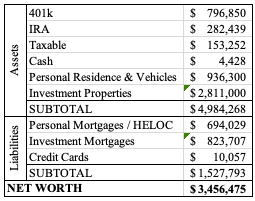
Well, even though our investments are declining and we took on a lot more debt, our net worth increased by 75k from last month. Truly, I’ve focused on the work we’ve had to do over the last month, and not necessarily on the spending or the market. At some point I’ll need to get through all our expenses and identify how our spending has changed, but perhaps that’s a job for another season while we continue to work on a new house and work towards moving our family in the coming months.

Tax Season

W2s and financial statements are arriving in the mail. It’s time to submit your taxes. We file our own taxes. And that surprises people every year.

We have 12 rental properties, two of which are owned with a partner. Mr. ODA works full time. I work random jobs, but produce income that requires filing. This sounds like it can be complicated, but it’s not.

Mr. ODA projects out our tax liability all year long, and he makes adjustments in his W2 paycheck to account for what we’ll owe. Our goal every year is to owe. Our philosophy is that if we get money back, that’s just an interest free loan the government has had from us all year. I can make a whole post on how getting excited for a tax return shouldn’t be a thing, but I’ll just leave it at. But you can’t owe too much, because then you have to pay a penalty. It’s a careful balance that I entrust Mr. ODA with and don’t ask any questions.

This post focuses on having business-type expenses. If you file just W2 income, then it’s not something you need to manage all year long, but you can still do your taxes on your own!

BUSINESS EXPENSES

The key to getting through tax season is knowing that it takes work all year long, not just in the one week crunch time to file your taxes. Schedule E is going to require you to put your income and expenses, per property, not as a whole, so it’s important to have expenses assigned to a particular house. If you record income and expenses as they occur, it’s less of a hurdle when the year is over. By recording the activity all year, it then becomes a verification process when the year is over, thereby reducing the possibility of missing something or recording something wrong.

At the beginning of every year, I create an Excel workbook to track each property’s expenses. I use it as a projection of income, a projection of expenses, and a way to keep track of re-occurring expenses (e.g., stormwater utility bills I can’t assign to the tenant for payment). I set up each property on a separate spreadsheet within the workbook to identify all known costs for the coming year.

Not all of these categories apply to each property (e.g., HOA, prepaid points), but I found it was easier flipping between each spreadsheet if they were uniformly set up. There’s also a chance that you’re carrying appliance depreciation costs. Appliance purchases aren’t captured as a one-time cost in the year of purchase; the purchase is required to be depreciated over its useful life (e.g., a $500 dishwasher purchased on January 1 is depreciated over 5 years, so it’s $100/year worth of an expense claimed on your taxes). As I incur expenses or need to adjust my income, I record it per property.

After the end of the year, I then verify what I’ve recorded. I make sure that I have the right income for each property (e.g., were there late fees collected, were there rent concessions granted, were there non-payments). Then I go through each property’s paper folder I have filed to make sure I’ve recorded anything I have a receipt for. Then I go through my electronic folder for each property, and this is where nearly all my record keeping is (e.g., I have Lowe’s and Home Depot automatically email me receipts for a purchase, and all my contractor work is billed via an invoice emailed to me). I’m verifying that I have a receipt for any expense that I incurred and recorded already. I’m also verifying that I haven’t missed recording an expense that I have a receipt for.

Once I have everything verified, I let Mr. ODA know that the business expenses are ready. Inevitably, we’re waiting for some final investment account documentation to be available before we can input our data, but we’re mostly ready to go.

TAX SOFTWARE

Each year, we hunt for deals on websites that will allow us to pay nothing or a minimal cost for filing our taxes. We’ve spoken to a couple of financial people to see whether having a CPA do our taxes would be better, but they always agree that inputting in Schedule E is the only way to go, which is really straight forward. If we’re trying to not pay to file our taxes online, then we don’t want to pay someone to enter the data on our behalf if they’re providing a benefit outside of that. I know several people who use a tax accountant to file their taxes, and they rush around looking for all their documentation to provide that person. That seems more overwhelming to me, and it just seems faster to be on top of it myself than gathering receipts and being ‘on call’ to answer questions.

Filing our taxes is usually a 2-3 hour process. It’s not complicated, but it’s time consuming. We’ve found the best way to do it is having Mr. ODA input the data, as I pull the information he needs. I keep a tax folder to file all the paperwork we receive around this time of year (mortgage statements, investment account statements, etc.). I have that file handy, as well as all our account log-ins. I’m trying to pull information as fast as I can while he’s entering it and clicking through the software. Sometimes there’s something that trips us up because there seems to be a change each year, but we mostly have a groove by now.

If you haven’t filed your taxes on your yet, take this as a sign to give it a try!

TAXES! Part 2 – Is Your Bonus at Work “Really” taxed more?

Hopefully you read my previous post trying to dispel some incorrect understandings of how marginal tax brackets work. This will build off of that, including showing how the marginal tax brackets for annual income affect the “per paycheck” payroll withholdings your employer processes before paying you.

Let’s take another common misconception, the payroll tax withholding.

When you start a new job, your employer likely hands you a W-4 to fill out. This tells them how you want your federal taxes to be withheld from your paycheck. This depends on your filing status, the number of dependents you have, the way some of your personal activities throughout the year may affect any tax credits or deductions you’ll claim, etc. The W-4 is used to approximate your federal tax liability for the year, divided by the number of paychecks you’ll get in the year.

download

I’m going to look in my crystal ball and know that my federal tax liability for 2019 will be $13,000. I want to fill out my W-4 so that my employer knows to take out $500 of my paycheck every two weeks to pay the tax man on my behalf.

This is easier said than done, and most employers will allow an employee to adjust their withholdings throughout the year (I can do it for every paycheck if I needed or wanted to).

When you file your taxes in the winter/spring of the following year, this process analyzes your tax liability (what you owe based on deductions, credits, income, etc) and compares it to how much your employer paid on your behalf throughout the year. If your employer withheld too much, you get a refund. If your employer didn’t withhold enough, you have to pay. There are differing opinions on how to strategize this situation, but a general rule of thumb should be to match as well as possible your withholdings to your projected liability.

  • If you get a refund, you’ve given Uncle Sam an interest free loan on your money for several months or the whole year. However, this can be a forced saving tool that people use who are scared they’d spend that money if they received it in their paycheck. Others see this as a cash windfall they receive in the spring and use it to splurge on a big purchase.
  • If you owe money, sometimes there are fines for owing too much, and it can hurt to have to shell out a big sum of money at the beginning of every year, if you weren’t saving for it and didn’t expect it.

Where things get tricky, and people start to misunderstand, is if people get a bonus at work, or work some overtime, and get a higher paycheck than normal.

Payroll processors use a chart similar to the tax brackets, where they know your filing status and the number of exemptions you requested on your W-4, and use your income for that pay period to determine how much federal tax to withhold.

If every paycheck you get in the year is for working the same amount with the same salary, your withholding amount will not change and your taxes will be easy to follow and understand.

When it changes, payroll processors do not look at your yearly salary or previous pay periods. They only look at the dollar amount that you earned for that paycheck.

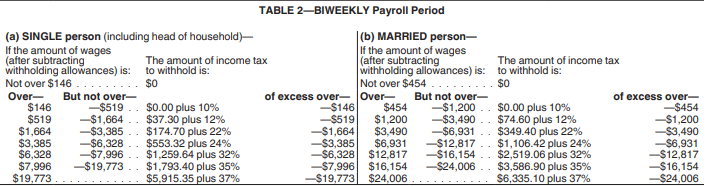
Let’s say you earn $2,000 per bi-weekly pay period in 2019. You file single with 1 exemption. Each exemption (withholding allowance) is worth a deduction of $161.50, so you can deduct $161.50 from your taxable wages for every paycheck for the purposes of reading the payroll withholding charts. (This dollar amount comes from the IRS, as part of their math for how withholdings are estimated to determine tax liability.) Now, you can say you “earned” $1,838.50.

More information on this can be found here, on pages 22 and 44 specifically.

capture

From the chart, you owe (will have withheld) $174.70 plus 22% of the amount over $1,664, which is a balance of $174.50. Times this amount by 22% = $38 (rounded). This totals $213 deducted from your paycheck.

Let’s say that happens 24 out of the 26 paycheck you get this year, but in one, you get a $2,000 bonus, and in another you work $500 worth of overtime extra.

For the check with a bonus, your payroll processor knows you earned $4,000 that pay period, independent of what has happened the rest of the year. Using the same table, your tax withholding will be $553.32 plus 24% of what you earned above $3,385 (don’t forget to subtract your exemptions). That’s $109 more dollars. So you’ll have $662 deducted. That’s a big difference from your $178! Makes the bonus come with a tad bit of bad news, right?

The overtime paycheck works similarly, but because it’s only a little bit more money that paycheck relative to the norm, your tax withholding that check is $323.

Let’s add up your whole year.

24 paychecks of $2,000 income = $48,000 with ($213 times 24) $5,112 taxes withheld

One paycheck of $4,000 with $662 withheld.

One paycheck of $2,500 with $323 withheld.

$54,500 in earnings and $6,097 withheld.

Federal Income tax liability is 10% of $9,700, then 12% from $9,701 to $39,475, then 22% for the rest; this comes to $7,848. However, our system includes a standard deduction of $12,000. This means that you can take $12,000 off the top of your earnings and it won’t be taxed. We’re going to calculate as if you earned $42,500 for the year.

Your tax liability for the year is $5,208. With $6,097 withheld by your employer, this means you should expect an $889 refund!

A couple things were in play here. You claimed one exemption. You could’ve easily claimed a second exemption for some or all of the year to have less deducted from each paycheck to more closely match your eventual full year liability.

Secondly, those two paychecks where the payroll processor charged you extra tax, your paycheck was proportionally smaller, which means your refund at the end of the year was higher. You weren’t ACTUALLY taxed more for that bonus check, you simply had more withheld, a majority of which you’ll get back when you file in the winter/spring of the following year. The bonus check had an even more profound difference because the marginal bracket it fell into that period was the 24% bracket!

If your employer allows as many withholding/exemptions adjustments as you want, you can track your tax withholdings and projected liability changes throughout the year to strategize and minimize your potential difference between the two numbers.

In summary, your total annual income is the only thing that affects the tax liability when you file income taxes at the beginning of the following year. It does not matter if your paychecks were consistent, all over the place, front loaded, back loaded, or any other weird scenario that might happen with bonuses, overtime, raises, job changes, etc. Those variables do affect a single particular paycheck and how much cash you bring home in net that week, but the effects of that can be mitigated by shifting withholding amounts with your payroll processor and planning ahead by tracking your numbers.

images

Reminder, do not confuse payroll tax withholdings from your tax liability. Withholdings are an estimate, meant to match your projected liability. Filing your income tax at the end of the year simply remediates the difference between the two total amounts. If you had too much withheld, you get a refund. If you didn’t have enough withheld, you’ll owe the tax man.

HAPPY TAX SEASON!

TAXES! Part 1 – What are Marginal Tax Brackets?

Recent national media, Facebook, and personal interactions served as the catalyst for these posts on taxes. There is a lot of misinformation and misunderstanding of the way things work, which create opinions and divisiveness not necessarily based on fact.

First, let’s talk about tax brackets and the key word for the American tax system: marginal tax brackets.

In 2019 there are 7 tax brackets: 10%, 12%, 22%, 24%, 32%, 35%, and 37%. Each of these brackets has varying dollar thresholds for the 4 filing statuses: single, married filing separately, married filing jointly, and head of household. Once you establish under what status you are filing, you know where each dollar you earn will fall in the brackets on the chart.

capture

What I’ve heard many times before, and still see implications of misunderstanding in the media, are folks that think that the last, or highest, dollar you earn is what dictates what tax bracket you fall in. This is incorrect.

In 2019, single filers get taxed on 10% of their income up to $9,700. That means that the first dollars they earn are taxed at 10%, but the $9,701st dollar they earn is taxed in the next bracket, or 12%. The 12% bracket goes to $39,475. Similarly, the $39,476th dollar they earn will be taxed at 22%, and so on.

Individuals that say they do not want that raise, or to make more money, because it would put them in a higher tax bracket are sorely mistaken. Yes, the higher dollars they earn would be taxed more, but those dollars do not suddenly make all the lower amount of dollars be taxed at the high rate too. Those lower amounts stay in the marginal brackets they already were being placed in, based on the way the charts work.

Another single filer example (simplified for easier illustration). You make $80,000, which is the 22% bracket. Taxes for the year are figured as follows.

10% for $9,700 = $970

12% for $9,701 to $39,475 = $3,573

22% for $39,476 to $80,000 = $8,915

For a total tax liability of $970 + $3,573 + $8,915 = $13,458

If you make $80,000 and have to pay $13,458 in taxes, that is 16.8% of your income, not the 22% that the “tax bracket you fall in” might create the perception of.

Say you get a $10,000 raise to $90,000.

We know an $80,000 salary pays $13,458. Let’s add the taxes for the final $10,000.

$4,200 of that is still in the 22% tax brackets, so we can multiply = $924

$90,000 minus $84,200 = $5,800 in the 24% bracket = $1,392

So total taxes are $13,458 + $924 + $1,392 = $15,774.

That represents 17.5% of your income of $90,000 being paid to taxes, not the whole 24% bracket.

If we did not have marginal tax brackets and that raise really did bump all of your dollars up, or if it was calculated in a manner that many Americans think it is, then $90,000 times 24% = $21,600. It would look like your $10,000 raise caused you to pay $8,142 more taxes.

Good thing it doesn’t work that way!

Tax Loss Harvesting

We’re in a market downturn. These are expected, happen fairly frequently, and contain strategies to efficiently optimize the times they happen. One of those strategies is tax loss harvesting.

This year, we “benefit” even more from this strategy because the downturn is happening at the end of the year, at a time when savvy personal finance folks are thinking about all the varying ways they can reduce their tax liability for the closing year.

For the last decade, we’ve been in an uncommonly long and strong bull market, so many young people have no experience adapting to a struggling market and understanding ways to harness the red numbers.

Tax loss harvesting involves selling shares of a “losing” stock, fund, bond, etc and immediately purchasing a similar asset that’s “on sale” to maintain exposure to the market, hopefully buy at the low point, and prepare yourself for the eventual market upturn.

You cannot sell and buy the same stock or fund in this process because that would invoke the “wash sale” rule that disallows claiming capital losses. If you re-buy after thirty days, it’s no longer considered a wash sale.

The reason for utilizing this strategy is to be able to write off capital losses on taxes come April. This could offset earned income, other capital gains, dividends, passive income streams, etc. Paying fewer taxes is the goal, always, right?!

It could even have the double benefit of allowing you to get rid of a stock that doesn’t have a bright future in exchange for one that you think might be better.

Minor issue

One caveat to this strategy: you’ve now placed yourself in a lower dollar value cost basis in the new security you’ve purchased. When you choose to sell that, you’ll be subject to higher capital gains amounts. There are strategies to minimize that too. Tax gains harvesting is something people frequently employ. You do this in a year where your taxable income is lower (preferably below the $77,400 married filing jointly threshold for 2018) so that you can pay less or zero in capital gains taxes.

tax planning

My circumstances

Personally, with Mrs. One Dollar Allowance quitting her job in 2019 to focus on child rearing and managing our rental properties, this year should be the highest tax liability we have in quite some time. Harvesting our losses this week will have a more substantial effect than it would in future down years, and will make the availability for tax gain harvesting in future up years more “profitable.”

Good luck to everyone in this tumultuous holiday week. Shutdowns and market losses don’t lend to great things on the news, but at least this strategy can add a silver lining to your end of the year tax decisions.