November Financial Update

Another month, and another delayed post while I juggle life. These numbers are mostly based on last Wednesday’s market close. I had big intentions of writing this on Thursday last week.

RENTALS

Our rental that we purchased a month ago is still vacant. It’s a commercial loan, so the first payment was just made on it yesterday. It always hurts to pay those bills without income. I’ve spent some time cleaning it. It looked fine if you just did a quick glance. But the details were terrible. I wiped down all the walls in the house and all the outlets and switch plates, which were extremely necessary. I wiped the baseboards with their first clean using the mop, but I’ll need to go back and do a wipe with something that gets directly on it. We were excited that the house didn’t need painted, but the closets are a bit of a mess. If I decide to make the time, I’ll throw some fresh paint on some parts. The bathrooms were pretty bad, and they’re about 70% done being cleaned. Maintenance wise, we just needed to replace a missing cabinet door pull, clean out the air return vent, and do a few random small fixes with caulk and screws. I’ve shown in several times. I even had a lease drawn up for one person, but it fell through.

We’ve had issues with our two new tenants getting their utilities in their name. We had one in Virginia who claimed she tried to get the water bill in her name and it just wasn’t happening. She always paid the day I sent the bill to her, so I just let it go. This past month was terrible. It took her over a month to get it paid, and I threatened to turn it off so that it would force her to get it in her name and keep me (and my property manager) out of it. One in Lexington was annoying that she didn’t get it done, and she’s not very communicative. Then the other in Winchester had to go in person to get the water in her name, so that wasn’t surprising that it took a while.

PERSONAL

Our 3rd kid got off the waitlist for preschool! Our beloved preschool closed down last year. Everyone flocked to this other preschool. I followed the “rules” and did things “ethically,” but we got waitlisted. Long story. I wasn’t pushing for him to be in preschool in the 2s year (he’ll be 3 next week, but our age cut off here is August 1st). I figured I’d push really hard in the next couple of months to make sure he got a spot for next year. This place I want him to go to has a lot more spots for 3 year olds than 2 year olds, so I had high expectations we’d get a spot next year. Well, we got the email a couple of weeks ago that there was room available for him! It’s a longer day than we’re used to, but he’s so excited to go to school. He asks to go to the playground daily, so that’s going to be nice that he’ll have TWO playground times twice a week. I can’t wait to hear all his stories.

My work schedule has me in the office for half a day on Monday, Tuesday, and Thursday. We’re going to look into adjusting that in January to account for the days he’s in school so that I can actually enjoy some kid free (guilt free…no strict schedules and babysitter availability) time since 2018.

We paid off the 0% interest card that was sitting at $14,000. It didn’t bother me to have that balance sitting there because it was for a good reason, but it sure does feel good to have that off our plate. Our spending has been relatively low the last few months. This month will see a small spike because I have’t preemptively bought any Christmas gifts, so that will likely be a large purchase amount later this week. We’re also in the market for camping gear since we took the kids camping this past weekend and noted a few gaps in our equipment.

SUMMARY

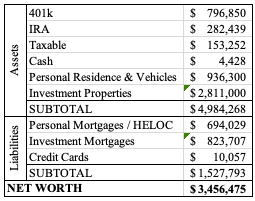
We’re up $1.5 million from 2 years ago, which is a cool number to see. Considering we paid off large credit card balances, I’m surprised our net worth only went up about $5k since last month. I updated the value of the houses in the past few weeks, so that’s where the hit is. Home values are expected to go down in the Fall, so I like to capture that adjustment from the higher values that appear in the Spring. Our cash value obviously went down since it went towards credit card payments and a down payment on a house (except it only decreased by $11k).

Our Money Management

I manage all our income and expenses (at a high level, like credit card payments, not individual line items). I have a spreadsheet that I set up in 2012 and have used religiously since then. I’ve shared how I set it up in the past, but we’ve entered a new phase that makes my spreadsheet even more important to me.

BACKGROUND

FIRE. Financial Independence, Retire Early. This isn’t a post about FIRE specifically, although it’s the movement that sparked Mr. ODA to go down our financial path.

The purpose of our rental portfolio was always for both Mr. ODA and I to quit working. We had covered my income before any kids were born, but I kept working because there was no reason to not be working. Once our son was born, I took 14 weeks maternity leave (not a separate bucket for Federal employees back in 2018; it came out of my own accumulated sick leave), then I worked about every other day for 8 months while Mr. ODA and I swapped child care roles, and I burned down my leave.

While we don’t plan to work full time, we do plan on keeping part time positions. We’ll work on things that bring us joy, rather than an office job with office politics. Since I stopped working, I’ve done odd jobs, part time. For example, I worked as a census taker and served beer at a local race track over the last 4 years. These were all seasonal, part time positions, with no long term commitment.

Now that I quit working, it’s Mr. ODA’s turn. We hardly skipped a beat when we left my six-figure salary behind (although a pandemic probably helped curtail spending on our behalf!). However, the thought of losing his salary as a safety net and losing insurance are two items that have caused some pause.

THE SPREADSHEET

For you to understand my panic that I’ll get into here, I thought a quick reminder was necessary. This is how I manage our money. It’s nothing fancy, but it works. I don’t miss payments. I can allocate expenses to a specific 2-week period against what income is brought in at that time.

There are two parts to the spreadsheet. Well, there are about 10 tabs, but this first tab, with two sections, is what’s pertinent.

Part 1 is this section. This image is a very scaled down version of the section. We have 13 houses, 6 mortgages that get paid, 6 credit cards that get paid regularly, and a few other lines that I removed.

All numbers are made up place holders, except the investments. I deleted my IRA contribution line because it’s wonky (but I will max out IRA contributions), but I wanted to show how much we’re investing regularly. There’s $75, per kid, per month, going into their investment accounts. Then there’s general investing happening with one $1000 transaction and two $800 transactions per month. Mr. ODA is investing into his IRA to max it out ($6500/12=$541 per month..sort of).

You can see that I’ve listed Mr. ODA’s pay dates at the top, and then his salary income on the next line. The gray section accounts for all rental income. I’ve allocated the income into the salary two-week period that makes the most sense (about half pay me on the 1st or 2nd, and the rest pay on the 5th). The green section shows routine rental property expenses. The entire next section are our personal expenses. The blue is left over from when I was managing two personal homes last summer (but kept it to differentiate our house bills versus other bills). The next gray section (which I’m only just realizing is a second gray and should be a different color as to not conflate the two grays.. what a rookie mistake) accounts for expense that come out of Mr. ODA’s bank account. Finally, I have an “other” section. This is where I capture large expenses that don’t need their own line item because they only happen once or twice a year. Here I’ve put tax payouts that will be due in October (that’s 4 houses worth, and it’s last year’s numbers – because I want to know how this year’s amount owed, when it comes in, changed from last year’s to discern if it’s reasonable or if I need to dig into it).

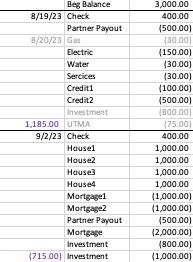
This is part 2. Now, part 1 accounts for the general timing of income and expenses, but it doesn’t perfectly capture the due dates, scheduled payments, or whether I’ve paid it and it’s hit the account.

The top line is linked to the section that I update our checking and savings account balances. Then I transfer all the items per pay period into this list format. In this example, let’s say I’ve already scheduled the gas payment. So I mark it as gray and put the date in the left column. Similarly, our investments are automatic, so I mark them in gray as we get to that two-week period.

At each border lined, I put the total for that section. You can see that at the end of the 9/2/23 pay period, I project a negative balance. Truly, we seem to have more income than I project (rewards cashed out, someone paying partial rent a little early, etc.), so I don’t take any action until I need to. There are Federal regulations regarding savings accounts; so we can only make 6 withdrawals from the savings account before fees apply. I manage these projects to know whether I need to make a withdrawal. If I need to, then I project what other expenses I may have and transfer a little more than I deem necessary.

THE PLAN

So our first step to him leaving is to pretend we don’t have his salary. Mr. ODA set up a new bank account. The majority of his paycheck goes into that account. We still have $250 going into another account, and about $400 going into a third account because we need to meet the requirements of direct deposits to prevent any account maintenance fees.

Our general principals in account management was always to take money into our main checking account, pay out bills for that two week period, and put the balance into savings. However, that wasn’t creating any forced feeling of managing without Mr. ODA’s salary. I’m more of a visual learner, so I appreciated this concept of having the money automatically transferred to a completely separate account.

EXECUTION OF THE PLAN

The first month of this plan had me on edge. The accounting in the checking account meant I was constantly back down to a balance of about $500. When I worked in an office, I was at the computer everyday checking our money. Now that I’m responsible for 3 tiny humans, I’m rarely on the computer. I project out our routine expenses, but there have been plenty of times where a $100 or $500 charge goes through that I didn’t have listed in my expense column for that period. Therefore, I like to keep at least $1000 as a buffer in the checking account to cover those little expense that can add up. So keeping the projection to less than $500 in the checking account panicked me.

Now wait. It’s not that we only had $500. We have a savings account linked to that checking account. We have this online account that’s taking Mr. ODA’s salary and just building the balance because we don’t use that account for anything. We have Mr. ODA’s old personal checking account. And last but not least (as my adorable 3 year old says all day long), we have plenty of investments that can be liquidated within 24 hours. We have the money. It’s just the panic of having the money in the spot where the bills are being paid.

SUMMARY

I’m sure there are easier ways or “better” ways to account for this. I don’t like automatic payments for bills because I like scheduling them against our cash flow. I’ve used this exact set up since 2012, and it hasn’t failed me. Taking full responsibility to pay bills means I am very scared to miss a payment and cause a negative hit on either of our credit reports.

Now that we’ve eliminated about $5,000 per month of income, without changing our spending in any way, I’m interested to see how things go. We have a great spending mentality – we’re not spending on frivolous items and we weigh the cost benefit of a purchase to us. That’s not to say we can’t do better. I’m sure we can be more diligent about our grocery spending or at least cooking what we already have in the house (we don’t spend much at restaurants in a month). I’ve already started tracking our expenses month to be sure we can watch our trends and re-evaluate our spending if needed.

Now that we have this account growing with no need for it to pay the bills, we will use it for fun things. We’re not very good about doing fun things. Two summers ago, we wanted to buy a vacation home at a nearby lake. We decided that instead of spending $1200 per month on a mortgage to go to the same place all the time, we’d plan vacations each month and spend up to $1200 without “guilt.” It was great. We had so much fun. But it lasted 3 months. Having a newborn put a damper on activities, but we’re ready to do the same again.

New Credit Cards

We turned over a rental in April, bought a new house that requires work in June, and turned over another rental in July. Those activities have a lot of expenses associated with it. While we could have strategically spent the money and paid off credit cards, it’s nice to have a cushion. When we’re faced with a lot of large expenses, Mr. ODA searches for a new credit card.

Why do we open a new credit card for big expenses? Because it’s a free short term loan for us. We’re looking for a card that provides an introductory 0% interest period, as well as some other bonus(es). Carrying a balance on a credit card and paying up to 25% interest is a non-starter in our financial portfolio.

Mr. ODA had searched for a new credit card back in the April timeframe, but we had multiple credit hits around that time, and I didn’t want to risk it. We paid off the expenses for the first rental turnover through our regular credit cards. Once we bought our new house and we knew that turning over another rental was looming (with big expenses like carpet replacement), Mr. ODA found a credit card he wanted.

At the last second, Mr. ODA switched which card he wanted. The card gave an introductory offer of $200 back after you spent $1000 within 120 days, up to 5% cash back on two categories you choose, 2% cash back on one everyday category, and 1% on all other purchases. It had 15 months of 0% APR and no annual fee. He received a credit limit of $500. Seriously. He called to get a credit increase and find out why it was so low, but they said they required another credit report pull to talk to him about anything. Nope. So we have this random $500 limit credit card in our portfolio. We’ve spent our $1000 and will get our $200 cash back (unless they find a loophole, which I would expect based on how this company’s relationship has been so far), and then this card will just sit unused until they close it years from now due to inactivity.

Since that was a bust, Mr. ODA opened a different credit card in my name (spread the wealth on credit inquiries). I was granted a $9,000 credit limit, and we got straight to work spending that. There’s no annual fee; it has a 15 month 0% introductory period; and earn 5% cash back on purchases in your top spending category (automatically, without choosing a category) up to the first $500 spent and 1% cash back after that. It gave us $200 cash back after we spent $750 in the first 3 months.

Two of our first few expenses were a vanity for our new master bathroom and 1,000 sf worth of vinyl plank flooring for a rental. Our balance within the first week was over $5,000. As much as I can’t stand to see that balance sitting there, it has helped us move money around. Usually we focus our spending in the categories that each credit card offers with higher rewards, but for these bigger expenses, we’re focused on being able to float them for several months.

We used a Home Equity Line of Credit (HELOC) for the down payment on the new house. Originally, we had been paying down the principal on that, and put $14k towards that over the last month. We then decided we should focus more into buying the dip of the stock the market instead of paying down that account with 4% interest rate (although that’s variable). That’s what we’re currently focusing on, knowing that when we sell our current house, proceeds will pay off the HELOC in a short few months. We currently have about a $1500 cash cushion because we know that we have the HELOC to fall back on. For instance, we’re replacing the driveway and walkways at our new house, and we’ll pull cash out of the HELOC to pay for that (they don’t take credit).

If your credit is in favorable standing and you have large expenses looming (without a need for a new loan/mortgage in the near future), then look for a new credit card. Don’t open any random one. You’re looking for 0% interest for 12-15 months, no annual fee, and the possibility of a reward system (whether it’s an introductory offer related to spending, a cash back incentive for spending, or some form of both).

July Financial Update

Welp, I haven’t posted in a month. We have been so busy and exhausted.

We bought a house on June 15. That process was not smooth in the week before closing, even through the day of. Our attorney had to come to our house the next day to have us sign other papers. Our lender was great, great, great, until they weren’t at the 11th hour. As always, everything went through, and we have ownership of the house. And that week will be a distant memory soon. But why does the mortgage industry get away with operating this way? I feel like there hasn’t been a single transaction we’ve done where there wasn’t a “where’s my paperwork????” or “why’s this wrong the day before closing???” moment (or my favorite, when we begged for the HUD-1 to review it before closing, and a traveling notary showed up at our house, only for the HUD-1 to be different than the closing disclosure and the numbers to be wrong on both documents).

We used our HELOC on our current house to pay the downpayment and closing costs on the new house, so that was a quick debt addition. We started with a balance of about 86k and have paid it down to 75k. We didn’t necessarily need to take the whole amount from the HELOC, but it was easier to get one cashiers check from the HELOC and immediately pay towards it than to transfer some from the HELOC and do a wire from our checking account.

This new house will be our personal residence, but it requires work. We’ve gutted the master bathroom, and I’ve been painting nearly all my free waking moments. I have the first floor mostly done (including making a ceiling go from navy to white.. ugh) and the kids’ bathroom done.

We opened two new credit cards in the last month, but I’ll get into that in the next post. Just note that our credit card balances are higher than our usual, and will remain that way.

We had opened a checking account for rewards a while back, and the account required $500 of direct deposits each month. It was one more account to manage, and it was no longer serving a purpose, so we finally closed that. Now we just manage two checking accounts.

RENTAL HOUSES

We have a vacant rental house as of June 30th, which I’ll also get into in a future post. The good news is that one of our houses that’s a repeat offender of not paying rent is now out of the picture. We still have one house that never pays on time, but I’ve at least got them paying half the rent by the 5th so that we aren’t constantly floating their mortgage and bills until the last Friday of every month.

We had two rental increases go into effect this month. One was for $20 (good tenants, long term, told us in advance they wanted to renew, but we also needed to cover our cost increases) and another was for $50.

Our property manager in KY hasn’t been easy. We’ve had to do a lot of managing the manager. All of our paperwork says not to charge the 10% fee on contractors. The document that they put in our file says it, and that’s the same document they put the charge on. I keep having to ask for all the documentation. Once I ask, they note the 10%, but it’s not until I ask.

We paid a plumber to fix a shower handle in one of our houses. On June 1st, she texted that it was loose. She didn’t really explain the situation, and I asked her to tighten the screw and let me know. She texted me on July 8th that it didn’t work. Where have you been for a month?! Then she said “let me know when the plumber is coming so I can wake my husband.” Um, you waited 5 weeks to tell me that it’s still broken, I’m not rushing a plumber out there today.

One of our insurance companies dropped us once they found out we don’t live within a certain radius of the houses. We have a property manager, so this rule doesn’t make sense to me. They let us finish out our policies, but they wouldn’t renew. Our agent quoted one company that doubled the cost we had been paying because the roof “may have been last replaced in 2000” (and we couldn’t prove otherwise). I said nope, and I asked another agent to give a quote. Their increased our cost by about $100, but it was better than $300. I executed that at the beginning of this month.

We had an HVAC go out, but luckily it was able to be fixed (for 225) than replaced.

NET WORTH

Well, even though our investments are declining and we took on a lot more debt, our net worth increased by 75k from last month. Truly, I’ve focused on the work we’ve had to do over the last month, and not necessarily on the spending or the market. At some point I’ll need to get through all our expenses and identify how our spending has changed, but perhaps that’s a job for another season while we continue to work on a new house and work towards moving our family in the coming months.

Credit Card Rewards

A while back, I wrote about how, if you really wanted to put the effort in, you could be maximizing credit card rewards. If you don’t want to put the effort in that I’ll get to in a second, then you could at least have one reward-earning card that you use for all your purchases and pay off each month.

Important reminders:

We don’t use cash. Everything goes on a credit card unless it’s prohibited or there’s a service charge that outweighs our rewards.

We pay off the balance of every credit card every month. We have never paid interest on a credit card balance.

Let’s dive in.

REWARDS

Credit card companies are offering rewards for using their card for purchases. Some even give a reward for making payments on it too. The rewards can be in a point system, cash back, or incentives for specific companies (e.g., Delta, Disney). We prefer more generic reward options, but some people like to use a specific reward card. The best reward credit card for you is one that matches your spending habits.

An example of a specific reward credit card would be a a Disney card. As you earn money, it goes towards their trip to Disney. Psychologically, they feel that their expensive annual trip to Disney is “paid for.” While this may work for some people, our thought process is that if I earn $1,500, then I have the flexibility to put it towards a Disney trip or can buy something else.

The simplest way to collect rewards is to have an all-category-cash-back credit card (e.g., 1% cash back on all purchases). However, to make the most, you could be using multiple credit cards so you can earn extra rewards in different categories. Then you need to know which card to use when, and also keep track of your statement periods so that you pay it off in full each month. A category type credit card can give rewards in multiple categories (e.g., 4% on gas, 3% of restaurants, 1% on all other purchases), can rotate reward categories (e.g., first quarter is 5% on gas, second quarter is 5% on groceries), or can be geared towards one specific category all the time (e.g., 5% on gas). There are typically earning caps in these categories.

CHOOSING A REWARD CREDIT CARD

Each credit card company has a variety of cards that offer different rewards. You can decide what fits your spending pattern the best. If you don’t want to identify the categories that you spend, then the Citi Double Cash is a great “catch all” with no annual fee and no reward earning cap. You earn 1% cash back on each dollar spent, and then an additional 1% on each dollar paid towards your credit card balance. We deposit our earnings into a checking account instead of a statement credit, because we learned that we don’t earn cash back on the statement credit made.

Some credit cards have an annual fee. We typically shy away from anything that has an annual fee because we don’t like paying money to spend money, but we did have a couple of exceptions. For instance, one card had a $450 annual fee. You earn 3% points (one point is the equivalent of a penny if cashed out) on all travel and dining purchases and 1% points on everything else, but if you redeem the points earned through their travel portal, you get a 50% bonus. One of the rewards was reimbursement of $300 worth of travel costs. The card reimbursed the cost of TSA Precheck too, which as $75, and had a DoorDash credit of $30. Then the last $45 of the fee was offset by the rewards granted through point usage. But the annual fee increased to $550, and we no longer thought it was worth keeping and that the cost would be fully offset by the rewards.

We also look for a sign on bonus. If we’re going to have our credit checked, we want to capitalize on it. Sign on bonuses are typically additional cash back or points once you hit a certain spending threshold. For example, the card may say “once you spend $3,000 in the first 3 months, you’ll earn a statement credit of $300.”

In addition to a sign on bonus, we would also prefer opening a card that offers a 0% introductory rate. I’ve shared before that we most often look for a new credit card because we have a large expense coming. When faced with paying for in-vitro-fertilization out of pocket, we opened a new credit card that had 15 months worth of 0% interest. This way, when we paid the tens-of-thousands owed, we gave ourselves an interest free loan. That particular credit card was only used for that expense because the reward categories were worse than other cards we had. However, we didn’t close that card because it helps our credit by having more of credit line open.

OUR REWARD USE

Besides the Citi Double Cash, we’re partial to the Chase options out there. We use different cards for different categories, and then use the Citi for anything that doesn’t fit into a category.

Between 5 credit cards, we brought in $4,232 worth of rewards last year. That’s money in our pockets that we did nothing except spend other money to get. In the past, it’s usually about $1,500 per year that we bring in with credit card rewards. The amount in 2021 was higher due to sign-on bonuses that were earned in a previous year, and then the credit card changed their reward redemption options, allowing us to pay ourselves back for restaurant purchases. We had previously been using the rewards to purchase travel needs through their portal, but we were able to dwindle down our rewards with this reimbursement change.

What could you do with a “free” and “extra” $1,500?

If you’re smart with credit cards, they can be a powerful tool to create financial flexibilities.

Prepare for a Closing

We have purchased 16 properties directly (3 personal residences) and 2 properties indirectly (partner); we’ve sold 3 properties. All houses have been mortgaged because we choose to leverage our money rather than own them outright (at least at first). This post covers the closing process in terms of clearing the loan processing.

Your loan must pass through underwriters before being approved and issued. The underwriter is evaluating your financial statements to determine risk and credit worthiness. While you’re given a pre-approval based on your credit score and report, the underwriter is verifying there are no other risk factors in the details. I’ll probably never cease to be amazed at what an underwriter focuses on – sometimes they want every account’s statement and several explanations, and sometimes they want you to confirm you don’t own a property that you never did own while ignoring the accounts you do own.

While a deadline is rarely given, you should provide the paperwork within a couple of days. The longer you take to gather the required documents, the more you jeopardize being able to close on time (the timeframe is set within the purchase agreement).

The are several documents that are going to be requested every time that you can keep filed away or know to start gathering them when you make the offer (some need to be more current than having them filed away). Inevitably, there will be follow up requests from the underwriter, so it’s best to get these files to them as quickly as possible.

  • Most recent 2 years of tax returns
    • Usually we just hand over the PDF version of our tax returns. One time, we actually had to fill out a transcript request form on the IRS page.
  • Proof of income (e.g., W-2)
  • Most recent paystub(s) (e.g., cover 30 days)
  • Color copy of drivers licenses
  • Most recent 1 or 2 bank statements
    • At the beginning of our purchasing, we had to provide a statement for every account (e.g., retirement, investments, banks). Over time, the request has become more focused on showing the statements associated with the accounts that will be used for funds as closing. I don’t know if this is related to our credit worthiness, or if it’s simply how they’ve streamlined the process. Here’s an example that shows they only requested accounts that make up our closing funds.
  • Proof of paid earnest money deposit (EMD)
    • EMD is a deposit made along with the signed contract. It’s the buyer’s showing of good faith to purchase the home. There are different expectations on the amount of the EMD. Sometimes it’s 1% of the purchase price, sometimes it’s a flat rate. We’ve just followed our agent’s lead on the amount to put on there, and it’s usually $1000 or $2000. The EMD is held by your Realtor’s office and credited to the total due at closing. If the buyer breaches the contract, the buyer may forfeit this deposit to the seller (e.g., backing out of the purchase without invoking a clause within he contract, such as the home inspection clause).
    • Proof is usually given by showing the check image along with the bank statement from the account it cleared.
  • Insurance agent contact information
    • This isn’t always known at closing, but you’ll need to provide your agent’s information before closing so that escrow can be set up. If the property won’t be escrowed, then you’ll need to provide proof of an executed policy before closing.

When investment properties are involved, you’ll need to provide documentation associated with those properties. For instance, a mortgage statement may be sufficient if you have the taxes and insurance escrowed. If you don’t have it escrowed or don’t have a mortgage, then you need to provide the current tax statement and insurance declaration. You’ll also be asked whether the property is subject to an HOA, and, if it is, you’ll provide a statement or coupon book showing the payment schedule. Neither Mr. ODA nor I are patient when it comes to illogical requests. For example, we were asked to give mortgage statements for all of our properties, as well as tax documentation and insurance policies for every property. Well, if the property is escrowed, then I don’t have tax paperwork because it’s sent to the bank, nor should I have to prove that the taxes are paid since it’s managed by the bank. I eventually provided all the tax documents though – it just took a while.

There may be large deposits or withdrawals that you’re requested to explain. For instance, I had to sign a statement that the deposit in our account was from the sale of our house. While it can be tracked with paperwork, there are many instances where the underwriter wants the details explicitly stated, versus making assumptions. For the example below, I provided the corresponding withdrawal from our main checking account.

Our first home purchase was at the same time as our wedding (we closed on our house on July 15 and got married on August 4!). A NY wedding isn’t cheap, and we were attempting to pay 20% down on our DC suburb home ($$$), so there was a lot of money movement around this time. Since my parents were helping pay for the wedding, we had large cash deposits into our account that had to be explained. We also had several investment account liquidation transactions. The underwriter had a hard time following the flow of money, and it took me several, very detailed, emails to show how each liquidation entered our checking account. We also had to provide gift letters, which stated we were gifted these sums of money and there was no expectation of paying it back (thereby creating another liability). That’s probably been the hardest closing in terms of our financial status, to date.

You may be requested to provide updated bank statements closer to the closing date, especially if there’s over a month between the initial documents given and the closing date. When you go into a closing, you’re told that it’s not a good idea to open new credit cards, make large purchases, or do anything along those lines that would affect your credit worthiness. They run a recheck of your credit before closing to ensure your credit card balances are about the same, and that there’s been no new credit opened in your name. Verification of more recent bank statements accomplishes the same.


We’ve had two closings delayed.

House 5‘s sale was about 6 weeks delayed due to the buyer’s lack of responsiveness. They didn’t respond to information requests quickly and struggled to provide the necessary documents to underwriting. Unfortunately, as the seller, our only ‘play’ is to take their EMD and walk away. If it’s bad enough, this is worth it. But it brings you back to square one. This was an off-market deal, which is enticing to see through rather than attempt to list and sell it. If we decide not to sell, we’re now looking at January or February before we had a renter; it could be even longer since we struggled in the summer to find someone for the house. Plus, the EMD doesn’t cover the lack of rent we experienced while under contract, where we expected to lose only one month of rental income, but it turned into 2.5 months. We had our Realtor (who was a dual agent, unfortunately for this matter) lean into the attorney on the buyer’s side after already being weeks beyond the contract’s closing date. By the time their delays were acknowledged, it was Christmas, which delayed closing into January, unfortunately.

Houses 12 and 13 were purchased together (and not yet discussed here). That closing was delayed a week, and it was completely the loan officer’s fault. We, the consumer, obviously get no restitution for their mishap. He didn’t order the appraisal timely and then had to put a rush on it, but it still didn’t come in on time. He created several errors in our paperwork (including the house number of one of the purchases). It got so bad that we just worked with the title agency, and she was awesome at getting all the documentation in order, even if it was a week later and Mr. ODA had to be my power of attorney!


Be prepared and be responsive. Understand that the bank is doing their due diligence and you want to be able to close on the loan and purchase that property. While there will be several requests for information, keep in mind that it’s over a short period of time and will soon be over.