Credit card rewards can be lucrative. In 2020, we earned $1,616 in cash rewards based on our credit card usage. That’s money in our pockets that we did nothing except spend other money to get. Plus, over $1,000 of those rewards are in the Chase Sapphire rewards account where the points are worth 50% more when redeemed for travel (i.e., they’re really worth $1,500).
I understand that credit cards can be trouble for some people, but I struggle to believe that people can’t learn how to use them properly and reap the benefits. I’m not here to provide personal financial advice, but perhaps our use of cards and our experiences can help you form your own opinion.
The most common excuse I hear is, “I don’t trust myself.” It takes discipline, but the internet has made tracking your balance even easier. Instead of having to go to the bank/ATM or wait for monthly statements in the mail to know your account balance, you can check it online whenever you want. Either keep a check register to manage your expenses on your credit card as if it’s using a checking account, or get in the habit of checking your balance daily. Heck, as soon as you spend something on the credit card, go into your checking account and pay that amount towards your credit card immediately. If you’re someone who regularly gets hit with insufficient funds fees, this probably isn’t the first step in your money journey.
We don’t pay cash for anything. Everything goes on a credit card unless it’s prohibited or there’s a service charge that outweighs our rewards.
We pay off the balance of every credit card every month. We have never paid interest on a credit card balance.
CASHING IN ON REWARDS
The simplest way to collect rewards is to have an all-category-cash-back credit card (e.g., 1% cash back on all purchases). However, we have several credit cards, and each have a different purpose. It’s more work to keep track of the spending categories and know which card to use in which situation, but if you take those few seconds to think of the right card, it can pay off in the long run. Over the years, the categories for each card have blended together as card companies compete for business and expand their reward programs, so we use fewer cards than we used to. We still have 5 that get used regularly.
Typically, one of our requirements is that it have no annual fee. However, we do break our own rule with one of the cards. If you look closer at the benefits the rewards cards offer that require an annual fee, you can compare to your lifestyle and decide if that fee will be worth it. I highlight each card we use here, but there will be an upcoming post specifically geared towards Chase rewards.
Chase Freedom: This card has different spending categories per quarter that it offers 5% cash back on, and you’re required to activate the rewards each quarter to earn those bonuses. The current category includes purchases at wholesale clubs, internet/cable/phone services, and select streaming services. Typically, we use this card the most when it’s a gas-spending category, which is usually one quarter per year. Other reward categories we have seen are grocery stores, restaurants, entertainment, or department stores, for example. There is a maximum amount of rewards that can be earned each quarter. There’s a lot of fine print associated with this type of card, so you need to make sure you’re aware of what counts and what doesn’t within that category.
Chase Sapphire Reserve: This card has an annual fee – $450. This seems steep at first, but the benefits of this card make it worth it for us. For one, you automatically get $300 worth of credit for travel-related charges (e.g., AirBnB, flights, hotels). The credit happens instantaneously when the charge hits. You earn 3% points (one point is the equivalent of a penny if cashed out) on all travel and dining purchases and 1% points on everything else, but if you redeem the points earned through their travel portal, you get a 50% bonus. We’ve booked several hotels, rental cars, and flights through their portal with the points earned. Right now, they’re also offering the 50% bonus on grocery store, dining, and home improvement purchase credits. You’re given access to select lounges at major airports through Priority Pass, get reimbursed on the fee for TSA Pre-Check or Global Entry, and earn an annual $30 credit on Door-Dash purchases. There are many more perks for this card that you can find on their site.
Citi Double Cash: The card provides 1% unlimited cash back for all purchases, plus 1% unlimited cash back for all payments made. We quickly learned that taking the rewards as a statement credit didn’t count as a ‘payment,’ so we didn’t earn 1% back for that. Since then, we transfer our rewards every month or so into our checking account, essentially giving us 2% back on all of our “everyday purchases.”
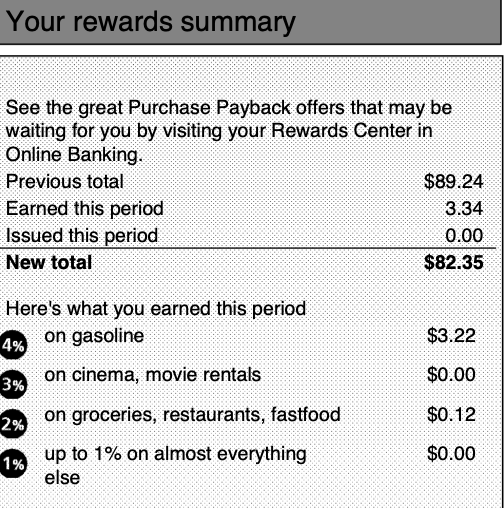
PNC Everyday Rewards: This card isn’t offered anymore, but a similar card (PNC Cash Rewards) is available. Our card offers 4% cash back on gas, 3% on cinema/movie rentals, 2% on groceries/restaurants/fastfood, and 1% on almost everything else. We use this card mostly for gas purchases now that we have the Chase Sapphire Reserve (used for restaurants and travel). This card also offers several worthwhile bonuses each month, but it’s on you to activate the reward before using it. For example, I currently have 10 days left on a Panera offer to “earn 10% cash back on your Panera Bread purchase, with a $2.00 cash back maximum.”
Bank of America: This card isn’t offered anymore. We’re earning 3% on online purchases, 2% at grocery stores and wholesale clubs, and 1% on all other purchases. When Mr. ODA got the card, the 3% category was used for gas, but BoA recently created the ability for the customer to choose their 3% category. Since PNC has 4% for gas, we were never able to take advantage of that for BoA and thus changed it to online purchases. So now, every time we order from Amazon we get 3% back! Before we were even dating, Mr. ODA didn’t appreciate that Mrs. ODA didn’t have a rewards credit card. He signed her up for this credit card the first moment he could. It literally went like this: Mr. ODA opens a computer and says to Mrs. ODA, “what’s your social security number?” We’ve since let my card close because we had the same card, and his card was more useful because if he deposits the rewards earned into a BOA checking account, he gets a 10% bonus on them. (Note: We let it close due to inactivity versus actively seeking closure on it because that card’s credit limit and history were useful to Mrs. ODA’s credit score. We’ll get into strategizing credit scores in a future post.)
Think about your lifestyle. Do you have a credit card that maximizes each activity or category of spending that you need (travel, dining, grocery, utilities, subscriptions, online purchases, gas, etc.)? Try and find the happy medium between the number of cards you need and your sanity in keeping up with them. Remember that even 1% cash back on purchases is better than $0. Try to use the cards that hit the most categories for how you spend most of your money.
OPENING NEW CREDIT CARDS TO MAXIMIZE REWARD BONUSES
Back in the summer of 2017, we were faced with a tough decision – find a way to pay for In-Vitro Fertilization or stop our quest to have a child. We had already spent thousands on infertility, and IVF was the next step. It was a minimum $22,000 to the doctor on top of what we already paid, and that didn’t include the medicine that was purchased separately. We were offered a personal loan through the doctor’s office – at 7% interest. Technically, we could pay for the procedure with cash, but we didn’t really want to liquidate stocks, we certainly didn’t want to pay 7% interest when it wasn’t absolutely necessary, and we thought it best to earn rewards on such a balance. That’s where a credit card came in.
We opened a new credit card that offered an introductory 0% interest rate. We basically gave ourselves a free loan. We also selected a credit card that provided an introductory bonus of some sort (e.g., spend $5,000 in the first 3 months and receive a $300 statement credit).
To utilize this approach, you need to be able to pay the monthly minimum requirement; if you miss a payment, you lose the introductory rate and have to pay the interest that would have accumulated on the balance from the beginning. On top of being able to pay the monthly minimum, you also need to have an idea of your financial status over the next year because if you only pay the monthly minimum, you’re going to be looking at a big balloon payment at the end of that introductory term.
Then in December 2019, my pregnancy with our second child became high risk. We knew that we would be meeting our deductible of $3,000, plus any other medical costs associated with my hospital stays and delivery. We opened another credit card at 0% interest to cover those expenses. We then had several expenses that we didn’t expect, but were able to put them on this 0% interest credit card (cars needed work to pass inspection, rental properties needed large investments (main water line replacement, roof, HVAC replacement), and insurance premiums). We paid over $25,000 of expenses between February 2020 and February 2021 on this card.
Each time, we could have paid off the card within the first few months if we wanted to push it. However, we kept our funding more liquid to make it work for us instead of going towards 0% interest debt. We paid well more than the minimum each month, and as we got closer to the end of the introductory period, I projected out our finances to ensure that we didn’t use our money to pay down mortgages when we would need it to pay off that credit card.
Basically, within reason, anytime we know a big purchase is coming, we open a new credit card to maximize the new account bonuses and not having to pay off or pay interest on those purchases for 12-15 months. This usually happens about once a year to 18 months. We find this is an appropriate spread of time to keep up with tracking, not having too many hard inquiries on our credit, and not violating restrictions that credit card companies have on opening too many accounts in too short of a time period.
If you’re smart with credit cards, they can be a powerful tool to wealth building, free travel, and creating other financial flexibilities.