December Financial Update

We are 2 months without Mr. ODA’s pay check. I honestly haven’t noticed because my day to day is just managing how much is coming in against how much is going out. My concern is the net I have for this year is $30k less than what Mr. ODA brought in. We’re adding nearly $2k per month for insurance costs, so that net difference is $42k. That’s a gap we’re going to need to focus on here shortly. I should note that our spending includes rental work that we pay out, and we had some major purchases in there (e.g., roof, HVAC). I could say I hope that our investments in the rentals will be less next year, but we seem to track the same expense totals each year.

End of year means I need to get my spreadsheet organized. I need to make sure all expenses are logged, that all logged expenses have receipts and documentation to support them, and that all our maintenance actions are logged in my maintenance sheet. The maintenance sheet is what I use to check back easily on what work we’ve done on each house. I was taking too much time trying to remember which house we replaced things in, so now I have this sheet that I can pull up and easily say, “I just replaced a valve in that toilet 4 months ago; this isn’t normal wear and tear.”

RENTALS

The 5th was a Friday, so you know what that means – I didn’t see most of our rent until then. After the 5th was over, I was short 25% of our rental income. That is fascinating to me. Everyone had told me what their plan was, but I can’t fabricate money where there isn’t any. I have a tenant that is using a program to pay partial payments throughout the month. I can’t stand it. It ensures I get my money at the “beginning” of the month, while it puts them on a payment plan. However, they have the payment set as the 5th, and then it doesn’t clear and hit my account until about the 12th. I’ve expressed my frustration that this has gone on for several months instead of it being a one or two month stopgap, but nothing is changing.

We got our new townhome rented right before Thanksgiving. That was helpful and a literal last minute prayer that was answered in a crazy fashion. She’s been in for 3 weeks now, and I haven’t heard anything.

I had a tenant inform me that she’s hit rough times and wants to be released from her lease. I was really hopeful for a calmer month, but I need to reset my expectations. 14 rental properties and 12 months out of the year = there probably won’t be a month where nothing comes up. The good news is that we can likely get it turned over and a new person in there for market rent. She’s currently paying $975, and we’re looking for about $1300 going forward. Because she always pays and I knew her financial situation, I’ve always held back on her increases. There was another $25-50 increase coming this year, but it still wouldn’t have made up the increases in carrying costs over the years.

PERSONAL

We’ve just been so busy that we’re not really spending that much. Most of our spending is for regular purchases. We had a huge purchase hit our credit card, but that was split among our family for the purchase of new phones. I did all my Christmas shopping in the last month, so that’s higher than usual spending on the cards, but overall still pretty low.

NET WORTH

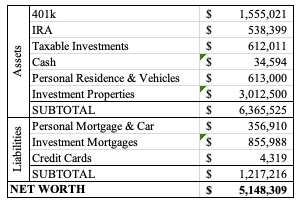
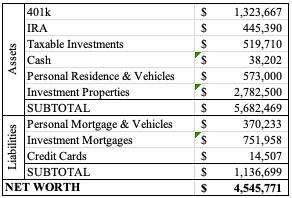
I got a new phone number and updated all my accounts before my old number was deactivated (lovely two factor authentication). One of my accounts (401k) updated my phone number, but that apparently didn’t correlate to updated the number associated with two factor authentication – ugh. I need to address that, and for the time being, that’s just a placeholder number that I guessed based on Mr. ODA’s 401k increase over the last month.

April Financial Update

We started getting emails about end of school year activities, and boy was that a surprise that we’re at that point. The middle one is done mid-May and the big kid is done at the end of May. Less than 2 months until summer break.

Mr. ODA took the second round of the government’s offer for administrative leave, which means he would only have a few weeks left working. I’m still working my part time job, which is taking way more hours than we had planned for. I’m enjoying it, but it’s been a juggling act with the family, which is probably why my son who absolutely loves school begged me to stay home because his belly hurt last week.

Buckle up because apparently I have a lot to share this month.

RENTALS

We received about $600 in tax payment reimbursements from one of our localities, so that was a fun surprise this month. Really helps my psyche that I have a tenant who hasn’t fully paid, didn’t tell us why ahead of time, and hasn’t been up front with when she’s going to actually pay us.

I executed 2 short term leases. Both included a rent increase for their short term period; one house is increased by $75 and the other by $25. Luckily, both are here in the Central KY area, so we can flip it between tenants. One is scheduled to leave June 30th. That house will need new carpet in the bedrooms, and it’ll need probably a whole-house paint job again. They smoked in there, even though we covered the lack of smoking rule multiple times. I’d be more upset about it if the carpet hadn’t reached its useful life years ago. The other house leaves July 31, and I can’t even tell you where we’ll need to begin with that one. She made a wood feature wall without permission. She had a giant fish tank without permission. She spent a lot of time doing things that really weren’t an improvement, so I’m definitely worried about what we’re going to uncover in that house. Mr. ODA and I are talking about fixing it up and selling it. We may look for a short term renter so that we can sell it in the Spring instead of this Fall.

I had 2 other properties accept a rent increase that will go into effect later this year. I require 60 days notice for changes so that starting at the 30 day mark I can begin advertising it if needed. One house goes up by $25 per month as of June 1, and the other goes up by $50 per month as of July 1. I also have another property that has a rent increase of $50 per month going into effect next month.

I have 4 houses that renewed another year, and I didn’t change their monthly rent rate. There are 4 more houses that haven’t been discussed. My intent is to have them renew for a year at their current rate. There are 2 of those 4 that could leave at the end of this term, but time will tell.

We have multiple maintenance issues to address. One house requires a tree trimmed off the roof, the siding cleaned, and the back deck stained/painted. We still have termite damage we’re dealing with at a house in Richmond. I have a leaking toilet that was just addressed, and then they hit me with a faulty HVAC unit during a heat wave. Then we have some houses that really need eyes on them to see what condition they’re in at some point this summer back in Richmond. It’s amazing to me how people just don’t care to tell a landlord that something is broken. I woke up this morning to a text that one of the houses here has a flooded basement due to a water heater failure.

I spent some more time fighting my insurance guy here. It irks me so much when I see him offer up his services on the local facebook group for property owners. He’s quite terrible. I sent him photos of a house that had some issues with a cluttered backyard and had the tenant clean that up. I had to fight him last month on an increase where he changed one house from a crawl space to a basement when I assure you that the vines growing through the windows solidify it should not be deemed a “basement.” When the dust settled from that debacle that he was insanely unresponsive to, I ended up owing $9.68. When I asked why my account wasn’t put back the way it was found before this mess he created, he said he didn’t know but it’s probably from the audit and changing square footage. HIs guessing and not actually answering infuriated me. I gave up and paid it, but then I ran to get quotes from other people. I hadn’t done that before because our 4 claims in a 12 months period are killing us (again, because I really wanted trees to fall on us!). I hate when people make the claim that because it’s not a lot of money, I should just give up and accept it. That’s a ridiculous way to treat people.

PERSONAL

Our electric bill is almost double what it was this time last year thanks to the vehicle charging and hot tub. Our electric bill is relatively low, so that’s not all that surprising. We also have 5 full people in this house now (as much as you can count a 2 year old as a full person… but he knows how to control light switches and eats a ton of food that we need to cook him, so I’m sure he’s a factor there!).

I’ve been working at my new part time job for over a month now. Mr. ODA was making fun of my hourly rate, but I’ll tell ya, it felt good to receive a paycheck that wasn’t $45 like it was for a day of subbing at the preschool.

I took the kids to get haircuts. My middle has had her hair cut once before, but I’ve cut the boys’ hair forever. I had family coming into town and the oldest was looking really shaggy. So I swallowed my pride and threw money at the problem, which is very out of character in this household. I just didn’t have the time to cut their hair, clean them, and clean up the mess. For $66 and 45 minutes from the time I left home until I got back, it was well worth it to me.

I had a medical procedure done this month. We haven’t met our deductible. In February, they said I had to pay my deductible to them. I said that didn’t make sense and refused to have them hold $2800 of my money for 2 months. They gave me an attitude and said I could never ever ever ask for a payment plan in the future, so that I could pay $500 to hold the date. I then showed up for the procedure, knowing I haven’t met my deductible, and they didn’t take any money from me. Another business model that bullies the customer into illogical money decisions. I also had an eye doctor appointment that was frustrating in itself, but I’ll spare you those insurance and communication details.

On top of everything else I’m juggling, Mr. ODA is coaching our kids’ t-ball team. Coaching means that I am team mom. That means that I’m responsible for communicating updates from the league (in the slow and haphazard fashion I receive information), gather value card sales that are required of every team member, organizing a basket for a raffle, and the best one – raising $350 for team sponsorship. What the heck, man?! Where did I say that my signing up of two children to play in the league means I have history or ability to gather money from businesses?? Well, I did it. I raised $350 and another mom raised $200 for the team.

No financial impact, but I’m also juggling our HOA board duties. I released our longstanding property manager and hired a new company, which took effect April 1. That’s taken a lot of time to get them stood up and make sure we stay on track for our annual meeting schedule in June.

NET WORTH

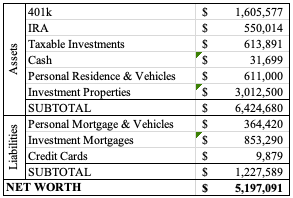
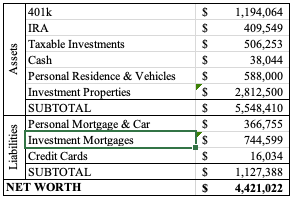
And with all of that said, that doesn’t even address the giant reduction in our investments that continues to happen. To counter some of the loss, I updated our property values for our houses. I don’t do that every month because they don’t move very much, but I can usually count on a few increases as the spring market ramps up. Our net worth did slightly increase (based on yesterday’s market closure, not today’s) from last month, which was a nice surprise.

I wonder why I’m tired and bogged down, but that post outlining what I’ve done recently made me realize all I was able to accomplish even though I felt like I was a jack of all trades and master of none. Hopefully things will settle down in our lives going forward now, even if I know there are definitely two house turnovers in my future.

January Financial Update

We’ve done a good job at enjoying time together this past month. We haven’t had a lot of expenses pop up, which was a nice reprieve. However, the market is much lower at this time this month than it was last month, so our net worth actually decreased. I keep focusing on the long term picture though, and our net worth is much higher than a year ago.

RENTALS

We have 13 rental properties. They were mostly purchased in 2016-2019, with one purchased in 2022. Most of them have sustained very little tenant turnover.

I had 4 houses not pay their full rent on time this month. As of this post, only 1 is still outstanding. They’ve had car troubles and have communicated regularly with me. While I’d prefer to see at least something paid towards rent by now, they’ve been with us for 8 years, and I know they’ll eventually be whole. They never take more than the month to get rent fully paid. Of the other 3 that were late, I only charged one a late fee. The others aren’t usual offenders and communicate up front, but this one has been more difficult to get rent paid from the time we purchased the house.

While looking back at last year’s January post, I must note that this past year has been fairly easy on the rental front. We’ve had a lot of frustrations and things to manage, but it hasn’t been as time consuming in the “people management” side of things. We had a few issues with a tenant that first moved in last winter, but they’ve been quiet since. We had 4 houses turnover tenants in 2024, with fairly little loss of rent.

PERSONAL

We have been battling snow for almost two weeks now, which is very unusual in Central KY. We’ve already taken the kids skiing twice this year. Even the baby got on skis! He’s 2, so I guess he isn’t such a baby anymore, but that’s the earliest we’ve put a kid on skis. He’ll slide down the mountain, but he doesn’t stand on the skis; he’s just squatting the whole way.

NET WORTH

Last year at this time, I was sharing that our goal was to reach $4 million. We were at $3.869 million.

Our net worth is about $66k less than last month. I don’t always update the value of our assets, so that’s a fairly static number. Everyone few months, I’ll check on the ‘zestimates’ though. Typically, we expect to see the total decrease in the winter months because there are less sales and less activity to raise the sale prices like you see in the Spring months. On top of that, all of our investment accounts (except one that increased by $22) decreased a bit.

We have a 0% interest credit card that has a balance over $12k on it. We also added a car payment, which we haven’t had since about 2015. Tesla was offering a 0% interest loan, so that monthly payment isn’t going away for nearly 5 years. Overall, our credit cards balances total more than $3k less than last month’s, which makes me happy to see.

July Financial Update

RENTAL EXPENSES

We took a trip to Richmond, VA to work on rental properties. It was fairly last minute. I had a schedule of work at each house that I planned. However, I didn’t plan on the heat index being 113 and 112 for the two main days we were there. I was able to get everything on my list done except for staining the new deck at one of the houses. I didn’t want to risk it not applying or curing correctly because it was too hot and in direct sun. Plus, the tenant didn’t even clear it off so I could work on it.

I had multiple houses pay rent late this month. I was surprised. One let us know on the 5th that they had an emergency, so they wouldn’t be able to pay until the 17th. I had someone pay half their rent early in June, but then haven’t received an answer as to why the rest of her balance ($345) hasn’t been paid yet. Another tenant misunderstood her maternity leave pay, so she asked for more time to pay rent. She paid $800 on the 7th. I told her not to worry about it, and just pay when she can, without the late fee; she only has $150 remaining.

I’m currently working through two roof replacements. One of them will be covered by insurance, but then I’ll be paying to have vents added, the chimney torn off and capped, and the soffits repaired on top of what insurance can do. Then the other one we’re paying out of pocket for. It’s original to the house, which was built 24 years ago. There has been storm damage to it over the last year, and it’s just generally time to address the age even though it hasn’t caused any problems yet.

PERSONAL EXPENSES

Our medical insurance company had some glitches in their claim processing through the first half of the year. Now they’ve caught up, meaning I’m paying large sums of medical bills. Mr. ODA took on booking lodging for his guys trip later this month, which meant that the second half of AirBnB payments were applied to the credit card.

Mr. ODA increased each kid’s UTMA from $75 to $100 per month. That means we’re investing $3,300 each month into accounts, on top of maxing Mr. ODA’s TSP contributions and both of our Roth IRA contributions for the year.

Our contractor has ghosted us on our own deck build. We bought some new furniture for the main deck area. Once it’s not 100 degrees outside, we’ll work on doing the waterproofing of the deck ourselves so that we can start living on the patio under the deck and get that hot tub ordered this fall.

NET WORTH

I updated the valuation of the houses this month. I typically only do that 3 or 4 times per year. I try to account for the big increases we see at the beginning of the spring, and then adjust slightly around this time of year once the comparable houses have closed and sold. This update added $140k worth of equity into the equation. All of our liabilities decreased since last month, and all our assets increased since last month. That has equated to an increase of over $200k in our net worth.

The Mentality from an MLM

These days, you’re probably not immune to being asked to join or buy from a multi-level-marketing (MLM) business. Also known as network marketing, it a way for companies to sell their product through individuals who market product(s) to their sphere of influence. It gets a bad reputation with “pyramid scheme” and the like, but it’s legitimate and makes sense if you take the time to step back and learn about it instead of repeating the rhetoric you’ve heard from your parents.

Our experience with an MLM led to being open to buying rental properties, which eventually led to me quitting my job and being happy outside of a career. Here’s what I learned by keeping an open mind to an MLM, even though we make $0 from that business today.

This is my experience with our time in an MLM. Mr. ODA would probably have something different to say. 🙂

AMWAY

BACKGROUND

By now, you may have seen the documentary on LulaRoe. Our experience was with Amway, and it was different from how LulaRoe operates. Now, Amway is the black sheep of the MLM world if you go just based on name. They’re one of the original MLMs. But they sell good products in the health, beauty, and home cleaning genres. As a “consultant,” you’re called an “independent business owner” or IBO. I thought the best part was that there’s no inventory you need to hold. If you want to do “parties,” then you need products on hand. However, it’s much different than how LulaRoe would have hundreds of leggings on hand and makes direct sales out of their on-hand inventory. To earn money, you can recruit more business owners, or you can have customers who just order directly from the Amway website each month. You make money off of what your customers buy, as well as the income that your IBOs below you generate.

TEAM SUPPORT

There are multiple “teams” associated with Amway. It’s the education arm of the business. Our team met once a week, and you were expected to be there if you really wanted to be in-the-know and considered serious about growing. They helped you structure your business to take advantages of bonuses offered by Amway, and they taught a lot about having the right mentality. Their goal was to foster personal and business growth, provide mentoring and coaching, and provide the tools to grow your business through conferences and seminars.

This is where we got our start. I know it’s hard to believe, but we both were exposed to a lot of growth through this team. The things we learned through the meetings and books we read during these couple of years gave us the courage to make the big decisions we did, getting us to currently having 13 rental properties.

THE CASHFLOW QUADRANT

Our introduction to the business was started by being given Rich Dad, Poor Dad by Robert Kiyosaki. The book references an earlier book of his, the Cashflow Quadrant. Each quadrant has its strengths and weaknesses.
– The upper left corner of the quadrant is for those who have Employee mentality. This is someone who is trading time for money. You work an hour and earn $20. If you’re not working, you’re not earning. You’re making money in someone else’s system, and there are people over you who are making more than you (e.g., a supervisor is making more than a secretary).
– The upper right corner is for Business Owners. You own a system that works for you. You have passive income in this quadrant. You may have an employee that is generating income that you earn.
– The lower left corner is for Self-employed people. Here you’re still trading time for money, but you have control over how much you earn based on how much effort and time you put in. This is a risky area because you don’t have security and may not have an established system to rely on and project your income.
– The lower right corner is for Investing. Your money makes money for you. This can also be risky because you’re not guaranteed positive returns on your investments. If you want to make a lot of money, you need to take on more risk.

The point here, according to the team we were on, was that you want to be a business owner. You want to generate passive income so that you’re not trading time for dollars. While someone else is selling to a new customer, you’re earning a percentage of that sale while not doing anything. As you grow your Amway business, you have more and more people generating income through these sales, which you get a percentage of. The kicker is that you need to hit a certain level within your own business before you earn. We set up recurring purchases to use the products we were selling, and had customers set up with recurring orders, so that we could hit that threshold to be eligible for the passive income.

OUR MOVE FROM MLM TO REAL ESTATE

The biggest hurdle to our success was the price of the products. We aren’t someone who values a better quality to be able to justify the higher price. There are people out there that value this, but it’s not our passion. A peanut butter meal bar comes to $3.14 per bar as a customer order (as an IBO, you get the product at cost, which would be $2.82 per bar). The peanut butter granola bars we buy are $0.50 per bar. Clearly, this isn’t a marginal difference in our expenses. The products were good, but not good enough for our finances to take such a hit. I tried to focus on the beauty side of the business and held parties where I recommend products and let women try it. I had passion behind it, but I wasn’t someone who washed my face regularly and put lotion on. I could see the benefits, but I wasn’t practicing what I preached, and I lost my drive.

The next hurdle was location. Our original meeting was with our specific team within the larger team (based on your “pin level,” you had a meeting with the people who were your “downline.”). We moved down to Richmond, and our closest meeting was Fredericksburg. It wasn’t insurmountable, but it was a 40 minute drive there and back once a week. The larger team would all come together in DC every quarter for a conference. We felt like time started moving faster, and we weren’t close enough to make these our friends between conferences, and so we stopped attending the big conferences. Then we stopped attending the weekly meetings. Then we cancelled our team membership. We still maintain our Amway IBO number, since it’s just $62 per year to do that.

The thought process that we learned from their weekly teachings and reading books we probably wouldn’t have read otherwise led to our desire to generate passive income. Mr. ODA had already been interested in the concept, and then when we were talking about venturing down that path with our Realtor selling our Northern Virginia home, he really got the urge to pursue it.

When we sold our Northern Virginia home, we had about $120,000 in our bank account. About $70k of that went to the downpayment and closing costs of our new house. The remaining went to finding a rental property… or two.

REAL ESTATE, PASSIVE INCOME, AND NO JOB

Real estate is in the business quadrant, but it’s not completely passive income. Truly, the Amway business wasn’t completely passive because you still needed to have the sales (either through your purchases or customer purchases) to be eligible to earn all the passive income available to you in the business. Most months with real estate, I take the rent money, pay out our mortgages, and that’s it. Sometimes I need to make some phone calls to contractors. However, we have to do very little to maintain our business of investment properties. We can also decide that we don’t want to field the phone calls and hand off the rest our properties to a property manager for 10% of rent. If we don’t have a new property or a property to turn over, then we probably put about 100 hours per year into managing the houses.

We knew we didn’t want to be in the employee mentality for the rest of our lives. Funny, because my goal when I was in college was to work for a “big 4” accounting firm and spend 80s hour per week at work. Then I started working for the government, and my goal was to be CFO in my 30s. Then I got to the headquarters office in my late 20s and hated the environment, so I decided I wanted to be no more than a state office’s financial manager. Then we had kids, and I decided I wanted to be home with them to see all the little moments. Things sure did evolve.

I believe that the time we spent with our Amway team changed my heart. I believe that time was important for me to see a different lifestyle and a different mentality. I don’t know that I would have seen the benefits of pushing ourselves to buy more rental properties had I not seen a lifestyle of entertainment.

I started to realize it would be nice to spend time with my family while the kids were little. Who wants to wait until retirement to spend time at home, when your kids are grown and moved out of your house? Why not spend the quality time in their early years? Let’s travel more and experience more in life. Let’s have more time with the kids than the hellish hours of 5 pm to bed time.

Our cash flow each month is about $7k, just based on the rental properties. That doesn’t include expenses that come up, and every once in a while we get hit with a major system that needs replacement, but most of the charges are a couple of hundred dollars here and there. Some days, I wish I could still do what I loved to do in the transportation world, but I don’t miss the office politics and the moderately strict work schedule.

I’m happy for all the experiences that have led me to this point in life. Perhaps you can read Rich Dad, Poor Dad or Cashflow Quadrant and learn a little bit more about all the options out there. Perhaps you just didn’t know that there are opportunities out there where you’re not trading time for money, or where you’re not cushioning the pockets of an executive while you make a certain salary. Perhaps you just needed your eyes opened to the chance to make your money work for you. Or, perhaps you’ll learn that you like the stability of being an employee, and you don’t want to change. But I urge you to take a look at the options and see what works best for you, now that you’re away that there are options.

Leveraging Money – Mortgage is not an ‘Eight Letter’ Word

Dave Ramsey has convinced (too many) people to pay off their mortgage and be “debt free.” Then you have Robert Kiyosaki telling people not to buy a house because its a liability, but never seems to address that you still have to pay for a roof over your head somehow. We subscribe to a different view – make your money work for you. There are certain types of debt that could truly benefit you, and a mortgage is one of those.

If we worried about paying down our mortgage, we wouldn’t have near the savings and investments we do, and wouldn’t be able to establish enough rental income to replace Mrs. ODA’s income, and being well on our way to replacing Mr. ODA’s. 

We lived below our means, took some loans, and bought a house in one of the more expensive regions of the country – DC suburbs (oh, and while paying for a wedding). We knew we’d have no trouble qualifying for a mortgage and paying the monthly payment, but we didn’t want to pay Private Mortgage Insurance (PMI), which meant coming up with 20% to put down (i.e., about $80,000). In fact, we were pre-qualified for double the purchase price of a house than we were comfortable with because we were more focused on our down payment threshold than what we could support as a monthly payment (which is how a bank will pre-qualify you based on your other monthly debt payments).

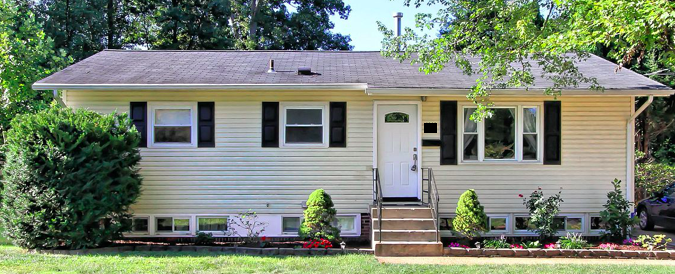
Our first, expensive, little house that jumpstarted our investing before we even knew

Our primary goal to enhance our savings in the months leading up to the house purchase was to keep the cost of our daily food intake below $10 between the two of us. We were cautious with how we spent money on groceries, whether we ate out (meaning no buying lunch during the work day), and the types of activities we did. While most of our meals consisted of macaroni and cheese and pb&j, we did ‘splurge’ a little more once in a while (read splurge as meaning “2 for $20” at Applebee’s, not steak dinners). That year of actively watching what we spent paid off in ways we wouldn’t know down the road.

Three and a half years later, we sold our house for a $60,000 profit and purchased a home in the Richmond area for less than what that first house cost us when we bought it. That left a substantial balance in our savings account that needed to get to work. 

We’re not interested in preparing for doomsday. In an emergency, there’s hardly anything that can’t be put on a credit card. If we can’t pay off the credit card, we have money in the stock market that can be liquidated within 24 hours to pay it. This perspective is particularly possible because we live a lifestyle that allows for a high savings rate while Mr. ODA is still W-2 employed, which means we’re even more unlikely to need stock liquidation to cover expenses. We weigh the risk of a possible emergency against not having our money make more money, which gives us the ability to live less conservatively. Since we’re not interested in maintaining 3x our monthly income in a savings account at 0.01% interest rate, the next option to discuss is paying down our primary residence mortgage. 

Our mortgage rate was 2.875%, a very cheap lending rate [this was a 5-year Adjustable Rate Mortgage (ARM), a topic we can discuss in a future post on weighing mortgage options]. The question we had to ask was whether paying down the mortgage at a low interest rate was more beneficial than the income we could bring in with a rental property. If we paid more than 20% for our new primary residence’s down payment, was that going to provide us a greater cash flow to leave our careers before typical retirement age? 

No, it wouldn’t allow us to leave our careers. So, we put the balance of money from the sale of our first home into the stock market and investment properties to make it generate income instead. 

Our first investment property purchase was in February 2016. Since then, we’ve purchased twelve other investment properties, with the most recent two being in September 2019. Mrs. ODA’s income was replaced by our rental property cashflow by the time our son was born in August 2018; that’s within 2.5 years after we purchased our first investment property. 

Of our 12 investment properties, two have mortgages paid off. First, there’s a maximum of 10 mortgages you can have when lending under Fannie Mae. There are ways around this in theory, but that’s another post. One of the mortgages we paid off because it had a balloon payment coming due. Another mortgage was paid off because it had a low balance and was one of the higher interest rates among our properties. Currently, we’re working to pay down two other mortgages due to their relatively high interest rates (5.1% and 4.95%), and each have a balance around $26,000 now. We’re choosing to pay down mortgages in this season instead of purchase new rental properties because we are not finding properties in decent condition that meet the 1% Rule. Plus, not having a mortgage on a property immediately increases your cash flow if you want to live off that monthly income rather than W-2 employment. 

Had we chosen to pay down our primary residence mortgage instead of leverage our funds through mortgages, we’d still have a mortgage payment of over $1,500 per month and no other income strings. Instead, we still have a mortgage payment for our primary home, but we also have the cash flow that replaced Mrs. ODA’s six-figure income.

Choosing Properties

Choosing Properties

Mr. ODA has regular emails come in with new listings in the areas we’re interested in. While some of our houses are 2 bedroom, we find it easier to rent 3 bedroom houses. We also are looking to the possibility of resale, which is better for the 3 and 4 bedroom houses.

First, we look at the condition of the property. We’re interested in properties that can be immediately rented, meaning we’re not looking for remodel projects. Most of our properties purchased required no work to prepare it for a renter, and they are typically recently updated. When I say these houses were recently updated, they weren’t top-of-the-line finishes.  Here’s an example of one we purchase 4 years ago, and the pink knobs are still there!

There are a few properties that took slightly more work. We purchased one property that required a whole-house paint job (including trim work) that took a week doing it myself. We also attempted to rent another property with old carpet on the main floor. The potential renter asked if we’d be willing replace it or refinish the floors; we ended up taking a week to refinish the floors, which has paid off in the long run.

Typically, we’re going to replace appliances, paint, and scrub the place down to prepare it for renting. We’re not looking to overhaul the building or do massive capital improvements for that first renter. However, I’ll note that it doesn’t mean we don’t eventually do that. Just this past year, we had several roof replacements/repairs, plumbing replacements, and HVAC repairs.

We want the house to be in good condition to keep a renter there (we’ve actually had very low turnover), make it easy to re-rent it when there is a vacancy, and to make it attractive for any future sale. We’ve noticed that homes that were typically owned instead of rented are in better condition than if it was managed by a landlord. We seem to struggle wanting to move forward with houses that are currently rented because of all the deferred maintenance.

We have been under contract on multiple houses that we walked away from after the home inspection (e.g., knob-and-tube wiring, vertical clearance requirements on stairs, remnants of a previous fire found, poor patch work). Don’t feel like you’re in too deep if the inspection comes back to show a lot of improvements are necessary. It’s a hard mentality to talk yourself (and your partner) through because you’ve spent time looking at the house, reviewing rental comps, possibly reviewing current lease agreements, and spent the money and time for the home inspection. But keep in mind that it’s not worth purchasing the house and spending more than you’d like to keep the house standing and rentable.

Then, in broad strokes, we’re watching the 1% Rule. This means the monthly rent should be 1% of the purchase price (e.g., a purchase of $100,000 house should yield $1,000 per month in rent). Review current rent prices in the immediate vicinity. We’ve purchased houses in areas that have several rental properties, so it’s been fairly easy to identify a rate based on the number of bedrooms and bathrooms, as well as the amenities we can offer (e.g., appliances, lease term, parking availability). In future posts, I’ll provide the details of each of our purchases.  

Here’s a break-down of our current properties related to the 1% Rule. 

You can see that we didn’t hit the 1% on 5 of them. The first had a tenant when we purchased it 4 years ago; we’ve risen the rent once and plan to raise it to $1200 at the renewal term in July (so raised the rent $50 every two years). The bottom two were in a market that we were unfamiliar with, and even though we thought we would yield $990 easily for rent (yes, is still below 1%), the houses were in excellent condition, so we looked to the future value in the decision making. Unfortunately, we didn’t close on these until September, which is difficult to find renters. We didn’t have many showings at ~$1,000 rent. We ended up lowering the rental price by offering an 18-month lease so that the future rental timeframe was in the spring, and we offered the rest of October as free.

Mr. ODA developed a spreadsheet to calculate all the costs associated with owning the house, which helps determine whether the house fits our portfolio goals, especially if it doesn’t exactly meet the 1% Rule. This spreadsheet makes assumptions for routine maintenance costs, capital improvement costs, vacancy assumptions, insurance, mortgage interest, etc. Calculate the monthly rent less than the monthly cost of each of these assumptions to arrive at the monthly cash flow. Annualize the monthly cash flow, and then divide it by the down payment and closing costs to arrive at a ‘cash-on-cash’ return, which we’re looking to be at least 8-10%.

Next, we examine the neighborhood. We have thresholds for prospective tenants, which typically yields to a middle-of-the-road neighborhood. We’re not looking for a perfect, upscale neighborhood to own a rental because these types of homes rarely meet the 1% Rule. I utilize Trulia to examine the crime rates of the area. We want to offer homes that are in reasonable city locations.

I had fully vetted one house and determined it was worth our purchase. A similar house, with an upgraded kitchen, was for sale a couple of blocks away. I assumed it was the same neighborhood and didn’t do my due diligence. The house showed very well online, and we had several showings from qualified individuals, but then they’d check the house details, only to find out that it was in a high crime zone. We ended up having to lower our credit score threshold to find a renter (compensating with additional security deposit), then had difficulties for over a year collecting her rent, which really should have been expected. We have since sold off that property. 

If all these steps, including the cash-on-cash evaluation, should take about an hour. If we get this far, we go see the house. If the house is in the condition we expect it to be based on the pictures, we make an offer. Our Realtor will write up that offer the same day. Recently, many houses have been in a multiple-offer scenario. This is another trap to not get sucked into. After so much time vetting the house, it’s easy to be attached, especially if you find very favorable data (e.g., you can get rent higher than 1%). It’s not worth owning the house if you have to purchase it at a higher price than you’re comfortable at; it must be a business decision, purely based on the financials.

Keep an eye on listings daily or weekly to keep a pulse on the neighborhoods you’re interested in, evaluate the property condition, consider the 1% Rule and evaluate the detailed financial cash flow, don’t skip the home inspection nor should you ignore the results of it, and keep it a business (not emotional) decision.