December Financial Update

I’m not even sure where to start for this month. It has been a whirlwind. There were a lot of tax payments last month, and this month I was still paying those among several other things.

PURCHASES

I purposely paid my credit card statement a little earlier than the due date so that it wouldn’t be that high for this update, but then I put a bunch of charges on it over the last two days. To catch you up – we’ve been holding money in our savings account for as long as possible. When we were getting 0.2% interest on it, it didn’t matter when I paid the card, so I typically paid it shortly after the statement closed. Now that we’re getting 4.22%, it’s worth keeping the money in there to earn interest, and then paying the credit card closer to the due date.

Our regular-use credit card is currently holding: $300 towards my dad’s iPhone (I should really share that mess of a story in purchasing that) (also, that doesn’t clearly account for my sisters having paid $200 towards that because that’s just “cash” in our checking account balance), $500+ of the kids preschool tuition, renewing our zoo membership for $139 (honestly, 5 of us enjoying the zoo for the year for that price is wonderful), over $200 for signing our son up for tee ball, two car insurance payments, and a rental insurance payment. I don’t typically go through the charges like that, but it’s just been a bunch of just-big-enough charges to grab my attention on our credit card balance. We drove to-and-from NY, so our gas station payments are higher than average too. As a reminder, the credit card balance you see also includes $10k worth of new carpet that we’re paying slowly on a 0% interest credit card.

RENTAL PROPERTY EXPENSES

I paid two of our Richmond houses’ taxes. The taxes are due on January 14th, but if I pay them this year, then it reduces what’s viewed as our ‘profit.’ I make sure to pay any known January bills in December of each year. Those two houses are so tiny, so their tax payments being so much larger than they once were kind of hurt (I’ve discussed the increases in property assessments, thereby increasing taxes). It was about $2,000 paid out (on top of all the things I paid over the last two months).

I also had to pay two supplemental taxes for Lexington. Government entities not meeting deadlines is a pet peeve of mine (I used to work for the Federal government). Last year, I completely missed that paperwork I received was a supplement bill for education, and then I received a penalty.I thought it was their typical assessment notice since it was outside of tax payment time. Luckily it was a few dollars, but I was so lost. This year, I paid close attention when I received an extra tax-related document. This supplemental bill was for trash services. Again, a few dollars. But think of all the extra paperwork, staff hours, postage, payment processing cost to collect an extra $20 from every house.

RENTAL PROPERTY INCOME

We had two tenants give us notice that they’re moving out. While extremely unfortunate timing on the year, I’m also human and understanding of their need. One tenant had a traumatic work event that led to him being laid off, and another family bought a house. We’ll find a way to get the houses re-rented as soon as possible, even though our vacancy time may be longer than it would have been if we were looking for a May 1st or June 1st renter. We have someone interested in both houses at this time, so that’s encouraging.

We had 4 tenants not pay in full. They all reached out to me to let me know in advance, and they paid what they could by the 5th (I always appreciate that – it holds them accountable, and it allows me to not foot all of the bills that I have to pay on the houses). As of the end of the 5th, we were short over $3,000 worth of rent ($1300 of that was for the house that has been late since October 1st and is finally working towards paying their debts).

As of today, we’re short $2,400. The tenant who’s playing catch up only has a balance of $960 left, which is great (that’s been a long road). Another tenant typically pays $750 on the 5th and 19th. So they’re not late on $750, but they are late on the $375 they didn’t pay in the first half of the month (this is a special scenario that we put in place for them because they couldn’t pay all at the beginning of the month, so we increased their rent as a concession to being able to pay twice per month without creating more late fees for them… but they’re still late).

NET WORTH

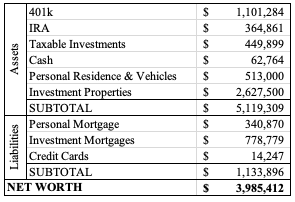
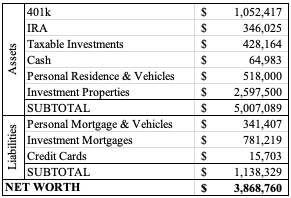
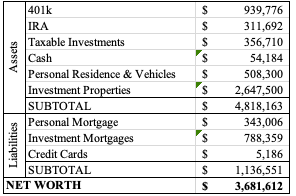
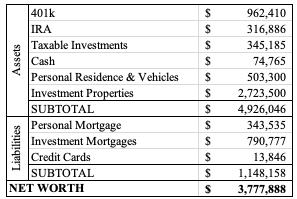
The market significantly increased over the last month. We also had $28k come in as part of our insurance claim; our cash increased by $35k though, so there’s an additional savings in there. And even though we had large expenses on our credit cards, it’s still slightly down from last month.

BONUS STORY

Mr. ODA and I wait for Black Friday deals to purchase our iPhones. We typically purchase every 3 years. I usually bite for a new phone so that the camera is better, but I’m suspicious that Apple is sending updates to alter the clarity of photos on older phones. How can I take these BEAUTIFUL pictures for the first few months of having a phone, and then all my pictures are grainy suddenly? ANYWAY.

Walmart had a deal that you purchase the iPhone 14 on a payment plan, and they give you a $350 Walmart gift card. These are the deals we typically seek. Apple is still getting their full price for the phone, but Walmart is offering a deal to bring our net to $0. When you want to purchase the phone from Walmart, it asks you to log into your carrier’s account. For this phone, it’s Verizon. We spend hours trying to figure out who the primary account holder is and what that log in it. Verizon does it where you can create your own log in and see you phone’s data at any time, but to see the entire plan’s data, you have to be the account holder (makes sense, but complicates this particular instance). The primary account holder is my mom’s phone number. Who died in March. We finally get assistance with that and log into the account through Walmart. It brings up all the lines on the account, we select my dad’s number, and then it gets to step 2. It says they can’t verify the address on the account and we need to go to Walmart mobile desk in a store. I call Verizon. Can’t help. I call Walmart. They keep telling me to put the item in my cart, which isn’t how you purchase a phone. So no help.

I finally bite the bullet, and on the Saturday after Thanksgiving, march myself to the nearest Long Island Walmart. They can’t help because they need the phone in the store. I swear if I were at my Walmart in Kentucky, they would have helped me. It was actually at the point where I was going to risk waiting until Tuesday so that I could have my phone desk people help me. The Walmart employee actually wasn’t flippant or trying to blow me off; I believe he genuinely thought he couldn’t help me. What needed to happen was that he called their help desk people, and then he was the mediator to figuring out the address. I figure this because a Walmart customer service person transferred me to such a person, who said he’s not allowed to talk to me and has to have a Walmart employee talking to him on my behalf.

I gave up. Sunday comes. I hope that some “overnight” processing of information has magically cured the process. It didn’t. I call Verizon again. Some angel of a lady answered the phone and actually helped me more than I could have imagined. I told her that I wanted the Walmart deal because all the Verizon deals require me to change my plan to unlimited data. I let her know that I’ve already spoken to several people, and they keep trying to convince me that I get a “free” iPhone while my plan increases $30 per month in perpetuity (versus $23 per month for 36 months for the phone). She offered me a deal that equates to $5/month for the phone for 36 months. So I put 100x more hours into this than I should have, but it ended up working out in our favor!

Rental Cost Changes from One Year Ago

I keep updating my investment property tracking spreadsheet to reflect the current costs of insurance and taxes. My tracking shows last year’s amount, which I use as an indicator on whether I need to look further into this year’s bill (e.g., is the amount a reasonable increase?). For so many years, most of our insurance policies changed by a few dollars; now, I’m seeing large swings in what’s being charged. Where jurisdictions were slow to change property assessments, they’re now catching up, which increases the taxes.

As a renter, your rent is increasing to cover these costs of the landlord/owner. Here’s a comparison of my fixed cost increases against my rent rate increases. As you’ll see, I’m not trying to get top dollar out of these properties because the market has increased so much (and that leaves me more exposed if someone doesn’t pay their rent on time). My rent increases barely cover the cost increases that are happening on some of these houses. Remember that while I’m showing fixed costs, this isn’t covering the maintenance calls that I receive and how they’re more expensive than they once were also.

ESCROW, CONCEPTUALLY

In most cases, for a traditional mortgage, an escrow account is set up. It calculates your taxes and insurance payments for the year, divides by twelve, and is added to your principal and interest payment for the mortgage. In addition to covering the total payments to be made, there’s also a requirement that the balance of the account never falls below twice the required monthly payment.

If your taxes owed for a year are $1500, and the insurance is $300, then your monthly breakdown is $150 ($1500+$300=$1800; $1800/12=$150). The minimum monthly required balance is $300 (twice the $150).

As taxes and insurance increase each year (typically), there’s an analysis done to ensure the projected monthly balance never falls below that $300 threshold. If the balance is projected to fall below the required minimum amount, then it triggers an increase in your escrow payment. Your escrow payment will increase to cover the shortfall, but also to cover the new projected costs to be paid. So while you may be offered the ability to make a one-time payment to cover the shortfall, your mortgage payment may still increase to cover the projected costs. For example, if last year, your tax payment increased to $1750, and your insurance to $350, then your monthly payment to cover those charges is $175 ($1750+350=$2100; $2100/12=$175). Your mortgage will increase by $25 per month because now your escrow agent knows the projected costs to cover are higher.

The analysis uses the current year’s amounts owed to project the coming year’s monthly balances; it doesn’t account for the probability that these amounts increase each year, which essentially means that there’s perpetually a shortfall. In other words, while in Year3, they know that there was an increase in costs from Year1 to Year2, they don’t inflate the costs of Year2 to cover Year3 projected payments.

I prefer to not have an escrow, but at this point, for any mortgages we have, they’re all escrowed. We have six of thirteen houses with escrow. While I pay more as my mortgage to feed into that escrow account, it means I don’t have to manage the annual or semi-annual payments. On the contrary, this means I need to be managing our finances to prepare for large outlays throughout the year on seven houses (in the last quarter of the year, I’m paying out over $8,000 to cover taxes owed).

ESCROW REANALYSIS

This post was prompted by a notification that an escrow reanalysis was done on a mortgage that was just transferred to a new company. I thought that their break down was the most clear I’ve seen. A quick note – your escrow will pay the bills that come due, regardless of the balance in the account, even if it means it’ll overdraw the account.

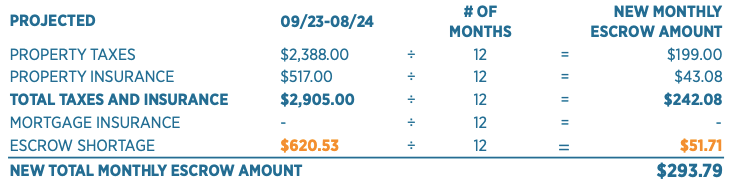
They clearly showed that the anticipated property taxes are projected at $199 per month (although, I’ll reiterate that this is based on last year’s actual outlay numbers, which aren’t accurate for the coming year). Then they show that the taxes are $43.08 per month. They then go as far to show the total of these two required outlays. There’s verbiage that explains the required minimum in the account must be twice the total taxes and insurance ($242.08 * 2 = $484.16).

There’s another detailed breakdown of each month’s escrow income and outlay (that I don’t have pictured here) that shows the month that is projected to fall below the required minimum. That month’s account balance is -$136.37. The difference between the required amount of $484.16 and the negative balance of $136.37 is $620.53 (pictured above). When that’s broken down by month, it’s $51.71. Take the total taxes and insurance payments and add the shortage amount to get the new monthly escrow amount of $293.79, a change from $222.25.

Below, they show you that there is no change in the principal and interest payment, then it shows how the current escrow payment is adjusted to the new escrow payment, along with the shortage amount.

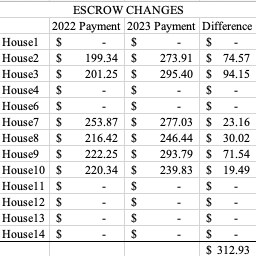
I created this table to show the differences between escrow payments over the two years. I kept the houses that don’t have an escrow because it can be compared to a future table in this post. There is no House5 in this table because we sold it several years ago (houses didn’t get renumbered because House5 still exists in terms of tax documentation).

TAX AND INSURANCE UPDATES

Each year, we see an increase in these amounts. Usually it’s across the board, but Kentucky districts had kept the housing assessments the same through the pandemic. As housing prices increase, your property assessment can be increased by your tax jurisdiction. The assessment increasing leads to an increase in taxes. This is why people getting excited that house prices in their neighborhood are selling higher than expected isn’t great if you’re not planning on selling any time soon; those increases in values means you’re paying higher in taxes.

In Richmond, VA, the property taxes are $1.20 per each $100 of the assessed value. In 2022, House2’s value $163,000. In 2023, the value was increased to $203,000. And let’s not forget that we purchased the house for $117,000. While it’s nice that the home values in the neighborhood are increasing significantly (and we knew the area was going to get better and better based on development happening), we can’t realize this gain until (and if) we sell. So in the meantime, we’re paying higher taxes on this amount. Although, I suppose the assessment could be even higher because the actual value of this house is probably more like $260,000.

Among 13 houses (don’t get confused – there’s no House5 up there because we sold it), I need to cover a total cost increase for taxes and insurances of over $4,500. This doesn’t include the higher costs of trades people if there are any maintenance calls, so this increase is the bare minimum for me to keep my same income.

RENT INCREASES

I constantly see complaints about the cost of rent, or that a landlord is increasing rent. Unless we’re looking for a tenant to move, our general philosophy is to increase rent $50 every two years. This worked fine because home assessments increased at a slow, reasonable rate until recent years. Now jurisdictions are capturing these larger increases based on those inflated sale numbers when competition was high in from 2020 through 2022.

In some cases, the rent for the area brought it in a higher amount than compared to our purchase price of a house. In those cases, we went several years without increasing the rent. Looking back, that probably wasn’t the best idea because now we’re behind on capturing how significant these last few year’s fixed costs have increased. However, the trade off to that is that we’ve kept great tenants in the house, haven’t had to pay to turnover the unit, and have minimal maintenance calls.

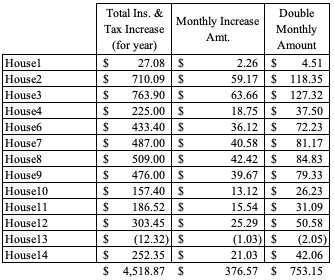
This table shows the total increase in insurance and tax payments from 2022 to 2023 in the first column. I divided that by 12 to get the monthly amount of that increase (second column). Then, since I said we typically increase our rent by $50 every two years for the same tenant, I multiplied that monthly amount by 2. I’m showing that if we want to only increase rent on long term tenants every other year, then I need to plan ahead on how much my costs are increasing.

This isn’t a perfectly accurate capturing of our cost increases since I’m not going back to 2021 to capture those changes in amounts, but it’s a general estimate. This shows that if I were to increase all houses by only $50 every two years, it’s cutting into my bottom line. Only 6 of the houses have increases less than $50 for two years.

SETTING THE RENTAL RATE

Let’s pause and talk about “bottom line.” Landlords have investment properties to make a profit. They’re looking for an income stream.

I regularly hear people say they can own a house for less than their rent, which is likely if you’re speaking only on principal and interest of a loan. However, you need to qualify for that loan. You may not have 20% down, so you may be required to pay private mortgage insurance (PMI). You may not have good credit, which means you’re probably going to pay a higher interest rate than I’m currently paying. You need to be able to cover taxes and insurance, which means you’ll have an escrow account set up, which increases your monthly mortgage payment. Then there’s all the other costs of home ownership.

That’s where people forget. When your hot water goes out, you call me. I spend $1,500 for about 2 hours worth of someone’s work to replace that. When you have a water leak, I spend $3,000 for a day’s worth of 2 plumbers’ work. When a storm drops a tree on your house, I’m the one spending hours on the phone with insurance, finding a contractor, getting quotes, and paying the contractor $3,700 before I get insurance reimbursement. Those are the big unexpected expenses. That doesn’t include all those smaller plumbing problems that cost $200 or $500 at a time.

Then in some cases, I probably put time and money into the house to even get it ready to rent to you. I didn’t always buy a house that was ready to live in. You may have projects that need to be done when you first move in also, so which costs money. Those are expenses that I’m trying to recoup through my rent rate also.

There may be other costs to my ownership that I’m trying to recoup through the rent, such as property management. I may have to pay someone else 10% of the rent, every month. I am projecting that there are going to be costs that I need to pay for also (e.g., water heater, roof replacement, plumbing issues). When I need to pay a plumber $3,000, I’m not coming to the tenant to say “I now need $3,000 to cover this cost.” Instead, I’ve set my rental rate the expect such a large payout on my part.

Not only am I trying to make sure that my rent is set at the right about to cover the costs that I’m putting into owning and maintaining the house, I’m also hoping that I’m going to make some money off owning this house so that I can live. I don’t get to pay myself for the hours I put into managing the property. Whether or not I have a property manager, there is still time that I put into managing the houses. Would you want to work for free?

BACK TO RENT INCREASES

While we manage each house individually on setting the rates (asking ourselves: do we think the tenant can absorb the increase, do we have to increase to cover actual costs now), this shows that our monthly income was increased by $475. If you look back at our total monthly increase in expenses of just taxes and insurance, it’s about $375; add in the cost increases for property management (increased rent means increased fees because fees are based on the rent price), and our fixed costs went up $415. On a whole, we’ve offset the increases.

However, you can see if we had one or two houses, some of those increases could be significant. House3 is costing us $64 more for each month, but our increases are typically about $50 at a time. We’ve had the same tenant in this house since we bought it. A $50 increase every two years hasn’t kept up with our costs. Since we have other houses, it helps cover the costs on House3.

House2 and House3 are identical in layout. House2 has been upgraded to all LVP, whereas House3 has carpet everywhere except the kitchen and bathrooms (granted, it’s new carpet two years ago). Since we purchased these two homes with tenants, rent was already set for us. House3 has been the same tenant since we bought the house, and the increases have brought us to $1200 per month in rent. House2 has been turned over 3 times: the first was a divorced lady who moved back in with her ex-husband; the second was there for several years, but we began having a lot of issues with her, and we told her the lease was up; the third was the one who flooded the house in December, and causing the need for the fourth. Now we’re renting that house at its market value of $1600. That means House3 is operating at a much lower rent than we could get if we rented to new tenants. However, the tenants are wonderful, and we’ve purposely not raised the rent on them in significant ways because we don’t want to cause them to move.

SUMMARY

Cost increases in rental properties can be significant over the years. With the rising costs of all goods and services, property values weren’t immune. The increase in property values leads to an increase in an assessment, which means an increase in taxes. That cost is relayed to the tenant, as this is a for-profit business. I’m trying to make an income for my family with rental properties.

I’m not trying to price gouge tenants, but make a fair living based on the costs of owning these houses. My first goal is to not turnover tenants, so I do what I can to make my tenants happy by taking care of the houses and not creating drastic rent increases each year. Secondly, I’m not going to set a price that my tenant can’t afford, thereby putting me in a hard position where I don’t have rent paid. Having multiple properties helps to offset the costs so I don’t have to play catch up on one or two houses worth of higher expenses, by putting my long-term tenants in an uncomfortable position where they can’t afford the rent.

November Financial Update

A day late, but here we are. The market has gone up a bit, so that helped our net worth increase, even though we had a $10k increase in our credit card balances because we replaced the carpet in our house. Again, we opened a new credit card for this large purchase, which will give us 15 months of 0% interest. While we could pay the balance now, it’s a strategy to allow us to keep more liquid cash and earn interest on the money.

We have a tenant that only recently paid October’s rent, and has paid about $200 towards November rent as of today. I’m frustrated, but I have another post that will go into all the details for that. I can be understanding and work with you, but only if you talk to me. She doesn’t communicate, and she hasn’t upheld any part of what she said she’s going to do about payments.

I had one tenant ask me about moving out early, but we haven’t pursued anything yet. I have another tenant who is under contract on a house, so we’re waiting for notice from them. We knew they were looking for a house to purchase, so we structured our lease to allow them out of the lease at any time. It’s unfortunate for our timing that it’ll probably be a January/February rental now, but I’m happy for them moving on to their next phase of life.

I had to pay two small tax payments to a local jurisdiction this month, and then also paid taxes on one of our properties (luckily they still take credit cards with no fee, so we get rewards for that payment!). I’ve had to pay several medical bills (for myself) over the past month, which has been annoying. All that money to bills, only for there to be no answers.

We went to a local ski mountain to look for ski boots for my new-to-me skis that I purchased. In the process, we ended up buying the two older kids skis and boots, along with season passes for the family. So medical bills, ski equipment and passes, tax payments, and Christmas gifts have our credit cards high now (even without the 10k+ for carpet).

Home Sale Proceeds

*This post was started in November 2022, but our son was born 3 weeks early (and on Thanksgiving), so it fell off my radar for a long time while I caught back up. Let’s dive in now.

We sold our primary home at the beginning of November to move a half hour away and closer to family. It was a new construction home, and we purposely sold when we did to avoid capital gains taxes. If you call it your primary residence for 2 of the last 5 years, you’re exempt from capital gains. Considering the market over the last two years (2020-2022), we were slated to owe a hefty penny if we sold before that 2 year mark.

Had we sold earlier or perhaps waited for the spring, we could have made more. Instead, we opted to be rid of the home, not try to rent, and be able to have that behind us. We were extremely fortunate that we were under contract by the end of the first weekend we listed. The market had cooled significantly from the multi-bid, exorbitant pricing, with appraisal waiving language days.

We only had 2 showings. The first politely let us know they wanted a walk-out basement. We had an amazing basement with 9′ ceilings and no soffits, but it didn’t have a door due to the floodplain. We don’t really understand why, but the backyard was definitely low enough for it to have been a walk out basement. It was one of the red flags that made me uncomfortable living there, along with a long delay for construction on our lot and a few around us due to extensive sink hole surveying. The second showing made us an offer 10k below asking. We sort of split the difference at $495k, and they accepted.

There were several houses listed in that neighborhood for weeks after we closed, that were listed the same weekend as us, so I am eternally grateful that the stars aligned for what we wanted/needed.

PROCEEDS CALCULATION

We purchased the home for $346,793 in November 2020. The contracted purchase price when we sold was $495,000, which was completed in November 2022. That’s a difference of $148,207, but that’s not “take away” money.

As the seller, you’re typically responsible for paying out the Realtor commissions. They’re typically 6%. We asked our Realtor if she would drop it to 5% (buyers agent gets 3%, sellers agent gets 2%) since we had drawn up our purchase contract sight unseen and this was the 4th commission based transaction she had from us in less than 2 years. She agreed. I truly don’t like asking someone to take a lower commission, but due to there being several transactions in a short period of time, many not even needing much effort (showings, phone calls, etc.), I accepted Mr. ODA’s plea to ask. That comes to $24,750 paid in Realtor commissions.

We then have to pay off any loans that used that property as collateral. We had a mortgage and a Home Equity Line of Credit (HELOC). We had put 20% down on the purchase, so the mortgage had about $266k left as the balance. The HELOC had been used for a couple of other things than just the down payment on a new home, and it didn’t require principal payments on it while we had it, so that balance was about $86k.

We walked away from the closing table with about $117,000 after tax offsets and such.

PAST DETERMINATIONS FOR WHAT TO DO WITH THE PROCEEDS

In July 2012, we purchased our first home for $380,000. We put 20% down; it was a foreclosure, but the only work we had to do was on the main floor bathroom. When we sold that home Fairfax, VA for $442,500 in October 2015, we paid off a car loan and bought our second two rental properties in Richmond, VA. The car loan was only at 0.9% interest, so it didn’t meet Mr. ODA’s requirements to pay down loans with higher interest rates, but it did alleviate one monthly payment I had to manage. The irony of that statement, now that I manage 14 houses worth of payments all year. We also used those proceeds to put 20% down on the purchase of a new primary home outside of Richmond, which had a purchase price of $359,743. We paid off House1’s mortgage because the loan had a balloon payment that we needed to be ahead of.

When we sold that Richmond home for $399,000 in September 2020, we took about $109k away. We used those proceeds to put 20% down on the purchase of our new home, at $346,793, outside of Lexington, KY. We paid off House4, House6, and House13. Since paying towards a mortgage and not paying it off doesn’t change your monthly cash flow, we focused on where we could eliminate a mortgage payment. We’ve since paid off House11 and House12. House12 had a high interest rate, so we were interested in eliminating that as fast as possible, even though we were paying for it with a partner.

WHERE DID THE MONEY GO THIS TIME

We purchased our current primary home last summer and put work into it. Since we purchased it before selling our house, we used a HELOC to pay for the down payment. That meant that when we walked away from the closing table, the money we were putting in our bank account had no distinct purpose (like in the previous cases where we had to use some of the sale proceeds to buy another primary house).

The first thing we did was open a high yield savings account. At the time, it was necessary because our savings account wasn’t paying market rate. I remember Mr. ODA complaining that interest rates on loans were increasing, but it wasn’t being shown on savings interest side. He found a high yield savings account that gave a sign on bonus (we like that ‘free’ money!). We put $50,000 into that account, earning over 4% interest. The money in that account was removed and put into our regular savings account, which is now earning over 4%.

Since the money didn’t have a purpose, we needed to get it into the market. If we put it all in the market at once, then we’re subject to a lot more fluctuation. To hedge our volatility, we planned to schedule regular investments. It seemed crazy to me, but our financial advisor and Mr. ODA decided on $5,000 per week. That would take 20 weeks to accomplish. To my chagrin, this was set up as an auto transfer. Even with a large balance sitting in the account, it didn’t hurt any less watching $5,000 every week be taken out. This plan didn’t last long though because Mr. ODA found Treasury accounts that act as short term certificates of deposit. My next post will go into this in more detail.

Not an immediate need, and we didn’t rush to buy something for the sake of buying it, but we earmarked about $20k for the purchase of a new van. I love the van we bought in 2019 (which was a used 2017), but it had a few kinks in it. I also felt pretty good about the deal I got on it. However, I didn’t put the time into test driving and looking at this van that I really should have because one of us had to stay in the show room with the kids while the other went for a drive. I also know what I’m looking for in a used car now (that was our first used car experience), versus buying a brand new car that hadn’t been driven by others. It helped that I was looking to buy the same exact van, just newer, so I know how it’s supposed to work and what to test. We ended up finding a van about 2 hours away from us in early 2023. We’re almost a year into this van, and I absolutely love it.

In the back of our minds, we’re still looking for another rental property. There’s an area in town near us that would work for short term rentals, which I’d like to dabble in. We have seriously considered a few, but interest rates have shot it down. A 1500 square foot house, with a $200,000 mortgage, comes to a monthly payment (of just principal and interest) of about $1,400. That’s just not good margins with such high interest on it. We’ll keep an open mind, but so far it isn’t panning out.

SUMMARY

Our savings account is currently earning 4.22%. Mr. ODA is also managing that balance by using the short-term Treasury bills. Since we started with the Treasury bills, we’ve made about $500, which is on top of the interest we’ve earned to date on the savings account, which is over $1600.

We started off with paying the mortgage that had a balloon payment. It was a commercial type loan, so it was amortized over 30 years, but was really only a 5 year loan. We decided to pay it off instead of re-mortgaging it at the end of the 5 years. After we took care of the balloon payment approaching, we started paying off mortgages where we could eliminate a payment (we had multiple houses with $30-60k worth of a balance), and then moved onto paying off high interest rate mortgages (for reference, a high interest rate was 5% … which is much different than today’s mortgage rates being “good” at 7.5%). We went through the process to refinance several mortgages, so we’re at a point where we’re happy with the mortgages that are left. If we wanted 100% cash flow, we’d start paying towards principal balances. However, we don’t feel that’s necessary for our current situation. We have 6 mortgages left (including our personal residence) out of 14 houses.

We definitely are more hands on with our money management than most people are going to be interested in. Now that we’re happy with our mortgage situation, we are focused on the interest side of our money working for us. With multiple Treasury bills that are reinvested for short periods of time (4 week and 8 week bills), then we’re able to earn quick interest while we don’t have a purpose for that money.

One of our houses has a balloon payment again (commercial loan). That will come due in about 3.5 years. Considering what current interest rates are, it doesn’t appear that refinancing is as enticing as just paying off the balance or selling the house. We’ll have to keep that in mind as we work on investments and having enough liquid cash over the coming years, because that loan’s balance is going to be about $173k at the end of the 5 year term.

For now, we’re in a good money management state with several short term bills and a savings account rate over 4%.

October Financial Update

Our net worth took a hit this month, over $96k less than last month. I updated the value of each house we own. I don’t do this regularly anymore because it doesn’t change significantly month-to-month and it’s very time consuming. The market is cooling from the multiple-bid market we were in over the last few years, so home values are starting to come down ever so slightly. They’re still much higher than what they were 3 years ago (and I have tax assessments to prove the pain of that), but it does affect our net worth this month since it’s lower than it had been.

Also affecting our net worth is the market itself. It’s down, which it does around this time every year (confirmed through the history of my financial update posts). Our investment accounts are slightly down, our cash is significantly down because I paid off a large credit card balance and because Mr. ODA has transferred to a Treasury account for some of it, and our investment property values are down.

We opened a new credit card this month because we have purchased new carpet for our house (our entire second floor except 2 bathrooms, the stairs, and the living room all add up very quickly). As I’ve shared numerous times, when we’re about to have a large purchase, we look to open a new credit card that we can use as a loan. Sure, we have the cash available to pay this immediately, but wouldn’t it be nice to earn interest on your cash balance for 12-15 months and get some sort of sign-on bonus from the company?

I paid off our last 0% interest credit card at the end of September. But our credit card balance is still slightly higher than I’d expect because I haven’t paid last month’s statement on one, which is almost $3,000. I used to try to pay off all balances before doing a net worth update so that it was the most accurate, but now that we’re keeping Mr. ODA’s paycheck separate and trying to capitalize on interest to earn, credit cards aren’t paid until the last minute. We’re also still carrying about $30k worth of insurance money that we can’t seem to spend because State Farm is doing their hardest to drag their feet and restart our claims process each week.

I have a house that hasn’t paid a penny towards rent this month. She did let us know that it’ll be paid in October some time (no date or expectation given to me is infuriating). If she doesn’t pay something tomorrow (assuming we’re two Fridays into the month for pay checks), I’ll give a warning about the notice of default being given.

September Financial Update

RENTAL FINANCES

It’s the calm before the storm with rental payments. We’ll owe multiple jurisdictions’ tax payments over the next month. We only have 5 houses with an escrow account, so I’m responsible for insurance and tax payments on my own. I don’t mind it because that means I don’t have to keep money tied up in an escrow account balance, but it does mean that there are large outlays multiple times a year that need to be properly accounted for.

I recently made a post about late rent payments this month. The one who I continue to charge late fees didn’t even pay on the day they said they would. I despise having to hunt tenants down for payment. She emailed me that “September 5th payment” would be late (ugh … it’s due on the 1st, maybe plan for that day instead), she said it would be paid on the 8th. I had to ask on the morning of the 9th where the payment was. I was giving her a few hours to respond and planned to send a notice of default. Lucky for them, I got distracted and busy, and I didn’t get around to it. They finally responded Saturday night that they had lost power and were distracted, but they sent payment then.

I paid out the invoice from our handyman that I had been waiting on, which was $810. I had mentioned that I’m waiting for an invoice from our HVAC guy, but I think he’s not charging me for the service since he had to go back after installing a new condenser. I’m STILL waiting on the roofer to complete the job on one rental. I signed the proposal on July 5th. He finally started the job at the end of August, but decided to change my scope of work without approval. That delayed the project another week. Then I have no idea what has happened over the past week and a half, but supposedly it’s finally done.

A plumber came out for a hot water heater issue at one of the properties. The tankless water heater wasn’t powered on. I don’t even know how that happens, but it seems like something that may become a bigger issue. The company even said they don’t service or work on electric tankless water heaters, so I don’t even know where we would go from here.

PERSONAL FINANCES

In my last financial update, I mentioned that our insurance adjuster had finally came out, three weeks after the tree falling on our deck. He took a week to get us the estimate. We then responded the next day with all the errors and omissions in the estimate. It then took 3 weeks for our email to be acknowledged (even with multiple phone calls). We finally escalated this two weeks ago (State Farm doesn’t make it easy to escalate beyond your desk adjuster answer the phone), had an estimate redone by our adjuster (supposedly) about 12 days ago, who then told us the supervisor approval process would be 3-4 days. Giving the holiday of Labor Day and benefit of doubt, we didn’t push it until Monday, hoping they’d do the right thing and get us information. Mr. ODA saw that we had been reassigned a field adjuster on their portal. So guess what? For an event that occurred over 10 weeks ago, we’re starting over! Lovely.

I paid the kids’ tuition for preschool late. Luckily there’s no late fee charged. The school “opens” links each month. I tried to pay it around the 20th of August for September because I knew the last two weeks were going to be crazy with visitors. When I couldn’t pay it that day, I completely forgot about it. I was part of the “hey, you didn’t pay” email from the director – so embarrassing. Our oldest is going 5 days a week, so now his tuition is $350 per month; our second’s tuition is $175 per month.

Our 0% introductory interest rate on our credit card we opened 15 months ago expires at the end of this month, so that’s over $5k that needs to be paid. Then our credit card statement balance owed on our regular card is about $4,800 because of large rental property expenses. I haven’t paid it yet because I need to transfer money from savings, so I’m waiting until the last minute to do that so we can earn interest on that amount.

NET WORTH

Nothing too exciting to note here. Credit cards are still high, but that will be significantly different next month with our 0% interest card being paid off.

I asked Mr. ODA for his 401k updated amount yesterday, and he made a comment that I should wait to update until today because the market went up yesterday. I had already done the majority of the work, but an ailment and children meant I didn’t get to posting yesterday. So this morning, I updated just our investment account totals to see the difference. The chart above is yesterday’s numbers. Today’s 401k, IRA, and taxable investment account totals are $10,000 higher today than yesterday. That means that if I had updated the numbers today instead of yesterday, we’d be showing an increase in net worth from last month’s update by about $6,000. Instead, I’m showing a slightly lower net worth by about $4,000. It just goes to show how much the market can affect the numbers on any given day, and my net worth in trending generally upwards, but it may not seem that way because of one day’s market closure.

Late Rent

Rent is due on the 1st of every month. There’s a grace period until the 5th. (Aside: I find it frustrating when someone says to me “rent is due on the 5th”) At 12:00 am on the 6th, rent is considered late. At that point in time, there’s a late fee applied to the amount owed. Typically, the late fee is 10% of the monthly rent. If your rent is $1000, then your late fee is $100. Legally, with no rent paid by the end of the day on the 5th, I can send a “notice of default” letter. This letter states that you have a certain amount of days (varies by state and/or local law) to pay rent, or I’ll file for eviction. Rarely, do I get to this point.

LATE FEES

There are two schools of thought (well, maybe more, but these are the main two I’ve dealt with). First, a late fee is free money. We had a handyman who was showing us a portfolio of houses say, “go ahead and let them be late; that just means more money for you.” Second, I wasn’t planning any of my finances on collecting late fees, so why collect them? This is the one I follow most of the time.

Sometimes, I feel that a late fee is a lesson. I typically follow through on charging a late fee if I had to “hunt” someone down to pay their rent or if they’re perpetually late and ignore that a late fee is owed when late.

RENT INCOME MANAGEMENT

I have 13 rental properties to manage. Each month, I record all the rent I collected with the date it was collected. I then do a simple “SUMIF” function in Excel to add up all the rent collected and attributed to each month, which I then compare to the total amount of rent I expected to collect for the month. This is how I manage who has paid and who hasn’t, and whether anyone is owed a letter of default (a letter stating rent is late, and if it’s not paid in X amount of days, I’ll file for eviction). I’ve had two tenants who were regularly late with zero communication, so I automatically sent the letter first thing on the 6th. More often, I have tenants who tell me that they’ve had some struggle, and they
1) Request a delay in rent payment;
2) Share their plan to get caught up (e.g., I’ll be able to pay $600 today, and then I’ll pay the remainder on Friday); and
3) Offer an apology.

If you communicate with me before the 6th, there is a 0% chance that I’ll be sending a “notice of default” or filing for eviction. Now, if you say you’ll pay by the 10th, and then you don’t pay and there’s no communication, then there would be a letter at that point.

If you communicate with me before the 6th, you’re not typically late with rent, and you have a plan to get caught up, I won’t charge the late fee. I have a chance to make someone’s day. In their head, I’ve “saved” them money at that point. Nearly all of my tenants are living paycheck to paycheck. If they’re late, that means they’re already worried and juggling bills. I don’t want to saddle them with another $100+ worth of a bill.

With that said, there are times that I stick to the late fee. I have a tenant who didn’t communicate up front, and then still had to be asked when we should expect payment. I held tight to a late fee on that one. I want it to be known that there are consequences. I can ease up on any future need for a late fee, but I’m setting a precedent there. If you don’t communicate nor pay rent, there’s a hefty consequence. In this case, it was $160.

THIS MONTH’S LATE PAYMENTS

Note that the 1st fell on a Friday. In these cases, I expect to see rent paid very timely. When the 5th falls on a Friday, then I expect to get the majority of my rent on the 5th. If the 6th is the 1st Friday, then I expect to receive a higher-than-average amount of late payments, and don’t charge late fees.

As I mentioned, I have 13 rental properties.
– I had 5 houses pay all or partial rent before the 1st of September (this is very unusual).
– I had 2 houses pay full rent on the 1st, and 2 of those who had prepaid rent paid the rest owed.
– I had 1 house pay full rent on the 3rd.
– I had 2 houses pay full rent on the 5th.
– I had 1 house pay partial on the 5th, with the intent to pay the rest on the 9th.

That leaves 2 houses that haven’t paid anything.

Here are texts or emails I’ve received.

  1. Good morning! We had a change in pay dates which of course affects everything. Can I pay $750 today and the remaining $1000 on Friday? What will the late fee be?
  2. I hope you’re doing well. I was wondering would it be okay if I paid rent on the 8th? …doc appointments have been a little more pricey than anticipated.
  3. Good evening, Sept 5th rent will be a few days late. We will have it to you on Friday 9/8/23 along with the late fee. Sorry for the inconvenience.

For the first two, I won’t charge a late fee. In #1, I let her know that it wouldn’t be an issue. I appreciated the advanced notice. She’s been late once before over 17 months, so it’s not a common occurrence. In #2, she’s been late once or twice before, but has always communicated well and is taking care of the house. I note though that I don’t expect tenants to share personal, health related information with me, but this is typical conversation with this tenant.

In the 3rd, this tenant will pay the late fee. Notwithstanding the “Sept 5th rent” part ;-), this tenant is routinely late. We’ve made excellent progress in the communication side of things though. Now I get an email that lets me know when rent will be late. Their routine late payments led us to change their lease set up. Their lease was $1450 per month. We offered them the chance to pay twice per month, $750 each. This would allow them to pay more related to their paychecks. Yet 5 of this year’s 17 payments owed are still late. They don’t take care of the property, and they don’t communicate well. We attempted to remove them from the house by drastically increasing their rent, but they accepted the increase. Since the change to rent being owed twice a month, their late fee is only $75 per late payment, instead of the $145 it could have been if they couldn’t pay every month in full.

SUMMARY

The original point of this post was to share that having multiple properties provides a luxury to allow for late rent payments without the collection of late fees. Outside of any abnormal maintenance charges, I owe 5 mortgages each month, totaling over $4,600, and property management fees worth over $700. I need 5 of 13 houses to pay their rent for me to cover those expenses. Note that this doesn’t mean the remaining 8 houses are all income for me; I still have other expenses in property management each month.

If you have to pay rent late, your landlord will appreciate anything you can put towards rent at that point in time. I shared with a tenant once that if they could pay something, that’s better than nothing because I still have a mortgage to pay, even when they don’t pay rent.

Understand that there are due dates and consequences for missing due dates all over life. If you don’t pay your mortgage by the due date, there’s a fee. There may even be larger consequences like losing a promotional rate. Similar with a credit card. There is interest accrued on credit card balances, late fees for lack of timely minimum payment, and the possibility of losing any promotional opportunities given.

Charging a late fee is completely within my legal ability, but I also understand that issues come up and that my tenants are humans. I’m not here to take advantage of them, so if I can “throw a bone,” I like to be that bright light in their day, especially when they were probably so timid about even sending the notice that they’d have to be late.

Our Money Management

I manage all our income and expenses (at a high level, like credit card payments, not individual line items). I have a spreadsheet that I set up in 2012 and have used religiously since then. I’ve shared how I set it up in the past, but we’ve entered a new phase that makes my spreadsheet even more important to me.

BACKGROUND

FIRE. Financial Independence, Retire Early. This isn’t a post about FIRE specifically, although it’s the movement that sparked Mr. ODA to go down our financial path.

The purpose of our rental portfolio was always for both Mr. ODA and I to quit working. We had covered my income before any kids were born, but I kept working because there was no reason to not be working. Once our son was born, I took 14 weeks maternity leave (not a separate bucket for Federal employees back in 2018; it came out of my own accumulated sick leave), then I worked about every other day for 8 months while Mr. ODA and I swapped child care roles, and I burned down my leave.

While we don’t plan to work full time, we do plan on keeping part time positions. We’ll work on things that bring us joy, rather than an office job with office politics. Since I stopped working, I’ve done odd jobs, part time. For example, I worked as a census taker and served beer at a local race track over the last 4 years. These were all seasonal, part time positions, with no long term commitment.

Now that I quit working, it’s Mr. ODA’s turn. We hardly skipped a beat when we left my six-figure salary behind (although a pandemic probably helped curtail spending on our behalf!). However, the thought of losing his salary as a safety net and losing insurance are two items that have caused some pause.

THE SPREADSHEET

For you to understand my panic that I’ll get into here, I thought a quick reminder was necessary. This is how I manage our money. It’s nothing fancy, but it works. I don’t miss payments. I can allocate expenses to a specific 2-week period against what income is brought in at that time.

There are two parts to the spreadsheet. Well, there are about 10 tabs, but this first tab, with two sections, is what’s pertinent.

Part 1 is this section. This image is a very scaled down version of the section. We have 13 houses, 6 mortgages that get paid, 6 credit cards that get paid regularly, and a few other lines that I removed.

All numbers are made up place holders, except the investments. I deleted my IRA contribution line because it’s wonky (but I will max out IRA contributions), but I wanted to show how much we’re investing regularly. There’s $75, per kid, per month, going into their investment accounts. Then there’s general investing happening with one $1000 transaction and two $800 transactions per month. Mr. ODA is investing into his IRA to max it out ($6500/12=$541 per month..sort of).

You can see that I’ve listed Mr. ODA’s pay dates at the top, and then his salary income on the next line. The gray section accounts for all rental income. I’ve allocated the income into the salary two-week period that makes the most sense (about half pay me on the 1st or 2nd, and the rest pay on the 5th). The green section shows routine rental property expenses. The entire next section are our personal expenses. The blue is left over from when I was managing two personal homes last summer (but kept it to differentiate our house bills versus other bills). The next gray section (which I’m only just realizing is a second gray and should be a different color as to not conflate the two grays.. what a rookie mistake) accounts for expense that come out of Mr. ODA’s bank account. Finally, I have an “other” section. This is where I capture large expenses that don’t need their own line item because they only happen once or twice a year. Here I’ve put tax payouts that will be due in October (that’s 4 houses worth, and it’s last year’s numbers – because I want to know how this year’s amount owed, when it comes in, changed from last year’s to discern if it’s reasonable or if I need to dig into it).

This is part 2. Now, part 1 accounts for the general timing of income and expenses, but it doesn’t perfectly capture the due dates, scheduled payments, or whether I’ve paid it and it’s hit the account.

The top line is linked to the section that I update our checking and savings account balances. Then I transfer all the items per pay period into this list format. In this example, let’s say I’ve already scheduled the gas payment. So I mark it as gray and put the date in the left column. Similarly, our investments are automatic, so I mark them in gray as we get to that two-week period.

At each border lined, I put the total for that section. You can see that at the end of the 9/2/23 pay period, I project a negative balance. Truly, we seem to have more income than I project (rewards cashed out, someone paying partial rent a little early, etc.), so I don’t take any action until I need to. There are Federal regulations regarding savings accounts; so we can only make 6 withdrawals from the savings account before fees apply. I manage these projects to know whether I need to make a withdrawal. If I need to, then I project what other expenses I may have and transfer a little more than I deem necessary.

THE PLAN

So our first step to him leaving is to pretend we don’t have his salary. Mr. ODA set up a new bank account. The majority of his paycheck goes into that account. We still have $250 going into another account, and about $400 going into a third account because we need to meet the requirements of direct deposits to prevent any account maintenance fees.

Our general principals in account management was always to take money into our main checking account, pay out bills for that two week period, and put the balance into savings. However, that wasn’t creating any forced feeling of managing without Mr. ODA’s salary. I’m more of a visual learner, so I appreciated this concept of having the money automatically transferred to a completely separate account.

EXECUTION OF THE PLAN

The first month of this plan had me on edge. The accounting in the checking account meant I was constantly back down to a balance of about $500. When I worked in an office, I was at the computer everyday checking our money. Now that I’m responsible for 3 tiny humans, I’m rarely on the computer. I project out our routine expenses, but there have been plenty of times where a $100 or $500 charge goes through that I didn’t have listed in my expense column for that period. Therefore, I like to keep at least $1000 as a buffer in the checking account to cover those little expense that can add up. So keeping the projection to less than $500 in the checking account panicked me.

Now wait. It’s not that we only had $500. We have a savings account linked to that checking account. We have this online account that’s taking Mr. ODA’s salary and just building the balance because we don’t use that account for anything. We have Mr. ODA’s old personal checking account. And last but not least (as my adorable 3 year old says all day long), we have plenty of investments that can be liquidated within 24 hours. We have the money. It’s just the panic of having the money in the spot where the bills are being paid.

SUMMARY

I’m sure there are easier ways or “better” ways to account for this. I don’t like automatic payments for bills because I like scheduling them against our cash flow. I’ve used this exact set up since 2012, and it hasn’t failed me. Taking full responsibility to pay bills means I am very scared to miss a payment and cause a negative hit on either of our credit reports.

Now that we’ve eliminated about $5,000 per month of income, without changing our spending in any way, I’m interested to see how things go. We have a great spending mentality – we’re not spending on frivolous items and we weigh the cost benefit of a purchase to us. That’s not to say we can’t do better. I’m sure we can be more diligent about our grocery spending or at least cooking what we already have in the house (we don’t spend much at restaurants in a month). I’ve already started tracking our expenses month to be sure we can watch our trends and re-evaluate our spending if needed.

Now that we have this account growing with no need for it to pay the bills, we will use it for fun things. We’re not very good about doing fun things. Two summers ago, we wanted to buy a vacation home at a nearby lake. We decided that instead of spending $1200 per month on a mortgage to go to the same place all the time, we’d plan vacations each month and spend up to $1200 without “guilt.” It was great. We had so much fun. But it lasted 3 months. Having a newborn put a damper on activities, but we’re ready to do the same again.

August Financial Update

It’s getting to be that time of year when large payments need to be made. I’m projecting out our account to cover several tax payments in October and December. I’m also paying insurance amounts, such as $1500 for two houses that’s currently on the credit card. We also have about $5,000 sitting on that 0% interest credit card that will need to be paid off by October 1st (when the 0% incentive expires).

Our credit card balances are higher than average because of rental payments. In addition to the insurance payments, we had an invoice come in that I knew was going to be high. We paid for the water line from the street to the house on a rental to be replaced, which was $3,080.

June and July were rough sick months on us, so now I’m paying those medical bills almost daily it seems. We reached our deductible early this year, so these are just the coinsurance amounts; those $5-20 payments add up though.

Our insurance adjuster finally came out, three weeks after the incident. He literally said “I’m not a contractor, and I’m not from here so I don’t know the codes,” and then proceeded to do the estimate wrong. He was missing items, called things the wrong thing (like a Trex water proofing system that costs $1500 just for materials, he called it a “vapor barrier” and put $190). Now we’re waiting on a second adjuster to come out and meet the deck contractor to go through what actually needs to be done. All the while, our 3 year old keeps sadly saying “I don’t like our broken deck.”

I had to call a medical provider and get some money back. I told them I didn’t want to pay in advance because then I have to call them to get my money back. They said “we’re good about sending it back” and said “it’s simple, it’s just 5% of the total cost.” I said “the total cost isn’t what the insurance allowance is, so whatever I pay you will end up being less.” So now I had to take time out of my day, after giving them a month to do it on their own, to call with 3 kids in the background making noise, and get my $5 back. But then there was a surprise where another urgent care that we saw almost a year ago sent me back the $20 I paid them. That one had slipped through the cracks on me. I had noted that I overpaid them, but then I had a baby!

We had two rentals not be able to pay rent on time this month. One was able to pay on the 12th, which they did. Another paid what they could, and I’m still waiting on the rest. I actually told them to catch up as they could because I didn’t want them to not be able to get their 3 kids ready for school. I’m waiting on an invoice from our handyman for work he’s done on multiple houses, an invoice from an HVAC guy who did work weeks ago, and a roofer to start his job that’s been two months in the making.

Our overall net worth went down slightly from last month because of market fluctuation. Our cash increased by over $30k, but that’s because we received a check from our insurance company to replace our deck after a tree fell on it last month. Some of that is going towards replacing furniture that has been bought already (so it’s on a credit card), and some of it is a reimbursement for the outlay I already made to remove the trees that fell on the deck and fence, but some of it is still to be paid out when the deck is replaced. In the meantime, we’re earning interest in our savings account on it at least.

House 2 Turnover & Flooding

This is long; I understand. It’s a detail account of our experience dealing with a catastrophic event and navigating the insurance process and tenants.


Over the winter, I received a call from one of my tenants letting me know that water was pouring out of the house next door (that’s also ours). The tenants had turned off the heat… when it was 6 degrees for 3 days straight. The water heater is in the attic and a pipe cracked during the freeze. When it started to thaw, the constant water running filled up the house. Our property manager went to the house and found two inches of water throughout the entire house, along with a collapsed ceiling in the master bathroom. Over the next two days, the ceiling in the adjacent laundry room and the master bedroom also collapsed. 

We took immediate action on the water remediation process. The clean up company had to put several fans throughout the house and crawl space after sucking out the standing water. The next step was to purge the damaged drywall, insulation, cabinetry, flooring, etc. However, the tenant was in our way.

TENANT ACTION

The tenant’s renters insurance was responsible for removing their belongings. They created quite the speed bump, and the tenant’s items weren’t removed for 5 weeks. FIVE! The insurance company [supposedly] was requiring the use of a specific moving and storage company, who had no availability. Eventually, the tenant had the insurance company agree to them removing their own belongings to begin moving forward. They finally got their belongings out a week or so after that process started.

When we started going through the process of remediation, the tenant asked to speak with us over their concerns regarding mold. We refused because we have a property manager, and the relationship is between her and the tenant. We asked them to write us an email expressing their concerns, and we’d respond to that. They didn’t write the email. We told the property manager to relay the message that we want the house restored back to the condition (or better) that we kept the house in, and we have no expertise in this area, which is why we hired a remediation company to handle it, and I’m to trust that they do their jobs correctly to dry out the house. After that message, they didn’t push any further on the subject.

There was a nuance in the lease that if there was a catastrophic event, the tenant could choose to be let go from the lease agreement with 14 days; after that timeframe, they’re still considered responsible for the lease. The tenant read this and wrote us an email to enact it about 6 weeks after the event. Technically, we could have held them to their responsibility. However, there wouldn’t have been anything good to come from that. The tenant went from being understanding to quickly being nasty and unreasonable; it was best to cut ties.

We had told them not to turn off any electric (they were worried that water and electric don’t mix, so they shouldn’t keep the electric on; we shared that we need the house kept a reasonable temperature, so that’s not the right answer). However, they did turn off the electric shortly after that conversation. They ended up not getting their security deposit back to cover the utilities incurred and lost rent for their lack of payment through their notice. We also charged them for leaving the refrigerator in poor condition and us needing to get extra cleaning for that (which didn’t work and we ended up needing to replace it, but that wasn’t within enough time for us to know before the security deposit notification was due).

REMEDIATION CONTRACTOR

We hired a company to come out and dry out the space right away. I don’t know the details of this process because I trusted the company to know what needed to happen. They sucked up the water and put big fans throughout the house and crawl space to dry everything out. Their process was at least a week long.

They submitted their bill and dry logs to the insurance company for about $22k. The insurance company rejected their process and everything they did, and they agreed to pay out about $16k. The contractor balked at it, but we said we didn’t know how to help, and he had to speak to the insurance agent himself. They went back and forth for weeks. The contractor submitted a new invoice for $25k (why more than what it was originally?!). The insurance company eventually agreed to their $22k figure.

I tried to pay him in July for work done in January (that’s how long it took!). My bill pay system flagged the check because of the amount, but never told me. They claim it was quickly released and delivered as expected and on time, but the company never received it. I had my bank place a stop payment on it. Then I went to the bank to get a cashier’s check and mailed that to the company. That was 3 weeks ago, so I’m assuming he got the check since I haven’t heard from him.

REBUILD CONTRACTOR

We received three quotes for cleaning out the damage and rebuilding those parts of the house. None of the quotes were close to what the insurance adjuster gave us as an estimate. One of the three companies that gave us a quote asked to speak to our insurance company. They went through all the line items, and the insurance adjuster agreed to the contractor’s price for the work, which was about a $6k difference. 

The initial contract with this company required 50% of the estimate up front. However, we didn’t feel comfortable handing over $25k. I spoke to the contractor, and he agreed to three payments. Their first payment was allowed via credit card, so we were able to capture $340 worth of credit card rewards on that $17,000 purchase. The second $17,000 was due upon flooring completion, and it had to be paid via check. The final amount was due upon substantial completion.

I spoke to the contractor about the vinyl floor in the bathrooms, and he actually said they’d be willing to lay the luxury vinyl plank for the rest of the house through the bathrooms also. While I’m sure it cost them less to handle such a change, it was nice that he didn’t charge us for a contract adjustment.

Once the contract was executed, we had to pick out all the replacement things. This sounded overwhelming, but it was pretty straight forward! I only had to tell him the paint color I wanted, and then pick out the cabinets and flooring. I went with a white cabinet for the lowers in the kitchen and the bathrooms. The upper cabinets in the kitchen are a brown, but I wanted to “upgrade” where I could instead of trying to match the existing. I figure eventually the upgrades will come if we ever want to sell, so I may as well do it nicely now and only have to change a few things down the road.

There were a few more selections during the process – little things like knobs and light fixtures. Again, I chose nice light fixtures, even if they didn’t match the brass that was already in the house.

There were some hiccups along the way. They painted the house the wrong color. I specifically discussed changing the color from the what was there since the whole house was being painted. The original house was built with brown carpet and yellow walls. We kept it the same color all along because we didn’t want to go through the effort of changing it (cutting in, two coats, etc.). This was our chance to change it to the color we’re using on our houses to make it more consistent. With a grayish floor, it worked better to have a light green than a yellow anyway. They also threw away our bathroom vanity counter tops, so they had to replace those at no charge to us because they were supposed to be salvaged.

All in all, everything went well with the contractors.

OTHER REPAIR WORK

Our previous tenant had burned the kitchen countertop. We decided to just keep the burnt counter and re-rent it for the time being (we didn’t have a good amount of time to add another contractor into the mess we were cleaning up at that time). Well, with the bottom cabinets needing to be replaced, here was an opportunity to replace the counter. I asked the rebuild contractor what he could charge. He was going to charge over $2k to replace the two bathroom counters and the kitchen counter.

He made the mistake of giving me the link to the countertop he would use for the bathrooms. It was $119. He charged $221.50. He also had a labor charge, plus a 10% charge for overhead, plus a 10% charge for profit. Once I saw all those details, I was put off. We said we’d just keep the bathroom counters and sinks – they were cultured marble, so they were fine, just more yellow than white. Then his guys ended up throwing away our counters by accident, and we ended up getting new bathroom countertops and sinks anyway for no charge to us.

We asked our handyman if he could do kitchen counters. He was able to get the new countertop installed and the sink set for under $500.

INSURANCE COMPANY

Our insurance company was actually really difficult to work with. They were willing to hand out money, but they weren’t there to communicate. Several voicemails and emails were left unanswered. Sometimes we’d get a random email that would say “I put a check in the mail,” but mostly, we just kept making phone calls that went nowhere.

Depreciation

As someone who worked in finance, the term depreciation makes no sense to me. The insurance company kept about $6k of our total amount they agreed to pay on the estimate. Once all the work was completed, we provided receipts of the work, and they paid out the rest of the estimate.

Because we had the rebuild contractor not do some of the activities from the original estimate (the washer and dryer were thrown away, so they weren’t hooked back up), or we had our handyman handle some of the items because they weren’t getting done (hooking up the dishwasher), the final estimate was lower than the original amount. Then I included the invoice from our handyman for the work that he accomplished. The total between these two invoices ended up being more than the original estimate from the rebuild contractor, which I expected was our loss, but the insurance company actually paid out on it.

Lost Rent

The insurance policy covered the lost rent for our vacancy. They took our lease agreement, determined the per diem amount, and then agreed to cover until the work was completed. There was a disagreement on when the work would be completed (they took a date off some paperwork that we had never seen, while we were told by the rebuild contractor that he’d be done by April 20th). Once we got that sorted, they sent us a check to cover all of March and most of April. We were able to get the house rented at the end of April, so it was only truly considered vacant for 3 days of the year, which I find impressive.

Utilities

The tenant turned off the electricity about a week after the incident (although we told him not to). Luckily, I have a program set up where the utilities aren’t actually ever turned off, but they’re reverted back to my name. We submitted receipts to the insurance company, who agreed to pay the excess amount of charges due to the house being open to the elements (missing ceiling and insulation). Their calculation was based on an average of bill total. Mr. ODA is a math wizard and didn’t accept that. He performed a calculation that equated to an average daily use of electricity, along with separating out the bills by days (because one of the bills was half a month of normal activity and half with the house open). The insurance agent said he wasn’t going to fight us over $50, so he just sent it to us. It was an interesting statement, considering all the calculations Mr. ODA did was in the original submission, and he decided to do his own math instead of accepting what Mr. ODA had said in the original email (granted, looking back, he may have never even read the email because that was the norm).

The water was turned off at the street when the initial report of an issue came in. Once everything was dried out and we had the pipe repaired (a $350 activity caused tens of thousands of dollars worth of damage .. gosh), we needed the water turned back on. That was a horrific process with the City of Richmond that ended with me screaming at a lady on the phone in some random street in my neighborhood during a walk. In order to speak to the City, you have to wait on hold for at least an hour; you can’t schedule water to be turned on via an online account. So after waiting 90 minutes for the first time to get it scheduled and being told no one needed to be home, they showed up, no one was home, and they left. There was no notice. No phone call. No voicemail. No email. No note on the door that they were there and tried to get in touch with us. Nothing. I was livid. So I called again. I waited over an hour. Then the woman who answered was very much not helpful. The conversation went quite poorly. I yelled, she wouldn’t give me a supervisor. Horrific. I finally got a new time scheduled for days out (and their window was 8 am to 5 pm – a lot of anger for that). They unlocked whatever it was that needed to be unlocked and our contractor handled it from there because it was done so poorly in the scheduling sense.

NEW TENANT

We actually struggled to find a new tenant. We were able to list it while the final clean up was happening. We had a lot of interest, but not a lot of people qualified. A neighbor had watched the rebuild happen, and she wanted the house. She didn’t qualify. And instead of accepting that information (and we’re pretty lenient), she started threatening us for not selecting her. Our initial choice fell through – and that’s why you should always be nice. She may have been a runner up, but she squandered all opportunities because of the way she handled herself and treated us. The new tenant was able to move in at the end of April. At the time that she moved in, she had two jobs. Unfortunately, she was laid off unexpectedly in June from one of the jobs, so she has struggled to pay rent in July and August. I’m understanding, but I didn’t appreciate that we had to ask where the rest of rent was and she didn’t send the late fee. Again, I’m lenient and understanding, if you’re nice. We had another tenant say that she needed another week to pay August rent because sickness kept her out of work, and I had no problem with that and waived the late fee. She told me up front; I didn’t need to go asking questions and wait all day for a response.

The new tenant did complain upon move in that the house wasn’t clean. We knew that may be an issue. The contractor’s cleaners didn’t do a great job, but the house was generally clean. The new tenant did mention that there was just a little too much dirt from the renovation to be acceptable, so we hired a cleaner to come in and get it done. Other than that, we haven’t had any maintenance requests or complaints from her.


For how big of an issue this was, I’m impressed by how easy it felt to come out the other side. We were lucky to have insurance cover lost rent and expenses, and they didn’t give us a hard time on nearly anything (we’re currently trying to manage a claim on our own how that is far from easy). We were able to re-rent the house for $150 more than it had been rented at. So while we had the house vacant and being worked on for 4 months, it really wasn’t too bad.