September Financial Update

We have two kids in school now, and my days are chaotic to say the least. I have not figured out my organization of all the “required” activities I have. I’ve written our schedule out several times over the last few weeks. It seems so easy because nothing overlaps, but my days are full of stress. I have 3 little humans’ emotions to manage on top of the organization of activities. Everyone’s tired because this is a change from the summer process. I keep hoping that “next week” will be better, but better isn’t coming. So, I missed last week’s post. I am taking several days to write this post. We’ll see how it goes.

Kid1 went to kindergarten this year, and Kid2 moved up to Pre-K. She went to school two days per week last year, which was $175 per month. Now she goes 5 days per week, which is $375. Since Kid1 is in public school now, I saved $175 per month, right? Mr. ODA is going to hate that line. ๐Ÿ™‚

We got hit hard with charges this credit card cycle. I purposely held an insurance payment until our main credit card’s statement started over so that I could feel like it was a less expensive month. I paid that the day $1500+ that the new statement started. Unfortunately, the remaining payment to the electrician also came due on that day, and that was $1,766 hitting the card at the same time. Mr. ODA went on a work trip, which gets reimbursed, but that hotel is still increasing the credit card balance. A gift for the grandparents keeping the kids while we went to NY last month, three invoices for rental work, and our YMCA membership are all on there. Our actual spending on things outside these costs is quite low, but it doesn’t look that way with the credit card balance.

I hit 100% of August rent paid as of August 30th. So I knew that I wasn’t going to be at 100% for September right away. I have one tenant who still owes half her rent, which is hopefully be paid over the next week and a half. They have blue collar jobs and seem to be caught up in layoffs. But they get a ton of credit because they always get right back up. They just ask me for a few weeks during that transition period, and I can’t respect that enough. They’re late a few times each year, but I’ve never charged them a late fee.

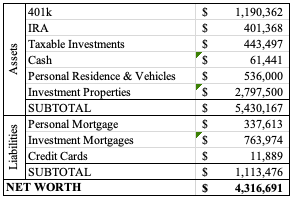
NET WORTH

Our net worth is up almost $600k from this time last year. From last month, it has increased by about $50k. Our credit card balance is similar to last month. Our cash has decreased a good amount as we had a roof replacement get paid out, but otherwise most line items moved in the ‘right’ direction.

Buying versus Renting

I have a tenant who, in the same day, told me that she couldn’t pay rent on time and asked whether she could buy the house. She said she paid $60,000 to me and that could have gone towards owning a house. While I understand the lump sum of what you paid being a pain point, owning a house isn’t that simple. I thought I’d break down a comparison of what she would have done to own this house versus her renting it over the last several years.

RENT HISTORY

Based on the proximity to Main St and the comps in the area, we went into the purchase expecting about $1,000 per month in rent. At the 1% Rule (where you set monthly rent at 1% of your purchase price), we should have been at $1,020. Knowing that it was October/November by the time we would get it rented (there aren’t as many people looking for a new rental in the Fall, after school has started and holiday activities are ramping up) we chose to list it at $975 and keep it below that 4 digit threshold. It sat for 3.5 weeks with hardly any activity, and we dropped it to $875. We found a tenant in under 2 weeks then, but we weren’t thrilled amount our cash flow on it.

The tenant’s lease started on November 1, 2019. Her rent was $875. My property manager incorrectly established a one-year term lease instead of an 18-month lease like she was supposed to, so we had to do a 6-month extension after the first year. Then in March 2021, we tried to increase the rent to $900, and she complained that due to the pandemic, she couldn’t afford that. We let it go and she renewed a year lease at $875.

Come February 2022, we were significantly under market value for rent and she hadn’t been a friendly tenant, so we were content pushing a raise to $950. If she didn’t want to pay that, she was free to leave and we would take the vacancy hit to fix it up and get it re-rented. She complained about the increase, and our property manager told her to take a few days to look around to see if she could find somewhere to rent that was at a price she would feel more comfortable with. She came back and said she couldn’t find anything and accepted the increase to $950.

Not including a few late fees she has owed over the last nearly-five-years, she’s paid us $52,850. While in total that appears to be a significant number, that number does not mean that you’d have $52k in equity in a home had you paid towards a mortgage.

OUR PURCHASE INFORMATION

We paid $102,000 for the house in 2019. We asked for several options for the loan structure. We asked about putting 20% versus 25% down, and whether the rate for a 15 year, 20 year, or 30 year loan would have the best rate. Going through those details is something I’ve done in the past, so for this purpose I’ll just note that we chose to put 25% down because then we didn’t need to “buy down” the rate. The rate for each loan length was 4.55%. With no incentive to do a shorter loan term (and therefore increase our monthly payment), we chose the 30 year term. I do want to note that our interest rate is higher than the average for 2019 (3.9%) because it was an investment property and not a loan for a primary residence.

Based on the 25% down and the closing costs, we had to come to the table with $26,589.12.

Our mortgage was $538.46, which includes escrow. We paid off this loan fairly soon after we closed on it, so we don’t have a monthly mortgage payment. However, I do need to plan for our current mortgage and insurance payments each year, which is currently over $2,000.

FACTORS TO CONSIDER

To keep this more consistent in the message, note that the loan discussed will be based on the purchase price of $102,000.

First, you need to have favorable credit to qualify for the mortgage. In an example, the lowest credit score I could plug in was 620. However, in much of what I’ve read, anything below 680 is questionable on qualification. Our requirement to rent a property is to have a credit score of 600. Perhaps there are lenders that will process a mortgage if your credit score is below 620, but you’re going to pay a premium via the interest rate.

With a credit score of 780, say you’ll have a rate of 6%. But then with a score of 680, you’re looking at 6.5%. At 6%, your principal and interest payment (doesn’t include the escrow required) would be $599.19. At 6.5%, it goes to $631.69. That’s only $32.50 per month extra; over 30 years, that’s an extra $11,700 paid to the bank. I have some tenants where an extra $32 per month is a big deal.

Without at least 20% down on a loan, you’ll likely have to pay private mortgage insurance (PMI). This amount could add a monthly premium to your mortgage payment anywhere from 0.2% to 6%. I did a quick calculator with the example of $102,000 purchase price, $3,060 down (typically the lowest available without any special loan structures is 3%), and a credit score of 620 (lowest it allowed). The PMI was calculated as $187 each month.

I mentioned that our final closing costs were over $26k. If I remove our down payment, that leaves $1,089 in closing costs. I will note though, that our contract had $2,000 in seller subsidy (a credit). Without that purchase agreement structure, that means your closing costs are actually $3,089. This means that you need to come to the table with $6,149. Buying a house is not like buying a car where you can roll all the costs into the loan, and I feel like people don’t realize this.

Your debt to income ratio also plays a factor in whether you can qualify and what your interest rate would be. So even with a decent credit score, you need to show a low debt-to-income ratio, meaning you can’t have your credit cards maxed out. The lender wants to see that you don’t have high monthly costs that would prevent you from paying your mortgage.

That brings me to the flexibility of paying rent. She paid $475 worth of August rent (due August 1st, with a grace period to August 5th before a late fee is owed) on August 20th. If you pay your mortgage late, there’s a late fee and it gets reported to the credit bureaus. Your late payment of rent doesn’t get reported to anyone. She also has the extra advantage that I’m willing to work with her on late payments. An apartment complex type owner is going to immediately file for eviction on the 6th without full rent payment, regardless of your story.

SUMMARY

While a mortgage payment of $538.46 looks favorable against a rent payment of $950, it’s not that simple. I was able to qualify for the mortgage, qualify for a favorable interest rate, and put significant money down.

If I add a premium to the rate we were able to get, assuming my tenant’s credit score is similar to what it was when she rented our house, and then add the PMI that would be applied by not having 20% down, then the mortgage payment (including escrow) would have been $903.02. PMI stays on the mortgage until you reach 78% loan to value ratio (unless you pay for an appraisal and can prove 80% earlier than that). That threshold in this example is $79,560. That principal balance would be achieved in over 11 years, which means you’ve paid $25,058 for essentially nothing.

Then on top of paying these premiums for the mortgage, she would need to pay for the maintenance of the property herself, which is included in my rent factors. I’ve paid over $3,000 for repairs and maintenance on the house over the last 5 years (which is fairly low). However, that includes a deck replacement that we did ourselves and probably would have cost $4,000 instead of the $400 we paid in materials.

So the next time you think that you could be paying half of your rent with a loan, know that you’re not looking at the whole story. There are many factors that go into a mortgage, especially the initial ability to qualify for such loan.
August Financial Update

Many of our activities over this last month were already paid for or minimal cost. We went to Colorado, and we’ve been doing back to school type activities. Mr. ODA was in Colorado longer than the rest of us (I flew home on my own with 3 kids!), and he went on a work trip for a week, so my goal has been activities outside of the house as much as possible in this final stretch before school starts. We’ve had quite a few activities on rental properties too.

RENTAL PROPERTIES

Historically, if the 1st through 5th of the month falls on a Friday, that’s the day that I receive rent. Meaning, if the 3rd is a Friday, then I get rent that day. This month, the 2nd was on Friday. I received very little rent. Going into the 5th, I was still waiting on 60% of rent payments; I was already told by 3 tenants (making up 23% of that amount I’m waiting on), that rent will be late this month. Luckily, 2 of those 3 tenants had paid partial rent already. That left 4 houses going into the 5th that hadn’t paid and I hadn’t heard from. That’s more than normal and was a bit worrisome. By the time of this post, I’m missing nearly $2,000 worth of rent, which is over 10%.

We’ve had several small actions that needed attention from our handyman, so I paid out on that. We had an AC go out before a hot weekend, so we had our technician go out and fix that (I haven’t seen that bill, but it’s expected to be around $1,000). Mr. ODA went out to a local house to properly fix their kitchen cabinets that were apparently never installed correctly (before we owned the house) to install them into the studs.

I was called for a garbage disposal that wasn’t working, and I attempted the fix on my own. I was nervous going into it, but I successfully fixed it in about two minutes. That felt good. I also went out to check on a roof replacement at a local house, and Mr. ODA replaced their deck. This tenant doesn’t communicate well whatsoever with us. She said “the deck is in bad shape.” That was it. Didn’t send a picture, didn’t give any details. I went out to check on it, and the deck stairs were hardly sturdy and none of the pickets were installed anymore around the decking part (it’s more of a landing than a deck when you think of size). It’s infuriating that people could not communicate such a dire issue. Most of my tenants do a great job, but this is why annual inspections are necessary.

PERSONAL ACTIVITIES

It has been a crazy month! I have thrived with the busy scheduled and a sense of accomplishment.

I was elected to our Homeowner’s Association board of directors this past month. I’ve spent a significant amount of my time going through that information and trying to get things organized and back on a schedule. I had my first meeting on the Landlord/Tenant Advisory Committee. And I joined on with a start-up school to be their financial consultant.

We signed our oldest kid up for Fall Ball and our second for gymnastics. She did acro last year, but I said all year that she would thrive better in actual gymnastics where they do more activities than dance. Our oldest started kindergarten, which is really exciting. That also required a lot of attention between back-to-school activities and paperwork to be filled out. I ran a 5k with zero training (I had run 1.4 miles the week leading up to the race), but my friend and I beat last year’s time by 5 minutes!

We worked on our own deck. A tree fell on it last July. We had to get our insurance company to understand our issue and fully cover the repairs that were necessary (it took them forever to get an engineer involved instead of all different adjusters). We finally got started in March on the replacement. After weeks and weeks and weeks of our contractor working on it, he finally ghosted us because he couldn’t get the waterproofing to be waterproof. So this past weekend, we tore up our deck boards and repairs the waterproofing issue. It’s supposed to rain this weekend, so hopefully we’ll see that our fix worked finally. Once we prove to ourselves that no water is getting down there, we can have the electricity finished. We also built a little wall to hide the storage being kept under the stairs under the deck, which was cool.

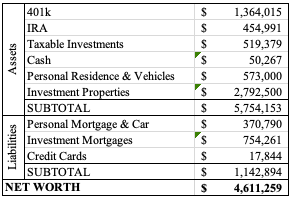
NET WORTH

Obviously, our investment accounts diminished slightly since last month, as the stock market has been a constant discussion point recently. Last August, my updated said: Our overall net worth went down slightly from last month because of market fluctuation. So this seems to be a typical cycle! Last year it was offset by a large insurance check we received, while this year our cash balance is much lower from last month to this month.

I have about $9k to still pay out on a roof replacement (insurance is covering most of it), about $1k to pay to a plumber, and a couple of other odd jobs that are waiting on invoicing. Our net worth isn’t 100% accurate this month because I don’t have access to a few accounts (well, I have the log in and password, but it requires either text or email verification to get logged in, and Mr. ODA holds those and isn’t available – annoying!). I also have a $1500+ insurance payment to make, but I’m purposely holding off until this credit card statement cycle ends so that I can feel like one month isn’t a crazy high balance.

To update our net worth, I have spreadsheets set up that I overwrite from last year. Last year’s August update had our net worth at $3.78 million. So even though this month is over $27k less than last month, we’re still up over $500k from a year ago without any drastic changes in investment portfolio.

5% Rent Cap

The President issued a statement calling on Congress to cap rent increases at 5%, specifically for corporate landlords. The statement appears to define corporate landlords as those owning over 50 units in their portfolio. This was not an executive action that is implemented. And while my numbers are different than the numbers of a “corporate landlord,” I do think it’s worth hearing a landlord’s side. I feel that there’s a lot of spite against landlords without a lot of knowledge about their actual financials.

I admit that there is a possibility that some of these companies with large complexes could be raking in on the fees or “utilities” that are in the unit, without actually providing a properly maintained building, but that’s not the case for everyone that’s labeled as a landlord. No one seems to step back and see that this is a business model for landlords, and while everything else around us is increasing in costs, rent needs to as well.

No one predicted such a significant rise in product costs or housing costs in such a short period of time, but here we are. And landlords aren’t in the business to graciously eat the costs of homeownership for renters.

LANDLORD COST INCREASES

The Presidential statement released refers to a press release that starts with, “Todayโ€™s U.S. Labor Department Consumer Price Index (CPI)ย reportย revealed costs remained largely unchanged in May, withย overall inflation coolingย faster than economists expected as the Fed considers finally reducing interest rates below a 23-year high.” Is there a comparison to costs that landlords had to take on because the costs of everything increased faster than expected back in 2020-2022? Increases have been seen on small things like a maintenance call for a technician, but also big things like property taxes and insurance.

That same article goes on to state, “Since 2019, the cost of rent hasย risenย 31.4%, with wages only increasing 23%, as tenants on average need to earn nearly $80,000 to not spend 30% or more of their income on rent.” In 2019, on one of my properties, the taxable assessment was $95,000, which equated to about $1,200 per year in taxes. In 2024, the taxable assessment was $242,000, which equates to about $3,000 per year in taxes. That’s a 61% increase in just my taxes over that same period of time where they’re complaining that the cost of rent increased by 31.4%. If rent had been set based on the 1% rule in 2019, rent would have been $950 per month. Had I increased 5% each year from 2019, it would be $1,212 in 2024. If I set rent based on the 1% rule now, it would be $2,420. However, the rent on the property is $1,750. So while it’s more than 5% each year since 2019 (the baseline the government is using), it’s set at an amount where I capture my expenses for owning the house, while also turning a small profit.

It’s taboo for a landlord to turn a profit, but that’s why we’re here. It’s an income stream that we’re establishing for profit. I don’t get to pay myself an hourly rate for managing the property. So this “profit” can actually be looked at like a salary. Every time I need to show the property to a prospective tenant, the lease signing, the walk through, every call or text you make, every trade that I need to schedule and coordinate with the tenant on, any fixes or improvements that I do myself. All of these minutes in a day add up, and I’m not directly paid for any of them.

On the particular house that I’m using for the example, we are assuming $300 per month in profit, which comes to $3,600 per year. Would you work as a manager of a company (e.g., hiring trades to fix things, performing maintenance, making sure all bills are paid timely, general management of having liabilities), for only $3,600 per year?

I wrote a post last Fall about the changes in my rental fixed costs from a year prior. I plan on doing the same this fall when more tax information comes due. The house I’m referring to has been at $1,750 for the past two years. However, between 2022 and 2023, my taxes and insurance have increased by $255 per year. That’s a cost that I’ve “eaten” from my “profits.” I could have said that equates to $22 per month increase, and I could have projected a similar increase for the year coming. I could change their monthly rent to be $1,790-$1,800 to keep my profits on a similar path. However, I didn’t, because they’re good tenants that haven’t had many maintenance calls.

However, if I don’t increase every year, then I could find myself in a sudden deficit like I did during the pandemic because costs increased faster than projected. A 5% cap could actually incentivize annual increases because I wouldn’t want to be caught behind and not able to catch up down the road.

LEASE TERMS

The Federal Housing Finance Agency announced protections for renters in multifamily properties that are financed with loans backed by Fannie Mae and Freddie Mac. The protections include: (a) requiring 30 day notice before rent increases; (b) requiring 30 day notice on lease expirations; and (c) providing a 5 day grace period before imposing late fees on rentals. I know for a fact that every single lease I’ve executed personally already has all of these requirements in it, at a minimum. In many cases, there’s a clause for 60 day notice of a potential rate increase, with negotiations being completed before 30 days from lease expiration.

Some states already have this codified. Other jurisdictions have landlord/tenant agreements that give the tenants rights (and awareness of rights) that can be lobbied against if the landlord is noncompliant.

There’s a clause that I’ve seen that requires expired leases to auto-renew on a month-to-month basis instead of for another year. I would argue that a requirement to renew a lease month-to-month instead of annually actually hurts a tenant. A landlord then only needs to give 30 days notice of a rent increase, and they could technically increase it month after month.

SUMMARY

If the ‘cap’ were to apply to me, then I’d be more inclined to increase rent every year. As a general rule, I increase rent for long term renters by $50 every two years. When we turnover a property, we will evaluate market rent in the area and set the monthly rent at what we see (which could be more than $50). In some cases, the evaluation ends up being too high, and we set the rent at something we think more people can afford. For example, there were comparable houses renting at $2,200 near a house we had listed. We’d rather get the property rented than shoot for top dollar, so we listed it at $1,600. While lower than “market value” probably called for, it was $400 higher than what we had it previously rented at, which covered cost increases that weren’t previously covered.

In the post that I previously linked, I highlight that our standard for increases barely offsets our increase in expenses. While we manage each house individually on setting the rates (asking ourselves: do we think the tenant can absorb the increase, do weย haveย to increase to cover actual costs now), our monthly income among all houses was increased by $475. If you add up the cost increases for taxes, insurance, and property management (increased rent means increased fees because fees are based on the rent price), our costs went up $415 (and that’s before any service calls). On a whole, weโ€™ve offset the ‘fixed cost’ increases. We’re taking ‘losses’ on houses where our routine for increases is slower. Therefore, having 13 properties affords us the ability to be more lenient with tenants and to keep good tenants in the house instead of forcing them out with hgher rent increases.

I support having protections in place for tenants. I’m sure there are landlords out there that aren’t interested in playing ‘by the book’ and just being decent human beings like I intend to. However, landlords are people too, and they’re running a business. Creating boundaries without fully understanding both sides of the situation and focusing on data points that only support your theory is unfair. I’ve joined the Landlord/Tenant Advisory Committee in my city. I hope to bring more awareness to the landlord side of things and bridge the gap between landlords and tenants when it comes to responsibilities.

Thermostats and Finances

There has been a lot of talk about thermostat temperatures recently because of how hot it has been where I live. There are Department of Energy images circulating that say keep your home at 78 when you’re home, 82 when sleeping, and 85 when away from home. Personally, I need it colder at night than during the day, but that’s not the point. My goal here is to make you stop and think about your actions. This applies to several areas of your financial life, but this post specifically will be regarding your heating and cooling process.

THERMOSTAT SETTINGS

In our house in the summer, we keep the thermostat at 75 or 76 during the day on the 1st floor. It usually starts at 76 and then if someone feels hot, they bump it down to 75. Upstairs, it sits at 77 for the day, is put at 76 for when the kids go to bed, and then 74 when we go to bed. When we leave the house, the thermostats are at 78; if we leave for extended periods of time, it’s set in the 80s. In the winter, the heat is set at 65 during our waking hours and 64 or 63 at night.

As a quick aside, our third son was born early and was having trouble breathing and regulating his temperature those first few weeks. We were told to keep the house at 70 or greater for him. We struggled! We made it to 69, but everyone was uncomfortable and hot. I mentioned this to the doctor and he said it was fine to be at 68 if that’s what everyone felt more comfortable at.

While we know these numbers now, we spent a lot of years working on different settings. We didn’t just assume that these were the numbers we wanted to be at. There were winter months where we set it at 63, but my fingers were hurting because they were so cold while I typed on my keyboard, working from home. I was at a friend’s house recently; they had it set at 70, and I was cold.

That brings me to another point. What’s the thermostat temperature where you’re comfortable in the summer while wearing shorts and a tshirt? If you’re wearing a sweatshirt and have the temperature set at 70, is that worth the extra cost to run the air conditioning at that temperature?

TIPS TO SAVE MONEY

This image was shared by a local meteorologist, but a citation wasn’t given, and it differs slightly from the numbers that the Department of Energy published. According to this, we’re saving 19% in the winter by keeping our heat at 65, but then we’re spending 32% more in the summer based on the recommended setting.

While you may have your expected temperature setting, you may want to consider is how hot (or cold) it is outside. If it’s going to be 100 degrees, maybe set the thermostat slightly higher on those days. It’ll feel comfortable at a higher temperature because the unit is going to be running more, therefore pumping more air into the room than on an 80 degree day.

In the summer, another option is to keep the blinds closed. If you keep the sun from peering into the house, especially during the heat of the day, it’ll help keep the temperature lower so the unit won’t want to kick on as often.

My local electricity company provided suggestions to keep your bill lower. Their article said to grill, use a slow cooker, and make sandwiches instead of using the oven and stove, which create more heat for the air conditioner to have to counteract. You can also use fans in rooms where you’re sitting so that you feel cooler while the thermostat is kept a degree or two higher. Make sure your filters are changed regularly so that your unit is working efficiently.


I implore you to increase your cooling temperature by one and see how that feels. Live with that for a week and see if going one more degree helps too. It could be that the cost to run your heating/cooling is worth the level of comfort you feel, but it could be that you find a setting that is still comfortable and it’s worth the savings you reap.

July Financial Update

RENTAL EXPENSES

We took a trip to Richmond, VA to work on rental properties. It was fairly last minute. I had a schedule of work at each house that I planned. However, I didn’t plan on the heat index being 113 and 112 for the two main days we were there. I was able to get everything on my list done except for staining the new deck at one of the houses. I didn’t want to risk it not applying or curing correctly because it was too hot and in direct sun. Plus, the tenant didn’t even clear it off so I could work on it.

I had multiple houses pay rent late this month. I was surprised. One let us know on the 5th that they had an emergency, so they wouldn’t be able to pay until the 17th. I had someone pay half their rent early in June, but then haven’t received an answer as to why the rest of her balance ($345) hasn’t been paid yet. Another tenant misunderstood her maternity leave pay, so she asked for more time to pay rent. She paid $800 on the 7th. I told her not to worry about it, and just pay when she can, without the late fee; she only has $150 remaining.

I’m currently working through two roof replacements. One of them will be covered by insurance, but then I’ll be paying to have vents added, the chimney torn off and capped, and the soffits repaired on top of what insurance can do. Then the other one we’re paying out of pocket for. It’s original to the house, which was built 24 years ago. There has been storm damage to it over the last year, and it’s just generally time to address the age even though it hasn’t caused any problems yet.

PERSONAL EXPENSES

Our medical insurance company had some glitches in their claim processing through the first half of the year. Now they’ve caught up, meaning I’m paying large sums of medical bills. Mr. ODA took on booking lodging for his guys trip later this month, which meant that the second half of AirBnB payments were applied to the credit card.

Mr. ODA increased each kid’s UTMA from $75 to $100 per month. That means we’re investing $3,300 each month into accounts, on top of maxing Mr. ODA’s TSP contributions and both of our Roth IRA contributions for the year.

Our contractor has ghosted us on our own deck build. We bought some new furniture for the main deck area. Once it’s not 100 degrees outside, we’ll work on doing the waterproofing of the deck ourselves so that we can start living on the patio under the deck and get that hot tub ordered this fall.

NET WORTH

I updated the valuation of the houses this month. I typically only do that 3 or 4 times per year. I try to account for the big increases we see at the beginning of the spring, and then adjust slightly around this time of year once the comparable houses have closed and sold. This update added $140k worth of equity into the equation. All of our liabilities decreased since last month, and all our assets increased since last month. That has equated to an increase of over $200k in our net worth.

June Financial Update

Welcome to summer, where we’re traveling and I’m not posting on time. This time it was because I had to figure out a few things with bills and health before I had the time to get to the update. I can schedule content in advance, but not this post where I need the most up to date numbers when talking about our net worth.

We’ve been busy with baseball and activities around the house, so our spending was lower than it had been. However, this time of year is typically where we see a lot of our rental property expenses come through. We purchased many houses around this time, which puts their insurance payments due now. Then the City of Richmond’s tax payments are due in June and December also. The City of Richmond doesn’t post our escrow payments timely, and it drives me crazy. Every 6 months, I get notification that I have unpaid taxes and it’s the due date. I have then go through every escrow and prove to myself that they were in fact paid out over 3 weeks ago, and then I have to go back and check that Richmond posts them eventually. I stopped sending checks into them for the accounts that aren’t escrowed because it took too long to monitor, so I pay the $0.95 fee to pay via their ACH option online.

Mr. ODA had been in a relationship with a financial advisor, which was $35 per month. Over the last 3 months, Mr. ODA has been working to become his ‘apprentice.’ He passed his Series 65 exam and will begin working on this guy’s team. Not that $35 is a huge amount, but that’s one less ‘subscription’ that we’re paying monthly.

Speaking of subscriptions, we did something that I’d venture to guess other people wouldn’t put the effort into. One of our credit cards (that we rarely use) had a promotion for a $15 statement credit if we had at least $100 worth of subscription and/or utility payments go through. Most of our utilities can’t be paid with a credit card without paying a fee. The fee for our internet service was low enough that we went ahead and switched that one over for one month. Then I went into our Y membership and switched the credit card on file for that payment. With a few button clicks in May and then later this month to switch everything back, we made $15. It doesn’t seem huge, but it’s the compound of that thought process and awareness that makes a difference in your finances.

The ‘bigger’ expenses of the month were one kid’s school registration fee ($175), purchased baseball tickets (the Oriole’s don’t charge for 2 kids per paying adult!), got an oil change ($65 ugh), paid two homeowners insurance policies that aren’t escrowed ($1,371), paid for pet sitting for a coming trip ($155), paid car insurances ($567), and built a few steps in a new walkway ($275). Our deck isn’t complete because the waterproofing isn’t waterproofed. We haven’t paid out the last $3,500 on that, but we also haven’t heard from our contractor in several weeks.

We initiated a homeowners insurance claim for one of our properties. The tenant wasn’t complaining about the house/roof, but we knew the roof and soffit were in rough shape. I was hesitant to contact a roofer because I wanted the job done right. I expected the house is really old, and there would be decking problems to fix. I dragged my feet on finding someone, but I did click with someone finally. He went out and actually suggested we go for a claim to cover the replacement. We’re in the process of that now. An adjuster has been out to see the damage, and now we wait for the estimate. In the meantime, another property had water spots on the ceiling show up. I had the roofer go out there to check it out, but he didn’t see anything glaring. That roof also needs replaced, but I’m going to get at least one more quote on that job since it’s not through insurance.

All the good things (assets) went up and all the bad things (liabilities) went down! Our net worth increased by $60k over the last month.

Hitting our Goals

I mentioned at the beginning of the year that our general financial goal is $4 million net worth. I acknowledge that this is not a specific goal that most people can relate to. But I also pointed out that we weren’t always sitting with nearly that amount in our accounts, and that made me start thinking about where we were. This is long, but I didn’t think it worth splitting into multiple posts. I’ve gone into the topic in general, but this is our actual story and the steps we experienced.

This is just meant to show you that you can grow each year and slowly chip away at a goal. Everyone makes fun of the “don’t buy Starbucks everyday” philosophy. It’s not that saving that $7 per day is literally going to make you a millionaire in itself. It’s saying that if you’re willing to spend that $7 daily, that’s likely indicative of other spending in your day, and you should be more deliberate with your spending. I saw a meme on Instagram that said something similar about buying decor for your home, and if you’re willing to spend “just $25 on this lamp,” those little expenses add up over the year. I’m a broken record in saying make every purchase a deliberate, thought-out action; I went into how much effort (and years) I put in to purchasing a $4 tape dispenser on this post.

The background here is to first show you how I had no money, but I’ve been diligent on my spending and working towards goals. Mr. ODA was more of a saver and more prepared for the big life expenses in your early 20s. The part where we work towards buying a house is where we really buckled up and made life decisions that kept us on that track. Our money philosophies have gotten us to where we are today – every dollar has a purpose.

MY FINANCIAL HISTORY: COLLEGE, WHERE I STARTED MY INDEPENDENCE

I never liked relying on other people, so I was interested in making my own way as fast possible. My parents gave me an ultimatum during my sophomore year of college – either become a resident assistant for free room and board, or take out loans to help pay for it in the next two years. I didn’t want to take out loans, so I started looking for off campus housing. I didn’t mind living on campus. I have no idea why I was so dead-set against taking out loans and how that would have been ingrained in me at that time. But living off campus would allow me to pay month to month, instead of living on campus where I’d have to pay each semester’s housing costs up front.

On top of that, my dad offered me to buy out his car. He had let me drive the car to college that year, but around Christmas time, it started acting funny. It turned out that second gear in the transmission needed to be replaced. He said I could pay for the fix, and then it could be my car. I didn’t like the idea of being 3.5 hours away from my family and having a car that appeared unreliable. So I went car shopping, and I leased a Honda Civic. My car payment was about $300/month. I leased it instead of buying it because I didn’t need to put any money down.

I worked three jobs that summer after my sophomore year of college. It was so hard. I was working 40 hour weekends, and then I’d put hours in during the week. I remember getting burnt out and being overwhelmed because I had to miss my sister’s graduation party. I was working at a catering hall, which meant late hours on Friday and Saturday, and early hours on Sunday. I was also working at a bagel shop (big on Long Island), which was a 5:45 am call time, but at least I’d be done by 10 am. Then I was working as a cashier at K-Mart, which was Monday through Thursday in the afternoon or evening, and sometimes on Friday.

Even though I was working all those jobs, I still struggled with paying my bills once I got to college for my junior year. I paid too much for rent because I wanted to live on my own. None of my friends were interested in living off campus, and I was too afraid to live with someone I didn’t know. My parents ended up giving me $100/month for 6 months so I could pay to run my heat. I remember it being October, and I told my mom that I hadn’t turned my heat on yet. So she sent me the money each month to cover the heating bill instead of trying to live in layers and blankets because I didn’t want to pay for it.

When I moved back up to college, I was working at JCPenney while going to school. I did pretty well. My grades didn’t suffer, and I still felt like I had a life so I didn’t get burnt out with only work and school. I took on extra shifts and stopped going home for the smaller holidays (e.g., Thanksgiving) so that I could work.

MY FINANCIAL HISTORY: MY BIG GIRL JOB

My guidance counselor told me that financial firms would be expecting internships on my resume. This was 2007; financial firms were fat and happy, so they weren’t paying interns. I kept my eye on the job boards (which were literal bulletin boards) in the financial building. I found an internship with the Federal government that was paying $13/hour! I applied in August. I heard nothing for weeks, so I gave up hope. Suddenly, I received a call asking me to come in for an interview on Halloween! I had never interviewed before, so this was scary. Then the guy told me that they didn’t even know if they were going to hire a mid-career hire or go the internship route, and they had never had an intern before. That was the second time I gave up hope. A month later, I received the job offer, and I started working in December 2007.

From the start, I put money into the Thrift Savings Plan (TSP), which is the government’s 401k equivalent. My parents told me to take each raise I got and put it right into there also. If I was used to living on the lower amount, then keep the rest in savings. I followed that advice until I maxed out the contributions. I didn’t have trouble paying my bills, but I wasn’t saving as much as I should have for rainy days.

MY FINANCIAL HISTORY: MEETING MR. ODA

Mr. ODA showed up in my office in October 2009. Shortly after meeting him, we were hanging out, and next thing I knew, he was asking me my social security number. He was signing me up for a rewards credit card, since I had a credit card through my bank that was getting me no incentives. By the time I met him, I was living comfortably, but I wasn’t saving with a goal in mind. Whatever was left over became savings, and it didn’t matter to me what that number was. I was maxing out my TSP and paying my bills comfortably, and that seemed good enough for me.

OUR FINANCIAL HISTORY: IN A RELATIONSHIP

Mr. ODA came with a lot more money than that into the relationship. He had always been planning to save for two big purchases: an engagement ring and a house. To me, buying a house was somewhere down the road, but I didn’t have the confidence to move forward on that. I hope to instill that confidence in my children because that would have made a big difference.

Mr. ODA designed my engagement ring at a little mom and pop jewelry store in Harrisburg, PA (long story on where we’ve lived, for how long, and why). He proposed in November 2011. In December, I moved to DC, and Mr. ODA joined me shortly after. We lived in an apartment. We lived halfway between where he and I worked, but I admit we paid way more for rent than we prudently should have. Even though I grew up in the shadows of New York City, actually living in a big city was scary to me. We went on a house hunting trip, and I struggled with anything that didn’t look really nice/new. We were able to get a reduced rent rate, but at about $800 per month for each of us, it was significantly more than the $450 per month I was paying in Albany, NY.

The goal was to rent for a year while we scoped out the area to find a house to buy. We didn’t know anything about Northern Virginia, and we wanted to go to open houses to learn how far our money would go. Newsflash: not far.

OUR FINANCIAL HISTORY: A WEDDING

While we explored the area for a house, we were also planning a wedding. We paid for more than half of our wedding. My parents gave us a chunk of money towards it. If I had been married in Kentucky, it would have covered most of the wedding. However, I grew up on Long Island, and a wedding is a very different kind of event there. I probably wouldn’t have known any different had I not attended several weddings in South Carolina, where weddings were low key. After looking at venues in both Kentucky and New York, I ended up breaking down one day that I had always dreamed of a specific type of wedding, and Kentucky just wasn’t it.

I saved as much as I could in all the other areas since the venue was so expensive. The venue cost included all the catering, staff, and cake. I went cheap on invitations, my dress, favors. I just didn’t have the cash on hand to do a lot, and I wish I had done more. I also wish that I had been married on site at that venue instead of in my hometown church, but it is what it is. I also went cheaper on the photographer, and the day was terrible because of him. I recommend to everyone to get a good photographer and really check their portfolio (and if they do crazy things for photos, don’t trust that they’ll not do crazy things when you ask them not to).

We got married in August, after our November engagement. We had to lay out over $12k for that. The unexpected part of that was that we found a house to buy earlier that summer.

OUR FINANCIAL HISTORY: OUR FIRST HOUSE

Mr. ODA was a good saver. The problem was that he didn’t expect to pay for a wedding, and he didn’t expect to live in Northern Virginia. He was expecting to buy a house around $150k. We were struggling to find a house with walls and floors (literally) at $350k.

We lived a meager state for that year. Our goal was to spend less than $5 per day on food. That meant we weren’t spending money at restaurants. We were packing our lunches for work days. We were living off of macaroni and cheese. We weren’t taking trips. And yes, we were literally tracking our expenses on food each day.

THIS IS IMPORTANT: We were preapproved to buy a house up to $750,000. THAT IS STUPID. We didn’t want to pay PMI, so our purchasing power was based on our down payment being 20% (if you don’t come to the table for a conventional loan with 20% of the purchase price, the bank tacks on PMI). Between loans we could take from each TSP, cash on hand that we projected to have with our savings over the year, and possible liquidation of investments, we projected we could have about $70,000 on hand. That means we were shooting for $350,000 as the purchase price.

Our Realtor knew we were approved for double that, but we held our ground on our price range. We considered several properties. We put an offer in on a house at $380k. It was a bank owned foreclosure that they had flipped for resale. The flip was bare bones, but the house looked ok. We wouldn’t need to put immediate work into it. Our offer was declined. Then later that day, the bank called and asked if we still wanted it. We were instructed that the previous bidder attempted to counter the bank, and that’s why we were given the offer. We weren’t willing to lose it and accepted. We were under contract for a $380,000 house. That meant we needed at least $76,000 by closing.

Mr. ODA and I each took out TSP loans, we were gifted money from our parents, and we used our savings. Our final closing costs were just over $78k. We got our 20% down, so no PMI. We then spent the next 3-5 years paying ourselves back in our TSP. The loan payment amounts were adjustable, so we paid more when we could, but we had the flexibility to back off some of the payment totals if we needed to.

OUR FINANCIAL HISTORY: SELLING OUR FIRST HOUSE

We bought our first house in July 2012. We sold the house in September 2015. In that time, the house appreciated by $70k. On top of that, we had the 20% equity we had put down, and we had the equity for the principal payments we made over the previous 3 years. We were moving from the DC area down to the Richmond, VA area. We ended up purchasing a new construction home for about $360k. After putting 20% down on that purchase and paying off some debt (I had a car payment, and even though it was 0.9% interest, I wanted to manage less payments per month), we needed to decide on what to do with the rest of the money from the sale. Mr. ODA convinced my to put that towards rentals.

OUR FINANCIAL HISTORY: RENTAL PURCHASES

With that extra equity we had sitting in our account (which we had in an interest earning account), we purchased 3 rental properties (all with at least 20% down). The leap of faith we took into a landlord role, while figuring out things we didn’t know as we went is why we’re where we are now. We created a semi-passive income stream with these rental properties. Our savings continued to grow, which we used to purchase several more rental properties (again, with at least 20% down each time).

OUR FINANCIAL HISTORY: MRS. ODA ‘RETIRED’

By 2017, we had several rental properties, had paid off all our debts (e.g., car, TSP loans, IVF cost), and the net from the rentals was enough to replace my six-figure income. At that time, we had no kids, so there was no ‘real’ reason for me to not be working. As I continued to work, we kept it in mind that we’d be losing my regular income in the near future. I kept working, drawing down my leave balances, until our son was 8 months old (May 2019). I’ve worked a few random jobs here and there since then, but that was for something to do and not because we needed money.

MAKING GOALS

Mr. ODA had a goal of $1 million by 30. He exceeded it. At no point did we say “reach $4 million by 40” or anything like that. However, we’ve regularly tracked our net worth and made smart moves with the money we have. We don’t keep money in a liquid state for long. We make sure our money is working for us as much as possible. We take calculated risks that allow for interest earnings.

We also keep our ears open for extra income opportunities. We’ve been secret shoppers before, and I’ve taken on different short term work roles. That extra income isn’t meant to be frivolously spent; it’s income that we still utilize to move our family’s goals forward. We don’t buy the latest gadgets, but it’s not like we don’t have nice things. We spend will intention within our means; we don’t take out personal loans (e.g., furniture loans, layaway loans).

A goal that keeps moving due to preference is that Mr. ODA will stop working a full time job as well. The lack of insurance options is keeping that from becoming a reality, but if we really wanted to push it, he could quit tomorrow because we’re in a good financial spot. Nearly a year ago, we set up a separate bank account to have his pay check go into. It’s nice to know that we can live without his income, all the while having that bank account as a safety net.