October Financial Update

We had two tenants move out at the end of July. We also had back to back trips scheduled for the end of July and beginning of August, with the kids starting school on the 13th. We also had the cruise planned for the end of September into October, so that was a decent push to get the rentals rented before we left. We put countless hours into those two houses and it definitely took its toll.

RENTALS

As of October 1st all our rentals are rented! That’s a good feeling after two months of vacancy. This is the month of taxes. We have several houses that are paid off, which means they aren’t escrowed, and I’m responsible for paying the taxes and insurance on them. The 4 houses we have in KY are owed this month, and it’s about $7k worth. We’ll owe 2 houses in VA that come to about $3k next month.

I have a couple of houses that are struggling to pay rent on time. Usually it happens for a couple of months and they get back on track, but that’s not happening quickly. I’m trying to remain optimistic, but there isn’t a track record of it getting easier if they have taken this long needing to catch up.

We closed on a new property near our house. It’s a townhouse that we hope to get rented later this month. We’ll see what it looks like once it’s empty, but it didn’t appear we’ll need to do anything to it to get it rented (which is how we buy our rentals). There will be separate posts going into the details of each rental turnover and the purchase of House15 using a commercial loan.

PERSONAL

This is the last month for the 0% interest credit card. When we have a major purchase on the horizon (it was house-wide carpet this time last year), we open a 0% interest credit card. We started this concept about 8 years ago. We look for a credit card that has 0% interest for at least 12 months and that gives us a bonus of some sort. We make more than the minimum payment each month and then pay it off before the deadline. A default payment can cause you to lose your 0%, so it’s important you’re making your payments. But we don’t pay a lot towards it because the money is doing more for us in our savings account (or the investments) than it would by paying down a 0% interest balance. This time around was a bit different. The carpet only cost us $10k, but the balance is over $14k. This credit card had the same incentive as our typically used card (2% cash back), so Mr. ODA used it a majority of the time. For a while, my goal was just to pay what gets our balance lower than the original balance from the carpet. But then we had some big rental purchases that we put on the card, and it just wasn’t worth paying $5k+ to the card. We will make a transfer from our big savings account to make that payment at the end of the month.

Mr. ODA’s last pay check arrived on October 11. He took the “deferred resignation program” as of April 30. The sunset date was September 30, so that covered the payout that we just received, including his balance of annual leave.

Outside of rentals, our spending has been minimal. With the cruise, we didn’t spend much since that was a week of almost everything paid for in advance. The dog had his annual check up, so he was the bulk of our costs. We have our routine costs we see, but happy to see lower balances after all the rental work costs.

SUMMARY

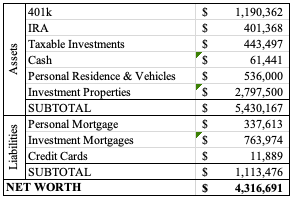
I don’t even want to admit what is about to leave our account this month. I guess the positive is that it’s under $100k..? We have to pay the taxes on the houses that aren’t escrowed, pay off that credit card, and buy a house. At least the house purchase goes right towards equity. Since I didn’t get all the account numbers yesterday morning like I planned, here’s an update that captures our new purchase.

Taxes are Done

On April 6, we submitted our taxes. Honestly, I think that’s the earliest we’ve ever done it. We usually owe a good amount, so there’s no incentive for us to do it early. After owing a penalty last year, we pushed to be on top of the projected tax liability. It looks like we’ll owe a bit on the Federal side and get a refund on the tax side.

And so here’s my annual reminder that if you take the time to manage your finances all year long, then tax season is not a hurdle. I find it much easier to maintain 13 houses worth of data if I do it during the time it’s happening. Life has gotten in the way a bit, and I find it hard to even make sure I have one or two months worth of things logged correctly. I hope to be more on top of it in this coming year.

I have a spreadsheet where I log all our income throughout the year. I set up a formula where I can track each month’s income to ensure I receive the total amount that I expect to receive. I found that since some of our houses pay the same dollar amount of rent, it’s harder for me to mentally track each month’s payments, and I like having the visual and verification through this sheet.

Then there is a tab for each property in that same workbook. The sheets are set up based on monthly expenses, and I plug in projected expenses (e.g., taxes, insurance, utilities). This helps give me a verification that expenses have been paid when owed. By now, I have nearly every invoice emailed to me, but I like having this ‘fail safe’ look at what may be owed that I hadn’t paid in a given month.

Then Mr. ODA enters our investment items, W2 income, and interest income into our tax software. Then I sit down next to him and dictate the numbers from my spreadsheets so he can enter them into the software. We have 13 rental properties, so this is time consuming. However, it’s really easy. We enter our data into the fields for each house. This year took us about 90 minutes to enter the rental property information.

I know multiple people who file extensions because it takes so much time and effort to gather the documents for their accountant to do their taxes. It’s like they don’t think about their taxes until April 1 and then decide it’s too much to do in two weeks. This is where being prepared all year long comes into play. Make it easier on yourself and put yourself in a position where it doesn’t feel overwhelming.

April Financial Update

We started getting emails about end of school year activities, and boy was that a surprise that we’re at that point. The middle one is done mid-May and the big kid is done at the end of May. Less than 2 months until summer break.

Mr. ODA took the second round of the government’s offer for administrative leave, which means he would only have a few weeks left working. I’m still working my part time job, which is taking way more hours than we had planned for. I’m enjoying it, but it’s been a juggling act with the family, which is probably why my son who absolutely loves school begged me to stay home because his belly hurt last week.

Buckle up because apparently I have a lot to share this month.

RENTALS

We received about $600 in tax payment reimbursements from one of our localities, so that was a fun surprise this month. Really helps my psyche that I have a tenant who hasn’t fully paid, didn’t tell us why ahead of time, and hasn’t been up front with when she’s going to actually pay us.

I executed 2 short term leases. Both included a rent increase for their short term period; one house is increased by $75 and the other by $25. Luckily, both are here in the Central KY area, so we can flip it between tenants. One is scheduled to leave June 30th. That house will need new carpet in the bedrooms, and it’ll need probably a whole-house paint job again. They smoked in there, even though we covered the lack of smoking rule multiple times. I’d be more upset about it if the carpet hadn’t reached its useful life years ago. The other house leaves July 31, and I can’t even tell you where we’ll need to begin with that one. She made a wood feature wall without permission. She had a giant fish tank without permission. She spent a lot of time doing things that really weren’t an improvement, so I’m definitely worried about what we’re going to uncover in that house. Mr. ODA and I are talking about fixing it up and selling it. We may look for a short term renter so that we can sell it in the Spring instead of this Fall.

I had 2 other properties accept a rent increase that will go into effect later this year. I require 60 days notice for changes so that starting at the 30 day mark I can begin advertising it if needed. One house goes up by $25 per month as of June 1, and the other goes up by $50 per month as of July 1. I also have another property that has a rent increase of $50 per month going into effect next month.

I have 4 houses that renewed another year, and I didn’t change their monthly rent rate. There are 4 more houses that haven’t been discussed. My intent is to have them renew for a year at their current rate. There are 2 of those 4 that could leave at the end of this term, but time will tell.

We have multiple maintenance issues to address. One house requires a tree trimmed off the roof, the siding cleaned, and the back deck stained/painted. We still have termite damage we’re dealing with at a house in Richmond. I have a leaking toilet that was just addressed, and then they hit me with a faulty HVAC unit during a heat wave. Then we have some houses that really need eyes on them to see what condition they’re in at some point this summer back in Richmond. It’s amazing to me how people just don’t care to tell a landlord that something is broken. I woke up this morning to a text that one of the houses here has a flooded basement due to a water heater failure.

I spent some more time fighting my insurance guy here. It irks me so much when I see him offer up his services on the local facebook group for property owners. He’s quite terrible. I sent him photos of a house that had some issues with a cluttered backyard and had the tenant clean that up. I had to fight him last month on an increase where he changed one house from a crawl space to a basement when I assure you that the vines growing through the windows solidify it should not be deemed a “basement.” When the dust settled from that debacle that he was insanely unresponsive to, I ended up owing $9.68. When I asked why my account wasn’t put back the way it was found before this mess he created, he said he didn’t know but it’s probably from the audit and changing square footage. HIs guessing and not actually answering infuriated me. I gave up and paid it, but then I ran to get quotes from other people. I hadn’t done that before because our 4 claims in a 12 months period are killing us (again, because I really wanted trees to fall on us!). I hate when people make the claim that because it’s not a lot of money, I should just give up and accept it. That’s a ridiculous way to treat people.

PERSONAL

Our electric bill is almost double what it was this time last year thanks to the vehicle charging and hot tub. Our electric bill is relatively low, so that’s not all that surprising. We also have 5 full people in this house now (as much as you can count a 2 year old as a full person… but he knows how to control light switches and eats a ton of food that we need to cook him, so I’m sure he’s a factor there!).

I’ve been working at my new part time job for over a month now. Mr. ODA was making fun of my hourly rate, but I’ll tell ya, it felt good to receive a paycheck that wasn’t $45 like it was for a day of subbing at the preschool.

I took the kids to get haircuts. My middle has had her hair cut once before, but I’ve cut the boys’ hair forever. I had family coming into town and the oldest was looking really shaggy. So I swallowed my pride and threw money at the problem, which is very out of character in this household. I just didn’t have the time to cut their hair, clean them, and clean up the mess. For $66 and 45 minutes from the time I left home until I got back, it was well worth it to me.

I had a medical procedure done this month. We haven’t met our deductible. In February, they said I had to pay my deductible to them. I said that didn’t make sense and refused to have them hold $2800 of my money for 2 months. They gave me an attitude and said I could never ever ever ask for a payment plan in the future, so that I could pay $500 to hold the date. I then showed up for the procedure, knowing I haven’t met my deductible, and they didn’t take any money from me. Another business model that bullies the customer into illogical money decisions. I also had an eye doctor appointment that was frustrating in itself, but I’ll spare you those insurance and communication details.

On top of everything else I’m juggling, Mr. ODA is coaching our kids’ t-ball team. Coaching means that I am team mom. That means that I’m responsible for communicating updates from the league (in the slow and haphazard fashion I receive information), gather value card sales that are required of every team member, organizing a basket for a raffle, and the best one – raising $350 for team sponsorship. What the heck, man?! Where did I say that my signing up of two children to play in the league means I have history or ability to gather money from businesses?? Well, I did it. I raised $350 and another mom raised $200 for the team.

No financial impact, but I’m also juggling our HOA board duties. I released our longstanding property manager and hired a new company, which took effect April 1. That’s taken a lot of time to get them stood up and make sure we stay on track for our annual meeting schedule in June.

NET WORTH

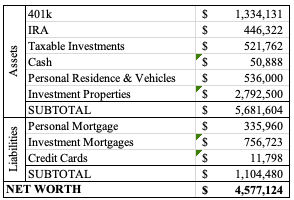
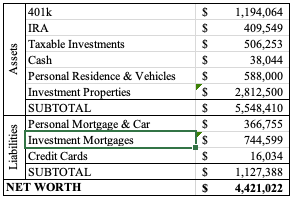
And with all of that said, that doesn’t even address the giant reduction in our investments that continues to happen. To counter some of the loss, I updated our property values for our houses. I don’t do that every month because they don’t move very much, but I can usually count on a few increases as the spring market ramps up. Our net worth did slightly increase (based on yesterday’s market closure, not today’s) from last month, which was a nice surprise.

I wonder why I’m tired and bogged down, but that post outlining what I’ve done recently made me realize all I was able to accomplish even though I felt like I was a jack of all trades and master of none. Hopefully things will settle down in our lives going forward now, even if I know there are definitely two house turnovers in my future.

Rental Cost Changes

In November 2023, I posted about rental changes that had occurred over the previous year. I wanted to update that analysis a few months ago, but I didn’t have all the KY data. I recently shared that my rent increases aren’t covering my cost increases, and my portfolio’s cash projections are lower now than when we first purchased all the houses. Here’s more of a breakdown of those changes per house.

ESCROW

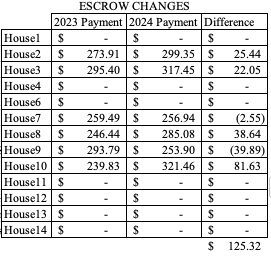
Escrow is an account that your mortgage company holds money to pay your insurance and taxes on your behalf. I have little faith in their management, as I’ve had to follow up on balances in the account and payments made incorrectly.

I created this table to show the differences between escrow payments over the two years. I kept the houses that don’t have an escrow because it can be compared to a future table in this post. There is no House5 in this table because we sold it several years ago (houses didn’t get renumbered because House5 still exists in terms of tax documentation).

INSURANCE

We had 3 insurance claims last year, and a big one the year before. It turns out, our portfolio is looked at as a whole, so 4 claims in a 12 month period doesn’t look good, especially when one of those was 6 digits and one was 5 digits. None of it was egregious, and they were each necessary. We were just a victim of poor timing (and for some reason, the 12 years prior to that with 0 claims of any kind mean absolutely nothing). While our own history is to blame in some aspects, insurance costs as a whole are increasing quickly over the few years. Here’s Google’s AI response:

And with that between payments made in 2023 and payments made in 2024, insurance is costing us almost $2,000 more for the year. I also just made my first 2025 payment, which increased that one house by $343. The total increase from 2022 and 2024 is over $3,000.

From the initiation of insurance on each house (so, when we first bought the house, which were mostly between 2015/2016) to today, we’re paying over 43% more in total for insurance.

TAXES

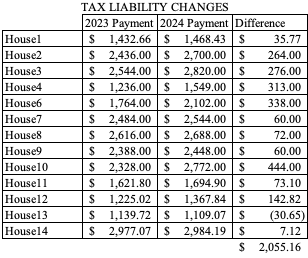
The table below shows the change between 2023 and 2024 for our tax payments. Last year, many jurisdictions that hadn’t captured the assessment changes since the pandemic made up for it last year, when we saw about a $3,500 increase for the year. This year, our increase was over $2,000. Fifty-five hundred over two years is nearly $230 per month, spread over 13 rental properties is $17 each. So for those that I didn’t increase rent last year, they’re not capturing that cost increase for our portfolio.

RENT INCREASES

So far this year, I’ve missed two opportunities to increase rent. I had planned on increasing one house by $25 to keep up with inflation costs, but it didn’t register that their notice had to be given by 1/1 (every one else is by the end of the month). The second is above market at this time, which was by design since they’re not easy to work with (tried to phase them out, but they accepted the rent increase). We last raised their rent in September 2022, so it’s been two years. But I couldn’t bring myself to do it. Next year we’ll increase them by $50 per month.

My plan is to increase the rent for 5 of our other houses. Four of these houses are planned to be $50 per month of an increase, and one is planned to be $75. Our management is generally to increase rent by $50 every two years if you’re a long term renter. There have been a few that we didn’t increase for a while, and the carrying costs have drastically increased, so we’re behind now.

SUMMARY

For our cost increases between taxes and insurance, we have over $4,000 that was paid out last year (and it’s really more than that in cases where the house has escrow, so our escrow was increased more drastically that the specific amount of change in bills).

We had 3 houses turnover from long term tenants, so we were able to increase the rent to market value. I prioritize keeping long term tenants, so I don’t always do rent increases. That means that sometimes the rent is stuck below market value, but I’d rather keep a good tenant than push them out with large annual rent increases.

By bringing those houses up to market rent, I’ve made up a good amount of our deficit. Now remember, these rent increases are catching up on multiple years of drastic increases. So even though it seems we’ve brought in more, we’re both making up for previous years that didn’t have such large rent increases and paying for more large scale improvements to these houses, in addition to larger contractor costs.

Rental Profit Calculations

When we consider purchasing a house to be used as a long term rental unit, we perform a “cash on cash” analysis. I’ve discussed this in the past, and I regularly share this with other people for their use. The gist of this calculation is to determine whether we would get a return on the cash put into the house.

The calculation considers the cost of taxes, insurance, homeowners association fees, vacancy expectation, maintenance expectation, costs to get the place rented, property management, etc. This is compared to the projected rental income. The upfront costs are compared to the annual cash flow projection. That ratio is hopefully in the 8%-10% range to be considered a reasonable cash flow to look further into the purchase.

Since we’re not really looking to purchase properties these days, I use this spreadsheet to consider changes in a tenant’s rent when it’s time for renewal. I kept all the original cash flow amounts to see how things change over the years. As I sat down to determine what changes, if any, are needed in the rents I charge, it was disheartening to see how our portfolio has dwindled in profitability over the years.

A few years back, housing prices skyrocketed, which drastically increased our taxes owed. Unfortunately, I hadn’t increased everyone’s rent consistently. I kept many people level or did small increases every two years, but that means I’m now “behind the 8 ball” in trying to make up for those drastic increases that happened in 2021-2022. In addition to tax increases, we’ve also seen huge insurance premium increases that weren’t projected in our portfolio.

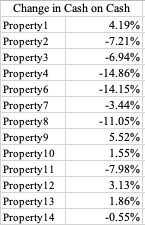
Our total “cash on cash” started at 11.42%. It’s now projected to be 7.58% – if the increases I project actually go into effect over the next few months.

We historically increased long term tenant’s rent by $50 every two years. Some of these tenants have been with us for over 5 years, and the $100-200 changes in their rent have not covered the increases we’ve seen. I hadn’t worried too much about it because the losses on those houses were offset by houses where we saw greater margins. Now, everything has leveled out, so those losses are felt harder.

The table above shows the change from our original “cash on cash” to our current status. In some instances, we’ve been able to increase our margins. But there are 8 instances our margins decreased, with some being drastic. Even though some are drastic decreases, there are only 5 properties that fall below the 8% goal we have.

For Property2, the projection shows that rent would need to be at $2,500 for us to hit our cash flow goal. The rent is currently at $1,600. The neighborhood doesn’t call for $2,500. I also don’t want to be in a position where I’m floating someone’s rent at that price. From the time we bought the house to now, our taxes and insurance have increased by $1575. That number only continues to grow. Our insurance started at $390 and is now at $765. Our taxes started at $1,500 and are now at $2,700.

On top of the obvious ones like that, our maintenance costs have also increased. As one example, our HVAC technician first was charging $125 per site visit. He now charges $325 just to show up. I’ve found someone who charges $200, so I’ve been going with that guy, but just knowing that there’s been such a change in pricing structure needs to be factored into our costs.

These are really big affects on our houses that a tenant and the average public opinion don’t seem to grasp. I don’t get paid hourly or per transaction I perform to manage these properties, so that decrease of 3.8% in our cash-on-cash analysis is actually a net loss in my “income.” In many cases, we catch up when there’s tenant turnover, but watching the rent compared to our expenses are things that I need to be more on top of year-to-year.

November Financial Update

We bought a hot tub! It’s something that we’ve been talking about for almost a year, went looking at in May, and then finally ordered it last month. It was delivered and set up this week.

RENTALS

We replaced the roof on one of the houses. I go into that a little more in the ‘insurance’ section, but that was a $6,300 payment that was made.

INSURANCE

The fact that I have a separate category to cover my insurance efforts is just frustrating.

Last month, I complained that we were threatened with our liability policy being dropped because we didn’t provide the necessary documentation … that. we. were. never. asked. for. So I dropped everything and got the documentation as fast as I could, while being praised for my organization and response time as usual. Then a few weeks later, I was told that our policy has expired because they couldn’t get to our documentation review fast enough. Awesome. I love the one way street. We were finally informed that everything was reviewed and our policy was reinstated with no lapse in coverage. I paid that policy.

During that process, we were informed that one of our policy providers does not qualify to be covered under our liability policy because their company rating fell below A. Ironically, we had already pulled all but this one policy from this company. We requested a quote from another agent, but she said they couldn’t write a policy on the account at this time. It’s frustrating to me that once you file claims on your insurance (which it’s there for), you’re blacklisted. There were no claims for 8 years of rental properties and 12 years of homeownership, but that doesn’t matter. Since 3/4 of our claims in the last year are all in the same location … all those houses were hit by the same wind storms to cause damage. I certainly didn’t request trees to fall on two houses. Add in that the damage to our house was severe, making our policy pay out high for the last year, so getting new insurance policies where necessary (and on houses with no claims) has been difficult. There’s nothing to say we can’t keep this policy on this house even though the rating declined (which I would have never even known about), so we’re not stressing about it.

One of the wind damaged houses with a claim caused that company to drop us. That’s fine. I have been working on this replacement since September 23rd and finally got everything squared away on October 31st. One of the frustrations on that was that I’d ask multiple questions, and this guy would either not respond to an email or respond to half of it. One of my complaints was that my original request was for $500k of liability coverage (which is higher than offered on most policies I’ve had written, but is the minimum required for our liability policy), but he wrote it at $1 million. I asked for it to be lowered no less than 4 times. He finally responded when I got stern and called out the lack of action; he said that since it’s only about $25-30, they just go ahead and do it. I finally said (again) that I have liability policies that give me extra coverage, so I don’t want my individual ones to give extra coverage “just because,” and that it’s up to me to decide whether that $30 is worth it. He finally reduced it. The new policies are $510 more than the policy we were covered with that got dropped.

Oh – the original policy that we got dropped from included two houses. It wasn’t clear whether the company was dropping both houses, but I went ahead and switched both. I was hoping that the new policies would be written like all my other houses – individually. Unfortunately, it’s under one company and they handle things the same way, so both houses are tied together under one policy number again. I have multiple houses covered by Travelers, and they’re each on their own policy. I don’t understand why these houses get lumped together.

Another house of ours was given “high risk” insurance because of our roof condition. Our partner didn’t tell us about the transfer of insurance or the reason why. I discovered it when I received weird paperwork for our liability policy (which, ironically, now that I think of it, my liability coverage didn’t call out as odd, but they weren’t happy about that company getting downgraded…hmm). I discovered this on September 6th. I started getting quotes for roofers immediately, but that process took forever. I finally got the roof replaced on October 18th, and then I requested her to find us new insurance on October 31st. We have a new policy being issued effective November 15th, which will cancel the higher insurance. The total savings equates to about $450, but it’s still over $300 more expensive than the original one that we walked away from.

TAXES

Central KY taxes were due this past month. I paid 4 houses worth of taxes. 3 were cashed immediately. I pay via online bill pay, where they send the check on my behalf, instead of online because there are fees associated with that. Well, now one of them is floating out there without my knowing what to do next. There’s a 2% discount if you pay before 11/2, and that check didn’t get cashed by that deadline. So now I have to make phone calls to track down why the check I sent via bill pay didn’t arrive, even though another one arrived just fine. I also have a city that I have to pay a small amount of taxes to, and I’m waiting for those two checks to cash as well.

NET WORTH

Our net worth is almost $100k over last month’s. Not reflected in the credit card yet is the payment for the hot tub that just happened this week. By next month’s update, I’ll have to pay off the 0% interest credit card, so the total credit card number probably won’t change drastically.

August Financial Update

Many of our activities over this last month were already paid for or minimal cost. We went to Colorado, and we’ve been doing back to school type activities. Mr. ODA was in Colorado longer than the rest of us (I flew home on my own with 3 kids!), and he went on a work trip for a week, so my goal has been activities outside of the house as much as possible in this final stretch before school starts. We’ve had quite a few activities on rental properties too.

RENTAL PROPERTIES

Historically, if the 1st through 5th of the month falls on a Friday, that’s the day that I receive rent. Meaning, if the 3rd is a Friday, then I get rent that day. This month, the 2nd was on Friday. I received very little rent. Going into the 5th, I was still waiting on 60% of rent payments; I was already told by 3 tenants (making up 23% of that amount I’m waiting on), that rent will be late this month. Luckily, 2 of those 3 tenants had paid partial rent already. That left 4 houses going into the 5th that hadn’t paid and I hadn’t heard from. That’s more than normal and was a bit worrisome. By the time of this post, I’m missing nearly $2,000 worth of rent, which is over 10%.

We’ve had several small actions that needed attention from our handyman, so I paid out on that. We had an AC go out before a hot weekend, so we had our technician go out and fix that (I haven’t seen that bill, but it’s expected to be around $1,000). Mr. ODA went out to a local house to properly fix their kitchen cabinets that were apparently never installed correctly (before we owned the house) to install them into the studs.

I was called for a garbage disposal that wasn’t working, and I attempted the fix on my own. I was nervous going into it, but I successfully fixed it in about two minutes. That felt good. I also went out to check on a roof replacement at a local house, and Mr. ODA replaced their deck. This tenant doesn’t communicate well whatsoever with us. She said “the deck is in bad shape.” That was it. Didn’t send a picture, didn’t give any details. I went out to check on it, and the deck stairs were hardly sturdy and none of the pickets were installed anymore around the decking part (it’s more of a landing than a deck when you think of size). It’s infuriating that people could not communicate such a dire issue. Most of my tenants do a great job, but this is why annual inspections are necessary.

PERSONAL ACTIVITIES

It has been a crazy month! I have thrived with the busy scheduled and a sense of accomplishment.

I was elected to our Homeowner’s Association board of directors this past month. I’ve spent a significant amount of my time going through that information and trying to get things organized and back on a schedule. I had my first meeting on the Landlord/Tenant Advisory Committee. And I joined on with a start-up school to be their financial consultant.

We signed our oldest kid up for Fall Ball and our second for gymnastics. She did acro last year, but I said all year that she would thrive better in actual gymnastics where they do more activities than dance. Our oldest started kindergarten, which is really exciting. That also required a lot of attention between back-to-school activities and paperwork to be filled out. I ran a 5k with zero training (I had run 1.4 miles the week leading up to the race), but my friend and I beat last year’s time by 5 minutes!

We worked on our own deck. A tree fell on it last July. We had to get our insurance company to understand our issue and fully cover the repairs that were necessary (it took them forever to get an engineer involved instead of all different adjusters). We finally got started in March on the replacement. After weeks and weeks and weeks of our contractor working on it, he finally ghosted us because he couldn’t get the waterproofing to be waterproof. So this past weekend, we tore up our deck boards and repairs the waterproofing issue. It’s supposed to rain this weekend, so hopefully we’ll see that our fix worked finally. Once we prove to ourselves that no water is getting down there, we can have the electricity finished. We also built a little wall to hide the storage being kept under the stairs under the deck, which was cool.

NET WORTH

Obviously, our investment accounts diminished slightly since last month, as the stock market has been a constant discussion point recently. Last August, my updated said: Our overall net worth went down slightly from last month because of market fluctuation. So this seems to be a typical cycle! Last year it was offset by a large insurance check we received, while this year our cash balance is much lower from last month to this month.

I have about $9k to still pay out on a roof replacement (insurance is covering most of it), about $1k to pay to a plumber, and a couple of other odd jobs that are waiting on invoicing. Our net worth isn’t 100% accurate this month because I don’t have access to a few accounts (well, I have the log in and password, but it requires either text or email verification to get logged in, and Mr. ODA holds those and isn’t available – annoying!). I also have a $1500+ insurance payment to make, but I’m purposely holding off until this credit card statement cycle ends so that I can feel like one month isn’t a crazy high balance.

To update our net worth, I have spreadsheets set up that I overwrite from last year. Last year’s August update had our net worth at $3.78 million. So even though this month is over $27k less than last month, we’re still up over $500k from a year ago without any drastic changes in investment portfolio.

5% Rent Cap

The President issued a statement calling on Congress to cap rent increases at 5%, specifically for corporate landlords. The statement appears to define corporate landlords as those owning over 50 units in their portfolio. This was not an executive action that is implemented. And while my numbers are different than the numbers of a “corporate landlord,” I do think it’s worth hearing a landlord’s side. I feel that there’s a lot of spite against landlords without a lot of knowledge about their actual financials.

I admit that there is a possibility that some of these companies with large complexes could be raking in on the fees or “utilities” that are in the unit, without actually providing a properly maintained building, but that’s not the case for everyone that’s labeled as a landlord. No one seems to step back and see that this is a business model for landlords, and while everything else around us is increasing in costs, rent needs to as well.

No one predicted such a significant rise in product costs or housing costs in such a short period of time, but here we are. And landlords aren’t in the business to graciously eat the costs of homeownership for renters.

LANDLORD COST INCREASES

The Presidential statement released refers to a press release that starts with, “Today’s U.S. Labor Department Consumer Price Index (CPI) report revealed costs remained largely unchanged in May, with overall inflation cooling faster than economists expected as the Fed considers finally reducing interest rates below a 23-year high.” Is there a comparison to costs that landlords had to take on because the costs of everything increased faster than expected back in 2020-2022? Increases have been seen on small things like a maintenance call for a technician, but also big things like property taxes and insurance.

That same article goes on to state, “Since 2019, the cost of rent has risen 31.4%, with wages only increasing 23%, as tenants on average need to earn nearly $80,000 to not spend 30% or more of their income on rent.” In 2019, on one of my properties, the taxable assessment was $95,000, which equated to about $1,200 per year in taxes. In 2024, the taxable assessment was $242,000, which equates to about $3,000 per year in taxes. That’s a 61% increase in just my taxes over that same period of time where they’re complaining that the cost of rent increased by 31.4%. If rent had been set based on the 1% rule in 2019, rent would have been $950 per month. Had I increased 5% each year from 2019, it would be $1,212 in 2024. If I set rent based on the 1% rule now, it would be $2,420. However, the rent on the property is $1,750. So while it’s more than 5% each year since 2019 (the baseline the government is using), it’s set at an amount where I capture my expenses for owning the house, while also turning a small profit.

It’s taboo for a landlord to turn a profit, but that’s why we’re here. It’s an income stream that we’re establishing for profit. I don’t get to pay myself an hourly rate for managing the property. So this “profit” can actually be looked at like a salary. Every time I need to show the property to a prospective tenant, the lease signing, the walk through, every call or text you make, every trade that I need to schedule and coordinate with the tenant on, any fixes or improvements that I do myself. All of these minutes in a day add up, and I’m not directly paid for any of them.

On the particular house that I’m using for the example, we are assuming $300 per month in profit, which comes to $3,600 per year. Would you work as a manager of a company (e.g., hiring trades to fix things, performing maintenance, making sure all bills are paid timely, general management of having liabilities), for only $3,600 per year?

I wrote a post last Fall about the changes in my rental fixed costs from a year prior. I plan on doing the same this fall when more tax information comes due. The house I’m referring to has been at $1,750 for the past two years. However, between 2022 and 2023, my taxes and insurance have increased by $255 per year. That’s a cost that I’ve “eaten” from my “profits.” I could have said that equates to $22 per month increase, and I could have projected a similar increase for the year coming. I could change their monthly rent to be $1,790-$1,800 to keep my profits on a similar path. However, I didn’t, because they’re good tenants that haven’t had many maintenance calls.

However, if I don’t increase every year, then I could find myself in a sudden deficit like I did during the pandemic because costs increased faster than projected. A 5% cap could actually incentivize annual increases because I wouldn’t want to be caught behind and not able to catch up down the road.

LEASE TERMS

The Federal Housing Finance Agency announced protections for renters in multifamily properties that are financed with loans backed by Fannie Mae and Freddie Mac. The protections include: (a) requiring 30 day notice before rent increases; (b) requiring 30 day notice on lease expirations; and (c) providing a 5 day grace period before imposing late fees on rentals. I know for a fact that every single lease I’ve executed personally already has all of these requirements in it, at a minimum. In many cases, there’s a clause for 60 day notice of a potential rate increase, with negotiations being completed before 30 days from lease expiration.

Some states already have this codified. Other jurisdictions have landlord/tenant agreements that give the tenants rights (and awareness of rights) that can be lobbied against if the landlord is noncompliant.

There’s a clause that I’ve seen that requires expired leases to auto-renew on a month-to-month basis instead of for another year. I would argue that a requirement to renew a lease month-to-month instead of annually actually hurts a tenant. A landlord then only needs to give 30 days notice of a rent increase, and they could technically increase it month after month.

SUMMARY

If the ‘cap’ were to apply to me, then I’d be more inclined to increase rent every year. As a general rule, I increase rent for long term renters by $50 every two years. When we turnover a property, we will evaluate market rent in the area and set the monthly rent at what we see (which could be more than $50). In some cases, the evaluation ends up being too high, and we set the rent at something we think more people can afford. For example, there were comparable houses renting at $2,200 near a house we had listed. We’d rather get the property rented than shoot for top dollar, so we listed it at $1,600. While lower than “market value” probably called for, it was $400 higher than what we had it previously rented at, which covered cost increases that weren’t previously covered.

In the post that I previously linked, I highlight that our standard for increases barely offsets our increase in expenses. While we manage each house individually on setting the rates (asking ourselves: do we think the tenant can absorb the increase, do we have to increase to cover actual costs now), our monthly income among all houses was increased by $475. If you add up the cost increases for taxes, insurance, and property management (increased rent means increased fees because fees are based on the rent price), our costs went up $415 (and that’s before any service calls). On a whole, we’ve offset the ‘fixed cost’ increases. We’re taking ‘losses’ on houses where our routine for increases is slower. Therefore, having 13 properties affords us the ability to be more lenient with tenants and to keep good tenants in the house instead of forcing them out with hgher rent increases.

I support having protections in place for tenants. I’m sure there are landlords out there that aren’t interested in playing ‘by the book’ and just being decent human beings like I intend to. However, landlords are people too, and they’re running a business. Creating boundaries without fully understanding both sides of the situation and focusing on data points that only support your theory is unfair. I’ve joined the Landlord/Tenant Advisory Committee in my city. I hope to bring more awareness to the landlord side of things and bridge the gap between landlords and tenants when it comes to responsibilities.

Property Assessments & Rent

At the end of last year, I received each property’s revised assessments for 2024 tax purposes. To no surprise, every single property drastically increased. A harder pill to swallow is to see how much it increased just from two years ago.

Higher home sales are great – if you’re in the market to sell. If not, it’s just fueling the local jurisdiction’s ability to increase their tax income. Again, this increase is great for a resale opportunity, but it’s not great when we’re content in our “buy and hold” at the moment.

Where I live, we received our property assessments recently as well. There was an uproar from the citizens. The Property Valuation Administration explained the increases and how they work, noting that home values in our area have exactly doubled since 2014. While their valuation process only occurs every few years, and home prices are increasing about 10% each year, people are seeing 30-50% valuation increases when they receive their notice.

COMPARABLE SALES

When determining a property’s assessed value, whether it’s for tax purposes or a bank loan or such, nearby home sales are used as the basis. Home sales denote what buyers are willing to pay (and likely what an assessor determined as fair market value) for a home. To determine your home value, you would need to look at sales in your neighborhood or close geographic area, for homes (and lots) that are of similar size with a similar number of bedrooms and bathrooms. There are factors that you can use to compensate for a different number of bedrooms and bathrooms, but it’s easiest if you find homes with similar data points.

In today’s market, you’re also going to focus on home sales in very recent months. The amount that a person is willing to pay, and the amount that a bank is willing to loan, is increasing regularly. A home value in 2021 is different than today’s.

HOW DOES A PROPERTY ASSESSMENT AFFECT YOUR RENT?

I wrote a post that went into the details of how our expenses have changed over the last year on these rental houses. It’s noteworthy, as a renter, to be aware of the changes in property assessments because it’ll help you anticipate and understand the need for rent increases that will be coming.

I recently saw someone complain that a landlord was raising rent with no improvements. Rent increases aren’t tied to improving the house (well, they can be). Rent increases are keeping up with the costs that are increasing for the landlord.

I’m a broken record on this, but I’ll continue to work to educate. When you rent a house, you see the one cost. You don’t see that the landlord is holding the mortgage. That mortgage likely has escrow that pays for insurance and taxes, which both increase every year. Even if it’s not escrowed, the landlord is taking the time to manage the income/expenses of the house and paying out the taxes and insurance.

You also don’t see the maintenance costs. When you call me to have a plumber come out, that’s an expense. I used to pay $125 for a service call and minimal work. Now that’s $200-375. Your rent is covering that possible future expense. Could you imagine if you found out you needed a new water heater in the house; would you have $1500 to hand over in a day’s time? As a renter, your rent is set to cover those future expenses.

We typically reserve rent increases for every other year, and it’s usually $50 per month. There have been some cases where a tenant has negotiated less, and a few other cases where we increased the rate more than $50 per month because of the drastic expense increases we incurred. I learned that if I don’t increase $50 every two years, I end up behind on the increases that are coming in future years. I don’t want to increase rent by $100 /month on a good tenant, so I try to keep with this schedule. I always explain that this increase is due to carrying costs. I also always provide a written documentation and give the tenant the option to move out. I’ve never had a tenant move out because of a proposed increase.

SUMMARY

If you’re interested in knowing more about these numbers, review the post that I linked. You’ll see that my annual costs increased by over $4,500 on these properties. You’ll also see that in some cases, where I prefer to only increase rent every two years instead of annually for tenant satisfaction, I’m not keeping up with the cost increases I’m incurring. House3’s two year cost increases of that property’s insurance and taxes total over $125 per month; I increased their rent $50 per month. I have other properties that can float that loss I’m taking there, but having happy, polite, and courteous tenants who take care of the property like its their own is more important to me than drastic rent increases and risking someone less vigilant moving in.

So the next time a landlord increases your rent when your lease term expires, understand that it’s to cover the expenses they’re covering for you to live there. When the property sales in the area increase, know that the landlord’s taxes are increasing, which equates to a higher rent needed to cover it.

Tax Returns

Typically, I write a post around this time of year on how we handled submitting our taxes. This year, I’m going to focus on the return itself, and the concept that a large return is somehow “gaming” the system.

OUR TAX FILING

First, I’ll remind you of our process. I spend all year getting ready to do our taxes. This isn’t a last minute activity where I’m trying to find all the income and expenses and recreate data. I know more than one small business owner that constantly files for an extension because they’re not ready. Make it a routine all year to be organized. This way, once the year is over, you’re just verifying you have everything recorded, instead of compiling all paperwork and documentation for the first time. It’s less stress and you’re doing less work (because it’s still work to file the extension).

Most people have just their W2 income, maybe a little other income, and a standard deduction. However, if you have any more than that, you should make it a whole-year process. I have a spreadsheet that I keep for each rental property. I copy the template over each year for a new workbook, keeping the basics (rent income, routine utility costs, taxes, insurance, etc.) and deleting the extra maintenance costs that went into the houses (plumbing calls, HVAC repairs, etc.). As expenses occur through the year, I input them into the appropriate tab in the spreadsheet. At the end of the year, I verify I have all my receipts/invoices recorded.

Then Mr. ODA sits at his computer while I read off each house’s totals from my spreadsheets. This year, I think we hit a record in that it only took about 90 minutes to do our taxes! That’s probably the quickest we’ve done it since we’ve had all these houses. Actually, let me back track for one second there. I’ve spent all year preparing for tax season by inputting information as it happens. Then I spend about 2-3 hours reviewing all the data to ensure I haven’t erroneously recorded data, haven’t missed data, or haven’t omitted recording an expense or income. But the actual time that it took to go from spreadsheet into software and press file was 90 minutes.

“THE GOVERNMENT IS SAVING FOR ME”

A financial friend asked for “financial wins” recently on Instagram. Someone responded that they received a $5,000 tax return. He then said that he had several people comment that this isn’t a win, but he came to this person’s defense that some people need the government to do their savings for them. He said that, for some people, if they had an $100 each week of the year, they would have spent it frivolously.

I actually think that’s an excellent thought process. I see where he’s coming from there. Instead of someone thinking “let me set aside $100 this week to put towards debt,” it just becomes part of the pot of money that goes out with each pay check. That’s also easy to see as not worth putting towards a separate financial goal because it feels like not enough.

My frustration with the thought process of wanting a large return is that people think they’ve gamed the system and done something special to obtain (or earn) that amount, rather than realizing it was “their money” all along. You can project your tax burden for the year; it’s not a secret formula. Paycheck withholdings throughout the year simply allow you to work with your employer to gradually meet that tax burden as you earn your salary.

We project our tax burden each year. Sometimes Mr. ODA doesn’t listen to me on what our net for the rentals is going to be, and then we owe a lot come April, but that’s our own fault for not projecting with the right variables. For most people, the projection is a much simpler formula.

AIM FOR A $0 TAX RETURN

If you are someone who is going to put that $5,000 towards something productive, rather than frivolously spending it just as you would have all year, then that’s fine. However, I encourage a look at your opportunity costs.

Did you receive your tax return and go buy a 75″ tv? Was that a necessity? Did the money that went towards that tv have a better financial purpose?

Did you spend the whole year living paycheck to paycheck and worrying about the next bill to come in? Did you pay bills late because you needed funds from a future paycheck to cover the balance?

Did you spend the year carrying credit card debt, paying 26% interest on the balance, and then wait for your tax return to pay towards your balance? If you did, then maybe realize that the $5,000 you got in a lump sum could have saved you in interest costs had you just put $400 extra per month towards your credit card balance.

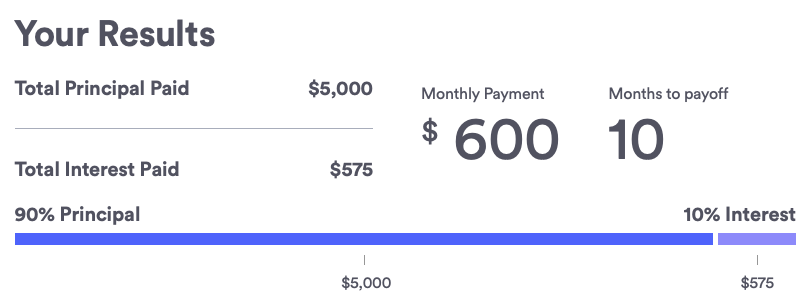
If you pay $200 per month (assuming a 26% interest rate):

If you pay $600 per month (that extra $100 per week that went into your taxes paid instead of into your pocket all year, causing a $5000 return):

You’ve paid off the balance in less than a year, and saved $1704 worth of interest payments. If you had paid $200 per month for a year and then used your tax return to pay off the balance, you’d have paid about $1,100 of interest, and then would be putting over $3800 of your tax return to pay it off. You also have the benefit of not having a bill hanging over your head at some point within that year, instead of worrying about meeting the minimum payments and continuing to accrue interest.

SUMMARY

So that’s my angst with the “financial win” of the tax return. Something as large as $5000 is an entirely different ball game than $500. Looking to get some money back and using the taxes as a ‘forced’ savings is an option. Perhaps you use that to take the only vacation in your year. But that should still be a reasonable vacation. Spend $1000 or $1500. You don’t need a $5000 vacation when struggling to pay bills or having debt that’s accruing interest.

So while I agree that the forced savings could be an excuse for a large refund, once someone receives a large refund, there should be an evaluation of their financial standing and an education on how that could be turned into a true, productive financial goal.