Taxes are Done

On April 6, we submitted our taxes. Honestly, I think that’s the earliest we’ve ever done it. We usually owe a good amount, so there’s no incentive for us to do it early. After owing a penalty last year, we pushed to be on top of the projected tax liability. It looks like we’ll owe a bit on the Federal side and get a refund on the tax side.

And so here’s my annual reminder that if you take the time to manage your finances all year long, then tax season is not a hurdle. I find it much easier to maintain 13 houses worth of data if I do it during the time it’s happening. Life has gotten in the way a bit, and I find it hard to even make sure I have one or two months worth of things logged correctly. I hope to be more on top of it in this coming year.

I have a spreadsheet where I log all our income throughout the year. I set up a formula where I can track each month’s income to ensure I receive the total amount that I expect to receive. I found that since some of our houses pay the same dollar amount of rent, it’s harder for me to mentally track each month’s payments, and I like having the visual and verification through this sheet.

Then there is a tab for each property in that same workbook. The sheets are set up based on monthly expenses, and I plug in projected expenses (e.g., taxes, insurance, utilities). This helps give me a verification that expenses have been paid when owed. By now, I have nearly every invoice emailed to me, but I like having this ‘fail safe’ look at what may be owed that I hadn’t paid in a given month.

Then Mr. ODA enters our investment items, W2 income, and interest income into our tax software. Then I sit down next to him and dictate the numbers from my spreadsheets so he can enter them into the software. We have 13 rental properties, so this is time consuming. However, it’s really easy. We enter our data into the fields for each house. This year took us about 90 minutes to enter the rental property information.

I know multiple people who file extensions because it takes so much time and effort to gather the documents for their accountant to do their taxes. It’s like they don’t think about their taxes until April 1 and then decide it’s too much to do in two weeks. This is where being prepared all year long comes into play. Make it easier on yourself and put yourself in a position where it doesn’t feel overwhelming.

April Financial Update

We started getting emails about end of school year activities, and boy was that a surprise that we’re at that point. The middle one is done mid-May and the big kid is done at the end of May. Less than 2 months until summer break.

Mr. ODA took the second round of the government’s offer for administrative leave, which means he would only have a few weeks left working. I’m still working my part time job, which is taking way more hours than we had planned for. I’m enjoying it, but it’s been a juggling act with the family, which is probably why my son who absolutely loves school begged me to stay home because his belly hurt last week.

Buckle up because apparently I have a lot to share this month.

RENTALS

We received about $600 in tax payment reimbursements from one of our localities, so that was a fun surprise this month. Really helps my psyche that I have a tenant who hasn’t fully paid, didn’t tell us why ahead of time, and hasn’t been up front with when she’s going to actually pay us.

I executed 2 short term leases. Both included a rent increase for their short term period; one house is increased by $75 and the other by $25. Luckily, both are here in the Central KY area, so we can flip it between tenants. One is scheduled to leave June 30th. That house will need new carpet in the bedrooms, and it’ll need probably a whole-house paint job again. They smoked in there, even though we covered the lack of smoking rule multiple times. I’d be more upset about it if the carpet hadn’t reached its useful life years ago. The other house leaves July 31, and I can’t even tell you where we’ll need to begin with that one. She made a wood feature wall without permission. She had a giant fish tank without permission. She spent a lot of time doing things that really weren’t an improvement, so I’m definitely worried about what we’re going to uncover in that house. Mr. ODA and I are talking about fixing it up and selling it. We may look for a short term renter so that we can sell it in the Spring instead of this Fall.

I had 2 other properties accept a rent increase that will go into effect later this year. I require 60 days notice for changes so that starting at the 30 day mark I can begin advertising it if needed. One house goes up by $25 per month as of June 1, and the other goes up by $50 per month as of July 1. I also have another property that has a rent increase of $50 per month going into effect next month.

I have 4 houses that renewed another year, and I didn’t change their monthly rent rate. There are 4 more houses that haven’t been discussed. My intent is to have them renew for a year at their current rate. There are 2 of those 4 that could leave at the end of this term, but time will tell.

We have multiple maintenance issues to address. One house requires a tree trimmed off the roof, the siding cleaned, and the back deck stained/painted. We still have termite damage we’re dealing with at a house in Richmond. I have a leaking toilet that was just addressed, and then they hit me with a faulty HVAC unit during a heat wave. Then we have some houses that really need eyes on them to see what condition they’re in at some point this summer back in Richmond. It’s amazing to me how people just don’t care to tell a landlord that something is broken. I woke up this morning to a text that one of the houses here has a flooded basement due to a water heater failure.

I spent some more time fighting my insurance guy here. It irks me so much when I see him offer up his services on the local facebook group for property owners. He’s quite terrible. I sent him photos of a house that had some issues with a cluttered backyard and had the tenant clean that up. I had to fight him last month on an increase where he changed one house from a crawl space to a basement when I assure you that the vines growing through the windows solidify it should not be deemed a “basement.” When the dust settled from that debacle that he was insanely unresponsive to, I ended up owing $9.68. When I asked why my account wasn’t put back the way it was found before this mess he created, he said he didn’t know but it’s probably from the audit and changing square footage. HIs guessing and not actually answering infuriated me. I gave up and paid it, but then I ran to get quotes from other people. I hadn’t done that before because our 4 claims in a 12 months period are killing us (again, because I really wanted trees to fall on us!). I hate when people make the claim that because it’s not a lot of money, I should just give up and accept it. That’s a ridiculous way to treat people.

PERSONAL

Our electric bill is almost double what it was this time last year thanks to the vehicle charging and hot tub. Our electric bill is relatively low, so that’s not all that surprising. We also have 5 full people in this house now (as much as you can count a 2 year old as a full person… but he knows how to control light switches and eats a ton of food that we need to cook him, so I’m sure he’s a factor there!).

I’ve been working at my new part time job for over a month now. Mr. ODA was making fun of my hourly rate, but I’ll tell ya, it felt good to receive a paycheck that wasn’t $45 like it was for a day of subbing at the preschool.

I took the kids to get haircuts. My middle has had her hair cut once before, but I’ve cut the boys’ hair forever. I had family coming into town and the oldest was looking really shaggy. So I swallowed my pride and threw money at the problem, which is very out of character in this household. I just didn’t have the time to cut their hair, clean them, and clean up the mess. For $66 and 45 minutes from the time I left home until I got back, it was well worth it to me.

I had a medical procedure done this month. We haven’t met our deductible. In February, they said I had to pay my deductible to them. I said that didn’t make sense and refused to have them hold $2800 of my money for 2 months. They gave me an attitude and said I could never ever ever ask for a payment plan in the future, so that I could pay $500 to hold the date. I then showed up for the procedure, knowing I haven’t met my deductible, and they didn’t take any money from me. Another business model that bullies the customer into illogical money decisions. I also had an eye doctor appointment that was frustrating in itself, but I’ll spare you those insurance and communication details.

On top of everything else I’m juggling, Mr. ODA is coaching our kids’ t-ball team. Coaching means that I am team mom. That means that I’m responsible for communicating updates from the league (in the slow and haphazard fashion I receive information), gather value card sales that are required of every team member, organizing a basket for a raffle, and the best one – raising $350 for team sponsorship. What the heck, man?! Where did I say that my signing up of two children to play in the league means I have history or ability to gather money from businesses?? Well, I did it. I raised $350 and another mom raised $200 for the team.

No financial impact, but I’m also juggling our HOA board duties. I released our longstanding property manager and hired a new company, which took effect April 1. That’s taken a lot of time to get them stood up and make sure we stay on track for our annual meeting schedule in June.

NET WORTH

And with all of that said, that doesn’t even address the giant reduction in our investments that continues to happen. To counter some of the loss, I updated our property values for our houses. I don’t do that every month because they don’t move very much, but I can usually count on a few increases as the spring market ramps up. Our net worth did slightly increase (based on yesterday’s market closure, not today’s) from last month, which was a nice surprise.

I wonder why I’m tired and bogged down, but that post outlining what I’ve done recently made me realize all I was able to accomplish even though I felt like I was a jack of all trades and master of none. Hopefully things will settle down in our lives going forward now, even if I know there are definitely two house turnovers in my future.

Rental Profit Calculations

When we consider purchasing a house to be used as a long term rental unit, we perform a “cash on cash” analysis. I’ve discussed this in the past, and I regularly share this with other people for their use. The gist of this calculation is to determine whether we would get a return on the cash put into the house.

The calculation considers the cost of taxes, insurance, homeowners association fees, vacancy expectation, maintenance expectation, costs to get the place rented, property management, etc. This is compared to the projected rental income. The upfront costs are compared to the annual cash flow projection. That ratio is hopefully in the 8%-10% range to be considered a reasonable cash flow to look further into the purchase.

Since we’re not really looking to purchase properties these days, I use this spreadsheet to consider changes in a tenant’s rent when it’s time for renewal. I kept all the original cash flow amounts to see how things change over the years. As I sat down to determine what changes, if any, are needed in the rents I charge, it was disheartening to see how our portfolio has dwindled in profitability over the years.

A few years back, housing prices skyrocketed, which drastically increased our taxes owed. Unfortunately, I hadn’t increased everyone’s rent consistently. I kept many people level or did small increases every two years, but that means I’m now “behind the 8 ball” in trying to make up for those drastic increases that happened in 2021-2022. In addition to tax increases, we’ve also seen huge insurance premium increases that weren’t projected in our portfolio.

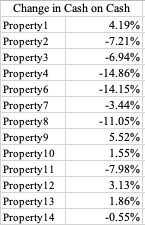
Our total “cash on cash” started at 11.42%. It’s now projected to be 7.58% – if the increases I project actually go into effect over the next few months.

We historically increased long term tenant’s rent by $50 every two years. Some of these tenants have been with us for over 5 years, and the $100-200 changes in their rent have not covered the increases we’ve seen. I hadn’t worried too much about it because the losses on those houses were offset by houses where we saw greater margins. Now, everything has leveled out, so those losses are felt harder.

The table above shows the change from our original “cash on cash” to our current status. In some instances, we’ve been able to increase our margins. But there are 8 instances our margins decreased, with some being drastic. Even though some are drastic decreases, there are only 5 properties that fall below the 8% goal we have.

For Property2, the projection shows that rent would need to be at $2,500 for us to hit our cash flow goal. The rent is currently at $1,600. The neighborhood doesn’t call for $2,500. I also don’t want to be in a position where I’m floating someone’s rent at that price. From the time we bought the house to now, our taxes and insurance have increased by $1575. That number only continues to grow. Our insurance started at $390 and is now at $765. Our taxes started at $1,500 and are now at $2,700.

On top of the obvious ones like that, our maintenance costs have also increased. As one example, our HVAC technician first was charging $125 per site visit. He now charges $325 just to show up. I’ve found someone who charges $200, so I’ve been going with that guy, but just knowing that there’s been such a change in pricing structure needs to be factored into our costs.

These are really big affects on our houses that a tenant and the average public opinion don’t seem to grasp. I don’t get paid hourly or per transaction I perform to manage these properties, so that decrease of 3.8% in our cash-on-cash analysis is actually a net loss in my “income.” In many cases, we catch up when there’s tenant turnover, but watching the rent compared to our expenses are things that I need to be more on top of year-to-year.

2023 in Review: Net Worth

A few years ago, I set out on this journey. I wanted to talk about money so that people would start talking about money. Talking about money is taboo. Someone will act funny talking about what they bought their house for, yet it’s public record that can be found in 2 seconds. People act like it’s “cool” to say they’re broke, as if it’s a badge of honor. I want people to talk about their spending and find ways to move forward so that money isn’t controlling their life.

In addition to that general goal, I’m also sharing lessons learned as we navigate owning rental properties. I hope that information helps both landlords (including potential ones) and tenants. I want tenants to understand the work that goes into owning the house and renting it to someone, and how the statement, “I can own a house for less than rent” doesn’t get you very far because you’re not the one maintaining the rental.

At the end of 2022, I was in the process of moving to a new home, renovating the new home, and was very pregnant with two toddlers nipping at my heels. My posts were just the monthly financial updates (and I didn’t even get to a December post because our baby was a sick little one). It was always in the back of my mind to make a post, but I didn’t have the bandwidth. It took until the last day of June for me to get my feet under me and start posting again. A few years ago, I tried to post twice per week. This year, my goal was once per week, with a schedule of Thursdays. I posted 31 times in 2023. I posted every week from June 30th until December 31st, except for Thanksgiving day.

MONEY

We used to make much bigger moves in our finances – buy a house, sell a house, pay off mortgages. This year, we did things differently. Mr. ODA discovered Treasury Direct. He invests in these short term savings bonds. They’re available from 4 weeks to 52 weeks, but we’ve only held them for 4 or 8 week periods. We had three different insurance claims over the last year or so, leaving high savings balances for a few months. Treasury Direct was a way to get our money to work for us, earning at a faster rate than a regular savings account.

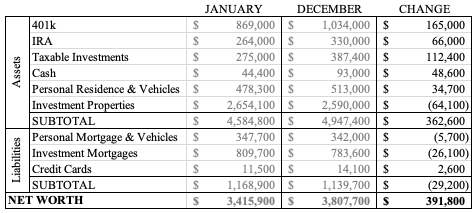
Our net worth increased by almost $400k, which is impressive since there wasn’t a large swing with a new house purchase. In January, home values were still high. However, the higher interest rates over this year cooled the market some, leaving our values $64k lower than January.

The goal all along has been for both of us to quit working. I quit in 2019, but have been doing odd jobs here and there. Mr. ODA’s quit date continues to be pushed back for a variety of reasons, but it’s something we’ve been planning towards. One step towards that goal was that we opened a new checking account. Nearly all of his pay check goes into that account, and we don’t touch it. While I could manually track our money as if we don’t have his income, it was a big step to helping us visualize him not working and how our finances would play out. I’m happy to report that I haven’t felt the strain of not having his paycheck coming into the account.

We opened one new credit card this year. We open new credit cards when we have a large purchase coming up. It started with our IVF journey, and we’ve continued that concept. It’s a “free loan” for us. We could either pay the total sum immediately (typically over $10k) from savings, or we could get an interest free credit card, allow our money to earn interest in savings, and then pay the balance by the end of the interest-free introductory period. That’s the path we choose. We replaced the carpet in our new home – the living room and entire second floor except bathrooms – for over $10,000. That’s sitting on an interest-free credit card right now, and I make $500 payments each month, until I need to pay the full balance at the end of the introductory period.

INCOME

Since I quit working my full-time-Federal-career in 2019, I’ve done several odd jobs. I’ve wanted the small break from being in the house, the small opportunity to have conversations with other adults, and a small feeling of contributing to the household’s finances. 2023 was the first year that I didn’t contribute more significantly. I worked 1 day as a substitute teacher in a preschool; $47 was deposited into our checking account. Comical. Even though in the literal “job” sense, I didn’t contribute much, I did work.

Besides the fact that I had to care for a newborn baby and keep three kids and a dog alive for the whole year….. ๐Ÿ˜‰

I manage our rental properties. This year required a lot of management. I’m managing the work that needs to be done at each property. I’m recording expenses per property. I’m tracking income each month to ensure that we’ve been paid rent from everyone (and one property made this a very frustratingly daunting task).

On top of that, I also have worked to declutter and organize our house. As our last baby grows, we don’t need all the baby accessories that take up space. By selling these, it’s providing the ability to buy things that the kids need now. I brought in nearly $1,000 through that process.

Mr. ODA signed up to be a secret shopper. He goes into restaurants, follows the instructions he’s given, and is essentially reimbursed for the meal. He “made” about $750 doing that. It’s important toโ€‚note that we’re spending money to get that money though. If he spends $15 on a meal at an assigned restaurant, he may be getting only $15 back from the company. Sometimes they offer a premium if they can’t get people to select the “shop,” but it’s just a few dollars.

CREDIT CARD REWARDS & INTEREST EARNED

Every year I love to tout this category. This year, the interest earned section far outperformed any recent years. I typically make a post where I go into the details of how our credit cards are earned, so this is just an overview. For the sake of this conversation, this is based on rewards redeemed as cash. Citi makes it easy to see how much has been earned/redeemed, but Chase has a portal where things are different. Chase allows for your points to go further if you redeem through their travel portal. That makes it hard to manage “earned” versus “redeemed” for a total each year, because the amount earned is inevitably less than it’ll be redeemed for.

Between all our credit card redemptions for cash and interest earned on checking and savings account, we brought in $4,000.

GOALS

I want to track our expenses more often throughout the year. I want to be able to get a handle on trends we’re making with our expenses and whether there’s an opportunity to cut costs. When I do this review once per year, it’s not giving me a lot to work with.

Mr. ODA is discussing leaving his job this year. It’s something that’s been on the table for several years now, but there’s never been a real reason to leave his flexible job where he has a bunch of leave and benefits.

Mr. ODA is working towards a financial advisor certification though. It’s a big deal, and I’m excited about it. He loves to talk about money and help other people with their finances, so I’m hoping this is a springboard for him to doing more of what he enjoys.

I’d like to work more. The few temporary jobs I’ve had have been more time consuming over a short period of time, whereas this substitute teacher position right now is so sporadic that I’m only working 1 day per pay period. While I appreciate the availability I have, I’m looking for something with a little more consistency (granted, for the Fall semester, I would basically be available everyday of the week, so maybe that will help).

We’d like our deck and patio to be replaced, which will then lead to more home improvement expenses. We plan to build a privacy feature wall under the deck, so that we can add a hot tub on the patio. There’s also an old hookup for a tv, which means some sort of tv set up is planned for out there, which may be further expenses. We have two more bathrooms in this house that haven’t been touched yet, and I plan to do a few upgrades.

A lofty goal will be that we keep our tenants in place and don’t have any insurance claims this year. The last year has definitely been more taxing on us than previous years.

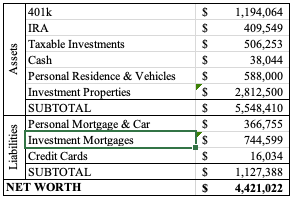
I think the big goal is that Mr. ODA wants to hit $4 million in net worth. Mr. ODA was 30 when we hit $1 million, 34 at $3 million, and hopefully 37 for $4 million (I don’t know when $2 million occurred because we weren’t updating regularly). Being that we’re at $3.98 million now, and that we grew by nearly $400k this year without any drastic moves (buying/selling a house), I think it can happen!


NET WORTH

This “net worth” graph isn’t the best since I didn’t update our net worth from February through June, but I kept those months in there so you can see the trajectory. I’m sad that life got in the way of my updating those data points. If I just post the first and last month, you can see there’s an increase. But that doesn’t show you that there are dips along the way, and everything is based on a single snapshot in time, even though balances are changing daily. I hope that I’m able to track each data point this year and in future years so I can see these trends.
Our Money Management

I manage all our income and expenses (at a high level, like credit card payments, not individual line items). I have a spreadsheet that I set up in 2012 and have used religiously since then. I’ve shared how I set it up in the past, but we’ve entered a new phase that makes my spreadsheet even more important to me.

BACKGROUND

FIRE. Financial Independence, Retire Early. This isn’t a post about FIRE specifically, although it’s the movement that sparked Mr. ODA to go down our financial path.

The purpose of our rental portfolio was always for both Mr. ODA and I to quit working. We had covered my income before any kids were born, but I kept working because there was no reason to not be working. Once our son was born, I took 14 weeks maternity leave (not a separate bucket for Federal employees back in 2018; it came out of my own accumulated sick leave), then I worked about every other day for 8 months while Mr. ODA and I swapped child care roles, and I burned down my leave.

While we don’t plan to work full time, we do plan on keeping part time positions. We’ll work on things that bring us joy, rather than an office job with office politics. Since I stopped working, I’ve done odd jobs, part time. For example, I worked as a census taker and served beer at a local race track over the last 4 years. These were all seasonal, part time positions, with no long term commitment.

Now that I quit working, it’s Mr. ODA’s turn. We hardly skipped a beat when we left my six-figure salary behind (although a pandemic probably helped curtail spending on our behalf!). However, the thought of losing his salary as a safety net and losing insurance are two items that have caused some pause.

THE SPREADSHEET

For you to understand my panic that I’ll get into here, I thought a quick reminder was necessary. This is how I manage our money. It’s nothing fancy, but it works. I don’t miss payments. I can allocate expenses to a specific 2-week period against what income is brought in at that time.

There are two parts to the spreadsheet. Well, there are about 10 tabs, but this first tab, with two sections, is what’s pertinent.

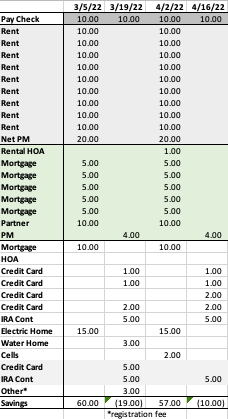
Part 1 is this section. This image is a very scaled down version of the section. We have 13 houses, 6 mortgages that get paid, 6 credit cards that get paid regularly, and a few other lines that I removed.

All numbers are made up place holders, except the investments. I deleted my IRA contribution line because it’s wonky (but I will max out IRA contributions), but I wanted to show how much we’re investing regularly. There’s $75, per kid, per month, going into their investment accounts. Then there’s general investing happening with one $1000 transaction and two $800 transactions per month. Mr. ODA is investing into his IRA to max it out ($6500/12=$541 per month..sort of).

You can see that I’ve listed Mr. ODA’s pay dates at the top, and then his salary income on the next line. The gray section accounts for all rental income. I’ve allocated the income into the salary two-week period that makes the most sense (about half pay me on the 1st or 2nd, and the rest pay on the 5th). The green section shows routine rental property expenses. The entire next section are our personal expenses. The blue is left over from when I was managing two personal homes last summer (but kept it to differentiate our house bills versus other bills). The next gray section (which I’m only just realizing is a second gray and should be a different color as to not conflate the two grays.. what a rookie mistake) accounts for expense that come out of Mr. ODA’s bank account. Finally, I have an “other” section. This is where I capture large expenses that don’t need their own line item because they only happen once or twice a year. Here I’ve put tax payouts that will be due in October (that’s 4 houses worth, and it’s last year’s numbers – because I want to know how this year’s amount owed, when it comes in, changed from last year’s to discern if it’s reasonable or if I need to dig into it).

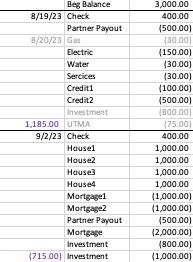
This is part 2. Now, part 1 accounts for the general timing of income and expenses, but it doesn’t perfectly capture the due dates, scheduled payments, or whether I’ve paid it and it’s hit the account.

The top line is linked to the section that I update our checking and savings account balances. Then I transfer all the items per pay period into this list format. In this example, let’s say I’ve already scheduled the gas payment. So I mark it as gray and put the date in the left column. Similarly, our investments are automatic, so I mark them in gray as we get to that two-week period.

At each border lined, I put the total for that section. You can see that at the end of the 9/2/23 pay period, I project a negative balance. Truly, we seem to have more income than I project (rewards cashed out, someone paying partial rent a little early, etc.), so I don’t take any action until I need to. There are Federal regulations regarding savings accounts; so we can only make 6 withdrawals from the savings account before fees apply. I manage these projects to know whether I need to make a withdrawal. If I need to, then I project what other expenses I may have and transfer a little more than I deem necessary.

THE PLAN

So our first step to him leaving is to pretend we don’t have his salary. Mr. ODA set up a new bank account. The majority of his paycheck goes into that account. We still have $250 going into another account, and about $400 going into a third account because we need to meet the requirements of direct deposits to prevent any account maintenance fees.

Our general principals in account management was always to take money into our main checking account, pay out bills for that two week period, and put the balance into savings. However, that wasn’t creating any forced feeling of managing without Mr. ODA’s salary. I’m more of a visual learner, so I appreciated this concept of having the money automatically transferred to a completely separate account.

EXECUTION OF THE PLAN

The first month of this plan had me on edge. The accounting in the checking account meant I was constantly back down to a balance of about $500. When I worked in an office, I was at the computer everyday checking our money. Now that I’m responsible for 3 tiny humans, I’m rarely on the computer. I project out our routine expenses, but there have been plenty of times where a $100 or $500 charge goes through that I didn’t have listed in my expense column for that period. Therefore, I like to keep at least $1000 as a buffer in the checking account to cover those little expense that can add up. So keeping the projection to less than $500 in the checking account panicked me.

Now wait. It’s not that we only had $500. We have a savings account linked to that checking account. We have this online account that’s taking Mr. ODA’s salary and just building the balance because we don’t use that account for anything. We have Mr. ODA’s old personal checking account. And last but not least (as my adorable 3 year old says all day long), we have plenty of investments that can be liquidated within 24 hours. We have the money. It’s just the panic of having the money in the spot where the bills are being paid.

SUMMARY

I’m sure there are easier ways or “better” ways to account for this. I don’t like automatic payments for bills because I like scheduling them against our cash flow. I’ve used this exact set up since 2012, and it hasn’t failed me. Taking full responsibility to pay bills means I am very scared to miss a payment and cause a negative hit on either of our credit reports.

Now that we’ve eliminated about $5,000 per month of income, without changing our spending in any way, I’m interested to see how things go. We have a great spending mentality – we’re not spending on frivolous items and we weigh the cost benefit of a purchase to us. That’s not to say we can’t do better. I’m sure we can be more diligent about our grocery spending or at least cooking what we already have in the house (we don’t spend much at restaurants in a month). I’ve already started tracking our expenses month to be sure we can watch our trends and re-evaluate our spending if needed.

Now that we have this account growing with no need for it to pay the bills, we will use it for fun things. We’re not very good about doing fun things. Two summers ago, we wanted to buy a vacation home at a nearby lake. We decided that instead of spending $1200 per month on a mortgage to go to the same place all the time, we’d plan vacations each month and spend up to $1200 without “guilt.” It was great. We had so much fun. But it lasted 3 months. Having a newborn put a damper on activities, but we’re ready to do the same again.

The Mentality from an MLM

These days, you’re probably not immune to being asked to join or buy from a multi-level-marketing (MLM) business. Also known as network marketing, it a way for companies to sell their product through individuals who market product(s) to their sphere of influence. It gets a bad reputation with “pyramid scheme” and the like, but it’s legitimate and makes sense if you take the time to step back and learn about it instead of repeating the rhetoric you’ve heard from your parents.

Our experience with an MLM led to being open to buying rental properties, which eventually led to me quitting my job and being happy outside of a career. Here’s what I learned by keeping an open mind to an MLM, even though we make $0 from that business today.

This is my experience with our time in an MLM. Mr. ODA would probably have something different to say. ๐Ÿ™‚

AMWAY

BACKGROUND

By now, you may have seen the documentary on LulaRoe. Our experience was with Amway, and it was different from how LulaRoe operates. Now, Amway is the black sheep of the MLM world if you go just based on name. They’re one of the original MLMs. But they sell good products in the health, beauty, and home cleaning genres. As a “consultant,” you’re called an “independent business owner” or IBO. I thought the best part was that there’s no inventory you need to hold. If you want to do “parties,” then you need products on hand. However, it’s much different than how LulaRoe would have hundreds of leggings on hand and makes direct sales out of their on-hand inventory. To earn money, you can recruit more business owners, or you can have customers who just order directly from the Amway website each month. You make money off of what your customers buy, as well as the income that your IBOs below you generate.

TEAM SUPPORT

There are multiple “teams” associated with Amway. It’s the education arm of the business. Our team met once a week, and you were expected to be there if you really wanted to be in-the-know and considered serious about growing. They helped you structure your business to take advantages of bonuses offered by Amway, and they taught a lot about having the right mentality. Their goal was to foster personal and business growth, provide mentoring and coaching, and provide the tools to grow your business through conferences and seminars.

This is where we got our start. I know it’s hard to believe, but we both were exposed to a lot of growth through this team. The things we learned through the meetings and books we read during these couple of years gave us the courage to make the big decisions we did, getting us to currently having 13 rental properties.

THE CASHFLOW QUADRANT

Our introduction to the business was started by being given Rich Dad, Poor Dad by Robert Kiyosaki. The book references an earlier book of his, the Cashflow Quadrant. Each quadrant has its strengths and weaknesses.
– The upper left corner of the quadrant is for those who have Employee mentality. This is someone who is trading time for money. You work an hour and earn $20. If you’re not working, you’re not earning. You’re making money in someone else’s system, and there are people over you who are making more than you (e.g., a supervisor is making more than a secretary).
– The upper right corner is for Business Owners. You own a system that works for you. You have passive income in this quadrant. You may have an employee that is generating income that you earn.
– The lower left corner is for Self-employed people. Here you’re still trading time for money, but you have control over how much you earn based on how much effort and time you put in. This is a risky area because you don’t have security and may not have an established system to rely on and project your income.
– The lower right corner is for Investing. Your money makes money for you. This can also be risky because you’re not guaranteed positive returns on your investments. If you want to make a lot of money, you need to take on more risk.

The point here, according to the team we were on, was that you want to be a business owner. You want to generate passive income so that you’re not trading time for dollars. While someone else is selling to a new customer, you’re earning a percentage of that sale while not doing anything. As you grow your Amway business, you have more and more people generating income through these sales, which you get a percentage of. The kicker is that you need to hit a certain level within your own business before you earn. We set up recurring purchases to use the products we were selling, and had customers set up with recurring orders, so that we could hit that threshold to be eligible for the passive income.

OUR MOVE FROM MLM TO REAL ESTATE

The biggest hurdle to our success was the price of the products. We aren’t someone who values a better quality to be able to justify the higher price. There are people out there that value this, but it’s not our passion. A peanut butter meal bar comes to $3.14 per bar as a customer order (as an IBO, you get the product at cost, which would be $2.82 per bar). The peanut butter granola bars we buy are $0.50 per bar. Clearly, this isn’t a marginal difference in our expenses. The products were good, but not good enough for our finances to take such a hit. I tried to focus on the beauty side of the business and held parties where I recommend products and let women try it. I had passion behind it, but I wasn’t someone who washed my face regularly and put lotion on. I could see the benefits, but I wasn’t practicing what I preached, and I lost my drive.

The next hurdle was location. Our original meeting was with our specific team within the larger team (based on your “pin level,” you had a meeting with the people who were your “downline.”). We moved down to Richmond, and our closest meeting was Fredericksburg. It wasn’t insurmountable, but it was a 40 minute drive there and back once a week. The larger team would all come together in DC every quarter for a conference. We felt like time started moving faster, and we weren’t close enough to make these our friends between conferences, and so we stopped attending the big conferences. Then we stopped attending the weekly meetings. Then we cancelled our team membership. We still maintain our Amway IBO number, since it’s just $62 per year to do that.

The thought process that we learned from their weekly teachings and reading books we probably wouldn’t have read otherwise led to our desire to generate passive income. Mr. ODA had already been interested in the concept, and then when we were talking about venturing down that path with our Realtor selling our Northern Virginia home, he really got the urge to pursue it.

When we sold our Northern Virginia home, we had about $120,000 in our bank account. About $70k of that went to the downpayment and closing costs of our new house. The remaining went to finding a rental property… or two.

REAL ESTATE, PASSIVE INCOME, AND NO JOB

Real estate is in the business quadrant, but it’s not completely passive income. Truly, the Amway business wasn’t completely passive because you still needed to have the sales (either through your purchases or customer purchases) to be eligible to earn all the passive income available to you in the business. Most months with real estate, I take the rent money, pay out our mortgages, and that’s it. Sometimes I need to make some phone calls to contractors. However, we have to do very little to maintain our business of investment properties. We can also decide that we don’t want to field the phone calls and hand off the rest our properties to a property manager for 10% of rent. If we don’t have a new property or a property to turn over, then we probably put about 100 hours per year into managing the houses.

We knew we didn’t want to be in the employee mentality for the rest of our lives. Funny, because my goal when I was in college was to work for a “big 4” accounting firm and spend 80s hour per week at work. Then I started working for the government, and my goal was to be CFO in my 30s. Then I got to the headquarters office in my late 20s and hated the environment, so I decided I wanted to be no more than a state office’s financial manager. Then we had kids, and I decided I wanted to be home with them to see all the little moments. Things sure did evolve.

I believe that the time we spent with our Amway team changed my heart. I believe that time was important for me to see a different lifestyle and a different mentality. I don’t know that I would have seen the benefits of pushing ourselves to buy more rental properties had I not seen a lifestyle of entertainment.

I started to realize it would be nice to spend time with my family while the kids were little. Who wants to wait until retirement to spend time at home, when your kids are grown and moved out of your house? Why not spend the quality time in their early years? Let’s travel more and experience more in life. Let’s have more time with the kids than the hellish hours of 5 pm to bed time.

Our cash flow each month is about $7k, just based on the rental properties. That doesn’t include expenses that come up, and every once in a while we get hit with a major system that needs replacement, but most of the charges are a couple of hundred dollars here and there. Some days, I wish I could still do what I loved to do in the transportation world, but I don’t miss the office politics and the moderately strict work schedule.

I’m happy for all the experiences that have led me to this point in life. Perhaps you can read Rich Dad, Poor Dad or Cashflow Quadrant and learn a little bit more about all the options out there. Perhaps you just didn’t know that there are opportunities out there where you’re not trading time for money, or where you’re not cushioning the pockets of an executive while you make a certain salary. Perhaps you just needed your eyes opened to the chance to make your money work for you. Or, perhaps you’ll learn that you like the stability of being an employee, and you don’t want to change. But I urge you to take a look at the options and see what works best for you, now that you’re away that there are options.

Filing Taxes

We filed our taxes. It just takes so long, but it’s easy. This year I recorded what I did and how long it took, so I wanted to share.

I’ve shared that I record transactions all year long. Inevitably, a few things slip through a crack. So I go through everything I have on file to make sure I can support a charge I’ve recorded (e.g., receipt) and that I haven’t missed entering something in my spreadsheet (e.g., I have a receipt for work, but didn’t put it in my spreadsheet).

DC TAXES

Mr. ODA works for a DC office, but lives in KY. The paperwork information got crossed, and he ended up paying taxes to DC for a little while. Apparently DC is used to this mistake. There’s a form he filled out, attached a copy of his W2, and mailed it to DC. He received a full refund within a couple of weeks! I couldn’t believe the timing of it and how it easy it was!

STEP 1

My first step was to load all my mortgage documents for the houses that we still have mortgages on. I need to know the mortgage interest for the year and what they paid out in taxes from escrow. For some reason, it never tells me the insurance payments made on the tax document, so I need to go through my email or look at the line-by-line escrow to see when and how much was paid for insurance. I estimate the mortgage interest each year, but I don’t have the final amount until January.

STEP 2

Then I go through my email files. I try to get most of my receipts via email (e.g., Home Depot and Lowes are good about tying your credit card to your email address so I keep everything filed electronically). This took me just over 3 hours. I went through each email receipt to see if I had it recorded properly. I found 2 or 3 transactions that I had receipts for, but they weren’t recorded in my spreadsheet. I also found out that I didn’t record any of my final December transactions (i.e., stormwater utility bills and property management).

STEP 3

After I go through everything I can electronically, I move on to my paper files. We have a lot of our insurance through State Farm, and they don’t email me receipts for payment, nor can I look up previous payments made on their website. So I keep a paper copy of all the insurance documents for each house. We had a huge debacle with two of our KY houses and insurance last Fall, so I had to make sure I had all of that recorded accurately. I used to rely on the paper stormwater utility bills that I pay directly, but this year I just went into our checking account and verified the amounts that I paid against what I recorded. Since most of my transactions are kept electronically (especially with having property managers, so they’re sending me the bills they receive electronically), the paper checking was only about an hour this year. It used to be longer, but I’ve streamlined my electronic filing so mostly everything is in there.

STEP 4

After just over four hours of “prep” work, we move on to the tax software.

Mr. ODA entered our W2 information, we both pulled up all our investment account statements, and then we got into the investment properties. It’s tedious, and each year we have to remember how we matched our terminology to the system’s terminology (why can’t I keep better notes on this?!). We got into a groove and knocked out half the properties in about 80 minutes before taking a break. We focused on the 3 properties that we received one 1099-MISC for first, which involved going back and forth on some screens. Then we knocked out some of the easier houses. The next night, we finished off the rest of the houses in about an hour.

We usually call it complete at that time, but we don’t submit right away. We take a few days to see if we think of something we may have missed (whether investment property or personal finance), and then we submit. We usually owe Federal and State tax every year, so we’re never in a rush to get this done and pay. Somehow, we get a refund for Federal this year, but we still owe the State.

SUMMARY

About 6.5 hours of tax work, after being pretty on top of it all year. People ask us why we don’t use someone to do it instead of putting all that time in. It’s not that easy. If we had to send our information to an accountant, we still would have to gather all our receipts and send them over. I think it’s easier to look at my receipt and record it, rather than gather all my emails and send them to an accountant (not to mention Gmail is not a great mail system in this regard because you can’t easily add emails to new emails). Then we have to field all their questions regarding the documentation that I send, which will inevitably be frustrating to me. It’s all around cheaper and easier to do it this way.

Expense Tracking

In January, I mentioned how I have a very detailed spreadsheet to track my expenses. I started this spreadsheet concept in 2012 when my husband and I started combining living expenses. We also moved from NY to PA to a VA apartment to a VA house in a matter of 22 months. I needed to have a way to make sure I didn’t miss any bills. I didn’t want to rely on receiving the bill itself in the mail or in my email before paying it. I chose to develop the spreadsheet based on our pay check dates, which were every 2 weeks.

Here’s my sheet, in essence. Pay no attention to the actual numbers in this screenshot, as I didn’t take the time to make sure they were made up but still proportioned to each other. The format is exactly as I use it though. I set it up at the beginning of each year.

For the entire year, I record the pay check receipt across the top of the sheet. The dates are based on the day the money hits our account. This has changed over the years, as we used to get paid on Tuesdays, but now Mr. ODA’s pay check shows up in our account on a Saturday.

The first section, which is all gray, is the rental income. I then record all the rental income near the 1st of the month. If a pay check isn’t near the first of the month, I record it for any pay check date that shows up in the first 10 days of the month. Realistically, I receive the majority of our rent on the 5th of each month, so it doesn’t make sense to record it as a projection any earlier than the 1st, and as near the 5th as I can. The ‘Net PM’ is because I don’t collect rent on our KY houses; the property manager collects rent, removes their expenses, and then we receive the net by the 10th of the following month.

The next section is the light green, which captures routine expenses on the rental properties. I record the HOA due date every 3 months, each month’s mortgage payment, the payout to our partner (I take in all the rent each month and then pay him out his half plus our half of the mortgage payment), and then the VA property manager’s expenses.

The white section covers all our personal expenses.
– The bottom two gray lines are simply an indication to me that those affect Mr. ODA’s account and not our main checking account.
– I pay our personal mortgage near the 1st of the month (some time between the 1st and the 10th, but I typically prioritize this getting paid as close to the 1st as possible).
– Our personal residence’s HOA is only due one per year, which is why there’s nothing on that line for this particular snapshot.
– Then I have all our credit card payments. For the year, I project based on the previous year’s average bill. As I get closer to the statement end period, I update the projection. If I project that a credit card bill is going to be $1000, but as we spend through the month, we had more expenses than I thought, I update the projection on the spreadsheet to reflect that. So where it said $1000, I may put $1700 to cover my savings projection.
– I project our my utilities too. I know that I have an electric and water bill each month, and I have a cell phone bill that I pay in 3-month increments to my sister-in-law for a family plan. When setting up the sheet for the year, I simply keep the same numbers from last year for the utility lines. While I can log into my account and see the details, it’s easier if I already have it laid out like this. Then I can see, “last year, for this month, my bill was only $40; why is it $70 now?” One caveat here is that I usually keep the lines on this sheet to those items that are going in or coming out of our checking accounts. The water bill can now be paid by credit card (since we moved to KY last year). Technically, I should remove that from the sheet because I track bill due dates separately from this part of the sheet, but since I’m used to tracking the water bill’s due date like this, and I like seeing how the bill changes from last year’s amount due, I’ve kept it on the list.
– I have our IRA contributions listed as well, since that’s a big chunk that comes out each month. The maximum contribution into a Roth IRA is $6,000. We have automatic contributions twice per month, so that’s actually $500 out of each ‘pay check’ grouping.
– The “other” line is for expenses that happen every year, but they aren’t worth having individual lines because there’s only one or two payments per year. As I type that, perhaps my own HOA payment could be added to the other line since it’s only paid once per year. In Virginia, we had personal property tax that would be due each year. We also have our taxes that we owe (because we purposely plan our taxes so that we don’t get a refund because that means you’ve given Uncle Sam an interest free loan). We have vehicle registration fees due. All these ‘one off’ payments are recorded on the “other” line and then I describe the expense two lines below with the asterisk.

As for the savings projection, this is probably mislabeled. It has always said ‘savings,’ but it’s really just the net of that two-week period’s income and expenses. To know if I’m in good shape (if perhaps I’m in a position where my account balance is being kept really low), I net the two ‘savings’ next to each other (so I would add the $60 and the -$19 to know that my income from that first two-week period will cover my expenses for the second two-week period also).

In practice, as I receive the income or I pay a bill, I change the text from black to gray. This tells me that it’s paid and accounted for. I also update to actuals as I go. So if I projected a credit card payment to be $150, but the actual payment was $147.34, that’s what gets put in the sheet when I make the payment. This helps me track actual amounts through the year, as well as sets myself up to create projections for the next year.

I have a separate tab in my workbook that tracks additional income for the year. For example, when I was working part time, I recorded that income on that other spreadsheet. Each time we get money from our credit card rewards, it gets recorded on my income spreadsheet. By keeping track of our additional, unplanned, income, I have the ability to identify our actual savings net for the year. I take the ‘savings’ bottom line from this spreadsheet and add all the additional income we’ve brought in from the other sheet.

While I’m not budgeting the details of our expense categories (e.g., $300 per month for groceries), I’m tracking my income and overall expenses based on bill payments. Last year, I had tracked my expenses by category to see if overspend in one area in particular. I didn’t keep up with it though because the billing cycles didn’t line up with when I’d be running my financial update, but I hope to get in a better grove this year. This set up makes me feel comfortable that I’m not missing a bill. If I get to the end of a 2-week period, and I haven’t grayed out an amount, then I know it’s time to investigate why I didn’t receive mail or an email prompting me to pay a bill. Usually what happens is I’m tracking Mr. ODA’s credit card payment and wondering how much longer he’s going to wait to pay it until the due date. ๐Ÿ˜›

I hope that was easy to follow. I don’t want to put all our exact numbers in there, but I wanted to share how I “budget.” If you have any questions, don’t hesitate to reach out!

Budgets and Overspending

I’ve rewritten this several times over the last two months, constantly afraid of who I’d offend. Instead, I’m just going to share my raw observations and hope it makes sense to the people who need it. Plus, what’s a better time to discuss budgets than the first post of the year? I actually have quite a few posts related to budget planned. So we’ll start with why I believe budgeting leads to overspending.

I don’t like budgets in the sense of the word’s common understanding. A literal definition of the word is, “an estimate of income and expenditure for a set period of time.” In this context, I’m all for a budget. I have a detailed (over-the-top, probably unnecessary) spreadsheet that I use to manage our money. In any given two-week period, since 2012, I can tell you my projection of money-in and money-out. I make sure my expenses are covered.

ENVELOPE SYSTEM

The extreme version of budgeting (in my opinion) is the ever-popular “envelope” concept. It’s simple: you decide on your monthly spending categories, and then you put your cash* in the respective envelope to pay your bills. (*Please don’t pay for everything in cash!) When you run out of money in a given envelope, that’s it for the month. There must be a way that this works for enough people that it keeps getting touted as a great idea, but I’ve seen it fail. You’re creating a dependency on these envelopes instead of an understanding of your finances.

What happens with any leftover money in the envelope? The articles I’ve read about this system literally tell you to celebrate if you come in under budget. No. How does taking your extra money and spending it frivolously get you to your goals faster? Or it tells you to add it to next month’s envelope (e.g., if you have $50 left over in this month’s envelope for groceries, put it in next month’s envelope and now you have $350 instead of $300 to spend on groceries). How are you creating discipline and an understanding of budgeting if you can splurge next month? Now you’ve spent an extra $50 in month 2, but you need to scale back to $300 for month 3. That’s not creating a routine.

I want you to create a relationship with money.

RELATIONSHIP WITH MONEY

We don’t budget in the colloquial sense. We have a relationship with money. I make sure that my mandatory expenses are taken care of (e.g., mortgage payments, utility bills). Everything that can, goes on a credit card. When it comes to paying off the credit card every month, it goes back several steps.

My thought process is cemented in whether or not the value of an item is worth it to me. When I’m about to buy something, I take the time to think:
1) Is this item worth the price I’d pay for it?
2) Will this item serve a need (not a want)?
3) If it’s a want, will this item bring me enough happiness that I’m willing to spend this amount of money on it?

Want to know something I recently struggled with? For years, I’ve wanted a desktop tape dispenser. Years. I don’t even think about it until I’m wrapping Christmas gifts. So once a year, I have tape, but I wish I had a desktop tape dispenser. I never bought it. I thought, I can struggle through needing two hands for my tape dispensing needs for a couple of days out of the year. I thought, if I buy a desktop tape dispenser, then I need to buy a different kid of tape than I already have on hand. Every year, I just dealt with it because it wasn’t worth the cost to me to invest in something that would make things marginally easier for me for a few days of the year. This year, after wrapping more than half the gifts, I decided enough was enough. I purchased 6 rolls of tape for 9.99 and a dispenser for 4.22. I’ve been wrapping gifts outside of my parents’ house (where there were tape dispensers) for more than 15 years. I’ve struggled with the decision to purchase a dispenser every single year, and it finally got to the tipping point this year. All that thought process, over all those years, to spend less than $15.

That’s my thought process for every non-routine purchase. Instead of putting cash in an envelope marked “something for me” each month, I’ve trained myself to manage our money from the purchase point instead of an envelope full of cash that I mindlessly spend down. I can make an informed decision on whether or not I need or want something. I’m taking the time to decide whether this is going to bring me long-term happiness, short-term happiness, and whether the cost of the item is worth it. Had that tape dispenser been $15, plus new rolls of tape for $10, I probably wouldn’t have bought it. Because at that point, I’d be happier with a new shirt or new pants for $25. So I would have decided that my $25 is more valuable to me than to spend it on tape. That doesn’t necessarily mean that I go out and buy a shirt arbitrarily; it just means that I’ve decided that the value of that money is worth more to more towards something else than this item I’m currently contemplating.

OVERSPENDING

I see it over and over: people who budget seem to be the ones buying things they don’t really need. Instead of changing your mentality to be whether a purchase is necessary or is worth the price, the decision becomes “I have $300 left over, what can I do with it?” I see people have their sights on a product that they want. They build it up in their mind that it becomes unattainable, so when the extra money is there, they splurge on it. But did they ever step back and ask if it was really necessary or if their money could be put to better use in their overall wellbeing?

There’s a time and place for splurges. I understand that buying something you want makes you happy, in that moment. What if you thought: does my happiness in buying this gaming console outweigh the anxiety and frustration that I can’t pay my bills in a couple of weeks?

If you struggle to pay your rent month-to-month, then a large influx of money should be earmarked for future bills, not to splurge over and over again. An envelope system creates a reward-driven desire to your spending. The goal should be a more comfortable lifestyle where you’ve set yourself up for success instead of a groundhog-day-struggle to make ends meet.

There have been several instances that I’ve seen in the last couple of months, but the one that really has been weighing on me happened in October when I was working.

I was working at the racetrack. It’s temporary work – working during the race meets and possibly during their horse sales. The Fall meet was 17 days. Depending on where you’re working, you can make some really good money. I happened to be placed in one of those locations, and next to me was a young girl. She complained of having to work two jobs and not getting a day off all month because she was working two jobs. She also shared that she struggles to “make a decent living,” and that she borrowed money from a friend to be able to pay rent on October 1.

The first day, we made over $400 in tips. The second day, she asked how we celebrated making that amount. I bought the Hatch sound machine. I’m going to assume that most of our readers have no idea what that is, but it’s a sound machine and a light that can be programmed for different needs (for instance, I wanted it to give our toddler the signal that it was OK to get out of bed). It’s $60. I had already looked into several options, and I had already determined that I was in a place in life where it was worth it to me to spend the money on the original than to attempt to buy a knock-off that doesn’t work great for $40. Personally, I was going to buy this thing regardless of what I made while working, but I used that as my example on what I splurged on with our unexpected earnings. She shared that she took her boyfriend out for a steak dinner. One celebration isn’t going to break the bank, but it became a routine. It wasn’t until the middle of the month that she said she had paid her friend back for helping her pay rent. That $150 you spent on one meal could have been prioritized to keeping a roof over your head, or being a good friend and paying your debt.

So often, I see someone else blamed for one person’s mistakes. It’s the greedy landlord’s fault that you need to pay rent. It’s the government’s fault for not increasing minimum wage. What if you stepped back and looked at your decision making? Did you buy the new gaming console and then struggle to pay rent on the first of the next month? Did you go to Costa Rica and then struggle to pay rent on the first of the next month? Did you buy that new gaming console, and not add to your savings for future planning? The televisions in our house aren’t huge, but they work. I don’t have a need to replace a working television simply so that I can have the newest technology and the biggest screen.

If you don’t create a relationship with money and an understanding of how to make informed decisions, you may end up with unnecessary expenses with money that could have been more productive. It’s time that you step back and look at your entire spending picture to know whether you’re truly budgeting and learning, or you’re mindlessly spending money because you’ve accepted that’s the cost.

Hear more from Mrs. ODA

Back in May, I was a guest on Maggie Germano’s Podcast, “The Money Circle.” I shared some of our background and how we started investing in real estate. We brushed on topics like establishing an LLC, tax advantages, and how you don’t need to start big to just get started. It was a brand new experience for me, but I’m passionate about our real estate experiences, and I loved being able to share. I hope you’ll check it out!